Search

fullybooked2017

Tag

Historical Crime Fiction

THE CHARTER OF OSWY AND LEOFLEDE . . . Between the covers

CHARTER HEADER

We are in the final decade of the twelfth century, in the market town of Wisbech, a place dominated by its Norman castle, and split by two rivers: the smaller, the Wysbeck is little more than a gentle stream, and can be crossed on stepping stones; the larger, the Welle Stream is more significant, and can only be crossed at high tide by ferry.

In the 124 years since England was conquered by the Normans, the old native tongue of the Saxons has become a foreign language, in both written and spoken forms. Sir John of Tilneye, a young man who was schooled in the old language by monks when just a boy, is called upon to translate an old manuscript which appears to be at the centre of a criminal conspiracy. Ostensibly, it is dull and tedious stuff relating transfers of land and property in the days before the Normans came. Someone, however, is convinced that it contains a clue to something extremely valuable.

Wisbech is neither more nor less lawless than other towns in the area, but when a series of fires and break-ins follow one after the other, the Bishop of Ely’s seneschal Sir Nicholas Drenge is determined to discover what is going on. Each of the incidents seems connected to a fatal fire which destroyed a house in the town. Its owner, Aelfric, who perished in the blaze, was Saxon nobility, but like most of his countrymen, all he had left was his memories. His lands and riches had long been appropriated by the descendants of the 7000 men who landed at Pevensey on 28th September 1066. So why burn down his house? What was he hiding? Drenge and his men-at-arms eventually catch the man who they think is the killer, but when he is murdered while in their custody, the mystery deepens.

Insofar as this is just a detective novel, Drenge is the principle character. No genius, perhaps, but steady and unwavering as he slowly unpicks the knot of lies, legends and loose connections that surround the mystery of Aelfric’s death. Diane Calton Smith gives us some fairly innocent romancing between Sir John and Rose de Hueste, the old man’s granddaughter, but above all she describes a place that is, literally, buried beneath the feet of townsfolk of modern Wisbech. The two rivers have traded identities to an extent. The inoffensive Wysbeck is now the deep and powerful tidal River Nene, while The Welle Stream – thanks to major 17thC drainage – shrank to being a canal in the 1800s, but was eventually filled in and is now a dual carriageway. As for the castle, it still carries the name, but is now merely a dilapidated Georgian house which no-one is quite sure what to do with.

Calton Smith weaves her plot this way and that, and doesn’t surrender the answers until the final pages. This is superior story-telling, and a magical glimpse into a world long since gone; that world created echoes, however, and if you listen attentively, they can still be heard. The Charter of Oswy and Leoflede is published by New Generation and is available now. I reviewed an earlier book by this author, and this link will take you there.

MURDER AT HOLLY HOUSE . . . Between the covers

MAHHSPINE

Screen Shot 2023-11-26 at 18.28.51The novel is subtitled The Memoirs of Inspector Frank Grasby, and Denzil Meyrick (left) employs the reliable plot-opener of someone in our time inheriting a wooden crate containing the papers of a long-dead police officer, and exploring what was committed to paper. Will crime writers in a hundred years hence have their characters discovering a forgotten folder in the corner of someone’s hard drive? I doubt it – it won’t be anywhere near as much fun.


We are in December 1952, although the book starts with an intriguing police report from three years earlier, the significance of which becomes apparent later. Frank Grasby is in his late thirties, saw one or two bad things during his army service, but is now with Yorkshire police, based in York. He is a good copper, albeit with a weakness for the horses, but has made one or two recent blunders for which his punishment is to be sent of the remote village of Elderby, perched up on the North Yorkshire moors. Ostensibly he is there to investigate some farm thefts, but the Chief Constable just wants him out of harm’s way – and the public eye – for a month or two.

Meyrick unashamedly borrows a few ideas from elsewhere. Rather like Lord Peter Wimsey’s car getting stuck in the snow at the beginning of The Nine Tailors, Grasby’s battered police Austin A30 gives up the ghost just short of the village as the snow swirls down, and he has to make the rest of the journey on foot. In Elderby he finds, in no particular order:

♣ A pub called The Hanging Beggar.
♣ Police Sergeant Bleakly – in charge of the local nick, but afflicted with narcolepsy due to his grueling time with the Chindits in Burma.
♣ A delightful American criminology student called Daisy Dean.
♣ A bumptious nouveau-riche ‘Lord of the Manor’ called Damnish (a former tradesman from Leeds, ennobled for his support of the government).
♣ A strange woman called Mrs Gaunt, with whom Grasby and Daisy lodge. Mrs G has a pet raven that sits on her shoulder, and seems to have a mysterious connection to Grasby’s father, an elderly clergyman.

The first corpse enters neither stage right nor left, but rather stage above, when Grasby inadvertently solves Lord Damnish’s smoky fireplace by dislodging an obstruction – a recently deceased male corpse. Next, the American husband of the local GP is found dead in the churchyard. Chuck Starr was a journalist embedded with the Allied forces on D-Day, was appalled by what he saw, and has been writing an exposé on military incompetence. His manuscript – yes, you guessed it – has gone missing.

The more Grasby tugs and frets away at a series of loose ends, the more the fabric of Elderby – as a jolly bucolic paradise inhabited by a few harmless eccentrics – begins to unravel and our man finds himself in the middle of a potentially catastrophic conspiracy.

Some crime novels lead us to thinking dark thoughts about the human condition, while others delight us with their ingenuity, humour and turns of phrase. This is definitely in the latter category but, amidst the entertainment, Meyrick reminds us that war leaves mental scars that can be much slower to heal than their physical counterparts. He takes the threads of familiar and comfortable crime fiction tropes, and weaves a Christmas mystery in a snowy village, but with the shadows of uneasy post-war international alliances darkening the fabric. Murder at Holly House is beautifully written, full of sharp humour, but it is also a revealing portrait of the political tensions rife in 1950s Britain. It is published by Bantam and is available now.
MAHH cover

FREEDOM’S GHOST . . . Between the covers

fg spine030 copy

“He now found a strange kind of peace when sitting alone with the dead. The dead were dependable. The dead had no pretence, no argument. If one only knew how to ask, the dead were always willing to share their dying secrets, their last link to the mortal world. They always told the truth”

This is Duncan McCallum, a Scottish physician who has settled in Massachusetts in the febrile years leading up to the American Revolution. I read and reviewed earlier books in this series, Savage Liberty (2018) The King’s Beast (2020) – to see what I thought, just click the links.The political situation against which the events of this novel is played out are complex. The British are determined to hold on to their American colonies despite resistance from a disparate alliance of groups, including the French, native American tribes and – most significantly – the fledgling revolutionary movement – The Sons of Liberty – whose leading lights are Benjamin Franklin and Samuel Adams.

King George’s grip on his American colonies is, however, tight and wide ranging. Not only do Redcoat platoons patrol the streets of Boston and the port of Marblehead – where this novel begins – but it is illegal to import sugar and other staples from anywhere but a British colony, and the import of industrial machinery – such as the Hargreaves Spinning Jenny – is strictly prohibited. McCallum, however, is no firebrand. He, unlike his lover Sarah Ramsey, seeks a bloodless and civilised transfer of power from Britain to America. His worst nightmare is a violent uprising resulting in a bloody conflict with the professional British army.

McCallum’s work is cut out when, within the space of a few days, two British army officers are murdered. One is found crucified in a shipping warehouse, his eyelids sewn open and his mouth sewn shut. Another soldier is hauled up in a fishing net and readily identifiable despite the work of crabs and other marine predators. McCallum realises that the British army – in the shape of the  29th Regiment of Foot –  now believes it has more than enough reasons to turn Marblehead upside down their search for vengeance. His problems become worse when he discovers that Sarah is hiding group of escaped slaves from Barbados, and is hoping to smuggle them away to her property up on the Canadian border.

When the warehouse of a merchant called Bradford – a man fully in sympathy with The Sons of Liberty – is burnt to the ground, with him still inside it, tortured and tied to a stake, McCallum vows vengeance. But who are the culprits? British military, for sure, but acting on whose orders? Are they renegades? McCallum’s relationship with the occupying force is ambiguous; he is made welcome in the forts and barracks because of his medical skills, but can he be trusted? He is suspicious when Sarah receives an invitation to visit New York to meet none other than the Commander in Chief of all British forces in America, General Thomas Gage. Ostensibly, he wants to use Sarah’s rapport with the warlike Iroquois-speaking tribes on the border to foster better relations with the British, and McCallum senses something more sinister when Sarah goes missing.

When McCallum eventually arrives in New York, he finds Sarah safe and well, and he meets General Gage. finding that his medical reputation has gone before him, as the General asks him to do a thorough health and hygiene inspection of the main fort. This suits McCallum very well, as he is by now engaged in an audacious plan to switch a shipload of faulty gunpowder – the Americans are unable to manufacture ‘King George’s Powder’ due to a shortage of essential ingredients – with top grade British propellant.

Eliot Pattison has produced an intoxicating blend of real events – such as the killing of Crispus Attucks – with all the imagination demanded of a modern political thriller. Freedom’s Ghost will be published by Counterpoint on 24th October

RUSTED SOULS . . . Between the covers

RS HEADER

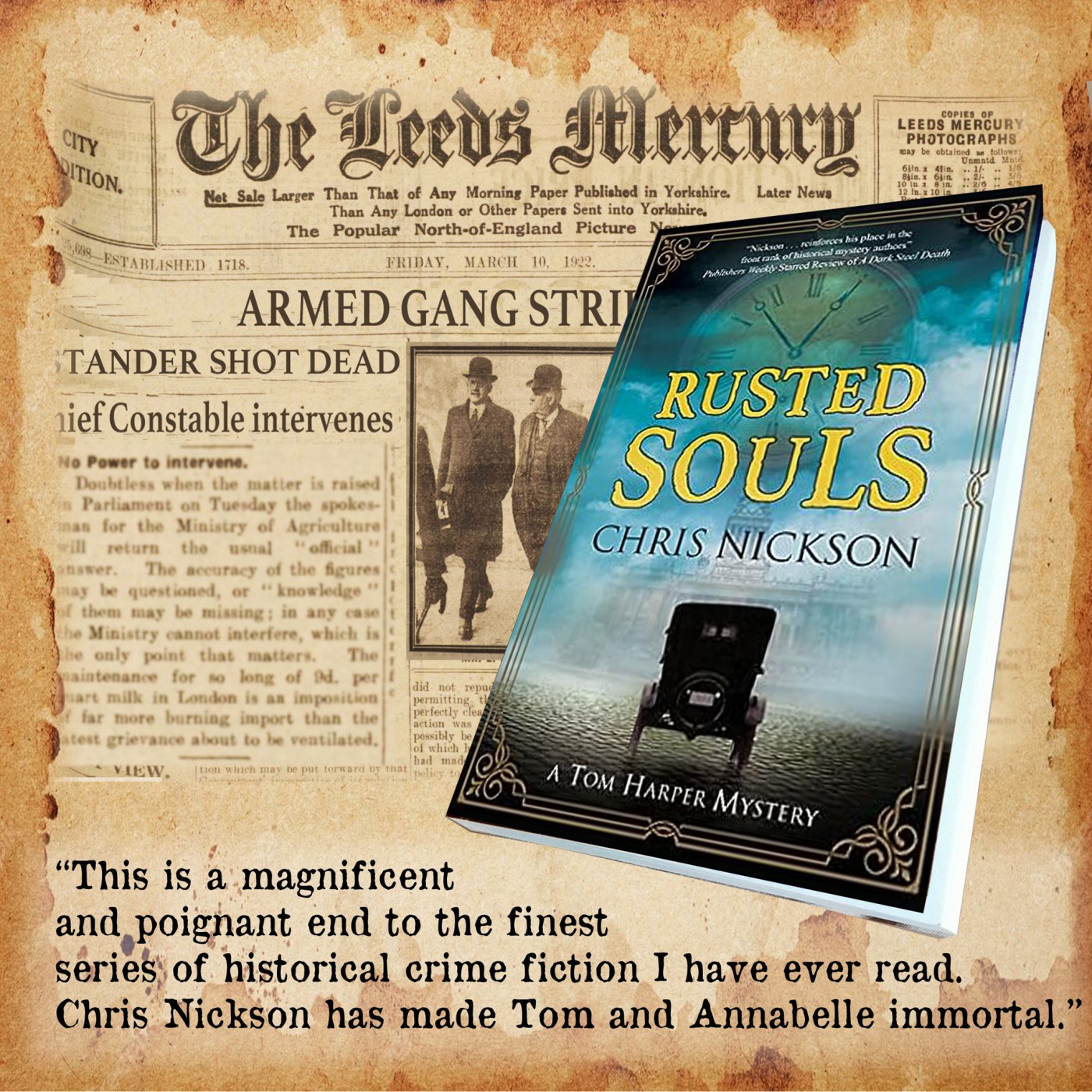
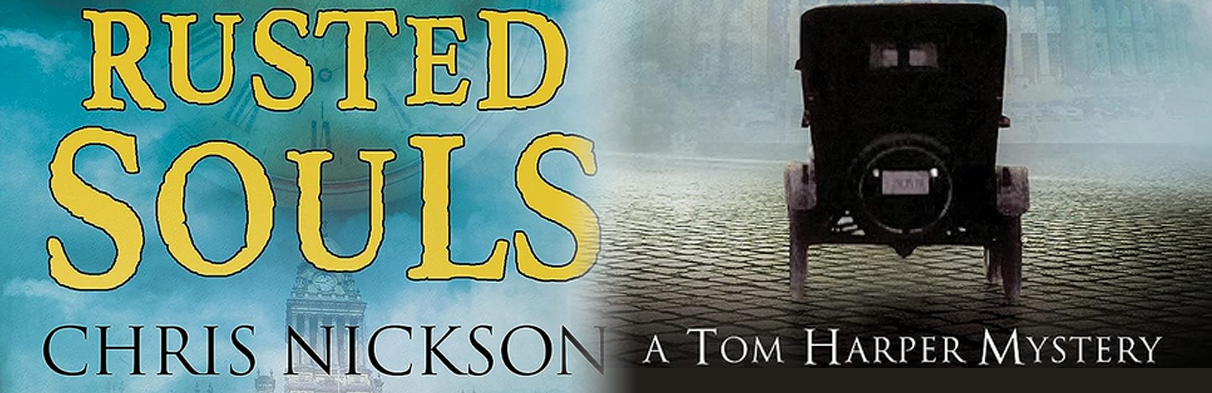
First sixLeeds, March 1920. Tom Harper is Chief Constable of the City force and, with just six weeks until his retirement, he is dearly hoping for a quiet ride home for the final furlong of what has been a long and distinguished career. His hopes are dashed, however, when he is summoned to the office of Alderman Ernest Thompson, the combative, blustering – but very powerful – leader of the City Council. Thompson has one last task for Harper, and it is a very delicate one. The politician has fallen a trap that is all too familiar to many elderly men of influence down the years. He has, shall we say, been indiscreet with a beautiful but much younger woman, Charlotte Radcliffe. Letters that he foolishly wrote to her have “gone missing” and now he has an anonymous note demanding money – or else his reputation will be ruined. He wants Harper to solve the case, but keep everything completely off the record. Grim-faced, Harper has little choice but to agree. It is due to Thompson’s support and encouragement that he is ending his career as Chief Constable, with a comfortable pension and an untarnished reputation. He chooses a small group of trusted colleagues, swears them to secrecy, and sets about the investigation.


He soon has other things to worry about. A quartet of young armed men robs a city centre jewellers, terrifying the staff by firing a shot into the ceiling. They strike again, but this time with fatal consequences. A bystander tries to intervene, and is shot dead for his pains. Many readers will have been following this excellent series for some time, and will know that tragedy has struck the Harper family. Tom’s wife Annabelle has what we know now as dementia, and requires constant care. Their daughter Mary is a widow. Her husband Len is one of the 72000 men who fought and died on the Somme, but have no known grave, and no memorial excep tfor a name on the Thiepval Memorial to The Missing.. Unlike many widows, however, she has been able to rebuild her life, and now runs a successful secretarial agency. Leeds, however, like so many  communities, is no place fit for heroes:

“‘Times are hard.’
“I know,” Harper agreed.
It was there in the bleak faces of the men, the worn-down looks of their wives, the hunger that kept the children thin. The wounded ex-servicemen reduced to begging on the streets. Things hadn’t changed much from when he was young. Britain had won the war but forgotten its own people.”

Last five

Nickson’s descriptions of his beloved Leeds are always powerful, but here he describes a city – like many others – reeling from a double blow. As if the carnage of the Great War were not enough, the Gods had another spiteful trick up their sleeves in the shape of Spanish Influenza, which killed 228000 people across the country. Many people are still wearing gauze masks in an attempt to ward off infection.

The hunt for the jewel robbers and Ernest Jackson’s letters continues almost to the end of the book and, as ever, Nickson tells a damn good crime story; for me however, the focus had long since shifted elsewhere. This book is all about Tom and Annabelle Harper. Weather-wise, spring is definitely in the air, as bushes and trees come back to life after the bareness of winter, but there is a distinctly autumnal air about what is happening on the page. Harper is, like Tennyson’s Ulysses, not the man he was.

We are not now that strength which in old days
Moved earth and heaven, that which we are, we are;
One equal temper of heroic hearts,
Made weak by time and fate, but strong in will.

As he tries to help at the scene of a crime, he reflects:

There was nothing he could do to help here; he was just another old man cluttering up the pavement and stopping the inspector from doing his job.”

As for Annabelle, the lovely, brave and vibrant woman of the earlier books, little is left:

The memories would remain. She’d have them too, but they were tucked away in pockets that were gradually being sewn up. All her past was being stolen from her. And he couldn’t stop the theft.”

This is a magnificent and poignant end to the finest series of historical crime fiction I have ever read. It is published by Severn House and will be available on 5th September. For more about the Tom Harper novels, click this link.


THE WIT AND WISDOM OF BERNIE GUNTHER

PK

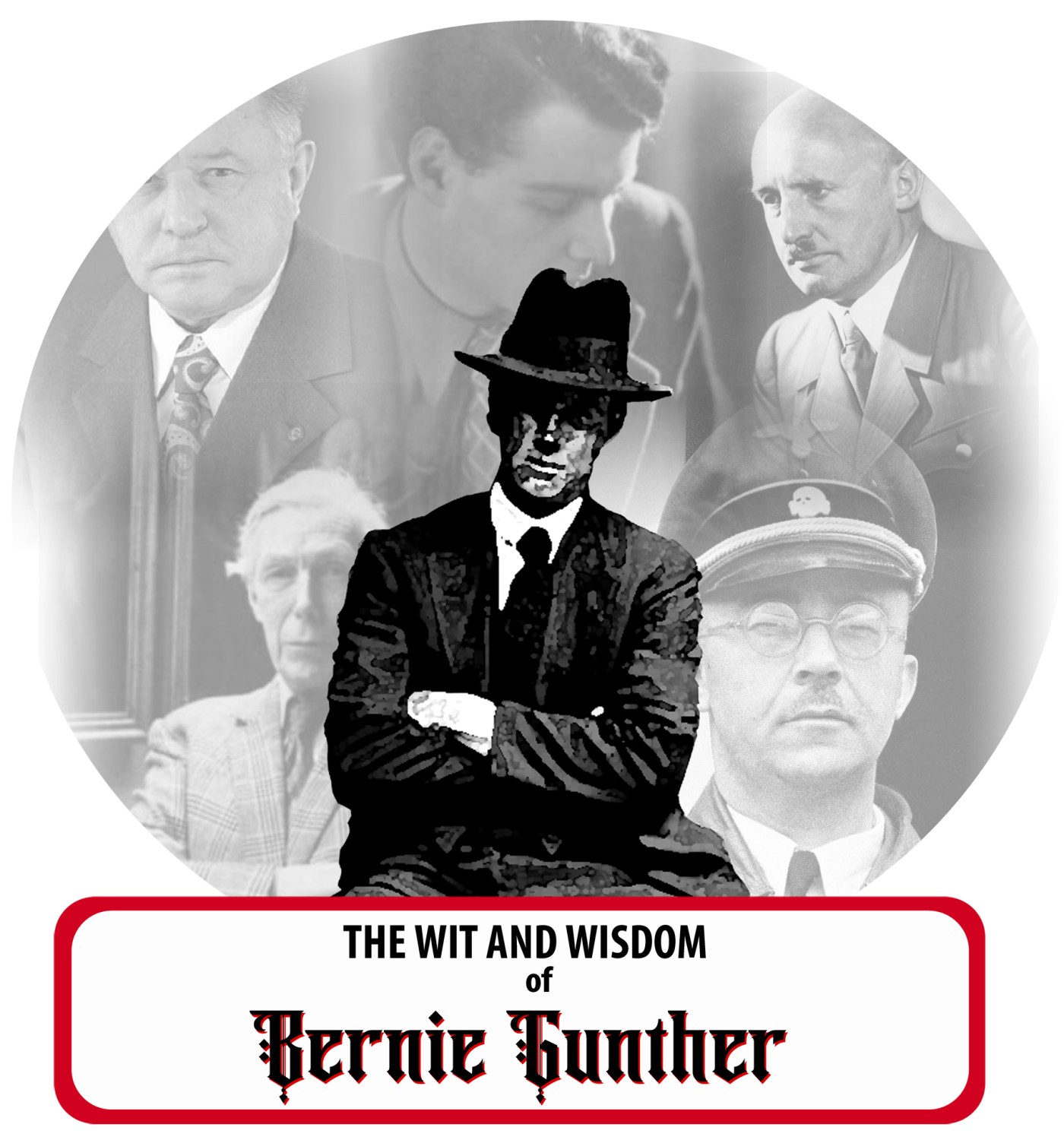
Over the thirty years and fourteen books of the series, Philip Kerr’s wonderful antihero Bernie Gunther was never afraid to speak his mind, both to us as readers, and often to the real-life characters – as diverse as Reinhardt Heydrich, William Somerset Maugham and Eva Peron – who peopled the stories. Sometimes he could be profound, sometimes savagely funny, but always observant. Here is a selection of his best lines.

Most of us who love great novels were aware that Philip Kerr was ill, and it was a moment of great sadness when we learned of his death in March 2018. We could not grieve in the full sense of the word. That was for his family. But we could only dream of what other adventures PK could have dreamed up for his magnificent creation, had he been granted more years. As it was, Metropolis – ironically, the book featuring Bernie at his youngest – was published posthumously. The Gunther books will be read as long as people have the desire to learn about 20thC history and the people who – for good or ill – shaped it. Also, as long as there are readers who enjoy a well-turned insult and a melancholy gaze into the human soul, Bernie Gunther will live for ever.

VOICES OF THE DEAD . . . Between the covers

VOTD spine009 copy

Edinburgh physician Dr Will Raven returns for the fourth in the series set in Edinburgh in the middle years of the nineteenth century. Ambrose Parry is the husband and wife writing team of Chris Brookmyre and Dr Marisa Haetzman. For new readers, a brief ‘heads-up’ about the personal dynamics between the main characters might be useful. Raven is assistant to – and disciple of – Professor James Young Simpson, pioneer anaesthetist and the only real life character in the book. Sarah Fisher was once Simpson’s housekeeper and, briefly, Raven’s lover, but he has since married, as did she, but her husband is now dead. She has a burning ambition to become a doctor.

VOTD cast

When Raven is summoned to Surgeon’s Hall by his friend Henry Littlejohn he becomes caught up in a chain of events which range from the comically macabre through to the murderous. Wrapped in a blanket and  deposited in the bottom of a cupboard, a human foot has been discovered. The head of the College, the aloof and irascible Dr Archibald Christie has been informed. Anxious to avoid any whiff of scandal, and aware that Raven has something of a reputation as an amateur investigator, Christie orders Raven to discover the origin of the foot without alerting the police. Things spiral beyond Raven’s control, however, when other body parts are located. Along with the irascible detective James McLevy, all concerned initially make a wrong assumption about the person whose limbs seem to be randomly scattered around the city. Will Raven’s past is punctuated with several episodes that might be described as unfitting for a respectable physician, and one such – by way of an all-too-human ghost from the past – sets him back on his heels.

We are soon drawn into a fascinating parallel plot involving the  ‘science’ of mesmerism. Its creator, the German physician Franz Mesmer has been dead for over thirty years, but displays of what we now call hypnotism are still able to draw crowds. The flames of interest in mesmerism are being found by the activities of two people. One, Richard Kimble is more of a stage illusionist but the other, Doctor Harland Malham, seems to have better credentials, so much so that Sarah is extremely interested in what he is doing. Her interest is heightened because, when meeting her for the first time, he suggests that she has an aptitude for mesmerism and could possibly be taken on by him as a trainee. Raven of course is deeply sceptical, but is acutely aware of Sarah’s determination to succeed in the medical profession by one way or another. Is she being duped? And who is the mysterious local businessman, Mr Somerville, to whom Sarah has become attracted?

One of the key elements in this series – and this book is no exception – is the nature of the relationship between Raven and Sarah, now Raven is married. He already has one child, a small son, and another is on the way. He is devoted to his wife Eugenie, but there is always a frisson between him and Sarah and we wonder, as readers, where this will end.

It doesn’t take a critical genius to work out that Brookmyre is providing the plotting and textual nuances while Haetzman is providing the (sometimes grisly)medical details and sense of medical authenticity. This is certainly one literary partnership that works very well, and the world of 1850s Edinburgh is portrayed in vigorous detail, contrasting the often squalid lives of the poor with the very different world of the more advantaged. The bottom line is that this is a bloody good crime novel, full of twists and turns, convincing historical ambience and main characters we believe in. It is published by Canongate Books and is available now.

THE ROOM WITH EIGHT WINDOWS . . . Between the covers

8windows header

December 1930. Henry Johnstone, a former Detective Chief Inspector with the Metropolitan Police, has been forced to resign due to a debilitating injury. Now, he ekes out a solitary existence in a crumbling Brighton house, empty except for a large library assembled by the former owner, the late Sir Eamon Barry. Johnstone’s task – one given to him by a friend, concerned about his mental state – is to catalogue the thousands of books in the library. He is convinced he is being stalked, perhaps by someone linked to an old case. Then, he disappears. We know how – if not why – but his friends, among them his sister Cynthia and his former Sergeant Mickey Hitchens, are left with few clues, but one – left behind by Johnstone – suggests there is a link to a mysterious death and disappearance five years earlier.

When Johnstone is eventually found, he has been beaten within an inch of his life by a criminal gang, and is in no fit state to help the investigation into what seems to be a brutal and very well organised smuggling cartel. England’s south coast has been the backdrop for smuggling for centuries. I am reminded of the romantic lines of Kipling:

“If you wake at midnight, and hear a horse’s feet,
Don’t go drawing back the blind, or looking in the street,
Them that ask no questions isn’t told a lie. Watch the wall my darling while the Gentlemen go by.
Five and twenty ponies,
Trotting through the dark –
Brandy for the Parson, ‘Baccy for the Clerk.
Laces for a lady; letters for a spy,
And watch the wall my darling while the Gentlemen go by!”

These days, sadly, the smugglers don’t tend to deal in the traditional commodities of brandy and tobacco, but in the more profitable contraband of human lives. I would like to think that back in the day, the profiteers were not aided and abetted by the historical equivalent of the RNLI and the Border Force, but that is a debate for another day As Henry Johnstone slowly recovers his strength, Hitchens – and his slightly odd (but learning something new every day) Sergeant Tibbs – eventually get to the root of the mystery, but not before more lives are lost.

As is only right and proper in novels set in the 1930s, Jane A Adams makes us aware that most of her protagonists have a shared history – that of The Great War. Those over the age of 35 will have either fought in that conflict or lost husbands and sons: Younger people will have fathers they will never see again, with only a marble gravestone somewhere in France as a far-away reminder of what they have lost.

The period details in The Room With Eight Windows are impressive and convincing, as are the quirks and foibles of the main characters. This excellent and atmospheric thriller will be published by Severn House on 4th July.

TWO MEN IN BERLIN . . . Bernie Gunther and John Russell (part one)

Berlin Header

Bernie Gunther is the anti-hero of fourteen novels by the late Philip Kerr. Berlin cop, turned private investigator, sometime employee of Goebbels and Heydrich, and finally an international pariah, Gunther’s exploits span post Great War Germany to international intrigue in the 1950s. John Russell is an Anglo American journalist who begins the series of seven books by David Downing based in Germany. The books are all named after railway stations and span the years 1938 – 1948.

BERNIE GUNTHER

Screen Shot 2023-06-02 at 20.14.08Philip Kerr’s Berlin Noir series was published between 1989 and 1991, and introduced the world to Bernie Gunther. Strangely, it wasn’t until 2006 that the books March Violets, The Pale Criminal and A German Requiem were followed up with The One from the Other, and until his death the Edinburgh-born author brought us regular episodes from the life of his tough, resourceful and compassionate hero. The final novel in the series, Metropolis, was published in 2019 after Kerr’s death and, ironically, is set in the earliest part of Gunther’s career.

To begin with, Gunther has survived two world wars and seen death in all its forms. However, what makes the series fascinating is the challenge he faces, which is to keep his moral compass steady. Uniquely amongst fictional detectives, Bernie has to operate during the dark and savage days of the Third Reich.

Having returned from the trenches of The Great War, Gunther becomes a member of Kripo (Kriminalpolizei), the investigative branch of the Berlin police. During the turbulent years of the 1930s, he tries to steer an even and honest course between the rival political thuggery of the Nazis and the Communists, and when Hitler seizes power he eventually finds himself forced to join the SD (Sicherheistdienst), the intelligence division of the SS. Sent to Ukraine as part of an extermination group but having no stomach for this, he is shunted into the Wehrmacht on the Eastern Front, and is captured by the Russians. After the War, his ambiguous record makes him a person of interest to the Americans, the Russians and the leadership of the GDR, and he leads a dangerous existence among Nazi refugees in Cuba and South America.

Like John Lawton and George Macdonald Frazer, with their respective Freddie Troy and Flashman series, Kerr places fictional characters within real events and alongside celebrated or notorious historical figures. And, he manages to do so in a fascinating and totally plausible way. Assuming that Gunther was born in the mid-to-late 1890s, he can still be at work in the mid 1950s, albeit a heavier, slower and more breathless version of his former selfa latter day Ulysses.

“Made weak by time and fate, but strong in will to strive, to seek, to find and not to yield,” writes Kerr of his hero.

Screen Shot 2023-06-02 at 20.15.51The author’s style, particularly his use of dialogue, set him apart from most contemporary writers. His books were genuine literature, although I suspect written without literary pretension. In Prague Fatale,  he described Gunther meeting an American war correspondent in a Berlin blackout:

“His Old Spice and Virginia tobacco came ahead of him like a motorcycle outrider with a pennant on his mudguard. Solid footsteps bespoke sturdy wing-tip shoes that could have ferried him across the Delaware….his sweet and minty breath smelled of real toothpaste and testified to his having access to a dentist with teeth in his head who was still a decade off retirement.”

In his toughness, moral strength and cynical view of the world, Gunther is very much the heir of Philip Marlowe. His descriptions, sarcasm and one-line put-downs can be very funny. This is a line from A Quiet Flame, which came out in 2008:

“The isosceles of muscles between her chin and her collar-bone had stiffened, like something metallic. If I’d had a little wand I could have used it to tap out the part for triangle in the Bridal Chorus from Lohengrin.”
For more on Bernie Gunther, click the link below

https://fullybooked2017.com/tag/bernie-gunther/

JOHN RUSSELL

Russell is an English journalist with an American mother. Until 1927 he was a member of the Communist Party but, like many others, he fell out of love with the kind of socialism being espoused by Stalin and his acolytes. After serving with the British army in The Great War, he moved to Berlin, married Ilse, and they had a son – Paul. The marriage didn’t last.

Screen Shot 2023-06-02 at 20.17.47In terms of the actual time setting, Wedding Station (2021) gives us the earliest glimpse of John Russell.It is just months after Hitler’s rise to power, and Russell watches the Reichstag burn. Four weeks after Hitler’s accession, brownshirt mobs stalk the streets and the press prints what the Party tells it to.

In the first book (in publication terms) in the series, Zoo Station (2007) we are are introduced to Russell. It is 1939, Berlin, and Russell is an accredited American journalist, safe (for now) from the excesses of Hitler’s government. He has a glamorous girlfriend in Effie Koenen, who is a rising star in German cinema, but he still has a relatively civilised relationship with Ilse – and her new husband – and has regular access to Paul.

His communist background, American passport and fluency in both Russian and German make John Russell a unique target for the intelligence services of all the major powers and, almost like a serial bigamist he becomes wedded to the Sicherheitsdienst, the NKVD, the Abwehr, and the OSS. He plays each one off against the other, more or less successfully and, along with Effie and son Paul, survives the war, but finds ‘the peace’ post 1945 just as traumatic. In Masaryk Station (2013) set in 1948, Russell is told by a Soviet stooge that there is still a war, but that it is different:

“That war is over. It’s time you realised that another struggle – one every bit as crucial – is now underway.”

Screen Shot 2023-06-02 at 20.18.57One of the main anxieties in Russell’s complex life is his son Paul. As the boy reaches his teens he becomes – like millions of other German lads – a member of the Hitlerjugend, and this threatens to drive a wedge between father and so. In Stettin Station (2009) we are in November/December 1941, and a famed German air ace of WW1, Ernst Udet is dead. In fact, he shot himself, disillusioned with Luftwaffe chief Goering, and the general conduct of the war, but for the purposes of national solidarity the official story is that he died in a plane crash. As his elaborate funeral cortege passes their viewing point, Paul chides his father for not making the Seig Heil salute with enough reverence. Russell dreads the day when Paul is conscripted to the army and sent to fight on the Eastern Front.

John Russell’s contact with senior Nazi officials is limited, but he does occasionally come face to face with Wilhelm Canaris, the head of the Abwehr, the intelligence service of the German army. One of Russell’s many uneasy allegiances is to the Abwehr which, in fiction if not in fact, has been seen as the acceptable face of the Third Reich. This is perhaps born out by the fact that Canaris was executed for treason on 9th April 1945, in the dying days of Hitler’s regime.

Russell’s connection with Joseph Goebbels is more distant, and it is through Effi Koenen. She is probably the most ‘box office’ star of German cinema, and Goebbels – as propaganda minister – has absolute control over what films can be made, and what message they send out. As such, Effi is much sought after. Again in Stettin Station David Downing presents us with the bitter irony that Effi – pale, dark haired and sexually vibrant – is required to play a Jewish woman in a film with a vehemently anti-Jewish screenplay. For full reviews of Silesian Station and Wedding Station click the link below.

https://fullybooked2017.com/tag/david-downing/

IN PART TWO OF THIS FEATURE
I will examine the differences – and similarities between Bernie Gunther and John Russell.

TOO GOOD TO HANG . . . Between the covers

TGTHheader

Confession time. I try to be honest and objective in my reviews, but there are certain authors who are so sure-footed that I know their novels will not disappoint, even before I have read the first page. One such is Sarah Hawkswood and her beguiling Bradecote series. They are not complicated. Central figure is Hugh Bradecote, noble of birth and Under-Sheriff of Worcestershire in the middle years of the 12th Century. I suppose he is the early medieval equivalent of a modern Detective Inspector and – like them – he has underlings. Bradecote is supported by the grizzled and worldly Sergeant Catchpoll and the Under Sergeant – a callow but rapidly maturing young man called Walkelin. My earlier reviews of the series can be found by clicking the link below:

https://fullybooked2017.com/tag/sarah-hawkswood/

This story begins in April 1145 with a terrible miscarriage of justice in a tiny hamlet called Ripple, the southernmost parish of Worcestershire. It is a real place, a beautiful village just north of Tewksbury. A young ploughman called Thorgar is about to be hanged for murder. He was found in the village church, crouched over the lifeless body of the priest, Father Edmund. Despite his protestations that he is unscyldig (Middle English – innocent), at the insistence of the Reeve, a man called Selewine, the villagers bear him away and he is hanged from an ancient oak tree. Thorgar’s sister Osgyth makes her way to Worcester and reports what she sees as the murder of her brother, which prompts Bradecote, Catchpoll and Walkelin to ride south to investigate.

They soon discover that Father Edmund’s death is linked to two deadly sins. The first is avarice; Thorgar, while ploughing has unearthed a treasure trove of silver artifacts – a priceless chalice, some coins and ornamental buckles dating back to Saxon times. The second is lust; this is far more sinister, as Father Edmund has been using his priestly influence to abuse young girls in Ripple, thus giving every angry father a motive for striking the ungodly cleric down.

Bradecote and his men eventually expose not one murderer – but two  – and there is a macabre finale when the respective killers are forced to disinter the mortal remains of their victims and take them to be given a Christian burial. Apart from the powerfully evocative atmosphere, this is a bloody good detective novel, but particularly impressive is the way Sara Hawkswood handles the dialogue. I suspect no-one has the faintest idea about how people spoke to each other in the 12th century, but the author establishes a style and sticks to it. As a long-time critic of what I consider to be botched attempts at authentic historical conversation in novels, I found Sarah Hawkswood’s method to be both satisfying and convincing.

EM Forster’s most celebrated – and enigmatic – dictum was, “Only connect.” Taking him literally, my goodness how Sarah Hawkswood connects. She connects us to the wonderful landscape of the Worcestershire/Gloucestershire borders, overlooked by the golden heights of the Malvern Hills. She connects us to the powerful – and sometimes destructive – presence of the River Severn. She connects us to a time when poor people lived hard-scrabble lives, totally dependent upon the whims of nature and weather and almost umbilically bound to the central focus of every town, village and hamlet – the church. She connects us to a world, perhaps not “better” than the one we live in, but one which had a firmer grasp of natural justice, common sense and spirituality. Too Good To Hang is a further gem in the crown of what is one of the best current historical series – the Bradecote novels. It is published by Allison & Busby and will be out on 18th May.

Blog at WordPress.com.

Up ↑