Search

fullybooked2017

Tag

English Crime Fiction

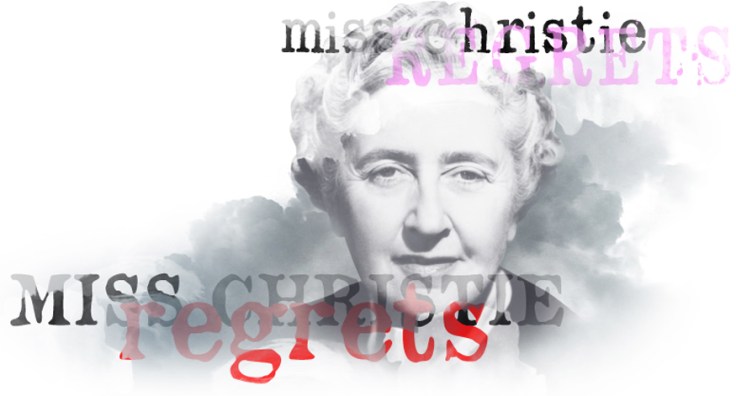
MISS CHRISTIE REGRETS … Between the covers

mcr2

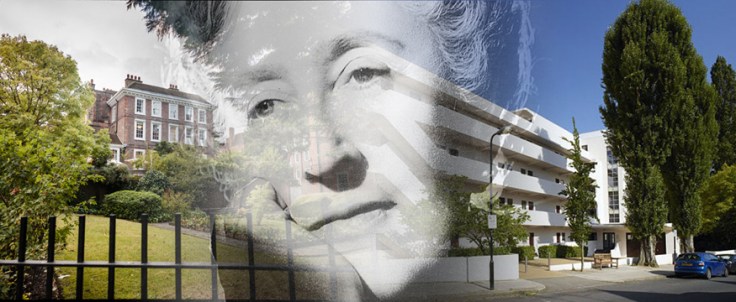
This is the second in a series by Guy Fraser-Sampson, set in the exclusive London borough of Hampstead.  As the police try to solve a not-quite-locked-room murder mystery in an elegant Queen Anne house, their task becomes doubly difficult when another body is found in a nearby block of flats, the Isokon Building. There is one crucial difference, however. The body in the upper room of Burgh House is that of Peter Howse a widely disliked researcher. The structure of his skull has been violently rearranged with a museum piece – an ancient police truncheon. The other deceased person? It’s fair to say that the first 48 hours of this particular investigation will not be so crucial, as the police pathologist states with some conviction that the bones have been in their bricked up cavity for at least half a century.

A quick word about Hampstead for those unfamiliar with London. Wikipedia tells us that Hampstead is:

“ …known for its intellectual, liberal, artistic, musical and literary associations and for Hampstead Heath, a large, hilly expanse of parkland. It has some of the most expensive housing in the London area. The village of Hampstead has more millionaires within its boundaries than any other area of the United Kingdom.”

mcr-coverBeing as this book is, in one sense, a police procedural, an introduction to the investigating officers is essential. Detective Sergeant Karen Willis is an elegant and well educated woman, whose personal life is complex. She is courted by two suitors; the first, Dr Peter Collins, is a consultant psychologist who, although undeniably clever, may not be entirely of sound mind himself, as he is prone to nervous attacks. When with Karen, he also tends to drop into a Lord Peter Wimsey persona and, yes, he does insist on calling Karen “Harriet”. The other claimant to the hand of Willis is Detective Inspector Bob Metcalfe, a much more grounded fellow who certainly does not mimic characters from Golden Age fiction. In fact, he could be said to be very worthy, but rather dull. Overseeing the investigations is Detective Superintendent Simon Collison, an urbane and civilised man who is regarded with a certain suspicion by more belt-and-braces officers such as Chief Inspector Tom Allen. One stock police character who is very much noticeable by his absence is a badly dressed, misanthropic and foul mouthed Detective Inspector type, much loved of many crime authors. If any such person did operate out of Hampstead nick, he must long ago have been transferred elsewhere.

As the police try to discover if there could conceivably be any connection between the suspicious deaths, decades apart, they discover that a fellow tenant of the apartment building to our skeletal friend was none other than Lady Mallowan – better known as Agatha Christie. Instead of the threads of the investigation becoming separated and more discernible one from the other, the tangle tightens when Collison and Metcalfe are informed by Special Branch that several of the Isokon Building residents during and immediately after WW2 were suspected of spying for Russia.

The author’s stated intent is to take the modes, manners and milieu of the Golden Age crime novel, and blend them into a modern setting. He succeeds, due in no small way to his sense of style and his lightness of touch. If the characters are not always totally plausible, then it matters not one jot. This book, like its predecessor Death In Profile, is an entertainment, pure and simple. There are 360 pages of sheer enjoyment, with the bonus of one or two rather good jokes along the way.

“Does anyone have a different view?” Collison asked quietly, looking around the room. “If so, please don’t hesitate to express it just because the DI and I are ad idem.”
Unsurprisingly, there was no answer. Firstly, because nobody was about to disagree with two senior officers. Second, because nobody wanted to participate in a renewed bout of house to house enquiries. Third, because nobody else, apart from Karen Willis, knew what ad idem meant.

It should be said that both Burgh House and the Isokon Building are real places, as are the pubs where Metcalfe and colleagues grab their lunch. This detailed local knowledge is used with subtlety and discretion throughout the narrative. There are other crime writers who, over the years have claimed particular areas of London as their own. We must allow Christopher Fowler to have his run of the lurid joys of King’s Cross and countless quirky abandoned theatres and lost railway stations. While the bleak and bloody suburban streets of places like Willesden and Kilburn, as well as the neon pallor of Soho clubs belong to the great Derek Raymond, we must grant Guy Fraser-Sampson ownership of the health-giving literary high ground of Hampstead.

Miss Christie Regrets is a beautifully written and cleverly plotted book which should be enjoyed by anyone who is a fan of The Golden Age, but also likes fare with a touch of spice added. It is available now, and published by Urbane Publications in paperback and Kindle.
mcr1

PURGED … Between the covers

purged-banner

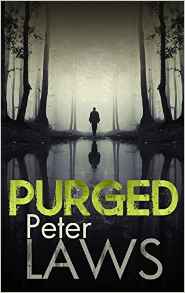
peter-lawsOrdained Baptist minister Peter Laws (right) has produced a 110mph debut crime thriller featuring Matt Hunter, a former clergyman and now devout sceptic who, like most fictional crime consultants, has special skills which make him invaluable to the police in murder cases. I don’t know if Laws has himself gone down the same Road to Damascus In Reverse as his fictional character, but the depth and bitterness of Hunter’s scepticism about God and all His works certainly makes for compelling reading.

Hunter is in a seemingly idyllic Oxfordshire village with his family, taking a sabbatical while his architect wife prepares to put in her bid for the contract to build an extension to Hobbs Hill church. If you are expecting a saintly country vicar with kindly eyes and a dwindling congregation, you will be in for a rude awakening. This church has become home to a congregation of over three hundred, and is led by a charismatic minister who goes in for full-immersion Baptism and the kind of wild call-and-response services which seem to be de rigeur in ‘new’ churches.

purged-coverFirst, an anorexic teenage girl goes missing, and then a lesbian artist who is in the terminal throes of stomach cancer disappears. Matt Hunter is sucked into the investigation via the simple ruse that photos of the missing women turn up as attachments in his email box. They stay there for a few hours but then mysteriously morph into pictures of a rainbow accompanied by a smiley face GIF.

The slightly manic minister of the Hobbs Hill church is no stranger to Matt Hunter. He and Chris Kelly studied together at bible college, where Kelly was an awkward and  unpopular student due to his fervent proselytising and strange behaviour. Hunter tries his best to be diplomatic with the over-intense church folk, if only to help his wife get the design commission, but when the isolated cottage where his family are staying becomes the target of sinister visitors, he senses that there is something malign lurking beneath the joyous born-again aura of Kelly and his congregation.

Peter Laws captures the essence of New Age Christian church groups in all their arm-waving, eyeball-rolling, tongues-speaking exuberance. We have the obligatory performance stage, complete with sound-system and live rock group, and every single man woman and child in the congregation has a steely determination to play The Ancient Mariner and grasp innocent visitors by the arm to save their souls from eternal damnation.

The concept of a small community gripped by a pervasive religious cult is not new. We have been there many times, and our tour guides have included Stephen King, John Connolly, Phil Rickman and John Wyndham. Laws grabs the cliché with great enthusiasm, and manages to conjure up menace from ostensibly benign surroundings. He also spins the tale cleverly so that we are persuaded to look in completely the wrong direction for the culprit, and he keeps us blind-sided until the last few pages of the book.

The only blot on the landscape for me was a literal one: the powerful and noisy waterfall, Coopers Force, which is central to events in the story, seemed out of place in the gentle hills and meandering streams of Oxfordshire. I could picture the feature in The Lakes, Scotland, Snowdonia, or the Pennines, but such an elemental force of nature didn’t seem to belong in the golden Cotswolds. That aside, I found Purged to be exciting, convincing and well written. Best of all, it has that one essential feature of all good novels – the reader actually cares what happens to the main actors in the drama.

Purged is published by Alison & Busby, and will be available on 16th February. You can pre-order a copy here.

purged-banner

DEATH SHIP … Between the covers

Death Ship spread


In Jim Kelly’s novels, the past is like a sunken ship that has lain undisturbed on the sea bed for decades. Then, with a freak tide, or maybe some seismic shift, the ship’s blackened timbers surface once again, breaking through the surface of the present. In this, the latest case for Detective Inspector Peter Shaw and Sergeant George Valentine, the metaphor becomes literal. In the terrible storm of January 31st 1953, a tempest that battered the East Anglian coast and claimed over 300 lives, a dilapidated Dutch coaster, the Coralia, went down, taking its captain and crew with her.

Meanwhile, the unique seaside town of Hunstanton – unique in that it is an east coast resort which faces west – has been literally rocked by an explosion on its crowded beach. Something buried deep beneath the sand is triggered by some boys determined to dig a sink-hole sized pit before the tide sweeps in. There is a brief moment when something metallic and shiny appears in the wall of their excavation, but then hell is unleashed. Miraculously, no-one is seriously hurt, but the beach is closed to holidaymakers while forensic experts and a bomb disposal team from the army do their stuff.

Shaw is faced with several possibilities. Was the explosive device recently planted by extremists from the STP – Stop The Pier – movement, who are protesting against the construction of a huge new pier which will suck trade and footfall from existing businesses? Was the explosion a result – as a teenage boffin from King’s Lynn suggests – of the very late detonation of an unexploded bomb dropped in a Zeppelin raid way back in 1915?

Shaw’s case is complicated by the discovery of a dead diver, tethered to the underwater remains of Hunstanton’s Victorian Pier, destroyed by storms in 1978. Eventually, he learns that the murdered diver is the son of one of the crew members of the ill-fated Lagan, whose remains are rotting on the seabed a couple of miles distant from the pleasure beach. And what of the apparently guileless old lady who has been caught giving arsenic-laced sweets to people in a local ‘bus queue.

Detective partnerships have become one of the enduring clichés of crime fiction. Sometimes – but not always – the pairings work, and when they do, they are a very satisfying literary device. The trope usually requires the senior partner to be yin to the junior’s yang. In this case, Peter Shaw has the imagination. George Valentine the curmudgeonly common sense; Shaw is the live wire to Valentine’s earth. The telling difference between these two and other ‘odd couples’ is that Kelly explores the psychological make up of both men, and the glimpses into their personal lives are equally perceptive and revealing. Valentine is older than Shaw by many a mile; so much so, that Valentine actually served in the force alongside Shaw’s late father, a man still revered within the Constabulary. We also learn that were it not for a faux pas which almost ended his career, Valentine would now be Shaw’s senior officer.

New readers will be pleasantly surprised at how Kelly knits together the misdeeds of the past and the murderous intent of the present. Existing fans will simply smile, and say, “He’s done it again.” You will be pushed to find a novel which so successfully welds together the police procedural, the psychological thriller, the ‘whodunnit’, and the atmospheric novel of place. If you find one, please let me know. In the meantime, I will not be holding my breath – except in waiting for the next masterpiece from one of our finest writers. Death Ship is published by Severn House, and is available here. The official launch will be – very appropriately – at the RNLI Headquarters in Hunstanton on 3rd September. For tickets and enquiries ‘phone 07840 375 984

jim kelly Small_0

JIM KELLY … A landscape of secrets

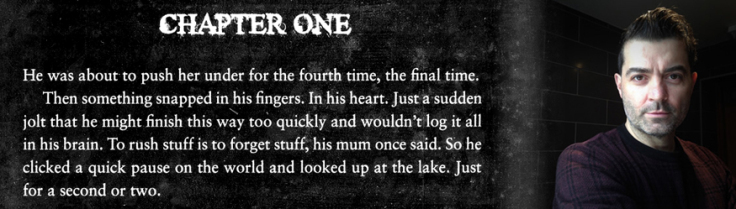
jim kelly Small_0JIM KELLY (above) grew up in the shadow of some of the worst criminal misdeeds the country had ever experienced and, as his childhood progressed, the evil that men do was seldom far away from the Kelly family. So, he had a brutal and disadvantaged upbringing? No, far from it – just the opposite. His father Brian was a top detective in the Metropolitan Police, and his maternal grandfather, too, had a background in keeping the peace as a special constable – he actually was there on the street, as it were, in 1911, when Home Secretary Winston Churchill and others managed to turn a hunt for anarchist criminals into the expensive and bungled farce that we know as the Siege of Sidney Street.

 Kelly was born in Barnet, originally a small Hertfordshire town, but now a borough long since absorbed into the suburban sprawl of north London. It was near Barnet on 14th April 1471, that one of the most influential battles of the Wars of The Roses secured the throne for the Yorkist King Edward IV. The only battles that Kelly recalls were, however, between his beloved Barnet Town Football Club and their rivals. ‘The Bees’ have been back and forth between league and non-league football over the years, with all the regularity of a fiddler’s elbow, but as long as hope springs eternal in the human breast, Barnet can be sure of at least one man’s loyalty.

Screen Shot 2016-08-18 at 19.40.08

After several years in journalism, which culminated in writing for The Financial Times, Kelly decided to put his skills to the ultimate test. He would become a full time novelist. By this time, he and his family had moved to the beautiful Cambridgeshire cathedral city of Ely, which had all the advantages of wide open spaces as well as the crucial railway connection to London. Before we continue, a word from one who knows. Ely is, geographically, in Fenland – an area of such fertile soil that it is said that a man only has to spit on the black soil for it to start growing into something productive. But Ely, with its tea-rooms, artisan bakeries, arts centre and elegant cafés may be in The Fens, but it is certainly not of The Fens. To explore the real Fenland, the traveler must visit such hard-scrabble towns and villages as Wisbech, Chatteris, March, Welney and Three Holes. It is among these sometimes insalubrious settlements that Kelly sets the series that first brought him to public attention.

Philip Dryden is the editor of Ely’s local newspaper. When he was first introduced, in The Waterclock (2002), local ‘rags’ had yet to feel the full force of digital competition, but they were already on the rocky road of no longer charging a cover price, but giving themselves away for nothing, hoping to cover costs from advertising revenue.

In Kelly’s books there is always a sense of déjà vu, of history coming back to bite people on the bum, and a telling awareness that despite tomorrow being another day, it is yesterday that casts the longer shadow on people’s lives. This is even evident in the fact that Dryden’s exotic wife Laura is lying alive, but insensate, in an Ely hospital. She is there as a result of a catastrophic road accident when she and Dryden ended up in a deep Fen ditch late on a winter’s night. When I first met Kelly, he came and spoke about his books at my local library. He revealed that one of his favourite authors is Dorothy L Sayers. And how does her most celebrated book begin?

“That’s torn it!” said Lord Peter Wimsey.
The car lay helpless and ridiculous, her nose deep in the ditch,
her back wheels cocked absurdly up on the bank,
as though she were doing her best to bolt to earth
and were scraping herself a burrow beneath the drifting snow.

Thus Lord Peter Wimsey and the faithful Bunter have to seek the help of the inhabitants of Fenchurch St Paul and, in doing so, become involved in the celebrated mystery of The Nine Tailors. The Sayers connection is further developed by Kelly in his novel The Funeral Owl (2013), the most recent Philip Dryden mystery, where much of the action is centred in the Fen village of Brimstone Hill. This village is easily identifiable on the ground as Christchurch, which is little more than a huddle of houses in the lonely expanse of flat farmland between March and Ely. And who was the Rector of the little Victorian church in the village (below), between 1917 and 1928? The Reverend Henry Sayers, whose daughter went on to become one of the great literary figures of her day, and also a member of the elite writers of Golden Age crime fiction.

christchurch_1

Like all amateur detectives, Dryden sticks his nose into places where it is likely to get stung or at least severely nipped. The fact that he lives on a houseboat moored on Ely’s River Great Ouse always adds a touch of the exotic, but his day job as newspaper man allows him access to places that mere interested passers by could never penetrate. After refusing ever to drive again after the accident which left his wife paralysed, Dryden relies for transport on an obese and sedentary taxi driver called Humph. Humph serves several functions, including playing the role of a Greek chorus, commenting on and observing at a small distance the complications and dramas with which his regular customer involves himself. On a less cerebral level Humph has an inexhaustible supply of snacks, as well as an impressive collection of spirit miniatures harvested during his frequent trips to Stansted airport.

Kelly’s other crime fiction series hovers closer to the police procedural landing strip than the Philip Dryden novels. Peter Shaw is a high-ranking detective based in King’s Lynn. He too has his Watson, but in this case it is in the form of the taciturn and misanthropic copper, Sergeant Valentine. Kelly’s portrayal of King’s Lynn is as accurate and revealing as his frank picture of the bleak, inhospitable, historically incestuous and endlessly resentful villages of Fenland. Lynn, as it is known to locals, is also a paradox. On the one hand we have the magnificent churches, the prestigious Festival, and the unbreakable connection with a certain family who have a country home just up the road in Sandringham. But we also have the rough estates, the ill-at-ease migrant workers, and the tough-as-teak descendants of the fishermen who once sailed out of Lynn in search of seafood for the tables of rich men in their castles.

Like Dryden, Shaw is a complex character. He conceals from his bosses the fact that he may be losing his sight as a result of an old injury. His father – like Kelly’s – was a hugely respected policeman. Unlike Detective Superintendent Brian Kelly, however, Shaw père may not have been as honest as the day is long. In recent Peter Shaw novels, readers have been taken away from King’s Lynn and led up the Norfolk coast to such places as Brancaster and Holme. This part of Norfolk has been called Chelsea-on-Sea, due to the rising numbers of wealthy second-homers who have invested money, if not time, in the area. Shaw’s beautiful wife, who runs a beach shop and store at Hunstanton, and our man’s part-time job as a member of the local lifeboat crew, certainly add depth to the character.

As a master of landscape and what has been called pyschogeography – the invisible pull that past deeds, embedded in the fabric of buildings and streets, exert on modern day events – Jim Kelly has only one equal, and that is Christopher Fowler, whose elderly detectives Bryant and May are always jerked this way and that by the powerful magnets of history which lie beneath the streets of London.

If you are yet to read one of Kelly’s novels, then you should do so as soon as possible. If, like me, you are a devout disciple, then I hope that I have summed up just a hint of the man’s magical writings.I am presenting the two series of novels as separate graphics, but you can find out more by visiting Jim Kelly’s Amazon page.

PHILIP DRYDEN NOVELS

Dryden

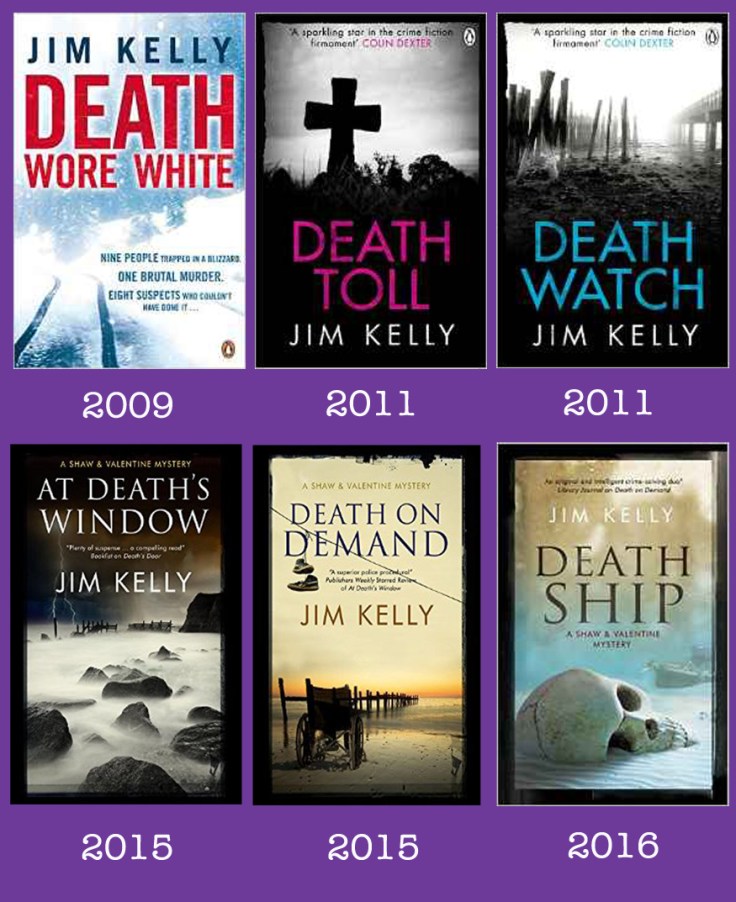
PETER SHAW NOVELS

Peter Shaw


Blog at WordPress.com.

Up ↑