
Jo Spain’s Irish copper Tom Reynolds – now Detective Chief Superintendent, if you please – returns in After The Fire and we are, as ever, in Dublin’s Fair City. Are the girls still ‘So Pretty’? The young woman walking naked down the city street, much to the astonishment of shoppers might have been pretty once, but now she is in a terrible state. Hair awry, skin blackened with dirt and a look of sheer terror in her eyes.
Except that is not dirt on her skin. It is soot, and she has escaped, traumatised, from a catastrophic house fire. The terraced house is in an area which has moved upmarket because of its proximity to the The International Financial Services Centre (IFSC) but the services being offered at the ruined house were something different altogether. First one body is recovered, and then another, and as the young woman – a Russian – recovers in hospital, it becomes clear to the police that the house was a brothel, and she was one of the items on the grisly menu.
As a DCS, Tom Reynolds is not meant to get his hands dirty at an investigational level, but there is no drama in balancing budgets and supervising staff deployment, so the admirable Mrs Spain has Tom notionally taking a spot of leave so that he can lend a hand in the case which is being led by his former protégé Laura Lennon.
Tyanna, the woman who fled the fire, is too terrified of the people who controlled the trade at 3 Shipping Row to be of much use, but she has mentioned a baby, now missing, the child of a young woman whose corpse was discovered in the building. Another frightened young woman – Nina Cusack – who was bought and sold there has also emerged, but she has sought sanctuary with her parents and is, again, too terrified to divulge much about the identities of the guilty men who are controlling the brutal trade.
The sheer fluency of Jo Spain’s writing will come as no surprise to those of us who are long term admirers, and the bottom line is that every book she writes is, quite simply, a bloody fine read. It is, however, worth taking a moment to look at just how and why she is so good. Lesser writers will seed their narratives with gore and gruesome detail, while Spain leaves us in no doubt about how brutal people can be, but in a much more subtle way.
Some police procedurals rely too much on the central copper being a maverick, or a bitter misanthrope, or a damaged person with a hundred different devils to fight each day. Tom Reynolds doesn’t distract us in that way – he is a decent man who has been dealt a fair hand by fate, and so we don’t waste valuable time having to understand him by examining his CD collection. (Yes, I know CDs are so very yesterday, but you get my drift)
As for elaborate scene setting with endless paragraphs about how Dublin looks, smells, sounds and feels, Jo Spain puts us in the place with a couple of telling sentences. We know we are in Dublin – that’s fine – but then she gets on with the important stuff. The important stuff? That is the story and above all, Jo Spain is a storytelling genius. Those who follow her career will know she is also much sought after as a screenwriter. The Tom Reynolds books and the stand-alones are not written for the screen, but they may as well be because every page, every paragraph and every sentence comes to life as vividly – and as visually – as if we were standing right there, watching.
After The Fire is published by Quercus. It is available now as a Kindle, and will be out in paperback on 6th August.
For more on Jo Spain and her novels, click the image below.


 This is a chillingly clever whodunnit shot through with a caustic examination of life among the moneyed classes of contemporary Ireland, particularly Dublin’s nouveau riche and their over-indulged teenage children. Fans of Jo Spain’s DI Tom Reynolds will be overjoyed to see him return for his fifth case, and those who know the author only through her spellbinding standalone novels such as
  his particular dark night ends in tragedy, as after he and his friends indulge in some horseplay with an ouija board, young Luke Connolly plunges to his death from an upstairs window. The youngsters involved in the escapade are not, however, from some run down social housing estate, the victims of neglect, poor schooling and brutalised by deprivation. No, Luke, Charlotte, Hazel, Brian, Jacob and Dylan are all students at the prestigious and very expensive Little Leaf College and their parents, while possibly having more money than sense, are pillars of the community. But. And there is a rather large but in the person of Daniel Konaté Jones. Daniel is mixed race, has a ‘job’ as a DJ, and is tolerated by the group as something rather exotic, like a strange tropical orchid springing up in the herbaceous border . The police investigating the death are quick to arrest Daniel, and their case against him is sewn up with speed and, to mix metaphors, seen as tighter than a camel’s arse in a sandstorm.
 aniel is related to one of Tom Reynolds’ most respected officers, and when she asks him to take a look at the case, he reluctantly agrees. There are just one or two complications, though. First, Daniel is refusing to say anything – not a word – to investigating officers or his lawyer. Then, Reynolds becomes aware that Daniel is gay, and that, despite protestations from parents and friends, it appears that Danny and Luke were “an item.” Thirdly, the grief of Luke’s parents at his death has to run alongside the tragic demise of Luke’s twin brother Ethan, who is near death in a local hospice.
 Jo Spain is the literary Diva of Deviousness, and while we learn early in the piece that Glenmore House has a bloody history, she waits for some while before reconnecting the earlier slaughter with the death of Luke Connolly. When she does – and Reynolds realises the connection a paragraph or three before we do – the investigation takes on a whole new slant.

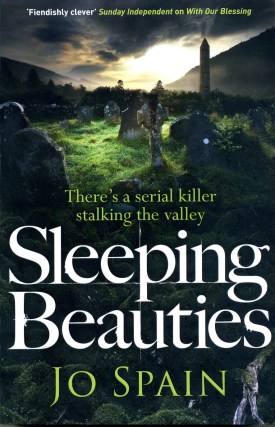 In the beautiful valley of Glendalough there are ancient stones, shades and spirits of the holy men who prayed in the monastery – and in the cemetery, lichen-covered headstones of generations of Byrnes, Cullens, Farrells, Nolans, Waldrons – all, both monks and villagers, at peace now. But the body of a young woman has been found. Interred without sacrament, beyond the gaze of those who would mourn her. In a shallow grave on a hillside, wearing the clothes she disappeared in. It is all that remains of Una Dolan, a twenty four year-old lass from Waterford. Last seen April 29th, 2011.
 Jo Spain writes like an angel. No fuss. No bother. No pretension. The narrative flows as smoothly as a glass of Old Bushmills slips down the appreciative throat, and she has us looking this way and that as we stand beside Tom Reynolds as he searches for the killer. This is, on one level, a police procedural, but Jo Spain doesn’t let methodology bog the story down. We know that she knows how the police operate, and that is more than enough. Her rural Ireland is beautifully described without unnecessary frills and furbelows, and she gives us as perceptive a story of the heights and depths of human behaviour as you will read all year. If you have come a little late to the Tom Reynolds party, the first episode of his career is
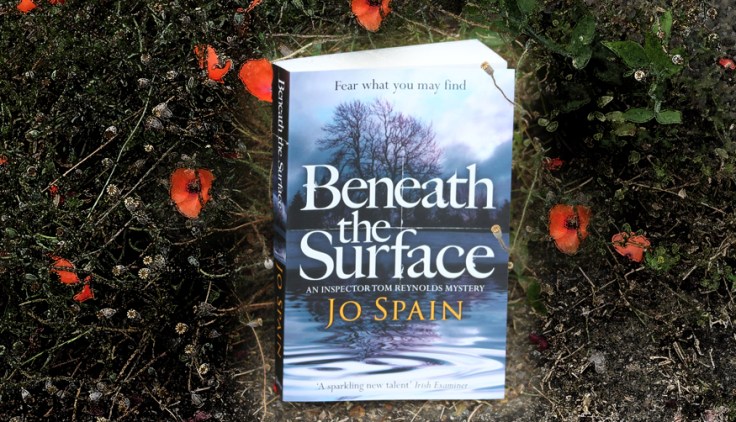 IRISH CRIME FICTION seems to be on a roll at the moment. With writers like Anthony Quinn, Stuart Neville, Ken Bruen, John McAllister and Sinead Crowley making headlines, it’s not too fanciful to see Ireland – North and South – rivaling its neighbour across the sea, Scotland, as everyone’s favourite setting for moody and intense crime tales. Is there room for one more at the top table of Irish crime? There certainly is, when it’s Jo Spain asking for a seat. Her debut novel


 fullybooked2017