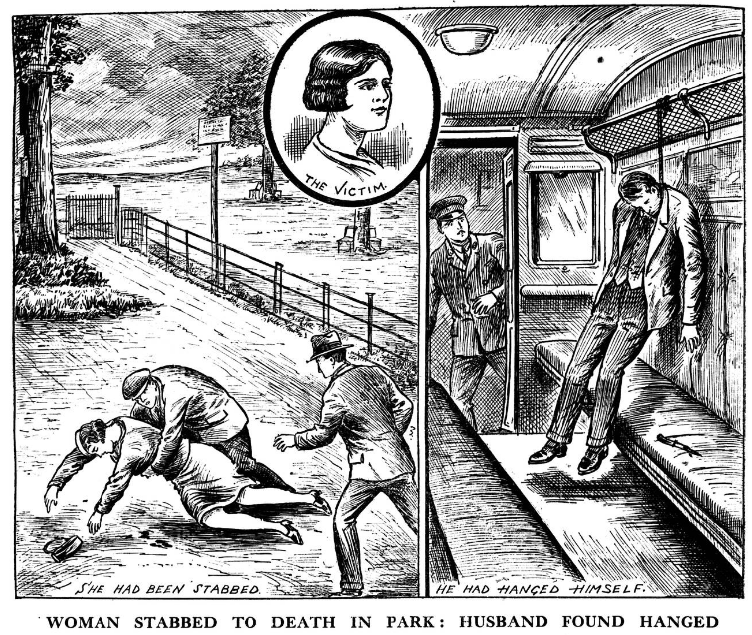
SO FAR – The murder-suicide of Doris and Walter Reeve in August 1933 has shocked Fenland and made the national newspapers. The Illustrated Police News – which had been publishing lurid accounts of crime since 1864 – had great delight in producing an imaginative illustration of the double tragedy.
Back in Wisbech, the inquest continues to investigate the relationship between Doris Reeve and her husband.
On the Tuesday, Doris’s father went to Upwell to confront his son-in-law. Walter Reeve was aggressive when spoken to, and accused Mr Reeve senior of only coming round to provoke an argument. When Walter Reeve was accused of carrying on with another woman, he replied:
“I know I have, and I shall do again.”
Later, Doris revealed, that in addition to physically knocking her about, Walter had shown her a double barreled shotgun and threatened to first blow her head off, and then turn the gun on himself. Eventually, later in June, Doris left Walter for good. Walter paid several visits to the Clarence Road home and was in turn both threatening, and playing the part of the heart-broken husband. On one occasion, Doris’s father said to Walter:
“You have turned out a rotter.”
Walter replied:
“You will not let her come back, and you will regret this.”
The events of that Saturday evening, 26th August became clear as the case progressed. PC Howard, who had been called to the grim scene in the railway carriage told the inquest that he had been on duty in Wisbech early on the Saturday evening. He had seen Walter and Doris Reeve standing in the High Street. Walter Reeve had his hands in his pockets, and Doris did not seem to be upset or distressed in any way.
May Simpson, of Norwich Road Wisbech, had known Doris as a friend since January. The two were meant to meet in Wisbech at 7.00pm that Saturday evening, but Doris did not arrive on time. Miss Simpson began walking up Norfolk Street, and stopped outside a butchers’ shop to talk to another woman friend, when Doris Reeve came rushing up. This was about 7.10pm. Doris seemed to be in good spirits. The three women then went to the Empire Theatre, and came out at about 10.45pm. They stood outside talking for a while, and Doris still seemed cheerful, and said nothing about any matrimonial troubles. Doris and the third woman, Mrs Read, then walked towards the Lynn Road, going via the cannon on Nene Quay, rather than the dark and rather confined Scrimshaw’s Passage. They said goodnight by Ames Garage, and Doris the walked briskly off in the direction of her own home. That was the last time that anyone – with the exception of her husband – saw her alive.
What had Walter Reeve been up to on that fateful evening? The court was told that he had no history of mental health problems, and was a man of “considerable bodily vigour and health”. On the evening of the murder, he met with some friends in The Five Bells on Norfolk Street. They stayed there drinking until about 10.00pm, when they went to Wombwells, a fish and chip shop next to The Electric Theatre. After enjoying a fish supper, they left about 10.40pm in the direction of Blackfriars Bridge over the canal, where they parted company
One of the men with whom Walter Reeve had been drinking was asked by the court if Reeve had been the worse for wear. He replied that he had been rather quiet all evening, when he was normally quite jolly. The witness said that he knew divorce proceedings had been started between Doris and Walter, and that Reeve had been seeing another woman.
Ernest Martin Henson, a garage proprietor of Cannon Street, Wisbech, said that he had heard knocking on his door between 11.30pm and 11.45pm on the Saturday night. He answered the door, and the man, who gave his name as Reeve, said that he wanted to be taken to Upwell. Henson said:
“I suppose you know what the fare will be?”
Reeve answered:
“Four shillings.”
“No, “ said Henson, “it will be twelve shillings and sixpence at this time of night.”
In a very offhand manner, Reeve said, “Oh, alright then.”
Henson took about five minutes to get dressed, and went and fetched the car. When he drove round to the front of the premises, there was no-one there. Henson waited for about forty five minutes, but when no-one came, he went back to bed.
Two men, itinerant fruit pickers who had been ‘dossing’ in the park on the Saturday night had an interesting tale to tell. One of the men, called Nesbitt, saw a figure standing by a gate, but the man was doing nothing to attract attention. Then Nesbitt heard groans, and said to his friend:
“Come along – there is somebody there badly using a woman.”
His friend replied that it might only be a couple in a domestic dispute, and so they decided to let discretion be the better part of valour. The next day, Nesbitt’s colleague said:
“There’s been a woman murdered over there..” and Nesbitt replied that he must have been correct all along the previous night.
In the Coroner’s summing up, he said that it was clear that Walter Reeve had murdered his wife and then done away with himself. He raised the question of Reeve’ sanity, but said that there was no evidence of mental health issues with either Reeve himself or any members of his immediate family. He did refer, however, to the testimony of Reeve’s mother, who had said that even as a child, Walter had been possessed of a very violent temper. The Coroner reminded the jury that if they were prepared to say that Reeve was out of his mind when he killed himself, they could then hardly say that he was sane a little earlier when he had plunged the knife into his wife. He said that the reverse was also true.
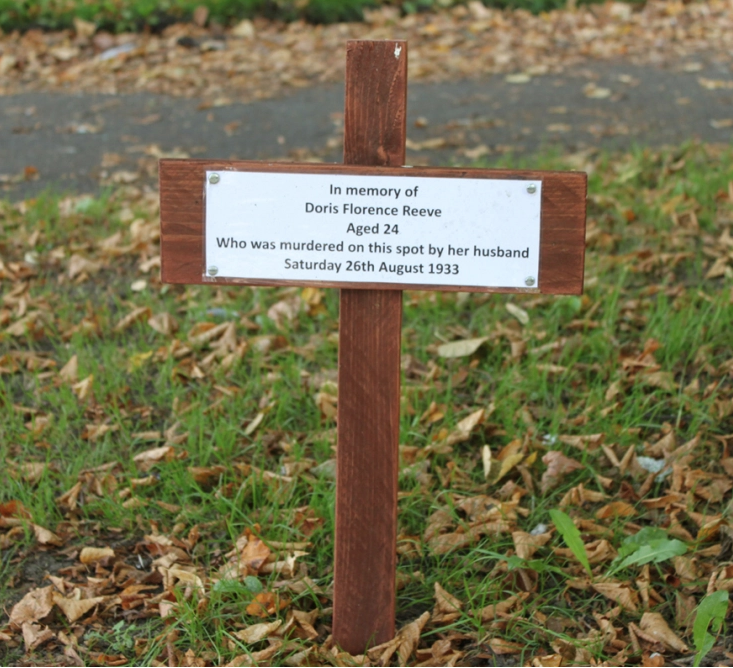
The jury returned the obvious verdict of murder in the case of Doris Reeve, but asked that the archaic verdict of Felo de Se be placed on record. The Latin term literally translates as “felon of himself”, and in earlier times, English common law considered suicide a crime. A person found guilty of it, even though dead, was subject to punishment which might include forfeiture of property and being given a shameful burial.
If only in the personal column of the local newspaper, Doris and Walter Reeve were united in death.
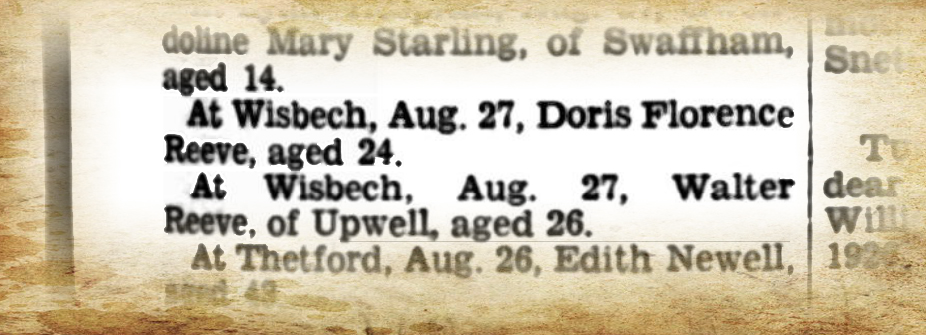
Regarding the burials of the two young people, shameful or otherwise, the Wisbech Advertiser had this to say in its edition of Friday 1st September:

Just six miles away, however, a rather different interment was taking place.There will have been tears shed, but no-one sang hymns, and the police were not required to control the crowds.


 Such is the case in The Perfect Lie. Erin Kennedy – an Irish lass – works in publishing in New York, is married to American cop Danny Ryan, and they live in Newport, Rhode Island. No, Danny is not a fellow Celt, despite his surname, but beautifully black, at least in Erin’s eyes. One morning, she answers the doorbell to their apartment and admits Danny’s cop colleague Ben – stern of face – and a couple of fellow officers. Within seconds Danny, freshly showered and shaved for the day’s shift has walked to the balcony and jumped to his death on the concrete four floors below.




 The restaurant is run by his relatives Saibal and Maya, with help from their daughter Anjali. At this point is worth reminding people that families are the big thing in the sub-continent, and most of the characters in the book are related in one way or another. The story starts on the evening that the restaurant has been booked to provide the food for the lavish 60th birthday party of rich entrepreneur Rakesh Sharma. He and his new wife Neha – half his age – are installed in a lavish mansion on Billionaire’s Row near Hampstead Heath. It’s also worth mentioning at this point that Sharma’s first wife (and son by that union) are still very much on the scene.







 Satoshi ‘The Prince’ Oji is the darkest character of the five. He is utterly without compassion. Other human beings – school teachers, teenage friends, other adults – only have value to him in the sense that they can be used for his entertainment. He is highly intelligent, but one of the more malevolent fictional villains I have encountered in recent times. Everything is thought through and planned in the minutest detail, such as his grip on Kamura. The grizzled gangster could, physically, chew up Satoshi and spit out the bones, but the teenager convinces Kamura that he has an insider in the hospital where the man’s son is lying in a coma, and should Satoshi fail to answer periodic calls to his mobile ‘phone, then this insider will find a way to disconnect the little boy’s life support system.

 While reporting on the death and mutilation of a young rent boy, Russell is asked by a friend to take on another case, this time on behalf of a senior army officer whose daughter is missing. It is a delicate business, because there is a strong suspicion that Lili Zollitsch has run off with a boyfriend who is an active member of the Kommunistische Partei Deutschlands.

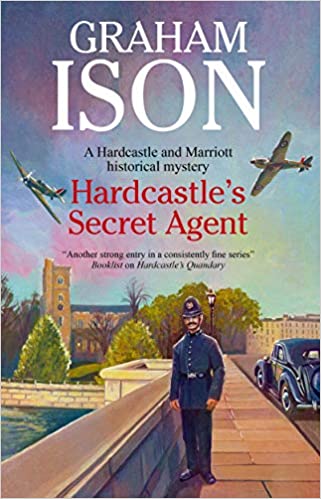 We are, as ever, in London, but it is 1940. The Phony War is over, and the Luftwaffe are targetting industrial sites they believe to be involved in making parts for military aircraft. When several important employees of one such factory are burgled – clearly by an expert – but with nothing other than trinkets stolen, Hardcastle believes he may be on the track of a German spy on the look-out for plans, blueprints or important military information. Hardcastle has to deal with The Special Branch, but finds them about as co-operative as they were with his father a couple of decades earlier. This has a certain tinge of irony, as part of the author’s distinguished police career was spent as a Special Branch Operative.