Search

fullybooked2017

THE WHISPERS . . . Between the covers

the whispers017

We are in a small town called Clearwater on the coast of England. Time – the present day, just before Christmas. Grace Goodwin, a young woman in her early thirties lives alone with her young daughter Matilda, as her husband is currently working abroad. Grace is a native of the town, but in her teens she was taken to Australia by her parents. Now, she has returned to England, and has sought out the company of her best school friend, Anna Robinson, who lives in the town with husband Ben and their child, Ethan. One evening, Anna invites Grace to join her – and her more recent friends, fellow school-gate-mums Nancy, Rachel and Caitlyn – for a girls’ night out in a local pub. It doesn’t go well for Grace. She feels cold-shouldered, and leaves. The next day she is told that Anna didn’t return home the previous evening.

Screen Shot 2021-03-23 at 20.24.37After a few days, Anna does return, and her reason for leaving provides one of the many clever twists in the plot . What follows is a complex – but intriguing – narrative, concerning an event which happened years earlier, when Grace and Anna were teenagers. Another girl from their class – the very cool and rebellious Heather – was found dead at the foot of one of Clearwater’s imposing cliff faces. Who was with her that night? Who knows the truth now, and who is prepared to reveal it?

The main stresses that begin to cause fractures in the the relationships between the characters are friendship, jealousy and control. I am sure it happens between male friends, but perhaps not with the intensity of the bond between teenage girls. If those bonds are retained – and tested –  when the girls become adults, then sparks can fly, as they seriously do in this book. This is tense and nervy stuff which explores the dark world of childhood friendships, lies – and death, as did Heidi Perks’s previous novel Come Back For Me (click to read the review).

The escalating tension between Anna and Grace, and – for us – the uncertainty of what actually did happen on that fateful evening back in 1997, makes for an unnerving read. There is a kind of catharsis at the conclusion of this story, and it brings to mind a phrase we were encouraged to sneak into our ‘A’ level essays on Milton’s Samson Agonistes – “all passion spent.” Suffice to say, for Grace and Anna the story pretty much ends where it began. Without over-egging the pudding, I can say that Heidi Perks (below) has written something which bears all the hallmarks of a classical tragedy, in that people who are not inherently evil, but have serious character flaws, pay an extreme price for their faults.


Heidi Perks

The author gives us mainly the viewpoints of Anna and Grace, but also uses the mothers outside the primary school as a kind of Greek Chorus filling in parts of the action with their own observations.  Perks also has great fun with the ‘unreliable narrator’ trope and keeps the reader guessing right until the end of the novel. The Whispers is published by Century and is out now as a Kindle. It will be available in paperback from 15th April.

THE STEN GUN KILLER . . . A brutal murder in 1949 Leamington (2)

Towle header

SO FAR – It is January 1949. Two men, Edward Sullivan (49) and Gordon Towle (19) have been working on a Leamington building site near what is now Westlea Road. There has been friction between them, with Great War veteran Sullivan (left) apparently sneering at Towle because the latter had not done his bit in the armed forces.

The events of Tuesday 25th January 1949 were to shock and mesmerise local people. At Leamington Police Station on the High Street it was 10.20am, and senior officers Inspector Green and Superintendent Gardner were leaving to carry out a routine inspection, when a burly, broad-shouldered young man entered the station. He was carrying what appeared to be a Sten gun. He said, quite calmly and without drama:
“I have shot a man. I am ill”
Green said, with some incredulity:
“Do you know what you are saying?”
The young man, who identified himself as Gordon Towle, handed the Inspector the Sten gun, along with an empty magazine and a magazine loaded with live 9mm bullets, and said:
“He has been pulling my leg and something came Into my head. I do silly things when I am funny like that. I think I have killed him. He is on the Bury Road estate; go to him. My head went funny and I shot him. I was not in the Army and they got on to me”

Towle was placed in a cell, and the officers took a police car and soon arrived at the building site. There lying in a pool of blood was the body of a man, later identified as Edward Sullivan. Around his body were found no fewer than 24 empty 9 mm. Sten gun cartridge cases – a full magazine holds 28 – and digging operations brought to light more bullets. Some were also found embedded in a nearby timber stack. When the police surgeon Dr. D. F. Lisle Croft arrived and examined the body, he was only able pronounce life extinct.

Events now moved on at pace. Chief Superintendent Alec Spooner, Head of Warwickshire CID was called, but that was a formality; there was little or no detective work required here. The first member of the Sullivan family to be told of the tragedy was son John, home on leave from the army. He had the melancholy task of telling his mother, Katherine Margaret Sullivan, that she was a widow. Above right, Towle is pictured being taken to the preliminary magistrate’s hearing.

In a newspaper report of one of Towle’s appearance before the magistrates, the journalist certainly exercised his imagination. Under a lurid headline headline, he described the scene thus:

“An unusually strong winter sun shone through the stained-glass windows of the Town Hall Council Chamber Wednesday, etching on the floor pattern in deep scarlet and blue. As the minutes went by, the shadow moved slowly and silently across the linoleum, and equally inexorably, quietly and persuasively, Mr. J. F. Claxton (for the Director of Public Prosecutions) outlined the history of the Kingsway Estate shooting on January 25th. Beside policeman, sat 19-year-old Gordon Towle, husband of less than six months, charged with murder. According a statement alleged have been made by him, Towle could no longer stand the taunts of a workmate, and so produced a Sten gun and fired two – or three, for the number is In doubt  – bursts into the body of Edward Sullivan (49), Irishman, 6, Swadling Street, Leamington.

A full public gallery heard that Sullivan was killed outright by the ten bullets which entered his body in every vital part. The proceedings were intently listened by his widow and daughter – both in deep mourning – and his son, whose Army battle dress bore, the left arm. a narrow black band. In the afternoon, when only three of the fourteen called to give evidence remained to be heard, the Court had to move into an ante-room to make way for the tea organised by the Church England Zenana Missionary Society.

Only three members of the public, the widow, the daughter and one other lady, remained. Towle, dressed a sports coat and grey flannels, with an open necked cricket shirt, appeared to take a keen interest in all that was being said, but it was noticeable that at the end of the hearing, he blinked and then screwed face as if trying desperately hard to understand what was being said to him. He was asked if he had anything to say or any witnesses to call, and replied, quite firmly “No. sir.” — the only time he spoke throughout the hearing. But as he went to regain his seat, he stumbled little though about to fall. He sat down and heard the formality of his committal for trial at Warwick Assizes”

LynskeyGordon Towle’s time in front of Mr Justice Lynskey (left) at the March Assizes in Warwick was short – if far from sweet. Doctors gave evidence that he was quite mad, and he was sentenced to spend the rest of his days in a secure mental unit. The most puzzling matter for me was how Towle came to in possession of a Sten gun. He told the court that he had simply “pinched it” from the local drill hall, (probably the one in Clarendon Terrace) and stole the ammunition – police later found hundreds of live rounds in his house – from “an aerodrome”.

A postscript, which may bring a touch of humour to an otherwise dark tale. I can vouch for the inventive ways Army quartermasters had of “balancing the books.” regarding missing firearms. Back in the day, I taught at a public school in Cambridgeshire. The school Cadet Corps was being wound up, and an old sweat arrived from Waterbeach barracks to take an inventory of the firearms. To his dismay, he discovered that the armoury held one too many Lee Enfield rifles. This sent him into a lather, as it was apparently simple to account for missing guns on an inventory. They could just be written off as damaged or stripped for parts. But one too many? This was serious, and could only be remedied by a couple of squaddies rowing out in a boat one dark night on a local gravel pit, and dropping the offending item over the side, never to be seen again.

FOR MORE LEAMINGTON, WARWICK & DISTRICT
TRUE CRIME STORIES, CLICK HERE.

THE STEN GUN KILLER . . . A brutal murder in 1949 Leamington (1)

Towle header

SwadlingSwadling Street in Leamington is an unassuming thoroughfare, with houses which were built on the old Shrubland Estate between the wars. It was named after a Leamington councillor of the 1920s, and in 1931 it boasted twenty addresses. In January 1949, number 6 was occupied by Edward Sullivan. A 49 year-old Irishman and father of six children – three sons and three daughters – he worked as a builder’s labourer. Known to his mates – inevitably – as Paddy – he was working on a council house building project on Westlea Road, which was another between-wars development on what had been the Shrubland Estate.

Just a couple of hundred yards away was Bury Road – again, named after a local civic dignitary – and number 120 was the home of Gordon Towle. He was 19 years old, and lived with his wife Lilian, who he had married just three months earlier. He worked on the same building site as Edward Sullivan. Towle was a Leamington lad, and had earlier applied to join the army, but had been rejected on medical grounds. At the age of 10, he had damaged his head in an accident, and went to hospital to have the wound dressed, but was sent home again during what he remembered as “the bad raids”. There were three air raids on Leamington on 1940. The first, in August, resulted in no casualties, but as a result of subsequent raids in October and November, 7 people were killed. It seems that Towle’s mother had a history of mental illness, and had been taken in care, which resulted in Towle and his two brothers being sent to live with family friends in Rugby.

It’s worth, at this point, to digress slightly and look at what Leamington was like in 1949. The great diaspora of families from the teeming terraces south of High Street up to the new builds in Lillington had yet to happen. Names of WW2 casualties had been added to the town war memorial but, thankfully, not in the number that the stonemasons had been tasked with in 1919. The damage caused by the Luftwaffe bombs in an effort to target Lockheed and Flavels factories had been cleared away and, despite the huge swing away from the Conservative party in the 1945 general election, Leamington still had faith in its pre-war MP, Anthony Eden. I was just 18 months old in 1949, so my memories are totally unreliable but I can tell you that our house in Victoria Street still had gas lighting, a pump in the scullery, and a large ‘copper’ in which water was heated for the weekly bath.

So, back to Edward Sullivan and Gordon Towle. The two men had clearly rubbed each other up the wrong way. Sullivan had mocked Towle for his lack of military service. We know that Sullivan had a son in the British army, and he himself had been a regular soldier with the Royal Army Service Corps during The Great War. He stayed in the army after the Armistice and did a further four years service out in India, returning in 1923. People tend to forget that men from what was to become the Republic of Ireland played a gallant part in The Great War. There were also some who fought for the British in WW2, and they were treated in a shocking manner by the Irish state after the war.

Whatever the reasons for the animosity between Sullivan and Towle, things were about to come to a dramatic and bloody head. Heaven only knows how or why, but Gordon Towle had, secreted in his bedroom a Sten gun and hundred rounds of ammunition. Most lads growing up in the 1950s with access to Commando comics and other bloodthirsty stuff, will have an instant image of what a Sten gun looks like. It was a brutally simple piece of engineering – a sub machine gun designed for destruction rather than accuracy. A full magazine contained 32 rounds of 9mm bullets, and at short range it was a devastating weapon. In part two, we will discover how and why Gordon Towle had a Sten gun in his possession and – more importantly – what he did with it.

Sten Gun

PART TWO will go live on Thursday 1st April

ON MY SHELF . . . Gardner, Grisham, Macmillan and Perry

Header

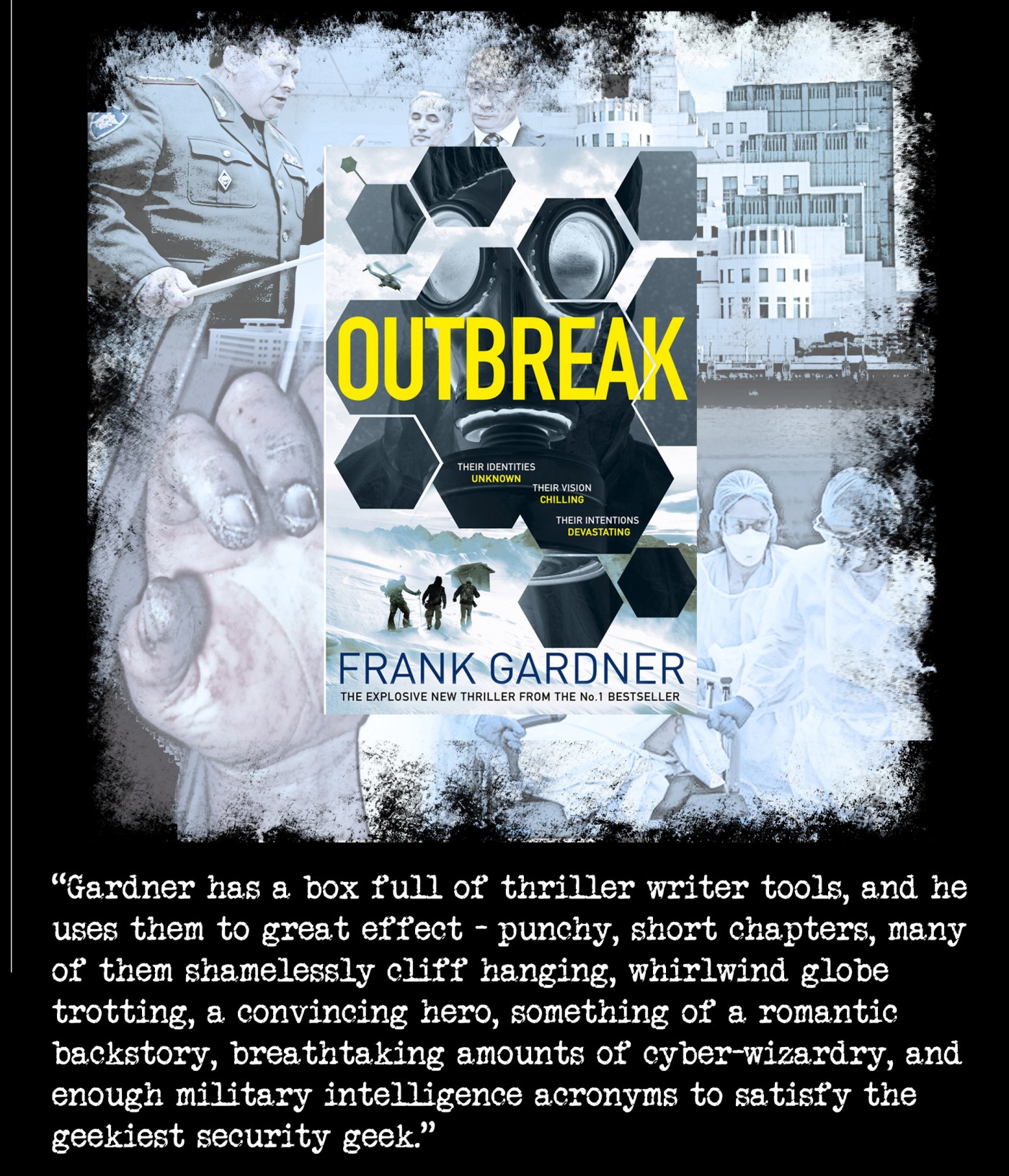
OUTBREAK by Frank Gardner

OutbreakFrank Gardner’s life has been like a thriller in itself. The former army officer had a glittering career in broadcast journalism until he narrowly escaped death at the hands of al-Quaida gunmen in Saudi Arabia. After numerous operations, he resumed his career withe BBC, albeit confined to a wheelchair. This is his third novel, coming after Crisis (2016) and Ultimatum (2018), and again features MI6 operative Luke Carlton. Carlton has his most desperate case yet, as he tries to get to the bottom of a terrifying contagion that seems to have its source in a desolate research station in the Arctic Circle. Outbreak is out in hardback on 27th May, and is published by Bantam Press.

THE FIRM by John Grisham

Firm019The author’s work has pretty much become the industry standard for legal thrillers, and this edition is the latest reprint of the book that made his name, way back in 1991. The cover looks like that of the 25th anniversary edition (2016) but with a different colour filter on the cover illustration. The novel tells the tale of a brilliant Harvard educated lawyer, Mitch McDeere, whose first job is a dream come true – especially with an astonishing salary, a new home, and keys to a gleaming new BMW. When he realises that Bendini, Lambert & Locke are little more than a front for the Mafia, he realises he is in deep, deep trouble. This will be available as an Arrow paperback on 1st April.

TO TELL YOU THE TRUTH by Gilly Macmillan

TTYTTLucy Harper is a best-selling writer of thrillers, whose talent for macabre invention and stunning plot-twists has earned her a small fortune and tens of thousands of devoted fans. What few of these readers know, however, is that when Lucy was just nine years old – thirty years ago – her brother mysteriously disappeared, and she was the only witness. The case was never solved, but now her husband Dan has also disappeared. What does Lucy know? Is this collision of past and present just a coincidence, or is there something more sinister going on? To Tell You The Truth came out in hardback in June 2020, but this paperback edition will be on sale (Arrow books) from 13th May.

THE HERETIC’S MARK by SW Perry

HereticsThe Nicholas Shelby books – known as  the Jackdaw Mysteries, after a London tavern –  are great fun, and rich in period drama and detail. Nicholas Shelby is a somewhat unorthodox physician in Elizabethan England, and he has dealings – somewhat reluctantly – with the Queen’s spymaster Robert Cecil. Here, Gloriana’s personal doctor has been executed for treason. Shelby and his wife Bianca are caught up in the wave of suspicion and conspiracy which follows, and are forced to flee to Italy before their necks are also on the axeman’s block. I have reviewed – and thoroughly enjoyed – earlier books in this excellent series, so click here for more detail.This latest ‘Mark’ will be available from 1st April, and is published by Corvus.

Footer

DEATH COMES TO NEWMARKET . . . A savage murder in Victorian Louth (3)

DCTN header

PART THREE

SO FAR – On the evening of Sunday 7th March, 1875, 22 year-old Louisa Hodgson is stabbed to death in the family home on Newmarket. Her killer, suitor Peter Blanchard, has been arrested and is awaiting trial at Lincoln Assizes.

It is worth, at this point – with Louisa dead and buried and Peter languishing in a prison cell – to examine the background – to the killing. It emerged during the investigation that all was not well between Louisa and Peter. While Mr Hodgson kept out of things, Louisa’s mother was beginning to frown on the relationship., partly because Peter Blanchard was subject to epileptic fits.

There is also the question of Peter Blanchard’s jealousy. Was there a rival for Louisa’s affections? At the inquest, evidence was given by John Campion:

“I am a farmer residing in Brackenborough Lane, Louth. I was at Mr. Hodgson’s house from eight to nine o’clock the previous evening. I saw Peter Blanchard there. He came into the kitchen to light his cigar. I left about 9 o’clock and when going out I could hear Blanchard and the deceased talking very loud. I thought I heard Blanchard say ” I will.” and the deceased burst out crying. I am a friend of the deceased’s brother and I had offered to keep company with her. I believe Blanchard was jealous of me and he had threatened to give me a good thrashing as he was going to chapel on Sunday night.”

The Spring Assizes at Lincoln was only a few days after the murder. The case was presented, but adjourned until the summer, to give more time for evidence to be gathered. The Summer Assizes opened at the end of July 1875 and, as usual, the jury was made up of men of ‘reputation and good standing.’

Trial

It might be thought that when Peter Blanchard came to take the stand, proceedings would have been relatively brief, given that there was little doubt that he had killed Louisa Hodgson. His defence team, however, lead by Mr Samuel Danks Waddy, knew that their only hope of saving Peter Blanchard from execution was to convince the jury that he was insane at the time of the murder, and so there was a long debate about the prisoner’s mental health. The jury eventually retired and returned with a verdict of ‘guilty’, but with a recommendation that Blanchard should be spared the hangman’s noose. Before the judge gave his verdict, Peter Blanchard was allowed to speak:

“My Lord and Gentlemen, – I have a few words to say. I did not not know what I was doing, or else I could not have done it. I loved her so much, and never believed it was true that I had killed her till I got one of her funeral cards, for I had never anything against her. I would take my place in hell if her dear soul might go to heaven, for I would at any time sooner suffer myself, than see her suffer. I should be thankful if you would give my parents my body to take to Louth, in order that I may laid by the side of my dear Louisa. I wish to give one word of advice to you. my dear young friends, both men and women. You have come here to see me. and hear sentence passed upon me. Keep out of bad company. That was my ruin. My first failing was that I was soon persuaded to smoke ; from that I got to drinking and then to gambling, and then to neglect to go to a place of worship. Then I lost my senses at times, and then the fits came on. Let this be warning to you all. Look to Jesus, or some of you may be standing where I am next year. And if parents would look after their own families they would find plenty of work, without looking after others. After naming a man who. he said, had caused him many restless nights, the prisoner continued : I pray to God that this may be a warning to you all, and I hope my Heavenly Father will permit me to meet you all in heaven, to part no more. I shall soon be in heaven, and I am sure to meet my dear Louisa there. Young and old. come to Jesus, for he will help you in the time of trouble. Good bye to you all.”

Mr Justice Lindley was not empowered, to be merciful, however, and was only able to put Peter Blanchard’s fate in the hands of the Home Secretary:

Verdict

Screen Shot 2021-03-22 at 19.36.24Sadly for Peter Blanchard and his family, the Home Secretary, Richard Blanchard Cross (left), was not inclined to be merciful, and Peter Blanchard was executed on Monday 9th August 1875. This newspaper report tells the melancholy story:
“Peter Blanchard, a tanner, of Louth, Lincolnshire, was executed yesterday morning at Lincoln Castle for the murder of Louisa Hodgson at Louth in March last. The prisoner was examined by Dr. Briscoe on Friday, by order of the Home Secretary, with the view of ascertaining whether the jury’s recommendation to mercy, on the ground of his mind having been weakened by fits, could be acted upon. The result, however, was unfavourable to the prisoner, and the law was allowed to take its course. The crime for which Blanchard was executed was committed in a fit of jealousy arising out of a love affair. The young woman whom he was courting disregarded his attentions, nor was he looked upon favourably as a suitor by her parents. On Sunday evening, the 7th of March, she was accompanied to church by a young man, and on returning home they were met by Blanchard, who walked the remaining distance with her. When he took his departure she went to the door with him, and he suddenly drew out a knife and stabbed her to the heart, death being instantaneous. He then left and called on a neighbour, to whom he said, “I have done it.” Since his conviction Blanchard has slept well, and has been most attentive to the ministrations of the clergyman daily. On Saturday he had a final interview with his father and mother, his four brothers, and a friend. He acknowledged the justice of his punishment, and stated he had no wish to live. He averred that he did not know at the moment what he was doing when he committed the deed. Yesterday morning he was quite resigned to his fate, and walked unsupported to the gallows. He shook hands with the gaol chaplain and officials, and the last words he was heard to utter were, “Good-bye, my dear fellows; I am quite re- signed, and hope to meet you all in heaven.” He slept well on Sunday night, rose at six yesterday morning, breakfasted at seven, and wrote a short letter to his parents and brothers. He died almost without a struggle. Mr Marwood was the executioner.”

PAST TIMES – OLD CRIMES . . .The Little Man From Archangel by Georges Simenon

Screen Shot 2021-03-06 at 19.19.52

Was Georges Simenon the greatest ever Belgian? He was certainly the most prolific both in his literary output and his apparently inexhaustible sexual appetite. Best known for his Maigret novels and short stories, he also wrote standalone novels. One such was Le Petit Homme d’Arkhangelsk, first published in English in 1957. This new edition, translated by Siân Reynolds (who is the former Chair of French at the University of Stirling) is, like most of Simenon’s books short – just 185 pages – but as powerful a story as he ever wrote.

Little man016

Little man013We are in an anonymous little town in the Berry region of central France, and it is the middle years  of the 1950s. Jonas Milk is a mild-mannered dealer in second hand books. His shop, his acquaintances, the café, bar and boulangerie he frequents are all like spokes of a wheel, and the hub is the bustling Vieux-Marché. Jonas appreciates his neighbours, such as Le Bouc behind the counter in his bar, Gaston Ancel the butcher, with his booming voice and bloodstained apron, and the Chaignes family in their grocery shop. Jonas values these people or, to be more precise, he values their acceptance of him, because he is an outsider. Sure, he has been in France since he was a small boy, his family – from the port on Russia’s White Sea coast – having sought refuge in France during the Revolution. They have all returned to their homeland, and Jonas does not know if they are alive or dead. He is also a Jew, but because of his fair hair and complexion he survived the attention of the Nazis during the Occupation.

Little man014 copyJonas Milk has a wife. Two years earlier he had converted to Catholicism and married Eugénie Louise Joséphine Palestri – Gina – a voluptuous and highly sexed woman sixteen years his junior. No doubt the frequenters of the Vieux-Marché have their views on this marriage, but they are polite enough to keep their opinions to themselves, at least when Jonas is within earshot. But then Gina disappears, taking with her no bag or change of clothing. The one thing she does take, however, is a selection of a very valuable stamp collection that Jonas has put together over the years, not through major purchases from dealers, but through his own obsessive examination of relatively commonplace stamps, some of which turn out to have minute flaws, thus making their value to other collectors spiral to tens of thousands of francs.

Gina has had her flings before, though, seeking physical excitement that Jonas does not provide. He has born his shame in silence, and it has never occurred to him to challenge her. This time, however, when he makes his morning purchases – his croissants, his cup of espresso – and is asked where Gina is, he makes a fatal mistake. Perhaps through embarrassment, or irritation perhaps, he tells a small lie.

“As a rule, Gina, in bedroom slippers, often with her hair uncombed, and sometimes wrapped in a flowery dressing gown, would do her shopping early on market days, before the crowd.
Jonas opened his mouth and it was then that, in spite of every instinct telling him not to, he changed the words he was going to say.
“She’s gone to Bourges.”

Four words. Each of them harmless on its own, but together, something entirely different . What happens next is a masterpiece of brilliant storytelling, as in just a few days, the world of Jonas Milk begins to unravel. Simenon’s ability to describe profound events while framing them with little inconsequential moments of observation – a blackbird pecking at crumbs in a back garden, a café owner turning his face away from the steam of his coffee machine, a wife not cleaning up the frying pan after cooking herrings – is astonishing.

You will probably read this book in a couple of sessions. Yes, it’s a short book, anyway, but my goodness, what an impact it makes. The Little Man From Archangel is published by Penguin Modern Classics, and is out on 1st April.

DEATH COMES TO NEWMARKET . . . A savage murder in Victorian Louth (2)

DCTN header

PART TWO

SO FAR – On the evening of Sunday 7th March, 1875, 22 year-old Louisa Hodgson is stabbed to death by a man – Peter Blanchard – who had been courting her for four years. She dies almost instantly after Blanchard’s knife pierced her heart. The pair had been together in the sitting room of Louisa’s family home at 29 Newmarket (below) Blanchard has fled the scene.

Painting

William Turner, a dealer in poultry, lived with his wife Emma in their small house in Vickers Lane. It was 10.30pm, Emma Turner had gone to bed, and William had locked the house up and was preparing to join his wife, when he heard someone trying the front door. He went to investigate, and found Peter Blanchard. Blanchard was clearly in a state about something, and asked if could come in. Turner’s evidence continued as follows:

“He asked if I would give him some whisky. I said my wife had gone to bed, but I would call her down and see if we had such a thing in the house. She came down and said we had not She gave him glass of brandy instead. He said, “I have done It”. I told my wife to take the bottle away and give him no more.

I said, “Done what Peter ?” At first he made no reply, but on my again asking him, he said, “I have stabbed the missus.” These were his exact words. I said, “What with ?” and he replied, “With a butcher’s knife. If I had not done it with a butcher’s knife I should have done it with this, putting his hand into his pocket and pulling out a razor. He put it back into his pocket. He first opened and shut it again. He was very excited and irritable. I could not say he was drunk. He had the use of his limbs as well as I have mine now.

My wife prevailed upon him to take the razor from his pocket and give to me. I told my wife to call my son to fetch Peter’s father and mother, and also to go to Mr. Hodgson’s and inquire what it meant. On my son’s return he said “She is dead.”

Town Map
Locations

The Hodgsons had already sent for the police, and Sergeant Wilkinson and Superintendent Roberts were at the scene when 16 year-old Thomas Turner arrived. He immediately informed the officers that Peter Blanchard was at the house in Vickers Lane. When Wilkinson and Roberts arrived, there was a scene of complete confusion. There were several members of the Blanchard family in the house, as well as the Turners and their five other children. Superintendent Roberts then arrested Blanchard. This was his evidence:

“On my seizing the prisoner he said, “I’ll go”. I’ll go without the handcuffs”.
He then said, “Is she dead?
I said, “Yes she is, and you are charged with killing her, but keep yourself quiet”.
He was a in a very excited state. He answered me:
It’s a good job, and I’m glad.”
We then brought him to the police-station, where I told him he would be detained on a charge of wilful murder. To this be said ,
“Oh, I did it and I’ll die like a man for her.”

I told him that what he said would be taken down and given in evidence against him.  I  cautioned him and expressly warned him that whatever said would be taken down and produced against him. I did not put any questions to him. The exact words I used were these, when he was in the cell:
“When I told you that you would be charged with this serious offence, I did not know for a certainty the girl was dead. You will be charged with the wilful murder of Louisa Hodgson”’
He then said: “Is she dead?” and on my replying, “I have already told you so” he said:
“God bless her.”
He was undoubtedly under the influence of drink; but my impression was that be knew well what he was doing.”

New map

At the Magistrate’s Court the next morning, Monday 8th March, Dr Higgins gave his account of Louisa’s injuries:

“I am a registered medical practitioner, practising in Louth. I was sent for to see Louisa Hodgson at about a quarter past ten o’clock. I went at once and found her dead. I saw a wound on the chest but did not then make further examination. This morning I made a post mortem examination. The wound was situated about half an inch below the nipple of the left breast. It was an incised wound about one inch in extent. I traced the wound which had penetrated the chest wall between the fourth and and fifth ribs, passed through the interior margin of the upper lobe of the left lung, and entered the left auricle of the heart.

I found a considerable quantity of blood effused into the pericardial and pleural sacs. The wound was sufficient to cause death rapidly, almost instantaneously. The heart would only beat a few seconds after it was inflicted.

I believe the knife produced would produce a similar wound to one described. It might have penetrated four inches.”

Blanchard had thrown away the murder weapon (a butchers’ knife) but it had been recovered in Aswell Street. He had taken the knife from his landlady’s kitchen. The magistrates committed Blanchard to be tried for murder at the next Assizes in Lincoln.

Louisa Hodgson was laid to rest in Louth Cemetery on Wednesday 10th March.

Funeral

In PART THREE – trial and execution

DEATH COMES TO NEWMARKET . . . A savage murder in Victorian Louth (1)

DCTN header

PART ONE

It is March 1875. Mr Disraeli is the Prime Minister, and in Louth, local architect James Fowler is Lord Mayor. At No. 29 Newmarket lives agricultural blacksmith John Hodgson, his wife Jane and their large family. Elder son Charles has moved out but there are still seven other young Hodgsons at home, the oldest being Louisa, aged 22.

For the last four years, Louisa has been courted by a young man called Peter Blanchard, aged 25, the elder of another large family who live at 29 Charles Street. Peter’s father, Peter senior, with whom he works was described as a fellmonger, an old word for someone who deals in animal skins. Peter the younger had moved out of the family home and was living in town with a woman called Mrs Baker who kept a lodging house on Eastgate.

Photograph of Free Methodist Church, Eastgate, Louth, Lincolnshire [c.1930s-1980s] by John Piper 1903-1992


The Hodgson family were devout churchgoers, and their chosen place of worship was the imposing Free Methodist church on Eastgate (above). This had been built in the 1850s after the so-called ‘Free’ Methodists split from the mainstream Wesleyan church. On the evening of Sunday 7th March, the Hodgson family attended the evening service in Eastgate. Peter Blanchard was standing across the way from the church, outside Mrs Baker’s house, and he came over to talk to Louisa but did not join them when they went into the church. At about 7.45 pm, the family left the church, to find Blanchard waiting for them. Mr and Mrs Hodgson went to visit friends in the town but Louisa, Blanchard and the two younger Hodgson girls – Alice and Harriet – walked up the hill to Newmarket.

Mr and Mrs Hodgson returned home at 9.15, along with another young man called John George Campion, a farmer who lived on Brackenborough Road. Louisa and Blanchard were  together in the sitting room, but the rest of the family were in the kitchen. Contemporary newspaper reports can do a much better job of describing what happened next that I can. These were the words of John Hodgson:

Body text1

In PART TWO – an arrest and a funeral

Blood Runs Thicker . . . Between the covers

BRT HEADERThis is the eighth book in a very popular series set in 12th century Worcestershire. I am a latecomer to the party, but I thoroughly enjoyed the previous book River of Sins, and you can read my review by clicking this link. Now, Under-Sheriff Hugh Bradecote and his grizzled ally Serjeant Catchpoll – along with apprentice lad Walkelin – investigate the murder of an irascible and little-loved nobleman, Osbern de Lench.

The late man had a habit of sitting on his horse atop a small hill near his house and gazing at his land. It was said that doing so calmed him down when he was in one of his more wrathful moods. On the fateful day the horse comes back alone and a search party finds de Lench stabbed to death. His family was certainly not a happy one. Baldwin, his son by his first wife (who died in a mysterious riding accident) has the same choleric temper as his father. There is a second son – the result of de Lench marrying again, but Hamo is very different from his half brother. He is studious and solitary and probably has what we now call Asperger’s Syndrome.

BRT DIVIDER

Incidentally, there are three real-life villages near Worcester which rejoice under the names Church Lench, Ab Lench and Rous Lench, but I believe Osbern de Lench exists only in Sarah Hawkwood’s vivid and blessed imagination. Back to the novel, and Bradecote & Catchpoll learn that de Lench had ‘history’ with other local landowners, but was this enough to link any of them to his death? And was Fulk, the family Steward providing home comforts to Lady de Lench, a woman not unused to being roughly dealt with by her husband? The seemingly pointless murder of Mother Winflaed, a harmless woman who ministers to the villagers with her herbal knowledge – and also delivers its babies – only adds to the confusion.

The ingredients that make up the chemistry between the three investigators is cleverly worked. Young Walkelin is callow, but clever and inquisitive, while Catchpoll’s world-wearness is an excellent counter balance to Bradecote’s more lofty idealism.

By no means is this a preachy or political novel, but Sarah Hawkswood has some pertinent points to make – via Hugh Bradecote – about the treatment and role of women, and the very real perils of childbirth. As a man of advanced years I can find much to moan about in current society, but modern obstetrics (at least in the western world) is something for which we should all be eternally grateful.

I am very much an amateur book reviewer, and there are probably hundreds of us who love to read, and are grateful for publishers and publicists who trust us to deal fairly with the books they send us. One of the downsides is that there is always a To Be Read pile, with deadlines to meet, and little chance to sit back and read purely for pleasure. I am determined, however, to find time to catch up with the previous books in this series. If they are all as good as this one, then my time will not be wasted

 This novel is thoroughly immersive and the blend of classic whodunnit, gritty historical detail and the sense of a glorious landscape now all but vanished is utterly beguiling. Blood Runs Thicker is published by Allison & Busby, and is available now.

Blog at WordPress.com.

Up ↑