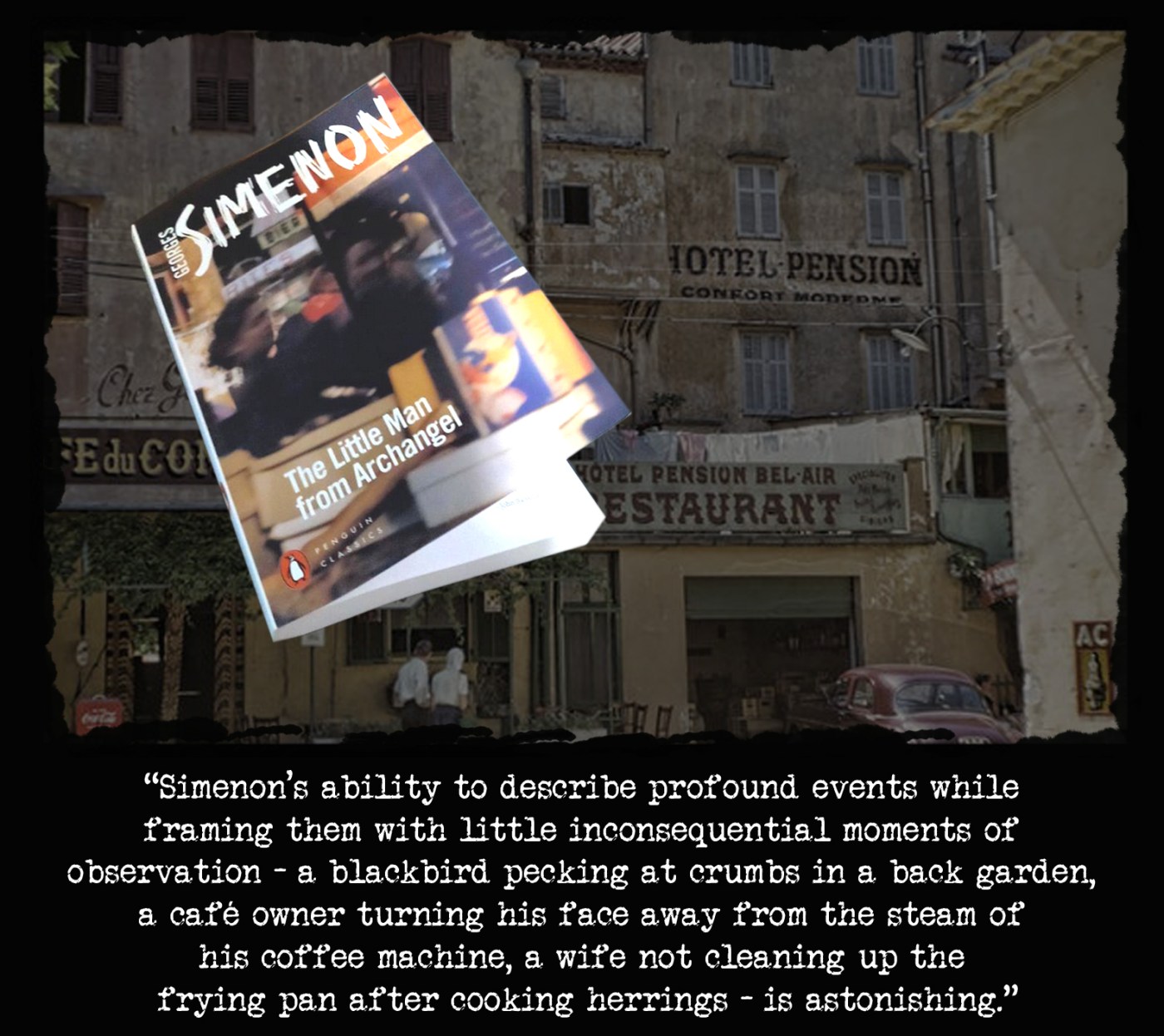

Was Georges Simenon the greatest ever Belgian? He was certainly the most prolific both in his literary output and his apparently inexhaustible sexual appetite. Best known for his Maigret novels and short stories, he also wrote standalone novels. One such was Le Petit Homme d’Arkhangelsk, first published in English in 1957. This new edition, translated by Siân Reynolds (who is the former Chair of French at the University of Stirling) is, like most of Simenon’s books short – just 185 pages – but as powerful a story as he ever wrote.

 We are in an anonymous little town in the Berry region of central France, and it is the middle years of the 1950s. Jonas Milk is a mild-mannered dealer in second hand books. His shop, his acquaintances, the café, bar and boulangerie he frequents are all like spokes of a wheel, and the hub is the bustling Vieux-Marché. Jonas appreciates his neighbours, such as Le Bouc behind the counter in his bar, Gaston Ancel the butcher, with his booming voice and bloodstained apron, and the Chaignes family in their grocery shop. Jonas values these people or, to be more precise, he values their acceptance of him, because he is an outsider. Sure, he has been in France since he was a small boy, his family – from the port on Russia’s White Sea coast – having sought refuge in France during the Revolution. They have all returned to their homeland, and Jonas does not know if they are alive or dead. He is also a Jew, but because of his fair hair and complexion he survived the attention of the Nazis during the Occupation.
 Jonas Milk has a wife. Two years earlier he had converted to Catholicism and married Eugénie Louise Joséphine Palestri – Gina – a voluptuous and highly sexed woman sixteen years his junior. No doubt the frequenters of the Vieux-Marché have their views on this marriage, but they are polite enough to keep their opinions to themselves, at least when Jonas is within earshot. But then Gina disappears, taking with her no bag or change of clothing. The one thing she does take, however, is a selection of a very valuable stamp collection that Jonas has put together over the years, not through major purchases from dealers, but through his own obsessive examination of relatively commonplace stamps, some of which turn out to have minute flaws, thus making their value to other collectors spiral to tens of thousands of francs.
Gina has had her flings before, though, seeking physical excitement that Jonas does not provide. He has born his shame in silence, and it has never occurred to him to challenge her. This time, however, when he makes his morning purchases – his croissants, his cup of espresso – and is asked where Gina is, he makes a fatal mistake. Perhaps through embarrassment, or irritation perhaps, he tells a small lie.
“As a rule, Gina, in bedroom slippers, often with her hair uncombed, and sometimes wrapped in a flowery dressing gown, would do her shopping early on market days, before the crowd.
Jonas opened his mouth and it was then that, in spite of every instinct telling him not to, he changed the words he was going to say.
“She’s gone to Bourges.”
Four words. Each of them harmless on its own, but together, something entirely different . What happens next is a masterpiece of brilliant storytelling, as in just a few days, the world of Jonas Milk begins to unravel. Simenon’s ability to describe profound events while framing them with little inconsequential moments of observation – a blackbird pecking at crumbs in a back garden, a café owner turning his face away from the steam of his coffee machine, a wife not cleaning up the frying pan after cooking herrings – is astonishing.
You will probably read this book in a couple of sessions. Yes, it’s a short book, anyway, but my goodness, what an impact it makes. The Little Man From Archangel is published by Penguin Modern Classics, and is out on 1st April.


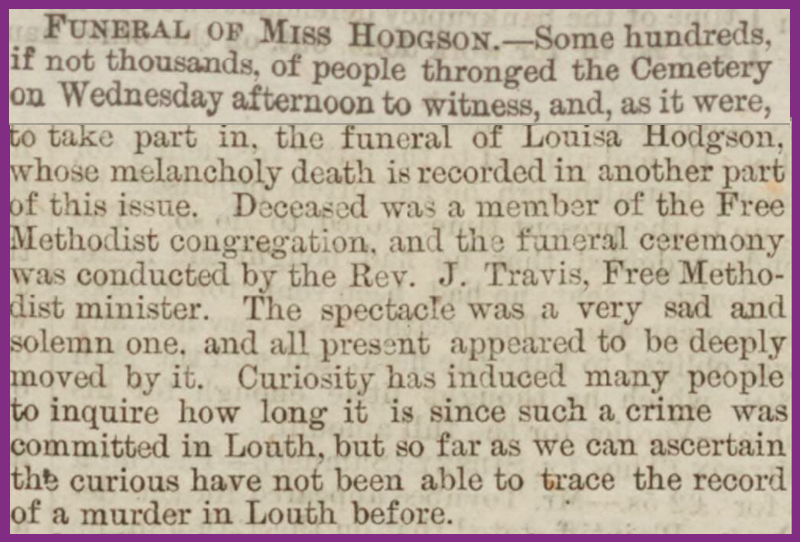
![Photograph of Free Methodist Church, Eastgate, Louth, Lincolnshire [c.1930s-1980s] by John Piper 1903-1992](https://fullybooked2017.com/wp-content/uploads/2021/03/chapel-copy.jpg)




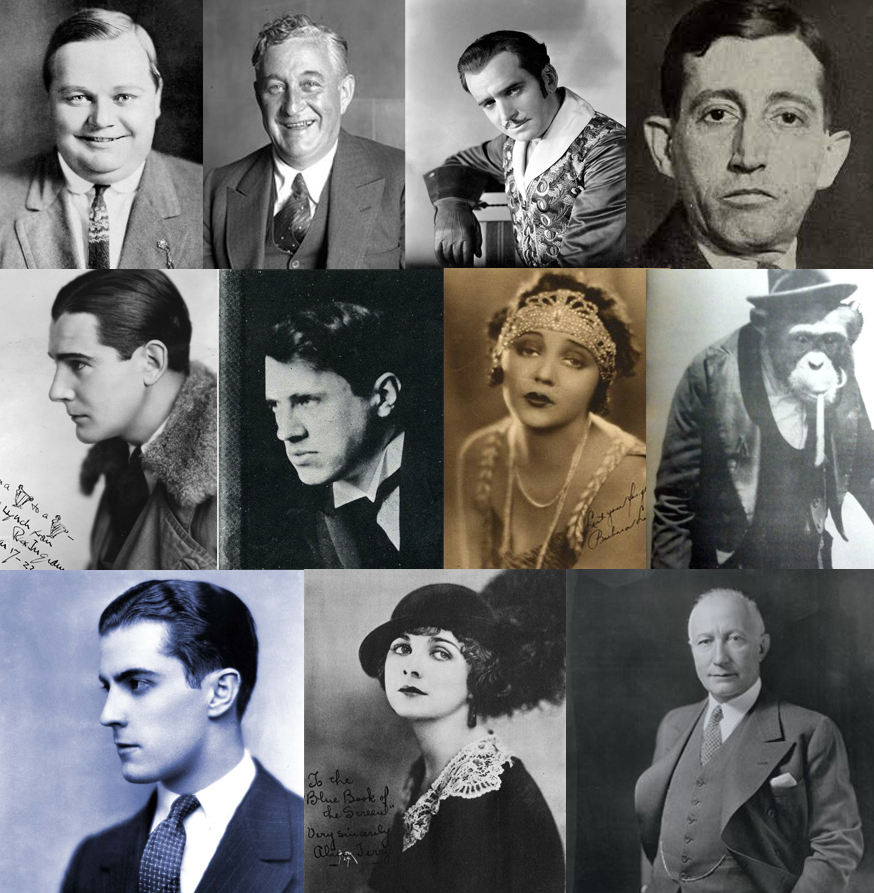
 Former city cop Collins has earned a reputation among movie producers and stars as a man who gets things done, but in a discreet way, and here he becomes involved in getting to the bottom of a nasty blackmail case involving one of Hollywood’s rising stars. José Ramón Gil Samaniego is a young man who was to become better know as Ramon Novarro, star of many hit movies, and an heir to the throne of screen heart-throb vacated by Rudolf Valentino after his untimely death. O’Donovan peoples his story with actual real life characters as far as possible, and it is a winning formula. Samaniego is in trouble because there are intimate photographs of him taken a notorious club for homosexuals. Both he and his studio bosses are desperate that these photos and the negatives are found and destroyed.

 In a sappingly hot Indian Summer in central London, Dr John Watson is sent – by a relative he hardly remembers – a mysterious tin box which has no key, and no apparent means by which it can be opened. Watson and his companion Sherlock Holmes have become temporarily estranged, not because of any particular antipathy, but more because the investigations which have brought them so memorably together have dwindled to a big fat zero.
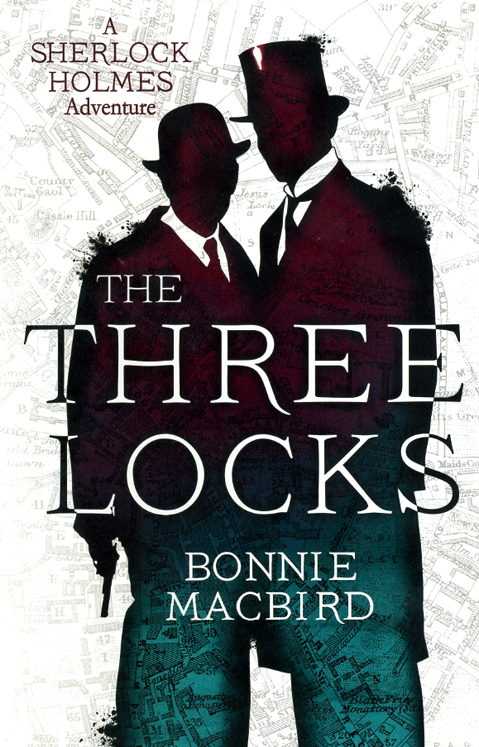 But then, in the space of a few hours, Watson shows his mysterious box to his house-mate, and the door of 221B Baker Street opens to admit two very different visitors. One is a young Roman Catholic novice priest from Cambridge who is worried about the disappearance of a young woman he has an interest in, and the second is a voluptuous conjuror’s assistant with a very intriguing tale to tell. The conjuror’s assistant, Madam Ilaria Borelli is married to one stage magician, Dario ‘The Great’ Borelli, but is the former lover of his bitter rival, Santo Colangelo. Are the two showmen trying to kill each other for the love of Ilaria? Have they doctored each other’s stage apparatus to bring about disastrous conclusions to their separate performances?

 CLICK ON ANY TAG AND THE CONTENT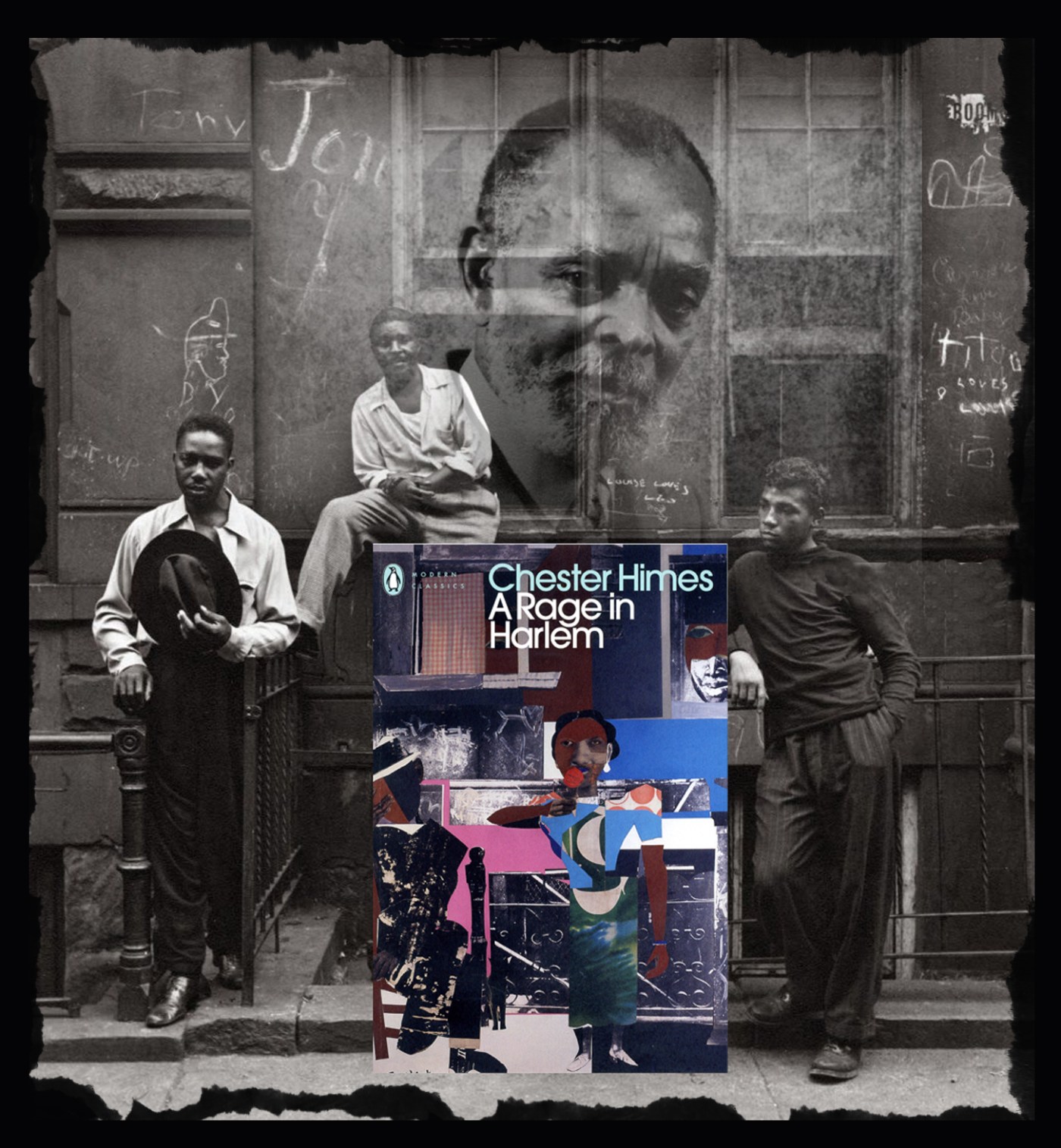
 Chester Himes was born into a middle-class family in Jefferson City, Missouri, in 1909. His parents both worked in education. When Himes was 12, his brother was blinded in an accident, and was denied treatment by the Jim Crow Laws (extensive segregation in all public services) and this shaped the way Himes viewed American society at the time. The family moved to Ohio, and after his parents divorced, Himes fell among thieves and in 1928 took part in an armed robbery, for which he was sentenced to 25 years hard labour. In prison, he began to write feature stories and articles for magazines. In 1936 he was released into the custody of his mother and, while working dead-end jobs, he continued to write. He moved to Los Angeles in the 1940s to write for movies but again, he felt the heavy hand of racial discrimination. He finally gave upon America, and moved to Paris in the 1950s. He never returned to America and died in Spain in 1984.
 Rage In Harlem is a very angry book, and the psychological scars borne by Himes are unhealed and very near the surface. There is a solid core of what appears to be slapstick comedy, but it is brutal, surreal and venomous. The mother of all car chase takes place when Jackson – an undertaker’s chauffeur – steals a hearse to shift what he thinks is a trunk full of gold ore (another scam). He is unaware that it also contains the dead body of his brother who, by the way, makes a living by dressing as a nun and soliciting alms while reciting bogus quotations from The Book of Revelations:


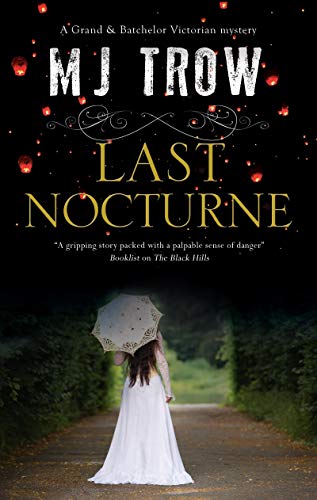 Grand & Batchelor are private investigators based in 1870s London and – much to the relief of James Batchelor, who is a terrible traveller – Last Nocturne has its feet securely on home soil. Grand is from a wealthy New England family, and fought bravely for the Union in The War Between The States, while Batchelor is a journalist by trade. Murder – what else? – is the name of the game in this book, and the victims are, you might say ‘on the game’. Cremorne Gardens were popular pleasure gardens beside the River Thames in Chelsea, but after dark, the ‘pleasure’ sought by its denizens was not of the innocent kind. ‘Ladies of the Night’ are being murdered – poisoned with arsenic – but the killer doesn’t interfere with them, as the saying goes, but instead leaves books by their dead bodies.


 fullybooked2017