1900
The 1891 census reveals that living in Alvingham was a family headed by Henry Mason. Henry Mason was not destined to survive until the next census. On 1st June 1900, The Lincolnshire Chronicle reported:
“An inquiry was held at the Iron Bridge House, Alvingham, on Saturday by the Deputy-Coroner touching the death of Henry Mason, a carrier and cottager, aged 48 years, whose body was found in the Louth Canal, in tbe parish of Alvingham, early that morning. Mr. George Bett was foreman of the jury. The deceased had been a healthy and strong man to last September, when he developed mental trouble and in consequence of then attempting suicide he was removed to the county Asylum. Having spent three months in this institution be had sufficiently recovered to justify his discharge, and he returned home and followed his occupation. On Thursday Dr. Higgins, of Louth, was called in to advise as to his bodily more than mental condition, several boils having broken out. He then seemed a little depressed, and complained of not sleeping well, but in other respects the doctor could not detect any mental trouble. He, however, impressed upon the family the importance of keeping an eye upon him for fear of the return of a fit of depression. The deceased continued to go about his work as usual, and on Saturday morning he intimated that as the man and boy were busy he would go and shepherd, which he had done alone before that week. The sheep were in a field near the canal, and as he did not return for some time search was instituted, with the result that the body was found in the canal. The jury returned a verdict of ‘Suicide whilst of unsound mind.'”
1909
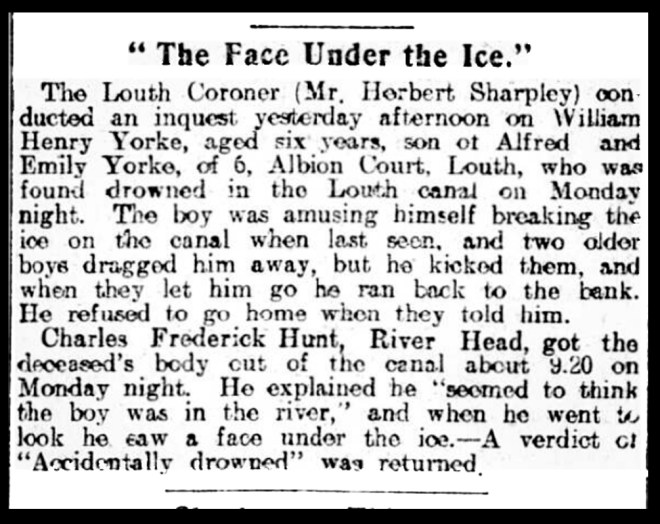
 The freezing weather at the beginning of 1909 – and the resulting ice – drew people to the canal, with fatal results. The wording used by The Sheffield Evening Telegraph, ‘The Face Under The Ice’ is horrifyingly graphic as it headed up a report on an event which occurred on Monday, 25th January.
Hard on the heels of this was the tragic death of Ida Brewer, which I featured in Part One of this story. Click this link and scroll down the page for the full story.
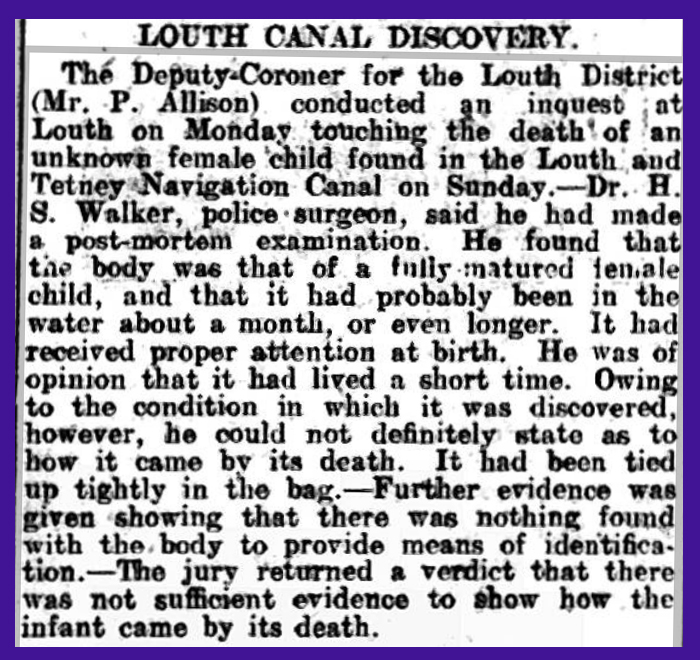
Better weather, as was natural for June, but the canal was still doubling as a mortuary. In this case, no-one knew if it was a case of murder, or a matter of illegally disposing of a body. The only certainty is that it wasn’t suicide.
1910
The North Lincolnshire Advertiser of Saturday 26th march carried this sombre report:
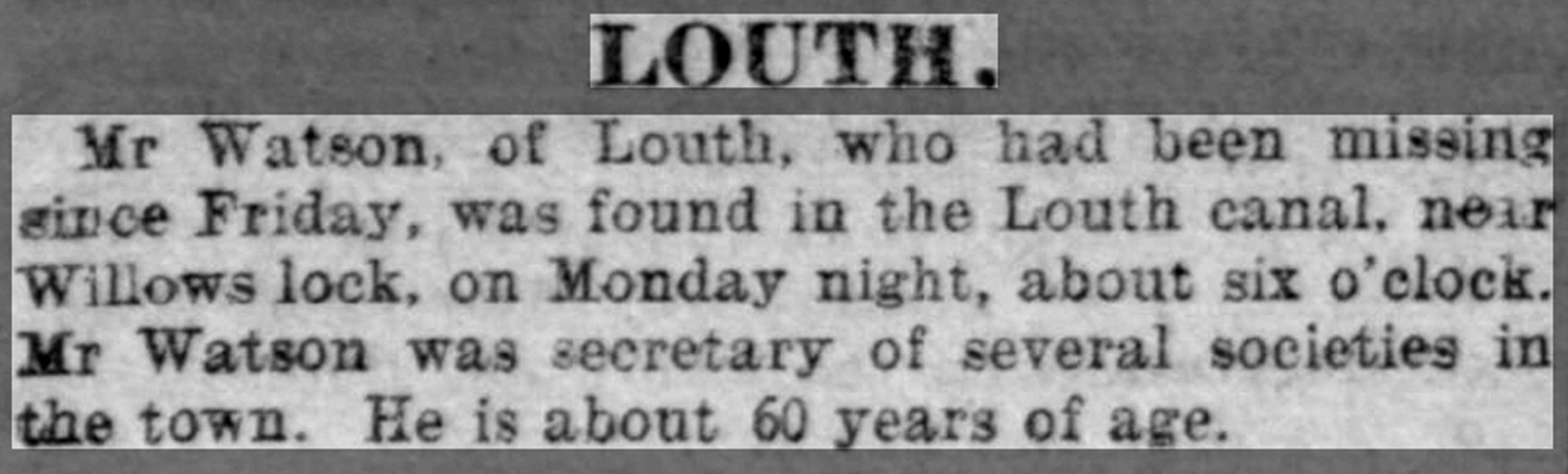
“The body of Charles Dobbs, aged 65, of Kidgate, Louth, formerly a farm foreman and subsequently a carrier at Swaby, was recovered from the Louth Canal on Monday afternoon, under circumstances pointing to suicide. An inquest was conducted by the Coroner for the Louth District (Herbert Sharpley, Esq.) at the Woolpack Inn on Tuesday afternoon.
The Coroner said when the jury had heard the evidence be thought they would come to the conclusion that deceased put himself into the water, and that he did not get there by any accidental means. Wm. Ashton, shoemaker, said he had lodged with the deceased for about six months. Deceased had a complaint which troubled him very much, and he had been very upset the last few days. He said there was no help for him since Dr. Higgins’ death. He had his dinner with witness the previous afternoon, and when witness remarked to him that he did not seem to be enjoying his dinner, deceased said ” must die ; it will kill me, the pain at the back of my head.’
Witness was not surprised when he heard afterwards what hail occurred, although he had never heard deceased threaten to take his life. John Melton, employed by Mr. White, coal merchant, said he was with his employer in Thames Street the previous afternoon about a quarter past one, and met deceased about thirty yards from Harvey’s yard gate. Witness spoke to him and deceased replied. About three quarters of an hour afterwards Mr. Harvey called him, and witness assisted get deceased out of the water. Joseph Harvey said he left his wharf a little after twelve the previous day, and returned about a quarter-past one. He went into the office, and came out again about a quarter-past two.
A young man named Finney called his attention to a coat hanging on the crane, and when witness examined it he found an envelope the pocket with ” Charles Dobbs, Louth,’ written on it. He looked in the water and noticed something, and, although be could not reach it with the boat hook at first, the wind shifted it, and he was able to get it to the side. Mr. W. R. Higgins said deceased was subject attacks which were attended by mental depression. He was one of his late father’s oldest patients, and was greatly attached to him. Witness was not surprised when he heard what had occurred. He thought his trouble had temporarily unhinged hi.s mind. The Foreman said thirty-five years ago deceased told him that he thought the pain would drive him mad. A verdict of suicide whilst of unsound mind was returned.”
1913
From the Sleaford and South Lincolnshire Advertiser, 25th October. The sub heading was probably made up ready and put to one side due to its frequent usage.

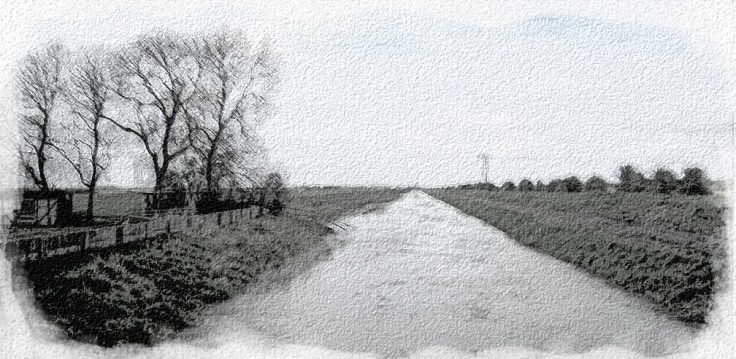
“An inquest was held on Monday at Louth on the body of an unknown man. apparently 23 of years of age which was found in the Louth Canal near Fulstow Bridge on Sunday. On October 10th a man who lives at Thoresby Bridge found a cycle on the canal bank and took it to the police. No trace of the owner could be found. On Sunday morning the body of the man was recovered. There were cycle clips in his pockets and tools, which led to the belief that be was a mechanic. There was, however, nothing to identify the body. A witness said he did not think the deceased fell into the water, owing to the way in which the cycle was lying. The deceased was wearing a black coat and vest, light cord trousers with a pair of boots marked “The Yorkshire Hero,” nearly new. A verdict of ‘Found drowned” was returned.”
1915
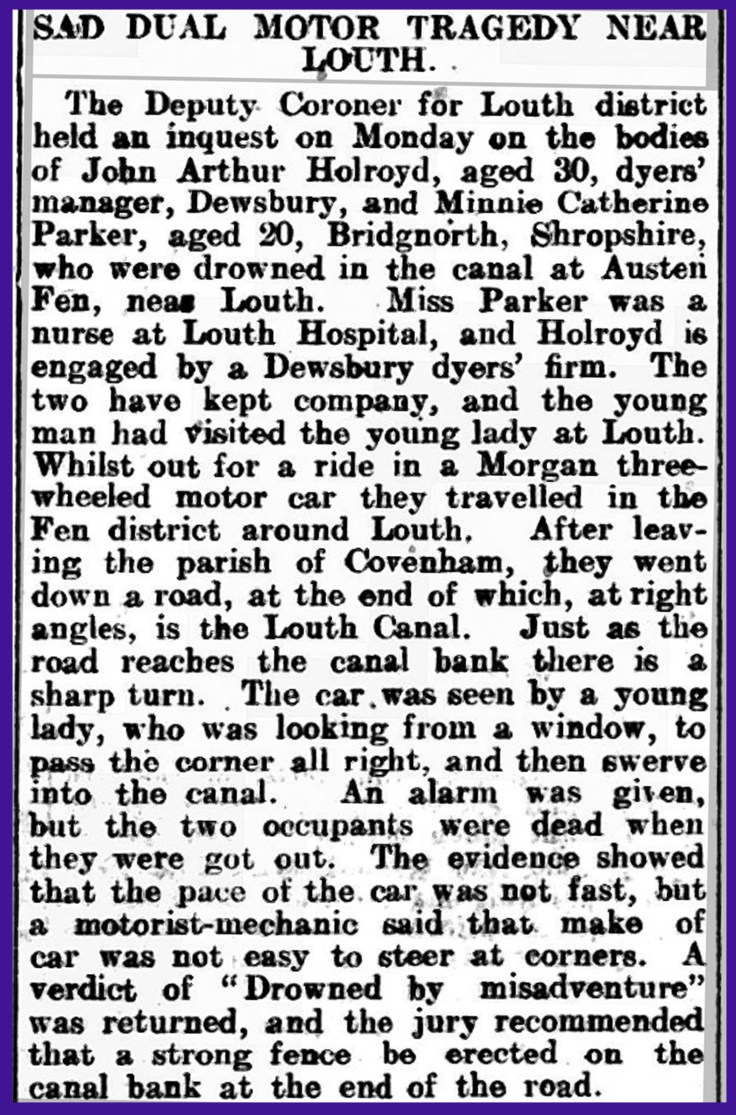
A new century, and a new way for people to kill themselves

1923

With a slightly disrespectful subheading, the Halifax Evening News reported the sad death of a seven year-old boy:
“Well-known Minister’s Son Drowned. On Saturday afternoon, Bernard Spurr, aged seven, younger son of the Rev. F. C. Spurr, the well-known Baptist minister and author, of Edgbaston, Birmingham, was drowned in the canal near Louth. He was on a visit to his grandparents, Ald. and Mrs. F. Thompson, of Louth, and went for a walk with two other small boys. When near a bathing pool, formerly a dry dock, in the canal, he took off his boots, and said he would walk along a plank which was suspended by chains over the pool, and is used as a diving board. As he was walking across the plank overbalanced, and the lad was thrown into the water. A man named Wray attempted to get the lad out, but was unable to do so until some of the water had been run off. P.C. Cook tried artificial respiration for 2O minutes, but the lad did not recover.”
1931

The Hull Daily Mail, on Tuesday 25th August, reported:

1938
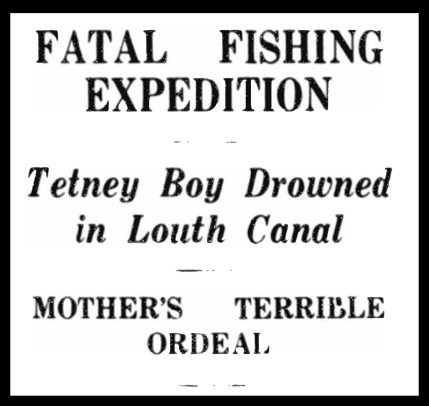 This tragic story, from the Louth Standard of Saturday 13th August, is made even more macabre by the fact that it attracted a huge crowd of spectators:
“After her son had been missing for twenty-eight hours and the police had dragged the canal at Riverhead unceasingly, a Tetney mother arrived on the scene at the tragic moment when the body her seven-year-old child was being dragged from the water. Scores of Louth people, mostly women, were on the canal banks as the child?s body was brought to light, and their gay dresses and the blazing sunshine made a strangely unreal setting to the tragedy that was revealed.
The victim of the tragedy was seven year-old John Tyson, son of Mr. and Mrs. Tyson, of Bishopthorpe, Tetney. He had been staying at 117. Eastfield Road. Louth, with his married sister. Mrs. Kirkby. It is understood that after dinner on Tuesday, which was to have been the last day of his holidav. the lad went out to the canal behind the house, telling his sister that it would not be long before he was back, as he was only going to fetch a jam jar which he had left at the side of the canal when he had been fishing before.
But he did not return either in a few minutes or a few hours even, and in the evening they notified the police. The police at once searched the canal banks, but could find no clue, and the fact that neither the lad’s cap nor his jam jar could be found led them to believe that the lad might have strayed. However, from midnight until about 1.30 on Thursday, the police dragged the canal behind the house, but without success.
Dragging operations were recommenced at 9 a.m. Later in the morning a search was also made in Hubbard?s Hills and a huge crowd of men. armed with sticks, walked through reeds and shallow water in lower reaches of the canal, working on the theory that the lad might have been wading in the shallow water and fallen down.
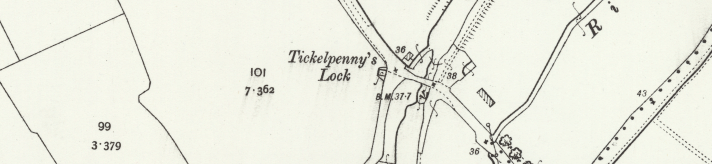
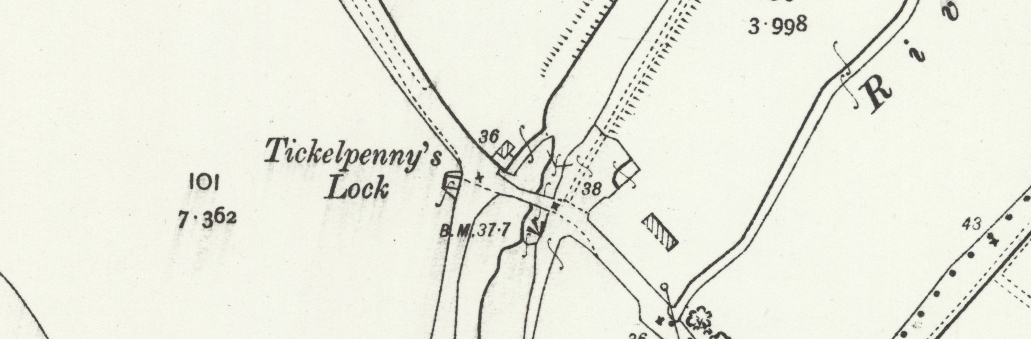
In the afternoon a big crowd gathered to see the police continue their search, which embraced the canal from Riverhead to Ticklepenny’s lock. The lock gates at the top of the canal were opened for the first time for many years ir an attempt to lower the level of the water at the places where it was thought that the lad might have fallen.
Later, the police worked their way back to the starting place, just behind the house where the lad had been staying, and it was here that the body was found at a quarter to four.
P.C. Storr was stirring the mud at the side of the canal with a grappling iron, when he touched the body, which rose immediately, and was fetched out of the water by another constable.
To add to the tragedy, the boy’s mother arrived on the scene at the fatal moment. She collapsed immediately and had to be carried indoors. A few minutes later, the boy’s father, who had stationed himself further down the canal, arrived at the scene and performed the sad act of identification.”
I am sure there were more suicides and more fatal accidents after the tragic death of John Tyson, but enough is enough, at least for this story. In a dry summer, the waters of the Louth Navigation are now generally shallow, placid and harmless. The waterway’s dark past tells a very different story and, if there are such things as ghosts and phantoms who have died in torment, then this would be the place to find them.











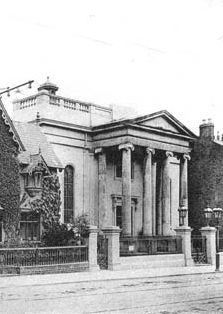
 SO FAR – Thomas and Bessie Lockyer, a young couple originally from Bridport in Dorset, have settled in Leamington Spa, where Thomas is working as a reporter for The Leamington Chronicle. They live in a rented house in Holly Street, and have a six-months old son, Arnold Edward. It is Sunday morning, 1st September 1901. Thomas has gone to sing at the morning service at Spencer Street chapel. Bessie, in a state of extreme distress, has gone to her her next door neighbour, Mrs Wiggins, to tell her that she has harmed her baby. Mrs Wiggins can’t believe that Bessie has hurt Edward, but she goes with Bessie back to No. 17.






 But back to Clay Edison. He is a Deputy US Coroner in Berkeley, California, and The Burning begins, quite topically, with a destructive bush fire that has knocked out power supplies for everyone except those with their own generators. When Edison and his partner are summoned to retrieve a corpse from a mansion up in the hills, they find that Rory Vandervelde – a multi millionaire – has died from gunshot wounds. He was an avid collector. Rare baseball and basketball memorabilia, Swiss watches, antique knives – you name it, and Vandervelde had bought it. It is when Edison is inspecting the dead man’s astonishing collection of classic cars, stored in a huge garage, that he discovers something that sends a shiver down his spine, and not in a pleasant way.