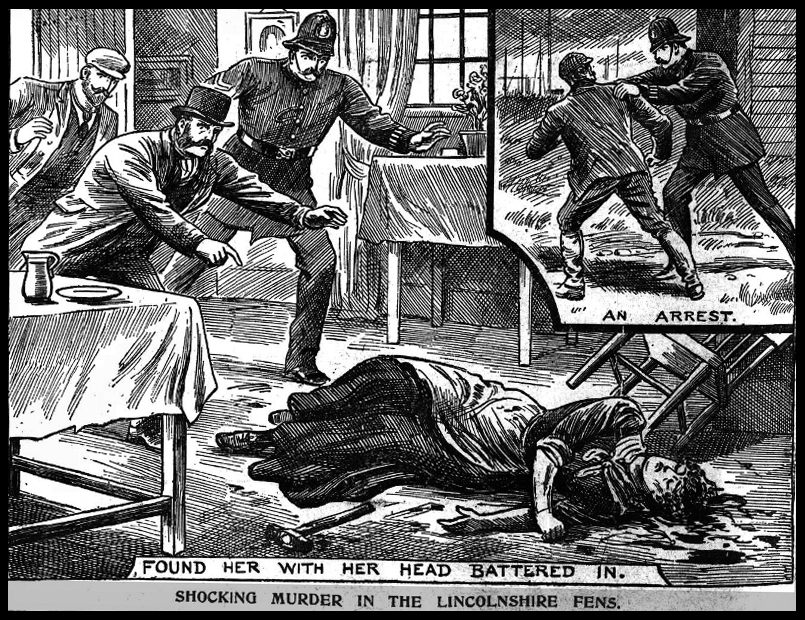
SO FAR: On the afternoon of October 8th 1907, a strange weekday drinks party had been held in a tied cottage belonging to Guy’s Head Farm near Sutton Bridge. Some of the drinkers went home for tea, the tenant of the cottage, William Gear, departed in fetch more beer, leaving his wife, Kate, alone in the house with their lodger, William Duddles. When her returned, he found that his neighbours had found Mrs Gear lying on the floor of the cottage, mortally wounded, a bloodstained hammer by her side. Of Duddles, there was no sign.
The police went in search of Duddles, and he was soon found. A newspaper reported:
“Sergeant Taylor, of Long Sutton, went in search of him. and he was discovered in the Marsh, near to the sea bank. He was then charged with attempted murder, the deceased at that time not being dead. His hands and clothing bore marks of blood, and in answer to the charge he said, “A still tongue makes a wise head,” and made no definite statement.”
The same newspaper went on to say:
“At Long Sutton, on Wednesday, William Duddles, aged forty-seven, was charged with the wilful murder of Catherine Gear, aged thirty-six, at Lutton Marsh, on October 8th. Supt. Osborn, of Spalding, gave evidence similar what is stated above. Sergt. Taylor, stationed Long Sutton, said he charged the prisoner with the attempted murder of Mrs. Gear, in Lutton Marsh, that afternoon. Prisoner replied : ” I have never done anything wrong before ; I am a bad ‘un, I know. I have been put on.” A short time afterwards he said: “A still tongue makes a wise head ; I shan’t say nowt.”
“That morning, from further information, and after cautioning him again, witness charged him with the wilful murder of Catherine Gear, and he made no reply. The prisoner was remanded until Wednesday, the l6th. He appeared in court with a black eye and cuts on the left temple and over the left eye, which, it was suggested, indicated that the woman had tried to defend herself. The inquest was held on Wednesday evening, before Dr. Barritt the Spalding District Coroner, at Lutton Marsh. William Gear, the husband, said that he and his wife got on very well together. A lodger named Duddles had been with them about two years, he occasionally had some words with them when was in drink, and sometimes made imputations against deceased.”
“They had some words recently. Duddles called his wife some some abusive names, and witness, taking her part, struck him. On Tuesday, witness went out at four o’clock to fetch some beer, and upon returning found his wife lying on the floor with her head in a pool of blood, a coal hammer lying few yards away. She was not dead, but was unconscious. Evidence was also given by Edwin Hocking, living next door, and a neighbour named Towson. The inquiry was adjourned until Monday next, and a post-mortem examination was ordered. The hammer, with which the tragedy alleged was alleged to have been enacted was produced in Court; it is an engineer’s hammer, fifteen inches long, with a heavy head of iron.”

The funeral of Kate Gear was a lonely and bleak affair:

Justice moved swiftly in the case of William Duddles. He was swiftly indicted for murder, and sent for trial at the November Assizes in Lincoln. This was not before the national press had a few things to say about him.

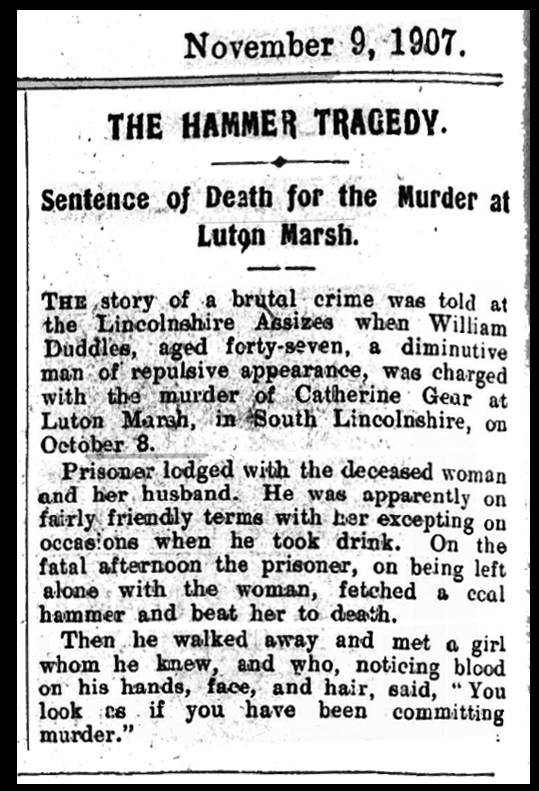 The “diminutive man of repulsive appearance” was found guilty of murder, and sentenced to death by the judge, despite the jury recommending mercy due to the prisoner’s mental state. One of the strange things about this case is that newspapers at the time normally reported verbatim anything said in court, either by the accused or his legal representatives. In this case, I have been able to find absolutely nothing. Defence barristers are known to this day for concocted elaborate excuses when pleading clemency for their clients, but here they either had nothing to say, or it was never reported. The obligatory plea for mercy was sent to the Home Secretary, Herbert Gladstone (son of the great former Prime Minister) but it fell on deaf ears, and William Duddles was executed on 20th November in Lincoln Prison. In charge of proceedings were the Pierrepoint brothers, Henry and Tom – father and uncle to the more celebrated Albert.
The classic mantra of solving murders – both real and fictional – is ‘Means, Motive and Opportunity’. In the case of William Duddles, the means and opportunity are obvious, but the big question remains “why”? From the limited evidence that remains available through old newspapers, it is hard not to conclude that there was a sexual element in this murder. Out of consideration for the dead woman and her family, the newspapers would have remained silent, but it seems to me that Kate Gear was, in some way, tormenting Duddles over a period of time, perhaps promising much but delivering little, and the teasing became too much for a man of limited intelligence made dangerous by drink.
Does this excuse what he did? Never in a million years. He battered a woman to death and, depending on your views on capital punishment, was punished accordingly. There is a strange undercurrent to this case – the mid-week drinking binge being the strangest – that will remain a mystery. Kate Gear lies in the peaceful churchyard of St Nicholas, Lutton, while her killer is buried in the poignant little plot reserved for hanged men within the grounds of Lincoln Castle.


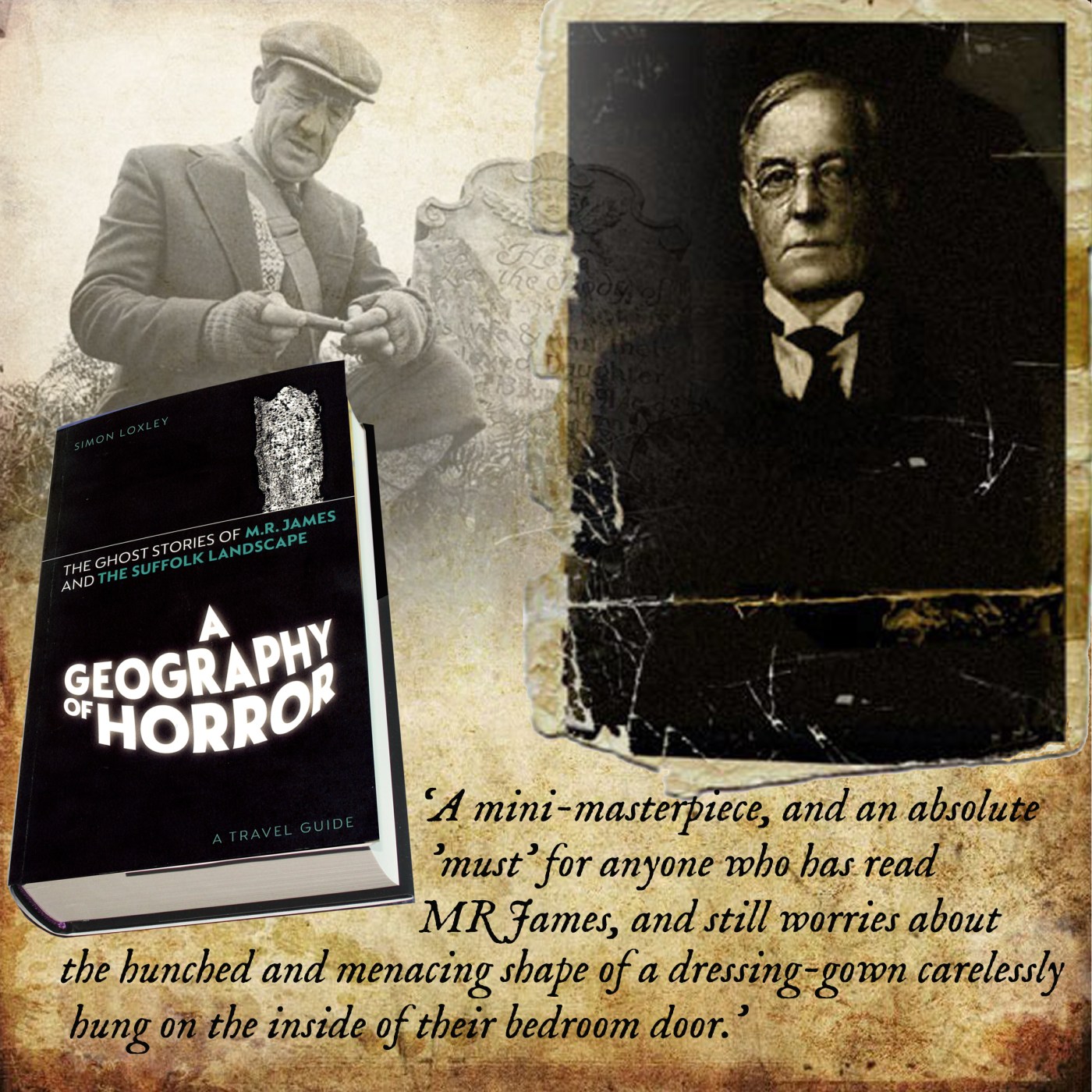
 Who was the most celebrated writer of ghost stories? The genre doesn’t lend itself particularly well to longer book form, and even classics like Henry James’s The Turn of The Screw and Susan Hill’s The Woman In Black are relatively slim volumes. The master of the shorter version and, in my view, a man who unrivalled in the art of chilling the spine, was MR James. Montague Rhodes James was born in Kent in 1862, and in his main professional life he became a renowned scholar, medievalist and academic, serving as Provost of King’s College Cambridge, and Provost of Eton. His first collection of ghost stories, Ghost Stories of an Antiquary, was published in 1904 and has, as far as I am aware, never been out of print.


 Whatever other qualities the book may have, the name of the town in which it is set gets first prize for the most sinister sounding location – Whistling Ridge. You just know that this is a town with dark secrets and simmering tensions that have festered for generations. Throw in a charismatic hellfire preacher who seems to have the town in his thrall, a girl who inexplicably disappeared into the woods, and a mysterious outsider who fascinates the young folk but arouses deep resentment in their parents – and you have a crackerjack thriller. Published by Doubleday, Tall Bones is
  A husband disappears, leaving only a one word scribbled note that says “
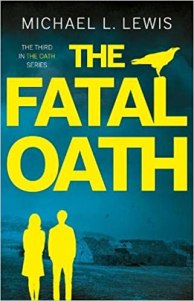 School stories, at least those written for younger readers, were once ‘a thing’ but something of a rarity these days. This book, the third in a series, is aimed at adult readers, and is set in 1957 within a boys’ boarding school in Yorkshire, and is centred on a Jewish teenager who is made to feel an outcast by senior boys who feel he is not “
 Sarah Pearse’s previous (and debut) novel
  Penguin are publishing new translations of Simenon’s stories. I’ve reviewed
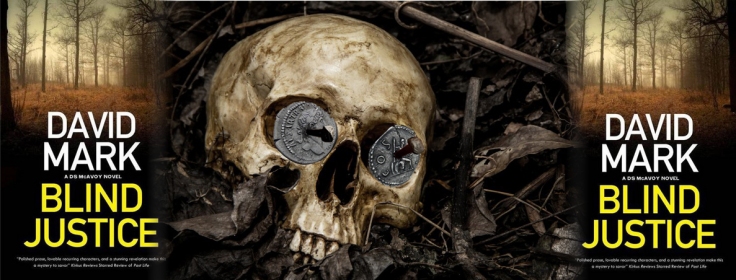
 The book begins with a flashback to an attempt by young men to carry out what seems to be a robbery in an isolated rural property. It ends in horrific violence, matched only by the destructive storm that rages over the heads of the ill-advised and ill-prepared group. Cut to the present day, and another storm has lashed Humberside, bringing down power lines, flooding homes, and uprooting trees. One such tree, an ancient ash, reveals something truly awful – a human body, mostly decayed, entwined within its roots in a macabre embrace.
 David Mark (right) writes with a sometimes frightening intensity as dark events swirl around Aector McAvoy. The big man, gentle and hesitant though he may seem, is, however, like a rock. He is one of the most original creations in a very crowded field of fictional British coppers, and his capacity to bear pain for others – particularly in this episode his son Fin and Trish Pharoah – is movingly described. Mark’s work may – at first glance – seem miles away from the Factory novels of that Noir genius Derek Raymond, but McAvoy shares the same compassion, the same sworn vow to find justice for the slain, and the same awareness of suffering shown by the nameless sergeant in masterpieces like I Was Dora Suarez.


 It seems like an eternity since I read a Stuart MacBride (right) novel, and it was back in his Logan McRae days. The last of those was All That’s Dead (2019) but this might be the start of a new police procedural series featuring Detective Sergeant Lucy McVeigh. We are once more in Aberdeen, and a serial killer known as The Bloodsmith is doing his grisly business, McVeigh’s police team, working under the name Operation Maypole, having failed to get close to the killer. To add to her problems, she has to deal with a young man who, at the age of eleven, inexplicably killed a homeless man. He served his time, and now is out and about again – and convinced that a mysterious ‘they’ are out to kill him. Does McVeigh ignore him and concentrate on finding The Bloodsmith, or could she have another potential maniac on her books? No Less The Devil will be published by Bantam Press

 Jim Eldridge (left) and his aristocratic Detective Chief Inspector Edgar Saxe-Coburg are working their way around the best hotels in 1940s London, investigating murder We have had
  Lurking in the background of this tale is a man who is less than noble, but with more power than all the kings and queens sheltering in London’s best hotel suites. Henry ‘Hooky’ Morton is a London gangster who is building his empire on black market scams, the most profitable of which is his manipulation of the petrol market. We think of fuel supply – or lack of it – as a very modern problem, but in 1940, having fuel to put in your car was crucial to many organisations. Hooky Morton has a problem, though. Someone has infiltrated his gang, and is making him look stupid. Then, Hooky does something really, really stupid and, no nearer identifying the garotte killer or their motives, Saxe-Coburg becomes involved in investigating what is, for any copper, the worst crime of all.

 On his trail is a grotesque cartoon of a copper – DCI Dave Hicks. He lives at home with his dear old mum, has a prodigious appetite for her home-cooked food, is something of a media whore (he does love his press conferences) and has a shaky grasp of English usage, mangling idioms like a 1980s version of Mrs Malaprop.
 “A fuchsia -pink shirt with outsize wing collar, over-tight lime green denim jeans, a brand new squeaky-clean leather jacket and, just for good measure, a black beret with white trim.”