 There is, perhaps, a legitimate debate to be had over what to call killings which are carried out in the name of a political cause. No-one in their right mind would label the millions of soldiers who died in the two world wars of the 20th century as murder victims. The wearing of a uniform, and the acceptance of the King’s shilling has always legitimised the act of pulling the trigger, firing the shell, or dropping the bomb.
But what about guerilla activities? What about resistance movements? When does a killing become a murder? Is one man’s freedom fighter another man’s terrorist? I am far from unique in being unable to resolve those conundrums. The men who assassinated Reinhard Heydrich on a Prague boulevard in June 1942 have been hailed as heroes. What about the Irishmen who killed eleven British soldiers in a few hours on the streets of London in July 1982? They wore no uniform and carried no flag, but in their hearts their targets were legitimate.
My view? Emotionally, I am drawn to the view that soldiers engaged in ceremonial duties in a nation’s capital are not fair game. Therefore, I am treating the events of 20th July 1982 as murder. Cold blooded murder, pure and simple.
London, 20th June, 1982. The weather was warm, but unsettled, with a promise of showers. A troop of The Household Cavalry, the ceremonial guardians of the English monarch, were calmly riding along South Carriage Drive in Hyde Park, on their way to the ceremony known as The Changing Of The Guard. Unknown to them, a blue Morris Marina car, parked alongside their route, was packed with gelignite and nails. At 10.40 a.m. the device was triggered, presumably by a nearby operative. The result was carnage.
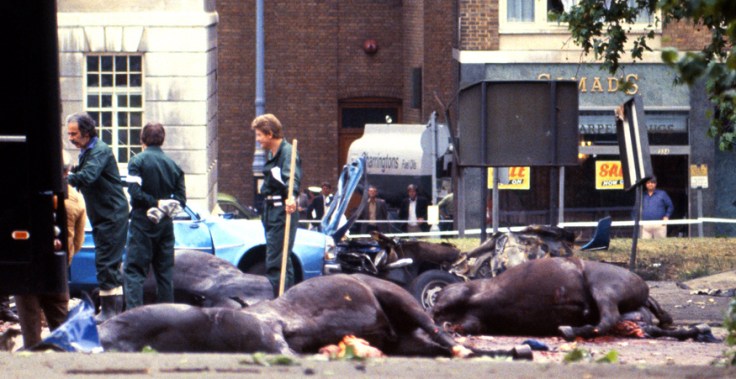
The road was littered with flesh, of the three guardsmen who were killed instantly (that telling euphemism which denotes catastrophic injuries) – and that of horses. The three soldiers who died at the scene were Lieutenant Anthony Daly, Trooper Simon Tipper and Lance Corporal Vernon Young. Corporal Raymond Bright was rushed to hospital, but died on 23rd July. The men are pictured below, left to right.

 Just a couple of hours later, as emergency services struggled to deal with the mayhem in South Carriage Drive, the terrorists struck again. It seems barely credible that in another part of the city, life was going on as normal. Remember, though, that these were the days before mobile ‘phones and social media, the days when news was only transmitted in print, by word of mouth and on radio and television. The regimental band of The Royal Green Jackets was entertaining a small crowd clustered round the bandstand in Regent’s Park. They were playing distinctly un-martial music from the musical ‘Oliver!’ when, at 12.55 pm, a massive bomb went off beneath the bandstand. The blast was so powerful that one of the bodies was thrown onto an iron fence thirty yards away, and seven bandsmen were killed outright. They were: Warrant Officer Graham Barker, Serjeant Robert “Doc” Livingstone, Corporal Johnny McKnight, Bandsman John Heritage, Bandsman George Mesure, Bandsman Keith “Cozy” Powell, and Bandsman Larry Smith.
Keith Powell’s mother, Mrs Patricia Powell was later to say:
“On the day (20th July 1982) at 1pm – I was rinsing a cup at the sink in my classroom – I suddenly felt very ill and mentioned it to a colleague – saying I’d no idea why I felt so ill. On the way home I went to the music store to purchase the score of Oliver – No idea why I wanted it suddenly nor did I have any idea this was what the band was playing. Got it – went to the bus station and saw on the placards news about the bombs in London – I knew instantly that he was dead. This was confirmed later that evening.”
Keith Powell’s comrades gave him his nickname because of the celebrated rock drummer Colin Powell, who played with bands such as Black Sabbath, the Jeff Beck Group and Whitesnake. No-one was ever convicted of the Regent’s Park atrocity, but responsibility was claimed by the IRA. In 1987, Gilbert “Danny” McNamee, an electronics engineer from Northern Ireland, was jailed for 25 years after being found guilty of building the radio-controlled bomb used in the Hyde Park attack.
He was released from prison in 1998 under the terms of the Good Friday Agreement, and later that year the Court of Appeal overturned his conviction on the grounds that it was unsafe. Another suspect, John Anthony Downey, was to be tried for his part of the Hyde Park bombing as recently as 2014, but his trial collapsed when it was revealed that he was one of those Republican activists who had been sent a ‘comfort letter’ by the British government, promising them immunity from prosecution. Following the 1998 Good Friday Agreement, which brought something resembling peace to Northern Ireland, there was an ongoing issue over what to do about IRA suspects who were still “on-the-run”. As part of the peace deal, IRA terrorists serving prison terms were granted early release but that could not apply to those on the run. A deal was reached between the Tony Blair government and Sinn Fein to carry out an exercise whereby checks would be carried out and for those who were no longer wanted by police, they would be sent a letter informing them of that fact.
 Downey (right) may or may not have been implicated in the Hyde Park murders. Only he knows for certain. At least he had the decency to cancel a party planned in his honour when he was released. He said:
“The party had been planned as a simple get-together of family, friends and neighbours who supported me after my arrest. Some elements of the media are portraying the event planned for tonight as triumphalist and insulting to bereaved families. That was never what it was about.”
There was a macabre and tragic postscript to the Hyde Park murders. One of the horses, named Sefton, survived the attack despite terrible injuries. The horse became something of a media celebrity, which is not surprising given the British public’s sentimental obsession with animals. Sefton’s days of celebrity were, at least, harmless. Not so the fate of his rider on that day, Michael Pedersen. He survived the attack physically, but suffered irreparable hidden mental damage. In 2012, after two failed marriages, he drove himself and his two children, Ben and Freya, to a remote lane near Newton Stacey in Hampshire, stabbed them to death, and then took his own life.

 “Harry Roberts is our friend, is our friend, is our friend.
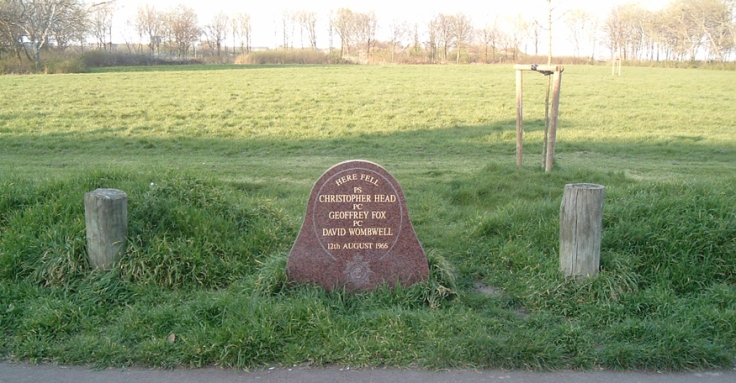
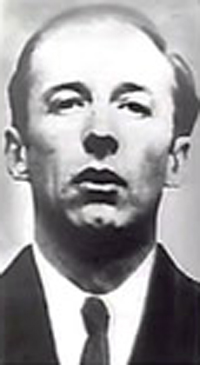
  aged 30, and 25-year-old Temporary Detective Constable David Wombwell were both members of the CID based at Shepherd’s Bush police station. Their driver was Police Constable Geoffrey Roger Fox, aged 41. As the unmarked police car pulled up nearby, DS Head and DC Wombwell got out and walked over to check the van. They noticed that it had no tax disc. While the officers were checking Jack Whitney’s documents, Roberts panicked, and shot DC Wombell with a Luger pistol. When DS Head ran back towards the police car, Roberts shot him, too. Duddy sprang from the back of the van, brandishing an old Webley revolver, and joined Roberts by the police car where, together, they shot dead PC Fox. The two killers ran back and got into the van, which Whitney drove away at high speed. (Below) The murdered officers PC Fox, DC Wombwell and DS Head, and their funeral cortege.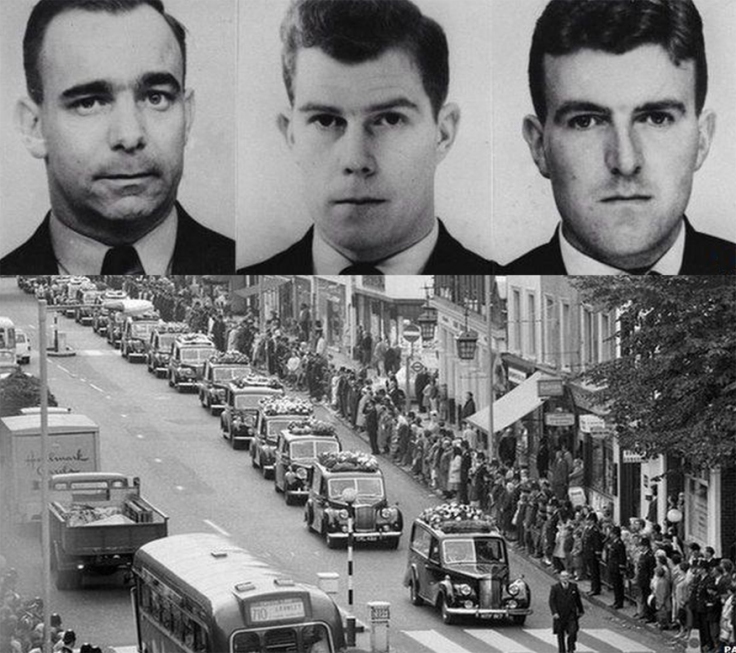
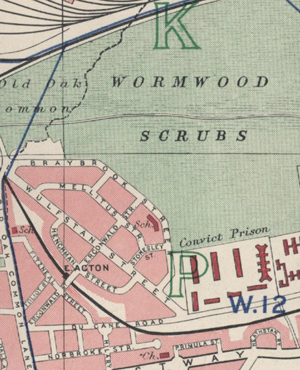
 What became of the Shepherd’s Bush Killers? It should be noted that the murders took place in Acton, but possibly because the dead officers were based at Shepherd’s Bush, that name has stuck. John Duddy (left) died in Parkhurst prison on the Isle of Wight in 1981, at the age of 53, while Witney, possibly because he never fired a shot back in 1966, was released in 1991. He had eight years left to enjoy his freedom before death was to seek him out.
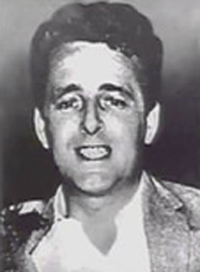
 of rent arrears. The two rowed over the money and daily household chores like washing up, Bristol Crown Court heard during Evans’ trial. Then, on August 15, 1999, Evans attacked Witney, (right) beating him around the head with a hammer. He grabbed him by the throat and Witney, who by then was quite frail, was throttled to death. Evans, aged 38, was found unanimously guilty, and given a life sentence.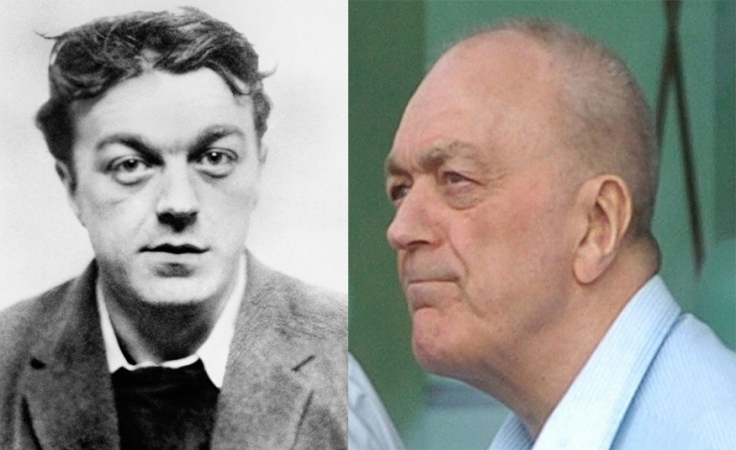
 THE 1999 SHOOTING OF A 16 YEAR-OLD BOY during an attempted burglary at a remote Norfolk farmhouse landed the unfortunate teenager in an early grave, and the farmer who fired the fatal shot was given a life sentence for murder.
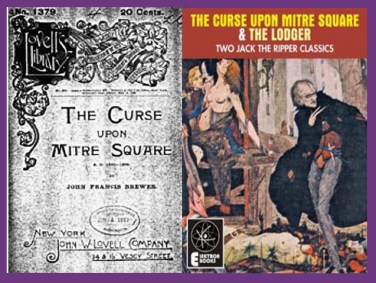 Kelly, met a bloody end in her Millers Court hovel. Of Brewer, we know very little, but his style can best be illustrated with a brief extract.
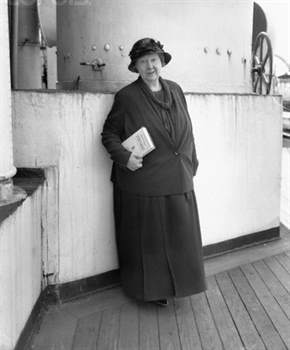 Belloc-Lowndes (right) was the older sister of the prolific writer and poet Hilaire Belloc, but she avoided her brother’s antimodern polemicism, and wrote biographies, plays – and novels which were very highly thought of for their subtlety and psychological insight into crime, although she preferred not to be thought of as a crime fiction writer. In The Lodger, Mr and Mrs Bunting have staked their life savings on buying a house big enough to take in paying guests, but just as their dream is on the verge of crumbling, salvation comes in the form of the mysterious Mr Sleuth, who knocks on the door and takes a room, paying up front with many a gold sovereign. As Mr and Mrs Bunting count their money – and their blessings – London is gripped with terror as a killer nicknamed ‘The Avenger’ stalks the streets searching for blood. The Buntings’ peace of mind evaporates as they suspect that their lodger is none other than The Avenger. Such is the quality of The Lodger that it has been filmed many times, most notably by Alfred Hitchcock in 1927. It would be remiss of me not to quote the famous bloodcurdling imprecation at the end of the book, directed at the hapless landlady.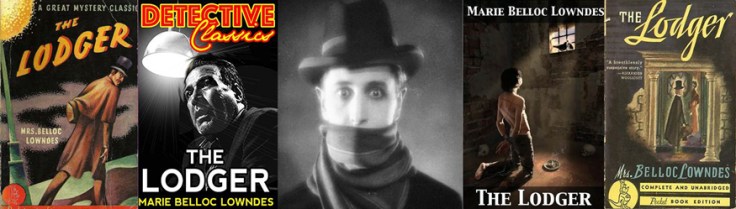
 Colin Wilson, who died in 2013, (left) was the kind of man with whom the British establishment, certainly in the 1950s and 60s, was most deeply ill at ease. He was, as much by his own proclamation as that of others, intellectually formidable. He burst on the literary scene in 1957 with The Outsider, a journey through an existential world in the company of, among others, Camus, Nietzsche, Kafka, Sartre, Hermann Hesse and Van Gogh. His novel that concerns us is Ritual In The Dark. Published, after a long gestation, in 1960, it examines how The Ripper legend transposes itself onto the London streets of the late 1950s. It must be remembered that many of the murder sites were still more or less recognisable, at that time, to Ripper afficionados. The tale involves three young men, Gerard Sorme, Oliver Glasp and Austin Nunne. Sorme goes about his life well aware of the significance of past deeds, but also knowing that a present day killer is out and about, emulating the horrors of 1888. Wilson could be said to be one of the pioneers of psychogeography, a linking of past and present much used by modern writers such as Iain Sinclair and Peter Ackroyd. Sorme says,
 “I am lying here in the middle of London, with a population of three million people asleep around me,
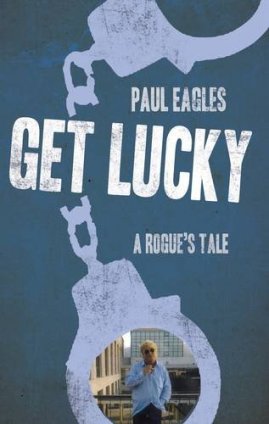 So was Mr Eagles a late 20th century Flashman? In some ways he seems to have all the charm of the fictional ne’er-do-well. He talks his way into posh company, is equally at home whether womanising, boozing or brawling, and thinks nothing of stealing a priceless Rubens painting from a Dutch museum.
 THE QUESTION WAS …..

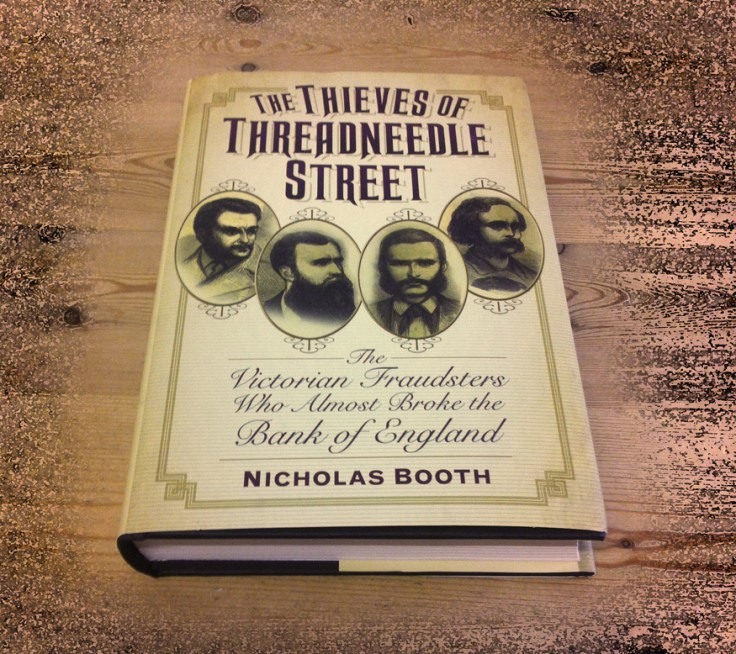
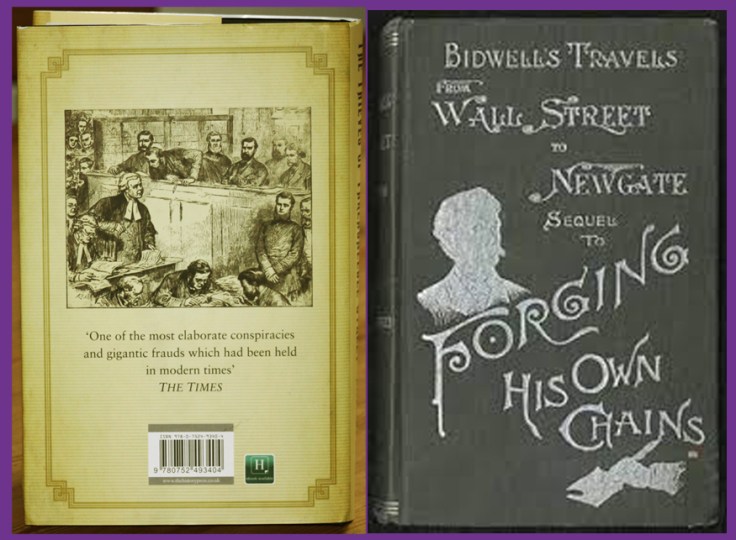
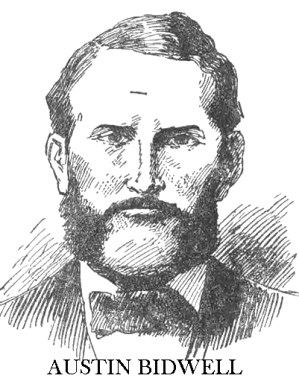 Still, even under lock and key in Spanish-ruled Havana, Austin Bidwell (right) thought he would get away with it. His absence from London at the most crucial juncture meant, in his estimation, that any evidence against him was hearsay. And, until my research, most of the accounts about the “great forgery” can be classed as the same. All the thieves of Threadneedle Street were inveterate liars and fantasists who shrouded their endeavours in mystery, but even Pinkerton was prone to self-aggrandisement.
 (left)– a baleful influence on his brother – had what he later termed “a series of the most extraordinary adventures” across Ireland and Scotland (“a hell’s chase, and no mistake”) before lapping up the attention at his subsequent trial. Another of the gang, George Macdonnell (“a debonair scoundrel”) made it across the Atlantic where he handed his spoils to corrupt NYPD detectives. “I’m clean,” he taunted Pinkerton’s operatives. “You can’t prove anything on me.”