Search

fullybooked2017

Category

True Crime

‘I WILL HAVE HER BEFORE THE NIGHT IS OUT” . . . A brutal murder in 1903 Lincoln (1)

Patchett header

I have been researching and retelling the stories of historic murders for  a long time now, and the overwhelming majority of these cases involve a man murdering a woman. There is rarely what one might call a motive, in the sense that the killer planned his act with the intent to gain an advantage. Occasionally, as with the Spalding Poisoner, the man plans the killing because he has another lover, but all too often, as is the case here, the murder is an act of rage, jealousy, with the sub-text of “If I can’t have you, then no-one will.”

The life of Sarah Ann Smith seems to be punctuated with misfortunes. Thomas Hardy, in Tess of the D’Urbervilles memorably imagined that our lives were manipulated by some unseen hand, moving us around like chess pieces for their own amusement.

“.. and the President of the Immortals (in Aeschylean phrase) had ended his sport with Tess.

The 1881 census has 9 year-old Sarah Ann Smith living in Greetwell Gate, Lincoln, with her parents John and Ann, and her two brothers. In 1891 she was working as a domestic servant in  a house on what was then called Asylum Road. The census that year was taken on 5th April, and in the summer of that year Sarah married Henry Healey Fletcher. Seven years later, on 17th February 1898 their son, Harold Fletcher was born. Sarah’s joy was to be short lived, because with twelve months both baby Harold and husband Henry would be dead. Henry Fletcher, an ironstone miner, hanged himself when rumours began to circulate that Sarah was having an affair with their lodger.

As in the case of Tess, the President of the Immortals had one last cruel joke to play on Sarah. She met and was wooed by a young bricklayer called Leonard Patchett, and in January 1900 they married in St Andrew’s church in Lincoln (picture below). Demolished in 1968, it was one of many Gothic revival churches designed by the celebrated Louth architect James Fowler.

Screen Shot 2022-06-27 at 19.53.13

Leonard Pratchett was what used to be called ‘a wrong ‘un’. He was handy with his fists, especially with women, as his criminal record shows.
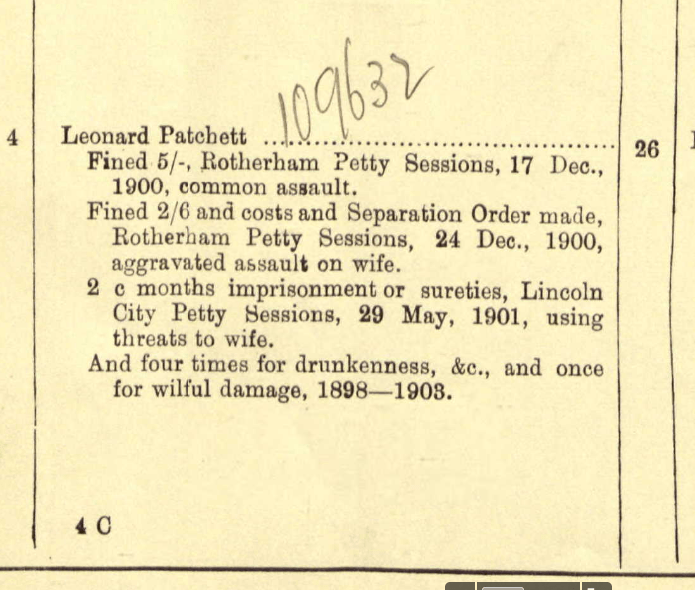
Criminal record

It wasn’t long before Sarah became fed up with Leonard’s casual brutality, and left him. There followed a sequence of uneasy reconciliations – and the birth of a daughter – Rachel Cecilia. The early summer of 1903 saw Sarah working as a housekeeper for a man named John King, a former military man who now worked as an insurance agent. He lived at 36 Spencer Street, Lincoln. Leonard, meanwhile was working in Gainsborough.

Towards the end of May, Leonard Pratchett took a train to Lincoln, with the intention of patching up his troubled marriage to Sarah. He sought her out at John King’s house, and on the evening of Tuesday 26th May, he asked her to walk with him to the station, from where he was going to catch the train back to Gainsborough. Earlier that evening, Sarah had been out when Patchett came looking for her, and he got into a conversation with a Mrs Emma Iremonger, next door neighbour to John King. It seems that Mrs Iremonger was looking after Rachel, who was a couple of months short of her second birthday. The exchange was reported in the press sometime later:

Emma Iremonger

John King later testified that he was uneasy about Sarah going off with her husband that evening, and asked her not to go, but she declined to take his advice. He waited up until 11.00pm that night, and when she still hadn’t returned by morning he contacted the police. Wednesday and Thursday passed without any sighting of Sarah Patchett.

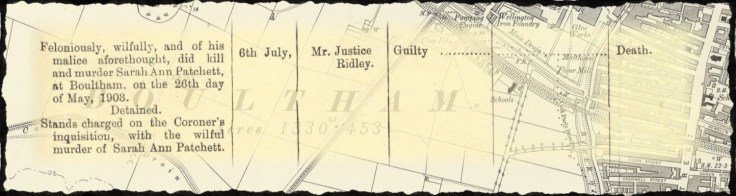
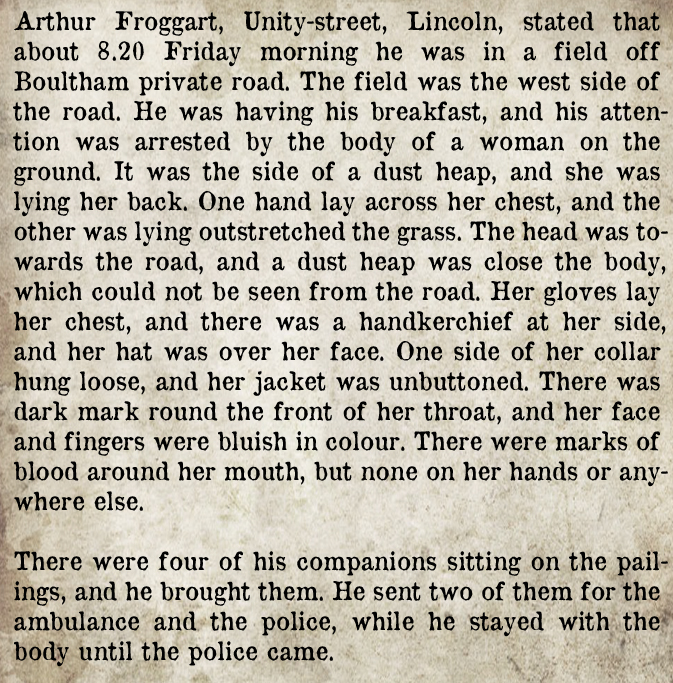
The next events in this tale unfold in a part of Lincoln that is completely unrecognisable today, and it is only by looking at maps side by side that we can get some sense of the landscape in 1903. What is now Boultham Park Road was, in 1903, a private carriage road leading to Boultham Hall, and on either side there were open fields. North of the drain in 1903 was the Wellington Iron Foundry, where some of the first WW1 tanks were built. One of the employees at the foundry was a young man called Arthur Froggatt. They worked long shifts in those days, starting early and finishing late. The men were allowed a break for breakfast around 8.00 am, and on the morning of Friday 29th May, Arthur had walked across the footbridge over the drain to breath some fresh air after the intense heat and fumes of the foundry. He had only walked a little way down the carriage drive, when he saw something untoward. Again this is from a newspaper report taken down verbatim at a court hearing:
Discovery

IN PART TWO
Arrest
A revealing letter
Trial and execution
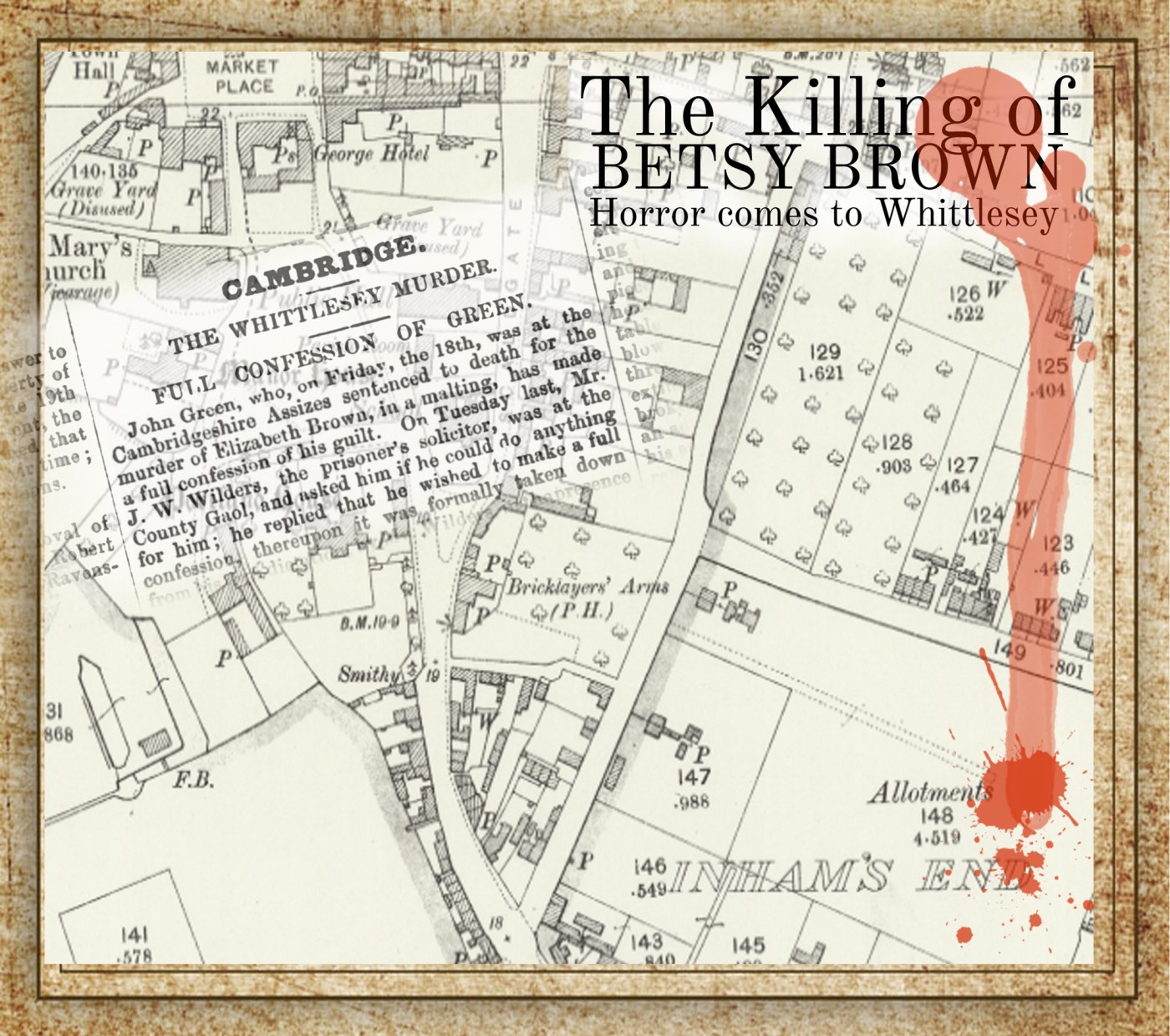
THE KILLING OF BETSY BROWN . . . Horror comes to Whittlesey (3)

Artists impression

SO FAR – Cambridge, 1863. Whittlesey man John Green has been convicted at the Cambridge Winter Assizes of murdering Elizabeth ‘Betsy’ Brown on the night of 11th/12th March, in the maltings behind the George and Star inn.

There was to be a final chapter in this horror story. While waiting for his rendezvous with Hangman Calcraft, Green asked to be allowed to make a full confession. It is highly unlikely that he was literate, so his solicitor, a Mr J. W. Wilders took his dictation, in the presence of the prison governor. It was grim stuff.

“Smedley and I locked up the malting on the night of the 11th March, about eight o’clock, and went together to the George and Star public-house, and I went into the store-room with Samuel Boyce to remove some forms up into the dancing room. At the time Boyce was taking the forms out of the store-room I drew a bucket full of gin from a puncheon in the same store-room. I then hid the pail of gin in corner behind some wood in the George and Star yard. I then went into the tap-room, where I saw Smedley, and told him what I had got.

Smedley and I then went together and took it to the malting and the malting door. I carried it, and he unlocked the door leading to the malting. When we got into the furnace room Smedley kept watch while I poured the gin into a stone jug covered by a whicker basket. We then sat down and drank a little, and then returned to the George and Star. Smedley said, “We won’t lock this (meaning the kiln door), as we may return again.: But we will lock the big gates.’

Smedley and I returned to the dancing room at the George and Star, and remained there until twelve o’clock, and I did not see Smedley afterwards. I then went down stairs into the tap-room and had some beer, and also some conversation with Elizabeth Brown and Ann MacDonald. About one o’clock in the morning the deceased, Mac Donald, and myself, went outside the George and Star door and had some conversation.

Elizabeth Brown said to me, “Can we get into the malting ?” and I said, “Yes, I have got a bottle of gin there,” and she replied, “Then let’s go.” She asked MacDonald to go with us, saying, “we shall have plenty to drink,’ and she said “No, one woman with one man is plenty;” and we  then left MacDonald and went round Mr. Waddelow’s by the Church wall, through the little gate into the George and Star yard which adjoins the malting premises, and got on to the cow crib over the wall on to the kilderkin into the malting yard in the manner described at my trial, and went into the kiln through the door which Smedley and I had left unlocked.

William-calcraftShe (Brown) was at that time smoking a long pipe, and when we got into the furnace room, I drew a quart pitcher full of gin out of the bottle, and sat down on the settle and drank most of it, if not all of it, both of us smoking. We had sat down for half hour, when I wanted to have connection with her, but she would not. I pulled her off the settle. She kicked and knocked about, and got hold of my hair, and I tried and tried as long as I could to have connection with her, and when she would not, I hit her on the body with my fists, and she fell on the floor. I then kicked her on the body more than once. She did not scream out. I then felt so bad that I did not know what to do, as I felt I had killed her. I stooped down and got hold of her and shook her, and I found that she was really dead. I then drank hearty of some gin.
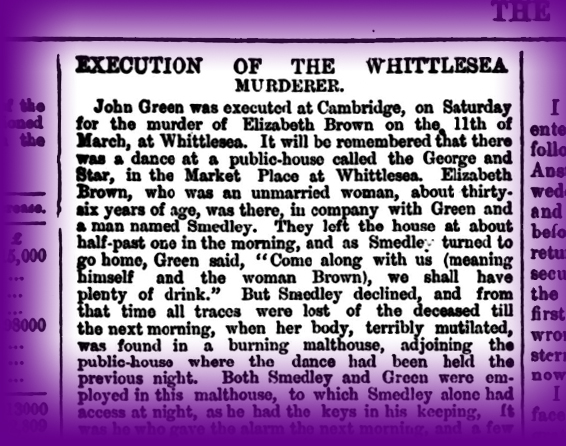
There were some sacks lying on the settle which I took off and put round her, and set fire to them,  putting a shovel full of hot cinders on the sacks. I sat down on a block against the furnace and watched the burning. After I had watched the burning for about an hour, I got up and drank some more gin and stirred up the burning sacks. I then sat down again and went off to sleep, I expect. When I woke and got up from the block, I was so stifled with the smoke that I did not know where to go, and at last I found the door in the coke place leading into the yard, and got out and over the wall and went running home.”

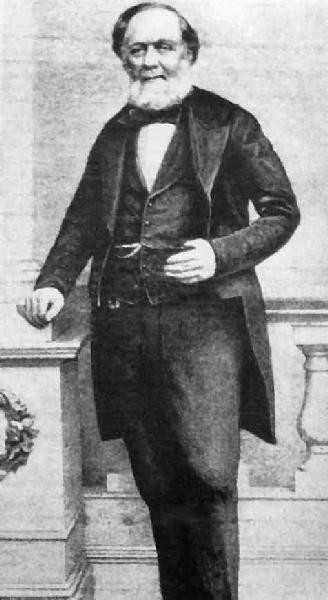
John Green was hanged at 9.00 am on Saturday 2nd January, 1864. The hangman was William Calcraft (above left)

Execution

FOR MORE INFAMOUS CAMBRIDGESHIRE MURDERS
CLICK THE IMAGE BELOW

Screen Shot 2022-06-16 at 18.20.58

THE KILLING OF BETSY BROWN . . . Horror comes to Whittlesey (2)

Part 2 header

SO FAR – March 1863. The remains of the body of Elizabeth ‘Betsy’ Brown have been found in the furnace room of Thomas Whyles’ maltings in Whittlesey. A young man named John Green has been arrested on suspicion of her murder.

The customary sequence of events in these sad affairs began. First, the coroner’s inquest. It was here – and the subsequent verbatim accounts in the newspapers – that the true horror of what had happened to Betsy Brown became known to the citizens of Whittlesey and thousands more across the region.

The first medical man on the scene at Whyles’ maltings had been a man called Robert Crisp, a surgeon. This was his testimony, and it is not for the faint-hearted.

Testimony 1

The police, who had been holding John Green in custody since his arrest on the morning of 12th March also testified that his clothes bore the smell of smoke, and a small patch of his hair was singed by coming into contact with extreme heat. The coroner’s jury took little time in finding Green guilty of murder, which he denied, insisting that he had gone home and was in bed by midnight. He was remanded in custody, and sent for trial at the next Assizes in Cambridge.

By the time of Betsy Brown’s murder County Assize courts were held three times a year, and named Spring, Summer and Winter. These were serious affairs for serious misdemeanours, which were anything from theft of valuable items up to murder. They were presided over by circuit judges who were senior members of the legal profession. Normally, John Green would have been tried at the Summer Assizes, as the preliminary court hearings came just too late for the Spring Assizes, but another complication to to the case meant a delay.

This complication was the police’s concern that John Green’s friend, William Smedley (Wyles’ head maltster) was involved in the death of Betsy Brown. As a key holder to the premises, he certainly conspired to make the premises available to Green for what he, Green, hoped would be a night of passion with Betsy Brown. But was he involved more deeply? In the event Smedley was also arrested, and it wasn’t until 18th December that the pair came to stand trial.

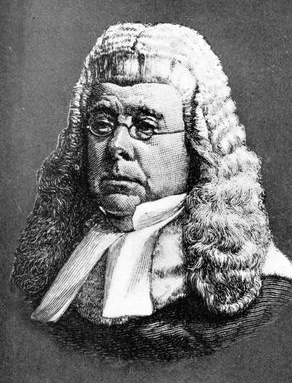
Screen Shot 2022-06-15 at 20.14.00The presiding judge was Sir Samuel Martin QC (1801-1883), Anglo-Irish Baron of the Exchequer (left). The first thing he did was to dismiss all charges against William Smedley. He said:
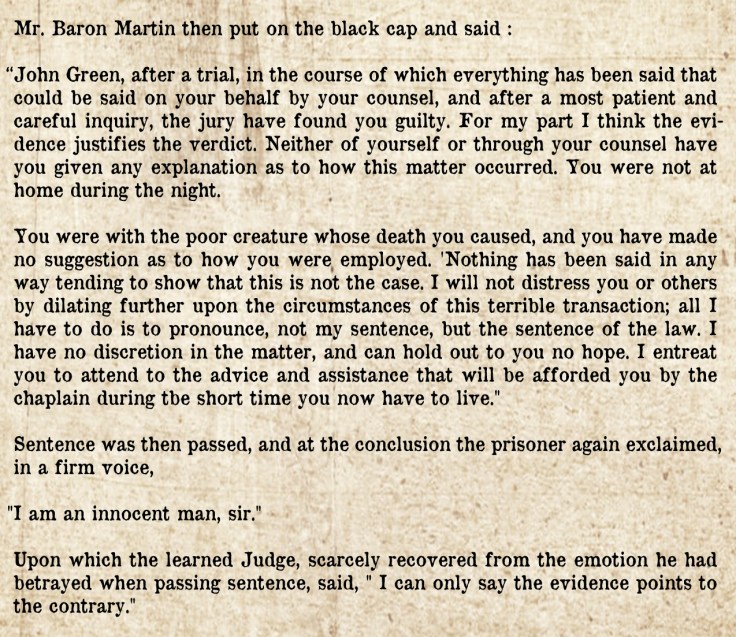
“Gentlemen, the two prisoners are charged upon an indictment — one (Green) with having of malice aforethought murdered Elizabeth Brown ; the other (Smedley) with having harboured the said Green, knowing him to have committed the murder. Now as to Smedley, there is no evidence against him worthy of your consideration. This is a question of law to be decided by the judge, and I at once tell you you must acquit the man. And further, I feel bound to say there was no pretence for ever putting the man upon his trial. It is the first time in my experience a man has been put upon his trial in this way with another charged with murder. Having this strong opinion, I feel bound to express it, and I repeat he ought not to have been put upon his trial here.”

Smedley was free to go, but John Green was not so fortunate. The jury took a mere ten minutes to find him guilty. The newspapers of the day had  a great sense of drama and theatre when reporting such things, and this what one reporter wrote:

Judgment

IN PART THREE
A confession, and the full horror is revealed

THE KILLING OF BETSY BROWN . . . Horror comes to Whittlesey (1)

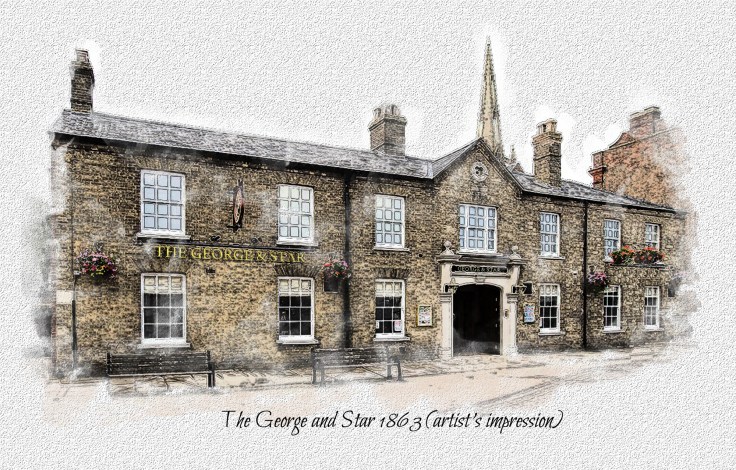
Artists impression

In 1863 The George and Star inn was, as it is today, the biggest in Whittlesey. It changed its name by dropping the Star several years after the events described in this story. Behind the inn was a maltings owned by Thomas Whyles, described in the 1861 census as ‘Corn merchant and miller.’ His house was in Church Street. Two other town residents acted out their parts in this drama. Elizabeth Brown was known as ‘Betsy’. The newspapers gave her age as 36, but the 1861 census gives us two Elizabeth Browns, one aged 24 living in Scaldgate, and another aged 39 in Private Road. You can take your pick as to which was ‘our’ Betsy Brown. Both were described as labourers, but  if truth be told, the Betsy who features in this story supplemented her income by being, as my grandmother used to say, ‘no better than she ought to be’. She was described as ‘a tall dark woman with coarse features, high cheek bones and black hair : she had led an abandoned life for some time.’

Just a few streets away,  in what was known then as Inham’s End, 24 year-old John Green – who worked for Thomas Whyles –  lived with his wife Martha and daughters Mary and Harriet. He was described thus in a newspaper report. “He is a married man with three children; is 25 years of age, rather tall, with dark hair and pale face, has no whiskers, and is of slight but muscular build.”

John Green 1861

On the evening of Wednesday 11th March, John Green was drinking in the tap room of the George and Star, along with – amongst others – a man called Smedley, who was head maltster for Thomas Whyles – and Betsy Brown. Smedley was to play – literally – a key role in this affair, as he had a key to the maltings, and John Green, as the night’s drinking intensified was paying court to Betsy Brown and, aware of her reputation, needed somewhere private to take her, should she go along with his plans.

At some point in the evening, Betsy Brown’s mother, perhaps having some kind of premonition or sixth sense that her daughter was in danger, arrived at the inn and tried to persuade Betsy to come , home, but she refused. About half past midnight, Green, Betsy Brown and a woman called Ann MacDonald left the inn, and Green said, pointing to the maltings, “Come along, we shall have some beer.” MacDonald, well aware of what Green’s intentions were, replied, ““No, one woman with one man is plenty;”

At this point, it is necessary to explain briefly what happened in a maltings. The process of malting grain for beer and whisky making involves three main steps. The first is soaking the barley – also known as steeping – to awaken the dormant grain. Next, the grain is allowed to germinate and sprout. Finally, heating or kilning the barley produces its final color and flavor. The kiln was used to produce hot air which would be passed under the bed of grain so that it dried out evenly. In Whyle’ maltings the place where the kiln stood was referred to as the furnace room.

At about six o’clock on the morning of Thursday 12th March, John Green was seen by a man called Robert Cunnington, Green was heading towards his home. When Smedley arrived at work a little later, he entered the furnace room to be greeted by a horrific sight. Against a door was a body with the head resting against the door. The door was burning, and there was smoke issuing from the lap and chest of the body. Smedley’s first reaction was to get water and pour it on the body, but it was too little too late. Other workers – including Cunnington – arrived. The body was removed to the pump room, and Smedley expressed a fear that the body was that of his “silly mate” Green, but Cunnington informed him that he had recently seen Green, alive and well, heading for his home.

The Police were fetched and immediate enquiries revealed that if the body was not that of John Green, it must be that of Betsy Brown. The  body was only recognized by keys found in the pocket of the what remained of the dress, and a ring of buffalo-horn worn by her. Remarkably, John Green turned up for work as usual that morning, and after a cap similar to the one he generally wore was found near the spot where Betsy Brown’s body body was discovered, he was arrested. Superintendent Smith later gave this account:

Headline 1

I went into the pump-room shortly after seven o’clock on the morning of the 12th, the finding of tinder of burnt sacks, part of woman’s crinoline petticoat, from which I drew a piece of cane, and the state in which I found the window. About a quarter to eight I went with Mr. Whyle to the top floor, where Green was turning the kiln. Mr. Whyle told him to halt for a minute. Green looked towards us, and turned very pale and confused.

I said to him, “What time did you leave the malting last night ?’ and he replied ” Sir, sir, about half-past eight, sir.” I asked him what time he went home, and he replied, ” I went into the George and Star, and had a pint of beer with my mate, and was at home and in bed by eleven o’clock.“, I said, Did you see anything of Elizabeth Brown last night ?” and he paused, and said “I did see her in the George and Star tap-room, but never saw her afterwards.”

I took the prisoner into custody shortly before nine o’clock. He was then working a cistern below. I put my hand on his shoulder and said, “John Green, I apprehend you on suspicion of having caused the death of one Elizabeth Brown, found burning the kiln-house of this malting.” Prisoner shrunk down, and said ” Oh, pray don’t, pray don’t.” I assisted him over the wall, and took him to the police station. His whole frame trembled as he walked along. At that time I observed a piece of skin had been recently knocked off the ridge of his nose. Green said, “I did not know it was there.” There was also a small scratch on the bottom lip. I searched him, and from his trousers pocket took a canvas purse, now produced, which had then a very strong smell of burning.”

IN PART TWO
The full horror is revealed to the Coroner
A confession
An appointment with Mr Calcraft

THE WHITE HORSE MURDER . . . A brutal killing in a Lincolnshire market town (2)

WHITE HORSE HEADER

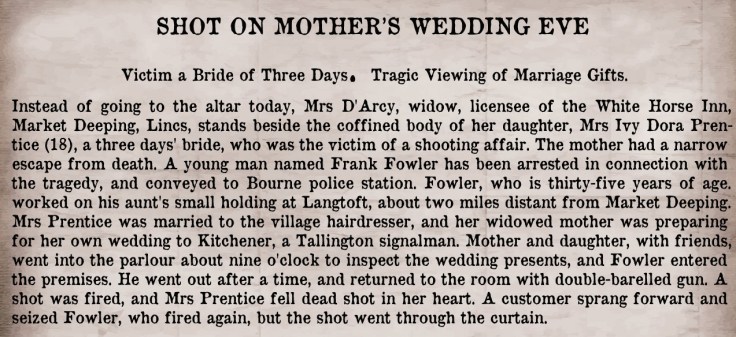
SO FAR – Market Deeping, Lincolnshire. September 1922. On Wednesday 20th, 18 year-old Ivy Dora D’Arcy had married her sweetheart, George Prentice. On the following Monday, her widowed mother Edith – landlady of The White Horse – was to remarry. At around 9.00pm on Saturday 23rd, Edith, Ivy, her sister Gertrude, and Edith’s soon-to-be daughter in law Eva are examining wedding presents in a back parlour, lit only by a candle. As ever, what happened next is vividly described by a local newspaper:

Blurb 1

At the coroner’s inquest on Monday 25th September, Edith D’Arcy explained that she was now Mrs Kitchener. Her new husband’s rather hard-hearted employers The Great Northern Railway Company, had refused to extend his leave of absence despite the tragedy, and so they had been married just an hour or so before arriving at the inquest. They are pictured below.

Mum arrives

Barely managing to keep her composure, she told the court that in the darkness, no-one realised what had actually happened. She said:

“Gertrude cried, “Bring a light, Ivy has been shot. I got some matches and lit the gas, and I saw them lifting Ivy onto a chair. She was smothered in blood, and a big clot of blood as big as my hand lay on her lap.”

What she saw was described in more chillingly anatomical terms by the doctor who was called to the scene:

“Dr. Benson stated that he was called to The White Horse Hotel soon after 9.20, on Saturday evening. Deceased was dead on his arrival. Her clothing was saturated with blood, and there was a 2½ inches by 3 inches wound on the left breast, whilst several ribs were smashed. A large cavity was formed In the thorax. The full charge from the gun had entered her chest at close range, from close range. Death was instantaneous, and due to haemorrage and shock. The wound was consistent with having been caused by the charge of a sporting gun such as that produced.”

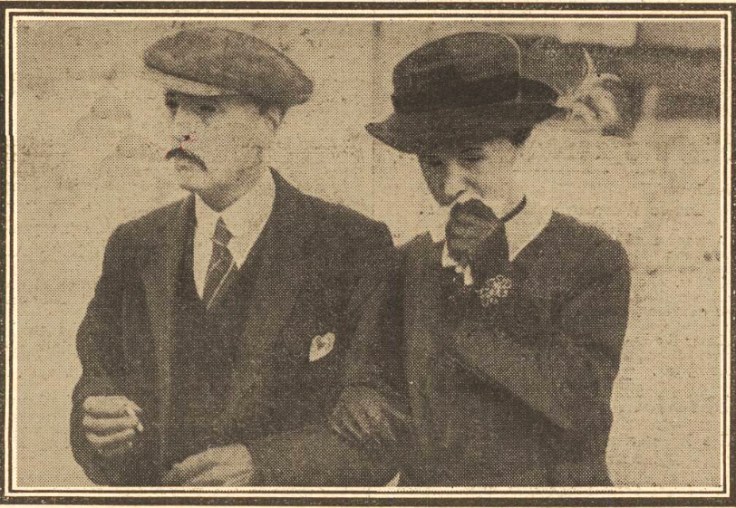
It is almost impossible to imagine the devastating effect this murder would have had on George Prentice. For three days he had a lovely young wife with the promise of children and years of happiness. Because of an instant of jealous rage, those dreams lay in tatters. He is pictured below, the man on the right, supported by a friend, arriving at the inquest.

George arrives cropped

Worse was to come for George Prentice. He had to watch as his young wife was lowered into the ground on Wednesday 27th September while the solemn words of the burial sentences were intoned.

I am the resurrection and the life, saith the Lord : he that believeth in me, though he were dead, yet Shall He live: and whosoever liveth and believeth in me shall never die.
I know that my Redeemer liveth, and that he shalt stand at the latter day upon the earth.
And though after my skin worms destroy this body, yet in my flesh shall I see God:
Whom I shall see for myself, and mine eyes shall behold, and not another.

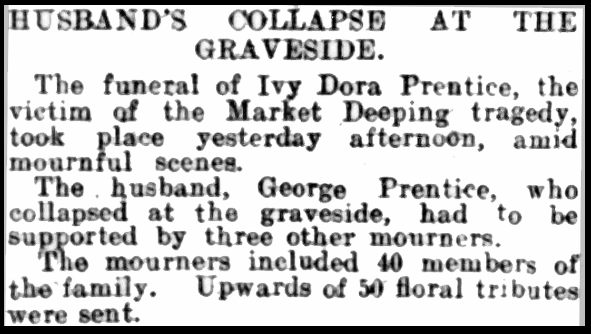
It is hardly surprising that the occasion was too much for George Prentice to bear.

Husbands Collapse

Ivy’s grave is very weathered, but can still be found in Market Deeping cemetery.

Ivy Dora Prentice smaller

FRANK FOWLERScreen Shot 2022-06-07 at 20.39.30

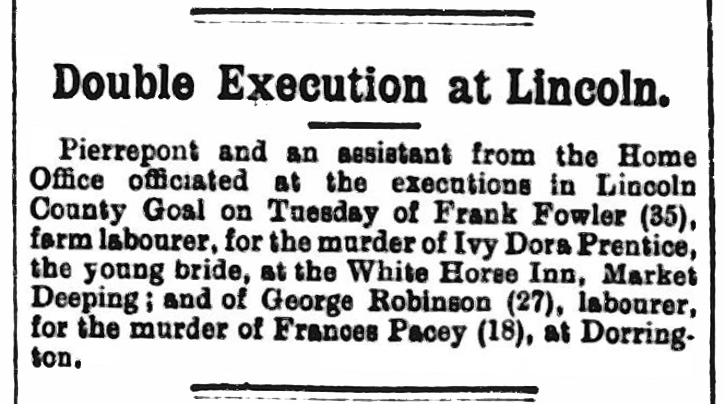
As for Fowler, (pictured left, leaving the inquest) he was clearly as guilty as sin. In his mind he had painted a picture in which he and Ivy D’Arcy were destined to be man and wife, despite the lack of any encouragement on her part. He was sent for trial at the autumn assizes in Lincoln, and it wasn’t until the jury found him guilty of murder, and the death sentence had been imposed by Mr Justice Lush  that his defence team  decided to ask for a  a repeal on the grounds of insanity. This was rejected, and Fowler was booked in for an appointment with the formidable Thomas Pierrepoint, (right). 13th December 1922 was a bad day for Lincolnshire, as the double execution despatched two men of the county, Fowler and a man called George Robinson who had murdered another 18 year-old girl in Dorrington.

Double Execution

As for Fowler’s motivation, one has to accept Edith Kitchener’s statement that there was never anything between Fowler and her late daughter. Whatever relationship there was must have existed purely in his own head. At the time of the shooting he was heard to say, “Now I’ve had my revenge.” He had determined that if he couldn’t have Ivy Dora D’Arcy, then no-one would.

These stories would wander interminably if we followed the future lives of the surviving participants, but thanks to Chris Berry, whose family tree Ivy D’Arcy is part of, I can add that George Prentice married again in 1927, to a woman called Florence Taylor. He died in October 1960, leaving the tidy sum of £20315 which is close on £330000 in today’s money. Edith and William Kitchener were recorded as living in Tallington in the 1939 register. She died in the spring of 1945, aged 75, while William died in the spring of 1951.

FOR MORE TALES OF MURDER AND TRAGEDY IN LINCOLNSHIRE
CLICK THE IMAGE BELOW

Imp copy

THE WHITE HORSE MURDER . . . A brutal killing in a Lincolnshire Market town (1)

WHITE HORSE HEADER

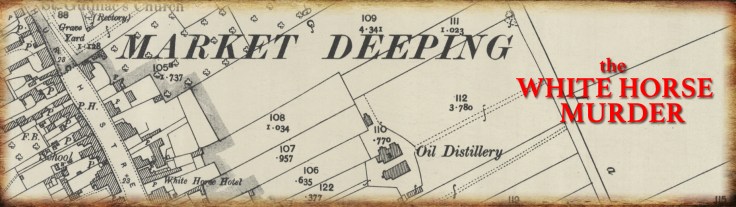
The ancient Lincolnshire town of Market Deeping sits on the north bank of the River Welland, and its many 17th century buildings would have appeared, in 1922, pretty much as they do today. The census tells us that its population had steadily declined from a peak of nearly 1300 in 1871, to 888 in 1921. A small part of this decline was due to the sacrifice paid by the men of the town – in common with almost every other community across the land – during The Great War. 25 men of the town went to war and never returned, and a plaque in their honour was dedicated in St Guthlac’s church in December 1920.

One of the most elegant buildings in the town is The White Horse on Church Street. In 1922 the hotel was run by Edith Caroline D’Arcy, helped by her daughters. She was a widow, her husband William George having died in 1915 at the age of 53. There was great anticipation in the household that September, as there was to be a double wedding. Edith’s youngest daughter, Ivy Dora, was to marry local hairdresser George Prentice on Wednesday 20th, while Edith herself was to end her widowhood by marrying William Kitchener – a signalman from Tallington – on Monday 25th.

The Darcy family had moved around over the years. The 1891 census has George and Edith (and daughter Winifred) living in Penge, with George registered as a jobbing gardener. 1901 has them living in Halfleet, Market Deeping, and they are still there – but with Lucy, Gertrude and Ivy – in 1911. It appears they are living at The Oddfellows’ Arms, a Market Deeping pub long since gone.

1911 census

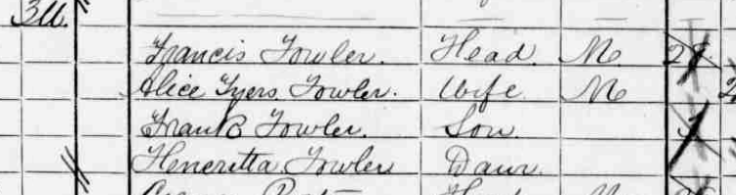
The D’Arcys seemed to be hardworking and a close family. Perhaps the same could not be said of Frank Fowler’s background. He was born in 1886, in  Langtoft, just a couple of miles north of Market Deeping. The 1891 census has him living with his parents Francis and Alice.

Fowler 1891

Frank FowlerBy 1901, however, he is still living in Langtoft, but with his grandparents Henry and Alice Rosling. His parents, along with daughter Henrietta and a younger son, Robert, had moved to Pickworth, 8 miles east of Grantham. One can only speculate why they left Frank – still only fourteen – behind. It is possible that there was no sinister reason behind this, as by then he may have been working, but it is not mentioned on the census return. In 1911 he is still living with his grandfather – now a widower – and certainly working on a farm. It seems he was either conscripted or joined up to fight in The Great War (pictured left), survived, and returned to Lincolnshire. In 1922 he was managing a farm owned by his aunt, a Mrs Ormer, and was a regular customer at The White Horse. It also seems he had developed an interest in the landlady’s daughter – Ivy Dora D’Arcy.
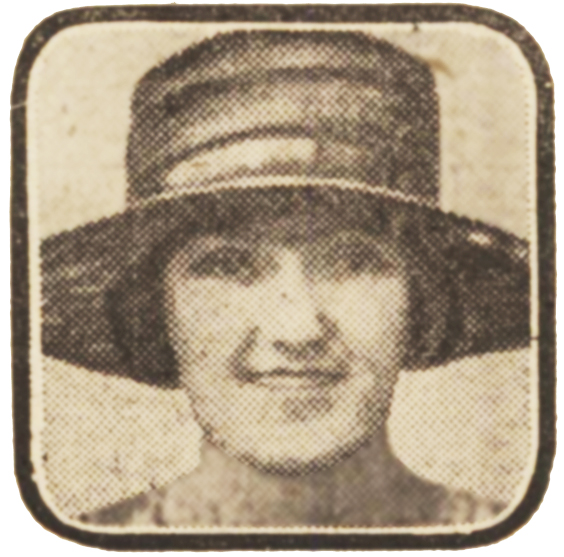
With all the characters in place, we must now move on to the events of the third week of September 1922. On the Wednesday, Ivy and George were married. They had not yet set up house together, but were staying in one of the guest rooms of The White Horse, helping prepare for Edith’s own wedding, scheduled for Monday 25th September. On the evening of Saturday 23rd, Edith and two of her daughters – Gertrude and Ivy (below) were in a candle-lit back parlour of the hotel, looking at some of Edith’s wedding presents. Suddenly, the door was violently kicked open, and a deafening blast of a shotgun doused the candle and plunged the room into darkness.

IVY DORA

IN PART TWO

A grisly discovery
A wedding and a funeral
Trial and retribution

THE FRITH BANK HORROR . . . A savage murder in 1901 (part two)

FBH header

SO FAR – March, 1901. William Kirk, by trade a plate-layer for The Great Northern Railway lives with his wife and younger children in a modest cottage beside Frith Bank Drain, just north of Boston, Lincolnshire. He has been unable to work for some time, and is convinced that his wife Ellen is having an affair with a younger man – farmer Henry Robinson. Ellen has temporarily gone to stay with the Robinsons – just the other side of the Frith Drain – as Mrs Eliza Robinson is due to give birth, and has asked for nursing.

A newspaper reported on the violent events of Friday 22nd March 1901.

The Murder

Kirk, having virtually decapitated his wife, and threatening to do likewise with Henry Robinson – the man he thought was cuckolding him – headed back to his own home, covered in Ellen’s blood, and with her desperate screams no doubt echoing in his head. Was he insane, as his legal defenders were to claim late, or was it that terrible male anger – repeated in murder after murder over the years – at his woman becoming more attracted to someone else?

Kirk made no attempt to escape the area, but put up a fierce struggle with the police and was soon in custody. The next step was the inquest into the death of Ellen Kirk, and it was held in a back room of The Malcolm Arms, a nearby pub (pictured below)

Malcolm Arms copy

The proceedings were grim for all those present, but the law had to take its course. Unlike today, where news is instant and digital, court reports sold newspapers.

THE INQUEST AT SIBSEY. VERDICT OF WILFUL MURDER AGAINST KIRK

The inquest was opened by the District Coroner (Dr. F. J. Walker, at the Malcolm Inn, Anton’s Gowt, Sibsey, at three o’clock this afternoon. The inn is a quaint brick building, with an old-fashioned swinging sign standing up from pillar on a stone base in front of the house, and is in a picturesque situation. The gowt’s bridge, from which the neighbour takes its name, is close to hand. The inquiry was held in the large parlour, and Mr. Charles Gilliatt was foreman of the jury. Supt. Wood, of the Spilsby police, Supt. Costar, the North Holland police, and Supt. Adcock, of the Boston Borough police, were present. The Coroner having formally opened the inquiry, the jury retired to view the body. On their return Fred Kirk, the accused’s son, was the first witness called. He identified the body as that of his mother, and said she was 46 years of age. He last saw her alive on Friday night. He did not see her again until that day.

In reply to Supt. Wood, witness said was in service at a farm close by, and went home on Thursdays and Sundays. On Thursday night, in answer to a note from his mother, he visited her at the house of Mr. Robinson, Frith Bank. In the kitchen he found his father and mother with Mr. Robinson and   the servant girl. Some unpleasantness had evidently occurred between his father and mother. His father said he should not. allow her to stay at Mr. Robinson’s until Tuesday. Witness tried to persuade his father to treat his mother more kindly.

After a time witness and his father left the house together, and went to his father’s house, where they slept, instead of witness returning to his situation. On the way his father promised to treat his mother more kindly, and said he would go and see after a job at Higdon’s. He would go there on Lady-day. On Thursday morning, at about 11.30, witness was passing Mr. Robinson’s house, and he saw his mother near the front gate. His father was standing also some distance off. His mother made complaint to witness of his conduct towards her. His father came up and said, “What is she she telling you now?” After further conversation, witness went along the road in the direction of his own home.

Henry Robinson, a pleasant-looking young farmer, was the next witness. He said he lived on Frith Bank. On Tuesday evening, Ellen came to nurse his wife. On Friday morning Kirk came into the house, and sat in the kitchen. Witness was in the room about a quarter of hour, and while he was there, there were some words between Kirk his wife. Witness afterwards went about the premises as usual about his work. At about 9.30 maid-servant, Amy Barber, called him into the house where he saw Ellen Kirk lying on the ground with her head on a block wood. Kirk was leaning over her with knife razor cutting the back of her neck, holding the head with his hand.

Witness at once shouted “What are you doing?” Kirk did not answer, but got up, and ran at witness with the weapon in his hand. Witness fetched a manure fork, and told Kirk leave his wife alone, he would knock him down. Kirk then went away. Witness fetched a man named William Bedford, who was at the brickyard close by. On looking at the body, witness found it was lifeless.

Dr. Reginald Tuxford was called. He said on Friday morning went see Mrs. Robinson and found he had already been sent for to see a woman who was lying in the back yard with her throat cut. She was quite dead, and death had taken place immediately. Witness had further examined the body that day and found a large gaping wound in the chin, running across the neck. The blood vessels on the left side were completely divided, and the wind pipe and gullet were separated. There were two or three gashes on the left of the face, near the jaw bone. In addition to these there was a wound at the back of the neck reaching nearly from ear to car, and also a wound down the vertebral column. Witness had also examined the internal organs of the deceased and found them healthy, with the exception of the kidney. The body was absolutely bloodless. He came to the conclusion that death was caused by shock following upon haemorrhage from the injuries caused to the threat.

Screen Shot 2022-05-28 at 15.20.16

Screen Shot 2022-05-29 at 20.07.34Inevitably, William Kirk was found guilty of murder, and his case was sent to the July Assizes in Lincoln. The trial, presided over by Mr Justice Wright (left) was a formality, and Kirk was sentenced to be hanged. Just days before he was due to meet James Billington for the first – and only time – the powers that be judged that he was insane at the time of the killed his wife, and he was reprieved, and sent to Broadmoor.

The future lives of the Kirk children are beyond the scope of this story, but one can only hope that they were not permanently traumatised by the killing of their mother. It is reported that Kirk wrote several letters to them while he was awaiting execution, but none of them ever came to visit him. Public records show that the death of a William E KIrk was registered at Easthampstead, Berkshire, in the summer of 1916. Easthampstead was almost certainly where deaths in Broadmoor were registered, so it seems Kirk reached his allotted three score years and ten without ever leaving the secure hospital. The one flicker of light in this sad tale is that the 1901 census records that the Robinson household now included Walter, aged just two weeks, so it is good to know that the murder of Ellen Kirk had no lasting effect on the woman she was nursing, or the baby she was hoping to help bring into the world.

FOR OTHER LINCOLNSHIRE MURDER STORIES, CLICK THE IMAGE BELOW

County Map

THE FRITH BANK HORROR . . . a savage murder in 1901 (part one)

FBH header

Frith Bank Drain is one of the innumerable channels which bisect the flat lands around Boston. Parts of the area are fens, meaning land reclaimed from fresh water inundation, while others are marshland, i.e. land recovered from salt water flats. Needless to say, the land rarely rises to much more than a couple of metres above sea level and, visually, it presents the visitor with huge skies and long horizons.

Our story centres on two people who lived beside the Frith Bank Drain. William Enoch Kirk was born in the village of Kirkstead in 1846. Kirkstead sits on the River Witham and at Anton’s Gowt, the Frith Bank Drain branches eastward. Gowt, by the way, is believed to be a corruption of ‘go-out’, meaning a sluice or outlet. Ellen Mountain was born in Boston in 1853. Her parents lived in Blue Street. A newspaper report contemporary to the tragic events about to unfold wrote:

Wedding copy

Will and Ellen lived at Kirton for a time, but eventually moved to Frith Bank. Will had a decent job as a plate-layer with the Great Northern Railway Company, and their modest cottage overlooking the Frith Bank Drain was described as “a pleasantly situated dwelling of the plain brick type, comfortable if not exactly roomy within. Attached is a piece of garden land, whereon much produce is cultivated, and the rent is only £5 year, and there were a couple of pigs in the sty, so the family lived “passing well.”

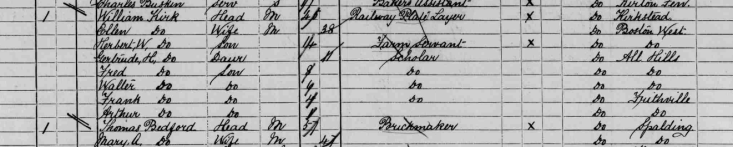
The 1891 census tells us that the Kirks had six children ranging in age from Herbert (14) to Arthur (1).

1891

The address is given as 1 Frith Bank Road which, if we follow modern numbering, puts in north of the drain, but a newspaper reported that the Kirk’s house was on the Boston side of the drain. The adjacent page of the census mentions Pepper Gowt Lot and part of Tattershall Road, which seems to confirm that.

It is rather ironic that when the 1901 census was taken, on the evening of Monday 1st April, the Kirk family were no loner a unit. Arthur, for example, now 11 years old, was described as a boarder in the house of George and Ellen Taylor, of Frithville, while Frank Kirk, again described as a boarder, was living with Henry and Caroline Nixon, Henry Nixon being a stockman on a nearby farm.

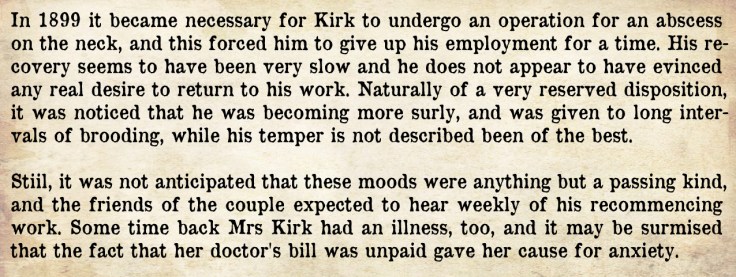
The circumstances that led to the terrible events of 22nd March, 1901 are, again, best described in the words of a contemporary newspaper report.

Illness

Money – or the lack of it – was clearly preying on Ellen Kirk’s mind, and she was glad to be offered paid employment as a nurse to supervise the impending birth of a child to Eliza Robinson, the wife of Henry Robinson, who ran a farm on the other side of the Frith Bank Drain. Although the two households were almost a stone’s throw from each other, Ellen Kirk had to cross a trestle footbridge (almost certainly the one pictured below) across the drain to be at the Robinson home. She told William that she would be staying there until the new baby was safely brought into the world.

Footbridge

For reasons best known to himself, William Kirk was convinced that the main reason for Ellen’s visits to the Robinson’s house was that she was having an affair with Henry. In the days leading up to 22nd March, he was haunting the house, turning up at all hours and demanding to speak to his wife.

IN PART TWO
The dreadful events of Friday 22nd March 1901
A family is destroyed
Another job for Mr James Billington

DEATH COMES TO BINSWOOD END . . . a dark deed in 1920s Harbury (2)

Harbury header

SO FAR –  Harbury, 1922. Rugby ne’er-do-well William Rider bigamously married Rosilla Patience Borton in 1918. As well as mistreating her, he has become  involved with her (under-age) sister Harriet. Rosilla has left the house in Pennngton Street, Rugby, to seek protection with her mother in the house at Binswood End, Harbury.

Rachel Freeman, Rosilla’s mother, hearing rumours that William Rider has been the seen the previous evening in the area, on the morning of Thursday 7th September had tried to make the house secure fearing that he was a threat. At the coroner’s inquest into the death of Rosilla, Mrs Freeman was questioned about her fears:

Coroner

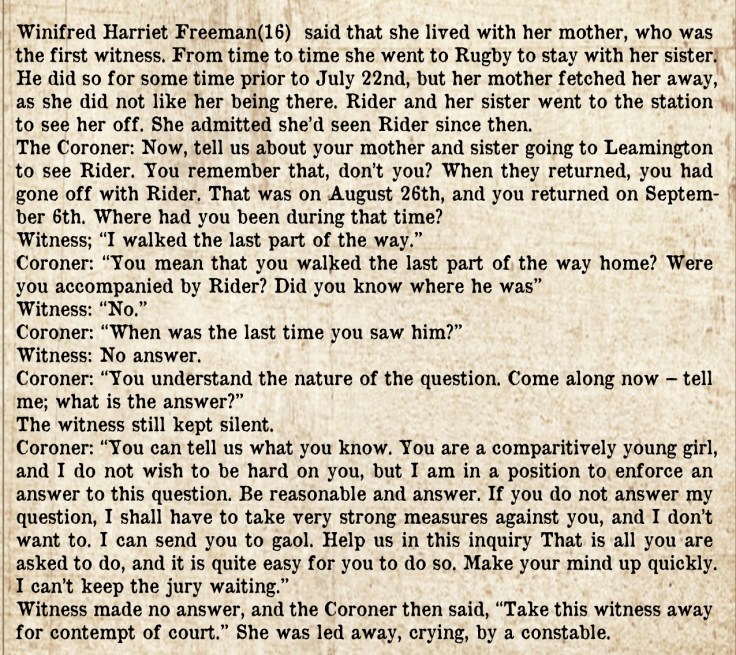
The next witness called was Harriet, who had been an apparently willing victim of Rider’s womanising. Despite the fact that she knew Rider had just murdered her sister in cold blood, she was what the papers called ‘a recalcitrant witness.’

Harriet

Rider claimed that he had taken the gun only to scare Rosilla into returning to him, and that it had gone off accidentally when she grabbed it in self defence. Rosella had been shot dead with a cartridge from a 16 bore gun. The medical examiner estimated that there were over one hundred pellets from the cartridge embedded in her skull. Neither the coroners inquest nor the magistrates’ court considered Rider’s version of events credible, and he was sent to face trial at Warwick Assizes in November. Meanwhile local papers covered the mournful event of Rosilla’s funeral.

Funeral

Screen Shot 2022-05-19 at 20.13.36

Rider’s trial began on Friday 17th November 1922. Mr. O’Sullivan and Mr. Bartholomew appeared for the prosecution, and Rider, who pleaded not guilty in a firm voice, was defended by Mr. Harold Eadon. In his opening address Mr. O’Sullivan, after outlining the facts of the case, submitted it was clear case of deliberate and premeditated murder. When Rider finally came to the witness box his story was that he had spent the night in the lavatory of the house, and had the gun so he could go out in the morning to shoot rabbits. He said that he went upstairs to see Rose, and she made a gesture from the bed which he interpreted as her wanting him to kiss her. As he stooped down to do so, Mrs Freeman ‘mistaking his kind gesture as a threat’ sprang from her bed and tried to grab the gun, at which point it went off, killing Rosilla instantly.

As preposterous stories go, Rider’s was up there with the best, and the jury took little time in pronouncing him guilty, at which point the judge donned the black cap.

Presiding over Warwick Assizes that November was Montague Lush ( above left) Wikipedia says of him:

“He retired from the bench in 1925 due to deafness, and was made a Privy Counsellor the same year, although he never sat on the Judicial Committee of the Privy Council. Although highly regarded as a barrister, he was not a successful judge: he was said to be too diffident and sometimes let personal feelings influence his decisions.”

William Rider’s legal team may have sensed that Mr Justice Lush’s mediocre reputation  gave them a chance of overturning the death sentence. It was not to be. The appeal was made before The Lord Chief Justice, Gordon Hewart but, like the relatively lowly Southam coroner and magistrates before him, he believed that William Rider was, by the standards of the time, unfit to walk among his fellow men. Regional newspapers across Britain carried this simple story on Tuesday 19th December 1922:

Penalty

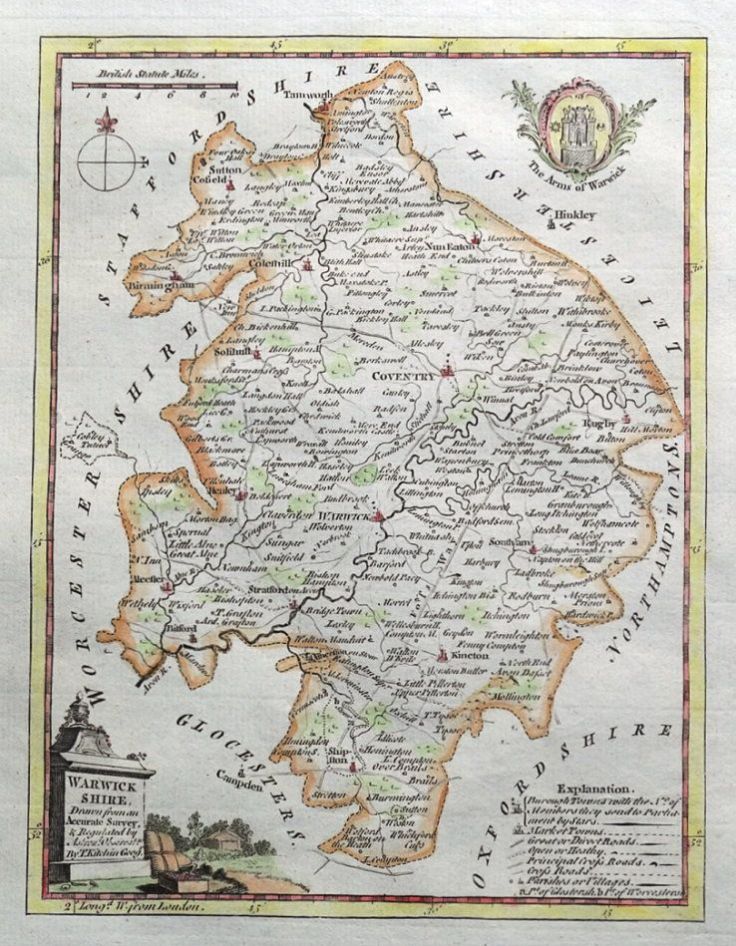
FOR MORE WARWICKSHIRE MURDERS, CLICK THE IMAGE BELOW

Warwickshire

Blog at WordPress.com.

Up ↑