
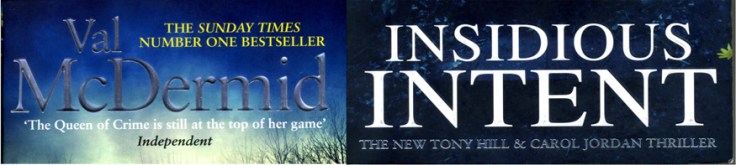
Crime Fiction’s Most Distinctive Odd Couple? There would be several nominations in this category, were it to be at an awards dinner of some kind. You can make your own suggestions, using whatever criteria you wish; eccentricity, diversity of character and background, problem-solving methods – the choice is yours. I am going for sheer darkness, grim back stories, and an occasional incompatibilty that sometimes verges on the disastrous, but also a symbiotic need for each other that has no sexual element but is unique in the annals of crime fiction If this sounds like the relationship between DCI Carol Jordan and clinical psychologist Dr Tony Hill, then we are spot on.
Val McDermid introduced them to us in 1995, with The Mermaids Singing, and now they are back for the tenth episode in their turbulent career. As we turn the first page, Jordan is already in trouble. She has tried to drink her way out of the life-shattering experience of feeling responsible for the terrible murders of her brother and his wife but, inevitably, one glass too many has resulted in a drink driving charge. Her bosses, not always as supportive, have conspired to declare the breathalyser equipment faulty, and Jordan is aquitted. But, having been tested with the same equipment, so is hell-raising young driver Dominic Barrowclough. When Barrowclough celebrates his freedom by killing himself and four other road users, Jordan’s guilt begins to reach crisis level.
 But there is still a job to be done, and in Carol Jordan’s case this is to head up a new police unit, called ReMIT – Regional Major Investigations Team – and their first case is a shocker. In a windswept lay-by on a lonely moorland road, a car is discovered, blazing out of control. When the flames die back sufficiently for the emergency services to get close, the charred remains of a young woman are discovered in the driving seat. The post mortem reveals that she has been strangled, and the blaze started, of all things, by a large box of potato crisp packets. Another such death soon follows, and the ReMIT team discover that they are dealing with a supremely clever killer who befriends his victims at weddings. He ‘crashes’ the wedding with consummate ease, and then targets young women who have attended the wedding unaccompanied. Spinning a yarn that he is a widower still mourning his late wife’s death from cancer, he seems to be the perfect gentleman. Caring, considerate, sexually undemanding – to the unfortunate women he seems like all their Christmases have come at once.
By sheer persistence and a stroke of good fortune, Jordan and her team find themselves a suspect, a young businessman called Tom Elton. But the evidence against him is, at best, circumstantial, and he attends the police interview alongside one of the smartest and most abrasive criminal defence lawyers in the region. Elton is scornful, triumpant, and he literally laughs in the faces of his accusers.
“I thought you lot were supposed to be the elite? I remember the news stories when you were formed. Top Guns, they said,” He scoffed, “Top Bums, more like. If I was your man, I’d be dancing in the streets. With you lot running the show, anyone could get away with murder.”
All the while, as the investigation gathers speed – and then founders – McDermid demonstrates why she is considered by many to be the greatest contemporary British crime writer. The black clouds loom ever lower over Carol Jordan. Her team, some with their own demons to exorcise, look in vain to their boss for inspiration, while Tony Hill, perhaps for the first time in his career, can see no obvious way out of their travails.
Thomas Hardy, in his Wessex novels, was the master of wicked coincidences; a misinterpreted gesture, words said or unsaid, a lover innocently going to the wrong church for her wedding – these all set in train events which will bring the worlds of these characters down around their heads. McDermid creates one here, albeit one very much of the 21st century. and it contributes to the dramatic and totally unexpected finale of this fine novel. Insidious Intent came out in hardback and Kindle in 2017, and this paperback edition will be available on 22nd February from Sphere.


 In this febrile atmosphere are many men and women who have memories of “the last lot”. One such is the latest creation from Jim Kelly, (left) Detective Inspector Eden Brooke. He saw service in The Great War, but were someone to wonder if his war had been ‘a good war’, they would soon discover that he had suffered dreadful privations and abuse as a prisoner of the Turks, and that the most physical legacy of his experiences is that his eyesight has been permanently damaged. He wears a selection of spectacles with lenses tinted to block out different kinds of light which cause him excruciating pain. For him, therefore, the nightly blackout is more of a blessing than a hindrance.


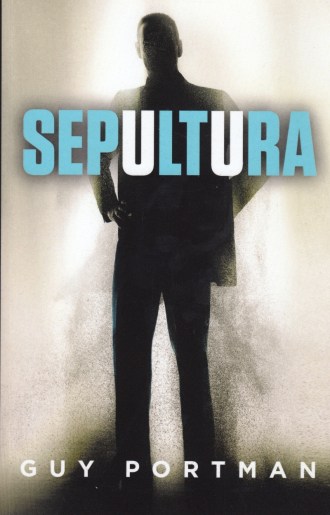 I must explain the apparent digression before you lose interest. Use your imagination. Conjure up a dreadful genetic experiment which breeds a being who, especially in his diarist’s style of first person narrative, shows very Pooteresque tendencies. But – and it is a ‘but’ the size of a third world country – the mad scientist has added Norman Bates and Hannibal Lecter into the mixing bowl, and then seasoned it with an eye-watering pinch of Patrick Bateman. What do you get? You get Dyson Devereux, Head of Cemeteries and Burials with Paleham Council.
 The trip to Italy temporarily removes Dyson from the cross-hairs of the local police, and also the relatives of the late lamented Jeremiah, who are out for vengeance. What follows is brilliantly inventive, murderous and breathtakingly funny. Guy Portman doesn’t reveal too much about himself, even on


 Amy Lloyd (right) makes sure that fans of Southern Noir who enjoy a tumbledown and gothicky old house in the Florida badlands are not disappointed. If you enjoy the odd sinister Sheriff, townsfolk who don’t hold grudges for much more than eighty years, and mentally disturbed teenagers in the body of a forty year-old man, you will not come away empty handed. But The Innocent Wife is much more subtle. As we follow the tortuous marriage of Sam and Dennis, we are reminded of the shocking consequences of ill-advised relationships forged on the flimsy anvil of whichever social media platform is currently in vogue. A chilling wind of truth blows through the narrative as we realise that the inch-thick perspex that separates prisoners from their visitors is a compelling metaphor for the separation which exists between people who only communicate via Facebook or Instagram.


 We are taken to an autumnal Boston. Initially, Warren has nothing more on her mind than the consequences of giving in to the demands of her young son that they should adopt a dog. Her domestic reverie is rudely and violently interrupted when she is called to a house in the Brighton district of the city, where she is confronted by a scene of carnage. Householder Charlie Boyd is sitting on his sofa, as dead as a doornail. His girlfriend Juanita Baez is in the kitchen, shot as she was taking something from the cupboard. In the bedroom, even worse horrors await. Lola and Manny Baez, two of Juanita’s children, are clasped in a protective embrace, but just as dead as the adults.


 Jo Spain not only takes on the challenge, but she meets it head on and completes it with subsequent pages of The Confession which manage to be, as night follows day, bravura, intense, full of authentic and convincing dialogue, utterly mesmerising and, in places, literally breathtaking. A countryman of Spain’s began his most famous novel with “Stately, plump Buck Mulligan came from the stairhead, bearing a bowl of lather on which a mirror and a razor lay crossed.” She counters with:
 Of course, we get there in the end, and understand why JP Carney has exacted such an emphatic revenge on the handsome, charismatic and plausible Harry McNamara, but sometimes book reviews have to stop dead in their tracks, and say, “Trust me, this is a brilliant novel, but to tell you any more would be little short of criminal.” Yes, The Confession is a brilliant novel. Yes, I read it through in one sitting, deep into the early hours of a winter morning. Yes, I am a fan of Jo Spain (right). Yes, if you don’t get hold of your own copy of this, you will receive scant sympathy from me. The Confession is published by Quercus, and will be on sale as a Kindle from 11th January, and as a hardback from 25th January. Check online buying choices

 James Lee Burke (left) turned 81 in early December 2017. When I picture the face of his majestic but flawed hero, Dave Robicheaux, it is his creator’s face I see. The Robicheaux books have been filmed several times but the best one I have seen is In The Electric Mist (2009) starring Tommy Lee Jones, and Mr Jones is good a ringer for Mr Burke – and my vision of Robicheaux – as you will ever see.
 “That weekend, southern Louisiana was sweltering, thunder cracking as loud as cannons in the night sky; at sunrise, the storm drains clogged with dead beetles that had shells as hard as pecans. It was the kind of weather we associated with hurricanes and tidal surges and winds that ripped tin roofs off houses and bounced them across sugarcane fields like crushed beer cans; it was the kind of weather that gave the lie to the sleepy Southern culture whose normalcy we so fiercely nursed and protected from generation to generation.”


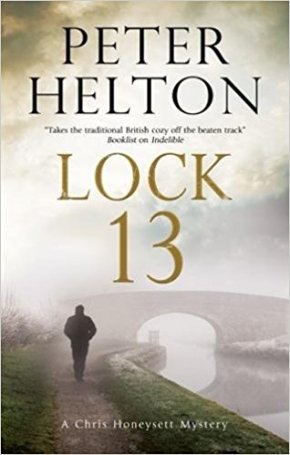 Lock 13 features Chris Honeysett, a private detective whose cases I had never read before, despite this being the sixth in what is clearly a popular series. The previous episodes are Headcase (2005), Slim Chance (2006) Rainstone Fall (2008) An Inch of Time (2012) Worthless Remains (2013) and Indelible (2014). Honeysett, like his creator Peter Helton (more on Helton’s website
  Sometimes a novel is so delightfully written that a reader can reach the last page with a smile and sense of contentment, despite the fact that nothing very dramatic or shocking, at least by the standards of some modern thrillers, has happened during the 200 pages or so which have made up the narrative. Lock 13 is one such book. Peter Helton (right) tells the story through the eyes of Chris Honeysett, and the style is fluent, conversational, occasionally erudite, often witty – but always very, very, readable. Established fans of the Honeysett series can feel duly smug that the amiable painter-sleuth has found another convert, and they can rest assured that I shall be working my way through the file of Honeysett’s previous cases. Lock 13 is published by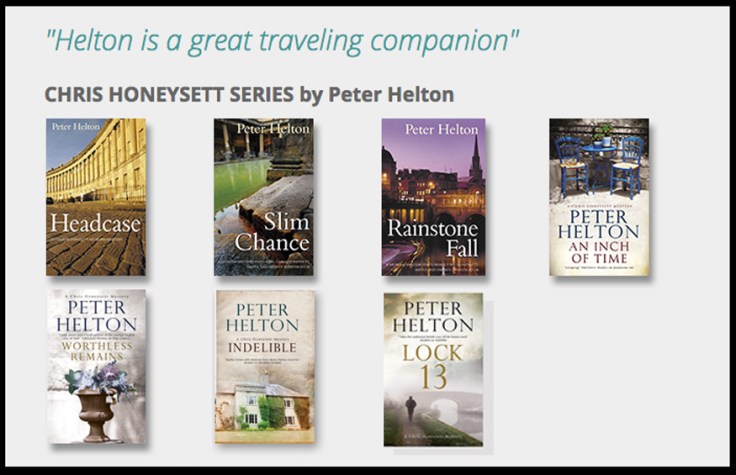

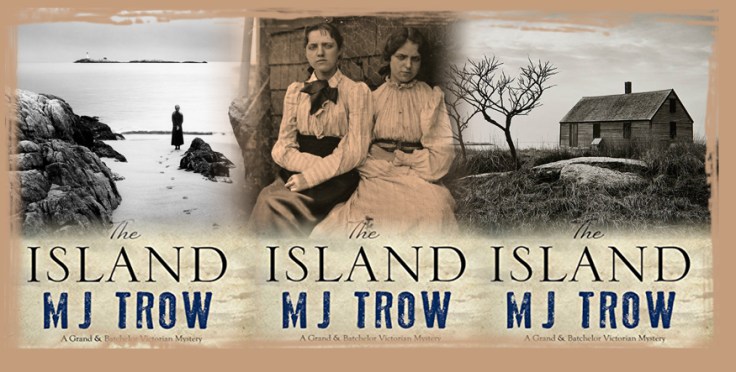
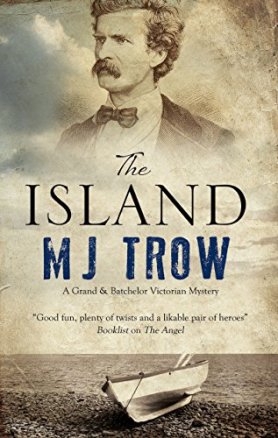 The Island is the latest episode in the eventful partnership between two gentleman detectives in Victorian London. James Batchelor is a former journalist, a ‘gentleman’ in manners and intelligence, if not by upbringing, while his colleague Matthew Grand is an American former soldier, and scion of a very wealthy patrician New Hampshire family. We first met them in
  A few words in praise of the author. Meiron Trow (right) is one of the most erudite and entertaining writers in the land. Over thirty years ago he began his tongue in cheek series rehabilitating the much-put-upon Inspector Lestrade, and I loved every word. I then became hooked on his Maxwell series, featuring a very astute crime-solving history teacher who, while eschewing most things modern, manages to be hugely respected by the sixth-formers (Year 12 and 13 students in new money) in his charge, while managing to terrify and alarm the younger ‘teaching professionals’ who run his school. I was well into the Maxwell series before I realised that MJ Trow and I had two things (at least) in common. Firstly, he went to the same school as I did, although I have to confess he was a couple of years ‘below’ me and would have been dismissed at the time as a pesky ‘newbug’. Secondly, and much more relevant to my love of his Maxwell books, I discovered that we were both senior teachers in state secondary schools, and shared a disgust and contempt for the tick-box mentality characterising the so-called ‘leadership’ of high schools.
 I digress, so back to New Hampshire in the early spring of 1873. The guests begin to arrive, and the ‘downstairs’ staff under the stern eye of the enigmatic butler, Waldo Hart, are emulating the proverbial blue-arsed fly. Trow, at this point, gleefully takes the template of the traditional country house mystery, and has his evil way with it. Despite the title of the book, we are not quite in Soldier Island (And Then There Were None) territory, but Rye is far enough from Boston to make sure that when the first murder happens, the real policemen are too far away and too engrossed with their city crime to pay much attention, even when when of the possible suspects is a certain Mr Samuel Langhorne Clemens. (left)


