
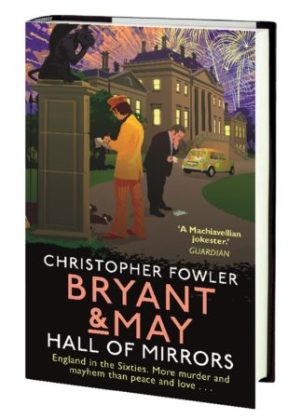
 If a more extraordinary duo of fictional detectives exists than Christopher Fowler’s Bryant & May, then I have yet to discover them. The peculiar pair return in Hall of Mirrors for their fifteenth outing, and this time not only are they far from their beloved London, but we see a pair of much younger coppers on their beat in the 1960s. Fowler’s take on the period is typified by each of the fifty chapters of the novel bearing the title of a classic pop hit. We are also reminded of the strange fashions of the day.
“Two young men in Second World War army uniforms painted with ‘Ban The Bomb’ slogans were arguing with a pair of Chelsea Pensioners who clearly didn’t take kindly to military outfits being worn by trendy pacifists. They were briefly joined by a girl wearing a British sailor’s uniform with a giant iridescent fish on her head.”

In attempt to keep them out of trouble, our heroes are given the task of being minders to an important witness in a fraud trial, but Monty Hatton-Jones is due at a country weekend party deep in rural Kent, and so John and Arthur must accompany him to Tavistock Hall. What follows is a delicious take on the Golden Age country house mystery, with improbable murders, secret passages, an escaped homicidal maniac and suspects galore. Things are complicated by nearby military manoeuvres involving the British army and their French counterparts. Fowler (above) reprises the great gag from Dr Strangelove – “Gentlemen – you can’t fight in here. This is the War Room!” Captain Debney, the British Commanding Officer is having a bad day.
“The menu for tonight’s hands Across The Water dinner has already gone up the Swanee. We had terrible trouble getting hold of courgettes, and now I hear there’s no custard available. I don’t want anything else going wrong. These are international war games. We can’t afford to have anyone hurt.”
The urbane John May is quite at home in the faded grandeur of Tavistock Hall, but Arthur is like a fish out of water. He also has an aversion to the countryside.
“It appeared to be the perfect Kentish evening, pink with mist and fresh with the scent of the wet grass. Bryant looked at it with a jaundiced eye. There was mud everywhere, the cows stank, and were all those trees really necessary? As a child he had been terrified of the bare, sickly elm in his street with a branch that scarped at his bedroom window like a witch’s hand and sent him under the blankets.”
As usual with the B & M books, the jokes come thick and fast, but we are reminded that Fowler is a perceptive and eloquent commentator on the human condition. Arthur investigates the local parish church as its rector, Revd Trevor Patethric is a house guest – and suspect.
“Bryant pushed open the church door and entered. He had never felt comfortable in the houses of God, associating them with gruelling rites of childhood: saying farewell to dead grandfathers, and the observance of distant, obscure ceremonies involving hushed prayers, peculiarly phrased bible passages, muffled tears and shamed repentance.”

Eventually, of course, the pair – mostly through Arthur’s twisted thought processes – solve the crimes. Prior to revealing his theories on the murder to the assembled guests, however, Bryant has a slight misfortune with a missing painting hidden in a very unswept chimney. Covered in soot, he somehow lacks the gravitas of a Poirot or a Marple.
“Bryant had made a desultory attempt to wipe his face, but the result was more monstrous than before. He rose before them now, a lunatic lecturer in the physics of murder.”
Reading a crime novel shouldn’t be about being educated, but Hall of Mirrors teaches us many things. Those who didn’t already know will learn that Christopher Fowler is a brilliant writer. He is, in my view, out on his own in the way he weaves a magic carpet from a dazzling array of different threads: there is uniquely English humour, the sheer joy of the eccentricities of our language and landscape, labyrinthine plotting, and an array of arcane cultural references which will surely have Betjeman beaming down from heaven. Those of us who, smugly perhaps, consider ourselves as old Bryant & May hands will also now know the origins of Arthur’s malodorous scarf and also his cranky, clanky Mini.
Amidst the gags, the fizzing dialogue and the audacious plot twists Fowler waves his magic wand, and with the lightest of light touches dusts a page near the very end with poignancy and great compassion. Look out for the section that ends:
“Bryant looked in his mirror to try and catch another glimpse of them, but they had disappeared, ghosts of a London yet to come.”
And do you want to know the best five words of the entire book? I’ll tell you:
Bryant and May Will Return
Hall of Mirrors is published by Quercus, and is available from 22nd March.


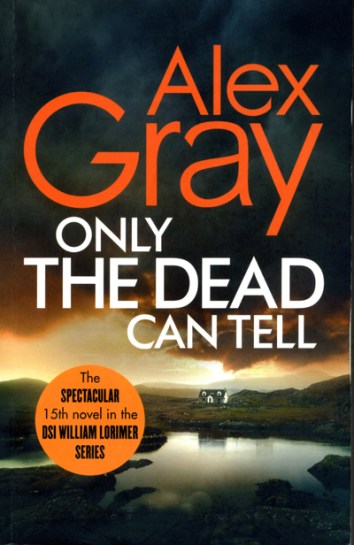 Lorimer has become bogged down in a partially – and only partially – successful investigation into murder, prostitution and people trafficking based in Aberdeen. In the Granite City some entrepreneurs, denied a living by the decline in the oil and gas industries, have taken to trading in other commodities – human lives. However, to borrow the memorable line from The Scottish Play, Lorimer’s team have “scotch’d the snake, not kill’d it.” The head of the gang responsible for taking young and innocent Romany women from impoverished Slovakian villages, and setting them to work in Scottish brothels is known only as “Max”. The very mention of his name is enough to silence witnesses, even those who have every reason to long for his downfall. But how – if at all – is Max connected to Peter Guilford, arrested for his wife’s murder, but now beaten within an inch of his life while on remand in Glasgow’s Barlinnie prison?
 The British police procedural – the Scottish police procedural, even – is a crowded field, and each author and their characters tries to bring something different to choosy readers. Where Alex Gray (right) makes her mark, time and time again, is that she is unafraid to show the better things of life, the timeless touches of nature in a summer garden, or the warmth of affection between characters, particularly, of course, the bond between William and Margaret Lorimer. Here is one such moment:
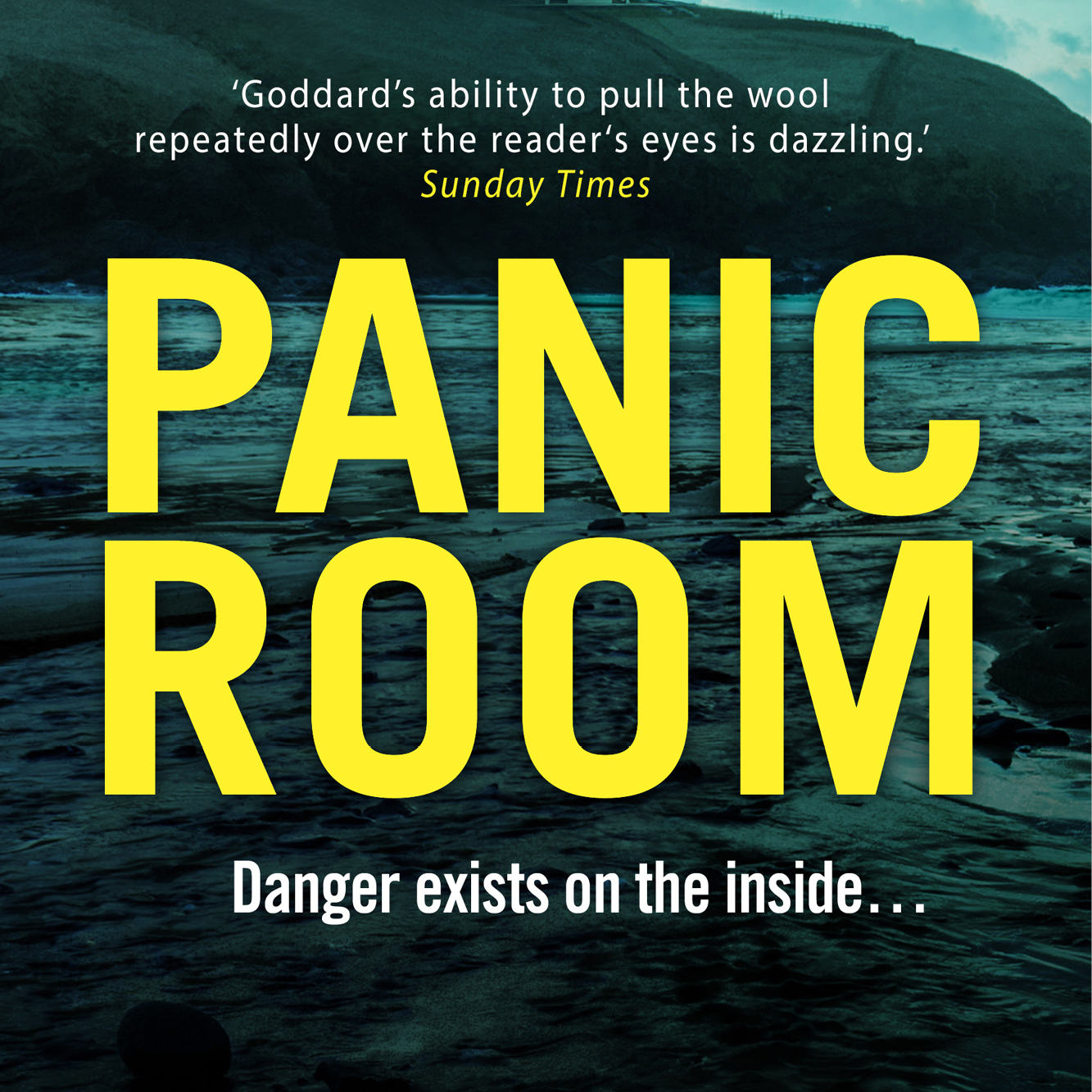
 Don Challenor is what Monty Python might have called at ex-estate agent. He is no more. He has over-egged his last pudding and hyped up his last hovel. The prestigious London property sellers Mendez Chinnery have, as the saying goes, let him go. He has been, to quote the late lamented Alan Clark, economical with the actualité once too often. He is at that stage of life when it is becoming harder and harder to slip into a new job. Not only is he sans employment, but he is also sans wife. Fran has married again and is still lawyering away, but with a new husband and his children. Challenor is surprised, then, when she makes contact to offer him a cash in hand one-off job. It sounds simple. He is to travel down to Cornwall, assess an executive-style property, and present her with a glowing file which will attract well-heeled buyers like moths to a flame. The house, Wortalleth West, was formerly owned by millionaire businessman Jack Harkness, but it has now been signed over to his former wife as part of a divorce settlement.


 Thor scrapes by as a barman in a local pub, and has a rudimentary bedsit over the local post office, but his world is turned on its head when he discovers that someone is trying to kill him. Not without taking a knock or two, Thor survives, and concludes that the attempts on his life are connected to the efforts of developers to buy up his patch of the Loxley land to add to a much bigger chunk of Crook territory. The result will be thousands of newcomers to the area, complete with pressing demands for new schools, new infrastructure and new services.
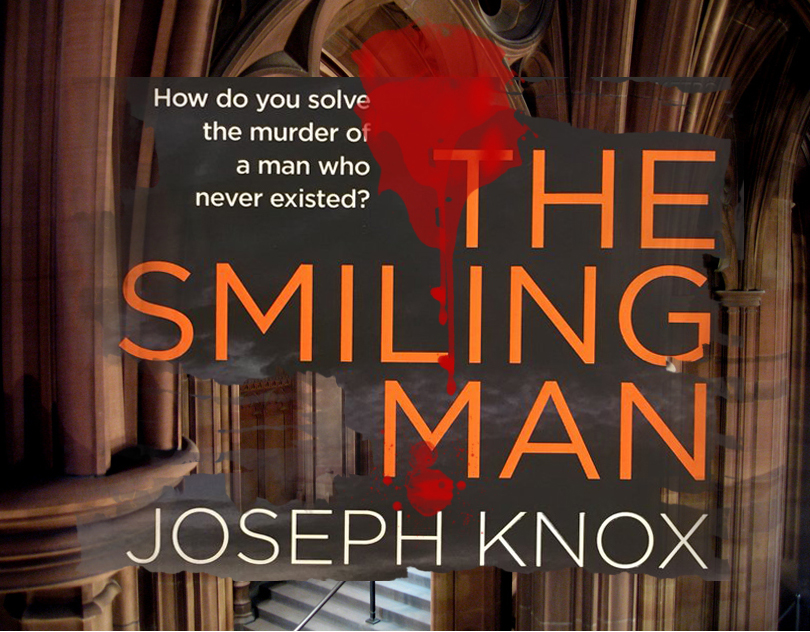

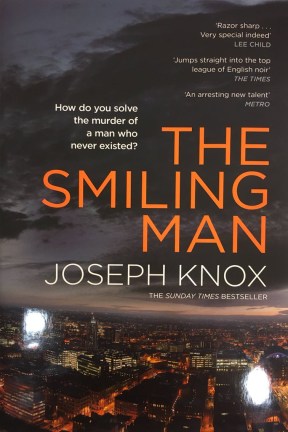 This is all too much like hard work for Sutcliffe, but despite warnings from his saturnine superior, Superintendent Parr, Waits digs deeper. He uncovers a labyrinthine series of connections between an absent solicitor doing his rich-white-man things among the bar girls of Thailand, an apparently gay businessman and his estranged wife, the corpse (now renamed The Smiling Man), and another hotel room, its floor saturated with pint after pint of human blood.
 This is little short of a modern masterpiece. You might imagine Joseph Knox (right) to be a weathered, life-weary cynical misanthrope, hunched in a corner of the pub, savouring a roll-up, rather like a latter day Derek Raymond, but anyone who has had the privilege of meeting Joseph will know that this is far from the case. He is well versed in the art of Noir, though, as he revealed when he spoke to us around the time that his first novel, Sirens, was published.

 Wolfe survives, and shoulders his way into the hit team which raids a nondescript terraced house in Borodino Street in East London. Their target? To capture two Pakistani brothers who have adapted simple commercially available drones into weapons of terror. Needless to say, the raid does not go according to plan. The lead police officer is shot dead at the outset, by one of the brothers disguised in a niqab. He is eventually shot dead, as is the remaining brother. But there are questions raised about the death of the latter. Was he shot as he was trying to surrender, or was he simply assassinated by a vengeful police marksman? And where are the two ex-Croatian hand grenades which informers say had been sold to the Khan brothers?
 The novel frequently holds you by the hand – no, make that puts you in an arm lock – and takes you to places you would rather not go. Parsons (right) is not someone with a well stocked cupboard full of tea lights, bunches of flowers and anodyne pleas for togetherness. He is not going to link arms with anyone and place these tributes at scenes of murder and carnage. Least of all will he, via Max Wolfe, be tweeting Je Suis Borodino Street any time soon. Some might say that for a humble DC, Max Wolfe certainly seems to get about a bit, but this is an irrelevant criticism, because what he thinks and sees are essential to the story. Wolfe is a a man of deep compassion and perception. Not only is his narrative reliable – it is painfully accurate and candid. Readers have, of course, the option of averting their gaze or thinking about gentle deaths in Cotswold villages, solved by avuncular local bobbies. Those who choose not to turn away from this brutal autopsy of Britain – and specifically London – in 2018 will not, I suggest, feel rejuvenated, life-enhanced or particularly optimistic by the end of this novel. Rather, they will follow the emotional journey of the celebrated wedding guest:
 But there is still a job to be done, and in Carol Jordan’s case this is to head up a new police unit, called ReMIT – Regional Major Investigations Team – and their first case is a shocker. In a windswept lay-by on a lonely moorland road, a car is discovered, blazing out of control. When the flames die back sufficiently for the emergency services to get close, the charred remains of a young woman are discovered in the driving seat. The post mortem reveals that she has been strangled, and the blaze started, of all things, by a large box of potato crisp packets. Another such death soon follows, and the ReMIT team discover that they are dealing with a supremely clever killer who befriends his victims at weddings. He ‘crashes’ the wedding with consummate ease, and then targets young women who have attended the wedding unaccompanied. Spinning a yarn that he is a widower still mourning his late wife’s death from cancer, he seems to be the perfect gentleman. Caring, considerate, sexually undemanding – to the unfortunate women he seems like all their Christmases have come at once.


 In this febrile atmosphere are many men and women who have memories of “the last lot”. One such is the latest creation from Jim Kelly, (left) Detective Inspector Eden Brooke. He saw service in The Great War, but were someone to wonder if his war had been ‘a good war’, they would soon discover that he had suffered dreadful privations and abuse as a prisoner of the Turks, and that the most physical legacy of his experiences is that his eyesight has been permanently damaged. He wears a selection of spectacles with lenses tinted to block out different kinds of light which cause him excruciating pain. For him, therefore, the nightly blackout is more of a blessing than a hindrance.


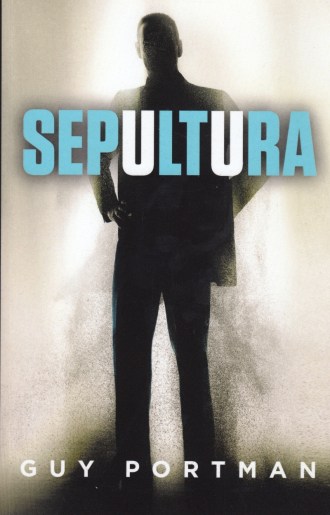 I must explain the apparent digression before you lose interest. Use your imagination. Conjure up a dreadful genetic experiment which breeds a being who, especially in his diarist’s style of first person narrative, shows very Pooteresque tendencies. But – and it is a ‘but’ the size of a third world country – the mad scientist has added Norman Bates and Hannibal Lecter into the mixing bowl, and then seasoned it with an eye-watering pinch of Patrick Bateman. What do you get? You get Dyson Devereux, Head of Cemeteries and Burials with Paleham Council.
 The trip to Italy temporarily removes Dyson from the cross-hairs of the local police, and also the relatives of the late lamented Jeremiah, who are out for vengeance. What follows is brilliantly inventive, murderous and breathtakingly funny. Guy Portman doesn’t reveal too much about himself, even on


 fullybooked2017