Search

fullybooked2017

Category

REVIEWS

THE SHOT . . . Between the covers

The late Philip Kerr is justifiably renowned for his magisterial series of fourteen historical books featuring the sardonic German copper Bernie Gunther. Kerr, however, was good enough – and confident enough – to write superior stand-alone novels. I read one such – Hitler’s Peace –  earlier this year and if you click the link it will take you to the review.

41PpZhwb-wLQuercus has just republished The Shot, a 1999 novel by Kerr. We are in America and it is the late autumn of 1960. In the pop charts, The Drifters were singing Save The Last Dance For Me, and a youthful looking senator called John Fitzgerald Kennedy had just won the election to become the thirty-fifth President of The United States.

Just a hundred miles or so from the tip of the Florida peninsula lies the island of Cuba, but its traditional role as puppet state of America, complete with Mafia-owned casinos, sex clubs and hedonistic lifestyles came to an  end in 1958 when communist rebels, led by Fidel Castro, finally overturned the regime of Fulgencio Batista. Cubans have fled in their thousands to Florida, while the American government looks across the waters for signs of Russian influence over the fledgling state.

Central to the story of The Shot is an American assassin who calls himself Tom Jefferson. We never learn his real identity. We only know that his aliases are always those of American Presidents, such as Franklin Pierce and Martin Van Buren. Tom is a military trained sniper who earns his living killing political targets by blowing off the tops of their skulls with a .30 calibre bullet.

PKAs ever with a Philip Kerr novel, we are in a world populated by a mix of fictional characters and real-life figures. Among the latter are Jack Kennedy himself and the Mob boss Sam Giancana. Giancana hires Jefferson to assassinate Fidel Castro so that the revolution will collapse, and the mafioso can return to their old lucrative ways. Jefferson does his homework and seems all set to put a bullet in Castro’s head.

In the wake of 22nd November 1963, Jack Kennedy achieved temporary sainthood, and it is only relatively recently that his less-than-saintly private life has become common knowledge. When one of his exploits affects Tom Jefferson personally, the whole plan to kill Castro is turned on its head. Jefferson goes missing, and becomes the object of a manhunt by the FBI, the CIA and the Mafia.

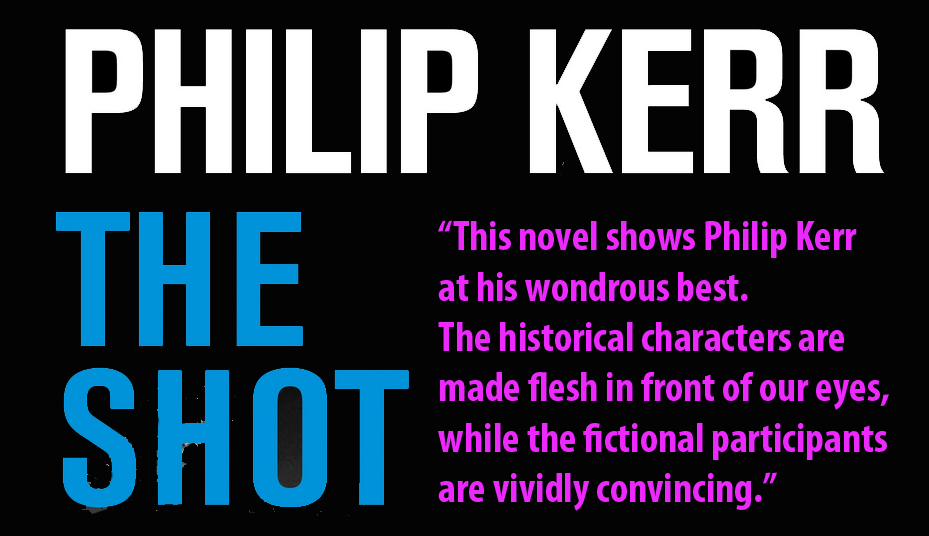
This novel shows Philip Kerr at his wondrous best. The historical characters are made flesh in front of our eyes, while the fictional participants are vividly convincing. Kerr’s grasp of history is immense, and he serves up a winning mixture of The Day Of The Jackal and The Spy Who Came In From The Cold. The Shot is out now.


STILL LIFE . . . Between the covers

Screen Shot 2020-08-29 at 10.49.21

Still Life sees the return of Val McDermid’s DCI Karen Pirie for her sixth case. For readers new to the series, Pirie is tough, intuitive and compassionate – qualities which stand her in good stead as leader of the Historic Crimes Unit. She has her vulnerable side, and it is never more obvious than when she contemplates the emotional scars inflicted by the murder of her former colleague and lover Phil Parhatka. In the previous book, Broken Ground, she met Hamish Mackenzie, a wealthy businessman and gentleman crofter. They are not completely ‘an item’. For Karen, the jury is still out.

McDermid loves nothing better than to juggle plot strands, and here we have two absolute beauties or, should I say, bodies. In the Blue Corner we have the corpse of a male (happily for the police complete with passport in his back pocket) recovered by fisherman tending their lobster pots. In the Red Corner is the desiccated corpse of a woman, discovered in an elderly and tarpaulined camper van, rusting away in a suburban garage.

51UwcxaxExL._SX329_BO1,204,203,200_The dead man is quickly identified as the brother of a long-disappeared Scottish public figure. Iain Auld, depending on your cultural terms of reference, did either a Reggie Perrin, John Stonehouse or Lord Lucan a decade earlier. He has officially been declared dead, but Pirie’s antennae are set all of a quiver, as her investigations into Auld’s disappearance have been fruitless.

The dead woman? Just as complex and convoluted. She may have been a capriciously talented jewellery designer, neither seen nor heard of for months after a troubled residence in a Highland artists’ commune. Then again, she might be the designer’s lesbian lover, a minor talent in the world of water colour landscapes.

McDermid creates her usual magic in this brilliant police procedural. Yes, all boxes are ticked, including starchy superior police officers, duplicitous figures at the heart of the world of Fine Art, sexual jealousy and crimes passionelle, government corruption and likeable (but slightly gormless) junior coppers. Long time fans of the former director of Raith Rovers FC will know that there is more – so much more. She pulls us into the narrative from page one. We are smitten, hooked, ensnared, trapped in her web – choose your own metaphor

Val McDermid is a political person, but she generally wears her views lightly. She cannot restrain herself, however, from having a little dig at her fellow Kirkcaldian Gordon Brown for ‘bottling out’ of an election in 2009 and thus succumbing the following year to a decade or more of rule by the ‘auld enemy’. The lengthy gestation period of novels usually prevents authors from being totally topical, but the final pages of Still Life have DCI Pirie and her crew clearing their desks and preparing for a Covid-19 lockdown. Karen, as we might expect, is made of stern stuff, and she faces an uncertain future with determination:

” – people would always need the polis – and even in a pandemic, murder should never go unprosecuted.”

For my reviews of the previous two Karen Pirie novels Broken Ground and Out of Bounds, click the links and you will get each in a new tab. Still Life is published by Little, Brown and is out now.

A PRIVATE CATHEDRAL . . . between the covers

APC spine009
Is it tempting fate to wonder who is the oldest living crime writer? James Lee Burke (below) is now 83, but writing better than ever. A Private Cathedral is another episode in the tempestuous career of Louisiana cop Dave Robicheaux and the force of nature that is is his friend Clete Purcel. Ostensibly about a simmering war between two gangster families, it goes to places untouched by any of the previous twenty two novels.

JLB

All the old familiar elements are there – Dave, as ever, battles with drink:

“No, I didn’t want to simply drink. I wanted to swallow pitchers of Jack Daniels and soda and shaved ice and bruised mint, and chase them with frosted mug beer and keep the snakes under control with vodka and Collins mix and cherries and orange slices, until my rockets had a three-day supply of fuel and I was on the far side of the moon.”

Then there are the astonishing and vivid descriptions of the New Iberia landscape, the explosive violence, and Louisiana’s dark history. But this novel has a villain unlike any other James Lee Burke has created before. We have met some pretty evil characters over the years, but they have been human and mortal. Robicheaux,  long prone to seeing visions of dead Confederate soldiers, is now faced with an adversary called Gideon, who is also from another world, but with human powers to wreak terrible violence.

APC cover008The Shondell and the Balangie families manipulate, pervert and use people. Robicheaux suspects that seventeen year-old Isolde Balangie has, to be blunt, been pimped out by her father to Mark Shondell. A ‘friendly fire’ casualty is a talented young singer, Johnny Shondell, Mark’s nephew. Ever present, bubbling away beneath the surface of the Bayou Teche is the past. At one point, we even get to walk past the great man’s house, so why not use his most celebrated quote?

“The past is never dead. It’s not even past.”
William Faulkner, Requiem For A Nun

The past involves Mafia hits, grievances nursed and festering over generations, and the sense that the Louisiana shoreline has been witness to countless abuses over the years, from the brutality of slavery through to the rape of nature to which abandoned and rotting stumps of oil rigs bear vivid testimony.

Music – usually sad or poignantly optimistic – is always ringing in our ears in the Robicheaux books. Sometimes it is Dixieland jazz, sometimes blues and sometimes the bitter sweet bounce of Cajun songs. At one point, the young singer Johnny takes his guitar and plays:

“He sat down on the bench and made an E chord and rippled the plectrum across the strings. The he sang ‘Born to Be with You’ by the Chordettes. The driving rhythm of the music and the content of the lyrics were like a wind sweeping across a sandy beach.”

In A Private Cathedral, the plot is not over-complex. It is Dave and Clete – The Bobbsy Twins – against the forces of darkness. Burke gives us what is necessary to ensure the narrative drive, but everything is consumed by the poetry. Sometimes it is the poetry of violence and passion; more tellingly, it is the poetry of valiant despair, the light of decency and honour, guttering out in the teeth of a malignant gale which forces Dave and Clete to bend and stumble, but never quite crack and fall.

A Private Cathedral is published by Orion and is out now. For more on James Lee Burke and Dave Robicheaux, click here.

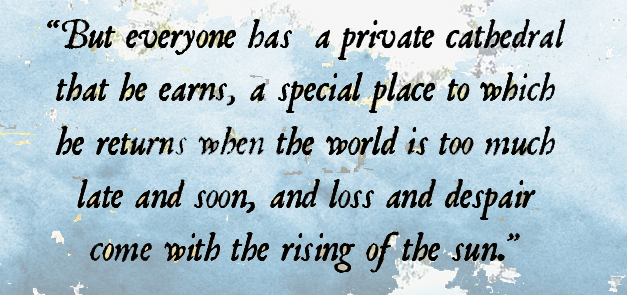
Cathedral quote


KILLING IN YOUR NAME . . . Between the covers

In February this year – remember when everything was normal, and Covid-19 was just something nasty that was happening in China and Italy? – I reviewed Blood Will Be Born, the debut thriller by Belfast writer Gary Donnelly. I said it was:
“… breathtakingly violent, vividly written and a bleak commentary on a seemingly terminal bitterness which makes normal human beings behave like creatures from a warped vision of hell.”

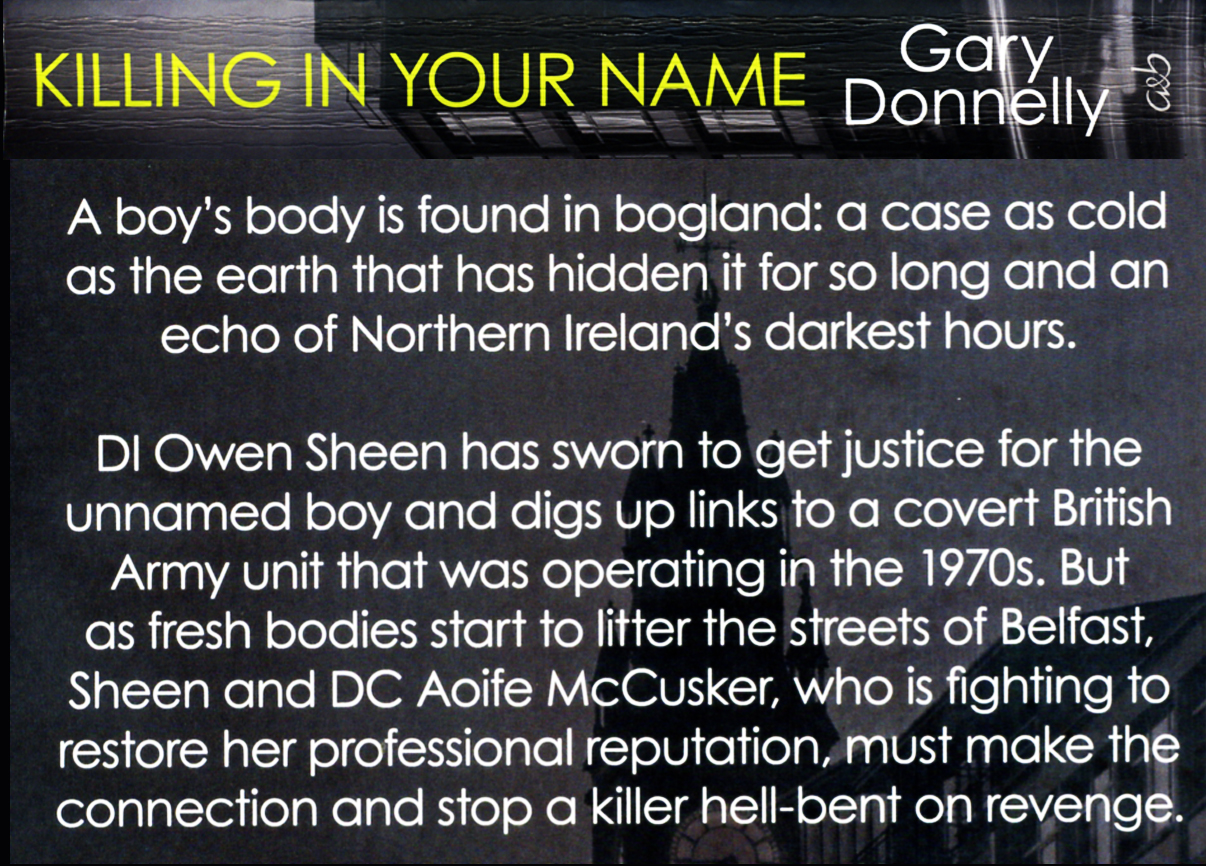
The full review of that book is here, but in no time at all, it seems, comes the second episode in the career of Met Police detective Owen Sheen. He has been seconded to the historic crimes unit of the Police Service of Northern Ireland. If ever there were a British city where historic crimes still haunt the streets, it is Belfast. Sheen was born in Belfast, and watched his own brother being blown to pieces by a terrorist bomb as the two youngsters played football in the street. Donnelly says:

“Over the decades, so much blood had spattered the streets of Belfast, all now washed away, and forgotten by many. But there would always be those, the ones who had been left behind to count the cost, for which the stain and the pain would never really go.”

The (literally) explosive conclusion to the previous case has left Sheen sidelined and his PSNI partner Aoifa McCusker walking with a stick and suspended from duty after a stash of Class ‘A’ drugs were planted in her locker. Sheen is haunted by the discovery of a boy’s body, found in remote Monaghan bogland on the border with the Republic. The body has been partially preserved by the acidic water, but even a post mortem examination reveals few details.

Meanwhile, a spate of horrific killings has perplexed PSNI detectives. A priest has been decapitated in his own sacristy; the teenage daughter of a prominent barrister has been abducted and then killed; her body, minus one of its hands has been dumped at her father’s front door. The adult son of a former hellfire Protestant preacher and politician has been found dead – again, butchered.

Against the better judgment of senior officers, Sheen is allowed to ‘get the band back together’ and so a limping McCusker, and colleague George ‘Geordie’ Brown are joined by Hayley, a mysterious transgender person who calls herself an ‘instinctive’ because she has what used to be called a sixth sense about death or extreme violence.

As ever in Belfast, the answers to modern questions lie irremovably in the past and, almost too late, Sheen and his team discover that the killings are bound up with acts of scarcely credible evil that took place decades earlier. Revenge is certainly being served cold and, for someone, it tastes delicious.

Donnelly (below) has another winner on his hands here, and it is partly due to his superb sense of narrative, but also to his ability to create truly monstrous villains, and there is at least one in Killing In Your Name to rival anything his fellow Irishman John Connolly has created. Connolly’s creations tend to have a sulphurous whiff of the supernatural about them. Donnolly’s monsters are human, if in name only. Killing In Your Name is published by Allison & Busby and is out today, 20th August.

CRY BABY . . . Between the covers

CB header

Mark Billingham is certainly a man of many parts. To name a few, there is Gary, the dim-but-lovable stooge to the Sheriff of Nottingham in Maid Marian and her Merry Men, stand up comedian and scriptwriter, acoustic guitarist with Fun Lovin’ Crime Writers and, of course, best selling crime novelist. But author of historical fiction? Well yes, in a manner of speaking. In his afterword to his latest novel Cry Baby, Billingham says that in writing this prequel to the Tom Thorne series he had to imagine a world of clunky computers the size of refrigerators, telephone boxes and ‘phone cards, and pubs where people smoked.

We are, as ever in London, but it is the summer of 1996. The city and the country – at least many of the menfolk thereof – are transfixed with the European Cup. Crosses of St George flutter from the aerials of Mondeos up and down the land and pubs are rammed with supporters of Shearer, Sheringham, Southgate and company. Detective Sergeant Tom Thorne is trying to schedule his work around the matches, but when a boy is abducted from a London park, football has to take a back seat.

54502348._UY2560_SS2560_Kieron Coyne is playing with his mate Josh under the watchful eyes of their mothers, Cat and Maria. Cat goes off for a pee, Maria settles back on the park bench and lights a fag. One minute Kieron is there, the next he has disappeared. Josh emerges from the little wood where the boys were playing hide and seek. He neither saw nor heard anything of his friend.

A major police investigation kicks in, with Thorne doing the leg work at the best of his incompetent boss. We learn that Cat and Maria are both single mothers – had ‘lone parents’ been invented in 1996? – but in different circumstances. Kieron’s father is doing a long spell in a maximum security prison, while Maria’s doctor husband divorced her a couple of years back.

Hours turn into days and there is no sign of Kieron, dead or alive. A birdwatcher thinks he saw a boy getting into a car with a man he obviously knew, and a Crimewatch presentation by the late lamented Jill Dando turns up nothing more useful than imagined sightings the length and breadth of the country, and the usual false confessions from the mentally ill.

Thorne does find a suspect – a neighbour of Cat’s with a suspicion of ‘form’ for dodgy sexual activity – but the arrest of Grantleigh Figgis does not go well for either the police of the suspect.

Billingham manages the historical details very well, and we meet one or two regular characters from the Thorne series for the first time, none more dramatically than Phil Hendricks, the much-tattooed and oft-pierced pathologist. In a rare droll moment in a seriously dark book, Billingham has gentle fun with making Thorne’s gaydar so wonky that he has our man making enquiries as to why Hendricks hasn’t found the right woman to settle down with. We also meet Thorne’s soon-to-be-ex wife Jan, and fellow copper Russell Brigstocke who, as lovers of the series know, manages subsequently to keep his CV much cleaner than Thorne.

Fans of Billingham’s novels, both the Tom Thorne series and the stand-alones, know that he likes nothing better than a dramatic twist in the final few pages, and he doesn’t let us down here. There is something of a ‘where the **** did that come from’ moment when all the patient door-knocking, statement-taking and deduction of the coppers is spun on its head in a few dazzling pages of revelation. Cry Baby is published by Little, Brown and is out now.

LOST SOULS . . . Between the covers

header

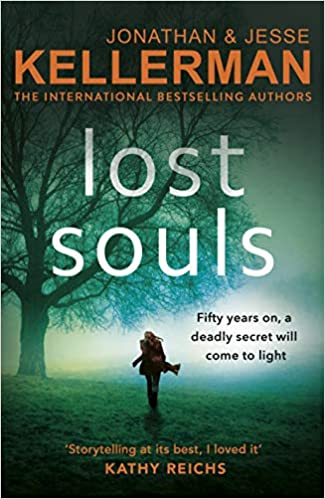
51K-Sy2OGJL._SX323_BO1,204,203,200_Lost Souls is something of an oddity, and no mistake. There’s nothing at all wrong with the novel itself apart from something of an identity crisis. Search for it on Amazon UK, and up it comes, but the page URL contains the title Half Moon Bay. Search for Half Moon Bay and up comes the same novel, but with a different cover. It looks as though Half Moon Bay is the Penguin Random House American title, while on this side of the Atlantic Century are going with Lost Souls.
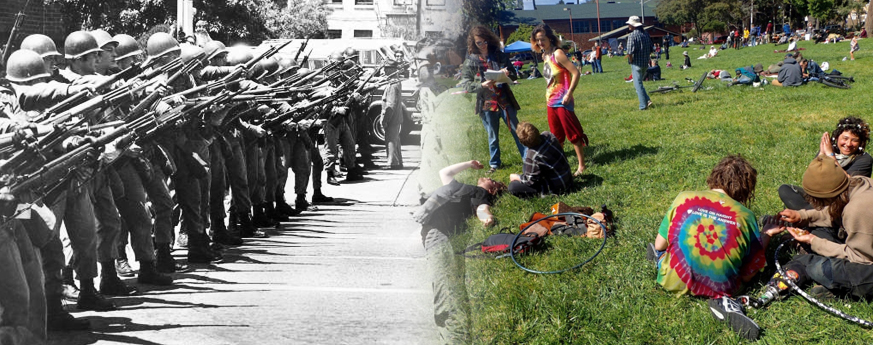
Deputy US Coroner Clay Edison first appeared in Crime Scene (2017). That was followed by A Measure of Darkness in 2018, and now Edison returns but this time with baby Charlotte to look after when his wife is out on shift in her hospital. The Edisons live in that eternal bastion of West Coast sensibilities, Berkeley, and it is in the infamous People’s Park that the case begins.

LS illustration

Clay Edison is called to the park, scene of decades of hippy protest. Two bodies have been found during building excavation. The first is neither human nor animal. It is a stuffed blue teddy bear, missing an eye. The second is the skeleton of a baby, and the glare of the pathologist’s strip lights reveal that it was once a little boy. Edison is drawn into an investigation to see if the teddy bear and the boy are connected, and this means he has to visit a truly terrifying settlement of biker red-necks:

“I bounced along the tracks, wheels spitting gravel. Slowly the smudge began to resolve like a body surfacing in swamp water. Structures, then vehicles, then living things: gaunt dogs and children chasing one another, their roles as hunter or prey in constant flux. Bare feet raised a dusty haze. ….. Amid a weedy patch a woman slouched in a lawn chair. Pustulant acne ravaged her face; she could have been eighteen or forty. A slack-limbed toddler slept on her chest.”

51wZ1Fd-WIL._SX327_BO1,204,203,200_As Edison tries to link the skeleton of the baby with the abandoned cuddly toy, he accepts an ‘off-the-books’ job. A wealthy businessman, Peter Franchette, asks him to try to find the truth about his missing sister. Possibly abducted, perhaps murdered, she has disappeared into a complexity of disfunctional family events – deaths, walkouts, divorces, remarriages and rejections.

The Kellermans clearly have an ambivalent view of Berkeley. A place perhaps, where a seventy-something former revolutionary might wake up and imagine, for a fleeting moment, before old age and reality kick in, that it is 1966, and everything is still possible. The reality is more sobering, however:

” … and the countless others, men and women alike, who’d found their way to the Pacific, only to find that it was not the golden bath they’d expected but a terrifying force of nature, immense and violent and indifferent.”

I’ll be blunt and say that I have never understood the concept of writing partnerships in fiction. Over many years I enjoyed Jonathan Kellerman’s Alex Delaware books. They are slick and formulaic, but never less than gripping, and it is obvious that Kellerman is a gifted writer. Why he should want to want to pair up with someone else – even if it is his son – is for him to know and me to be left wondering. Lost Souls reads as if it has been written by one person, so I suppose that is all that matters.

Lost Souls is cleverly written and has a plot which is, like Chandler’s immortal The Big Sleep, deeply complex. Rather like the anecdote which has Chandler being asked who killed the chauffeur, and him replying that he wasn’t sure, I couldn’t put my hand on my heart and say that Edison finds Peter Franchette’s missing sister. I think he does, but you must judge for yourselves.

Lost Souls and/or Half Moon Bay are out now, and available here.

AFTER THE FIRE . . . Between the covers

ATF header

Jo Spain’s Irish copper Tom Reynolds – now Detective Chief Superintendent, if you please – returns in After The Fire and we are, as ever, in Dublin’s Fair City. Are the girls still ‘So Pretty’? The young woman walking naked down the city street, much to the astonishment of shoppers might have been pretty once, but now she is in a terrible state. Hair awry, skin blackened with dirt and a look of sheer terror in her eyes.

Except that is not dirt on her skin. It is soot, and she has escaped, traumatised, from a catastrophic house fire. The terraced house is in an area which has moved upmarket because of its proximity to the The International Financial Services Centre (IFSC) but the services being offered at the ruined house were something different altogether. First one body is recovered, and then another, and as the young woman – a Russian –  recovers in hospital, it becomes clear to the police that the house was a brothel, and she was one of the items on the grisly menu.

As a DCS, Tom Reynolds is not meant to get his hands dirty at an investigational level, but there is no drama in balancing budgets and supervising staff deployment, so the admirable Mrs Spain has Tom notionally taking a spot of leave so that he can lend a hand in the case which is being led by his former protégé Laura Lennon.

Tyanna, the woman who fled the fire, is too terrified of the people who controlled the trade at 3 Shipping Row to be of much use, but she has mentioned a baby, now missing, the child of a young woman whose corpse was discovered in the building. Another frightened young woman – Nina Cusack – who was bought and sold there has also emerged, but she has sought sanctuary with her parents and is, again, too terrified to divulge much about the identities of the guilty men who are controlling the brutal trade.

The sheer fluency of Jo Spain’s writing will come as no surprise to those of us who are long term admirers, and the bottom line is that every book she writes is, quite simply, a bloody fine read. It is, however, worth taking a moment to look at just how and why she is so good. Lesser writers will seed their narratives with gore and gruesome detail, while Spain leaves us in no doubt about how brutal people can be, but in a much more subtle way.

Some police procedurals rely too much on the central copper being a maverick, or a bitter misanthrope, or a damaged person with a hundred different devils to fight each day. Tom Reynolds doesn’t distract us in that way – he is a decent man who has been dealt a fair hand by fate, and so we don’t waste valuable time having to understand him by examining his CD collection. (Yes, I know CDs are so very yesterday, but you get my drift)

As for elaborate scene setting with endless paragraphs about how Dublin looks, smells, sounds and feels, Jo Spain puts us in the place with a couple of telling sentences. We know we are in Dublin – that’s fine – but then she gets on with the important stuff. The important stuff? That is the story and above all, Jo Spain is a storytelling genius. Those who follow her career will know she is also much sought after as a screenwriter. The Tom Reynolds books and the stand-alones are not written for the screen, but they may as well be because every page, every paragraph and every sentence comes to life as vividly – and as visually – as if we were standing right there, watching.

After The Fire is published by Quercus. It is available now as a Kindle, and will be out in paperback on 6th August.

For more on Jo Spain and her novels, click the image below.

image

ORANGES AND LEMONS . . . Between the covers

OAL header027

For a good part of its long and curious history, it seems that The Peculiar Crimes Unit of London’s Metropolitan Police has been under threat. Civil servants and box-tickers without number have tried to close it down; it has endured bombs (courtesy of both the Luftwaffe and those closer to home); it has suffered plague and the eternal pestilence of whatever vile tobacco Arthur Bryant happens to stuffing into his pipe at any particular moment. The PCU has become:

“..like a flatulent elderly relative in a roomful of
millennials,a source of profound embarrassment..”

But now, yet another crisis seems to be the fatal straw that will break the back of the noble beast. Bryant’s partner John May (the sensible one) is on sick leave recovering from a near-fatal gunshot wound. Mr B has gone AWOL (trying to have his memoirs published), and the office has been invaded by a tight lipped (and probably ashen-faced) emissary from the Home Office who has instructions to observe what he sees and then report back to Whitehall.

The PCU creaks into arthritic action when Arthur Bryant puts his literary ambitions on hold, and links three apparently random deaths. A Romanian bookseller’s shop is torched, and he dies in police custody; a popular and (unusually) principled politician is grievously wounded, apparently by a pallet of citrus fruit falling from a lorry; a well-connected campaigning celebrity is stabbed to death on the steps of a notable London church. For Bryant, the game is afoot, and he draws on his unrivaled knowledge of London’s arcane history to convince his colleagues that the killer’s business is far from finished. His colleagues? Regular B&M fans will be relieved to know that, in the words of the 1917 American song (melody by Sir Arthur Sullivan) “Hail, Hail – The Gang’s All Here!”

roster

An intern in the PCU? Yes, indeed, and in the words of Raymond Land;

“You may have noticed there’s an unfamiliar name attached to the recipients at the top of the page. Sidney Hargreaves is a girl. She’s happy to be called either Sid or Sidney because her name is, I quote, ‘non gender specific in an identity-based profession.’ It’s not for me to pass comment on gender, I got lost somewhere between Danny la Rue and RuPaul.”

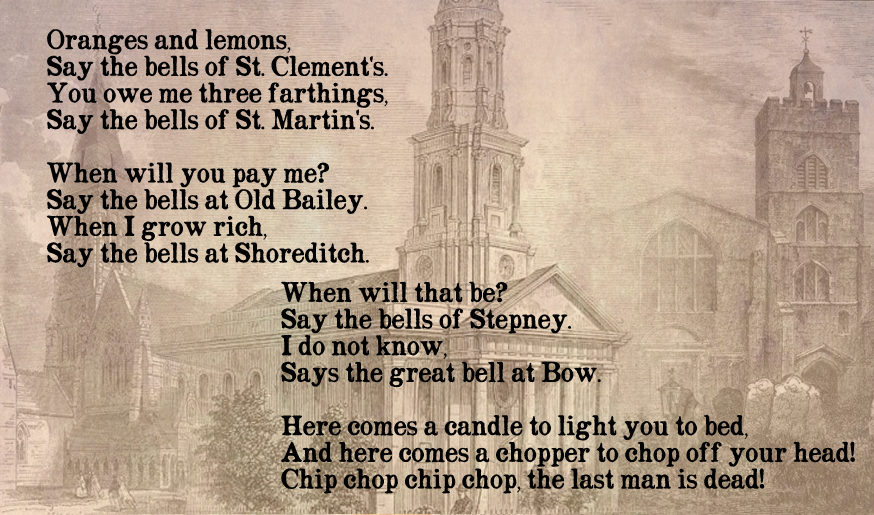
There are more deaths and Arthur Bryant is convinced that the killings are linked to the London churches immortalised in the old nursery rhyme, with its cryptic references:

Poem

But what links the victims to the killer? Beneath the joyous anarchy Arthur Bryant creates in the incomprehending digital world of modern policing, something very, very dark is going on. Fowler gives us hints, such as in this carefully selected verse between two sections of the book:

“The past is round us, those old spires
That glimmer o’er our head;
Not from the present are their fires,
Their light is from the dead.”

Also, underpinning the gags and joyfully sentimental cultural references there are moments of almost unbearable poignancy such as the moment when the two old men meet, as they always have done, on Waterloo Bridge, and think about loves won and lost and how things might have been.

There is no-one quite like Christopher Fowler among modern authors. He distills the deceptively probing gaze of John Betjeman, the sharp humour of George and Weedon Grossmith, the narrative drive of Arthur Conan Doyle and a knowledge of London’s darker corners and layers of history quite the equal of Iain Sinclair and Peter Ackroyd,  The result? A spirit that is as delicious as it is intoxicating. Oranges and Lemons is published by Doubleday and is out now.

More about the unique world of Arthur Bryant and John May can be found here, while anyone who would like to learn more about the origin of the rather sinister verse quoted earlier should click on the picture of its author, below, Letitia Elizabeth Landon.

Letitia_Elizabeth_Landon_-_Pickersgill

THE FINISHER . . . Between the covers

Finisher018

51bAlRSlCzL._SX323_BO1,204,203,200_Fictional police officers come in an almost infinite number of guises. They can be lowly of rank, like Tony Parsons’ Detective Constable Max Wolfe, or very senior, such as Detective Superintendent William Lorimer, as imagined by Alex Gray. Male, female, tech-savvy, Luddite, happy family folk or embittered loners – there are plenty to choose from. So where does Peter Lovesey’s Peter Diamond fit into the matrix? As a Detective Superintendent, he pretty much only answers to the Assistant Chief Constable, but for newcomers to the well established series, what sort of a figure does he cut? Lovesey lets us know fairly early in The Finisher, the nineteenth in a series that began in 1991 with The Last Detective. Diamond is on plain clothes duty keeping a wary eye on a half marathon race in the historic city of Bath:

“Difficult to tell whether Detective Superintendent Peter Diamond, on duty in the gardens, was overt or covert. If he had been in the race, you might have taken him for one of the jokers in fancy dress. He might have stepped out of a nineteen-forties film, a sleuth on the trail of Sydney Greenstreet. The gabardine trench coat and dark brown trilby, his so-called plain clothes, weren’t plain at all in twenty-first century Bath.”

Neither is Peter Diamond a vain man, nor one who gives excessive attention to his personal appearance:

“He didn’t waste time showering or shaving. A swish of tap water took the sleep from his eyes and a squirt of deodorant completed his grooming. Unshaven jowls were standard among the younger members of his team.”

The book’s title is a clever play on words and has a double significance. It can be someone who manages to complete ‘The Other Half’ – an alternative half marathon pounded out along the elegant streets, disused railway tunnels and steep wooded hillsides of Bath. It also has a more sinister connotation – a person who gets things done, even if doing so involves a lack of compassion and, even, a willingness to use violence.

Lovesey’s clever novel combines the events surrounding the race, as well as a particularly brutal example of modern day slavery – illegal immigrants forced to work for a pittance, housed in grim conditions, and for ever in thrall to men and women who earn fortunes exploiting the vulnerable.

Finisher021There’s a dazzling array of characters to act out the drama. We have an earnest school teacher who forces herself to run the race in order to make good a lost donation to a charity; there is a statuesque Russian, wife of a cynical businessman, determined to lose weight and gain her husband’s respect; instant villainy is provided by a paroled serial seducer and sex-pest who has taken on a new role as personal trainer to the rich; at the bottom of the pond, so to speak, are a pair of feckless Albanian chancers who have escaped from an illegal work gang, and are trying to avoid the retribution of their controllers.
Throw into this mix a fascinating geographical background which comes vividly to life, even to someone like me, who has only a limited knowledge of Bath. Like most, I knew of its Roman heritage and the wonderful Georgian architecture, but I was totally unaware that the hills surrounding the city conceal warrens of quarries, caves and tunnels from which the beautiful local limestone was hewn.

Throughout his long and celebrated writing career, Lovesey has never given away his solutions without putting the reader through their own private marathon of false clues, and misdirections. So it is with The Finisher. If you get within ten pages of the end and reckon you know who did what to whom – then trust me, you don’t! This wonderfully entertaining novel by one of our finest living writers is published by Sphere and is out now.

Finisher020

Blog at WordPress.com.

Up ↑