Search

fullybooked2017

Category

REVIEWS

STAY BURIED . . . Between the covers

SB header

Screen Shot 2022-10-01 at 19.38.56Writing as Katherine Webb, the author (left) is a well established writer of several books which seem to be in the romantic/historical/mystery genre, but I believe this is her first novel with both feet firmly planted on the  terra firma  of crime fiction. Wiltshire copper DI Matthew Lockyer, after a professional error of judgment, has been sidelined into a Cold Case unit, consisting of himself and Constable Gemma Broad.

He receives a telephone call from a most unexpected source. His caller is Hedy Lambert, a woman he helped convict of murder fourteen years earlier. The case was full of unexpected twists and turns, none more bizarre than the identity of the victim.  Harry, son of Emeritus Professor Roland Ferris had left home as a teenager and, seemingly, vanished from the face of the earth. Then he returns home to the Wiltshire village where his father lives. This variation on the tale of The Prodigal Son, takes a turn for the worse, however, when Harry’s dead body is discovered, and standing over it, clutching the murder weapon, is Ferris’s housekeeper Hedy Lambert. Problem is, it’s not Harry Ferris.

After a few days it transpires the the murder victim is actually Mickey Brown, a Traveller, who superficially resembles Harry. Despite the absence of any plausible motive Hedy Lambert is convicted of murder and found guilty, condemned almost entirely by  convincing forensic evidence. Now, Lambert has telephoned Lockyer from her prison to tell him that the real Harry Ferris has returned to his father’s house. Lockyer visits Longacres, Ferris’s house in the village of Stoke Lavington, to find the old man at death’s door with cancer of the blood and Harry Ferris totally unwilling to co-operate with the re-opening of the murder case.

As the story develops, we learn more about Lockyer and his background. His parents are what Americans call hardscrabble farmers, elderly and increasingly unable to make a living out of the farm or see any fruits for their lifetime of hard work. The obvious person to take over the farm was Lockyer’s brother Chris, but he is long dead, having been stabbed in a fracas outside a local pub. His killer has never been brought to justice.

One of the many admirable qualities of this book is that Kate Webb doesn’t take any prisoners in her portrayal of rural Wiltshire. Yes, there are obviously some beautiful places, but there are also farms which are bleak, wind-swept and run-down; there are villages and small towns with rough and tumble pubs which are no strangers to violence. Please don’t expect the sun-kissed limestone cottages and trim thatched roofs of Midsomer; this is Wiltshire in winter from a literal point of view, and metaphorically it is darker territory altogether.

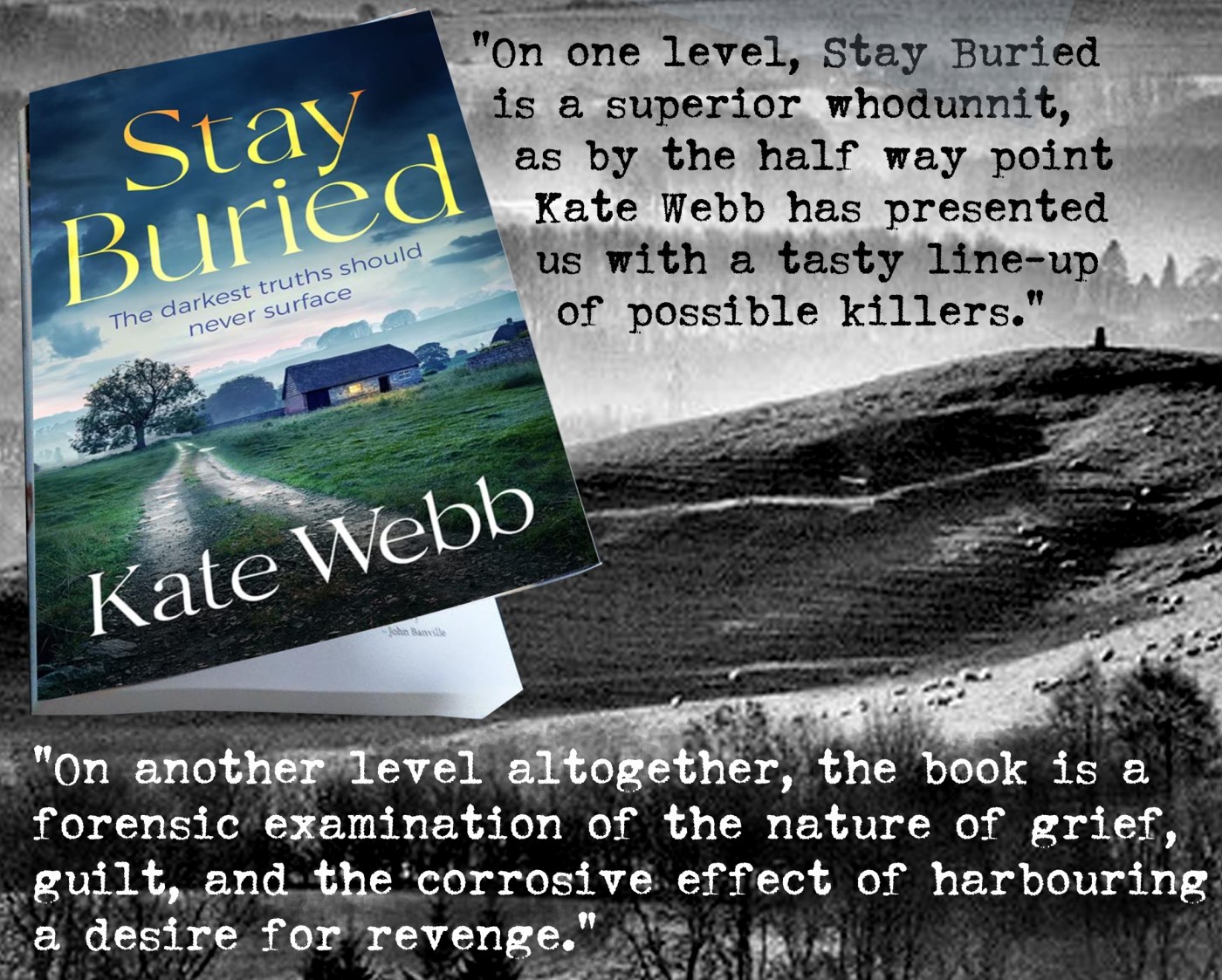
On one level, Stay Buried is a superior whodunnit, as by the half way point Kate Webb has presented us with a tasty line-up of possible killers. There is Paul Rifkin, Ferris’s factotum, the real Harry Ferris, Tor Gravich, the young research assistant who was in Longacres at the time of the murder, Sean Hannington, a violent Traveller thug with a grudge against Mickey Brown, Serena Godwin, and even Roland Ferris himself. Or are we being led up the garden path, and is the killer Hedy Lambert after all? The eventual solution is elegant, complex and unexpected. On another level altogether, the book is a forensic examination of the nature of grief, guilt, and the corrosive effect of harbouring a desire for revenge.

This is excellent crime fiction, with a central character who has the quirks and flaws to make him totally credible. The geographical backdrop against which DI Matt Lockyer does his job is painted ‘warts and all’, lending a psychological darkness to proceedings. Stay Buried is published by Quercus and will available as listed below:

Kindle – 27th October 2022
Audiobook – 27th October 2022
Hardcover – 19th January 2023
Paperback – 29th July 2023

Quercus-Logo-reverseout1

A DARK STEEL DEATH . . . Between the covers

ADSD header

Chris Nickson’s long running saga about  Leeds copper Tom Harper continues with our man now Deputy Chief Constable. We are in January 1917 and, like in other major cities, patrols are on the look out for the silent peril of Zeppelins, while Harper has a possible act of sabotage to investigate after a pile of newspaper and kindling is found inside a warehouse used for storing military clothing. The book begins, however, a month earlier with a true historical incident.

In nearby Barnbow, a huge munitions factory had been established from scratch in 1915. Its prime function was the filling of shells. With the constant drain of manpower to the armed forces, the workforce at Barnbow became over 90% female. On the night of 5th December 1916 a massive explosion occurred in Hut 42, killing 35 women outright, maiming and injuring dozens more. In some cases identification was only possible by the identity disks worn around the necks of the workers. It is believed that the explosion was triggered by a shell being packed with double the required amount of explosives. The dead women, at last, have their own memorial.

Barnbow_Lasses_park_memorial_3_26_August_2017

With the Barnbow investigation ongoing, Harper has more problems on his hands when a sentry outside a barracks in the city is shot dead with, it turns out, a SMLE (Short Magazine Lee Enfield) .303 rifle, adapted for sniping, which was stolen from the barracks own armoury.

There are so many things to admire about this series, not least being the meticulous historical research carried out by the author. One example is the development of police investigative techniques. Back at the beginning, in Gods of Gold (2014), the idea that people could be identified by their fingerprints would have been seen as pure fantasy but, as we see in this novel, it was an essential tool  for the police by 1917.

Nickson text

Back to Tom Harper’s current case. As he and his detectives sift what little evidence there is, they seem to be chasing their own tails. Harper’s worries don’t end as he closes his office door each evening. In an earlier book, we learned the grim news that his vivacious and beautiful wife Annabelle, a tireless campaigner for female equality, has developed early-onset dementia. Harper has employed a Belgian refugee couple to run Annabelle’s pub, and keep a close eye on his wife, but he never knows from one day to the next what state she will be in. If he is lucky, she will show glimpses of her old self; when she is having a bad day, she inhabits a totally imaginary world and slips from all the anchors of reality. The most painful moments for Harper come when Annabelle believes that he is her late first husband, Harry.

Eventually the case breaks. Harper and his team are astonished to find they are facing not just one killer, but a partnership. Two former soldiers, Gordon Gibson and James Openshaw were virtually buried alive when a shell exploded near them on the Western Front. Openshaw was a sniper and Gibson, not much of a shot but with superb eyesight, was his spotter. Both men were invalided out, but Openshaw, after a spell at the famous Edinburgh hospital, Craiglockhart, remains under constant medical care at Gledhow Hall, a Leeds stately home used as a hospital for the duration of the war. It seems that for whatever motive, Gibson smuggled Openshaw  and the rifle out of the hospital to commit the murder of the sentry. Now, Gibson is at large with the rifle and, despite his poor marksmanship, has shot at Tom Harper’s official car, and badly wounded a policeman.

The endgame takes place as Gibson uses all his fieldcraft to find his way into a heavily guarded Gledhow Hall to liberate Openshaw and resume their killing spree. The finale is breathtaking, powerfully written – and deeply moving. A Dark Steel Death is published by Severn House and is available now.

FOR MORE ON THE TOM HARPER SERIES CLICK THE IMAGE BELOW

LEEDS

DEMOLITION . . . Between the covers

demolition header

Former Lancashire copper and now best-selling novelist Nick Oldham doesn’t muck about. By the time you have read the first half dozen pages of his latest Henry Christie novel, we have had a gangster shot dead in his own swimming pool, another very rich but rather ‘iffy’ businessman bludgeoned to death with a huge spanner he has been using to rebuild a WW2 aircraft – and Henry himself dodging bullets.

High speed back story for new readers (Where have you been? This is book 30 in the series!) Henry Christie, former senior copper, now in his 50s, rather tragic ‘love life’, runs a pub in Kendleton on the Lancashire moors, frequently engaged by his former employers as a civilian investigator, usually involving crimes committed by local gangsters operating a kind of triangle-of-death between Preston, Blackpool and Fleetwood. No kiss-me-quick hats here, just deprivation, drugs and violence.

As has been customary in the recent novels, Christie is signed back on to help with the two murders – a perfectly plausible move by the Lancashire Constabulary, as  their staffing levels have taken a hit through Covid. Henry’s police ‘chaperone’ is DS Deb Blackstone. She is a feisty and competent officer who just happens to dress like a slightly deranged Goth, with spiked pink hair and all the trimmings.

Our man has other things on his plate, too. One of the regular groups to meet in his pub rather like rural Lancashire’s answer to The Thursday Murder Club, and the case they are currently working on is not so much cold as embedded in the permafrost. It concerns the murder of Lucas Grundy, back in 1941, and spice is added to the investigation by the fact that Eric, the murdered man’s brother is still alive, albeit aged 100. Christie learns from an elderly woman in the village that she believes Eric Grundy raped her, many decades earlier, but the crime was never properly dealt with.

A couple of days before Lucas Grundy was murdered, a Heinkel bomber, damaged in a raid, crashed on the moors nearby. Three of the five-man crew died at the scene and were buried in the local churchyard, but nothing was ever found of the other two. Was it possible that they were somehow involved in Grundy’s death, and how did they simply seem to disappear of the face of the earth?

As a humble reviewer, I can’t begin to comprehend how Nick Oldham keeps so many sub plots going at the same time without the narrative collapsing in confusion. One metaphor, I suppose, is that of the plate-spinning juggler, who manages not to break any of the plates, but stacks them neatly one on top of the other at the end of his performance. Oldham rounds off the action with his customary inventiveness and panache, but be warned  – there is a particularly venomous sting in the tail. Demolition is published by Severn House, and is available now.

FOR REVIEWS OF EARLIER NOVELS IN THE SERIES,
CLICK THE AUTHOR’S IMAGE BELOW

NO

FROM THE ASHES . . . Between the covers

fta header009 copy

Deborah Masson is back with another gritty police thriller set in her home town of Aberdeen. This time, DI Eve Hunter (previously seen in Out For Blood and Hold Your Tongue) faces the grimmest challenge presented to police officers all over the world – the death of a child. Lucas Fyfe – dead mother, drug addicted father and unfeeling grandmother – has been in care since he was little. When someone deliberately sets fire to Wellwood, a children’s home, he is the one resident who doesn’t make it out. Why? Because the body of the eleven year-old is discovered in the cellar, and the trapdoor which is the only access is concealed under a heavy carpet.

Literally from page one, Masson gives us another perspective – that of the presumed arsonist. We know it’s a ‘he’, and we know that he was a former resident of Wellwood when it was run by the current warden’s father, William Alderton and the sadistic Sally Fields. I find that the backstory narrative trope can be irritating when an author uses too many viewpoints and too many time frames, but here it is used with subtlety and works very well.

Eve Hunter’s team consists of DS Cooper, DS Mearns and DC Ferguson, and the sparky dynamics between them provide an intriguing counterpoint to the investigation. Scott Ferguson is peripherally involved in a road accident on his way to work, but his obsession with the young man who was the main casualty starts to distract him from the Wellwood case. When a further shocking discovery is made in the cellar where Lucas Fyfe died, Ferguson’s lack of attention becomes even more serious. We eventually learn why Ferguson feels compelled to be at the bedside of the young vagrant who was badly injured in the RTA, and it turns the case on its head.

Hunter and her team soon realise that the surviving children and the three adult staff of Wellwood are not telling all that they know. That much is obvious, but penetrating the veil of secrecy proves more difficult. With both of the original owners dead, and local Children’s Services being very protective of the few remaining historic records of the children who were residents, the case seems to go round in circles, until Ferguson’s with Archie, the young RTA victim, finally pays off.

Deborah Masson is a writer who enjoys providing her readers with the unexpected, and the finale of the novel, in the grim basement of Wellwood, is a prime example. Eve Hunter comes over as tough and uncompromising in pursuit of the bad guys, but her family background has left her with a strong streak of compassion, and when Scott Ferguson finally reveals his own secrets – and his link to the Wellwood basement – she is well-equipped to provide emotional support.

This novel is dark, cleverly plotted, full of well-concealed surprises and a master class in how to write a good police-procedural. From The Ashes is published by Transworld/Penguin and is available now.

JOSEPHINE TEY . . . New editions from Penguin

Tey header

Screen Shot 2022-09-05 at 19.33.36Penguin have a treat in store for fans of British ‘Golden Age’ crime novels. On 22nd September they are publishing new editions of three novels by a woman who many people feel deserves to be up there with Allingham, Christie, Marsh and Sayers in the Pantheon of female crime fiction giants.

Elizabeth Mackintosh was born in Inverness on 25th July 1896. When she left college, her day job was what we now call PE teacher at various schools in England and Scotland, but she returned to Inverness in 1923 to care for her invalid parents. Writing as Gordon Daviot, she published her first novel, Kif: An Unvarnished History, in 1929, but her work had appeared in periodicals and magazines before this.

She is best known today for her crime novels featuring Inspector Alan Grant. The first of these, originally called Killer in the Crowd, but later retitled The Man In the Queue, appeared in 1929, still under the Gordon Daviot pen-name. For the following five she adopted the name of her great-great grandmother. The books are:

A Shilling for Candles (1936)
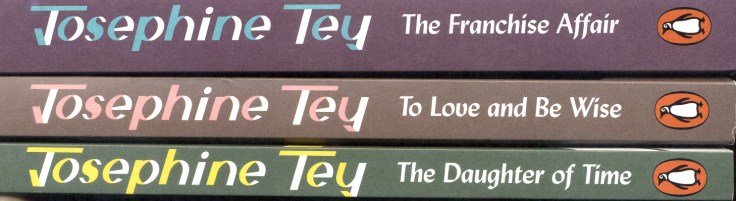
The Franchise Affair (1948)
To Love and Be Wise (1950)
The Daughter of Time (1951)
The Singing Sands (1952)

THE FRANCHISE AFFAIR

The ‘Franchise’ in question is the country home of Marion Sharpe and her mother. When the apparently mild mannered pair are accused of kidnap and abuse by a local war orphan, Betty Kane,  Inspector Alan Grant and local solicitor Robert Blair are called in to get to the bottom of the story.

TO LOVE AND BE WISE

Once again, we are in that most favoured setting of mystery writers of the time, a peaceful and sleepy English village. Salcott St Mary has a celebrated and rather exotic resident, the young and gifted Hollywood photographer, Leslie Searle. When Searle disappears without trace, Alan Grant has to discover if the disappearance is voluntary, or the result of something much more sinister.

THE DAUGHTER OF TIME

Tey’s most celebrated novel and probably one of the greatest crime novels of all time, has a delightfully simple but clever plot. Alan Grant is laid up in bed, recovering from a broken leg and bored out of his mind. While looking at the celebrated portrait of Richard III, Grant struggles to see the evil fiend of Shakespeare’s imagining. With the help of the British Museum and an eager American researcher, Grant sets out to solve one of history’s greatest unanswered questions – who killed Edward and Richard, the Princes in The Tower?

Screen Shot 2022-09-05 at 19.38.06

These three novels with introductions by Tana French, Kate Mosse and Alexander McCall Smith, will be available on 22nd September, and nearer the time I will be running a give-away competition to win all three books .

Tey footer

BRYANT & MAY’S PECULIAR LONDON . . . Between the covers

London spine006

Yes, yes, Arthur Bryant died peacefully at the end of London Bridge Is Falling Down, but the old boy isn’t speaking from beyond the grave, or ectoplasmically appearing at his former landlady’s spritualist church. This delightful conceit – and I use the word in its literary sense – is Christopher Fowler (aka @Peculiar on Twitter) imagines a long conversation between Arthur and his long-time colleagues from the Peculiar Crime Unit, to put in print a kind of concordance of the wonderful quirks and hidden histories of London which underpinned the memorable series of novels featuring the two detectives.

This is not a geographical street-by-street tour, but more a recollection of bizarre events and strange legends that darts this way and that, rather like the working of Arthur’s mind. Most of the PCU team have an input with something that has taken their fancy, except (naturally) poor old Raymondo – Raymand Land, the exasperated, ineffectual and much mocked titular head of the PCU. He is given the wrong time for the meeting, and so when he arrives, everything is done and dusted. This little episode is a reminder that (imaginary) cruelty is an essential ingredient of English comedy.

The reader can dip in and out of this book pretty much taking the chapters in any order There is, quite rightly, no sense of one thing leading to another as, perhaps for the first and only time in this series, there is no need for a coherent plot. The events described have already happened – or not, as the case may be. Christopher Fowler, as an expert Londoner, is well aware that fable and legend do not need to cling too closely to probability.

For those wondering where this blissful blend of the arcane, the shocking, the macabre, the comical and the eccentric comes from, the author provides a ‘further reading’ list.

Reading list

It is right and fitting that the closing words in this book should be spoken by Artur Bryant himself:

“London.
According to the playwright Ben Jonson it was the city of bawds and roysters, claret-wine and oysters. To me it is just home, where I am on the inside looking out instead of somewhere outside looking in. It’s my city, not yours. Which is to say that I see it in a certain way that you do not, and vice-versa.
I have no fantasies involving a comatose retirement on the Isle of Wight, like poor old Raymondo. I have no intention of leaving this grubby, exhausting, maddening city.
London is like a greedy old landlady. She didn’t ask me to come, didn’t invite me to stay and won’t miss me when I’ve left.
And that suits me fine.”

Bryant and May’s Peculiar London is published by Doubleday, and is available now.

For more about Christopher Fowler and the Bryant & May novels, click the image below.

Link

THE LONG KNIVES . . . Between the covers

LOng Knives header005

Irvine Welsh introduced us to Edinburgh detective Ray Lennox in Crime, but it has taken fourteen years for the second in the series – The Long Knives – to emerge. The title is not a metaphor, as the opening chapter describes the castration of a rather unpleasant Conservative MP in an empty warehouse in Leith.

There is no shortage of people who might have wanted Ritchie Gulliver dead. They range from political opponents, via victims of his predatory sexual habits, to activist groups he has offended. Lennox is given the case, and is immediately alerted to a recent incident in London which sounds similar. Home Office civil servant Christopher Piggott-Wilkins has been attacked in the Savoy Hotel. He managed to escape, badly wounded, and immediately transferred himself to a Harley Street hospital, after which what occurred in his suite has been cleaned up, both literally and metaphorically, by un-named but powerful agencies. Piggott-Wilkins has been left with one testicle, while Gulliver’s complete ‘package’ was discovered, draped from the Sir Walter Scott memorial, by an unsuspecting tourist.

After a lighting trip to London to speak to Mark Hollis, the larger-than-life Met copper investigating the Savoy case, Lennox returns to Edinburgh to face a sea of troubles. His fiancee Trudi not only seems to be ignoring his calls, but may have another love in her life. A former colleague, Jim McVittie, has transitioned to female, but has been found horrifically beaten up and is not expected to survive. Before the assault, Lennox meets one of the more ‘in your face’ transexuals in the local scene:

“What appears to be a brawny young man of around six foot four in a blue dress not so much enters as bulldozes in, a charged storm of bristling rage. He has a big hooked nose, and long flowing brown hair, which seems to have been given the attention of crimping tongs fashionable in the eighties. On his face a long scar bubbles thickly from under a  trowelling of foundation.”

An investigative journalist has tipped Lennox off that the two cases may be linked to a serious sexual assault at a ski resort some years earlier, and that high class prostitutes – and the men who run them – may be involved.

TLK author

Readers familiar with Welsh’s style over the years will recognise his trademarks, including the unpunctuated rapid-fire dialogue, the demi-monde of drugs, violence, sex and alcohol, and the underpinning ground-bass that tells us it’s an us-and-them world. There is even a passing reference to the most infamous of the author’s creations, Francis Begbie.

One of the more memorable characters in the drama is the brilliantly over-the-top Mark Hollis. He is more redolent of the glory days of The Sweeney than the current fashion of dancing the Macarena at Gay Pride marches. Hollis provides valuable information to Lennox, and slowly but surely the Edinburgh cop connects the pieces of the jigsaw. The picture that emerges is a chilling one. The killings are the work of a partnership. The man is linked to an act of random cruelty some years previously in Tehran, while his female partner is, indeed, seeking revenge for her abuse in a ski-lift gondola, but when her identity is revealed, Lennox is beyond shocked.

Welsh brings us horrific violence, but also the dark poetry of compassion. I can only liken Ray Lennox’s desire to avenge the murder victims whose suffering is imprinted on his soul, to Derek Raymond’s nameless Sergeant in books like I Was Dora Suarez. This is a magnificent work of fiction, not just a good crime novel. It is published by Jonathan Cape and will be out on 25th August.

UNDER THE MARSH . . . Between the covers

UTM header

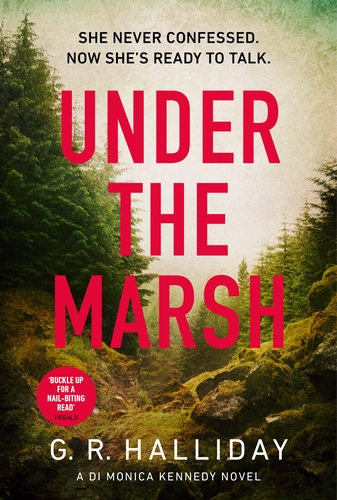
This is the third novel by GR Halliday featuring Inverness copper DI Monica Kennedy, and you can read my review of the previous book, Dark Waters, by clicking on the title link. DI Kennedy’s life revolves around being the best mother she can be for her five year-old daughter Lucy, and solving serious crime for Police Scotland. When those two vocations collide, she is helped out by her willing, but rather reproachful mother.

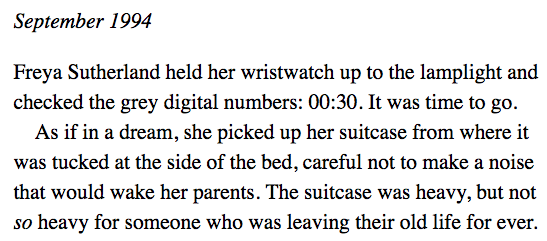
The novel begins with one of those “She’s Leaving Home” moments, but there is a difference. The worst that we know of what became of the girl in the Beatles song is that she went off with a man from the motor trade. What happens here is worse. Much, much worse.

Screen Shot 2022-08-11 at 19.53.18

UTM coverOne of Kennedy’s chief scalps was serial killer Pauline Tosh, who now faces spending the rest of her days in a remote high security jail. Out of the blue, Tosh requests a visit from the officer who ended her murderous career, and what she reveals sets off a search for a body. When it is discovered, and is revealed to be that of the long-since missing Freya Sutherland, what is in effect a massive cold-case-murder hunt is put into place.

I am not the greatest fan of the split time frame mode of storytelling, but Halliday uses it sparingly. Freya’s links with some minor celebrities back in the day provide leads for the investigation, but they are not necessarily fruitful. Along the way, the author has fun painting dark pictures of people who were once ‘something’ in the entertainment business, but whose best days are long behind them, but the questionable ethics and narcissism that brought them fame are as strong as ever. More troubling for Monica Kennedy is that one of the people who crops up in her investigation into what happened decades ago is now a prominent Scottish politician.

Monica Kennedy gets on really well with her professional partner, DC Connor Crawford, but then he goes AWOL at a time when the investigation is floundering. When he does surface, it is to tell Kennedy that he is in la merde profonde. He has become captivated with a Lithuanian stripper who works for one of Scotland’s major villains, who now has compromising footage of Crawford and Emilija. This footage will be revealed to all and sundry unless Crawford agrees to feed him with information. It is not all doom and gloom, however, as Crawford has had a bit of luck via a cassette tape which seems to indict several of Kennedy’s suspects in the search for Freya’s killer.

Screen Shot 2022-08-13 at 19.09.20As with all good crime writers, Halliday (right) leads us up the garden path, and killers (plural) are actually found, but the solution is surprising and beautifully complex. Oh yes, I almost forgot. From his bio, GR Halliday is a lover of cats, so if you share his passion, there are cats in this story. Several of them.

The author brings us a dark and compelling mystery set against the dramatic and occasionally unforgiving landscape of the Scottish Highlands. Monica Kennedy is a fully fleshed out character we can all believe in. Under the Marsh is published by Vintage, and is available now.

THE GHOSTS OF PARIS . . . Between the covers

TGOP header

Ghosts cover

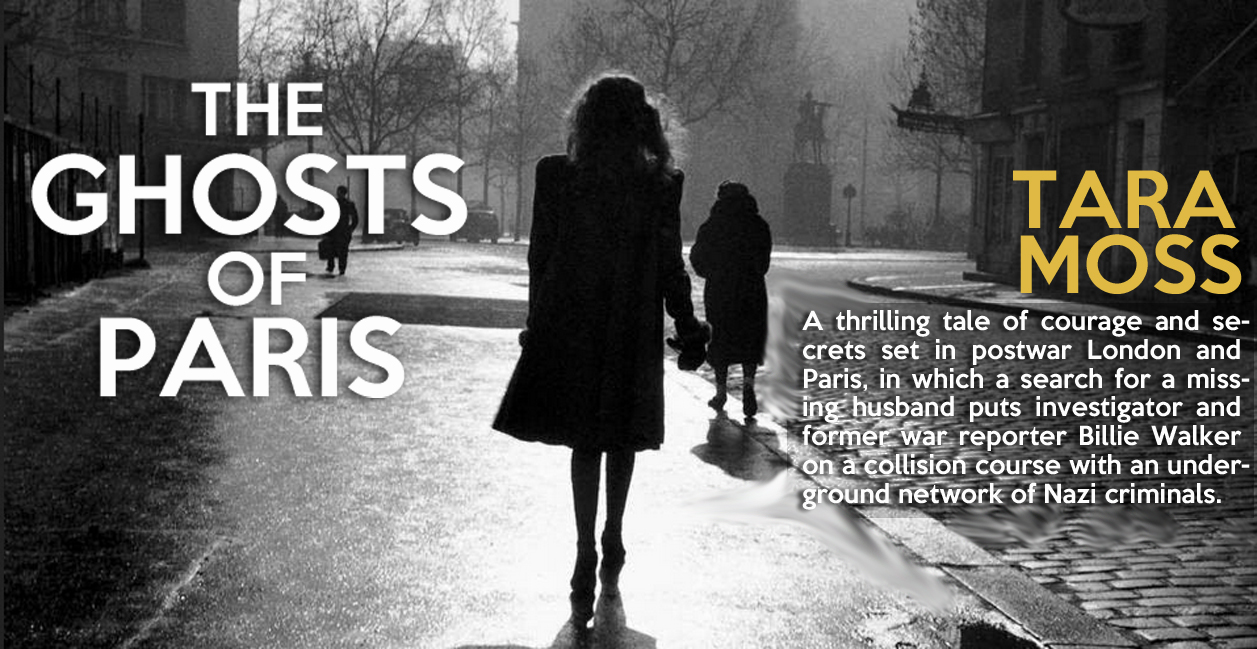
It is 1947, and in Europe both victors and vanquished struggle to rebuild shattered lives, towns, cities and democracy itself. Although nearly 30,000 Australian servicemen lost their lives, their homeland remained physically untouched. Former war reporter Billie Walker has set up as a private investigator in Sydney and, with her assistant Sam, is making a decent go of things, but their cases are very parochial and largely mundane. Then everything changes. She accepts a case to investigate the disappearance of Richard Montgomery, last heard of in London, and possibly Paris.

This book is full of interesting historical detail, some of which was new to me. For example, I never knew that flights between Australia and Britain at the time were often made in hastily converted Lancaster bombers, renamed ‘Lancastrians’. Billie and Sam, aboard one of these lumbering giants, take three days to reach London, and when their hearing and sleep patterns have returned to normal, they begin their investigation.

It soon becomes clear that the Richard Montgomery’s London trail has gone cold, and so the pair move to Paris where, from their luxurious HQ of the Paris Ritz they start to make enquiries. At this point, some of the back-story needs telling. Billie Walker was once married to Jack Rake, another war reporter and photographer, but in the vicious chaos that was wartime Central Europe, they became separated. Jack was last heard of in Poland but Billie has had no communication of any kind from him since then, and she fears he is dead. Back in Australia, on an earlier investigation, Billie had accidentally uncovered part of the ODESSA network. This had nothing to do with the Black Sea port, but was an acronym for Organisation Der Ehemaligen Ss-angehörigen, a highly secret group dedicated to smuggling as many former SS men out from under the noses of the Allies as possible. The encounter pitted Billie against one of the most vicious former Nazis in the organisation. She brought about his downfall, but ODESSA have neither forgotten nor forgiven.

le-stryge-17626773

Billie Walker is an admirably resilient and resourceful investigator, and Tara Moss tells a tale that gallops along at a cracking pace, and includes a very cinematic scene where Billie fights for her life on very rickety scaffolding high up on the wall of the Cathédrale Notre-Dame de Paris, with Le Stryge (above) gazing impassively at the struggle. The Ghosts of Paris is published by Dutton (an imprint of the Penguin Group) and is available now.

Tara Moss

Author Tara Moss  (right) has a pretty impressive CV. She holds joint citizenship of Canada and Australia, and is an international advocate for human rights, particularly those of women and children. She is renowned for researching the physical action in her novels, and this has included shooting firearms, being set on fire, being choked unconscious by Ultimate Fighter ‘Big’ John McCarthy, flying with the Royal Australian Air Force, spending time in morgues and courtrooms and obtaining a licence as a private investigator. She has also been a race car driver (CAMS), and holds a motorcycle licence and a wildlife/snake-handling licence.

Blog at WordPress.com.

Up ↑