

Wisbech is a town in the fenland area of Cambridgeshire, and that is where I live. At which point some unkind wag will usually comment, “Well, I suppose someone has to.” That slight is not undeserved, as much of the place is pretty grim. It has some pretty Georgian and Victorian architecture, but in recent years it has had the stuffing knocked out of it by immigration. Add to that the disease infecting so many similar places in the country, that of the shops we knew and loved (but not patronised enough, sadly) being replaced with a seemingly endless supply of charity shops, mobile phone stores, bookies, coffee shops and pound stores. The town has featured peripherally in some novels; perhaps the brewery that featured in Graham Swift’s Waterland was our our own Elgoods; the town makes a brief appearance in my favourite crime novel, Dorothy L Sayers’ The Nine Tailors, gets a passing mention in some of Jim Kelly’s novels, but now there is a novel firmly centred in the town.
 The legend of King John’s lost treasure is an intriguing one, and Diane Calton Smith (left) cleverly reimagines it in her novel In The Wash. I am not normally a fan of split time narratives, but she does it beautifully here, with the events of October 1216 being mirrored perfectly by a present day story beginning, also, in October. Perhaps ‘mirror’ is not the best metaphor – the two stories are more like a melody and its counterpoint in music, each complementing the other. In 1216 we meet Rufus, a young clerk under the tutelage of Father Leofric, a priest at Wisbech Castle, and the entire establishment is waiting for the arrival of King John, who is to make a break in his journey from Bishop’s Lynn to Newark. In present day Wisbech, Monica Kerridge is the curator of The Poet’s House Museum, an establishment dedicated to the life and work of celebrated Georgian poet Joshua Ambrose.
Rufus and his fellow clerks can only watch in awe from a distance as the King and his retinue arrive. Beset by political troubles both at home and abroad, the King appears tense and distracted at the lavish feast prepared for him, but his mood worsens when he receives shocking news from one of his courtiers, freshly arrived at the castle. His baggage train, a mile long and consisting of lumbering bullock carts and hundreds of men has fallen foul of the capricious tide as they attempted to ford the river mouth where it meets The Wash – with catastrophic results. In the days that follow, Rufus is called upon to catalogue the battered remains of the king’s wagons and the scores of of corpses washed up on the sea banks.
Back in the present day, Monica and several other town worthies become involved with a new group being set up to try to get to the bottom of the enduring mystery of what actually happened on that day in October 1216 and – more importantly – establish exactly where the abortive attempt to cross from Norfolk into Lincolnshire was made.
It is an established fact that King John died not long after his fateful sojourn in Wisbech, and was succeeded – at least in name – by his nine year-old son. Rufus becomes involved in a dangerous search for one particular item of John’s lost treasure – an item so precious that powerful interests in the land think little of murder in order to gain the prize. The search by Monica and her friends is less perilous, but they uncover a mystery just as intriguing.
Diane Calton Smith lets her two narrative melodies weave their magic and cleverly keeps the two time lines running almost exactly parallel, just separated by the eight centuries. Then, to extend the musical metaphor, the two themes resolve together in an very satisfying cadence to bring the piece to an end. I loved this book. Yes, the local interest intrigued me, but this is writing of the highest quality, backed by scrupulous historical research, a genuine sense of place, and shrewdly observed characters. In The Wash is published by New Generation Publishing and is available now






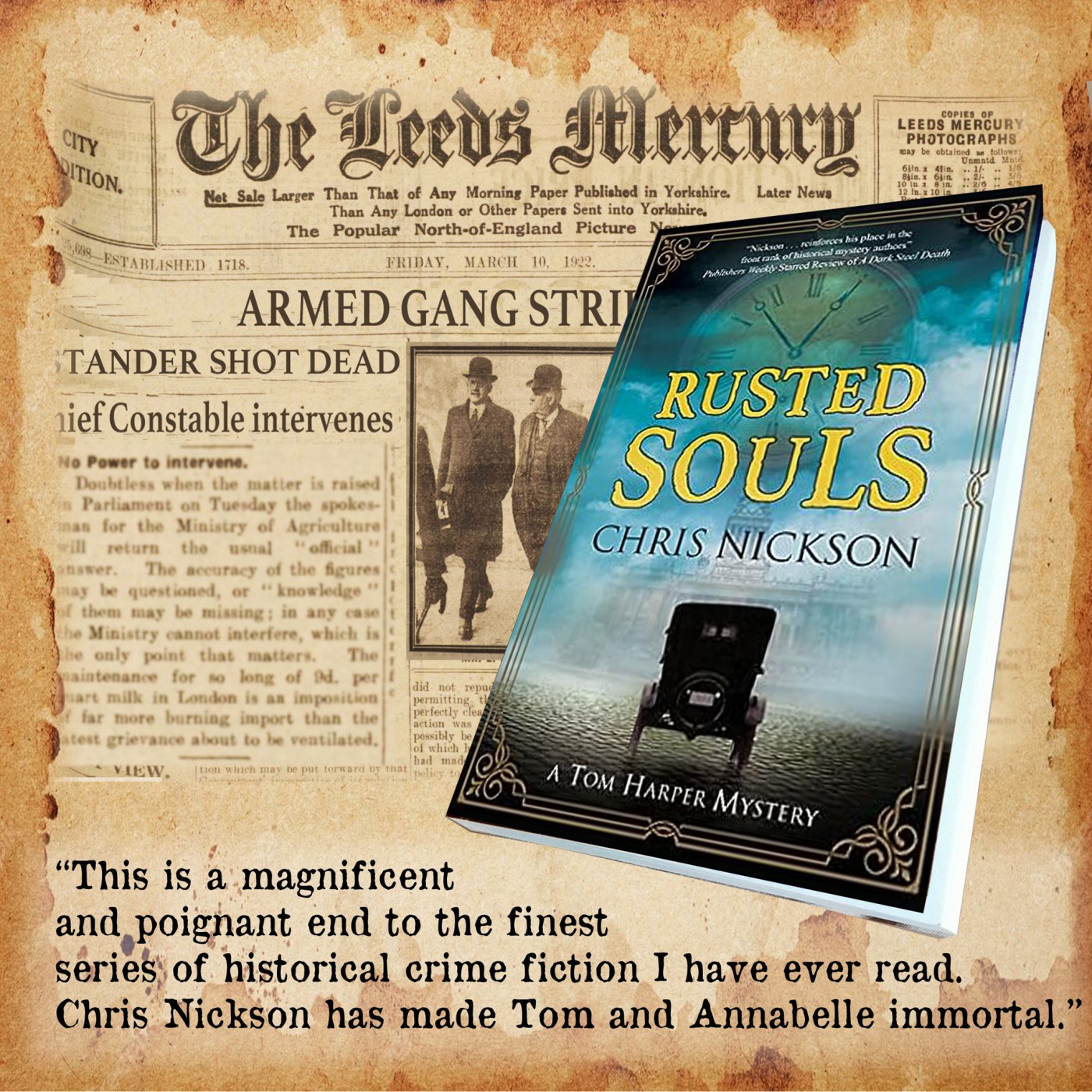
 Leeds, March 1920. Tom Harper is Chief Constable of the City force and, with just six weeks until his retirement, he is dearly hoping for a quiet ride home for the final furlong of what has been a long and distinguished career. His hopes are dashed, however, when he is summoned to the office of Alderman Ernest Thompson, the combative, blustering – but very powerful – leader of the City Council. Thompson has one last task for Harper, and it is a very delicate one. The politician has fallen a trap that is all too familiar to many elderly men of influence down the years. He has, shall we say, been indiscreet with a beautiful but much younger woman, Charlotte Radcliffe. Letters that he foolishly wrote to her have “gone missing” and now he has an anonymous note demanding money – or else his reputation will be ruined. He wants Harper to solve the case, but keep everything completely off the record. Grim-faced, Harper has little choice but to agree. It is due to Thompson’s support and encouragement that he is ending his career as Chief Constable, with a comfortable pension and an untarnished reputation. He chooses a small group of trusted colleagues, swears them to secrecy, and sets about the investigation.



 I must confess to not having read anything by Robert Goddard (left) for a few years. Back in the day I enjoyed his James Maxted trilogy, which comprised The Ways of the World (2013), The Corners of the Globe (2014) and The Ends of The Earth (2015), which focused on a young former RAF pilot and his involvement in the political fallout in Europe after the Versailles Conference ended in 1920. I reviewed his standalone novel



