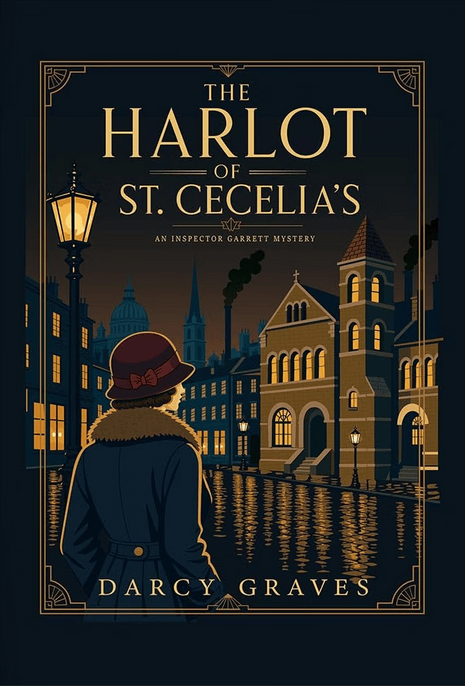

England, 1923. Eden Brior is a librarian at a London institution called St Cecelia’s, and a long way from home, even though her native Boston was at that time perhaps, the most English of American cities. Through no fault of her own, she becomes involved in the investigation into a particularly horrid murder, that of a beautiful – but damaged – French actress. The dead woman is Isabelle Jalbert, someone whose physical beauty has caused those around her – both men and women – an exquisite blend of pain and joy.
Her current husband (although we learn that she is guilty of bigamy) is an American theatre producer called Alan Holloway, although we have already been told that Isabelle has considerable ‘history’ with an apparently feckless and reckless man called Simon Cross who lives with his sister Meg and her husband Arthur in a London suburb.
I have been fascinated by The Great War since I was a teenager, have walked countless miles across the former battlefields, and I am drawn instinctively to novels set in the 1920s and 1930s. At the forefront of my mind is always a variant of the question, “What did you do in the war, Daddy?” Simon Cross is certainly of an age to have served, as is Inspector Garrett. In fact, Simon Cross served in France as a Captain in the East Surreys, and was awarded the Military Cross but, as he tells Garrett, “After The Somme, they just gave them to anyone who was left.” Two days after The Armistice, Cross simply disappeared in Paris, was eventually found, court marshaled and dishonorably discharged. Garrett also did his bit, but with the London Irish in Palestine, and he has a leg disfigured by Turkish shells and bullets to prove it.
While Cross lives with his sister and her rather pompous husband, Garrett rents a room in a noisy and inhospitable house. The owner sells up, and our man has to seek accommodation elsewhere. Cross is the enigma. He is apparently louche, decadent, and idle, but Garrett discovers he secretly trains as a sprinter. We also discover that his post war Paris days were spent in the company of both Isabelle and a mysterious painter called Marc Etienne, now in the later stages of morphine addiction, a habit he shared with Isabelle.
At the root of the mystery, I suppose, is the question of money. Simon Cross appears to have no income, yet he lives the high life of gentlemen’s clubs and expensive taxis. The pompous Arthur Drake is a university lecturer, but he and Meg can afford a chauffeur and a maid. Isabelle was supposed to be on the verge of a family bequest, and Alan Holloway, like many theatre producers, is almost permanently broke.
Eden Brior flits in and out of the narrative. She is certainly not a conventional heroine. She seems dowdy and frequently flustered, although intelligent and observant. In the end, she identifies the killer of Isabelle at about the same time as Garrett, but for different reasons.
Darcy Graves (below) grew up in Boston and holds an MA in English history. She brings to her work a deep love of the Golden Age of detective fiction — particularly Agatha Christie and P.D. James — and the whimsy of P.G. Wodehouse.

There is, at the end of the Kindle version of the book, a set of readers’ discussion questions, presumably aimed at groups that like to talk about books and their interpretation. One of the questions is about the title. Ms Graves asks, “Who, or what, do you think the title ultimately points toward?“Good question. For all her faults, Isabelle Jalbert was only briefly acquainted with St Cecelia’s and, if we take the ‘H’ word to mean a prostitute, then Eden’s morals seem to be unblemished. Perhaps, then, it is a ‘what’, and there is some metaphor hidden here. Obviously, this book is a pastiche, but it is delightfully done, with a genuine sense of awareness for the brittle and uncertain times that followed The Great War. It is independently published, and available now.