 James Barlow was a Birmingham-born novelist who served as an air gunner with the RAF in WWII. Invalided out of service when he contracted tuberculosis, he faced a long convalescence. He began writing at this time, and after he worked in his native city as, of all things, a water rates inspector, he made the decision to write for a living. His first novel, The Protagonists, was published in 1956, but made little impact. It wasn’t until Term of Trial (1961) that he began to make a decent living from writing, and then more because film director Peter Glenville saw the cinematic potential in the story of an alcoholic school teacher whose career is threatened when he is accused of improper behaviour with a female pupil. The subsequent film had a star-studded cast including Sir Laurence Olivier, Simone Signoret, Sarah Miles, Terence Stamp, Hugh Griffith, Dudley Foster, Thora Hird and Alan Cuthbertson.
 Term of Trial was a powerful and controversial film, but clearly had nothing to do with crime fiction. Barlow’s 1968 novel The Burden of Proof was another matter. By the time it was published, the Kray twins’ days as despotic rulers of London’s gangland were numbered. They were arrested on 8th May in that year and the rest, as they say, is history. The Burden of Proof is centred on a Ronnie Kray-style gangster, Vic Dakin. Dakin is psychotic homosexual, devoted equally to his dear old mum and a succession of pliant boyfriends, while finding time to be at the hub of a violent criminal network.
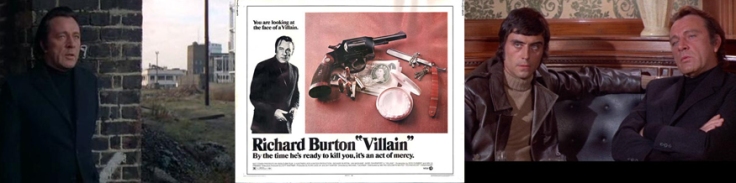
The cast of the subsequent film version of The Burden of Proof was similarly stellar to that of Term of Trial. Villain (1971) starred none other than Richard Burton, Ian McShane, Nigel Davenport, Joss Ackland, Donald Sinden and T.P, McKenna.
Barlow seems to have been a fairly misanthropic fellow who raged at what he believed was a gathering darkness afflicting an England that he once loved. A year after The Burden of Proof was published he decided he’d had enough, and decided to relocate to a place to which many Englishmen of a previous generation were sent as a punishment – Van Diemen’s Land, latterly rebranded as Tasmania. Barlow’s departure was accompanied by a fanfare of his own devising, a rancorous demolition job on what he saw as a corrupted and increasingly shallow country – Goodbye England (1969)
Much of Barlow’s intense disgust at what was happening around him spills out onto the pages of The Burden of Proof. The crime plot centres on Dakin’s plan to pull off a lucrative wages heist, but this almost becomes secondary to Barlow’s polemic about his homeland being reduced to what he saw as an obscene freak show where morality and integrity were turned on their heads in favour of a mindless and debased popular culture. Re-reading the novel exactly half a century after it was published, I am astonished by how contemporary his words sound. They could be put in the mouths of many modern alt-right commentators. Given access to today’s social media he would rage like an Old Testament prophet and, just like his modern counterparts, he would enrage and delight in equal measure.
Barlow on Speakers’ Corner and the how the statuary of London acts as a metaphor:
“The small indifferent crowds hung around the rostrums on Sundays, laughing at the remnants of free speech. The pigeons excreted as they stood on the heads of statues of forgotten men of a time despised now by the liberals who knew better …”
1960s London is portrayed in the bleakest of descriptions:
“London was tired, seedy, cunning, ugly, here and there beautiful. In 1914 it had been at its most powerful; in 1940 at its most heroic. Now, in the 1960s, it was impotent and had the principles and self-importance of an old queer.”
As I read Barlow’s cri de cœur about what he clearly saw as the triumph of the metropolitan elite, I might have been something by Rod Liddle in one of his recent rants in The Spectator or The Sunday Times;
“Nobody could do anything now without being accountable to the scorn of the liberal intellectuals in print or on television. England was too articulate at the top. Nobody, even in a Socialist liberal permissive society, had the slightest notion of the wishes of the people, out there beyond the great conversational shop of London.”
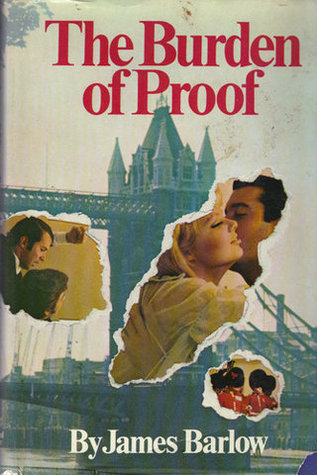 In the city which is portrayed as little more than a moral sewer, we have the vile Dakin and his criminal associates; we have an earnest and incorruptible copper, Bob Matthews who Barlow sets up – along with Bob’s mild-mannered and decent wife Mary – as the apotheosis of what England used to be before the plague took hold. We have Gerald Draycott, a dishonest and manipulative MP who flirts with the dangerous world of gambling clubs, casinos, girls-for-hire and drugs-for-sale, but still dreams of becoming a cabinet minister.
Back to the crime story. Dakin’s attempted wage-snatch, described in terrifying detail, does not go according to plan, but such is the depth, ferocity and intensity of the man’s evil, that there are casualties a-plenty beforte he gets his come-uppance. There is also a terrible incident, unconnected and not criminal by intent but more a result of negligence, which is described in horrific detail and left me dry-mouthed with a mixture of pity and shock. Of the people, volunteers, who help with the consequences of the disaster, Barlow says;
“They came when England and London needed them, and sank back into obscurity afterwards while the more important people postured before cameras with their guitars or explained the need to hate Rhodesians, or Arabs, or Israelis, or Americans…”
Nothing else I have read by Barlow comes close to The Burden of Proof in terms of its rage, its disgust and the sheer firepower of words when used by someone who believes he is on a mission. You may be appalled, you may be left thanking whoever you believe in that we live in more ‘enlightened’ times, but if you read this bitter and brilliant novel and don’t experience an emotional jolt then you may well be in a permanent vegetative state.
For a more recent slant on the real life connection between Ronnie Kray and powerful political figures in the 1960s, take a look at Simon Michael’s novel Corrupted.


 Something we do all too rarely on Fully Booked, mea culpa, is to feature articles and reviews by guest writers. I am delighted that an old mate of mine, Stuart Radmore (we go back to the then-down-at-heel Melbourne suburbs of Carlton and Parkville in the 1970s, where he was a law student and I was teaching art at Wesley College) has written this feature on a writer who, as an individual, never actually existed. Stuart’s knowledge of crime fiction is immense, and so I will let him take up the story.
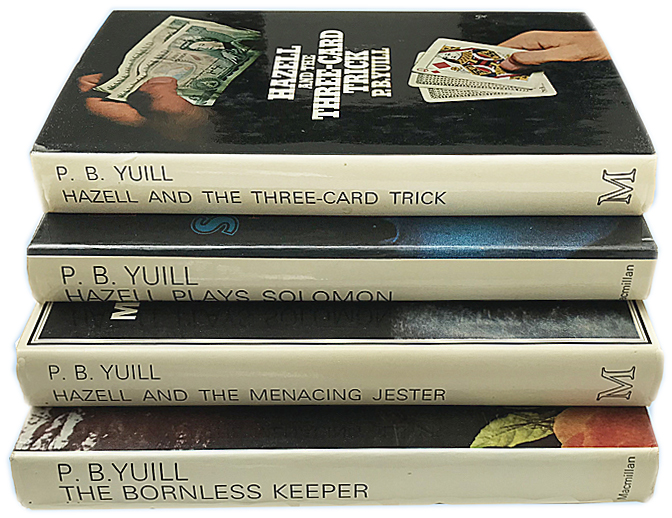
 Their first joint outing (published under their own names) was They Used To Play On Grass (1971). Described, not incorrectly, on the paperback cover as “the greatest soccer novel ever”, it’s still an enjoyable read, with each man’s contribution being pretty obvious.
 The authors were keen to develop the Hazell character into a possible TV series, and the later two books seem to be written with this in mind. This duly came to pass, via Thames Television, and the first series was broadcast in 1978, starring Nicholas Ball as a youthful James Hazell. Gordon Williams, with Venables (right) and other writers, was responsible for a number of the episodes (including ‘Hazell Plays Solomon’), and it remains a very watchable series. The second, and final, series broadcast in 1979/80 was not so successful. The hardness was gone, Hazell and Inspector ‘Choc’ Minty had become something of a double act and, while not outright comedy, it came close at times. It’s not surprising to learn that Leon Griffiths, one of the second series screenwriters, went on to create and develop the very successful series Minder later that year.


 I have a close friend who keeps himself fit by walking London suburbs searching charity shops for rare – and sometimes valuable – crime novels. On one particular occasion he was spectacularly successful with a rare John le Carré first edition, but he is ever alert to particular fads and enthusiasms of mine. Since I “discovered” PM Hubbard, thanks to a tip-off from none other than
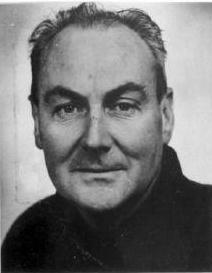
  Seldom, however, can a treasure have been protected by two more menacing guardians in Aunt Elizabeth and her maid-of-all-work Coster. Remember Blind Pew, one of the more terrifying villains of literature? Remember Tod Browning’s Freaks (1932) and the decades that it was hidden from sight? With a freedom that simply would not escape the censor today, Hubbard (right) taps into our visceral fear of abnormality and disability. Hubbard has created two terrifying women and a dog which is makes Conan Doyles celebrated hound Best In Show. The dog first:

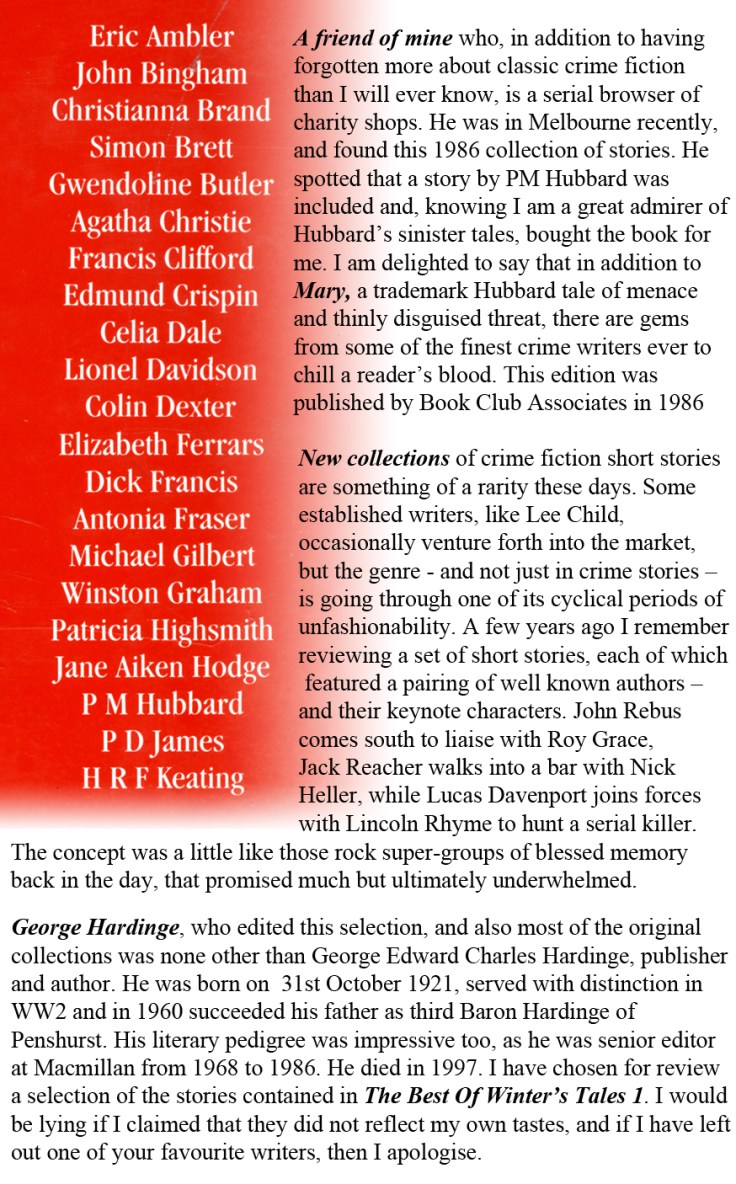
 Mr Bulmer is a uniquely repulsive little man who manages a dry cleaning shop in Mayfair, and uses the opportunity of searching through the jackets and trouser pockets of wealthy individuals to service his own very profitable blackmail industry. His malignant little sideline has provided him with a regular income – and driven at least one of his victims to suicide. When he seizes upon what he sees as the opportunity of a lifetime, he is unaware that is about to be snared by his own hook. John Bingham, in addition to being a writer of distinction, was also a highly placed official in British Intelligence operations.
 Crispin, aka Robert Bruce Montgomery, is best known for his Gervase Fen novels but here he spins a delightfully black tale of a struggling writer whose hospitality is impinged upon by a pair of runaways, both seeking a new life away from their spouses. Crispin intersperses the narrative with vivid accounts of a writer desperately searching for the words which will bring his latest novel to life. Sadly for the would-be lovers, their fate is to be organic fertiliser for Mr Bradley’s vegetable plot.
 Davidson’s internationally themed thrillers were his bread and butter, but we must not forget that he was a writer of immense sensitivity with a wide range of influences. His own upbringing as a child of a hard-scrabble Polish-Jewish family might have made it unlikely that he would compose a chilling tale of murder on the banks of s Scottish river frequented only by rich Englishmen with the money to buy the rights to snare incoming salmon. A man whose sexual abilities have been devastated by a potentially fatal illness plans revenge on a friend whose libido remains undiminished. The denouement takes place on the banks of Scotland’s sacred salmon river – the Spey.
 Colin Dexter? Cue Oxford, an irascible senior policeman, pints of English beer and crossword puzzles? Think on. When this story was published, Dexter was already four books into his Inspector Morse series, but the TV adaptations were still six years away. In this tale, Dexter takes us to, of all places, rural America, where a coach load of middle-aged and elderly tourists take a rest stop at the eponymous wayside hotel. The action is centred around a game of vingt-et-un, designed to empty the wallets of the gullible travellers. Dexter describes a scam-within-a -scam -but saves until the last few paragraphs a chilling finale in which the scammer becomes the scammed.
 People might forget that Antonia Fraser, as well as being the daughter of Lord Longford the widow of Harold Pinter and a superb historical biographer, is no slouch when it comes to crime fiction. Here, she taps into that strange love affair that English people have with their dogs. Richard Gavin is a successful barrister (is there ever another sort?) who has kept his upper lip stiff and tremble-free during the death of his first wife, and remarried. The new lady of the Gavin household is Paulina – young. bright and adorable. Her judgment, however is brought into question, when her decision to put an aged, smelly and incontinent spaniel out of its misery coincides with Richard opening an ominous letter from his London doctor.
 This is the most shocking and slap-in-the-face story in the collection. I would go as far as to suggest that it would not have been written – let alone published – today, with our heightened awareness of child abuse and domestic violence. As an account of casual violence, domestic cruelty, alcohol abuse – and the pervasive power of the Roman Catholic church – it makes for uncomfortable reading. Highsmith’s misanthropy can never have been more glaringly or honestly displayed. her publisher wrote:
 Like Hubbard’s longer works, which are examined in this feature, a dream-like quality pervades this story, but the dreams are not necessarily pleasant ones. The first words are:
 This exquisite masterpiece tells of a nameless girl, an orphan, who is brought up in a loveless terraced house in east London, the home of her Uncle Victor and Aunt Gladys. Her only joy is the adjacent cemetery which becomes a place of mystical and endless attraction:


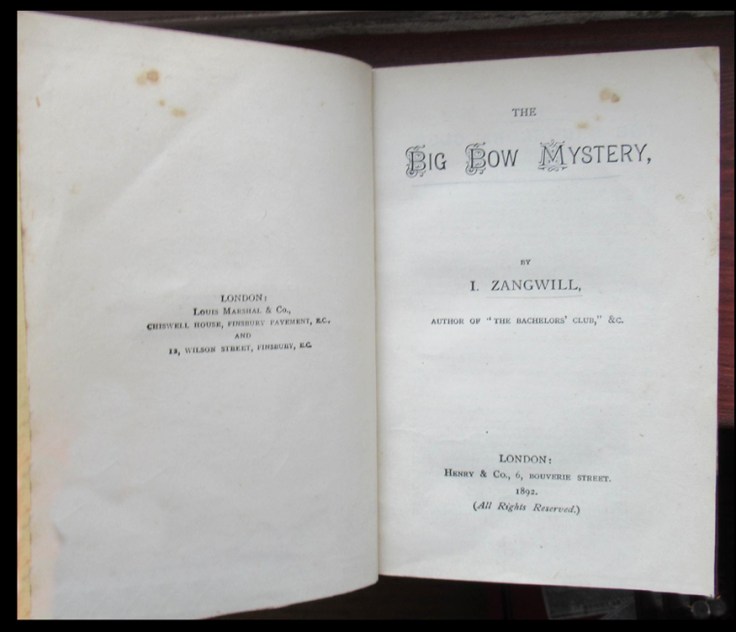
 The ‘Bow’ in the title is not some fabric adornment, but the working class district in East London. If you were born within earshot of its church bells, then you were said to be a true Cockney. It’s December, and the nineteenth century is on its last legs. A dense morning fog, aided and abetted by the smoke of a million coal fires, swirls around the mean streets.
 The formidable lady has overslept, but after lighting the downstairs fire, she remembers to wake one of the lodgers. Arthur Constant is an idealist, and a campaigner for workers’ rights. She bangs on his bedroom door, then makes the day’s first pot of tea. Taking a tray upstairs, she calls again. Still no response. She peeps through the keyhole, but the key is firmly in place. As she pounds on the door once again, she has a premonition that something is very, very wrong. So she summons her neighbour, the redoubtable retired detective Mr George Grodman. He batters down the door, which was locked and bolted from the inside, and is forced to cover Mrs Drabdump’s eyes from the horrors within…
 Some contemporary critics were puzzled and irritated by Zangwill’s satirical style. They felt that there was no place for comedy in the tale of a young man, dead in his bed, his throat cut from ear to ear. The exchanges in the court scenes between pompous officials and outspoken ‘low life’ types on the jury are delightfully reminiscent of similar encounters between Mr Pooter and disrespectful tradesmen in that classic of English humour, The Diary of A Nobody.