Search

fullybooked2017

Category

FEATURES

THE FORGOTTEN … A series re-evaluating forgotten authors. Part Three – Colin Watson (1)

CW header

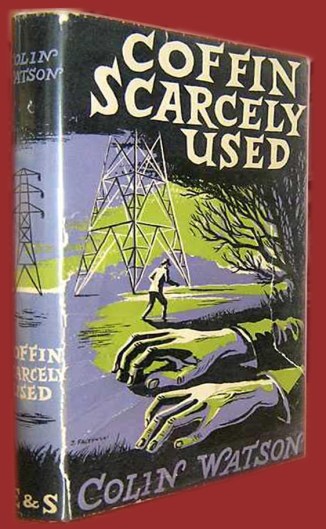
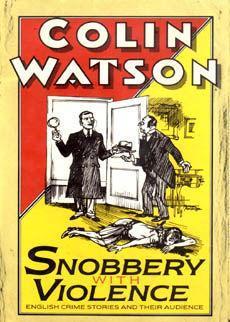
To be unfashionable is no crime, especially at a time when fame is so fleeting that it makes Andy Warhol’s fifteen minutes seem like a lifetime. Even if he were still alive and working, the books of Colin Watson would not be found bulk-bought and jostling for space with the latest James Patterson between the party goods and the lottery machine at the local ASDA. Am I being snooty? Almost certainly I am, but I’m also more than happy to wear my love of Watson’s humour, ingenuity and exquisite use of English, as a badge of honour. Watson was, in his day, very well thought of. His Flaxborough novels sold well, and until relatively recently were always well represented on library bookshelves, because local library users were not, by and large, fools.

It would be tempting – but incorrect – to think that Watson would be turning in his grave at some of the writing which is passed off as crime fiction these days. Incorrect because he was a man who, by all accounts, was at peace with himself and with those around him. Another Lincolnshire man, Alfred, Lord Tennyson, imagined his pale Queen Guinevere describing Sir Lancelot:

“For manners are not idle, but the fruit
Of loyal nature, and of noble mind.”

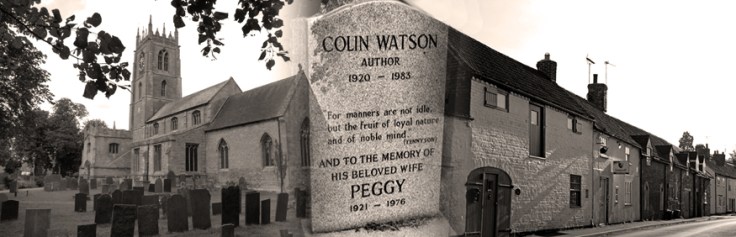
Those words are inscribed on Watson’s tombstone in the village churchyard at Folkingham, where he is buried under a beautiful and ancient chestnut tree. It was a curious reflection on the fickleness of fame that when I first visited Folkingham, the good natured locals who showed me to the headstone had no idea who Watson was, or what he had written. In part two of this feature, I will look in more detail at Watson’s novels, but I am indebted to Stuart Radmore who has researched and prepared this timeline for Colin Watson.

CW bio

TO BE CONTINUED

THE FORGOTTEN … A series re-evaluating forgotten authors. Part Two – Rex Stout (2)

Stout Header

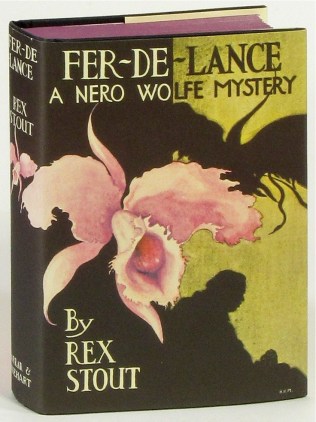
Fer-de-Lance was published in 1934 by Farrar & Rinehart, Inc. I doubt there will be any readers living for whom this novel was their introduction to the series. Most, like me, will have read one of the other 45 first. I mention this because it is astonishing how Stout brings the curtain up on the whole Wolfe household so that we feel we have known them for ever. Not for him the clumsy explanations or contrived insertion of the back-story. “Here they are”, he seems to say, “.. let’s get on with the story.”

Fer de LanceAnd what a story it is. A wealthy and highly regarded academic, Peter Oliver Barstow dies from an apparent heart attack while he is engaged in a foursome on a golf course. Meanwhile, an Italian metalworker, Carlo Maffei, has disappeared, but then turns up – as a corpse – murdered, if the knife embedded in his chest is anything to go by. As Wolfe uses his phenomenal intellect to link these cases, we learn that he is partial to a glass (or six) of beer. Bear in mind that Prohibition in America had only ended in 1933. Wolfe, perhaps disheartened by the lack of a decent drink, decides to cut down on his intake:
“I’m going to cut down to three quarts a day. Twelve bottles. A bottle doesn’t hold a pint. I am now going to bed.”

Archie is sent (because Wolfe rarely if ever leaves the house) to interrogate the residents of the house where Maffei lived. Archie Goodwin, remember, is the sole narrator of these stories. He sums up Anna Fiore:

“I went over and shook hands with her. She was a homely kid about twenty with skin like stale dough, and she looked like she’d been scared in the cradle and never got over it.”

 It turns out that Barstow was killed by a poison dart which was loaded into the specially prepared shaft of a golf club. The club’s shaft was adapted by the late Carlo Maffei to release its deadly projectile when the face of the club head made contact with the ball. Wolfe directs operations from the brownstone house, where he sits like a fat spider at the centre of a deadly web. When it emerges that Barstow was not the intended victim, and that the truth behind the killing implicates so many people, Wolfe pronounces:

“It is an admirable dilemma; I have rarely seen one with so many horns and all of them so sharp.”

Eventually, of course, after encounters with a deadly snake and a a scheming attorney, the mystery is solved, but not before Wolfe demonstrates that he is prepared to dispense his own rather harsh brand of justice. We are also treated to his own lordly – and almost Dickensian – use of language:

“I have just being explaining to Mr Anderson that the ingenious theory of the Barstow case which he is trying to embrace is an offence to truth and an outrage to justice, and since I cherish the one and am on speaking terms with the other, it is my duty to demonstrate its inadequacy.”

The relationship between Archie Goodwin and Nero Wolfe lies at the heart of these novels. There is a sense of servant and master, and Goodwin clearly worships the ground that Wolfe walks on, despite his frequent frustrations and occasional attempts to ruffle Wolfe’s imperious demeanour. In his own magisterial way, Wolfe treats Goodwin like a much-loved but slightly wayward son. This affection occasionally gives way to acerbic put-downs:

“Some day, Archie, when I decide you are no longer worth tolerating, you will have to marry a woman of very modest mental capacity to get an appropriate audience for your wretched sarcasms.”

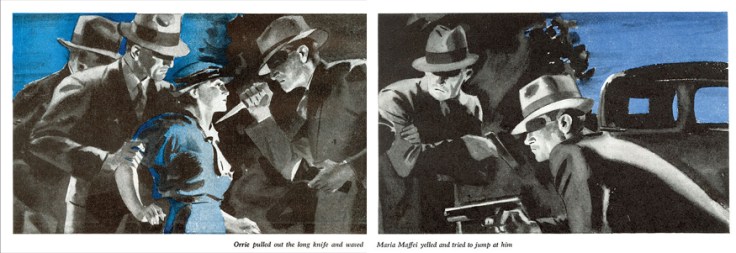
 Stout always had a weather eye open for commercial opportunities, and he was able to arrange for an abbreviated version of this story to be re-hashed as a pulp short story re-named Point of Death – complete with illustrations.

FDL footer

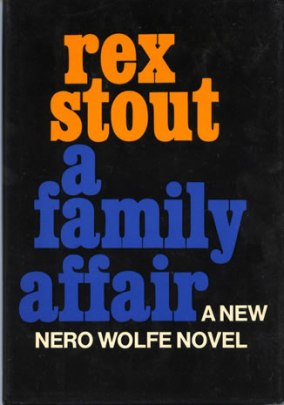
Fam_Affair_1stEd_fsAlmost the first thing which strikes you as you settle in to read A Family Affair (1975) is the sheer breadth of real life events straddled by the Nero Wolfe novels. When Fer de Lance was published America was in the dying throes of Prohibition, John Dillinger, Bonnie Parker and Clyde Barrow had only recently been shot dead, but Pretty Boy Floyd was still at large. By the time Stout’s final novel was published, America was still reeling from the Watergate scandal, Nixon had resigned, The Rocky Horror Show had opened on Broadway, and a man called Bill Gates was playing around with words which could describe his new micro software.
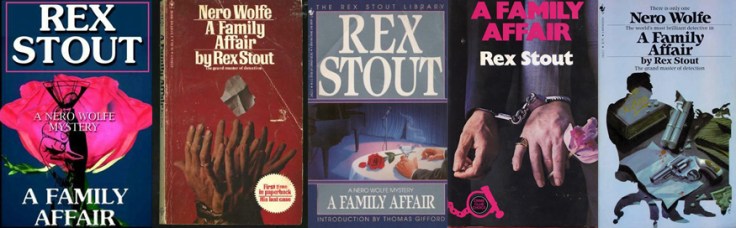
If you want a literally explosive opening to a novel, look no further. Late at night, Paul Ducos, a waiter from Wolfe’s favourite New York restaurant, rings the bell on the front door of the old brownstone, and beseeches Archie to let him speak to Wolfe. He says his life is in imminent danger. Fearful of waking his boss at such an inhospitable hour, Archie compromises, and allows the fearful Frenchman to stay the night in a spare room, with the promise of an audience with Wolfe in the morning.

As Archie prepares for bed, the house shakes and there is a terrible noise. The spare bedroom being bolted from the inside, he clambers in through the shattered window via the fire escape, and sees Ducos lying on the floor:

“He had no face left. I had never seen anything like it. It was about what you would get if you pressed a thick slab of pie dough on a man’s face and then squirted blood on the lower half.”

We learn fairly quickly that Ducos has been killed by a bomb he was inadvertently carrying. A doctored aluminium cigar tube had been planted in his jacket. He discovered it and, fatally, unscrewed the cap. Wolfe reacts to the death with barely suppressed fury. Ducos is dead, yes, but the real assault is on his sanctuary, his own home, the place he values so much that he rarely leaves it.

Archie – assisted by the usual supernumaries Saul Panzer, Fred Durkin and Ollie Cather – is turned loose to find out who killed Paul Ducos. One of the leads takes Archie to the dead man’s home which he shares with his father and daughter. The old man is wheelchair bound, and speaks no English, and the young woman is unwilling – or unable to help. Archie is unimpressed by the contents of her bookshelves and has something to say about Lucile Ducos’s espousal of the feminist agenda:

“All right, she’s a phony. A woman who has those books with her name in them wants men to stop making women sex symbols, and if she really wants them to stop she wouldn’t keep her skin like that, and her hair, and blow her hard-earned pay on a dress that sets her off. Of course she can’t help her legs. She’s a phony.”

 It becomes clear that Paul Ducos was a bit-player in a wide screen drama involving senior industrialists and lawyers, one of whom died the week before the waiter was killed. When Lucile Ducos is also killed, Archie and Wolfe find themselves not working alongside the local cops, but prime suspects, and they spend several uncomfortable hours under lock and key. When they are released, and despite the demands of the case, Wolfe does not lose his appetite, neither does master chef Fritz Brenner succumb to the pressure:

“He tasted his lunch, alright. First marrow dumplings, and then sweetbreads poached in white wine, dipped in crumbs and eggs, sautéed and then doused with almonds in brown butter.”

AFA

This is one of the more serious and deadly episodes in the career of New York’s most celebrated private investigator, but there is still time for humour. Wolfe’s magisterial demeanour and studied delivery does not go un-noticed or unchecked by his right-hand man:

“’Whom did you hear say what?’
I have tried to talk him out of “whom”. Only grandstanders and schoolteachers say “whom”, and he knows it. It’s the mule in him.”

The Goodwin-Wolfe partnership has never come under such strain, and the servant comes within a couple of breaths of finally severing ties with his master but, thanks to a social link with Archie’s long-time lady friend. Lily Rowan, it dawns on all concerned that the villain of the piece is not one of the highly placed lawyers or politicians, but someone much closer to home. By the by, Archie’s admiration for Lily Rowan is unashamed, but he cannot resist a seasoning of irony:

“I’d buy a pedestal and put her on it if I thought she’d stay. She would either fall off or climb down. I don’t know which.”

 amer3Eventually, in a chilling and brutal conclusion, justice of a kind is served. Wolfe and Archie escape the clutches of the District Attorney and his officers, but there is a final knock on the door from an angry policeman. Fully aware of his machinations but frustrated by Wolfe’s ability to enforce his own law while remaining invulnerable to the laws of the city of New York, Inspector Cramer lashes out, bitterly, but his barb simply bounces off and rolls harmlessly into a dark corner of the office:

“He went and got his coat and put it on and came back, to the corner of Wolfe’s desk, and said, ‘I’m going home and try to get some sleep. You probably have never had to try to get some sleep. You probably never will.’”

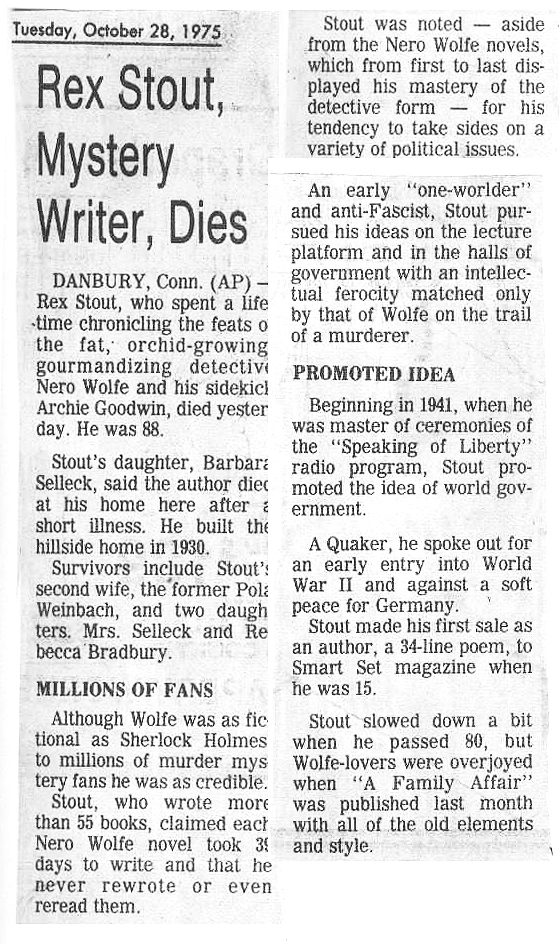
This is the last episode in the long and illustrious career of the gargantuan, pompous – but eerily perceptive consulting detective. Of his origins we learn little, except that he is, by origin, a Montenegran, and that he has an aged mother living in Budapest to whom he sends money. It is tempting to ascribe elegiac qualities to Wolfe’s last bow. Rex Stout was to die in the same year as the novel was published. Wolfe had survived the greatest challenge – a challenge made from within his trusted family, and a challenge aimed at the high altar of his own church – the brownstone on West 35thStreet. That altar has been desecrated but, in the end, Wolfe clings to his certainties.

“When the sound came of the front door closing, Wolfe said,
‘Will you bring brandy, Archie?’”

The last word should go to Thomas Gifford (1937 – 2000) who was no slouch at crime writing himself.

“Through Wolfe and Archie, Stout shows you how people are supposed to behave. How grownups act when the pressure is on. So in the very best and wisest sense, and quite painlessly too, Stout shares his code with you, and you are improved a bit.. You would be hard pressed to find another popular writer of his era who more subtly and ably defined what it was to be civilised, to have standards.”

Stout obit

PART ONE of our celebration of the Nero Wolfe novels is HERE

THE FORGOTTEN … A series re-evaluating forgotten authors. Part Two – Rex Stout (1)

Stout Header

Rex Todhunter Stout (above) packed several lives into his 88 years on God’s earth. He was a publisher, a propagandist, a radio celebrity, a campaigner for author rights, inventor, husband and father – and the creator of one of the immortal crime fiction partnerships. The son of Quaker parents, Stout was born in Noblesville Indiana in 1886, and if the tale of him reading the Holy Bible from cover to cover twice by his fourth birthday is true, then he must have been an extremely precocious child.

After serving in the U.S. Navy and honing his writing skills with magazine articles and stories for pulp periodicals Stout achieved some level of financial independence in an unusual fashion. Had it been in the digital age, his achievement would probably be that he designed a piece of software, but this was 1916, and his creation was a banking system designed for school to keep track of cash paid in by children. Stout was clearly canny enough to demand royalties, and the income enabled him to travel widely, and to write what he wanted to write, rather than what paid.

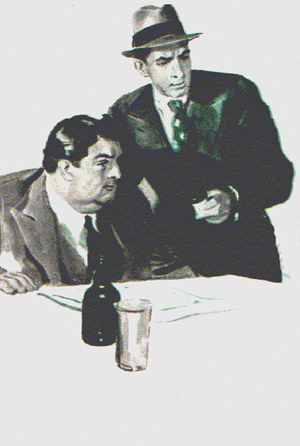
ArchieFor all that Stout was an intellectual and a vigorous campaigner for what he believed in, his legacy remains the creation of Nero Wolfe. Wolfe is an obese, physically lazy but improbably intelligent detective who loves his food and alcohol, cultivates orchids, but never leaves his brownstone house on New York’s West 35th Street. Much of Wolfe’s crime solving is done from the comfort of his armchair, or while consuming fine food and drink. His mind can only achieve so much, however, and he needs access to the streets. This comes in the form of Archie Goodwin (pictured left in a period illustration). Archie would, in truth, have made a perfectly good PI on his own. He is physically fit, handsome, as sharp as a tack, and can handle himself when it comes to physical violence. He lives on another floor of Wolfe’s house, and according to a memo written from Rex Stout to a friend, Archie is:

“Height 6 feet. Weight 180 lbs. Age 32.”


The pair first appeared
in 1934 in Fer de Lance, published by the New York company Farrar & Rinehart. Re-reading it for the first time in many years, I was struck by how easily Stout introduces the Wolfe household, almost as if he is gently reminding us of old acquaintances of long standing. As well as Wolfe and Archie, we have Fritz Brenner the cook, and Theodore Horstmann the cantankerous expert who does the hard work up in the expertly-designed cultivation rooms where the precious and capricious orchids are pampered like dissolute and demanding princesses from a bygone era. When heavy lifting out on the tough streets of New York is needed, Saul Panzer, Fred Durkin and Ollie Cather can always be called upon to get their knuckles grazed.

It is little short of astonishing how Fer de Lance delivers the Nero Wolfe template complete and ready formed, almost as if Stout had already written all the books in one superhuman creative effort. A Family Affair (1975) was the 46th and final Nero Wolfe mystery, and it shows just how successfully Stout was able to keep the train chugging along on the same rails for over 40 years. Goodwin and Wolfe have, of course, not aged by a day, nor do their characteristics and personality quirks deviate by so much as the thickness of a cigarette paper. Wolfe still takes the lift up to his orchid rooms twice a day, while Fritz prepares the gourmet meals. Goodwin still likes the odd slug of whisky, but his drink of choice remains a glass of cold milk.

In Part Two of this feature, we will look in detail at both Fer de Lance and A Family Affair, while assessing Rex Stout’s legacy. To close, though. here’s a quote from the early chapters of Fer de Lance, where Goodwin gives us some idea of the sheer physical presence of his boss.

“Wolfe lifted his head. I mention that, because his head was so big that lifting it struck you as being quite a job. It was probably really bigger than it looked, for the rest of him was so large that any head on top of it but his own would have escaped your notice entirely.”

NW images

THE FORGOTTEN…. A series re-evaluating forgotten authors. Part One – Philip Maitland Hubbard (2)

CGAAP header

Hubbard_DancingThe Dancing Man was published in 1971, and is set in Welsh hill country. An engineer, Mark Hawkins travels to a remote house to collect his late brother’s belongings. Dick Hawkins was an archaeologist by profession and mountaineering was his drug of choice. He set off one day for the nearby mountains, and never returned.
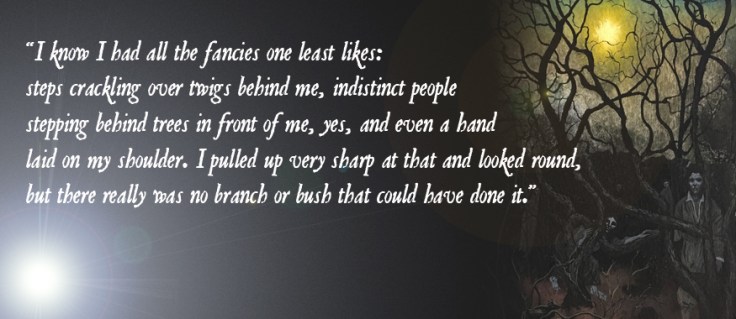
The house where Dick Hawkins was staying when he disappeared is called Llanglas and it is owned by Roger Merrion, another archaeologist, who lives there with his wife Ethel and sister Cynthia. Near the house is the site of a ruined Cistercian monastery circled by a much more ancient earthwork, and the woods which surround the ruin also contain a strange obelisk on which is engraved a primitive but sinister figure – of a dancing man.

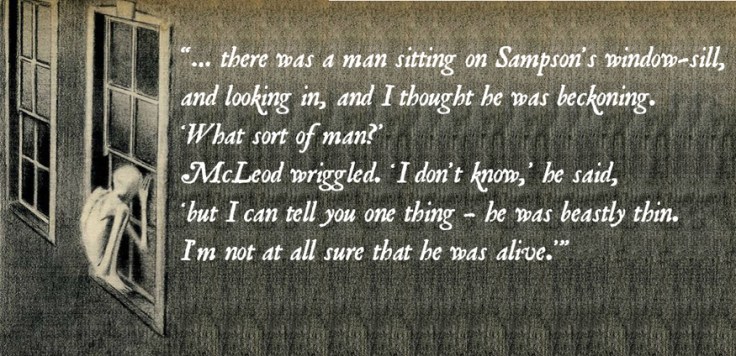
Of the Hubbard novels I have read, this one reveals most about what I believe to be one of the major influences on his work. The ghost stories of MR James are uniquely frightening, due in no small part to the writer’s skilful powers of suggestion. In A School Story, a boy in a boarding school sees something frightful trying to creep in through the window of one of the masters in the dead of night. He tries to describe it to a chum:

ASS quote

In The Dancing Man, Mark Hawkins describes his first sight of the shiveringly disturbing Old Evans.

“He was enormously tall. His clothes flapped round him in the wind, but I got the impression that he was very thin under them, and his head looked disproportionately small. He was too much like a walking scarecrow for comfort.”

That description also immediately brought to mind the hideous entity which conjures itself up out from bedsheets and pursues the unfortunate Professor Parkins along the seashore in Oh, Whistle, and I’ll Come to You, My Lad.

In James’s A View From A Tower, Mr Fanshawe makes the mistake of using a particularly strange pair of field glasses, and finds himself in a very unfriendly wood:

AVFAH quote

Hawkins has a similar experience in the woods by Llanglas, but his is made infinitely worse by the fact that he is about to have company:

“I came to the stone as unexpectedly as I had that first evening. I never seemed to know how far it was. I stopped about fifteen yards from it, suddenly unwilling to go any further. I could see it quite clearly, standing up and motionless, while the trees threshed about over it. I started to turn my back on it, and then the dancing man came out from behind it, white all over and capering in the moonlight with his white matchstick arms straight up over his head.”

Mark Hawkins ponders his brother’s mysterious disappearance, becomes erotically involved with both Mrs and Miss Merrion, but the climax of the story involves the discovery of the hidden twin of the standing stone – and what lies beneath it.

Scroll

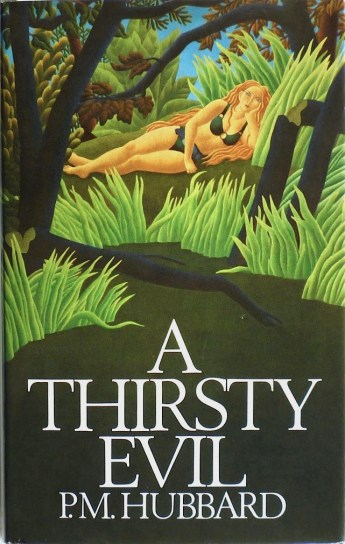
Hubbard_Thirsty_Evil2With A Thirsty Evil (1974) Hubbard once again mines Shakespeare for his title, in this case, Measure For Measure.
“Our natures do pursue
Like rats that ravin down their proper bane,
A thirsty evil; and when we drink, we die.”

In almost every respect this has a much less complex plot than The Tower or Flush As May, but one which is just as powerful and – ultimately – shocking. It is the story of an obsession. Ian Mackellar is a fledgling novelist with the added luxury of a private income from his family business. He sits opposite a woman on a train for a couple of hours, and although not a word – and scarcely a glance – is exchanged between them, he is hopelessly smitten. She leaves the train – and Mackellar – at her destination. He says:

“That could have been the end of it, but in fact it was only the beginning.”

By sheer chance, Mackellar sees the woman again, at a publishers’ party. She is with an older man, but convinced that this is not her husband, he makes small talk and gives her his telephone number.The next few weeks are something of an agony for Mackellar as he waits for her call, but just when he has given up hope, she does ring from a call box, reversing the charge. She makes it clear that she has only called out of good manners, and that it would be quite impossible for them to actually meet. She does, however, tell him that her name is Julia Mellors.

Her call is like one of those intrinsically harmless incidents, so beloved of Thomas Hardy, which trigger a sequence of unintended – and fatal – consequences. Mackellar traces her to a farm called Windbarrow (again, strange echoes of Hardy). Such is his persistence, Mackellar presents himself, and finds that Julia heads a household consisting of herself and her younger siblings Beth and Charlie.

The relationship between the three is complicated by Julia’s remoteness, Beth’s unashamed sexuality and Charlie’s mental condition. He is physically fit and active, but with a psychological flaw which is only controlled by medication. Despite himself, Mackellar is both magnetised and repelled by Beth:

“… it was the way she looked at you. There was nothing secretive about her. Like Cressida, there was language in her eyes, her cheeks, her looks, and like Ulysses I set her down instantaneously as a daughter of the game.”

As with the other Hubbard stories under consideration, the power of the landscape is never far away, and while he tends to deal in tumps, tumuli, barrows and other high places which our ancestors carved out of the landscape, here he gives us something quite different. In the valley carved out by the stream which runs near Windbarrow, long ago, someone dammed the stream and created a deep pool, known as Grainger’s. The Mellors use it as a swimming pool, but Charlie takes Mackellar beneath the surface – literally – and shows him a strange and menacing stone obelisk which rises from the impenetrable depths of the dam.

PMHThe story moves swiftly on. Hubbard’s novels are, anyway, relatively short but his narrative drive never lets us rest. Beth’s carnality and opportunism get the better of Mackellar in a brief but shocking encounter, but this is only a staging post on the path to a violent and tragic conclusion to the novel. Mackellar survives, but he writes his own epitaph in the very first chapter.


“She was the only woman I have ever really wanted. For the matter of that, she still is. I suppose she may always be.”

I came fresh to Hubbard’s books, and I read three or four in quick succession. I found them powerful, frightening and written with icy brilliance The novels are still available, thanks to the Orion imprint, The Murder Room. It must be said, however, that the paperbacks are very expensive, but the KIndle versions are more accessible for readers on a limited budget.

PM Hubbard – Amazon UK author page

MAKING CHARACTERS GENUINE … Cheryl L Reed


Poison header
CherylCheryl Reed
(left) is an author and a journalist. Currently, She is  working on a series of novels set in Chicago. Her first novel, Poison Girls, will be in bookstores on September 12, 2017. The novel explores the intersection of drugs, wealth, politics and race when dozens of daughters from politically connected families die mysteriously from a strand of street heroin.Here, she writes about the challenges of making characters believable – and she starts with a homeless Chicago drug user.

When I met Theodore on the needle exchange truck, he wore a dirty ski vest and a candy necklace—the kind with little sugary o’s that you bite off. Only it was harder for Theodore to chew on his necklace because he had only a single jagged front tooth. Maybe it was because I’d worn that same kind of necklace when I was nine years old or maybe it was because I was two inches taller and had fifty pounds on the guy, but I didn’t hesitate to follow Theodore when he offered to show me the heroin house he ran near the El tracks on the South Side of Chicago.

Chicago

The house’s owners had abandoned the unstable structure after a fire ravaged much of the upper floors, including the staircases marred with gaping holes. I hadn’t expected to be tramping through a drug house that morning, and had stupidly worn high heels. I used the spiky heels like cleats, digging them into the soft wood of the stairs to pull me over the gaps. When we finally reached the upper perch, Theodore proudly showed me his shooting room. Vanilla bean-scented candles lined the floor. A single bed, its nylon bedspread neatly tucked into the corners, took up one side of the room. It was too early in the day for customers, but Theodore’s trip to the needle exchange truck allowed him to stock up on supplies—new needles, cotton balls and little bottles of distilled water he kept neatly in a basket, as if they were door prizes at a Longaberger basket party.

I learned a lot that day from Theodore. And Theodore was his real name. He showed me how he tested his clients’ heroin to see if it contained the deadly fentanyl that was leaving bodies in its wake all over Chicago and its suburbs. He told me how he helped his clients find veins, how he took a cut —about 10 percent—of their drugs in return.

poisongirls-coverlargeI didn’t have to meet Theodore. But I would argue that my new debut novel, Poison Girls, is much richer for my having done so. Theodore was just one of many real characters I met as I explored the underbelly of the heroin drug culture, researching the real story of fentanyl-laced heroin in Chicago that killed more than 250 people in a few months. One thing I learned working for more than two decades as a journalist—many of those as a crime reporter—is that real people are far more complex and interesting than solely relying on my imagination. I’ve read a lot of books and watched a lot of movies that feature drug dealers and drug fixers, but I’ve never read one named Theodore who wore a candy necklace that he chewed on with a single fang. Shit like that, you just can’t make up.
That’s not to say that the Theodore in my book Poison Girls isn’t more interesting and vivid than the real life version. The Theodore 2.0 I created is more sure of himself, a sort of sage character, a drug dealer who advises other drug dealers. That’s the beauty of twisting the real details with the imagined ones.

Every crime novelist comes to the genre by way of their own unique navigation. My map started when I was a street reporter, vicariously living through my subjects, using my job to infiltrate subcultures and soak up their secrets. When I was a newspaper crime reporter—back in the day when people read newspapers—my work provided access to the macabre and the maddening. I interviewed mothers who forced their babies to drink Draino, love-struck girls whose boyfriends convinced them to kill strangers for their sneakers, and teenage serial killers who detailed their crimes with dry eyes.

I’m a visual writer and often have to see the story before I can write it. For me, when the writing isn’t going well, it’s usually time to take a field trip, hit the streets, meet some real folks who can infuse my fictional story with unique details.

When I wrote Poison Girls a story about dozens of suburban girls from political families in Chicago mysteriously dying of poisoned heroin and the reporter who is obsessed with tracking down their killer — my biggest fear was inventing characters that felt too familiar. Theodore appears on only four pages, but even minor characters deserve to be authentic.

You can find out more from Cheryl’s website
and
Check buying choices for The Poison Girls


THE FORGOTTEN…. A series re-evaluating forgotten authors. Part One – Philip Maitland Hubbard

Forgotten header

Fashion in crime fiction, like in all other aspects of life – and literature – is a strange business. Who are the ‘immortals’, and who are the fine writers who have simply vanished from shelves both in the bookshop and the home? The ‘immortals’ number just a handful. I would nominate Conan Doyle, Chandler, Christie and Simenon. There are other writers who have produced books which regularly feature in ‘best of’ lists, such as Capote, Sayers, Du Maurier, Wilkie Collins, Leonard and Highsmith, but whose body of work does not stand up with the four ‘immortals’. This series will focus on a handful of authors whose works, for whatever reason, have passed from mind and familiarity.

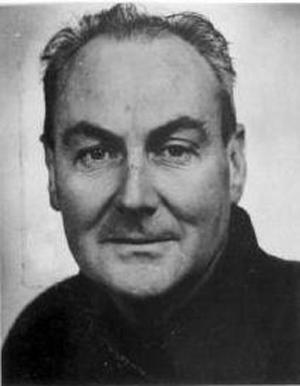
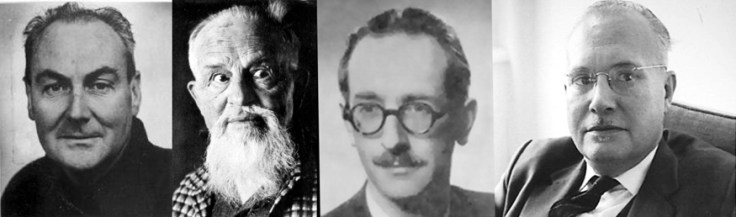
PMHOne of my favourite contemporary writers, Phil Rickman, pointed me in the direction of PM Hubbard (left) who wrote English crime novels with just a hint of supernatural menace about them. After a career in public service, he became a full time writer, and contributing to  the magazine Punch as well as writing verse, both of which activities contrast strongly with his dark novels. Although Hubbard died in 1980 his books are still available, and although I have come late to the feast, I can still savour the meat. This is the first of a two part examination of Hubbard’s writing.

CGAAP header

FAMFlush As May (1963) takes its title from a soliloquy by Hamlet, and Hubbard sets the piece in an ostensibly idyllic rural England, contemporary with the time of the novel’s publication. Margaret Canting is an Oxford undergraduate staying in the nearby village of Lodstone She takes it upon herself to see in May Morning, not by carolling from the top of a church tower, but with a dawn stroll. Her idyll is interrupted when she finds the corpse of a man, sleeping his final sleep against the grassy bank at the edge of a field.
She strides back into Lodstone and rouses the village policeman, PC Robin. His scepticism about her discovery is confirmed when the pair arrive at the scene to find – absolutely nothing. Humiliated by the constable’s scorn, Margaret returns to her B & B, having briefly made the acquaintance of a young chauffeur at the roadside. She learns, upon her return to Oxford, that his name is Jacob Garrod and that he is a fellow undergraduate. The pair meet for a drink, and Margaret reveals the full story of her May Morning adventure.

Together, the pair decide to get the bottom of the mystery of the missing corpse, with the assistance of one or two of Margaret’s well connected relatives. What has so far been something of a ‘jolly jape’ becomes infinitely more serious when they discover that an unholy alliance of old established farming families in and around Lodstone has an unhealthy influence on local events.

This is a lighter novel than those which followed, and there is plenty of gentle humour, such as when Jacob  tries to find out more about the agricultural mafia by attending a cattle auction:

“…..where he bid unsuccessfully for a lot of heifers whose air of gentle bewilderment appealed to him. They attended the event placidly, like a consignment of Circassian virgins under the hammer in ancient Rome …”

But as if he were holding his fire until he could see the whites of our eyes, Hubbard gently ramps up the music of unease by turning our attention – alongside that of Margaret and Jacob – to the landscape itself. We discover that the residents of Lodstone and their ancestors have an allegiance to the shape of the hills and fields that is fired by a folk memory which stretches back much further than the laws and conventions of either the Christian church or the civil justice system. The climax of the story brings Margaret face to face with the very embodiment of an ancient evil.

Scroll

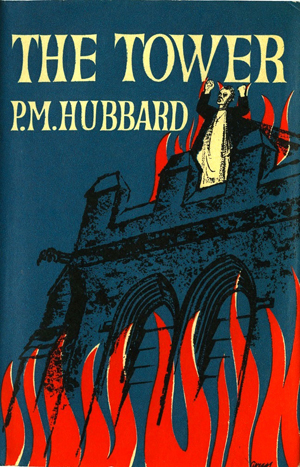
Hubbard_The_Tower_GreenThe Tower (1968) begins with Hubbard tipping his hat in a gentlemanly fashion in the direction of a lady. The lady is none other than Dorothy L Sayers. Her masterpiece (other opinions are available), The Nine Tailors, begins with Bunter and Lord Peter abandoning their car in a snowy ditch outside a remote Fenland village. So it is that John Smith, the central character in The Tower, finds his car refusing to travel an inch further on an inky black night, a mile or so outside the village of Coyle. That, however is pretty much where the homage ends. Coyle is a far more sinister place that Fenchurch St Peter, and its vicar, Father Freeman, is infinitely less benevolent than dear old Reverend Venables.

After roadside assistance provided by a mysterious young woman Smith is able to get as far as The Bell, Coyle’s only pub. Given a room for the night, Smith signs the register with an all-too-familiar misgiving.

“That was the trouble with John Smith. They always expect you to bring in a giggling blonde with the wrong initials on her suitcase.”

Smith realises, as he drinks his pint of strong bitter and eats the meal provided by the landlord’s wife, that the customers of The Bell are not the average clientele of a rural boozer. He eavesdrops on a fairly foul-mouthed argument, but then:

“A man started to sing, casually, as if he was singing to himself, but loud enough to be heard above the general uproar. Gloria Deo – ‘ he sang, with a long twisting run of notes ….two more voices took it up in different parts, a very sweet clear tenor led the way into Et Filio, and by the time ‘Sancto was reached he counted four parts going great guns with several voices to each.”

Clearly, this is not a regulation saloon bar singsong. Smith’s curiosity is aroused, and he decides to stay for a few days. He meets local academic, Charles Hardcastle, and his daughter Cynthia – who he realises immediately is the enigmatic wraith who repaired his car the night before. Hardcastle – and George Curtis, Landlord of The Bell – explain to Smith, in very different ways, what is going on in the village.

The tower of Coyle’s parish church (dedicated to the fictional St Udan) is structurally compromised due to a series of unwise modifications over the last century. Father Freeman is obsessed with raising the £20,000 it would take to restore the tower and make it safe. His only hope of raising the cash is the benevolence of Mrs Mary Garstin, the widow of Sir Gerald Potter, and heir to his land and fortune. She has remarried, unhappily, and seems strangely drawn to the menacing priest.

John Smith and Cynthia Hardcastle are drawn into Coyle’s business, and find that it is far from straightforward, and that Father Freeman’s zeal is linked to something far older than his avowed Christianity. The conclusion of the novel is violent and incendiary. In addition, without writing anything remotely explicit by today’s standards, Hubbard bestows Mary Garstin with an erotic persona which is all the more startling, given the rural conformity and apparent benevolence of her surroundings.

PART TWO of this account of the writing of PM Hubbard will follow


THE MUSIC OF CRIME FICTION

TMOCF header

V: ADAGIO

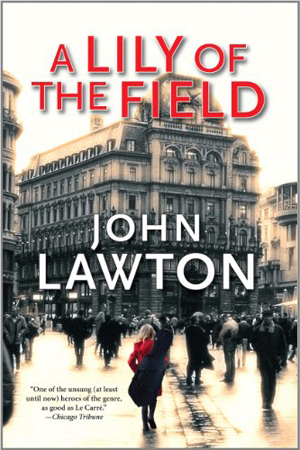
alotfJohn Lawton is a master of historical fiction set in and around World War II. His central character is Fred Troy, a policeman of Russian descent. His emigré father is what used to be called a ‘Press Baron’. Fred’s brother Rod will go on to become a Labour Party MP in the 1960s, but is interned during the war. His sisters are bit players, but memorable for their sexual voracity. Neither man nor woman is safe from their advances.
Fred becomes one of London’s top coppers, but to categorise the novels as police procedurals is accurate only in as far as that there are policemen in the books, and they occasionally have procedures. All this being said, Troy is in the background during much of A Lily of the Field, where we follow the life of teenager Méret Voytek, a brilliant young Viennese cellist.

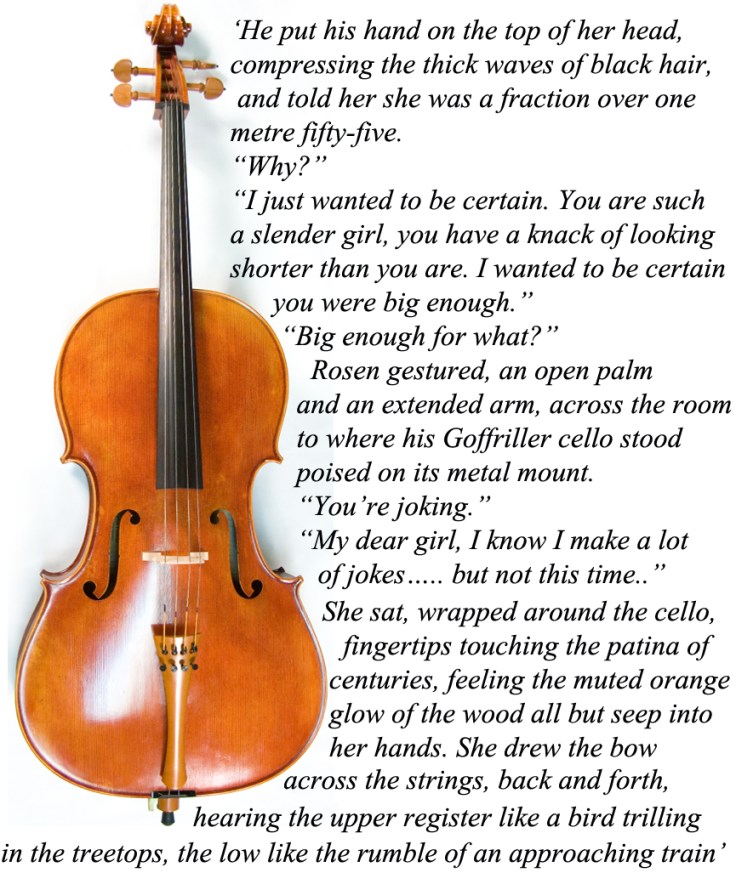
As a twelve-year-old, she begins lessons in cello and piano from an eminent musician, Viktor Rosen. He realises instantly that she is prodigiously talented, and he gives her a gift:

Cello graphic

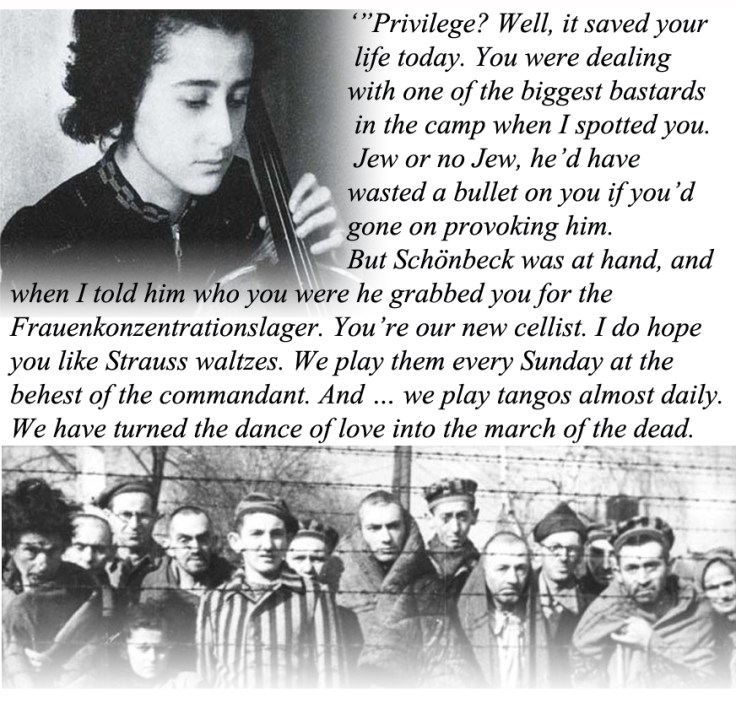
After the Anschluss, through her own naivete and a tragic act of fate, she is caught holding a bundle of anti-Nazi leaflets while traveling on the tram. She is taken by the SS and ends up in Auschwitz. Meanwhile, her parents have been likewise detained, and their family home ransacked. Méret’s skill as a musician has already been noted but, ever naive, she questions her friend Magda about why she has been singled out.

Quote2In the bitterest of paradoxes, the Auschwitz commandant, has a musical ear, and so he puts together an orchestra made up of the many skilled inmates. One of their bizarre duties is to play beautiful music as their less talented companions trudge off to work in the morning. Méret plays for her life, literally. The physical privations she undergoes are heart-breaking, but still she plays, still she clings on to what is left of her humanity.

In January 1945, with the Russians approaching from the east, and the British and Americans from the west, the Germans realise that the game is up. Auschwitz inmates who are too infirm to walk are shot, and the remainder are sent out, under guard, to start the infamous Death March. In the freezing conditions few survive, but just as Meret is about to succumb, their column is overtaken by a Russian detachment. Salvation? Hardly. The first instinct of the Russian soldiers is to rape the women. Méret is saved by a no-nonsense officer. At this point, Fred Troy aficionados will recognise Major Larissa Tosca, Fred’s one-time lover. She has, in her time, spied for both America and for Russia, but here her cap bears the Red Star.

Long-time Lawton readers will know that he leaps about between the years with a sometimes bewildering agility. True to form, the climax of this book is played out in post war London and Paris. Méret’s rescue by the Russians has come at a price, and we find her tangled up in the spy ‘games’ which characterised much of the Cold War period. Lawton is much too clever a writer just to tell this one tale, however gripping it may be. Woven into the fabric is another thread which involves an interned Hungarian physicist, Dr. Karel Szabo, who ends up as a key figure in the American efforts to build and test the first atomic bomb.

One of the key figures from the spy ring of which Méret is a part is murdered in London, and it is then that Fred Troy becomes involved. For all his many qualities, Troy is an inveterate womaniser, but he is not a sexual beast, and the late scenes where he spends time with the fragile Méret, still beautiful but old before her time, are haunting in their compassion.

‘Troy had never heard her laugh. It was like that moment in Ninotchka when Garbo laughs on-screen for the first time. It is not merely that she laughs, but that she laughs so long and so loud.
As the laughter subsided she was grasping at words and not managing to get a sentence out.
“Oh, Troy ….oh, Troy..this is….this is a farce. Don’t you see? Viktor taught us the same part.”

“We’re two left-handed women trying to dance backward. Neither of us knows the man’s part.”
She reached up her sleeve for a handkerchief to dab her tears and found none. Troy gave her his, a huge square of Irish linen with an overfancy  ‘f’ in one corner.
Being drunk did not make her loquacious. In that, she was like Troy. At two in the morning Voytek was deeply asleep in front of the fire. Troy picked her up, astonished at how little she weighed, carried her upstairs and slid her into the spare bed. She did not wake. He went to his own bed.

A Lily of the Field is far from being a dry history novel where the factual details are more important than the plot and the dialogue. It is tense, funny, occasionally very violent, and written with a style and fluency which leaves lesser authors struggling in Lawton’s wake.  Above all, of course, it is about music. Méret’s brilliance as a musician is both her curse and her salvation.

A final little gem, which I only noticed recently. If you look closely at the book’s cover, you can see Méret Voytek, in her red coat, moving away from us. With her cello slung over her shoulder, she walks into history.

ALOTF2

Follow the links below to read the previous four parts in the series.

IV: SCHERZO

III: RONDO

II: MARCHE FUNEBRE

I: PRELUDE & FUGUE

THE MUSIC OF CRIME FICTION

TMOCF header

IV. SCHERZO

I like to think I have a wide taste in music, and can get something out of almost every genre and style. I do draw the line at ‘modern’ jazz, however. My view is – and I show my age by borrowing a phrase from the 1957 Wolfenden Report – that it should be permissible only between consenting adults, and very definitely in private. So, no Crime Fiction set around an alto sax player who plays thirty-five minute solos (sadly, he’s not fictional, but he is certainly committing a crime.)

51G3AhWKo0L._SX311_BO1,204,203,200_I do love Operas, though – at least those written up to the death of Giacomo Antonio Domenico Michele Secondo Maria Puccini (who would be just as wonderful even if he didn’t have six christian names.) I would add the personal caveat that for me it is sometimes better heard than seen, as stage productions can sometimes demand too much suspension of disbelief. Our chosen book, then, is Spur Of The Moment by David Linzee, and it is set around the St Louis Opera company as they prepare a performance of Bizet’s wonderful, preposterous, exhilarating four-act classic, Carmen.
The central character in the book is Renata Radleigh, an English mezzo-soprano who is employed by the St Louis Opera to sing the relatively minor role of Mercédès. Her brother, fellow ex-pat David, is also employed by the SLO, but his task is to tout far and wide for commercial sponsorship.

When a key company patron Helen Stromberg-Brand is found brutally murdered, the police suspect David Radleigh and arrest him. His motive? It seems that Helen – nicknamed Sturm und Drang – and her husband were on the verge of cancelling a huge donation. Could they have argued? Did David lose his temper with the headstrong woman?

But there could be another motive. Helen Stromberg-Brand was a national celebrity, at least in the field of pharmaceutical research. She and her team were on the threshold of patenting a revolutionary drug to combat urinary tract infection in women. In partnership with the charismatic billionaire Keith Bryson – who has the casual dress sense, long hair and boyish charm of Richard Branson – Helen’s unit at the Adams University Medical Centre were about to find even greater fame and riches. Now she lies in the police mortuary, her head shattered by a heavy glass bowl.

Renata is not the world’s most loving sister, but she refuses to accept that David could have killed Sturm und Drang, if only because he is far too wet and wimpy for murder. Together with a former reporter, Peter Lombardo, she thinks the lady’s demise was less to do with the SLO, and more to do with the cut-throat world of drug patenting.

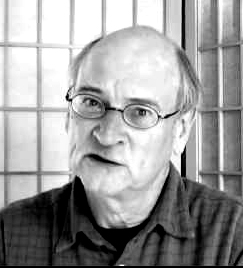
DLDavid Linzee has himself been a ‘supernumary’ – basically the opera equivalent of a spear carrier – and he enjoys several digs at the way an opera company in a mid-sized city is run. I particularly enjoyed his jibes at the ubiquitous need for sponsorship. Linzee (right) explains that the SLO has to make sure that literally every brick in the building has corporate support. Thus we have the Peter J Calvocoressi Administration Building, the Charles Macnamara III Auditorium and – best of all – the Endeavour Rent-a-Car Endowed Artist. In this case it’s Amy Song, the woman playing Carmen.


By the time Renata and Peter think they have unraveled the mystery of who killed the formidable Mrs Stromberg-Brand, the unorthodox stage set of the Carmen production experiences a malfunction. A giant playing card land on the heroine’s head. An all-points-bulletin is issued for the only actress who can replace the stricken Ms Song – none other than our very own Renata Radleigh. Renata takes the stage in triumph, but before the distraught Don José can plunge his stage dagger into Carmen’s heart, a real killer pre-empts the drama at the bull-fighting arena.

SOTM middle

If anything, the plot of Spur Of The Moment is even more unlikely than the full blooded passion and drama taking place on stage between the doomed gypsy girl and her battling lovers, but what the tabloid press might call THE SHENANIGANS IN SEVILLE make a wonderful backdrop for this beautifully written and sharply funny murder mystery. A tad cosy, perhaps? Maybe, but when something is as well written as this, you won’t hear me complaining. A final word, if I may. Try to get to a production of Bizet’s masterpiece as soon as you can. Why the hurry? Well, it stands to reason, surely? Not only was Bizet not Spanish, his opera may well come to be classified as ‘cultural appropriation’ as well as making harmful stereotypes of people from Seville, women who make cigars, gypsies, policemen and bullfighters. Don’t say you weren’t warned.

Spur Of The Moment is published by Coffeetown Press and is available here.

You can catch up with the previous parts of this series by clicking the links.

I. PRELUDE and FUGUE
II. MARCHE FUNEBRE
III. RONDO

SOTM footer

THE MUSIC OF CRIME FICTION

TMOCF header

III. RONDO

Existing fans of Phil Rickman’s superbly evocative Merrily Watkins novels can skip this paragraph. As in all the best fiction series, there is a stable cast of recurring characters. So, for new readers, the Rickman Repertory Company is led by the Reverend Merrily Watkins: widow, mother, parish priest and Dioceson Deliverance officer (modern C of E speak for exorcist). Then comes Jane, her teenage daughter and inveterate dabbler-into-things-she-oughtn’t-to-be-dabbling-in. Gomer Parry, local drainage contractor, voice of common sense and elderly savant. Representing the forces of law and order is Frannie Bliss, detective with the Herefordshire Constabulary, scouser and all-purpose square peg. The musical director of this ensemble is Lawrence ‘Lol’ Robinson, dazzling guitarist, singer songwriter, sometime depressive, sufferer from paralysing stage fright – and the long term boyfriend of Merrily.

Lol has a serious back-story. In To Dream of The Dead, Rickman spells it out in stark clarity:

“Barely twenty and convicted of sexually assaulting a fourteen-year-old girl while on tour with Hazey Jane. An offence actually committed, while Lol was asleep, by the band’s bass player, who’d walked away, leaving Lol on probation, unjustly disgraced, disowned by his creepy Pentecostalist parents, swallowed by the psychiatric system. His career wrecked, his spirit smashed.”

As he creates Lol’s complex character, Rickman wants us to think of a real-life singer and guitarist, Nick Drake. Cynics might say that when the Gods take young musicians, it is a cast iron guarantee that both victim and music will achieve a kind of immortal celebrity that they may not have reached had they lived. Who can say with certainty that Eddie Cochran, Buddy Holly, Janis Joplin, Marc Bolan, Jimi Hendrix and others in the pantheon of dead rock stars would now be as famous in life as they have become in death?

Lol Robinson shares Nick Drake’s intensity, delicate guitar playing, haunting voice and sense of sublime anxiety about himself and the world he lives in. But, thanks to the support of Merrily Watkins and others, Lol comes through his bad times and lives to perform and record again. As he emerges from the darkness, he almost becomes as one with his guitar. Like Frank Westworth, Phil Rickman clearly knows, loves and plays the instrument, and he gifts Lol a beautiful hand-made guitar. Its maker is Al Boswell, a unique craftsman; part gypsy, part mystic and a man whose hands seem guided by forces older than any skills learned in a school woodwork class.

LOL

Not content with making one of the spear-carriers in his ensemble a fascinating and compelling character, Rickman goes one step further. He has actually recreated Lol’s band Hazey Jane, and they have made videos and sound recordings to prove the point.

https://www.youtube.com/watch?v=5ND_CkcUb78

Click on the image below to visit Phil Rickman’s own site, and learn more – and hear more – about Lol Robinson and Hazey Jane II.

Screen Shot 2017-06-30 at 21.01.10

philrickmanBefore he had the brainwave which gave us Merrily Watkins in The Wine of Angels (1998), Rickman wrote several standalone novels. The most music-centred one was December (1994). It begins on the evening of Monday 8th December, 1980. For most people of a certain age, that date will be an instant trigger, but Rickman (right) sets us down in a ruined abbey in the remote Welsh hamlet of Ystrad Ddu, which sits at the foot of one of The Black Mountains, Ysgyryd Fawr – more commonly known by its anglicised form The Skirrid. Part of the medieval abbey has been fitted out as a recording studio and, in a cynical act of niche marketing, a record impresario has contracted a folk rock band, The Philosopher’s Stone, to record an album of mystical songs in the haunted building, and he has stipulated that the tracks must be laid down between midnight and dawn.

Shortly before 4.00am, as the band are playing a song which relates the tragic story of Aelwyn, a young Celtic man who was hacked to death in the abbey grounds by Norman invaders in 1175, what was already a fractious and uneasy atmosphere turns distinctly sinister. Acoustic guitarist Dave Reilly is overcome by disturbing visions and, as he escapes the studio to shelter under an ancient oak tree, over three thousand miles away it is 10.50 pm and a disturbed young Hawaiian man called Mark David Chapman is pumping four bullets into former Beatle and musical legend, John Lennon.

As if the ill-fated recording session is not already attracting enough malevolent vibrations, things are about to get worse – much, much worse. Lead guitarist Tom Storey – as notorious for his abuse of drink and drugs as he is celebrated for his guitar virtuosity – has had enough. He has left his pregnant wife Deborah in a nearby hotel and, angry at the shambolic and disturbing recording session, commandeers a Land Rover and storms off to be with her. Deborah, meanwhile has decided to come out to Ystrad Ddu to ‘rescue’ her husband. As John Lennon is bleeding to death in the back of a police car, Tom’s Land Rover smashes into Deborah’s Lotus sports car.

“Twenty yards away, the old blue Land Rover driven by Tom Storey has brought down a low, sleek Lotus Elan, like a lion with a gazelle. The Land Rover has torn into the Lotus and savaged it and its guts are out and still heaving, and Dave can see flames leaping into the vertical rain …..”

December middle.jpg

Rickman takes us forward to the present day. The Philosopher’s Stone is no more. It died on that fateful December night. Tom Storey has remarried, but lives as a recluse in a Cotswold mansion with his second wife and daughter Vanessa, removed from the dying body of her mother but afflicted with Down’s Syndrome. Singer Moira Cairns has flirted with the folk music scene, but has largely retreated from public life. Dave Reilly has eked out a threadbare living as a musician, but is cursed with an ability to sense the supernatural, and his ‘gift’ has done him no favours. Bass player Simon St John has abandoned music altogether (apart from in the privacy of his own room) and has taken holy orders.

Novels and, indeed, films, would not be able to create their magic were it not for the priceless ability of fictional characters to make decisions which turn out to be disastrous – and often fatal – mistakes. So it is in December. An unscrupulous music executive, desperate for something that will give his flagging career an edge, discovers a box of tapes, all that remains of the fatal pre-dawn music making in December 1980. A highly respected producer, Ken ‘Prof’ Levin (who features as a mentor to Lol Robinson in the Merrily Watkins novels) is persuaded to restore the tapes. To say that all hell breaks loose as a consequence is putting it mildly. Ghosts don’t like being woken from their dreamless sleep by money-grubbing mortals, and they exact a high price for their inconvenience.

Amid all the psychic mayhem, this is unashamedly a novel about guitars and their magic. We have Stratocasters, Martins, Takemines, Ovations, Telecasters and Les Pauls. Rickman’s fascination with his chosen instrument shines through, and his enthusiasm will inspire many a lapsed player to blow the dust off their guitar case, open it up and coax an old tune from their neglected lover.

Check out the buying options for December, and other Phil Rickman novels, here.

You can also read the Fully Booked review of the most recent Merrily Watkins novel
All Of A Winter’s Night

You can catch up with the previous parts of this series by clicking the links.

I. PRELUDE and FUGUE
II. MARCHE FUNEBRE

Guitars

Blog at WordPress.com.

Up ↑