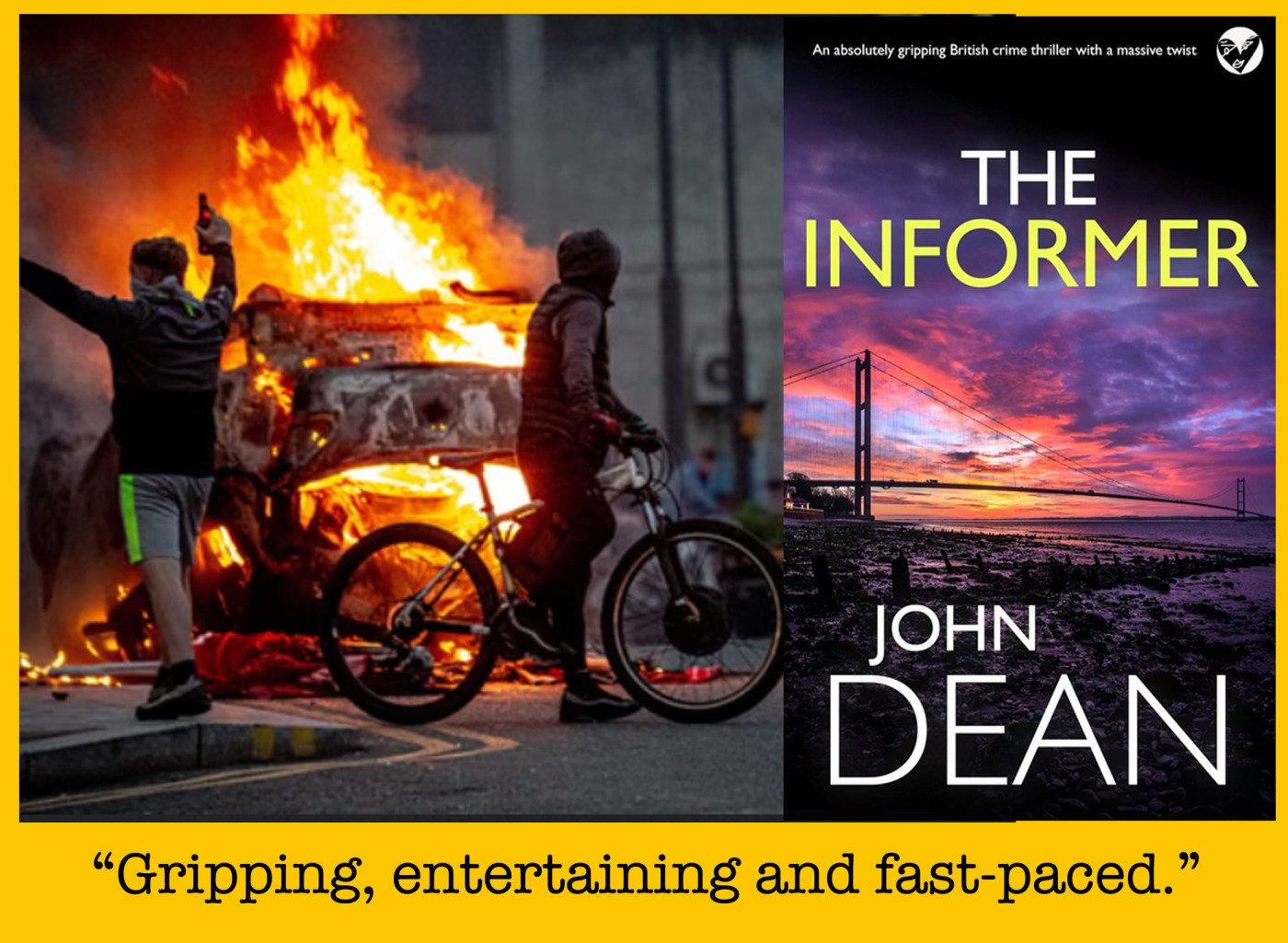

Authors, often unwittingly, can be prescient in what they write. Urban riots in Britain are, thankfully infrequent but, as I write this review, the headlines about the disturbances in Middlesborough following the death of two police officers are beginning to recede. Here, in Hafton, a fictional northern city which could well be Hull, DCI John Blizzard is wiping the grit from his eyes after several nights directing the police response to violent disorder on a sink estate euphemistically christened The Willows, but commonly known as The Spur.
On The Spur there are neither Willows, Meadows, Brooks, Glades nor any other of the other fatuously improbable terms used by town planners to name cheap housing estates. Instead, The Spur is home to broken families, feral youths and a violent hatred of any kind of authority. I am old and very grey, if not full of sleep, and the horrors of the digital age never fail to appall me, and here Blizzard encounters an abomination known as Grief Tech.
AI enables dead loved ones to be recreated, revoiced, and their lives re-enacted on video. John Dean is writing fiction, of course, but can it be that something so awful is now ‘a thing’? The mother of a police officer, Kenny Jarvis, slain on The Spur years earlier, is sucked into such a scheme, known as Second Chance, and tries to convince Blizzard that her dead son, via his AI reincarnation, has vital clues to the identity of the man dubbed ‘The Orchestrator’, believed to be planning and directing the violence on The Spur. Blizzard is a bluff and uncompromising old fashioned copper who is unashamedly baffled by the acceleration of technology in law enforcement, but when his more enlightened colleagues expose Second Chance as a multi-million bitcoin money laundering agency, he is delighted at their work, but still unsure of how this is connected to the appalling violence emanating from The Spur.
He is equally baffled by what connects the ancient parish church of St Andrew’s to the unrest, and cannot see that its almost complete destruction by arson is linked to the lowlife criminals who are on the rampage night after night. And why are the earnest evangelical Christians from the Love Foundation connected to the mayhem? I always try to avoid spoilers, so suffice it say that someone who appears to be ‘holier than thou’ is at the centre of the villainy.
Also, it is reassuring to meet a senior copper like Blizzard who is not always the best judge of character. This is not a criticism of the novel which was, in turn, gripping, entertaining and fast-paced, but I do wonder why crime writers bother to invent fictional cities. I feel much more at home reading a novel if I know it is set in Leeds, Oxford, Cambridge, Peterborough, Manchester, London, or Bristol. I can understand it when writers create fictional villages; real villages have relatively tiny populations and easily identified buildings, but large urban conurbations? As ever, I am happy to hear your views. There is a contact form on the website, but my immediate email is dprestidge@yahoo.com The Informer is published by Joffe Books and is available now.


Leave a Reply