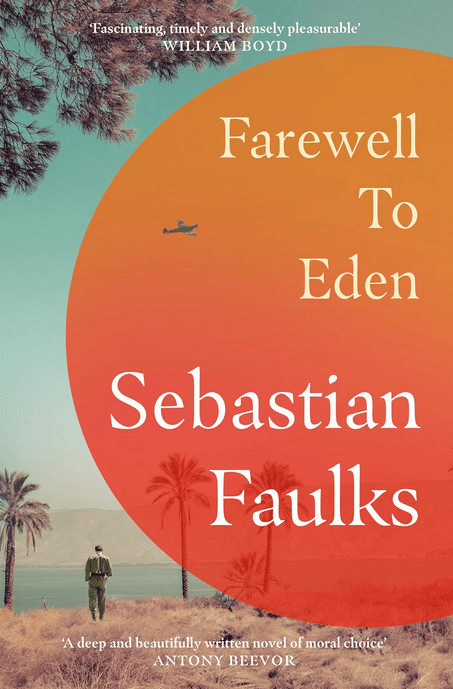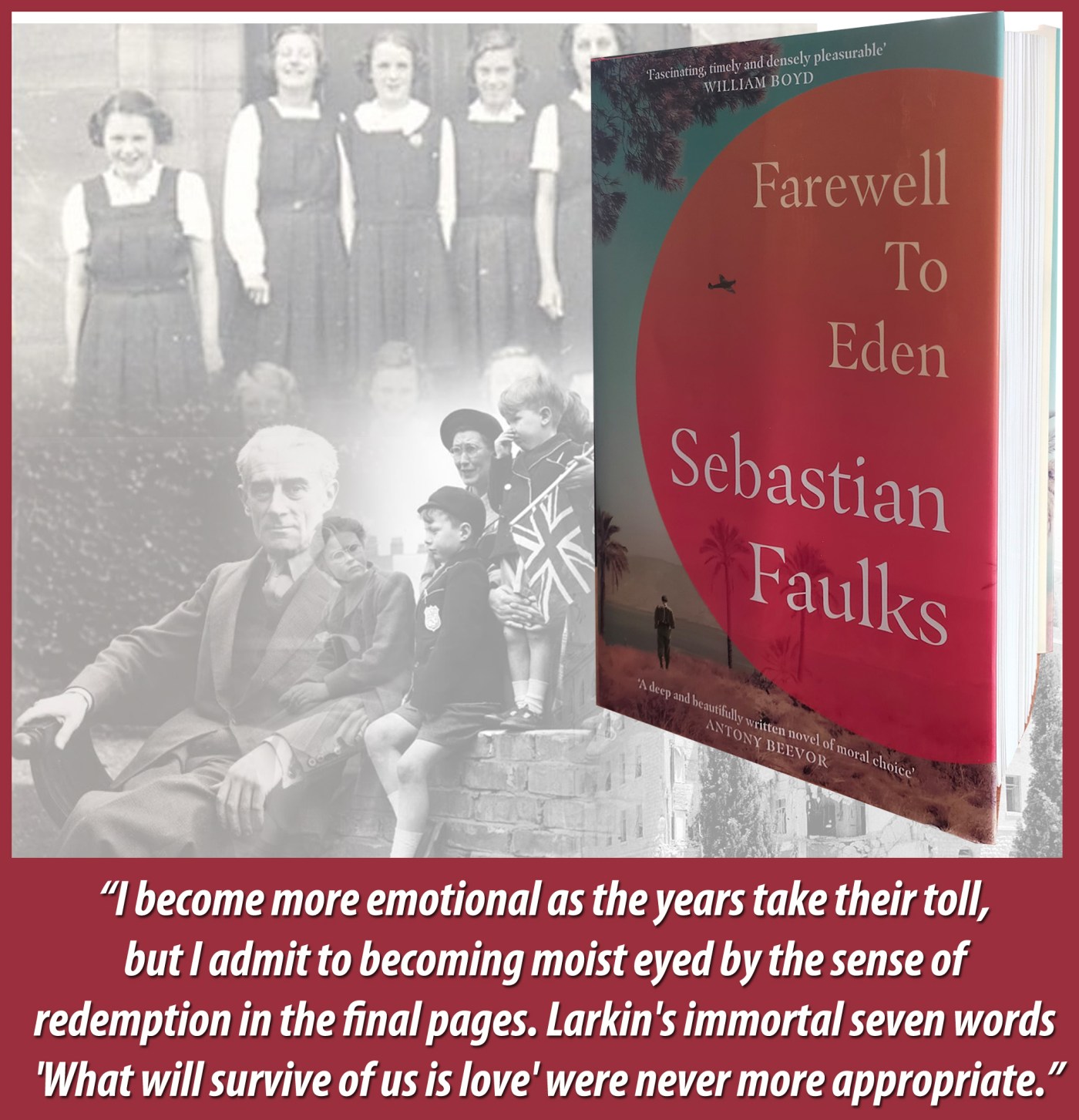

Historical fiction is particularly powerful when it reminds the reader of particular experiences within his or her lifetime. Faulks starts this book with a train journey through England. It is 1951, and Philip Deval is in a carriage sauntering through the English countryside towards Witchelm, home to the rural private school for girls where he has been appointed teacher of French. Yes, I remember those tobacco smoke impregnated fabric seats and the carriage doors which you could only open by pulling down the window with a leather strap.and reaching outside to turn the door handle.
The narrative switches between the months leading up to the war, Deval’s time in the army, and post-war England. There is a breathtaking section quite early in the book which relates Deval’s first experience of Palestine. He is part of the British peace-keeping force whose mandate (a potent word) is to be equally amicable to the indigenous Arab population and the more peaceable Jewish settlers. The main physical threat comes from violent Jewish Nationalist groups like Irgun, who see British troops as a target both vulnerable and legitimate.
On a sight-seeing drive with the company’s padre. Deval sees places forever imprinted on his consciousness after years of biblical education at home. Like Deval, I am a lukewarm Christian, but years of Sunday School have given names like Nazareth, Cana and Galilee an almost mystical sonority which barely makes itself heard above the violent screeching of modern hatred and warfare. One of the standout quotes from this book is uttered by a weary British army officer called Knox, talking to Deval:
“And it all seemed so pleasant here in Galilee.”
“It still is. A promised land.’
Knox turned to look out of the window.
“I just wish it hadn’t been promised to quite so many people.”
I am sure that no contemporary writer relishes being compared to great writers of the past, but as reviewers, we must say what we think. There are shades of Evelyn Waugh in this novel. Both Witchelm and Llanabba Castle in Decline and Fall are struggling private schools, even though the staff of Witchelm does not contain anyone as grotesque as Captain Grimes. Although Guy Crouchback in the Sword of Honour trilogy is older than Philip Deval, they have a similar ambivalence about army life; both men cherishing the comradeship and sense of belonging, while sharing a distaste for the dark things that men in uniform often have to do.
In no sense is this a political novel, but Faulks has certainly done his research. He pinpoints the fact that in the post war years, Britain was something of an international orphan. America viewed us as a temperamental former ally who owed them billions of dollars: to Russia we were an insignificant military threat despite our nuclear expertise: most inexplicably, France viewed us with a sense of betrayal, despite the torrents of British blood shed on their soil during the war years. And in the Middle East? Once again, we were the hated intermediary, loathed equally by Jewish terror gangs, innocent settlers and Arab nationalists. Here, in an incident worthy of Milo Minderbinder in Catch 22 (remember when he took out a subcontract from the Germans to bomb US bases because of mutual profit margins?) the Arabs raid a British arms depot, seizing thousands of rifles, Sten guns and hand grenades – which they then sell to Irgun, the Jewish terror group who, as we later learn, have long memories and an even longer reach.
Lurking beneath the poignant portrayal of a Britain trying to understand why, if it had won the war, daily life was such a miserable struggle, and the nostalgic social reminiscences (forget Proust and his Madeleines) such as tinned peaches and evaporated milk, lies something much darker, and it involves two crimes. Having lured us into a world of regret, fond memories and a country that ‘kept calm and carried on’. Faulks springs his trap relatively late in the book, and it is astonishingly effective – a literary punch in the midriff. Farewell to Eden is profound, compassionate, historically assured – but with a killer twist. I become more emotional as the years take their toll, but I admit to becoming moist eyed by the sense of redemption in the final pages. Larkin’s immortal seven words ‘what will survive of us is love’ were never more appropriate. The book will be published by Hutchinson Heinemann on 17th September.