

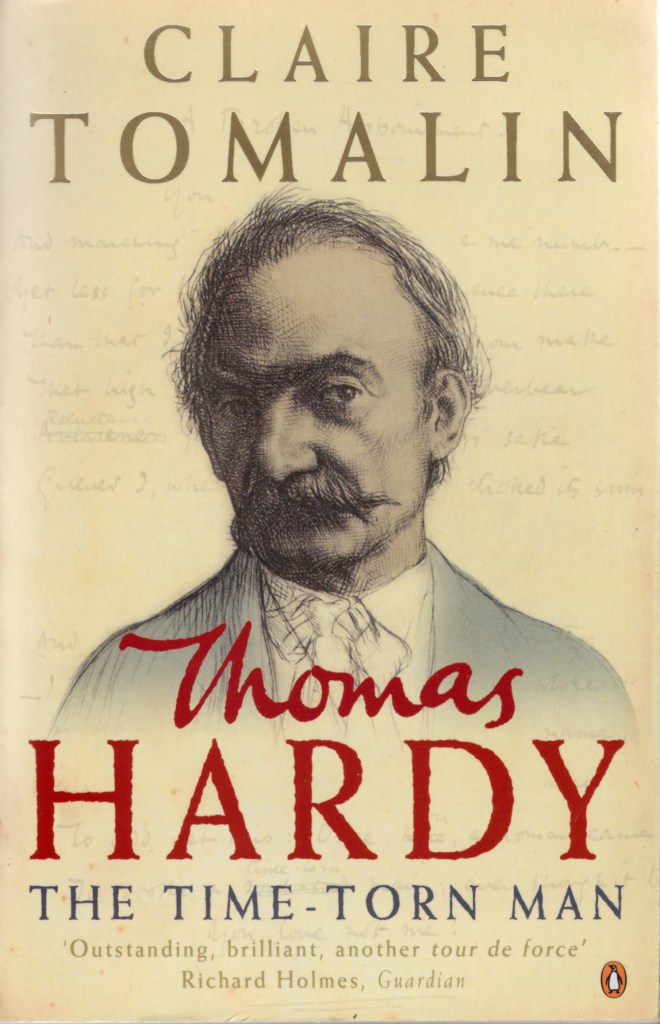
This, for me, is the definitive account of the life and work of the great novelist and poet. It was published in 2006. More recent books have explored the complex relationship Hardy had with his two wives, and his various infatuations, but Claire Tomalin was the first to put forward the simple – but sadly accurate – premise that Thomas Hardy was more in love with his great fictional creations than he ever was with flesh and blood women. Bathsheba Everdene, Tess Durbyfield, Eustacia Vye and Marty South were closer to his soul than either of his two wives.
Hardy, as a writer, was a great one for irony and tragic coincidences. There is the poem where a young parishioner is entranced by the stirring rhetoric of the handsome vicar’s sermon. When she goes to the vestry door to pay her respects, she sees him rehearsing his gestures in the wardrobe mirror.
“And now to God the Father”, he ends,
And his voice thrills up to the topmost tiles:
Each listener chokes as he bows and bends,
And emotion pervades the crowded aisles.
Then the preacher glides to the vestry-door,
And shuts it, and thinks he is seen no more.
The door swings softly ajar meanwhile.
And a pupil of his in the Bible class,
Who adores him as one without gloss or guile,
Sees her idol stand with a satisfied smile
And re-enact at the vestry-glass
Each pulpit gesture in deft dumb-show
That had moved the congregation so.“
Observing two families bickering over the exact location of the graves of their respective loved ones, two saturnine grave diggers chuckle over the fact that all the remains had been dumped in a communal pit to make way for a new sewage system.
“You see those mothers squabbling there?”
Remarks the man of the cemetery.
“One says in tears, “Tis mine lies here!’
Another, ‘Nay, mine, you Pharisee!’
Another, ‘How dare you move my flowers
And put your own on this grave of ours!’
But all their children were laid therein
At different times, like sprats in a tin.”
And then the main drain had to cross,
And we moved the lot some nights ago,
And packed them away in the general foss
With hundreds more. But their folks don’t know,
And as well cry over a new-laid drain
As anything else, to ease your pain!”
Hardy’s courtship of and love for Emma Lavinia Gifford was genuine and heartfelt. She defied parental disapproval to marry him, and for several years, their marriage seemed to work. The steady erosion in their relationship had complex causes, but central to the decline was their inability to have children. Over the decades Emma, who had literary pretensions of her own, became more eccentric. As Hardy’s celebrity grew, she became to feel more on the fringes of his life. By the time of her death in 1912, they were living two separate lives under the same roof.
Well before Emma Hardy died, Hardy had transferred his affections to a young woman called Florence Dugdale who had become, depending on whose account you believe, his secretary, typist, amanuensis or spiritual companion. After Emma died, effectively alone in her attic bedroom, Hardy married Florence, but almost immediately began to write a series of heart wrenching poems of regret for the Emma he had known and loved as a younger man.
For all that she may be perceived as an opportunist, the effect of this on Florence was one of cruelty, albeit unintended. The final macabre ironic twist came after Hardy’s death in 11th January 1928. In his will he had asked that his body be buried in Stinsford churchyard, where his family lay. His literary executors, probably mindful of the continuing royalties from his works, persuaded Florence to agree to a high profile interment in Westminster Abbey. The Abbey authorities declared they had no room for a full sized coffin, but could accommodate an urn of cremated ashes. In a bizarre compromise that sounds like one of his Satires of Circumstances, a local doctor removed Hardy’s heart before the rest of him was taken to the crematorium in Weymouth. Allegedly, it was put in a biscuit tin and taken to a local undertaker.
There used to be a piece of conventional wisdom that Hardy gave up writing novels after the critical reception of Jude the Obscure. This, as Claire Tomalin explains, is nonsense. Hardy’s most celebrated novels were best sellers, even Jude, despite the shocks it caused in the late Victorian world. The success of these books had made Hardy a very wealthy man. Why would he bother to further endure the lengthy process of writing tens of thousands of words, having it serialised, abridged and then issued as a complete book, when his poems were equally well received and, in collections, remained hugely popular? The concept of a poet being both popular and financially successful is largely absent from the modern literary world.
The book’s subtitle, The Time Torn Man is acutely perceptive. Every word Hardy wrote, every situation he described, every emotion he recalled – each is embedded firmly in his emotional past. The charming rustics he described in his novels, jocular, well-fed and comfortable had, by the time his first novels were published, been driven from the land to the larger towns to escape rural poverty. The waves of love he wrote about, on watching Emma ride her pony along the Cornish cliff tops were simply memories enhanced with regret and an awareness of what might have been. When he writes about a worm-eaten old violin, hanging on a cottage wall, he hears the jigs and reels that it once played, while the cottagers formed their exuberant squares and circles. Claire Tomalin has written a deeply moving and compassionate account of one of our greatest writers.
The last words of this wonderful book are:
“He wrote honest poems, almost every one shaped and structured with its own thought and its own music. They remind us that he was a fiddler’s son,with music in his blood and bone, who danced to his father’s playing before he learned to write. This is how I like to think of him, a boy dancing on the stone cottage floor, outside time, oblivious, ecstatic, with his future greatness as unimaginable as the sorrows that came with it.“


Leave a Reply