
In part one of this feature I looked at the two fictional characters Bernie Gunther and John Russell and what happens in the novels, by Philip Kerr and David Downing, both series being rooted in Berlin. There, I dealt with the two series separately, and here I look at what divides them, and what common ground they share
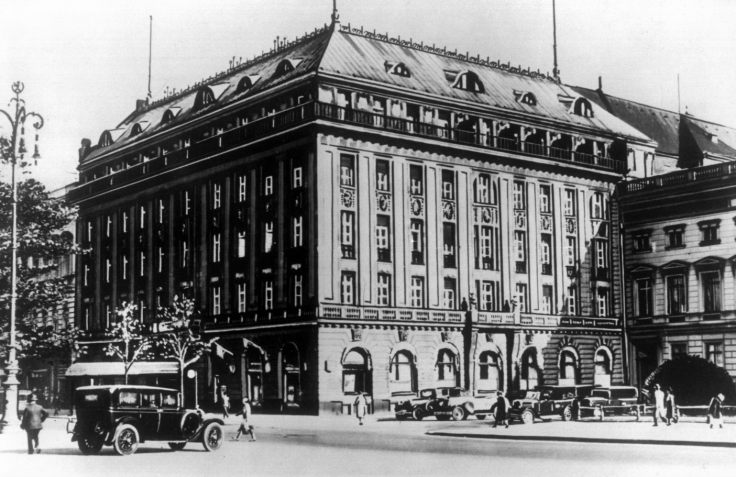
In an imaginary world the two men might have met but, of course, they never did, despite Gunther being House Detective for the celebrated Adlon hotel (below), an establishment sometimes patronised by Russell.
Both men fought (for opposing sides) in the Great War and, in theory, coul have faced each other on opposite sides of No Man’s Land. Both have indelible memories of comrades being blown away by artillery and their tunics smeared with the brains of best mates. Both have an almost umbilical connection with Berlin, its parks and rivers, its tram and railway stations and its monumental architecture.
 Gunther is on nodding terms with such Nazi luminaries as Joseph Goebbels, Rheinhardt Heydrich and Arthur Nebe. In contrast, John Russell operates well below this elevated level of the Nazi heirarchy, although he references such monsters as Beria and Himmler, and does have face to face meetings with Wilhelm Canaris, head of the Abwehr (left).
John Russell is, largely, lucky in love. True, he has a failed marriage behind him but Paul, the son conceived and born when he was still married to Ilse, is a huge part of his life. He is also madly in reciprocated love with a prominent German actress, Effi Koenen. In the final novel, Masaryk Station, they are married. Effi is safe and well in Berlin – albeit in a Berlin being carved up between the Americans, the British, the Russians and the communist Germans who would go on to rule East Germany until the fall of the Berlin Wall. John and Effi have an adopted daughter Rosa, and Paul, who served as a teenager with the Wehrmacht, has survived the cataclysm of Hitler’s strategic blunders in the last two years of the war, and by 1948 he is living in London.
 Gunther, in contrast, has known nothing but trauma in family terms. His wife dies in tragic circumstance and then his girlfriend – whi s regnant with his child – dies in one of the most infamous acts of WW2 – the sinking (by a Russian submarine) of the Wilhelm Gustloff in 1945. This account, detailed in The Other Side of Silence (2016) is, for me, the most compelling part of any of the Gunther novels:
The Wilhelm Gustloff was a cruise liner pressed into service as a military transport vessel, and in January 1945 it attempted to sail across the Baltic from Prussia. It was overloaded with some 10,000 personnel, mostly Germans fleeing the advance of the Red Army. The Soviet submarine S-13, captained by a maverick drunk and against orders sent three torpedoes into the side of the Wilhelm Gustloff. The ship sank killing 9,400, and is the worst maritime disaster in history.
Gunther is not a sexual predator, but beds women when they they present themselves, wherever and whenever. Russell remains resolutely faithful to Effi, but as she is an improbably beautiful film star with a healthy sexual appetite, we should not be placing the martyr’s crown on Russell’s head just yet, but he always has someone to fight for – Effi and Rosa, and his son Paul. By contrast Gunther is mostly only fighting for himself and his tarnished ideas of what is right and what is wrong. When he dies, he suspects that there will be few mourners as his coffin is laid in earth.
As far as Berlin is concerned, the two series run on parallel tracks. They share the final decadence of the Weimar years, the descent into Nazi rule, the devastation after the spring of 1945, and the finger-on-the-trigger tensions of the 1960s.
Russell’s geographical stamping grounds are tight: his domain is Europe – Prague, Triest, Belgrade, Danzig, occasionally London but – of course – always Berlin. Gunther goes where the job – or his pursuers – send him. In the novels, we see him operating all over the world – Argentina, Cuba, Greece, the South of France and Russia. Neither David Downing nor Philip Kerr waste time on political posturing, but both remind us that no known measurement – not even the thickness of the proverbial Rizla cigarette paper – separates the degeneration of Hitler and Stalin. This is never more prominent than in A Man Without Breath in which Gunther is sent by Goebbels to Smolensk. His task? To prove that it was the Russians who murdered thousands of Polish officers and flung their corpses into deep trenches. In the real world, it was not until the 1990s that Russia admitted its guilt.
Gunther is – first and last – a cop. He is physically imposing and familiar with violence. Russell is – at least in his day job – a freelance journalist, and avoids physical confrontation if he possibly can. Stylistically, the novels are also chalk and cheese. We share Gunther’s world through his own voice while we learn what John Russell is up to via the invisible third party. There is another important difference in the way the two series sit in what could be called a family tree of thrillers. Philip Kerr shapes his man more in the image of Philip Marlowe, albeit a Marlowe much more enthusiastic about using his fists (or any other available weapon). Gunther also echoes Marlowe’s bitter poetry, and talent for memorable descriptions. This is Bernie Gunther on Heidrich:
“Tall, skeletally thin, his long, pale face lacking expression, like some plaster of Paris death mask, and his Jack Frost fingers clamped behind his ramrod-straight back, Heydrich stared outside for a moment or two, saying nothing to either of us.”
David Downing portrays the world of espionage in a way familiar to readers of John Le Carré; this world is undeniably dangerous and fatal to those who make mistakes, but it it is less overtly dramatic, and – although more subtle – nonetheless deadly. John Russell is – in his heart – a socialist, but one who despairs of the direction taken by post 1945 communist regimes. Bernie Gunther is resolutely German and someone who has suffered grievously at the hands of the Russians, but a man who has gazed into the depths of evil plumbed by Hitler and his minions and realises that there are four combatants in his particular battle – the Germans, the Russians, the Anglo-Americans – and himself.
David Downing’s series ends with John Russell and Effi, like tens of thousands of other Berliners, becoming engulfed by the total Russian shut-down of land access to the city in 1948 – the act that precipitated the legendary Berlin Airlift. Philip Kerr’s premature death in 2018 means we shall never know if Bernie Gunther eventually enjoyed his retirement, but David Downing is – happily – still with us, and an eighth novel, Union Station, is due in 2024, and jumps forward to 1953, with Russell living in California.


 fullybooked2017
June 23, 2023 at 3:02 pm
Interested in real raw intelligence or espionage, the CIA, FBI and MI6, the Cold War, Churchill, Gordievsky, Monty, Ungentlemanly Warfare, John le Carré, the SAS and Philby’s interest therein? Do read the epic fact based spy thriller, Bill Fairclough’s Beyond Enkription, the first stand-alone novel of six in TheBurlingtonFiles series. He was one of Pemberton’s People in MI6.
Beyond Enkription follows the real life of a real spy, Bill Fairclough (MI6 codename JJ) aka Edward Burlington who worked for British Intelligence, the CIA et al. It’s the stuff memorable spy films are made of, raw, realistic yet punchy, pacy and provocative; a super read as long as you don’t expect John le Carré’s delicate diction, sophisticated syntax and placid plots.
For the synopsis of Beyond Enkription see TheBurlingtonFiles website. This thriller is like nothing we have ever come across before. Indeed, we wonder what The Burlington Files would have been like if David Cornwell aka John le Carré had collaborated with Bill Fairclough. They did consider it and even though they didn’t collaborate, Beyond Enkription is still described as ”up there with My Silent War by Kim Philby and No Other Choice by George Blake”. Why? The novel explores the exploitation of the ignorance and naivety of agents to the same extent as MI6 does in real life.
As for Bill Fairclough, he has even been described as a real life posh Harry Palmer; there are many intriguing bios of him on the web. As for Beyond Enkription, it’s a must read for espionage cognoscenti. To relish in this totally different non-fiction espionage thriller best do some research first. Try reading two brief news articles published on TheBurlingtonFiles website. One is about characters’ identities (September 2021) and the other about Pemberton’s People (October 2022). What is amazing is that these articles were only published many years after Beyond Enkription itself was. You’ll soon be immersed in a whole new world!
As for TheBurlingtonFiles website, it is like a living espionage museum and as breathtaking as a compelling thriller in its own right. You can find the articles at https://theburlingtonfiles.org/news_2021.09.26.php and https://theburlingtonfiles.org/news_2022.10.31.php.
LikeLike