Search

fullybooked2017

Month

October 2016

THE POSTMAN DELIVERS …Skin and Bone

sab
robin_headshotRobin Blake
(left) was born in Preston, Lancashire, and says that he belongs to a lucky generation that missed two world wars, benefited from the National Health Service, and entered their teens just in time for sex, drugs and rock n roll. His latest novel is set in his home town, but it is 1734, and we have another case for Titus Cragg and Lucas Fidelis.

The pair first appeared in A Dark Anatomy in 2012. Cragg is the Coroner for Preston and, among other duties, he must investigate suspicious deaths, while Fidelis is a young doctor who plays the role which in modern crime fiction is played by the pathologist.

The trade of tanning leather, so essential for thousands of years, has always set its participants apart from polite habitation due to the appalling smells which are created by the process of using urine and animal faeces to cure the leather, and so it is in Georgian Preston, where the tannery is banished to the banks of the River Ribble. When the body of a baby is found in one of the tanning pits, Cragg must defend the tanners against a murder charge, and tackle a ruthless group of local businessmen whose plans for the town will benefit their own pockets rather than the lives of ordinary citizens.

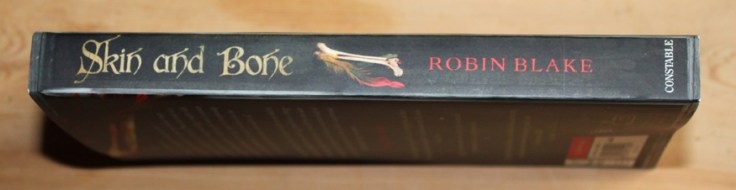
Skin and Bone is published by Constable, came out in Kindle earlier this year, and will be available in paperback from 3rd November.

skin-and-bone-spine

THE POSTMAN DELIVERS …The Final Seven

the-final-seven

Erica Spindler was raised in Rockford, Illinois. She had planned on being an artist, earning a BFA from Delta State University and an MFA from the University of New Orleans in the visual arts. In June of 1982, in bed with a cold, she picked up a romance novel for relief from daytime television. She was immediately hooked, and soon decided to try to write one herself. She leaped from romance to suspense in 1996 with her novel Forbidden Fruit, and found her true calling.

The Final Seven features a tough and unsentimental cop, Micki Dare. She has a reputation as being a ball-buster, but her hard exterior is something of a defence mechanism. She remains immune to the blandishments of her good-looking partner Zach Harris, but things take a different turn when she realises that Harris is one of an elite group of FBI-trained officers who are able to use supernatural methods to solve crime. The alumni group is known as The Sixers, and Micki’s natural scepticism is blown away when she meets dark forces head on.

Many thanks to Ella Bowman and Little Brown Publishers
for a copy of this novel, which is available here

spindlers-list

A BOY’S BEST FRIEND IS HIS MOTHER

for-blog

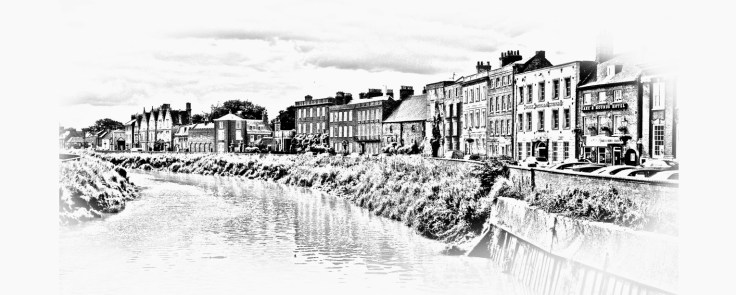
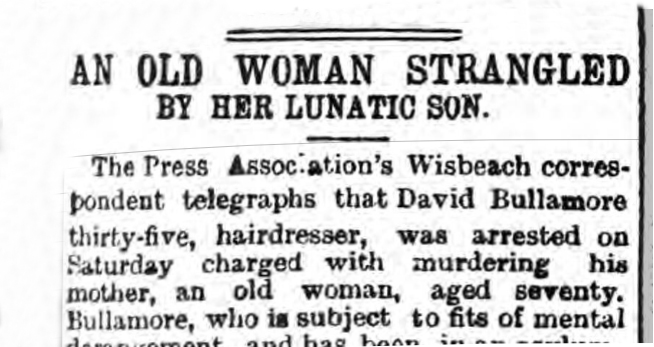
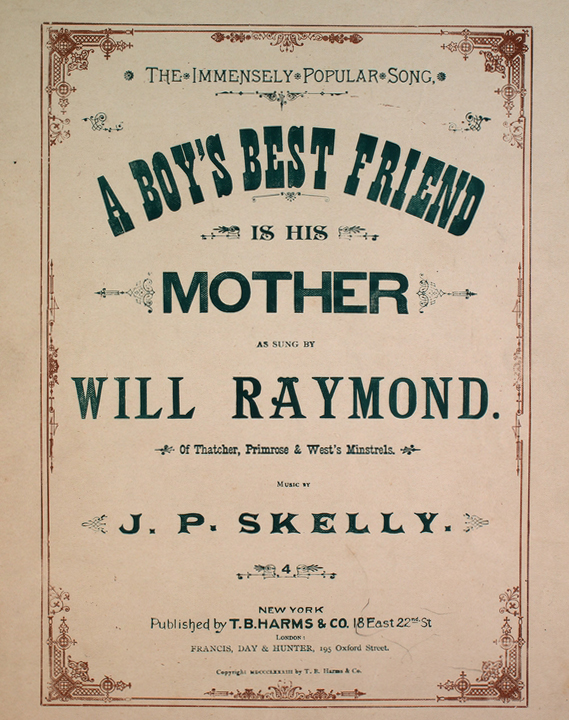
After a brief visit to Bermondsey, the podcast is this week back on home territory in Wisbech, to tell the sad saga of a man with a debilitating mental condition who was left to roam the streets, with dire consequences for the person who loved him the most.

headline

A BOY’S BEST FRIEND IS HIS MOTHER

a-boys-best-friend

THE MINIVER PLACE MURDER …Podcast

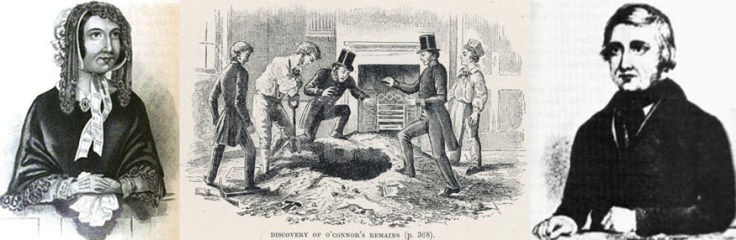
mpm-headerThis is the tale of a ghastly pair of opportunists in Victorian London. Frederick Manning turned a blind eye to his wife, Marie, while she dispensed her favours to a rich customs official, Patrick O’Connor. The pair prepared a grave for him under their kitchen floor, and having murdered him, tried to escape with all his money. Inevitably, they were caught, and provided yet another job for William Calcraft, the Lord High Executioner.

THE MINIVER PLACE MURDER

INTRODUCING GARY CORBIN

gary-corbin-4010-low-res-web-rgb

Let’s meet Gary Corbin. Gary is a writer, actor, and playwright, and he lives in the city of Camas, which is actually still in Washington State, but a stone’s throw from Portland Oregon. If the stone thrower had a particularly strong arm, he could probably lob the rock over the 49th Parallel and have it land in America’s noisy neighbour, Canada.

Gary’s creative and journalistic work has been published in the Portland Tribune, The Oregonian, and Global Envision, among others. His plays have enjoyed critical acclaim and have enjoyed several productions in regional and community theaters. He is a member of PDX Playwrights, the Portland Area Theatre Alliance, the Willamette Writers Group, 9 Bridges Writers Group, and the North Bank Writers Workshop, and participates in workshops and conferences in the Portland, Oregon area.

When he is not busy writing, Gary is a home-brewer as well as a maker of wine, mead, cider, and soft drinks. He is a member of the Oregon Brew Crew and a BJCP National Beer Judge. He loves to ski, cook, and watch his beloved Red Sox, and hopes someday to train his dogs to obey. And when that doesn’t work, he escapes to the Oregon coast with his sweetheart.
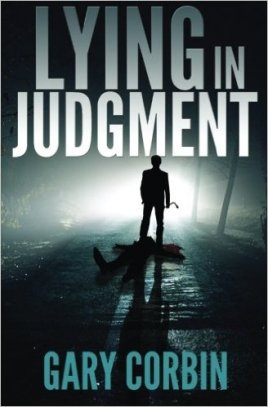
lying-in-judgmentIn his debut novel, Lying In Judgment, he has created both a cunning title and a positively perverse plot. Peter Robertson has left his youth behind but, having become a ‘thirty-something’, he is appalled to find out that his wife is being actively – very actively – unfaithful. He becomes obsessed with his wife’s betrayal and decides to confront her lover. The confrontation turns violent, and Robinson exacts a terrible kind of justice on the man who has broken up his marriage. Except – and it is as big an except as you could imagine – Robertson has made a stupid mistake, and battered to death a completely innocent stranger.

In a dreadful turn of fate that is worthy of Thomas Hardy, Robertson finds himself called up for jury service, and the big case in front of what was known, in less enlightened times as “Twelve Good Men and True” is the prosecution of a man for an apparently motiveless murder. And the murder victim? Yes, you’ve got it – it is the man Robertson killed because he mistook him for his wife’s lover.

Corbin plays the fascinating possibilities for all he is worth, and leads the reader a merry dance across the fields of guilt, conscience, deception and psychological trauma.

Check UK Amazon for more details of Lying In Judgment.

tmmdCorbin opts for a slightly lighter atmosphere in his second book, The Mountain Man’s Dog. I guess that’s obvious, as dogs, being such cheery souls for the most part, don’t do Noir and psychological intensity. We are still in the wilds of the North West, Clarksville Oregon, to be precise, and we are introduced to one of its more rugged citizens, the delightfully named Lehigh Carter. Mr C is far more at home working under a stand of timber than he ever is in polite company, but his innocent love for a feisty girl, Stacy McBride, has him in all sorts of bother. The dog? Well, Stacey McBride, Carter’s former fiancee, persuades him to adopt the stray, and she only has to flutter her eyelashes for him to agree.

The problems start when Stacey’s pop – an ambitious local politician – decides that the the well-meaning but unsophisticated Carter is not suitable to become a member of his extended family. After all, what would the voters think? Carter may not be the sharpest chisel in the toolbox, but he is as honest as the day is long, and the closer he gets to the world of Senator George McBride, the more the smell from the politician’s crooked dealings offends his nose, a nose more used to the clean smells of pine resin than those of corporate corruption. Carter’s honesty wins through, and you will have to buy the book to see if Carter gets his girl – or just the dog.

Check UK Amazon for more details of The Mountain Man’s Dog.

POISONFEATHER … by Matthew Fitzsimmons

poisonfeather

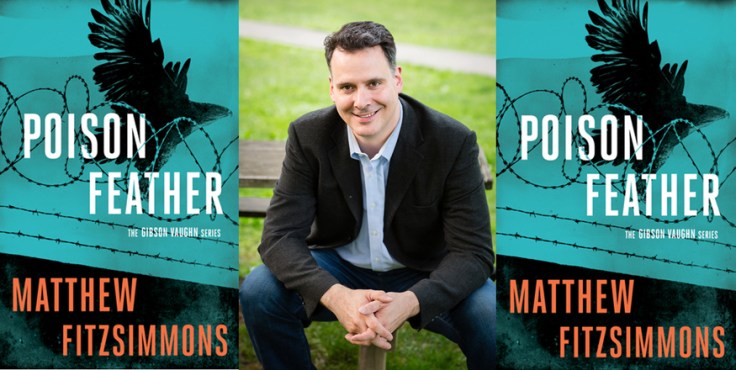
Matthew FitzSimmons is the author of the bestselling first novel in the Gibson Vaughn series, The Short Drop. Born in Illinois and raised in London, England, he now lives in Washington, DC, where he taught English literature and theatre at a private high school for over a decade. Poisonfeather is the sequel to The Short Drop, and we are delighted to present a synopsis and an extract. It is now available in several formats.


POISONFEATHER
Jailed billionaire Charles Merrick hints publicly that he has stashed a fortune in an offshore cache, and a school of sharks converges upon his release from federal prison. The promise of billions has drawn a horde of ruthless treasure hunters, including an edgy ex-con, a female bartender with a mysterious history, a Chinese spy with a passion for fly-fishing, and a veritable army of hardened mercenaries. To stay ahead of the sharks and win justice for his mentor, Gibson will need all his formidable skills. But at the end of the road, he’ll still have to face “Poisonfeather”—a geopolitical secret that just might get Gibson killed…or worse.

EXTRACT
It had been a hard couple of years, and he’d had to scrounge for work. It had cost him his marriage and very nearly the dream house that he’d intended for his family. Bought at the height of the market before the financial collapse, the house had teetered on the edge of foreclosure for several years. It was Gibson’s nightmare, losing that house. He might not ever live there again, but nothing mattered more to him than his daughter growing up there. It was safe. Good schools. Pretty backyard with a canopy of elm trees. Gibson smiled. It was finally within reach. With Lombard no longer in the picture and a job with Spectrum Protection on the table, he could, for the first time since he’d left the Marines, envision a future in which Ellie’s childhood at 53 Mulberry Court was secure. 
Maybe that explained how badly things went from there. 
The polygraph was going smoothly in hour three. Gibson was starting to anticipate the break for lunch at noon. Ms. Gabir’s questions flowed steadily, punctuated by his staccato yeses and nos. His readings fed into a laptop, and she paused periodically to type a note, but otherwise they were making good progress until the knock at the door. Amanda Gabir excused herself and stepped out into the hall. When she returned, Gibson saw a pair of security guards behind her. 
“What’s going on?” he asked.
“I’m sorry. The polygraph has been terminated.” 
“What? By who?” 
She didn’t answer but set to unstrapping him.
“By who?” he said, voice rising.
One of the security guards stepped into the room. “Sir, please lower your voice.” 
He took that as an invitation to yell. “Who?” 
“At the request of Spectrum Protection,” Amanda Gabir said. “I’m sorry. I don’t know why. Please don’t ask me any more questions.” 
Unwilling to sit still and be unstrapped like a child on a fairground ride, Gibson ripped the blood pressure cuff off and threw it to the ground. 
“Easy there, friend,” the guard said. Gibson chose not to be easy, and by the time he was hustled out the back into a service corridor, they weren’t friends anymore either.
“Get the hell off me,” he shouted to the empty corridor as the door slammed shut.
Traffic was a typical Northern Virginia quagmire. It took forty-five minutes to drive the fifteen miles to Nick Finelli’s offices at Spectrum Protection. Security was there waiting for him. Five of them. Solid men in matching blazers. They saw him coming and formed a wall; Gibson didn’t even get through the front door. He made his scene, and they let him rage for a while. He mistook their restraint for timidity and made a lunge for the door. They threw him to the ground and threatened to call the police.
“Go on home,” the oldest of the five said. “You had a bad day. You want to top it off with a night in jail?” 
Gibson dusted himself off and thought about whether or not he did. He knew he wasn’t thinking straight, but he was in one of those states of mind in which knowing better wasn’t the same as doing better.
“What’s it going to be, friend?” the guard asked.
That made Gibson laugh. “I’m everybody’s friend today.” 
“I’m trying, but you need to go home. There’s nothing in there for you.”
That was becoming abundantly clear. Gibson walked back to the street and turned around to stare at the building. Was Nick Finelli staring down at him? Did he feel like a big man hiding up in his office? How many times had Gibson covered his ass? Debugged his elementary-school coding? He tried Nick’s number. It rang until it went to voice mail. Gibson hung up and dialed again. The fourth time, the phone rang once and a prerecorded message told him that the number he was dialing was unavailable. Nick had blocked his number rather than give him an explanation. So that was how it was going to be.
They’d see about that.
Excerpted from POISONFEATHER © Copyright 2016 by Matthew FitzSimmons. Reprinted with permission. All rights reserved.

THE BLACK FRIAR … Between the covers

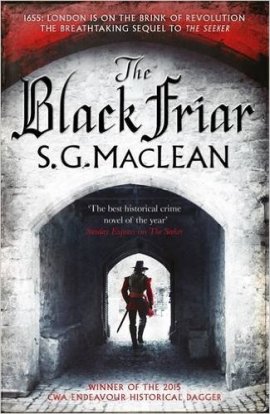
the-black-friarShona MacLean opens the door of her time machine and takes us to the city of London in the third year of Oliver Cromwell’s Protectorate, 1655. It is almost exactly six years since the severed head of King Charles was shown to the crowd around the scaffold in Whitehall, but Cromwell’s England is still a troubled place. There are still pockets of secret Royalist sympathy up and down the land, and the dead king’s son is in exile, waiting his moment to return.

By far the deepest thorn in Cromwell’s side, however, are firebrand extremist preachers (some things never change) who believe that The Lord Protector has compromised the purity of the cause. One such group is The Fifth Monarchists, a group of zealots who hold true to a strange prophecy in the Book of Daniel, which said that the four kingdoms of Babylon, Persia, Macedonia and Rome would pass away before the fifth kingdom would be visited on the earth – that of Christ himself.

 We are quickly introduced to a stern and forbidding Yorkshire soldier called Damian Seeker. He is a veteran of the recent wars, and is now a Captain of the State Guard. It seems that he is directly answerable to Secretary Thurloe, Cromwell’s spymaster – and to Old Noll himself. When the body of a man, dressed in the distinctive black robes of the Dominican order, is found walled up in a ruined priory, those involved are amazed that the corpse is relatively intact after 300 years of entombment. Seeker lets the rumour fly around the streets of the city, but he soon realises that not only has the man been dead only for a matter of weeks, but that he knows his identity.

 The dead man is none other than Carter Blythe, one of Thurloe’s most secretive and effective agents. He had embedded himself at the heart of a group of Fifth Monarchists in order to keep track of their plans for insurrection, but he has clearly been rumbled. While keeping the dead man’s true identity a close secret, Seeker – whose surname has earned him the sinister but appropriate appellation of The Seeker – tries to discover the fate of a number of children who have mysteriously disappeared in recent weeks.

The author introduced us to Seeker in her 2015 novel, The Seeker. He is big, tough, implacable – and more or less indestructible. This enables him to stride about the place with great physical authority, and where this is ineffective, he seems to have a direct line to the most powerful man in the country – The Lord Protector himself. The scene–setting is excellent, and I breathed a sigh of relief when it became obvious that MacLean has allowed her characters to talk to each other relatively normally, without any attempt to replicate the conversational mannerisms of the time – whatever they may have been.

sg-macleanMacLean (right) has great fun with prominent real-life characters who would certainly have been involved in affairs of state at the time. We have a nicely imagined Andrew Marvell, the poet best known for his erotic supplication To His Coy Mistress, and a walk on part for Samuel Pepys. The great diarist is merely a clerk at The Exchequer, but his later reputation as a serial seducer of young women is hinted at. We see the spymaster John Thurloe apparently at death’s door with some unspecified illness, but in real life he was to survive the restoration of the monarchy, and died peacefully in his bed in 1668.
 This is, I suppose, a 17th century police procedural, and eventually Seeker gathers his evidence, exposes a Royalist plot, and enhances his reputation as the Jack Reacher of his day. The Black Friar is recommended to anyone who might like a convincing glimpse of old London, with a decent cast of villains and a sturdy plot. The Black Friar is out today, 6th October, and is published by Quercus.

The image below shows contemporary portraits (left to right) of
Andrew Marvell, Samuel Pepys and John Thurloe.

portraits

THE MURDER OF SIR HENRY WILSON

The Britain of summer 1922 was, in some ways, similar to the island in The Tempest:

“the isle is full of noises,
Sounds and sweet airs, that give delight and hurt not.
Sometimes a thousand twangling instruments
Will hum about mine ears..”

abbsThe sounds and sweet airs might have been provided by Haydn Woods’ A Brown Bird Singing or, if you were more disposed towards the art of Edith Sitwell, William Walton’s setting of her poetry – Façade. The discordant sounds of the thousand twangling instruments could have come from several sources; possibly the thousands of impoverished ex-servicemen sold short by the country they had fought for; perhaps, however, the isle which was most full of noises was that of Ireland, and in particular the newly formed Irish Republic.
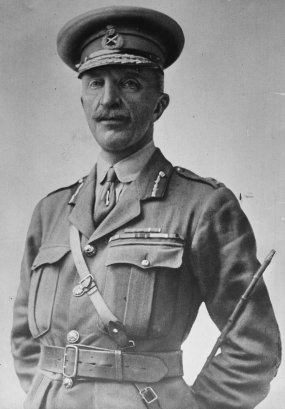
wilsonSir Henry Wilson was a former General in the British Army, and his contribution to events in The Great War divides opinion. Some have him firmly in the ‘Butchers and Bunglers’ camp, a stereotypical Brass Hat who send brave men off into battle to meet red hot shards of flying steel with their own mortal flesh. Others will say that he was part of the combined military effort which defeated Germany in the field, and led to the surrender in the railway carriage at Compiègne in 1918. Whatever the truth, Wilson was never a field commander. He was much more at home well behind the front line, hobnobbing with politicians and strategists.
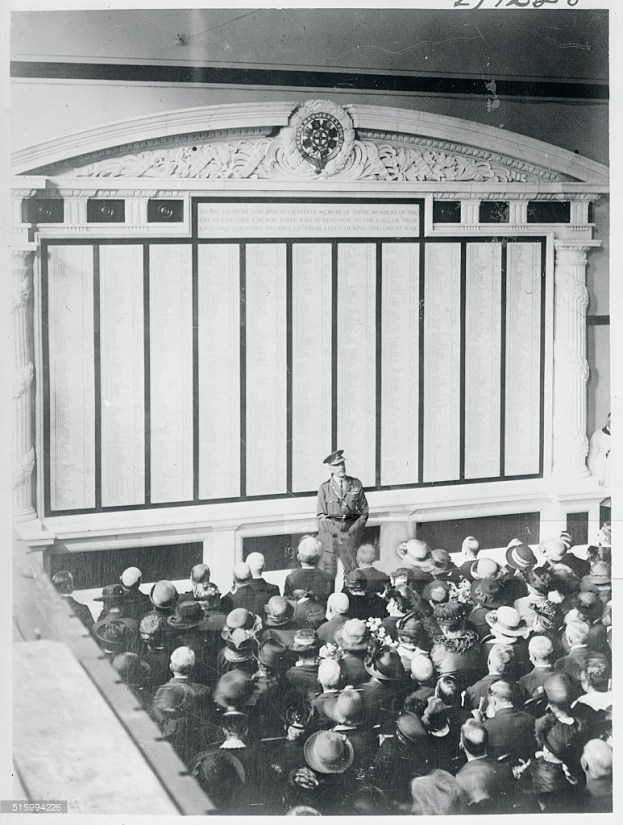
When the war ended, he was promoted to Field Marshall, and made a baronet. With Ireland beset by all manner of plots and factional fighting, he resigned his army post and was elected as MP for the Ulster constituency of North Down. He had made it very clear that he despised the Irish Republican movement, and had written in June 1919 that “Ireland goes from bad to worse” and that “a little bloodletting” was needed. His view of the British government’s attempts to deal peaceably with the Irish Problem is summed up by his belief that such peace moves were a “shameful & cowardly surrender to the pistol” by a “Cabinet of Cowards”. Ironically, his own demise was brought about by the pistols of two IRA killers.

In the early 1920s, there was one common activity which retired army generals shared, and it was to travel far and wide across the country, sanctifying by their presence the hundreds of war memorials bearing the names of the 704,803 men who had perished while under their command in the recent conflict. Thus, on the morning of Thursday 22nd June, 1922, Wilson had traveled by cab to Liverpool Street Station, where he had been invited to unveil the memorial to the men of The Great Eastern Railway who had died in the war. Having done his duty, and addressed the crowd of relatives and well-wishers, he returned to his house in Eaton Place in London’s Belgravia.

speech

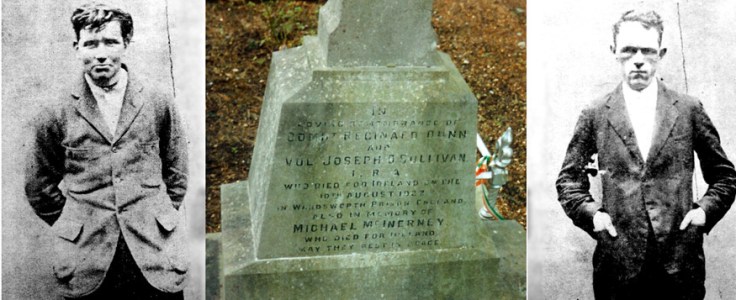
As the taxi pulled away, Sir Henry was attacked by two men, Reginald Dunne and Joseph O’Sullivan. He was shot nine times, and the killers made their escape, only to be arrested shortly after. Newspapers made much of the possibility that Sir Henry had drawn his ceremonial sword in his own defence, and had cried, “You cowardly swine!” as he was attacked, but only he and his assailants could verify that, and they are long gone from us.

assassination

 Wilson’s murder outraged popular opinion in England, and polarised views on the situation in Ireland. It was a widely held belief that the murder had been carried out on the orders of the Republican firebrand Michael Collins. Collins himself, incidentally, had only a few more weeks to live, as in the August of 1922, he was murdered, probably by rival Irish factions. Wilson’s funeral was a public affair attended by Lloyd George and the cabinet. French Generals Foch, Nivelle and Weygand came to pay their last respects, as well as many of his former British army colleagues including French, Macready, Haig and Robertson. The Field Marshal was buried in the crypt of St Paul’s Cathedral.

 And Sir Henry’s killers? They were duly tried and convicted of his death and hanged at Wandsworth prison on 10th August 1922, and buried in the prison grounds. As befits the adage that one man’s terrorist is another man’s freedom fighter, the remains of both Dunne and O’Sullivan were repatriated to the Irish Republic and given a heroes’ burial in 1967. A final irony in a case that is positively dripping with it, is that both men had fought for King and Country, with great gallantry in the war that had made Sir Henry Wilson such a prominent public figure.

killers


ON MY SHELF …October 2016

oms-october

Author Emma Kavanagh

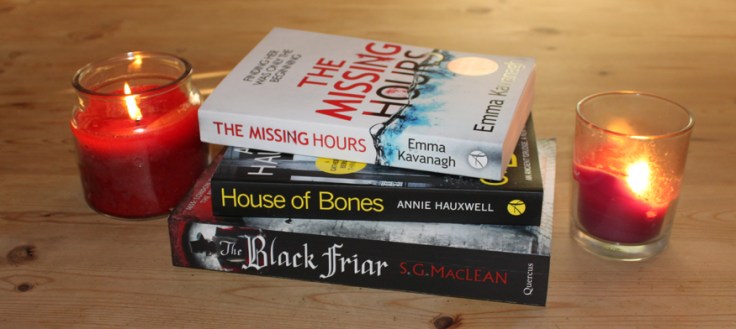
The Missing Hours by Emma Kavanagh
No-one can doubt the Welsh author’s background training to write taut crime thrillers. For many years, after gaining her doctorate in Psychology, she trained police firearms officers and military personnel to cope with the aftermath of that crucial moment when the trigger is pulled. In this novel she tackles the story of a woman psychologist who, with her husband, ran a consultancy advising the families of kidnap victims. Selena Cole’s husband is dead, killed in a Brazilian terrorist attack. Now, she goes missing from a children’s playground, while supervising her young daughters. When she returns, 24 hours later, she has no recollection of where she has been or what has happened to her. DC Leah Mackay and D.S Finn Hale must investigate if there is any connection between Selena Cole’s disappearance and a murder. This novel came out in hardback and Kindle earlier in the year, but you can check out the soon-to-be-released paperback version here.

ahx_smallHouse of Bones by Annie Hauxwell
Hauxwell’s flawed heroine Cathy Berlin returns in a mystery which has its roots in an incident in the colonial Far East in 1961. Berlin is not in good shape.

“The blanket of fog shrouding London was a perversion of the season. It drifted in dense clouds across the capital as Catherine Berlin followed a hearse through the grand arch of the City of London Cemetery and Crematorium. She wondered how long it would be before she passed under it feet first.”

As Berlin struggles with her drug addiction, she tries to clear her mind to understand the links between a seemingly motiveless murder, a rich Chinese student with powerful friends, and a decidedly bent Peer of the Realm. The author was born in London’s East End but emigrated as a teenager with her parents to Australia. She has worked as a nurse, a taxi driver and a lawyer, but left the judicial world, to settle as a private detective and screenwriter. She lives in Castlemaine, Victoria, but is regularly in Europe – whether to go on vacation, or because research beckons her here. House of Bones is out now, in Kindle and paperback.

sg-macleanThe Black Friar by S. G. MacLean
Maclean takes is back a good bit further than 1961, and we are in the London of Oliver Cromwell’s Protectorate. It is 1655, and Cromwell’s rule is threatened by a variety of political and military plots. When a body, clothed in the robes of a Dominican monk, is found walled into the ruins of a monastery, investigator and soldier Damian Seeker soon learns that the corpse is that of an elusive secret agent who worked for John Thurloe – Cromwell’s spymaster. In a city divided by warring religious zealots, and with Royalists conspiring to restore the Stuart monarchy, Seeker must also discover  the fate of a number of abducted children. Shona MacLean, who is the niece of Alistair MacLean, Scotland’s most successful thriller writer and author of Where Eagles Dare, also manages to give a couple of celebrity ‘walk-on’ parts to Andrew Marvell and Samuel Pepys. The Black Friar is available from 6th October.

Blog at WordPress.com.

Up ↑