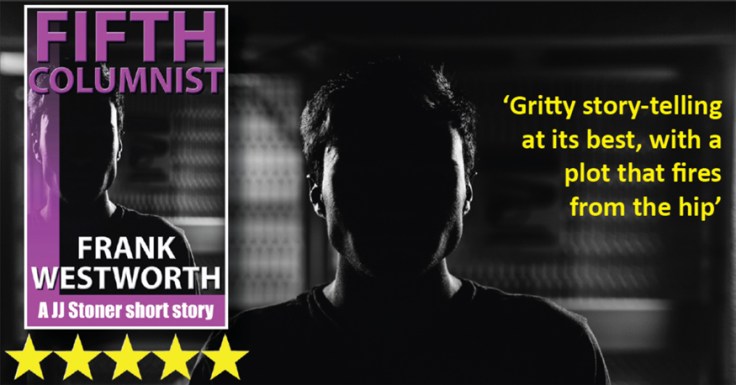
While waiting for his new quick thriller to be unleashed upon an unsuspecting world, author Frank Westworth considers creative ways to kill people…
Killer thrillers demand thrilling killers, no? I mean … that’s the whole point of them, surely. It is entirely unclear why so many folk are fascinated by creative ways of dying, but we are. Some of us are intrigued enough to write about it, maybe to see how it works, how a murder fits together, how it might feel were the author the killer. Which, usually, is not the case. Usually.
Most deaths – even the deliberate and premeditated deaths which define an actual murder – are pretty mundane. Most professional killers do it in the usual ways: either long range, the most popular and involving missiles, bombs, artillery and the like; medium range, using guys with guns operable by just the guys with the guns, and only occasionally by professionals involved in one-on-one – actual hand-to-hand combat. The latter is pretty rare, research reveals.
Research? Yes indeed. It’s not difficult to find a retired (let us pray) killer and ask. I did this, and I assume that other authors of killer thrillers do the same. Look around you; it’s statistically pretty likely that you know ex-military types. Maybe well enough to ask them all about the mechanisms. And maybe not.
Creative ways of killing apparently make a book more appealing – they certainly make writing the book more entertaining. I’ve recently completed a short story which required a surprise person being killed in a surprising way. In a disguised way; a murder disguised as an accident. And as all parties involved were military or police professionals, that was a fun challenge. Grab a copy of ‘Fifth Columnist’ if you’re interested in the resolution.
Unlike most killings, novels are written to entertain, so maybe the killing ways should also be entertaining. This is plainly a decently bizarre notion, not least because most killings are accidental, for passion or for money – think about it for a second – but I doubt that many killers do it to entertain others. Although…
So I try to provide variety, and even a little originality – entirely to entertain The Reader. So far, in three novels and a half-dozen short stories, methods of murder have included the usual handguns, sniper rifles, a rocket or two, several knives (usually long, sharp and with black blades – I took advice on that) and a couple of one-on-one slug it out fights, although the best advice with the latter is always to strike first, strike extremely hard and carry on doing that until your own life is safe. Talk to a serving soldier, preferably an infantryman.
However, I’ve also managed a couple of deaths by bathroom furniture, in the shower – dangerous places, hard surfaces, slippery and easy to clean. And for a little variety in one incident the bad guy used a catapult, while in another a nun used an exploding guitar case. It all made sense at the time. The killing I was most amused by – if it’s OK for an author to be amused by their own copy – was death by industrial strength Viagra. It was appropriate for the situation, trust me. Also titillating? OK. Maybe a little. A not so petite mort, maybe.
It’s not all violence for its own sake, though. When I working up the characters of the – ah – characters, I wanted to portray a couple of them as decent humans, not stone killers, psychopaths or the deviant fruitcakes so popular in the movies and on the telly. OK, so they’re killers – that is what soldiers do – but they do not revel in that. Let’s take the idea a little further – can you imagine a situation in which death would be a mercy? Of course you can … probably. There’s a great movie called ‘They Shoot Horses, Don’t They?’ which isn’t about contract killers in any sense (but is well worth watching all the same) which suggests the desperation which could lead someone – a very best friend, maybe – to do a deed which is entirely socially unacceptable, but which is actually a kindness, a mercy killing. I’ve told that very tale twice, using different reasons and entirely different characters. It’s not easy to write. Not at all. The exact opposite of the alleged ‘spree’ killers so beloved of so many.
An unexpected outcome of the killer novelist’s life is the popularity of the anti-hero. Not the villain, everyone has their favourite villains, from Moriarty to Hannibal Lecter, no; the anti-hero. The character whose view of life can become so bleak that he (or indeed she…) finds it increasingly easy to consider that final kill, that kill of the killer – suicide. One or more of my own characters face this, stare it down, consider it anew, find the idea appealing, so appealing that they need to distract themselves from their own final solution. Distractions? How would an increasingly nervous, distressed and unbalanced person distract themselves? It’s not easy, is it? And it’s very easy for a killer to kill themself, no matter the means or the method. And surviving a professional killer’s suicide would surely be the greatest comeback in killer history, no?
I can’t wait to write it…
 FIFTH COLUMNIST comes out on 14 September 2016. This quick thriller features covert operative JJ Stoner, who uses sharp blades and blunt instruments to discreetly solve problems for the British government. A bent copper is compromising national security and needs to be swiftly neutralised, but none of the evidence will stand up in court. That’s exactly why men like Stoner operate in the shadows, ready to terminate the target once an identity is confirmed…
FIFTH COLUMNIST offers an hour’s intrigue and entertainment. It features characters from the JJ Stoner / Killing Sisters series. You don’t need to have read any of the other stories in the series: you can start right here if you like. As well as a complete, stand-alone short story, Fifth Columnist includes an excerpt from The Redemption Of Charm (to be published in March 2017).
Please note that FIFTH COLUMNIST is intended for an adult audience and contains explicit scenes of a sexual and/or violent nature.
GRAB FRANK WESTWORTH’S NEW THRILLER for just 99p/99c
Amazon UK: www.amazon.co.uk/dp/B01L5TEUEG/
Amazon US: www.amazon.com/dp/B01L5TEUEG/
Shelve it on Goodreads: www.goodreads.com/book/show/31699504-fifth-columnist
READER FEEDBACK:
‘A fast-paced, high-powered thriller… Terse and stiletto streamlined and sharp as the blade of a knife.’
‘Imagine an intimate encounter between Jack Reacher and the girl with the dragon tattoo: that’s JJ Stoner and the Killing Sisters.’
‘Gritty story-telling at its best, with graphic (but well-written) sex and a plot that fires from the hip.’
‘I implore lovers of crime/thrillers to get their hands on the JJ Stoner series. Both the short and full length books are just fantastic.’

ABOUT THE AUTHOR:
Frank Westworth shares several characteristics with his literary anti-hero, JJ Stoner: they both play mean blues guitar and ride Harley-Davidson motorcycles. Unlike Stoner, Frank hasn’t deliberately killed anyone. Frank lives in Cornwall in the UK, with his guitars, motorcycles, partner and cat.
AUTHOR LINKS:
Facebook: www.facebook.com/killingsisters
Website: www.murdermayhemandmore.net
Blog: https://murdermayhemandmore.wordpress.com/category/frankswrite/
Amazon: www.amazon.co.uk/Frank-Westworth/e/B001K89ITA/
Goodreads: www.goodreads.com/author/show/576653.Frank_Westworth

 The Book of Mirrors by E O Chirovici looks to be Penguin’s big promotion for the early autumn. There’s an excellent cover with peep-through perforations, and the promo pack includes a very tasty spiral bound notepad/sketchbook. The author, Eugen Ovidu Chirovici, was born in Transylvania, which all fans of the lethal Count Dracula will know is in modern-day Romania. The story? It’s one part literary novel, in that Chirovici examines the nature of memory and recollection; a second part aims to be stylish, and the author openly admires Raymond Chandler and Mario Vargas Llosa for their flawless technique. The third part, perhaps most importantly, is that we have a cracking CriFi story about a cold-case crime and a lost manuscript which contains clues to the identity of a killer.
 The Vanishing Year by Kate Moretti certainly wins title of the month award, as those of us in the UK cling on desperately to every vestige of summer, while preparing ourselves stoically for yet another northern winter of rain, diminishing days, and media hysteria over football results. Moretti’s novel focuses on Zoe Whittaker, a woman whose life has metamorphosed from desperation and danger into one of luxury, love and positive vibes. But the past is never very far away, and when Zoe’s life comes under threat from those she thought had been cast aside, just as a dream dies at the dawn of day, she must make a decision which will either bring salvation – or damnation.
 Get Lucky by Paul Eagles is one of those confessional ‘Jack The Lad’ stories about someone who has lived his life at the sharp end. It is, I suppose, True Crime, but aficionados of the genre will know that they will need several pinches of salt in order to separate the fact from the fantasy. Basically, Eagles tells his life story thus far. It is as far removed from anything you and I have experienced as is Tennyson from E J Thribb. But, I suppose, there lies the charm. We are invited to gasp and gawp at the goings on, charmed by the fact that we could never, ever have got away with things in the way that Mr Eagles describes.
 The Child Garden by Catriona McPherson tells the story of one of those ‘special’ schools set up in the 1970s, when people still believed that Hippy peace and love was a viable and cogent philosophy. Conventional schools were simply prisons for young minds, Bob Dylan reminded us of “the mongrel dogs that teach”, and, just for a nanosecond, in someone’s mind, there seemed to be a way forward. The school in question was called – clearly with the irony meter turned off – ‘Eden’. Inevitably, it folded, with its alumni and teaching staff scattered to the four winds. But a sinister suicide during the school’s heyday returns to haunt former pupils, and they learn that the dead have ingenious ways of speaking to the living.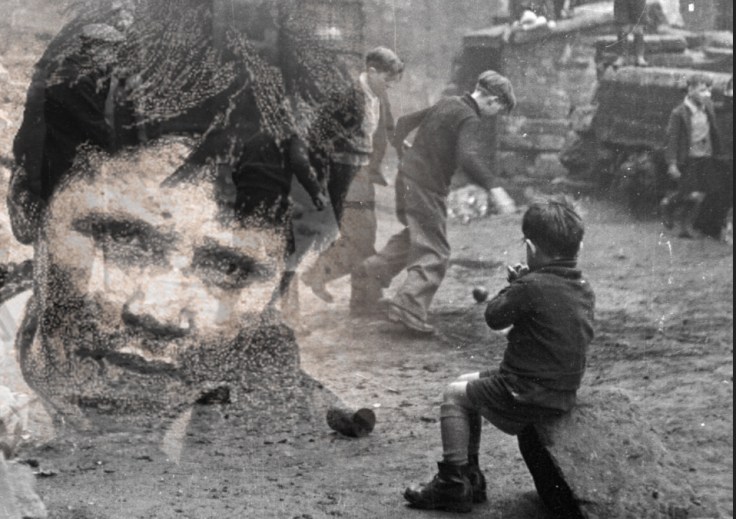
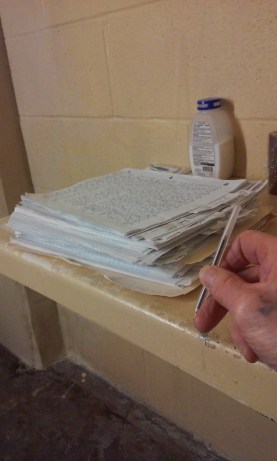 Roy’s workspace was adequate for writing. But the inadequacies far surmounted any conveniences: No computers, word processors or typewriters were available. Paper was hard to get, and because of the high-security, regular ink pens were banned. Every page, 1,162 in total, was handwritten multiple times to render a final clean draft with a “flex-pen”, a plastic ink cartridge with a soft, flexible rubber shroud. These sub-par ink dispensers are immensely taxing on the hand.
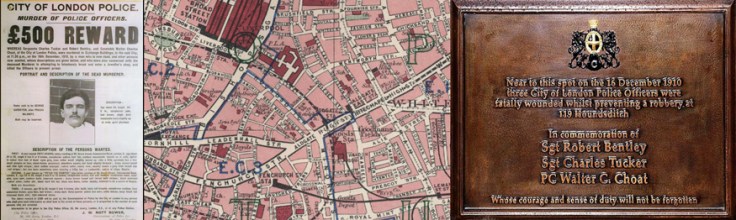

 What followed was chaotic. The police, unwittingly, were walking into a situation where they would be faced with desperate men armed with sophisticated semi-automatic weapons. In the semi-darkness of the shop, there was a murderous burst of gunfire which woke people living in adjacent properties, and brought them from their beds. Three policemen were shot and killed – Sergeant Bentley, Sergeant Tucker and Constable Choat, of the City of London police. Bentley died from wounds to the shoulder and neck; Choat from six bullet wounds; Tucker from gunshots to the heart and stomach. Almost incidentally, George Gardstein was also shot – probably by one of his co-conspirators – and dragged from the scene. He died later at 59 Grove Street (now Goldring Street), off Commercial Road, a house leased to Peter Piatkov, later known as Peter The Painter.
 While London came to a standstill for the memorial service for the three dead policeman at St Paul’s Cathedral of 23rd December, the colleagues of the three men had not been idle. Tracing the culprits was made no easier by the fact that many of them had a different alias for every day of the week and, in the eyes of the expatriate Russian and Latvian community in the East End, the British Police were no different from the dreaded Okhrana secret police operating in their homelands. Eventually four members of the gang were brought to court in May 1911. Peters, Duboff, Rosen and Vassileva were charged with a variety of offences including murder and conspiracy to commit burglary.
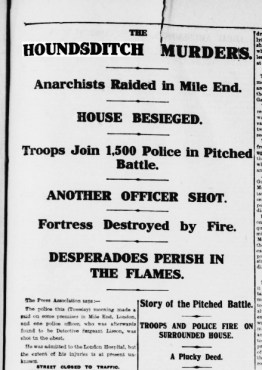 On 3rd January 1911, however, an event had occurred which gripped the imagination of the public at the time, and still casts a lurid shadow over a century later. Two of the gang, Svaars and Sokoloff, were believed to be holed up in a dwelling on Sidney Street in Whitechapel. The attempt to capture them featured a detachment of the Scots Guards, the fire brigade – and the Home Secretary, a certain Winston Churchill. Svaars and Sokoloff perished in the ensuing gun battle and fire, but a full account of the happenings of that day – both tragic and farcical – is for another time.
 There are few grander places in Dublin’s fair city than Leinster House, even though its style and grandeur might hark back to the days when the Irish aristocracy – with its links to England – were a power in the land. Whether the current inhabitants of the ducal mansion do its stately rooms and grand corridors proud is not for me to judge, for it houses Oireachtas Éireann, the parliament of the Irish Republic. There must have been a whole lexicon of killing words uttered between political opponents over the decades, but few – if any – actual murders have despoiled the Georgian grandeur. Jo Spain puts this right within the first few pages of Beneath The Surface.
 There have been several examples of literature being written by imprisoned authors. Described as the first modern novel, Don Quixote, was conceived while Miguel de Cervantes was in jail for debt, although it was finished and published after the author was freed. Oscar Wilde’s De Profundis was a poignant letter to his fickle lover, Lord Alfred Douglas, and was composed while the author was serving his sentence for indecency. The powerful Ballad of Reading Gaol was, however, written after Wilde’s release.
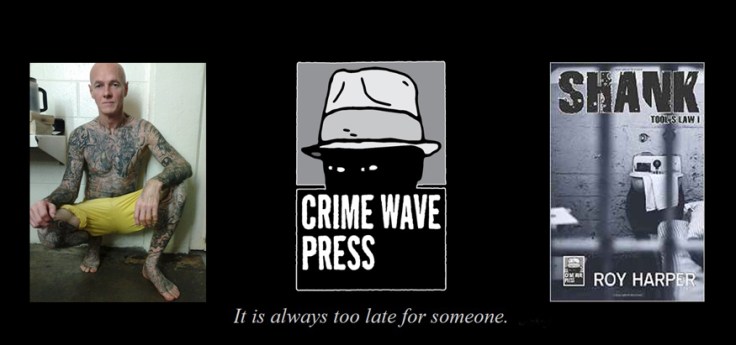
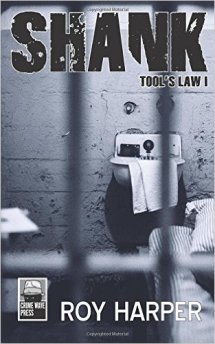 Roy Harper would not claim literary kinship with Cervantes, Wilde and Genet, yet he shares the unique kinship of living a life behind bars. He also writes, and after an exercise in smuggling manuscripts out of prison that merits a novel all by itself, his first book – Shank (Tool’s Law 1) – was published in May 2016. Let Henry Roi, of Crimewave Press, take up the story.
 Roy Harper (right) never murdered anyone, and the worst that ever befell those he encountered while on the run was to be shocked, and then accosted and harassed by reporters looking to sell the news as entertainment. Raised in Tempe, Arizona, Roy enjoyed exploring the desert and playing at gun fighting, and was fascinated by outlaw cowboys, the most infamous being Public Enemy No.1, John Dillinger.


 Here on the coast of The Wash we can, if we wish, still measure the seasons by produce. I say “if we wish”, because supermarkets have no seasons – everything is available all the year round. But in the old fashioned world of buying food when it is fresh and local, the year has its own rhythm. Early summer gives us asparagus, followed by strawberries. In autumn and winter Brancaster mussels and native oysters are delicious, but for me, the true treasure of the summer months is samphire. This plant of the coastal marshes, Crithmum maritimum, allegedly gets its name from a corruption of the French “St Pierre”, but whatever its etymology, it is utterly delicious. Lightly boiled or steamed, it is best eaten with the fingers. Running the stems through your teeth to strip off the flesh is a completely sybaritic sensation. Local folk love it with vinegar, but with butter and coarsely ground pepper it is little short of heavenly.
 Shaw and George Valentine series with At Death’s Window. In addition to solving a series of burglaries at properties along the Norfolk coast owned by wealthy out-of-towners, Shaw and Valentine become involved in a turf war between product dealers. These are not your common-or-garden drug barons, or even owners of ice cream vans, but dealers in samphire! As I have illustrated, with a 300% mark-up available for an item that can be had for nothing, why bother with something as illegal and potentially lethal as narcotics? The problem in At Death’s Window comes when local folk are muscled off their home territory by criminal gangs using illegal immigrants as pickers. Think cockles and the Morecambe Bay tragedy, and you can see how it all might go pear-shaped.


 fullybooked2017