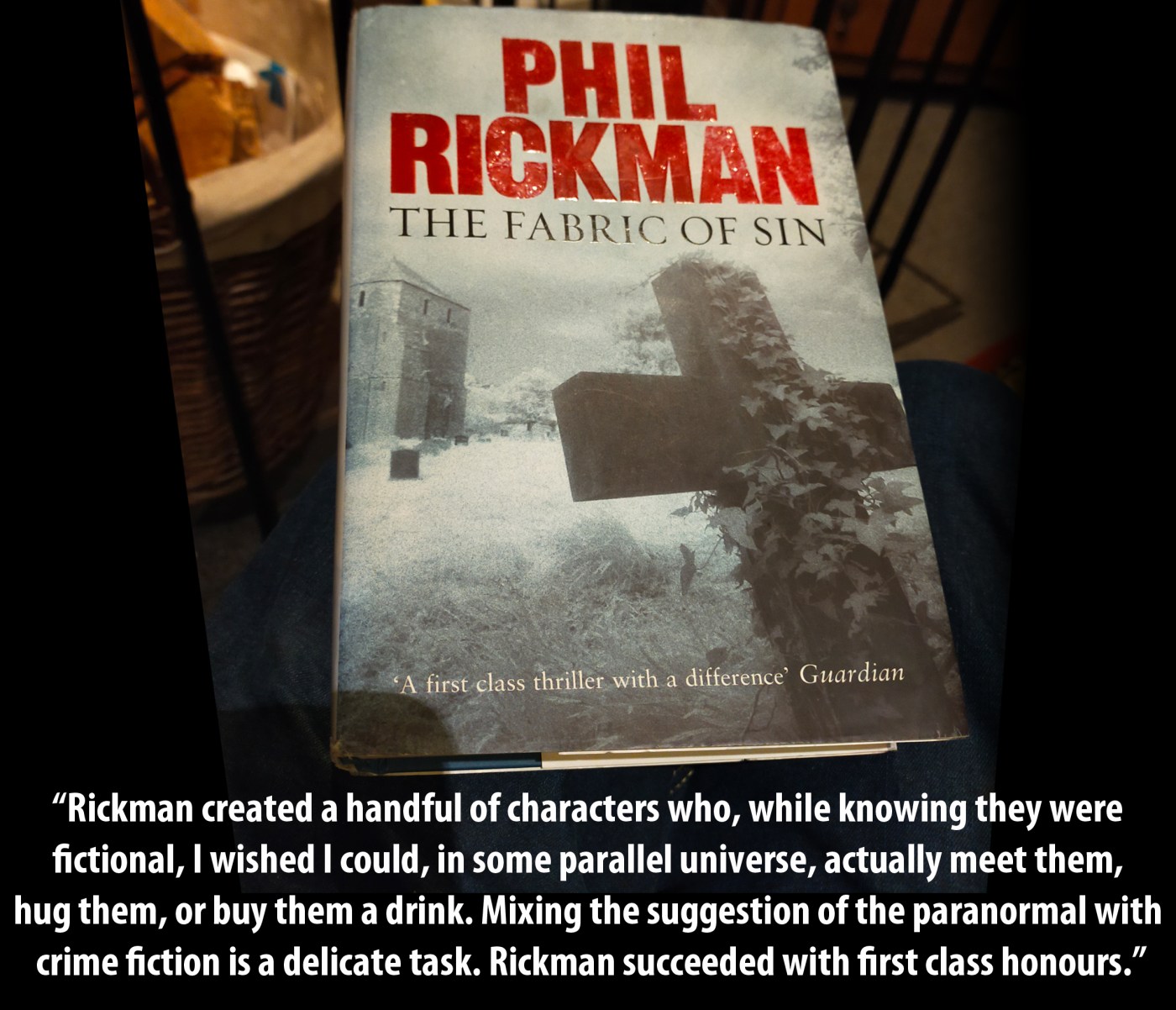

Long before I started Fully Booked, or began my brief career reviewing for Crime Fiction Lover, I was an ardent customer of the local library. I still had the day job then, and so it was always a Saturday afternoon when I visited. There, I discovered wonderful crime writers such as Jonathan Kellerman, Christopher Fowler, Jim Kelly, David Baldacci, Anne Perry, Nick Oldham and, in particular, Phil Rickman. It would have been in 2008 when I borrowed The Fabric of Sin, which had been published a year earlier. It frightened the hell out of me back then and so, eighteen years later, with Phil sadly dead and in his grave, I bought a copy to re-read.
Perhaps I had been too easily impressed. Maybe, like childhood memories, things improve with age. Not so. I have just turned the last page, and I will say that it is the best crime novel I have read this century. Straightforward crime, as Rickman fans will be quick to remind me, is not central to this, or any of his other Merrily Watkins novels. Yes, there is straightforward villainy, and Rickman shrewdly inserted the Hereford copper Frannie Bliss and his investigations into most of the books in order to tick the CriFi box.
The background. Merrily Watkins is a widow with a teenage daughter, Jane. Merrily is the vicar of a Herefordshire village, and she is also the Deliverance Consultant for the diocese. In the past, she would have been known as an exorcist. Through prayer and the use of Christian ritual she calms people – and places – that are spiritually disturbed. I once asked Phil if Merrily believes in the paranormal. His answer was enigmatic. “She believes that other people do“, he replied.
Here, the problem is a building, an old converted barn in the village of Garway. Garway is a real place, and has a distinctive church which owes its origin to the Knights Templar. The estate of which The Master House is part has been recently bought by none other than The Duchy of Cornwall, the head of which, of course, was. at the time the book was written, the heir to the throne, and a man known for his unconventional views on religion and spirituality. When the builder hired to renovate the house quits because of the atmosphere of evil he feels the house exudes, Merrily is instructed by her boss, the Bishop, to investigate. The builder is later found battered to death on the steps of his mobile home and his girlfriend – perhaps his killer – has lain down on a railway line in front of an oncoming train.
Phil Rickman’s awareness of the warp and weft that underlays both English folklore and paranormal fiction was both deep and broad. It was he who directed me to the books of PM Hubbard, a novelist who specialised in describing how the normal trappings of life can quickly become sinister. Here, he mentions that master of the macabre, MR James, whose memorable description of the being that terrorised poor Professor Parkins in Oh Whistle And I’ll Come To You My Lad, “a face of crumpled linen”, haunts this book. He also quotes the Herefordshire folklorist Ella Leather, who provided Ralph Vaughan Williams with source material for several of his carol settings.
Merrily’s boyfriend is Laurence ‘Lol’ Robinson, a Nick Drake-style acoustic guitarist and songwriter. Through a mutual acquaintance he visits Lord Stourport, aka Jimmy Hayter, a wealthy music entrepreneur and minor aristocrat, who has an interesting tale to tell. In the 1970’s, he and a coterie of drug loving friends leased The Master House for an endless summer of sex, drugs and rock and roll. But it ended badly. One of the residents, a devotee of Aleister Crowley and mysticism, brought something back to the old house that had lain dormant for centuries.
Rickman used several recurring plot lines in the novels. The most regular was the rather wilful Jane putting herself into some harm’s way, either from human agencies – or otherwise. After a few books, one realised that she was always going to survive, but Rickman’s skill was to keep each episode freshly worrying, as here, where she borrows Merrily’s ageing Volvo to drive over to Garway in the company of Mrs Morningwood, a mysterious Garway resident heavily into herbs, potions, reflexology – and the sinister history of The Master House.
In the end, in a breath-taking final chapter, Merrily unmasks an all-too-human killer. I can only say that Rickman created a handful of characters who, while knowing they were fictional, I wished I could, in some parallel universe, actually meet them, hug them, or buy them a drink. Mixing the suggestion of the paranormal with crime fiction is a delicate task. Rickman succeeded with first class honours, and there was always a rational explanation to events. Except he always allowed room for one extremely potent word. But?
For more on Phil Rickman and his books, click the image below.