
Search

fullybooked2017

Tag

Psychological Thriller

THE INNOCENT WIFE . . . between the covers

TIW header

Samantha is a schoolteacher, and to say that she is unhappy in her work would be an understatement. As she presides over a violent and potentially criminal separation from her wimpish boyfriend, she is hooked into a social media storm centred on the imminent execution of Dennis Danson, a Florida man who has been accused, tried and convicted of the murder of a teenage girl. Danson has a fervent and vocal set of social-media followers. There is only circumstantial evidence to connect him to the killing, yet the court has pronounced him guilty, and so he resides in that most gruesome of thoroughfares, Death Row

Samantha kicks into touch her recent romantic travails, and begins an online relationship with the condemned man. Dennis writes back to her, and senses that Sam is not just another execution groupie with a bizarre fascination for a notorious criminal. Sam decides that her future is inextricably entwined with that of Dennis, and she uses a recent bequest to finance a trip to the USA. Breathless and uncertain, she finally meets the man of her dreams, albeit on the wrong side of a protective screen at Altoona Prison. Sam and Dennis officially become man and wife, in a cruel parody of the normal wedding ceremony


central text


AmyAmy Lloyd (right) makes sure that fans of Southern Noir who enjoy a tumbledown and gothicky old house in the Florida badlands are not disappointed. If you enjoy the odd sinister Sheriff, townsfolk who don’t hold grudges for much more than eighty years, and mentally disturbed teenagers in the body of a forty year-old man, you will not come away empty handed. But The Innocent Wife is much more subtle. As we follow the tortuous marriage of Sam and Dennis, we are reminded of the shocking consequences of ill-advised relationships forged on the flimsy anvil of whichever social media platform is currently in vogue. A chilling wind of truth blows through the narrative as we realise that the inch-thick perspex that separates prisoners from their visitors is a compelling metaphor for the separation which exists between people who only communicate via Facebook or Instagram.

One of the most obvious paradoxes about reading psychological crime thrillers is that we come to expect the unexpected. It becomes less a matter of a surprise twist being a possibility, but more trying to work out who or what is going to provide the statutory jolt, and when it will occur. In The Innocent Wife it is a given that Sam will come to regret falling for Dennis Danson. Or will she? The final pages are exquisitely subtle and – even if this sounds like one of the more bizarre utterances of George W Bush – Amy Lloyd doesn’t give us quite the surprise that we were expecting.

The Innocent Wife is out now in Kindle and hardback. The paperback edition will be available in summer.

Amy Footer

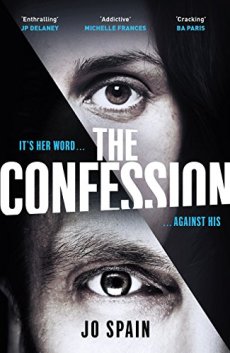
THE CONFESSION . . . Between the covers

TC header

Here’s a challenge for you. A challenge for writers, and for those who like to write about writing. Begin your novel like this. Time? The present day. Scene? A comfortable room in an Irish house. Characters? A man and woman watching television, and an unknown intruder. Action? The intruder hacks the man to death in front of his horrified wife. Placement in book? The opening pages. Now, write a compelling and hypnotic novel of 400 pages which follows this dramatic beginning, and keep your readers hooked until the last paragraph.

The ConfessionJo Spain not only takes on the challenge, but she meets it head on and completes it with subsequent pages of The Confession which manage to be, as night follows day, bravura, intense, full of authentic and convincing dialogue, utterly mesmerising and, in places, literally breathtaking. A countryman of Spain’s began his most famous novel with Stately, plump Buck Mulligan came from the stairhead, bearing a bowl of lather on which a mirror and a razor lay crossed.” She counters with:

“It’s the first spray of my husband’s blood hitting the television screen that will haunt me in the weeks to come – a perfect diagonal splash, each droplet descending like a vivid red tear.”

Now that is as fierce an opening paragraph as you will ever read. The speaker is Julie McNamara. The victim – of a perfectly timed swing with a golf club – is husband Harry, a financier who has recently fallen from grace as his empire took a huge hit in the 2008 financial crash. He is still formidably rich by most people’s standards, but his reputation as some kind of investment Midas has been destroyed. We hear the story of his rise and fall through Julie’s voice. She says, of the beginning of their love affair:

“Young, innocent, hopeful, in love. That was us at the beginning of our fairytale. But here’s the thing about fairytales. Sometimes they’re darker than you can ever imagine.”

Jo Spain continues to defy crime fiction convention by eschewing the standard police procedural manhunt. Instead, the killer of Harry McNamara turns himself in at the nearest police station in his blood-stained clothes and announces himself as John Paul Carney. At this point, Spain introduces us to a very distinctive member of An Garda Síochána, Detective Sergeant Alice Moody:

“Gallagher’s senior detective sergeant arrived at the top of the stairs, sweat patches already forming under her armpits from the three flights, her thin mousy brown hair gleaming from the perspiration emanating from her scalp.Every time that woman took the stairs she gave a convincing performance of somebody on the verge of a heart attack.”

 So DS Moody is not cut out to be a TV producer’s idea of a marketable sharp, charismatic – and stunningly sexy – detective. But she is bright. Very, very bright, as we are to discover.

The Confession unfolds like a beautiful but deadly flower opening its petals, one by one. Our narrators are the widowed Julie, Alice Moody, and JP Carney himself. A phrase here and there, a paragraph or two, an apparent revelation, and we think we know why JP Carney has bludgeoned the living daylights out of Harry McNamara. But this is Jo Spain’s skill. A page at a time, she weaves her spell and points us in the direction of the truth. Except we come to a dead end. A literary rockfall. An emphatic no-entry sign.

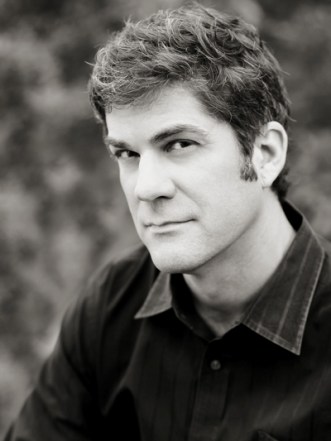
JSOf course, we get there in the end, and understand why JP Carney has exacted such an emphatic revenge on the handsome, charismatic and plausible Harry McNamara, but sometimes book reviews have to stop dead in their tracks, and say, “Trust me, this is a brilliant novel, but to tell you any more would be little short of criminal.” Yes, The Confession is a brilliant novel. Yes, I read it through in one sitting, deep into the early hours of a winter morning. Yes, I am a fan of Jo Spain (right). Yes, if you don’t get hold of your own copy of this, you will receive scant sympathy from me. The Confession is published by Quercus, and will be on sale as a Kindle from 11th January, and as a hardback from 25th January. Check online buying choices here.
For reviews of earlier Jo Spain novels, click on the titles below.

Sleeping Beauties

Beneath The Surface

TC header


BLAME . . . Between the covers

Blame header

JeffAbbottI guess we all play the game. We know the rules, every one of us. No expensive equipment required and no real skill needed, that’s for sure. The Blame Game, it’s called, and when something bad happens in the world it plays out on every social media feed, every newspaper paragraph and every breathless sentence from every permatanned TV news anchor. Bestselling thriller writer Jeff Abbott (left) convinces us that it’s also very popular in the little Texas town of Lakehaven where, just two years ago, a car carrying two teenage friends plummeted off a lonely road and down into a deep gully.
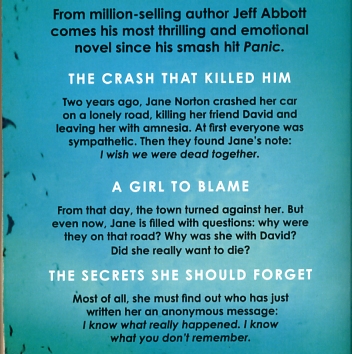
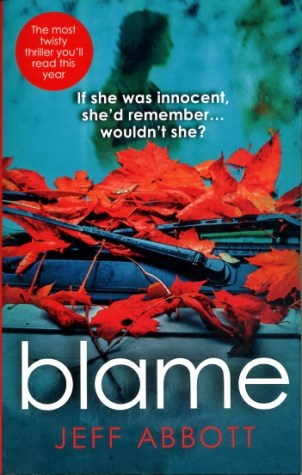
When the paramedics arrived, all they could do for young David Hall was to get his body clear of the wreckage – and then zip up the body bag. Jane Norton, the driver? Well she got lucky. After a fashion. Multiple broken bones, but nothing fatal. And a major bang to the head, which has left her with partial amnesia. When a suicide note surfaces, written by Jane, the Lakehaven rumour mill starts to grind, and it grinds exceeding small. Obviously, Jane intended to kill herself, and she took David – the trusting, popular, talented, handsome David – down with her.

Two years on, Jane has learned to recognise her mother and her college friends, but as to what actually happened on that dreadful night, nothing. Nada. A big fat blank. This big fat blank makes her the perfect hate figure for many former school and college buddies, and she has shrunk into what is left of herself. She has left home, and is ‘crashing’ in the dorm room of one of the few friends who is still prepared to give her – literally – house room.

blame015

Jane and David were inseparable childhood friends. Their parents still live next door to each other. Perri Hall and her soon to be ex- husband Cal no longer speak to Laurel Norton who is also on her own for a different reason. Her husband Brent is three years dead from a gunshot from his own weapon, either intentionally or maybe through a tragic accident; the gossip jury is still out but, like Old Jacob Marley, Brent Norton is as dead as a doornail.

The two year anniversary of David’s death is being commemorated in the modern way, along with other tragedies, baby scans, bad moods, good moods, cute cats, photos of ‘what I had for dinner’ and Trump memes on the (strangely familiar) social media hub, Faceplace. David is the martyr, Jane and her mother equally culpable as the villains.

blame017In a nutshell, the novel is an account of Jane’s attempt to find the truth about what actually happened on that dreadful night on High Oaks Road. We have to assume – because we are seasoned readers of crime thrillers – that Jane is innocent of a brutal suicide mission which claimed the life of a boy whose only crime was to be in love. As Jane turns over rock after rock, and unpleasant critters scuttle about, exposed to the light of truth, the novel builds to a dramatic and breathless finale. As might be expected from a writer of Jeff Abbott’s pedigree, he keeps his cards close to his chest, and keeps us guessing until the final few pages.

I particularly loved how Abbott works the Jane character; at the beginning, despite her having suffered a terrible physical trauma, she still comes over as being something of a pain in the butt; as the novel develops, and the web of possible suspects widens, her courage and determination not to take shit from anyone began to grow on me. Remember, as well as having lost her memory, the boy they tell her was her best buddy is also gone, and she has completely forgotten how to talk properly to people. As for normal social and conversational responses, they are also an unfathomable mystery. Blame came out earlier in the year in hardback, but will be available in paperback from 28 December.

blame footer

THE HOUSE … Between the covers

The House Header
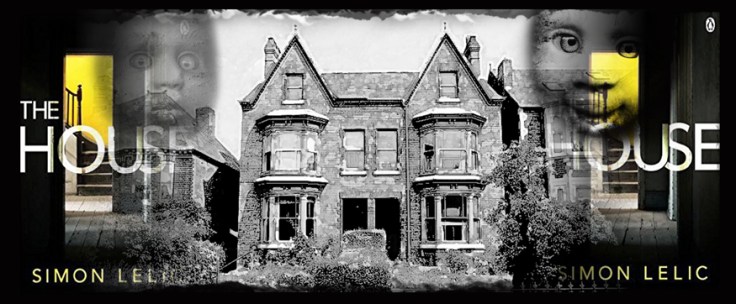
Do houses have souls? Do they retain some of the psychological warmth – or chills – of the people who have lived there previously? When a young couple, against the run of play in terms of the asking price, find themselves proud owners of a higgledy-piggledy house, they can’t believe their luck The previous owner has struck lucky in the romance game, albeit late in life, and has hotfooted it to Australia to be with his love. He has left the house ‘as found’, and this includes paintings, random stuffed animals and a plethora of clutter. And the ‘soul’ of this house? Once rid of the examples of the taxidermists’ art, Jack and Syd begin to transform the house into something more reflective of their own moods and personalities.

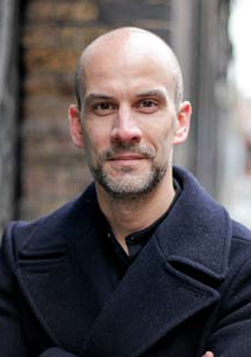
the-house-book-review-Simon-Lelic-credit-Justine-StoddartThere is, however, that strange smell. A certain je ne sais quoi which will not go away, despite the couple’s best efforts. When Jack finally plucks up the courage to climb up into the roof space, he finds the physical source of the smell but unpleasant as that is, he also finds something which is much more disturbing. Simon Lelic (right) then has us walking on pins and needles as he unwraps a plot which involves obsession, child abuse, psychological torture and plain old-fashioned violence.
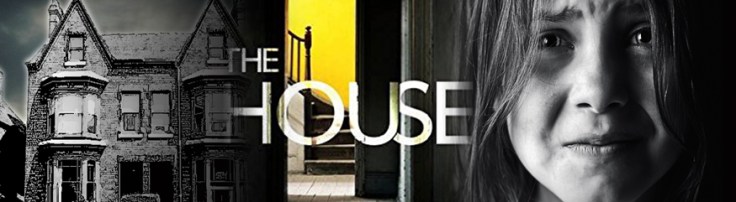

The novel does pose one or two challenges. The first is that we have two narrators, Syd and Jack. We see events retrospectively. At some point we learn that they have challenged each other to write up their personal version of what has happened. Inevitably, their stories are not identical. While this is part of the charm, we do have to ask ourselves the key questions,”do we trust Syd or do we trust Jack? Do we believe both – or neither?”

This leads to the second challenge, and it concerns our judgment about the personality of the two individuals. I can only tell it as I see it, and for what it’s worth, neither came over as being particularly likeable. I am sure that there are dozens – hundreds, maybe tens of thousands – of perfectly worthy people who work in and on the fringes of the social services, but in fiction – and the perception of some journalists – there exists a stereotype. He or she is mild mannered, anxious, keen to please and with a tendency to be naively trusting when dealing with people (I believe ‘clients’ is the preferred word) who are scrabbling around, for whatever reason, at the fringes of comfortable society. Jack certainly has all his ducks in a row here.

Syd, by contrast, is spiky enough to give the biggest Saguaro cactus a run for its money. Of course, Lelic doesn’t just shove her on stage and make her behave badly without giving us her backstory. It is a pretty grim narrative and, trying to avoid any spoilers, I have to say that it is fundamental to what happens in the book.

This is a genuinely disturbing psychological thriller, and we are kept guessing almost until the last page as we try to make sense of what has happened. Not all new novels live up to the entertaining and inventive hype which precedes their publication, but this one certainly does. The House, by Simon Lelic, is published by Penguin and is out now on Kindle, and will be available in paperback from 2nd November.

The House Footer


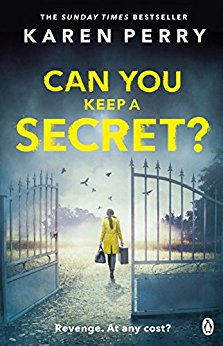
CAN YOU KEEP A SECRET? … Between the covers

Karen-Perry-M2C-1
This is the latest from Karen Gillece and Paul Perry
, the successful Dublin writing partnership. How two people can write one novel remains a mystery to me but, my goodness, Gilece and Perry do the business. Who contributes what may well remain a trade secret, but if you have any misgivings about the effectiveness of collaborations, ditch them now. This narrative is seamless, gripping, intensely creepy, and an object lesson in how to to convince the reader that they know what is going on, while cooking up surprise after surprise and twist on twist. Eventually, a rather sinister rabbit is pulled out of a bloodstained hat.

CYKAS coverLindsey Morgan is our narrator. She is a photographer with the Irish police, the Garda Síochána, and her frequent visits to gory crime scenes mean that she must don a cloak of cold objectivity as she looks through her camera at the damage people do one another. The distance between the person behind the viewfinder and the scene captured by the lens is a key motif in the story, as you will discover when you read the book.


Lindsey finished her education at an independent school, and it was there that she met the players in this drama. There’s Niall, Marcus and Hilary but, most significantly we have Rachel Bagenal and her older brother Patrick. Rachel and Patrick are the children of what used to be called landed gentry. Their home is Thornbury, a substantial mansion in the countryside.

We have two separate timelines here. First, we have the present day, where Patrick Bagenal, living alone in the decaying house, invites his old school friends for a final weekend at Thornbury. The house has deteriorated beyond Patrick’s ability to maintain it, and so he has been forced to sell. His parents, Peter and Heather, are both dead. The second timeline takes us back to the early 1990s. The youngsters are all still at school, but enjoy being invited for weekends at Thornbury. It is one such visit – for Patrick’s lavish eighteenth birthday party – which ends in a tragedy which will resonate down the years.

As with all reunions, the adults appraise each other and remember how they used to be, and how they have changed. Marcus has embraced modern acceptance of homosexuality and is comfortably gay, while Niall has made a success of his business but failed in the marriage game. Hilary has metamorphosed from the archetypal fat girl into a waif-like lifestyle coach. Patrick retains his boyish charm, but has grey hairs because of the demands imposed on him by being the sole tenant of Thornbury. Rachel? Rachel was always the force of nature, the woman among the teenagers, the assured femme fatale among the gauche schoolgirls. Now, she returns from a life in London to preside over a weekend which will self destruct in a clatter of betrayal, guilt, recrimination and violence.

CTKAS banner

This is an outrageously brilliant thriller, and we are pretty much hit with every shot in the stylistic locker. We have a classic convergence of past and present, where convergence becomes a collision, and the collision explodes into a catastrophe. We have the timeless element of a crumbling old house, complete with secrets, unexplained noises, and the shades of the dead – some of them malevolent, but some of them wronged. Thornbury is every bit as haunted as Daphne du Maurier’s Manderley. We may not have a Mrs Danvers, but we certainly do have a Rebecca.

Throughout the book, I felt an over-arching sense of regret for lost innocence, but the authors are far too canny to make that straightforward as they shine a torch into all the little guilty corners in the lives of the characters. And, the novel’s tour de force, the narrator herself. Victim? Catalyst for tragedy? Innocent observer? As the saying goes, if I told you, I would have to kill you. You can avoid further bloodshed by buying your own copy of Can You Keep A Secret, which is published by Penguin.

For more top quality Irish crime fiction, check out our reviews of:

So Say The Fallen by Stuart Neville

Beneath The Surface by Jo Spain

DEADLY DANCE … Between the covers

DD header

Detective Inspector David Vogel, of Avon and Somerset Police, cuts a rather different dash from many of his fellow fictional DIs. He is a tall, bespectacled and slightly shambling figure, teetotal and resolutely vegetarian. His only leisure pursuit is assembling crossword puzzles. Formerly with the Metropolitan Police in London, he, wife Mary and daughter Rosamund had moved from their Pimlico flat out to the suburbs of Bristol to an unassuming bungalow which had an unusual attraction – its own swimming pool. Rosamund has cerebral palsy, and we are told:

“She was a happy and intelligent girl, trapped within a body that consistently failed her, except when she was in water………the water gave her freedom. In water, her body was no longer an encumbrance.”

Deadly DanceWhen the battered body of teenager Melanie Cooke is found amid the garbage bins in a seedy Bristol alleyway, it is obvious that she has been murdered. Only fourteen, she is dressed in the kind of clothes which would be considered provocative on a woman twice her age. Vogel goes to make the dreaded ‘death call’, but he only has to appear on the doorstep of the girl’s home for her mother and father to sense the worst. Like many rebellious teenagers before her, Melanie has told her parents that she is going round to a mate’s house to do some homework. When she failed to come home, their first ‘phone call confirmed Melanie’s lie, and thereafter, the long dark hours of the night are spent in increasing anxiety and then terror, as they realise that something awful has happened.
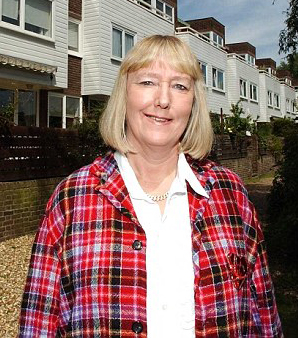
Hilary BonnerThe book actually starts with a prologue which at first glance appears to be nothing to do with Melanie’s death. It is only later – much later – that we learn its true significance. Bonner (right) is determined not to give us a straightforward narrative. The progress of Vogel’s attempts to find Melanie’s killer are sandwiched between accounts from three different men, each of whom is living a life where all is not as it seems.
Saul is socially inept and has reached early middle age without achieving his ambition to become a caring husband and father. His first attempt at marriage had been a disaster, and subsequent efforts to find a life partner have been impeded by his inner sense that his mind harbours demons over which he has little or no control should they choose to wake within him. He settles for internet dating, and heads up his CV as follows:

“My name is Saul and I am a 33 year-old supply teacher. I live in a village near Swindon and I would like to meet a young woman of around my age whose intentions are as serious as mine….. my interests are simple and quiet. I like to read and go to the cinema. If you are out there, please get in touch. I need you.”

Leo is a very different kind of fellow. He spends his leisure time cruising gay bars and clubs in London. He clearly has some kind of day job where ‘coming out’ is not an option. He cultivates the blokeish image when at work, but when he goes to London he adopts a different persona, but one with which he is not entirely at ease.

“I didn’t have the slightest desire to be gay. I didn’t even like the word. I’ve never liked euphemisms and that’s surely what ‘gay’ is. When you called yourself a homosexual it didn’t sound quite so modern and attractive. And what about queer? Is that what I was, queer?

GB

Leo’s misgivings are put to one side, however, when he goes on the prowl. Just as he puts on the skinny Levis, gels his hair, squeezes into a black T shirt that reveals his six-pack and insouciantly slings his studded leather jacket over his shoulder, Leo adopts a different mental mindset from his ‘one of the lads’ image.

While Bonner might coax a sliver of sympathy from us as we read of the personal lives of Saul and Leo, when Al introduces himself it is abundantly clear from the start that he is a wrong ‘un.

“They get what they deserve, these young girls in their skimpy skirts and the little shorts they call hot pants. They’re hot all right. Everything about them is hot. Burning hot.”

Al cruises around the streets of Bristol, usually in a stolen van, ogling schoolgirls, and occasionally trying to bring his sordid fantasies to reality, but without success. Until he discovers a teen dating site on the internet, and he is amazed at the ease with which he can construct a fake profile and attract the attention of a teenage girl whose hormones are racing in the opposite direction to the concerns and limitations her parents seek to impose.

Deadly Dance works very effectively as a police procedural. Vogel is an interesting character, very much left field of his fictional contemporaries, and I anticipate that he will have a long and successful career between the covers of British crime novels. Bonner’s solution to the apparent dislocation between Vogel’s investigation and the lives of Saul, Leo and Al is audacious. To reveal any more would be to give the game away, and no-one will thank me for that. Does it work? I think it does, but you must be the judge. Deadly Dance will be published by Severn House next month, August 2017.


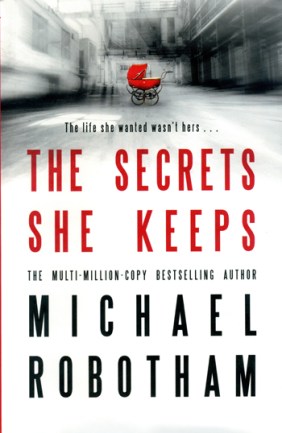
THE SECRETS SHE KEEPS . . . Between the covers

TSSC header

Two women. Two lives. Two worlds. Two pregnancies. Two sets of very different secrets.

Meghan Shaughnessy is a former journalist but now something of a super-mum via her blog about family life. Her husband Jack is an ambitious and confident sports presenter for a television company. They live, comfortably and pleasantly, with their two existing children, in an affluent district beside the River Thames, a district so full of delis, bookshops, fine restaurants and boutiques that the residents, rightfully smug about their little enclave, have added the word ‘Village’ to the perfectly acceptable name by which it has been known since being recorded in The Domesday Book.

Meghan’s third pregnancy is something of an accident but nonetheless welcomed. She has been advised by her obstetrician to have a Caesarian section this time, to avoid the painful tearing she has suffered at the the previous births, but she is anxious to explain this to her thousands of blog readers, as she doesn’t want them to think that she is Too Posh to Push.

Secrets coverAgatha Fyfle works for peanuts in a ‘Village’ supermarket but Mr Patel, her boss, is not the kind of man to be offering generous maternity leave. He is so tight that he once docked her pay for putting the wrong price on a tin of peaches. The father of her baby is far, far away on a Royal Navy ship patrolling the Indian Ocean, chasing Somali pirates. Despite her nothing job and the desperate ordinariness of her life, Agatha has her imagination and her dreams:

“Shrugging on my winter coat, I slip out of the rear door, skirting the rubbish bins and discarded cardboard boxes. Pulling my hood over my head, I imagine I look like Meryl Streep in The French Lieutenant’s Woman. She was a whore abandoned by a French ship’s officer, and she spent her life staring out to sea, waiting for him to return. My sailor is coming home to me and I’m giving him a baby.”

Agatha lives in a shabby flat, and her life would be as grey as a December dawn were it not for one simple blessing:

“I love being pregnant, feeling my baby inside me, stretching, yawning, kicking. It’s like I’m never alone any more. I have someone to keep me company and listen to my stories.”

Agatha ‘knows’ Meghan in the sense that she comes into the shop to buy essentials, but they have never spoken. Agatha also knows that frumpy women stacking shelves are rarely – if ever – noticed by customers, but sometimes, of a morning, she watches wistfully through the window as Meghan takes her children Lucy and Lachlan to their highly regarded schools. Some days Meghan goes off to her yoga group, other days she meets other Yummy Mummies for skinny cappucinos, chai lattes and pots of herbal teas.

Robotham tells his tale through alternate chapters spoken by Agatha and Meghan. The two women are due to give birth at around the same time, and as their due dates come nearer, we learn more and more about their families, their childhoods, their hopes and fears. And their secrets. Ah yes, those secrets. Those mistakes, those misfortunes, those cruelties of Fate, even those occasional acts of mad jealousy collison between which turn lives on their heads, and inseminate the body with an embryonic demon who grows daily stronger and more malevolent until it is time to burst out and cause devastation to both the host and their nearest and dearest.

TSSK middle

Robotham orchestrates a collision between the lives of Agatha and Meghan. The two ships are slowly and inexorably heading towards each other and by the time they realise what is happening, there is no time to turn.

It would be an act of criminal irresponsibility to reveal any more about the plot. Suffice it to say that Robotham boxes very cleverly for several chapters, but then unleashes a series of crunching blows which put our preconceptions on the canvas. To say the plot twists would be an understatement – it spins, but always in a stable way, a little like a gyroscope, dizzyingly fast but always under control.

This is a brilliant example of Domestic Noir. The tension is ratcheted up a notch at a time, and sometimes it becomes almost unbearable. We know what is about to happen but, like Meghan and Agatha, we are powerless to alter the course of events. Readers of Robotham’s Joseph O’Loughlin novels will not be surprised at the psychological intensity in The Secrets She Keeps. Readers new to the author need to be prepared for an uncomfortable few hours.

We reviewed Close Your Eyes, a novel featuring Robotham’s forensic psychologist O’Loughlin, a little earlier and you can check buying choices for The Secrets She Keeps by clicking this link.

TSSC footer

THE ORPHANS … between the covers


Orphans031

A beach in Goa, 1992. A boy and a girl, a brother and his older sister, are amusing themselves at the water’s edge. Their parents, unconventional, more in love with their own escapist lifestyle than they are with their children, are nearby. But then they aren’t nearby. They are gone. What happens next is a blur of childlike confusion, incomprehension and false memory. But Jess and Ro are now orphans.

The years pass. The remains of the children’s father are eventually discovered in the jungle not far from the beach, but of their mother, Sophie, not a trace. Well meaning but reluctantly relatives have cared for and schooled Jess and Ro until they pass from their scarred childhood into the uncertainty of adulthood. Jess, though has made a success of her life. She is a successful commercial lawyer, has a treasured daughter with husband Charlie, and she lives in a delightful house just on the edge of Clapham Common in south London.

But little brother Ro – short for his nickname, Sparrow – has fared poorly. His school days were troubled and tormented, and he has carried the trauma of that hazy day on a tropical beach like a monster clinging to his back. He has led a largely nomadic life and, like the obsessed Captain Ahab, he travels the world in search of his lost mother. His most recent attempt to track her down leads him to a hamlet in rural Ireland where Sophie Considine was known. This particular trip ends badly, however, and he makes his way to England.

Annemarie-NearyAnnemarie Neary gives us a chilling sense of separate events which are not fatal in themselves but deadly when they collide, and while Ro is making his way to Clapham, the normally self-assured Jess is in trouble at work. She has rejected the advances of a senior partner at an office social, and he uses the rebuff to light a fire under Jess’s professional life.
Ro arrives at his sister’s home and Neary skilfully describes how the young man’s near-autism and utter self-obsession starts to undermine the household. Charlie already holds Ro in contempt after previous clashes but the live-in au pair, a balefully unpleasant young Brazilian woman called Hana, is the final ingredient in a the shaking up of a poisonous cocktail of guilt, lust and fractured relationships.

Sensing that he has at last found gold at the end of his rainbow, Ro projects his fixation on Maya, the wife of an old family friend, Eddie. The fact that Eddie was part of the loose community of beach bums in Goa convinces Ro that Maya – complete with a tell-tale scar where a tattoo has been removed – is his mother.

Neary has a silken touch and she spins a web of potential tragedy that is gossamer light, shot through with poetry, but one that will draw you, the reader, into its folds and not let you escape. Here, she describes Ro’s conviction that his lonely quest is over.

“And as he passes under the great avenue of chestnuts, his heart rises like freshly baked bread and he imagines himself a stork, not a swallow. If he were a stork, with a sash in his beak, this is where he would take his mother. He would carry her up into the high branches, make a nest there for her. He would keep her safe from predators, out of the reach of the grubby little world.”

The book succeeds on every level: it is near perfect as a tragedy in that it has the three Aristotelian demands of drama – the unities of time, place and action. Like the tragic figures of Hardy and Shakespeare the doomed protagonist is not totally devoid of human decency, and this makes their downfall ever more bitter because we onlookers can see that it is preventable. The Orphans is a tale as dark as ebony, and as convincing a description of a descent into madness as I have ever read. It is published by Hutchinson and will be available in July as hardback, paperback and Kindle.

Orphans footer

THE KILLER ON THE WALL … Between the covers

DescriptionVB21980382

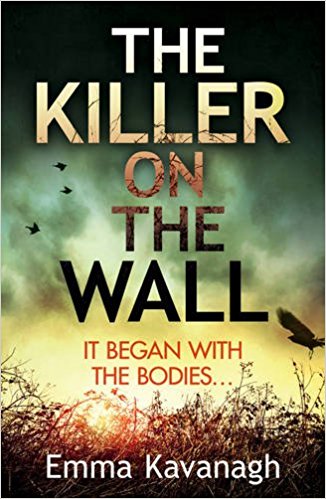
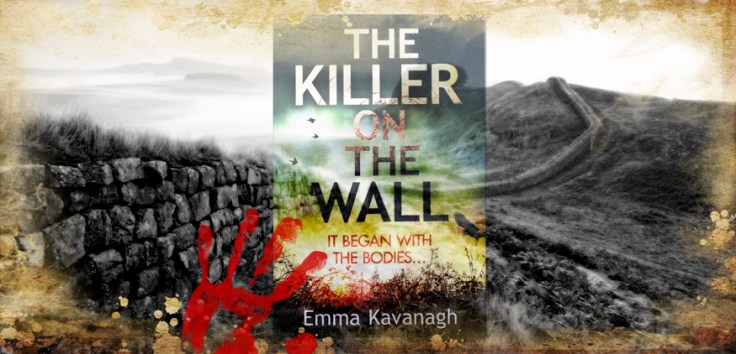
There are towns and villages the world over which in themselves are insignificant in the greater scheme of things, but whose names are indelibly imprinted on the public consciousness for the evil deeds committed there. My Lai, Sandy Hook, Columbine, Dunblane, Hungerford: the names resonate, and cause us to shudder. In the latest novel from Emma Kavanagh, Briganton is such a place. It is a village otherwise little worthy of note, with nothing to detain either the traveller or the tourist save, perhaps, for its proximity to the remains of the winding wall built to protect the northern limits of Roman Britain from so-called Celtic barbarians.

TKOTWThe name Briganton, to most British people, conjures up a series of murders, where the victims were dragged up the steep hillside and posed, in death, gazing with sightless eyes out over the windswept moorland. But all that was long ago. The killer, Heath McGowan, was brought to justice by the determination of Eric Bell, a local policeman who has since been promoted and has achieved national celebrity due to his solving the case. His triumph had added poignancy because it was his teenage daughter, Isla, who discovered the first bodies while out for an early morning run.

Twenty years have past, and now Isla Bell is Professor of Criminal Psychology at the University of Northumberland. Her husband, Ramsey Aiken was one of the original victims of The Killer On The Wall, but he survived his injuries, and is now a freelance journalist, while her father, Superintendent Eric Bell has become something of a police legend.

Isla is working on a project to identify physical differences between the brains of serial killers and normal people, and her work takes her to the prison where Heath McGowan is serving several life sentences for his murderous activities in and around Briganton. As she persuades him to undergo an MRI scan, she tries to persuade him to talk about the killings, but he treats it as a game, and refuses to divulge any useful information.

Then, the unthinkable – even the impossible – happens. In quick succession, two more local women are murdered and take the places of the long-dead bodies propped up against the limestone blocks of Hadrian’s Wall. Clearly, McGowan is not the killer, but does he have an imitator? An accomplice, maybe, who was never caught decades earlier? A young Detective Constable, Mina Arian, has made her home in Briganton and she becomes obsessed with finding – or disproving – links between the original killings and the new murders.

Emma Kavanagh has a doctorate in psychology, and her understanding both of what we know – and what we don’t know – about the workings of the human mind give this novel a very distinct and disturbing potency. Her academic credentials aside, she is a very gifted writer. As far as the plot is concerned she gives us a trawl net full of red herrings to sift through, and her vivid characterisations, particularly of Mina Arian, Eric Bell and Isla Aiken, give the narrative an electric charge.

This is a guided missile of a book: it explodes into life, and then keeps burning, inexorably homing in on a target which you will only foresee by cheating and flipping through to the last few pages. When it comes, the detonation is as devastating as it is unforeseen. Only the very best writers have the daring and dexterity to deliver such a plot twist and make it as credible as it is shocking, and Emma Kavanagh must be a founder member of that exclusive club.

You can read our review of The Missing Hours, an earlier novel by Emma Kavanagh, and she also wrote a very perceptive feature on Trauma. The Killer On The Wall is out now.

Killer footer


Blog at WordPress.com.

Up ↑