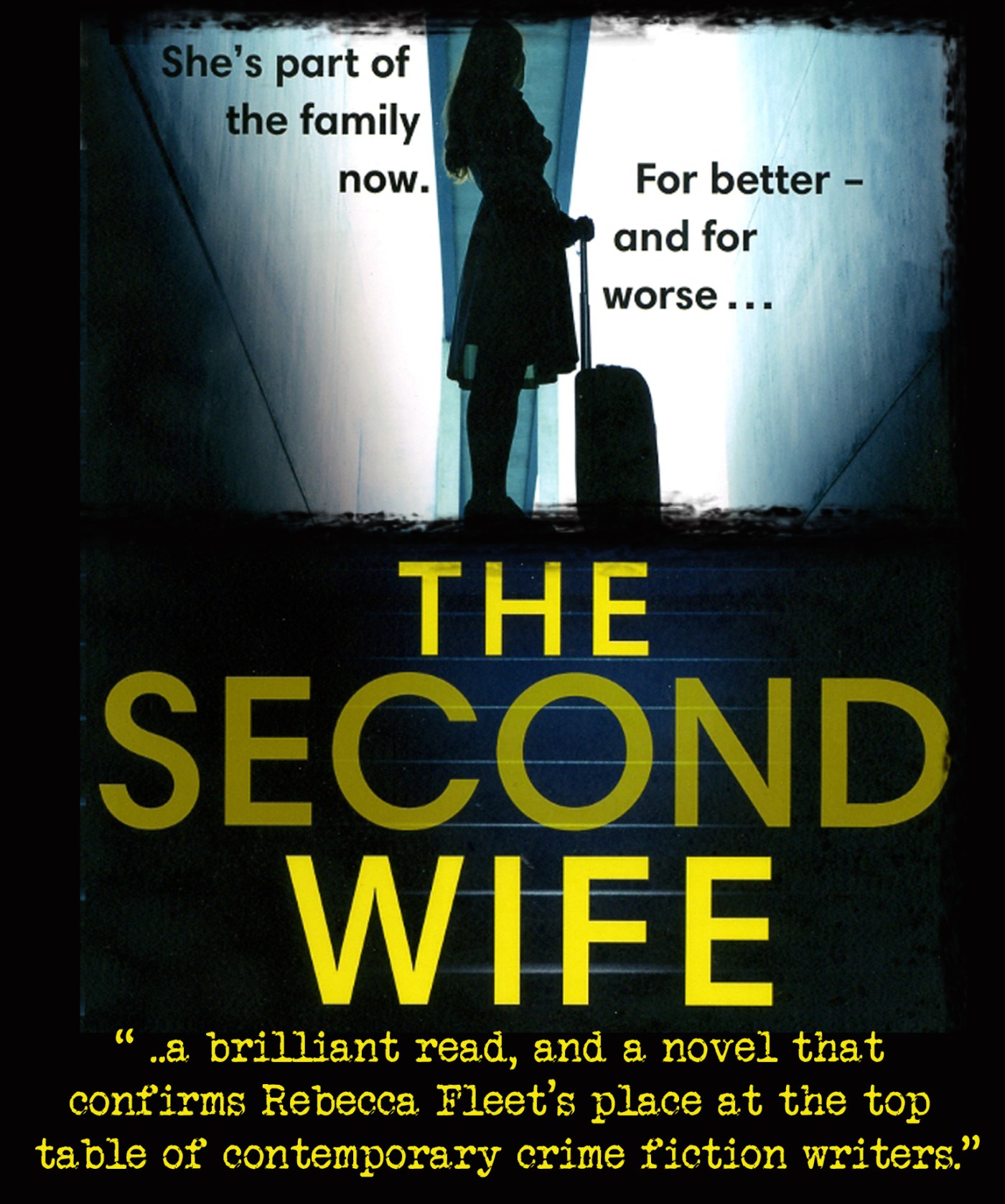

The Second Wife is Rebecca Fleet’s second novel. Her first, The House Swap, was well received and now she takes her skill at writing engaging domestic thrillers to the next stage. I will say at the outset that as much as I was gripped by The Second Wife, I was cursing quietly to myself because it contains a seismic plot shift towards the end which completely demolishes every assumption the reader may have made about what is going on, based on what he or she has been told by the different narrators. But why the curses? Simply because it makes a summary doubly difficult, because no reviewer wants to be known as the person who gave the game away. I loved the book, however, and I want you to love it too, so here goes – treading on eggshells.
 There are three narrative viewpoints; centrally, there is Alex. He is a widower with a teenage daughter, Jade. He works in an advertising agency in Brighton, on England’s south coast. His first wife died from cancer when Jade was just a little girl, but he has remarried. The titular second wife Natalie is one of the storytellers, and she does her best to be a decent ‘second mum’ to Jade, although hormones have started to kick in and Jade is, like every modern teenage girl, obsessed with her social media profile and perceived slights from her step mum.
The novel begins with a serious fire in Alex’s house. Natalie, overcome by the smoke and flames, has been unable to rescue Jade, but the emergency services arrive in time to bring the teenager to safety. Temporarily relocated to a hotel, Alex and Natalie take turns at Jade’s hospital bedside as she slowly recovers from the ordeal. As Jade comes back to life, Alex is both puzzled and horrified at his daughter’s insistence that there was a strange man in the house at the time of the fire. Now, Alex’s disquiet turns to genuine alarm, and Natalie admits to him that she has a disturbing back-story.
 Her estranged sister, Sadie, has led a wayward and self-destructive existence which has forced Natalie to put some distance between herself and her sister, and reinvent herself using a different identity. Sadie’s obsession with a violent criminal has gone disastrously wrong, and Natalie is trying to lead a new life. By this time, Fleet (right) has given Sadie a voice of her own, and we listen to the musings of a sexually promiscuous young woman who has used men like Kleenex, and has a moral compass that barely makes the needle flicker beyond zero on the scale. But she has fallen under the spell of Kaspar, a London club owner who uses women in the same way that Sadie has come to use her queue of suitors.
So, we have the three viewpoints. Timewise, they span almost a decade. All I can say is that one of them – and you have to choose – is telling the mother of all lies. The Second Wife is anxiety-on-a-stick and, although the plot twist left me wondering who on earth I could rely on to tell me the truth, this was a brilliant read, and a novel that confirms Rebecca Fleet’s place at the top table of contemporary crime fiction writers. The Second Wife is published by Doubleday and is out today, 5th March.
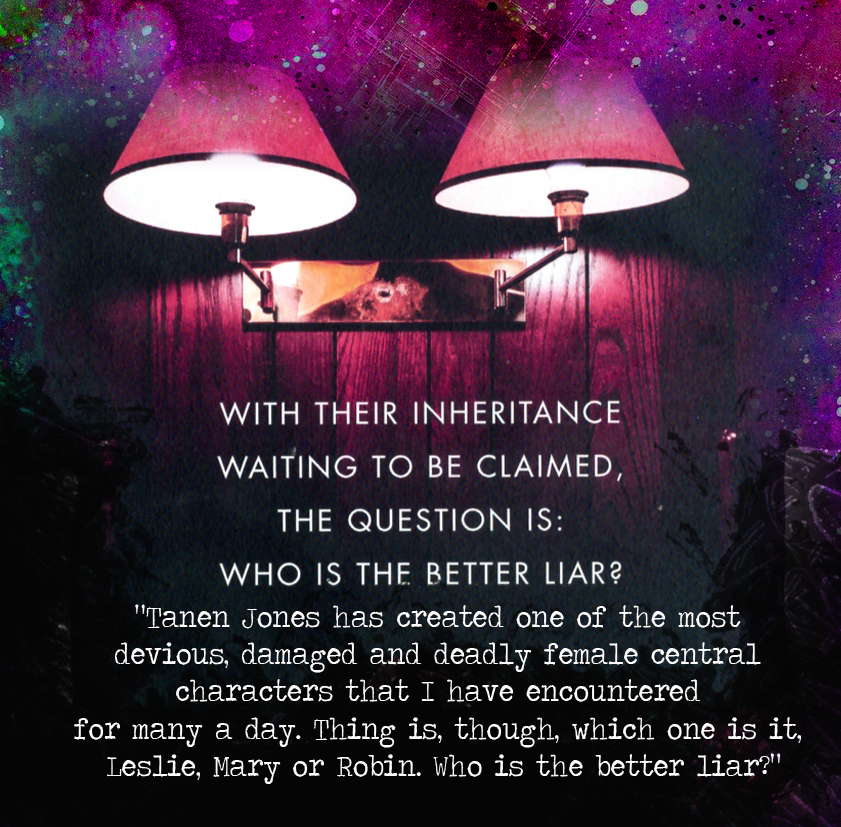

 When their father dies after a long illness, Leslie sets out to find Robin and eventually tracks her down to a seedy apartment block in Las Vegas.One slight problem. Robin is face down on the bed in the cockroach infested room, dead of a drug overdose.
 Alert readers may well figure out what is actually going on well before we get the big reveal, but even if you do, it won’t spoil the enjoyment. Tanen Jones (right) takes a wry look at modern obsessions, including a single mom who earns a living for herself and two little boys by posting stuff on Instagram, the debilitating half life lived by relative strangers messaging each other on social media, and the grim reality of women hooked into relationships with parasitic and abusive men.

 aomi is a feature writer of some sort, while Charlie is an entrepreneur designer in the tech industry. While a succession of sharp-intake-of-breath builders and carpenters transform the neglected house into a Sunday supplement paradise, Naomi is desperate to conceive a second child. Naturally, both she and Charlie have smartphone apps which track her fertility cycle and give the couple vital windows when hurried coupling should produce little Prue’s sibling. Sadly, none of the digital wizardry seems to work. Charlie is all-too-often not up-to-snuff, and Naomi’s obsessive quest is becoming counter productive.
 While on her daily run there and back to Prue’s nursery school, Naomi meets a stunningly attractive alpha male called Sean, and his bluff insouciance is such a contrast with Charlie’s needy self-absorption that she is smitten. One thing leads to another – the ‘another’ being hurried stand-up sex in the shower cubicle at a local leisure centre – and guess what? Sean’s urgent thirty seconds has done the job, and Naomi is, at last, pregnant, but possibly by the wrong man.
 acDonald doesn’t set out to make us laugh with obvious satire, but he has fun casting a jaundiced eye on Naomi’s preoccupations. She is at a rather pretentious playgroup called ‘Sing, Sign and Movement.’
 Any sense of lifestyle mockery, gentle or otherwise, dissipates once we reach the final quarter of the book. Naomi discovers that whoever Sean really is, his plans for her and her family involve much than a few moments of lust. I certainly didn’t see the plot twist coming, and MacDonald (right) springs one surprise after another, right up to the final paragraphs. If you can’t make sense of the brief chapter interludes which consist of MSN messages (remember them?) between some bitchy schoolgirls, don’t fret – you will.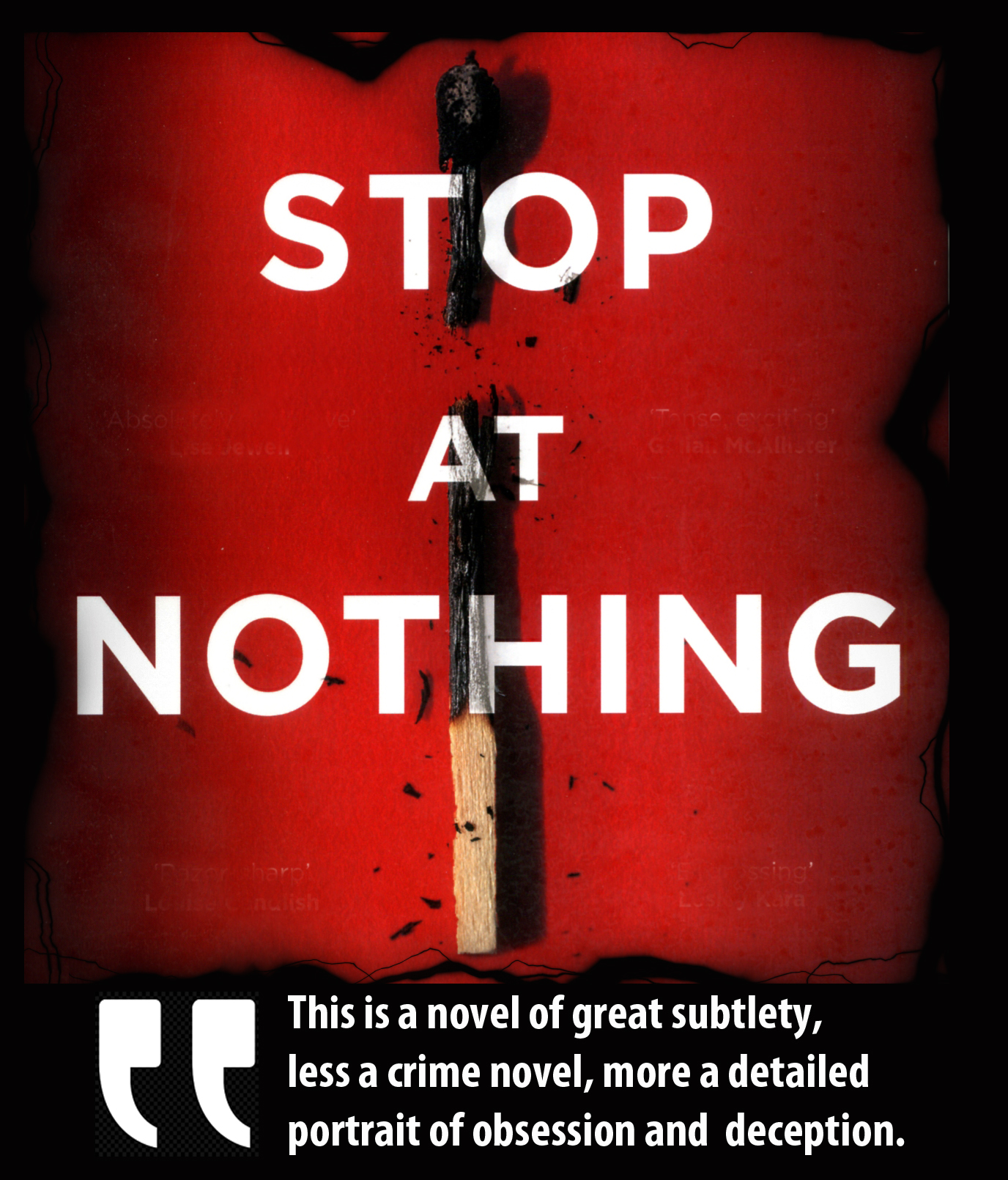

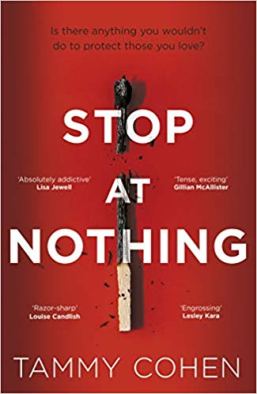 Poor Tessa is a mess, actually. Struggling to cope with the physical and psychological effects of the menopause and her self-esteem battered by redundancy, she is prey to all manner of fancies, midnight imaginings and “the thousand natural shocks that flesh is heir to.” Much of Stop At Nothing is pure anxiety porn, as Tessa makes bad judgment after bad judgment, wrong call after wrong call. Readers will see the picture – at least part of it – way, way before she does, and in places the narrative reminded me of the frequent moments in Hammer horror films where the heroine (usually scantily clad) insists on going down into the cellar clutching only a flickering candle. We want to grab Tessa by the arm and say. “Do. Not. Do. This!”
 Personally, I warmed to Tessa – and her unfailing knack of getting things wrong – much more when her relationship with her elderly parents moved to centre stage. The tragedy of dementia is a natural cruelty that makes even the most devout religious person want to howl with rage at the heavens, and Tammy Cohen (right) handles this poignant mix of frustration and fury with a deft touch.
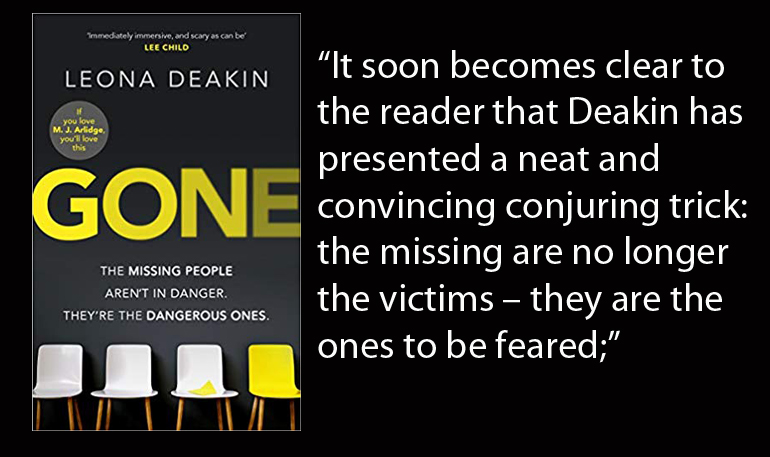

 Jameson’s sister Claire has, for some time, fulfilled a mixed role of aunt, mother and babysitter to a teenage girl called Jane. Jane’s mother Lana, is a single mum, loving but chaotic, perhaps suffering from PTSD after several tours in conflict zones when she was a soldier in the army. Now she has disappeared, leaving Jane with no money for food or rent. Knowing of her mum’s fragile mental state. Jane was not initially alarmed, but when she began to investigate, after receiving no help from the police, she made several disturbing discoveries.
Lana disappeared on her birthday. Immediately before her disappearance she had received a mysterious card inviting her to play a game. The beautifully presented card bore the words, elegantly embossed in silver on cream:
Jameson’s sister Claire has, for some time, fulfilled a mixed role of aunt, mother and babysitter to a teenage girl called Jane. Jane’s mother Lana, is a single mum, loving but chaotic, perhaps suffering from PTSD after several tours in conflict zones when she was a soldier in the army. Now she has disappeared, leaving Jane with no money for food or rent. Knowing of her mum’s fragile mental state. Jane was not initially alarmed, but when she began to investigate, after receiving no help from the police, she made several disturbing discoveries.
Lana disappeared on her birthday. Immediately before her disappearance she had received a mysterious card inviting her to play a game. The beautifully presented card bore the words, elegantly embossed in silver on cream: Leona Deakin’s own experience and training in psychology gives this novel a framework of authenticity to which the more fanciful parts of the narrative can cling. It soon becomes clear to the reader that Deakin has presented a neat and convincing conjuring trick: the missing are no longer the victims – they are the ones to be feared; those left behind have become the prey.
The relationship between Bloom and Jameson is intriguing. It reminded me of the unresolved tension and undeclared love between Val McDermid’s doomed lovers Tony Hill and Carol Jordan. We are left to decide for ourselves what Augusta Bloom looks like; Deakin (right) suggests that she might be rather dowdy, an academic in flat shoes. She is certainly razor sharp mentally, however, and she plays a devastating human chess game with the organisation behind the birthday card disappearances.
Leona Deakin’s own experience and training in psychology gives this novel a framework of authenticity to which the more fanciful parts of the narrative can cling. It soon becomes clear to the reader that Deakin has presented a neat and convincing conjuring trick: the missing are no longer the victims – they are the ones to be feared; those left behind have become the prey.
The relationship between Bloom and Jameson is intriguing. It reminded me of the unresolved tension and undeclared love between Val McDermid’s doomed lovers Tony Hill and Carol Jordan. We are left to decide for ourselves what Augusta Bloom looks like; Deakin (right) suggests that she might be rather dowdy, an academic in flat shoes. She is certainly razor sharp mentally, however, and she plays a devastating human chess game with the organisation behind the birthday card disappearances.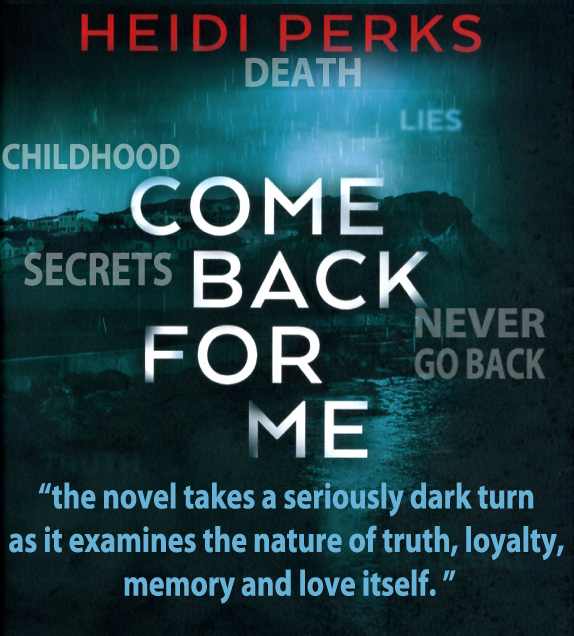
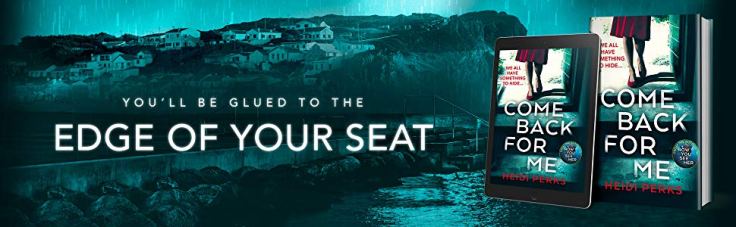
 On a tiny island off the Dorset coast of southern England, a little girl lives a dream childhood. Loving parents, the beauty of the sea and the sky, and the cloudless blue optimism of the young. But then, one terrible night, Stella Harvey’s idyll is shattered. On a September evening, with a violent storm lashing the tiny harbour of Evergreen Island, David Harvey ushers his family on board the ferry he runs for a living, and takes them away to the mainland. For ever.
 ears have flown by. Stella is now a consulting psychotherapist. Sister Bonnie is married with children. Their mother, Maria, is long dead, killed in a road accident. Father David, having left Maria for another woman, is now in the throes of dementia.
 nevitably, as night follows day, Stella’s arrival on Evergreen is not a joyful homecoming, and several skeletons come dancing and rattling their bones out of the cupboard to which time has consigned them. Firstly, Stella learns the tragic reason why her best friend and sworn blood-sister never replied to any of the letters she sent when the Harvey family began their new life on the mainland. Then, with the cruel perceptiveness of adulthood stripping away the illusions of youth, Stella looks on with horror as, first, the grisly remains are identified and personalised and then, second, questions from the past, smothered by time for so long, leap out into the present and demand answers.
 When Stella’s long-since-estranged brother, Danny, is drawn into what has become a murder investigation, the novel takes a seriously dark turn as it examines the nature of truth, loyalty, memory and love itself. Heidi Perks (right) has written a novel which will entrance readers who like a good psychological thriller, and she leaves us with a sense of sadness, certainly, but also an affirmation that, in the words of St Paul:


 his is not a conventional crime novel. There are victims, for sure, and perpetrators of terrible acts which still, when described, take the breath away in their depravity and cold, organised manifestation of evil. English academic Martin Goodman (right)
  has written a starkly brilliant account of Nazi oppression in Central Europe in the late 1930s. He achieves his broad sweep by, paradoxically focusing on the fine detail. One family. One teenage boy, Otto Schalmek. One fateful knock on the door while Vienna and most of Austria are waving flags to welcome ‘liberation’ in the shape of the Anschluss.
 The Schalmek family are Jewish. That is all that needs to be said. The family becomes just a few lines on a ledger – immaculately kept – which records the ‘resettlement’ of Jewish families. Otto is taken to Dachau and then to Birkenau. His ability as a cellist precedes him, and he is sent to play in the house of Birchendorf, the camp Commandant. His wife Katja is the artistic one, and her husband merely seeks to keep her entertained by using Schalmek as a kind of performing monkey who plays Bach suites on the cello in between sanding floors and mopping up shit in the latrines.
 oodman’s book spans the years and the continents. Having been shown the shattering of the Schalmek family we go from the Nuremburg trials to late 1940s Canada and then, via Sydney in the 1960s, on to 1990s California, where Katja’s grand-daughter Rosa, an eminent writer and musicologist, seeks an audience with the elusive and very private genius Otto Schalmek. Rosa Cline is determined to write the definitive biography of Otto Schalmek, but their relationship takes an unexpected turn.
 is a distinctive and beautifully written novel, full of irony, heartbreak and a scholarly brilliance in the way it portrays the human devastation of Hitler’s assault on the Jews. Yes, there is the almost obligatory account of the depravity and sheer horror of the camps, but Goodman also brings a sense of great intimacy and a telling focus on the small personal tragedies and discomforts – an interrupted family meal, a tearful and hurried “goodbye”, and a new grandchild never to be cuddled by grandparents. Crime fiction? Probably not, in the scheme of things. Thrilling, often painful, and full of psychological insight? Certainly. J SS Bach is published by

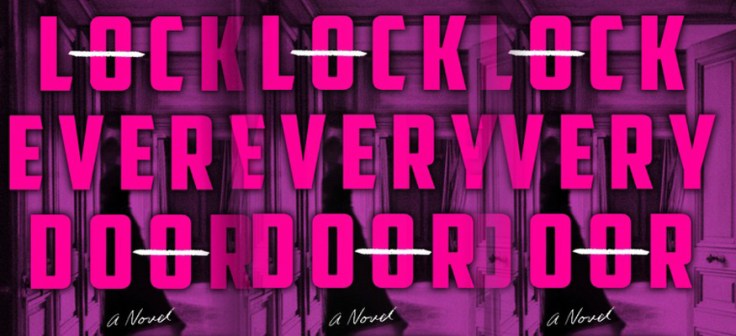
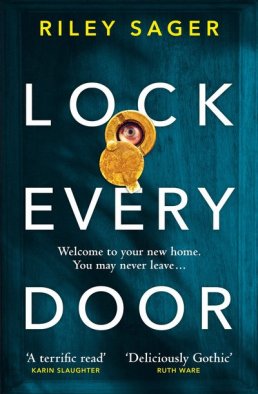 It could be said that fate has not treated Jules Larsen with kindness. Her family disintegrated. Sister Jane mysteriously went missing one night, last seen getting into a black VW Beetle, but never to be seen again. Her mother, literally crippled with cancer and her father, metaphorically so but by unpayable medical bills, perished in a disastrous fire. Jules paid her way through college and graduated with a qualification that secured her a non-job as a gopher and photocopying skivvy in an anonymous New York office. When they decided to ‘rationalise their human resources’ her job was one of the first to go. Ah well, at least Jules had her relationship with sweet, goofy, sexy Andrew, and their shared apartment. Until she came home one time and found lovely Andrew between the legs of some random girl. Andrew is the keyholder, and so adding homelessness to emotional injury, it’s Jules who has to go.
 ules ends up sleeping on the couch of her best college friend, Chloe. Down, definitely, and almost out. Until her daily scan of the situations vacant notices gives her a faint sniff of hope. Someone wants an apartment sitter. It’s not just any old apartment, though. The apartment is in one of New York’s most celebrated buildings – The Bartholomew. Neither as celebrated nor as notorious as The Dakota, The Bartholomew shares spectacular views over Central Park, is built with the same attention to German Gothic details, and is regarded with awe by passers-by as they gaze up at its pediments and gargoyles.
 This is a very clever thriller. Riley Sager (right), as he did in his previous novel
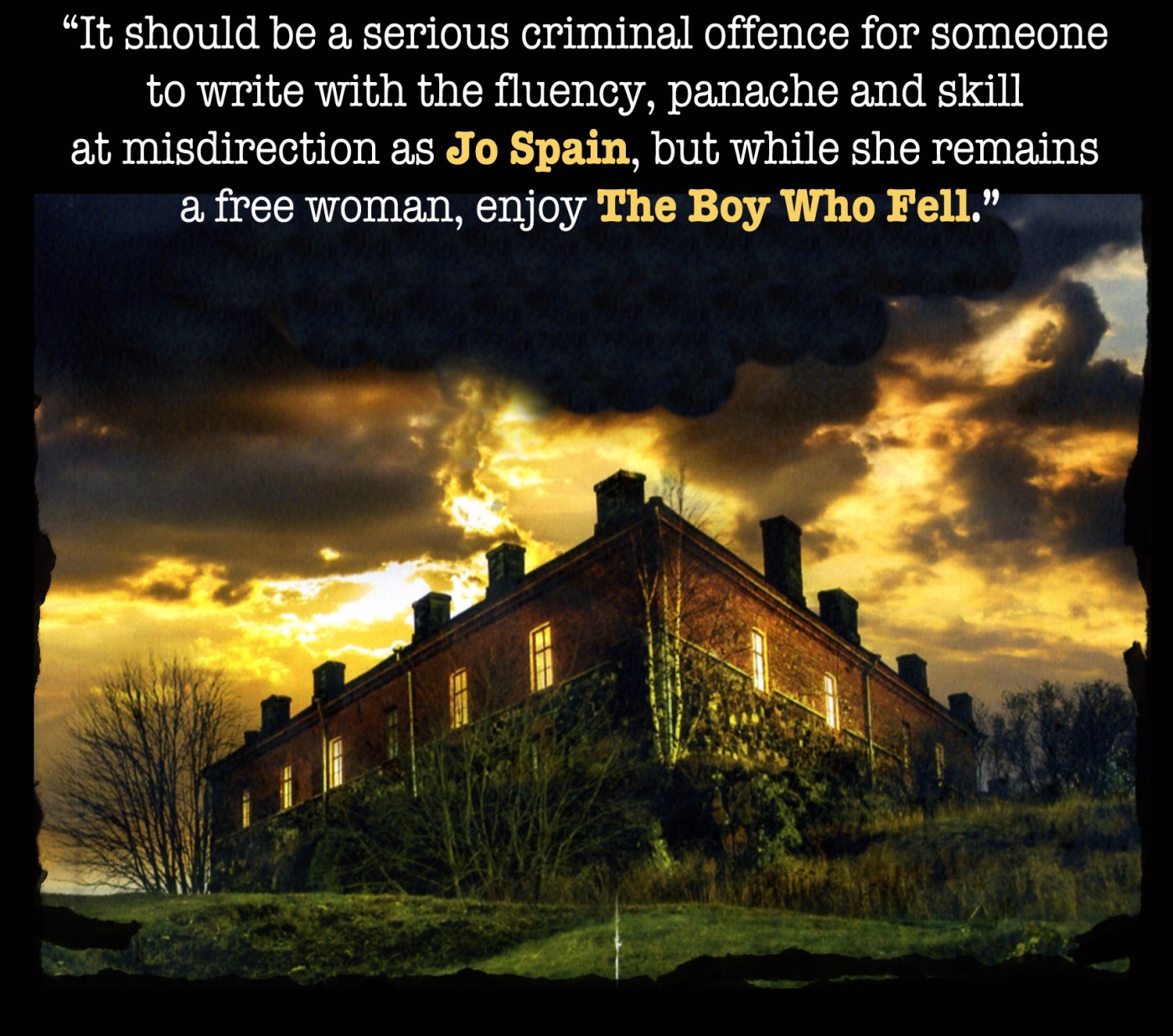

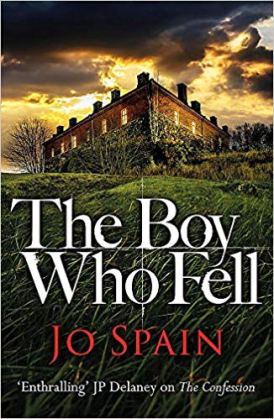 This is a chillingly clever whodunnit shot through with a caustic examination of life among the moneyed classes of contemporary Ireland, particularly Dublin’s nouveau riche and their over-indulged teenage children. Fans of Jo Spain’s DI Tom Reynolds will be overjoyed to see him return for his fifth case, and those who know the author only through her spellbinding standalone novels such as
  aniel is related to one of Tom Reynolds’ most respected officers, and when she asks him to take a look at the case, he reluctantly agrees. There are just one or two complications, though. First, Daniel is refusing to say anything – not a word – to investigating officers or his lawyer. Then, Reynolds becomes aware that Daniel is gay, and that, despite protestations from parents and friends, it appears that Danny and Luke were “an item.” Thirdly, the grief of Luke’s parents at his death has to run alongside the tragic demise of Luke’s twin brother Ethan, who is near death in a local hospice.
 Jo Spain is the literary Diva of Deviousness, and while we learn early in the piece that Glenmore House has a bloody history, she waits for some while before reconnecting the earlier slaughter with the death of Luke Connolly. When she does – and Reynolds realises the connection a paragraph or three before we do – the investigation takes on a whole new slant.


 fullybooked2017