

 After I had read Death In Profile, and saw that it was billed as the first of an intended series, I did softly uttered something akin to “hmmmm…?”, quietly questioning if there was any room in the crowded contemporary crime fiction market for books which unashamedly borrowed tropes and mannerisms from books written seventy years ago. I have just finished A Death In The Night, the fourth in the series, and I am now a true believer, and devoted disciple. Guy Fraser-Sampson (left) has created a delightful repertory company of characters, and set them to work catching killers in the highly exclusive avenues and cul de sacs of London’s Hampstead.
Principally, we have a quartet of investigators. Chief Superintendent Simon Collison, Inspector Bob Metcalfe and Sergeant Karen Willis all work for the Metropolitan Police, while Dr Peter Collins is a psychologist and criminal profiler who acts as consultant to the Hampstead coppers. In the first three books, Metcalfe and Collins are jointly suitors of the radiant and ravishing Willis. This strange ménage à trois has now resolved itself, however; Collins has Willis to himself, and Metcalfe has a new object of his passion. (To read our review of an earlier book in the series, A Whiff of Cyanide, just click the link)

Naturally enough, this being a murder mystery, the examining pathologist discovers not only that Bowen was murdered by smothering, but she was also three months pregnant. Further investigations by Collison and colleagues uncover that Bowen was in a relationship – along with countless other bedazzled women – with a libidinous and charismatic QC, Simon Fuller. It seems that he and his wife have come to ‘an arrangement’. Mrs F has neither interest nor ability in the sexual side of marriage, so she is quite content to let Mr F seek his pleasures where he will, provided that he remains her husband, in a strictly social sense.

As Collison and Co. scrape away at the wall of lies and deflection which surrounds the truth about Bowen’s murder, they get the distinct feeling that as fast as they chip and chisel, someone else is busy repairing and replacing the brickwork. Of course, the killer is revealed in the end, but not before Fraser-Sampson puts his company through their paces. Collison is educated, urbane and thoroughly professional. Metcalfe is dogged, decent and determined. Willis belongs on the cover of Vogue, but is also blindingly intelligent, and a damn good copper. Collins? Well, he is an exercise in eccentricity. He is possessed of a mind which can think three or four steps ahead of less gifted people, but he does have his little moments. Such as when, in times of great stress, he imagines that he is Lord Peter Wimsey, and that Karen Willis is his Harriet Vane.
To borrow and adapt from Matthew chapter 7, verse 20, “Therefore by their tea-times ye shall know them..”, we are not surprised that Peter Collins serves up Earl Grey to accompany anchovy toast: we would expect nothing less of him. Without extending the metaphor too much beyond its breaking point, I can say that Fraser-Sampson’s writing is – just like Dr Peter’s four o’clock fare – elegantly presented, fragrant, but with a salty piquancy to add balance. I have become a great admirer of the Hampstead Murders series. They may be making a reverential nod in the direction of Christie, Sayers and Allingham et al, but they are beautifully written, cleverly plotted and, above all, superbly entertaining. After all, isn’t that why we open crime fiction books in the first place?
You can buy A Death In The Night here, but if you fancy a freebie, simply click on the image below, and that will take you to our competition page.

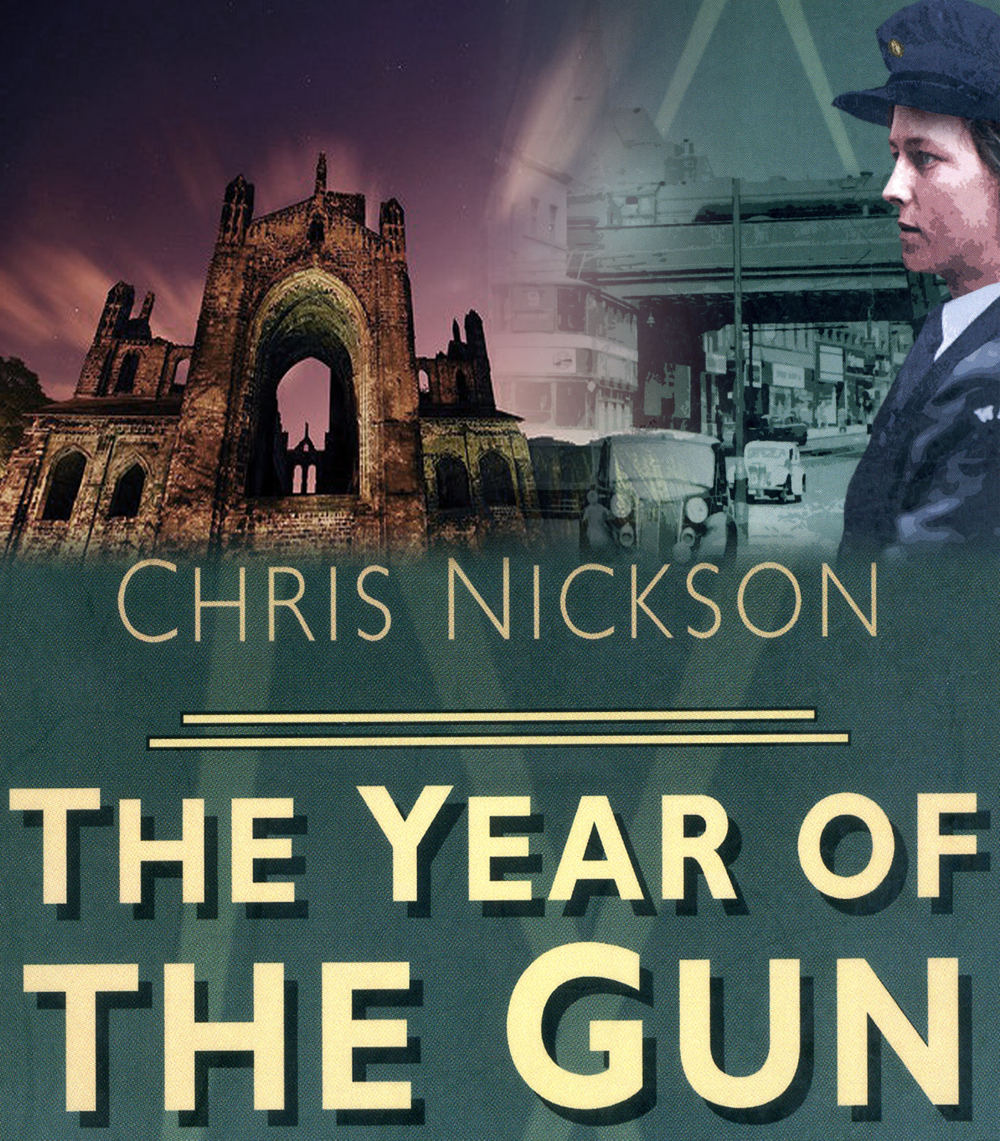
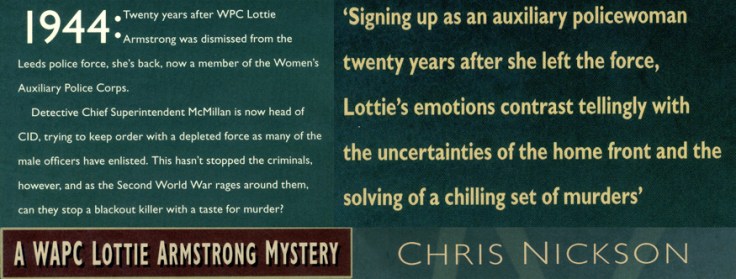
 So, Lottie is back in uniform again, but this time as a lowly member of the Women’s Auxiliary Police Corps. Her main job is to drive her boss, Detective Superintendent McMillan, to wherever he needs to go. McMillan, a veteran of The Great War, certainly needs his transport as a killer seems to be stalking vulnerable young women across the city. Kate Patterson, a Private in The Auxiliary Territorial Service (ATS) is found dead in the sombre ruins of the medieval Kirkstall Abbey. She is the first victim, but others follow, and Lottie and McMillan are soon convinced that the killer is a member of the American forces based in the city.
 You will note the date – spring 1944 – and will not need a degree in military history to work out what those ‘vital operations’ might be. Invasion or no invasion, McMillan still has a job to do, and the murderer is eventually cornered. Don’t anticipate a comfortable outcome, however. Nickson (right) doesn’t do cosy, and the conclusion of this fine novel is as dark as a blacked out city street.

 When the battered body of teenager Melanie Cooke is found amid the garbage bins in a seedy Bristol alleyway, it is obvious that she has been murdered. Only fourteen, she is dressed in the kind of clothes which would be considered provocative on a woman twice her age. Vogel goes to make the dreaded ‘death call’, but he only has to appear on the doorstep of the girl’s home for her mother and father to sense the worst. Like many rebellious teenagers before her, Melanie has told her parents that she is going round to a mate’s house to do some homework. When she failed to come home, their first ‘phone call confirmed Melanie’s lie, and thereafter, the long dark hours of the night are spent in increasing anxiety and then terror, as they realise that something awful has happened.
 The book actually starts with a prologue which at first glance appears to be nothing to do with Melanie’s death. It is only later – much later – that we learn its true significance. Bonner (right) is determined not to give us a straightforward narrative. The progress of Vogel’s attempts to find Melanie’s killer are sandwiched between accounts from three different men, each of whom is living a life where all is not as it seems.


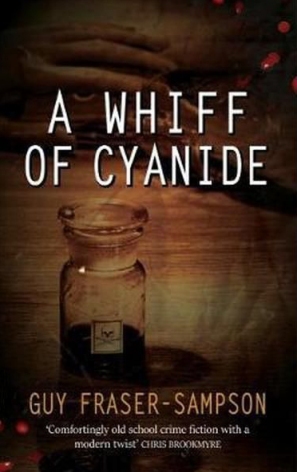 Readers of the two previous books in the Hampstead Murders series, Death In Profile and Miss Christie Regrets, will know what to expect, but for readers new to the novels here is a Bluffers’ Guide. The stories are set in modern day Hampstead, a very select and expensive district of London. The police officers involved are, principally, Detective Superintendent Simon Collison, a civilised and gentlemanly type who, despite his charm and urbanity, is reluctant to climb the promotion ladder which is presented to him. Detective Sergeant Karen Willis is, likewise, of finishing school material, but also a very good copper with – as we are often reminded – legs to die for. She is in love, but not exclusively, with Detective Inspector Bob Metcalfe, a decent sort with a heart of gold. If he were operating back in the Bulldog Drummond era he would certainly have a lantern jaw and blue eyes that could be steely, or twinkle with kindness as circumstances dictate.


 Now, Thorne becomes involved in another kind of hell on earth, and one where all absent devils have been called home, all leave cancelled, and any recently retired fallen angels pressed back into duty. The fires stoked in this particular hellish pit illuminate the ghastly world inhabited by some British Asian communities who sanction murder in the name of their warped concept of family honour. Among the ghosts which inhabit the darker parts of Thorne’s memory is that of Meena Athwal. She was killed, he is certain, at the behest of her family, but her death remains unavenged in a court of justice.
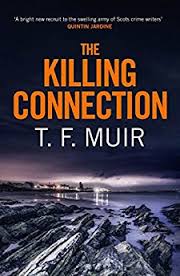

 The woman is eventually identified as Alice Hickson, a journalist, and the woman who provided the ID, a literary editor called Manikandan Lal, is flying home from holiday to give further background to her friend’s disappearance and death. ‘Kandi’ Lal fails to make her appointment with Gilchrist, however, and soon the police team realise that they may be hunting for a second victim of whoever killed Alice Hickson. Gilchrist’s partner, DS Jessie Janes has problems of own, which are become nagging distractions from her professional duties. As if it were not bad enough to learn that her junkie mother has been murdered by a family member, Jessie is faced with the heartbreaking task of explaining to her son that an operation to correct his deafness has been cancelled permanently.
 Detective Inspector characters have become a staple in British crime fiction, mainly because their position gives them a complete overview of what is usually a murder case, while also allowing them to “get their hands dirty” and provide us readers with action and excitement. So, the concept has become a genre within a genre, and there must be enough fictional DCIs and DIs to fill a conference hall. This said, the stories still need to be written well, and Frank Muir (right) has real pedigree. This latest book will disappoint neither Andy Gilchrist’s growing army of fans nor someone for whom reading The Killing Connection is by way of an introduction.


 Thrill Kill is a brisk, no-nonsense police procedural thriller set amidst the hurley burley of Carnival season in New Orleans. Homicide cop Quentin ‘Q’ Archer sets out to bring to justice a serial killer whose calling card is a can of aerosol coolant – tradename ‘Chill’ – beside the bodies of his victims. Archer burns the midnight oil to solve the crime, but it is not the only thing on his mind. He is not a native of The Big Easy, but a displaced person from Detroit, where his police career became violently complex when his wife was mown down by a car, and Archer was forced to turn against his own family in a personal war against police corruption, drugs and racketeering.
 Don Bruns himself (right) is an interesting character. As well as the first book in the Quentin Archer series Casting Bones, he has written two other series, Caribbean and Stuff. He describes himself as “a musician, song writer, advertising guru, painter, cook, stand-up comic and novelist who has no idea what he wants to be when he grows up.” His music is mainstream country, but with a little twist of this and that to spice things up. You can hear

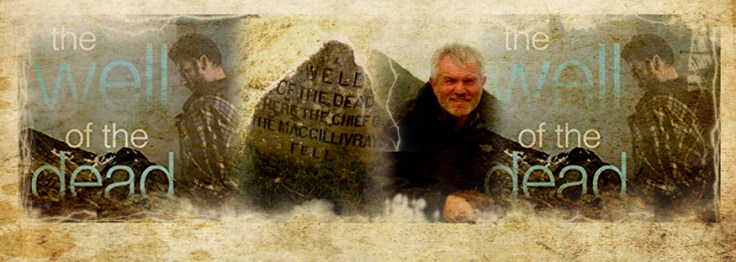
 In the icy Scottish dawn of 16th April 1746, the last battle to be fought on British soil was just hours away. The soldiers of the Hanoverian army of William Duke of Cumberland were shaking off their brandy-befuddled sleep, caused by extra rations to celebrate the Duke’s birthday. Just a mile or two distant, the massed ranks of the Scottish clans loyal to Charles Edward Stuart, the Young Pretender, were shivering in their plaid cloaks, wet and exhausted after an abortive night march to attack the enemy.
 The Well Of The Dead is a winning combination of several different elements. It’s a brisk and authentic police procedural, written by someone who clearly knows how a major enquiry works. For those who enjoy a costume drama with a dash of buried treasure, there is interest a-plenty. Military history buffs will admire the broad sweep of how Allan (right) describes the glorious failure that was the Jacobite rebellion, as well as being gripped by the detailed knowledge of the men who fought and died on that sleet-swept April day in 1746, bitter both in the grim weather conditions and what would prove to be a disastrous legacy for the Scottish Highlanders and their proud culture.

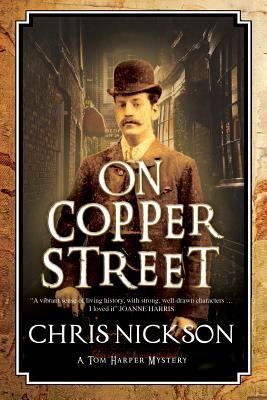 On Copper Street opens in grim fashion, with death and disfigurement. The dead pass in contrasting fashion. Socialist activist Tom Maguire dies in private misery, stricken by pneumonia and unattended by any of the working people whose status and condition he championed. The death of petty crook Henry White is more sudden, extremely violent, but equally final. Having only just been released from the forbidding depths of Armley Gaol, he is found on his bed with a fatal stab wound. If all this isn’t bad enough, two children working in a city bakery have been attacked by a man who threw acid in their faces. The girl will be marked for life, but at least she still has her sight. The last thing the poor lad saw – or ever will see – is the momentary horror of a man throwing acid at him. His sight is irreparably damaged.
 Nickson is a master story teller. There are no pretensions, no gloomy psychological subtext, no frills, bows, fancies or furbelows. We are not required to wrestle with moral ambiguities, nor are we presented with any philosophical conundrums. This is not to say that the book doesn’t have an edge. I would imagine that Nickson (right) is a good old-fashioned socialist, and he pulls no punches when he describes the appalling way in which workers are treated in late Victorian England, and he makes it abundantly clear what he thinks of the chasm between the haves and the have nots. Don’t be put off by this. Nickson doesn’t preach and neither does he bang the table and browbeat. He recognises that the Leeds of 1895 is what it is – loud, smelly, bustling, full of stark contrasts, yet vibrant and fascinating. Follow this link to read our review of the previous Tom Harper novel,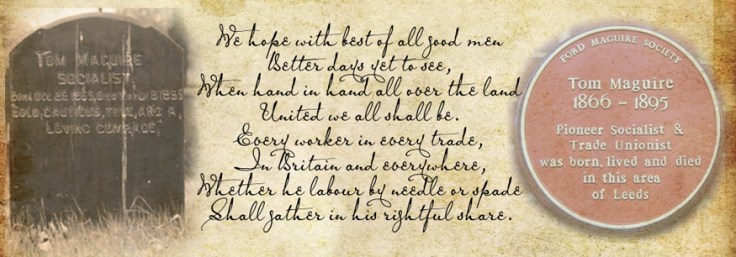


 fullybooked2017