

 I was working in Australia when Peter Weir’s 1975 film Picnic At Hanging Rock premiered. I remember pub and dinner party talk for months after being dominated by interpretations and explanations about what might have happened to the ‘lost girls’. In the endpapers of Last Time I Lied American author Riley Sager, (left) acknowledges his debt to this film (and the short story on which it was based). Instead of a 1900 Melbourne, Sager beams us into up-country New York State in, more or less, our times.
When Emma Davis, a skinny and gawky thirteen year-old just on the verge of young womanhood, wins a place at a prestigious summer camp for privileged teenagers, she falls under the spell of three older girls with whom she shares a cabin. In particular, the assured and sexually aware Vivian captivates Emma, just as she has captivated the other two, Natalie and Allison.
Camp Nightingale was created by a timber baron in the early years of the twentieth century. His master design featured a lake and, as there wasn’t one to hand, he simply evicted the inhabitants of a nearby valley, dammed the river and created his own huge water feature, Lake Midnight. Now the property is in the hands of his descendant, Francesca Harris-White, who presides in benign dictatorship over the gathering of rich city girls every summer.
 Emma’s summer idyll is destined to come to an abrupt and tragic end, however, when the three older girls in the cabin disappear one night, never to return. Despite the massive search and rescue operation, Vivian, Natalie and Allison remain missing, and Franny is forced to close the camp in disarray.
Now, fifteen years on, Emma Davis is a successful artist who is on the verge of giving up her day job in an advertising agency to paint full time. Her huge canvases create a stir in the New York art world, but they contain a hidden image known only to the artist. Each painting begins as a depiction of the three missing Camp Nightingale girls, who are progressively painted over by ever more intense foliage until only tantalising glimpses of them remain.
Emma is shocked when she receives an invitation to have lunch with Franny, and her shock turns to panic when she learns that the heiress plans to reopen Camp Nightingale and wants Emma to return for the season as artist in residence. Can she bear to relive the tragic events of that fateful summer? What is Franny’s real motive for reopening the camp? And, most importantly for us as readers, is Emma providing us with a classically misleading unreliable narrative?
Emma does return to Camp Nightingale and, naturally enough, since this is a thriller all about fate and coincidence, she has to sleep in the cabin called Dogwood – the selfsame one which she shared with Vivian, Natalie and Allison. Her new companions are Miranda, Krystal and Sasha. But now, of course, they are the giggly fifteen year-olds, and she is the mature and experienced woman.
Riley Sager packs the story with the literary equivalent of Improvised Explosive Devices, destined to go off at any moment with devastating consequences. We have Theo, Franny’s adoptive son, the subject of Emma’s massive and breathless crush all those years ago. There is Ben, the moody ‘bit of rough’ who has always been the camp maintenance man. Added to the mix are Lottie and Becca, both ‘survivors’ of the first downfall of Camp Nightingale. Above all – or, better, beneath all – is the moody presence of Lake Midnight itself, beneath which lie the stone memories of the displaced villages from over a century ago. Incidentally, if anyone can think of something more dramatically Gothick than Sager’s drowned lunatic asylum, whose roof appears only when the lake suffers from drought, I will give them a prize!

Last Time I Lied cleverly alternates between Emma’s recollections and the present time. Events in the reopened Camp Nightingale come to resemble nothing more nor less than a disturbing re-enactment of a cold-case crime, where the spectral presence of the fifteen-years-lost girls looms larger and larger with every page.
The eventual solution to what happened to the three girls is dazzling, ingenious, gasp-provoking – and fairly improbable – but, hey, this is a cleverly constructed and blissfully entertaining novel and no lesser person than Aristotle, in his Poetics, declared
“for it is probable that many things may take place contrary to probability.”
Riley Sager is the pseudonym of a New Jersey author who has published several mysteries under his own name, Todd Ritter. Last Time I Lied is published by Ebury Press (an imprint of Penguin Random House) and will be out on 12th July.


 While Elder whittles away his time helping out the local police force with difficult cases, and his wife gets on with her own life, Katherine is eking out an existence in a North London flat share, trying to hide the scars – both real and figurative – of her abduction. She has taken to modelling for life drawing classes in an effort to pay the rent independent of her mother’s generosity, and this has led her into a relationship with a highly respected artist whose career is on a definite upward surge.
 Body and Soul also takes an unflinching look at how love in itself is sometimes not enough – or possibly too much. I read elsewhere that this is to be John Harvey’s last novel. If this is the case then regret is permissible, but dismay would be churlish. We can only thank John Harvey (right) for his matchless legacy. Body and Soul is published by William Heinemann,


 Colin’s day has already been bad enough. He has been summoned to the office of Frank Figgis, the News Editor, and given a daunting task. The newspaper’s Editor, Pope by name (dubbed “His Holiness”, naturally) has a brother called Gervaise. Gervaise is in trouble. He has been mixing with some rather unsavoury characters, namely the adherents of Sir Oscar Maundsley, the aristocratic former fascist leader. Interned by Churchill during the war, he now dreams of Making Britain Great Again.


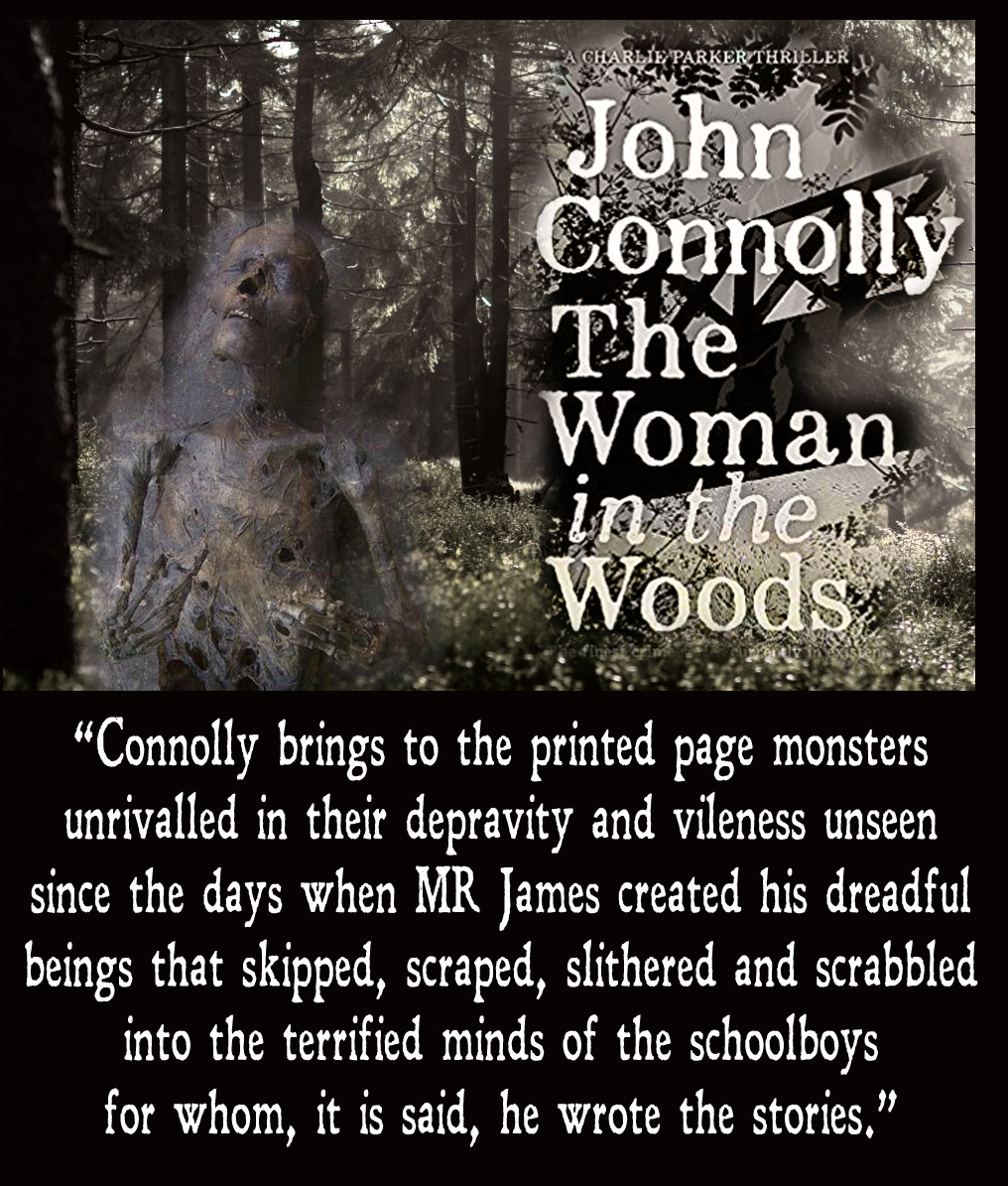

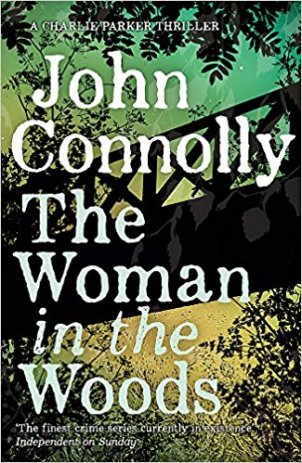 In the dark woods of Maine a tree gives up the ghost and topples to the ground. As its roots spring free of the cold earth a makeshift tomb is revealed. The occupant was a young woman. When the girl – for she was little more than that – is discovered, the police and the medical services enact their time-honoured rituals and discover that she died of natural causes not long after giving birth. But where is the child she bore? And why was a Star of David carved on the trunk of an adjacent tree? Portland lawyer Moxie Castin is not a particularly devout Jew, but he fears that the ancient symbol may signify something damaging, and he hires PI Charlie Parker to shadow the police enquiry and investigate the carving – and the melancholy discovery beneath it.
 In another life John Connolly would have been a poet. His prose is sonorous and powerful, and his insights into the world of Charie Parker – both the everyday things he sees with his waking eyes and the dark landscape of his dreams – are vivid and sometimes painful. Connolly’s villains – and there have been many during the course of the Charlie Parker series – are not just bad guys. They do dreadful things, certainly, but they even smell of the decaying depths of hell, and they often have powers that even a gunshot to the head from a .38 Special can hardly dent.
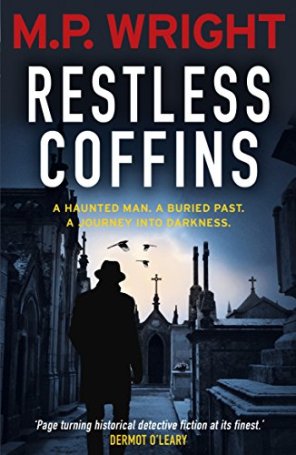 Ellington, broke and broken-hearted has ended up in 1960s Bristol, where he uses his police training to eke out a living as a private investigator. When he receives the news that his only sister, Bernice, has died in Barbados, he is compelled to return home to wind up her affairs. Hovering in the background, however, is Ellington’s violent criminal cousin Victor, who has reappeared after rumours of his tumbling to his death on the rocky slopes of Bristol’s Clifton Gorge prove to be greatly exaggerated. When Ellington arrives in New York after the first leg of his journey home, he rapidly realises that ‘born-again’ Vic is involved in something much more dangerous – and potentially lethal – than his previous mildly illegal entrepreneurship within the West Indian community in Bristol.
 Wright has made the decision to phonetically transcribe all the dialogue between the main characters in his books. I have to admit that in Heartman it was a source of irritation to me, but such is the pace and vigour of the action in Restless Coffins that it didn’t seem to matter as much this time around. The new ‘crime’ of Cultural Appropriation seems to me to be one of the most pointless, misguided and irrelevant of fashionable 21st century dogmas, so you will hear no complaint from me about a white Englishman writing a novel with an almost entirely black cast, complete with speech patterns, vocabulary and inflections.
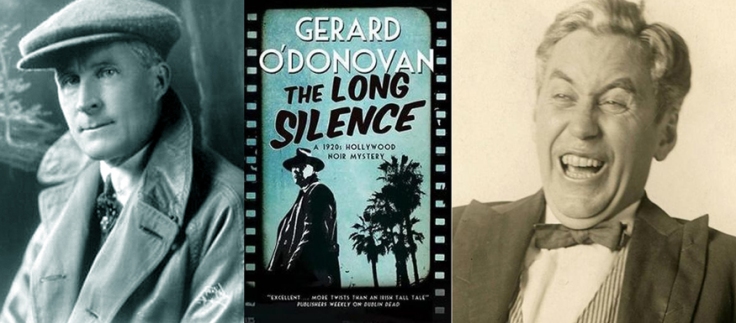
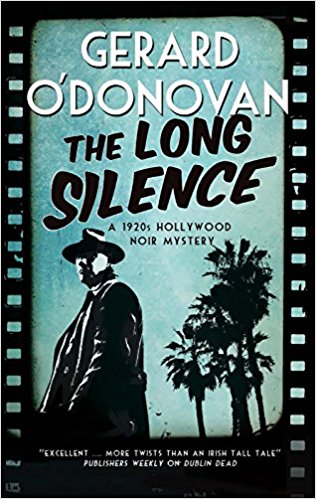 The most intriguing feature of this novel – and there are many – is the way O’Donovan drops us into the real life Hollywood of 1922. I knew something about the demise of Roscoe ‘Fatty’ Arbuckle, was aware of Mack Sennett and, of course, the names Douglas Fairbanks and Mary Pickford resonate with people of my generation who are reasonably well-read. But I had neither heard of – nor seen pictures of – Mabel Normand and, thanks to the wonders of Google, I could see instantly how she was able to mesmerise a generation of movie goers and readers of magazines. Those eyes! Tom Collins tells us about them quite early in the book.
 This is a cracker of a book. To the casual observer, looking on from the safe distance of the best part of a century, Hollywood in the 1920s appears innocent and other-worldly. We might smile at the fluttering eyelashes and coy gestures of the female stars, and the black-and-white (both figuratively and literally) lack of ambiguity of the male heroes and villains but in reality the movie world was just as venal, corrupt and hard nosed as it is today. Gerard O’Donovan (right) lifts the stone from the ground and we see all manner of unpleasant – and deadly – creatures scurrying around in the unwelcome light. The first pages of the book might suggest that Tom Collins has told us all that he has to say, but I hope this is not the case. The Long Silence is published by Severn House, is available now in hardback and will be
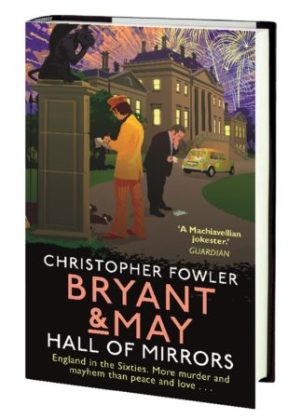 If a more extraordinary duo of fictional detectives exists than Christopher Fowler’s Bryant & May, then I have yet to discover them. The peculiar pair return in Hall of Mirrors for their fifteenth outing, and this time not only are they far from their beloved London, but we see a pair of much younger coppers on their beat in the 1960s. Fowler’s take on the period is typified by each of the fifty chapters of the novel bearing the title of a classic pop hit. We are also reminded of the strange fashions of the day.


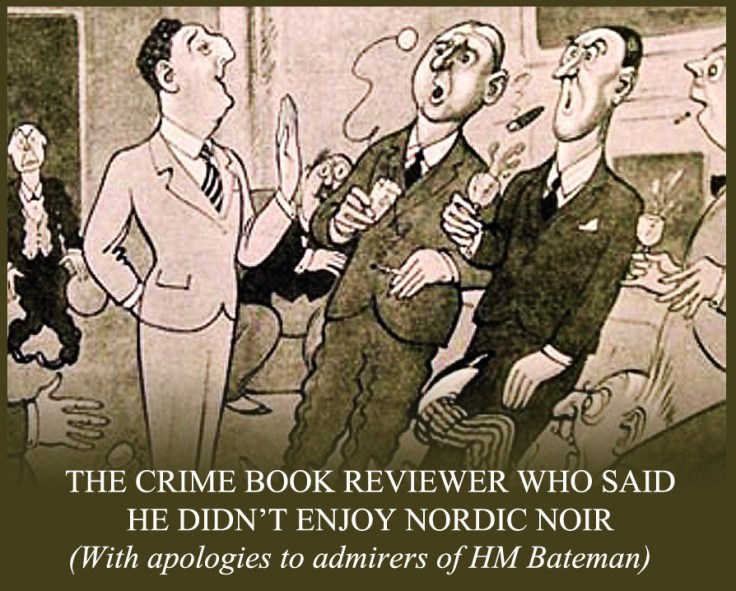
 Younger readers, please bear with me for a moment. People of my generation will need no introduction to the wonderful world of HM Bateman, a satirical cartoonist whose brilliance often matched that of Gillray and Hogarth. He was prolific and, like many cartoonists before and since, was a sublime draughtsman. One of his most popular series was ‘The Man Who ….” – and each featured someone who has committed a terrible social faux pas and provoked expressions of disdain, anger and astonishment on the faces of other characters in the picture. My personal solecism is that I remain lukewarm about much crime fiction which has its origins in Scandinavia. Not because I doubt the worth of the original, but more because of the insertion of a third party – the translator – into the relationship between reader and author. Yes, I know that puts me on shaky ground in many people’s opinions regarding writers such as Simenon and Vargas, but my stance is what it is, and I will happily defend my stance at another time and in another place.
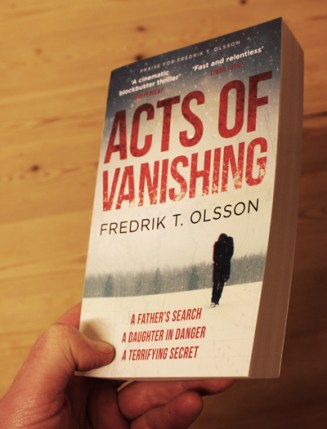
 That lengthy preamble is by way of an introduction to the latest book to be passed from my postman into my grateful hand. Acts of Vanishing by Fredrik T Olsson came out in Kindle in August 2017, but Sphere are publishing the paperback version in just a couple of days – 8th March – and those who love hardback editions will be able to buy it from Little Brown in April. Olsson (right) hails from the Swedish city of Gothenberg and is not only a successful novelist, screenwriter and director, but also a stand-up comedian.


 fullybooked2017