Search

fullybooked2017

Tag

murder

THE WISBECH TRAGEDY . . . Part One

TWT HEADER

Wisbech is a small Cambridgeshire market town on the banks of the River Nene. It is Spring 1905. The Mayor is Mr H.C. Elgood, patriarch and owner of the local brewery. The Rev. R.E.R Watts, Vicar of Wisbech is retiring due to ill health, and his grateful parishioners have raised the sum of £224.19s as a testimonial. Sadly, due to the cleric’s infirmity, there is to be no public presentation.

Away from the rectories and grand villas, the world goes on. In the insanitary slum courts off the main thoroughfares, men get drunk. their women goad them, and there is violence a-plenty. One such instance is the tragic – and painful – death of Frances Parlett. Most of the following narrative is taken from contemporary newspaper reports.

Frances Parlett was married about six years previously, but left her husband, and for two years she had lived with the John Day at 18a Carpenter’s Arms Yard. At one o’clock in the morning May 2nd they were in their living room, one of two rooms in which they lived. Day, having fallen asleep, was awakened by the woman, and it was said that either in sudden anger or with malice aforethought, he seized a lighted paraffin lamp which was on the table, and threw it at her. She was at once covered in flames, and screamed and rushed to the front door.

A very worthy man who lived near, and who often heard screams, went out and saw the poor creature. With remarkable courage and pluck, this elderly man rushed hack into his house and secured some blankets, with which he put out the flames. Next day the woman died, fearfully burnt. The evidence was that the accused, about 11 o’clock that night, was heard to say to her that he would do something to her when he got home.
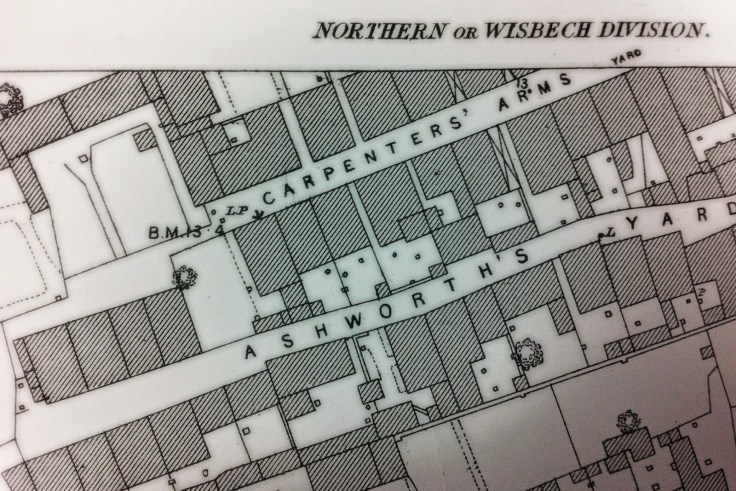
Map1
Nothing remains of Carpenter’s Arms Yard today
. It was a narrow lane running off what is now West Street, and it ended just short of Tillery Field, which in those days was a cemetery. Its position was more or less where St Paul’s Close is now. By all accounts it was one of the meaner streets of the town. I have been unable to find any image of Carpenter’s Arms Yard, but it is safe to imagine that it would have been narrow, dirty and the tiny terraced houses would have been packed with residents  who were at the bottom end of society.
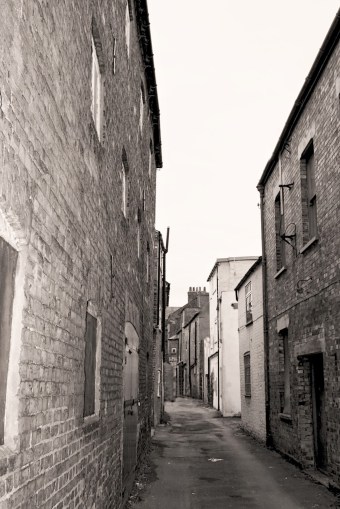
PretendThe photo on the right is of an existing Wisbech alley which, due to its central position has survived more or less intact, and gives us an idea of what the Yard might have looked like. Carpenter’s Arms Yard was earmarked for slum clearance in the late 1920s along with its near neighbour Ashworth’s Yard, and both were gone before the outbreak of World War II. What is now St Peter’s Road was probably more prosperous than either of the Yards, and its terraced houses were spared the redevelopments of the 1930s. It is tempting to look back and wish that more of old Wisbech had been preserved, but we would do well to remember that conditions in these old houses would be awful, even by standards of the time. Damp, insanitary and built on the cheap, these grim places contributed to the general poor health and high death rate of the time. The cemetery at the bottom of the slight slope of Carpenter’s Arms Yard was actually instituted as an overflow burial ground when a cholera epidemic struck the town earlier in the 19th century.

Back to the terrible events of May, 1905. Sadly, Frances Parlett died of her burns the next day, and the wheels of the law began to grind. The first step was a Coroner’s Inquest. At the inquest, it was reported that:

“Deceased was suffering from extensive superficial burns, extending from the knees to the armpits, and the front part was worse than the back. If deceased had been sitting at a table and the lamp capsized one would have expected more severe burns at one particular spot. There were no marks on her face or chest to show that they had come in contact with a hard substance, and would have expected to have found some marks on the body if it had been struck by the lamp with much violence.”

In answer to the Foreman, a witness said he thought the lamp could be thrown with sufficient force on the steel of the deceased’s corsets to break the lamp and not mark the body. The skin was discoloured too much to see any bruise. Herbert Brightwell, bootmaker, of 19a, Carpenter’s Arms Yard, said he heard the deceased and Day come home about 11 o’clock on the night in question. At about one o’clock he was awakened by the shuffling of feet, but he heard no voices. Immediately afterwards he heard a woman scream, and saw a bright light flash across his window. The woman continued to scream, and he went downstairs. When he opened the door of Day’s house the deceased, who was in flames, fell into his arms. Brightwell attempted to put out the flames by wrapping blankets round her.

Brightwell asked Day to assist him, but he did not do so, and said nothing. Having put out the flames, Brightwell ran to tell Frances Parlett’s sister, and Day ran after him, saying:

“What the **** are you exciting yourself about. If you don’t come back here I will jolly well put you through it as well.”

NEXT – John Day is tried for murder,
and faces an appointment with Henry Albert Pierrepoint

Part Two of A WISBECH TRAGEDY,  will go live on the evening of Friday 24th July.

THE FINISHER . . . Between the covers

Finisher018

51bAlRSlCzL._SX323_BO1,204,203,200_Fictional police officers come in an almost infinite number of guises. They can be lowly of rank, like Tony Parsons’ Detective Constable Max Wolfe, or very senior, such as Detective Superintendent William Lorimer, as imagined by Alex Gray. Male, female, tech-savvy, Luddite, happy family folk or embittered loners – there are plenty to choose from. So where does Peter Lovesey’s Peter Diamond fit into the matrix? As a Detective Superintendent, he pretty much only answers to the Assistant Chief Constable, but for newcomers to the well established series, what sort of a figure does he cut? Lovesey lets us know fairly early in The Finisher, the nineteenth in a series that began in 1991 with The Last Detective. Diamond is on plain clothes duty keeping a wary eye on a half marathon race in the historic city of Bath:

“Difficult to tell whether Detective Superintendent Peter Diamond, on duty in the gardens, was overt or covert. If he had been in the race, you might have taken him for one of the jokers in fancy dress. He might have stepped out of a nineteen-forties film, a sleuth on the trail of Sydney Greenstreet. The gabardine trench coat and dark brown trilby, his so-called plain clothes, weren’t plain at all in twenty-first century Bath.”

Neither is Peter Diamond a vain man, nor one who gives excessive attention to his personal appearance:

“He didn’t waste time showering or shaving. A swish of tap water took the sleep from his eyes and a squirt of deodorant completed his grooming. Unshaven jowls were standard among the younger members of his team.”

The book’s title is a clever play on words and has a double significance. It can be someone who manages to complete ‘The Other Half’ – an alternative half marathon pounded out along the elegant streets, disused railway tunnels and steep wooded hillsides of Bath. It also has a more sinister connotation – a person who gets things done, even if doing so involves a lack of compassion and, even, a willingness to use violence.

Lovesey’s clever novel combines the events surrounding the race, as well as a particularly brutal example of modern day slavery – illegal immigrants forced to work for a pittance, housed in grim conditions, and for ever in thrall to men and women who earn fortunes exploiting the vulnerable.

Finisher021There’s a dazzling array of characters to act out the drama. We have an earnest school teacher who forces herself to run the race in order to make good a lost donation to a charity; there is a statuesque Russian, wife of a cynical businessman, determined to lose weight and gain her husband’s respect; instant villainy is provided by a paroled serial seducer and sex-pest who has taken on a new role as personal trainer to the rich; at the bottom of the pond, so to speak, are a pair of feckless Albanian chancers who have escaped from an illegal work gang, and are trying to avoid the retribution of their controllers.


Throw into this mix a fascinating geographical background which comes vividly to life, even to someone like me, who has only a limited knowledge of Bath. Like most, I knew of its Roman heritage and the wonderful Georgian architecture, but I was totally unaware that the hills surrounding the city conceal warrens of quarries, caves and tunnels from which the beautiful local limestone was hewn.

Throughout his long and celebrated writing career, Lovesey has never given away his solutions without putting the reader through their own private marathon of false clues, and misdirections. So it is with The Finisher. If you get within ten pages of the end and reckon you know who did what to whom – then trust me, you don’t! This wonderfully entertaining novel by one of our finest living writers is published by Sphere and is out now.

Finisher020

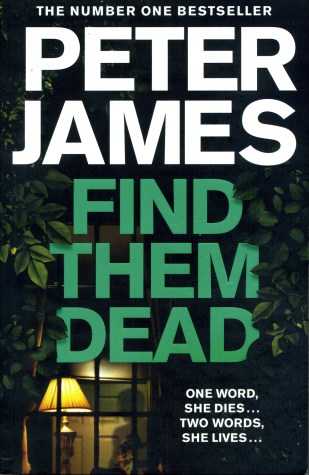
FIND THEM DEAD . . . Between the covers

dead012

Brighton copper Roy Grace seems to have been with us for ever. Since Peter James introduced him in 2005 there have been sixteen episodes in the career of the resolutely honest and decent man who shares none of the character faults of some of his fictional contemporaries. Yes, there was the protracted mystery of his missing wife – now solved, thank goodness – but Grace has few demons; certainly none that involve drink, drugs, dodgy tastes in music or sexual fallibility. Neither is Roy Grace, perceptive and intuitive though he may, cursed with second sight or prone to supernatural whimsies.

So what keeps him as a permanent resident in the crime fiction best-seller charts? It hasn’t hurt that Peter James has pretty much patented the use of that potent four-letter word DEAD in his titles. Simple, Looking Good, Not … Yet, At First Sight are just a few of the the inventive titles James has used. I’ll answer my own question with a simple reply. Peter James is a bloody good writer. End of.

dead013Strangely though, Find Them Dead sees Roy Grace rather in the background. He binds the narrative together by his presence, of course he does, but he mostly takes a back seat in this tale of drug dealers, bent lawyers and jury-nobbling. He has returned to Sussex after a spell working with the Metropolitan Police in London. The sheer depth and depravity of London’s crime has been an eye-opener, but the south coast is not without its villains.
A Brighton solicitor called Terence Gready – what a wonderful Dickensian name – has been arrested on suspicion of being near the top of a multi-million pound drug ring. His favourite modus operandi has been importing the pharmaceuticals packed into bodywork cavities of fake classic cars. His main man on the ground has also been arrested and Gready is in grave danger of spending the rest of his life in jail.

The spine of Find Them Dead concerns the ordeal of Meg Magellan, a middle-aged widow who has been summoned for jury service in the trial of Terence Gready. The bent solicitor is not quite at the apex of his organisation; his bosses believe that his downfall would also implicate them,and so they they target the jury – Meg in particular – in whose hands Gready’s fate lies.

Meg’s daughter is on a gap-year jaunt to Ecuador, and it is by threatening her that the bad guys hope to persuade Meg to emulate Henry Fonda’s Davis in the 1957 classic Twelve Angry Men. If Meg can persuade her fellow jurors that Gready is innocent, then all will be well. If she fails, then Laura will never leave Ecuador alive.

James ratchets up the tension with the true zeal of a torturer. As Grace – and his long term offsiders Norman Potting and Glenn Branson try to get to the bottom of who knows what in the case, we tread a tightrope of anxiety where it is never clear what the next step will bring.

Find Them Dead is published by Macmillan and is out now.

DARK WATERS . . . Between the covers

DW header

Police Scotland DI Monica Kennedy is a distinctive woman. Tall, angular, gaunt, even. She can seem forbidding, and has little personal life outside of bringing up her daughter with the help of her long suffering mother. Monica Kennedy can be brusque with her young male DCs, Fisher and Crawford, but she is not without charm. Towards the end of the book, she and Crawford are having a rare bevy in an Inverness bar.

He tilted his head. She could tell he was already a little drunk.
“You know, you could be a model.”
Monica laughed. Almost choking on the mouthful of vodka and orange she’d just taken. Sensing the hysteria that proximity to death seemed to encourage. Sex, anger, laughter – anything to keep the reaper at bay.
“What?”
Crawford screwed his forehead up and glanced round the pub.
“You’re statuesque. It was a compliment.”
“You’re funny, Crawford.”
She finished her drink and stood up to leave, but lingered for a second, glancing around the bar. The sounds of casual drunken conversation were a comforting reminder of normality.’

DW coverThe dark waters of the title are both literal and metaphorical. Deep in a cave system beneath a mountain lies a sump, whose black depths feature in the tense and frightening final stages of this story. The dark metaphorical waters are mainly centred on a deeply disturbed – and disturbing – family who have lived their lives in a remote Highland glen, happily divorced from civilisation and its moral code. If I drop the names Deliverance and The Hills Have Eyes, you should get a snapshot of the Slate family.

In a nutshell the plot of Dark Waters is that the remains of two horribly butchered men have been found, separately, in water near a huge hydro-electric dam in the Highlands. The autopsy reveals that the atrocities inflicted on the bodies were not the cause of death. As Kennedy and her lads try to identify the two men, and unpick the tangled knot of how they came to be where they were found, Halliday has a neat little game going on. A young woman disappears in the same area. The police have no idea she is missing, let alone know who she is, but we do. The first paragraph of the book is a cracker:

“When she still had all of her arms and legs, Annabelle liked to drive. And it was while she was on one of her drives that she made her first mistake.”

We share every agonising second of Annabelle’s fate,and I should mention that people with even a hint of claustrophobia or nyctophobia will not enjoy parts of this entertaining novel, nor do those who enjoy a good plate of meat get off scot-free.

halliday006Talking of Scots, GR Halliday (right) has an interesting bio:

“G.R. Halliday was born in Edinburgh and grew up near Stirling in Scotland. He spent his childhood obsessing over the unexplained mysteries his father investigated, which proved excellent inspiration for his debut novel. He now lives in the rural Highlands outside of Inverness, where he is able to pursue his favourite past-times of mountain climbing and swimming in the sea, before returning to his band of semi-feral cats.”

I might be mistaken, but I think the author makes a brief appearance in his own novel. Monica’s daughter Lucy has long wanted a cat, and Monica knows just the person to provide one:

“Michael Bach was outside in the hall, crouched over a cat basket. He stood up when he heard the door opening. He was almost as tall as Monica and seemed even larger than the last time they’d met, months before. Michael was a social worker Monica and Crawfor had previously collaborated with on a case. More important on this occasion was the fact that a number of semi-feral cats had moved in with him at his remote croft house.”

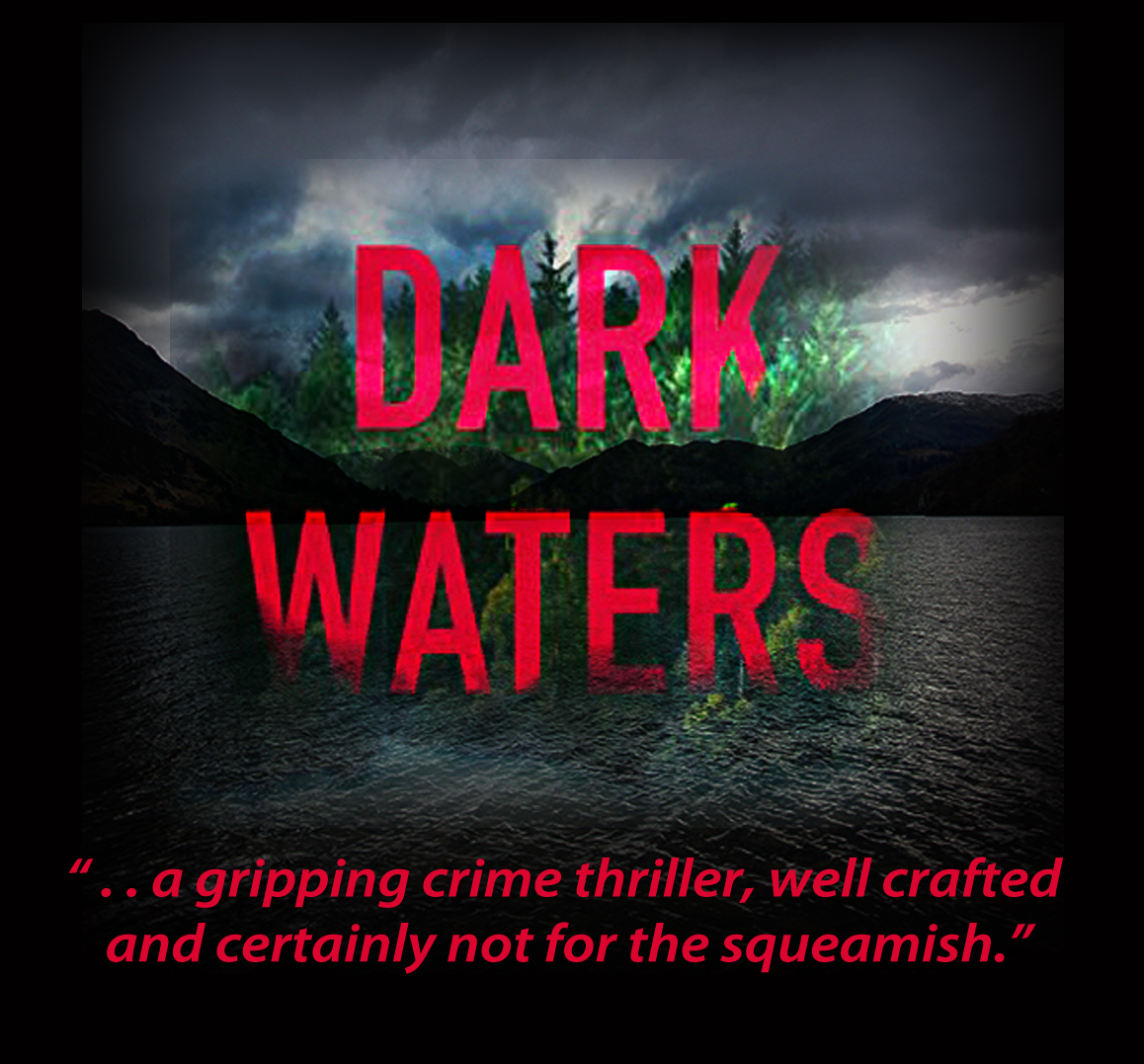
Dark Waters is a gripping crime thriller, well crafted and certainly not for the squeamish. It is published by Harvill Secker and will be out on 16th July.

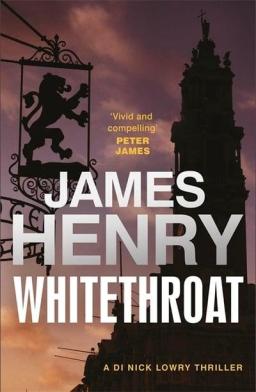
WHITETHROAT . . . Between the covers

Whitethroat header

There are locations for British crime novels that fit certain moods. You can have rural idylls which are shattered by evil deeds – the Cotswolds, the Yorkshire Dales and the majestic Scottish Highlands all fit that bill. Then you have the criminals hiding behind the bright lights of cities like London, Glasgow, and Manchester. James Henry has chosen a rather more understated milieu for his Nick Lowry police novels – Essex, and in particular, the garrison town of Colchester.

9781529401134Essex has become something of a trigger word in recent years, conjuring up images such as lavish mansions owned by London gangsters and dumb bottle-blondes with their perma-tanned, medallioned boyfriends. James Henry, however, takes us back forty years to the 1980s. DI Nick Lowry and his boss, Chief Superintendent Sparks, inhabit a police HQ which leaks, has rotten floorboards, and is maybe only months away from the demolishers’ wrecking ball. Sparks contemplates his desk:

“He studied the wooden surface of his desk. Countless semicircles, rings from years of mugs, cups, scotch glasses, placed carelessly and staining the untreated grain. The there were more pronounced wounds and scars: cigarette burns, knife scores, unusual marks – traces of events only the man behind the desk could read.”

Since Roman times, the history of Colchester has been inextricably intertwined with that of soldiering, and it is the death of a young ‘squaddie’ (an unranked private soldier) that Lowry investigates. Improbably, it seems that the dead man was shot in a Victorian-style duel, complete with gentlemanly observance and the presence of Seconds. With the help of his friend Captain James Oldham, of the Military Police, Lowry discovers that the two men had been fighting over a woman. But who was the other duellist, and who was the woman?

The plot goes this way and that, but this is a book that is always about the quality of the prose. Lowry has a young subordinate called Kenton, who has been on leave since being traumatised by the death of a young girl. Kenton is clever, well-educated, but enjoys his stimulants. In pursuit of the more legal kind, he observes pub life:

“..it was different being here as a punter. You saw the place through different eyes; peaceful and inviting and shabbily familiar. Flaking paintwork, worn hardwood surfaces, the yellow, cracked ceiling; a naked aging structure smoothed by the warmth of alcohol and density of cigarette smoke.”

And again:

“The first to arrive were the regulars. Men in their sixties. One, Wilf, was already in situ, perched quietly at a corner table, steadfastly drinking IPA. He would sut there until last orders, then leave as silently as he had arrived. Around midday, the bohemian set – ‘intellectual dossers’, Sparks called them – would drift in. Young men clutching tatty paperbacks. Sucking the end of biros and staring pensively into the middle distance.”

Like most self-respecting fictional police detectives, Lowry’s personal life is something of a wasteland. He is divorced, and his wife has poisoned their son against him. He feels that the years are taking their toll on him, but he remains compassionate:

“Lowry moved to place his arm across Sparks’s shoulders, but instead grasped the nearest arm, squeezed the firm bicep and bowed his head. He was winded by a surge of sympathy, revealing an attachment to the older man that seldom surfaced. Even now – more and more, in fact, the older he became – life caught Lowry out, introducing unsolicited emotions and concerns, age bringing with it a new sort of awareness.”

HenryThe plot is the least important part of this fine novel, but it unfolds gradually. The woman whose favours are being fought over by the duellists is not a woman at all, but a fifteen year-old schoolgirl, the daughter of a local businessman. He, in turn, has unfinished business with a local enrepreneur, and business that dates back to a racial attack three decades earlier. We are in a world of simmering resentment born out of old slights, and the result? The proverbial dish that is best served cold.
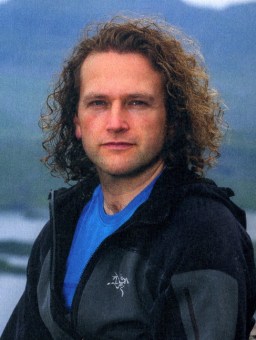
Whitethroat is bleak, downbeat and mesmerising; a subtle, compassionate and beautifully written novel that is something of an elegy to a way of policing – and living – that is gone for ever. James Henry (above right), as James Gurbutt, has also written prequels to RD Wingfield’s Jack Frost series. Whitethroat is published by Riverrun and will be out in hardback on 9th July. The two previous Nick Lowry novels are pictured below.

Books

OFF SCRIPT . . . Between the covers

OffScriptHeader

It’s just as well that I don’t work in publishing, because I have no nose whatsoever for what makes an author popular. Some of my very favourite writers clearly have their audiences, but never have their names “up in lights’. One such is Graham Hurley. He created one of the truly original fictional coppers – Joe Faraday – and then killed him off. Poor Joe didn’t survive his Reichenbach Falls moment but subsequently, Hurley gave us a quartet of beautifully crafted novels featuring Faraday’s young sergeant, Jimmy Suttle.

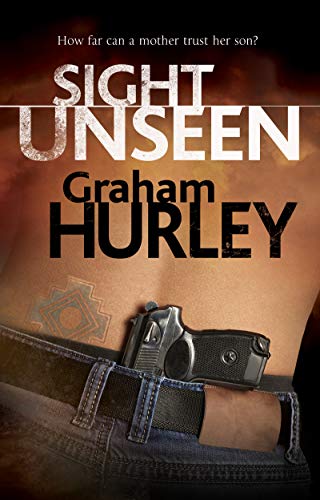
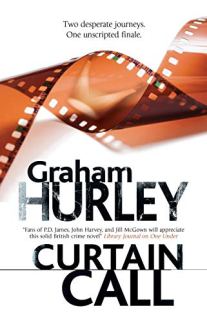
Hurley’s latest creation is not a police officer. She is an actress, Enora Andresson, who doesn’t even solve crimes as an amateur, but her circle of acquaintances and personal circumstances lead her into dangerous situations. The first two books in the series are pictured below,and clicking the images will take you to a detailed review of each.

Sight UnseenCurtain Call


Now we have a new Enora Andresson novel, Off Script, and it is every bit as cleverly written and perceptive as Graham Hurley fans have come to expect. For newcomers, here is a quick precis of Enora’s world.

She is a distinguished and much-admired actress, having appeared in many stage productions and is best known for her roles in what used to be known as art-house films. She lives with a brain tumour which she hopes is now in remission. Her former husband, whose name she retains is, as they say, a ‘nasty-piece-of-work’. She has a rather feckless son, Malo. We learned in Curtain Call that his father is a gangster-gone-legit, Hayden Prentice. Another significant figure in Enora’s life is a former scriptwriter called Pavel. Once Enora’s lover, he is now blind, and paralysed after a freak accident.

41tNcNbzycL._SX319_BO1,204,203,200_In Off Script, the early focus is on Carrie, one of Pavel’s carers. She has received a terrifying small-hours visit from an apparent psychopath, and when she confesses how much this has disturbed her, Enora sets out to find the strange young man who, after his chilling threats to Carrie, seems to have disappeared into the twilight world of the homeless and uprooted.

Enora’s world is tipped on its head when she discovers a terrible murder:

“She’s sprawled on her side, one knee up, a semi-foetal pose. Her eyes are wide open in the blankness of her face. Naked, she’s lying in a drying pool of what must be her own blood. It’s everywhere, over the sheets, the duvet, the pillows, the wallpaper, everywhere.”

The search intensifies for Carrie’s midnight visitor, and along the way Enora and an investigative journalist take a trip to the Somerset seaside, but it is far from idyllic.

“Mitch has never been to Weston before but what he sees on the way in doesn’t surprise him. Scruffy industrial estates. Boarded up units. Heavy security outside supermarkets. Kids on their bikes pulling wheelies in the middle of the road, eager for their day in court.”

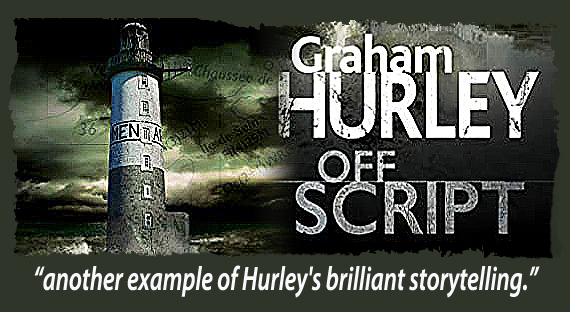
Enora is blindsided by a new man in her life, and makes a terrible mistake. She eventually realises what she has done, and it takes all her skills as an actress to prevent catastrophe. Not the least of Graham Hurley’s wizardry is the bravura way he tells the tale through the eyes of a 39 year-old woman. Enora is utterly convincing, and has become another example of Hurley’s brilliant storytelling.

Off Script is published by Severn House and is out now.

GRAVE’S END . . . Between the covers (click for full page)

GE header

Former music journalist William Shaw (left) introduced us to Detective Sergeant Alex Cupidi in Salt Lane (2018). This was followed by Deadland in 2019, and the third in the series is Grave’s End. Alex Cupidi is socially something of a loner: she has a teenage daughter, Zoe, who she has raised pretty much on her own; her only other family is her mother, 80 miles or so up the road from the bleak Kent marshes, in London. Zoe Cupidi, like many other idealistic young people, is a fervent defender of nature, and sees the adult world in which her mother has to work as a grimy conspiracy to fell every tree and concrete over as much of green England as possible.

For those who know something of England, Alex Cupidi’s Kent is not the rosy cheeked rural idyll of The Darling Buds of May. This is the coastal Kent of the Romney Marshes and Dungeness; beautiful in its own way, perhaps, but bleak; the coastal fringes are flat, scoured by cruel winds, and shunned by holidaymakers who prefer deck-chairs and the friendly smell of fish and chips to solitude and the mournful cry of the curlew.

GE coverThis taut thriller is  distinctly unusual, in that one of its main characters is neither a fellow member of Kent Police, nor one of the villains they spend their professional lives trying to put behind bars. Instead we see – or sense – some of the action through the perceptions of an elderly badger. Before such thoughts can gain foothold, I can assure you that this is no Wind In The Willows. Our badger is not an avuncular personification. He is old, fearful of younger rivals, and hungry – always hungry.

Of course, readers have to accept that the badger’s perceptions are expressed in our language. Since this particular representative of Meles Meles has none that can be written, what is the alternative? I was not convinced at the start of the book that the idea was going to work, but after reaching the last page, I think it does. Shaw keeps the badger’s subterranean activity linked to the plot, and from the very start it is his sense of smell that alerts us to the fact that something is very, very wrong.

“By now, the air should smell of fresh grass, cow parsley, other badgers and dog shit. He moves forward more cautiously in the blackness and his snout meets something hard. At the end, where darkness should change to dusk, he finds the tunnel blocked. He digs, but there is something in his way, so hard his big claws make no impression on it at all. He sniffs. It smells rank. People stink.”

When an enterprising junior estate agent decides to impress his girlfriend, he ‘borrows’ the keys to an impressive empty property, but his hopes of a passionate afternoon’s grappling on someone else’s bed are dashed when they find a dead body in a freezer. Alex Cupidi and her team soon identify the frozen corpse of that of a local wildlife activist. Further investigations lead them in the direction of a controversial housing development on a site inhabited by, among other various fauna, our friend the badger.

Alex Cupidi is like the proverbial dog with its bone as she relentlessly follows the trail leading away from the murdered activist. High profile government ministers, avaricious property speculators, a minor public school with a terrible secret – every time she lifts a stone, nasty things scuttle about, unaccustomed to the light. Grave’s End is a totally compelling read. It is published by riverrun, an imprint of Quercus, and will be available in July.

quercus

THE SARACEN’S MARK . . . Between the covers (click for full screen)

TSM spine010

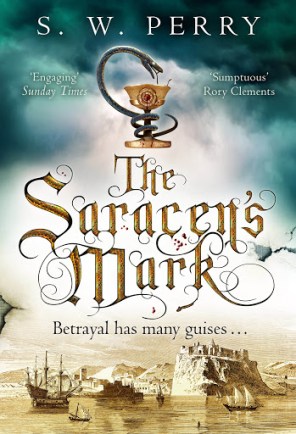
SW-Perry-photo-1-2-300x482SW Perry (left) whisks us away from our disease ridden present misery to – with almost supernatural prescience – the streets of London in 1593, where plague is also keeping the gravediggers and the parsons working around the clock! The late sixteenth century versions of  plucky NHS employees come in the shape of Bianca Merton, a young Anglo-Italian woman who keeps The Jackdaw, a Bankside tavern (and who is also much in demand as a herbalist – a purveyor of what we now call alternative medicine) and her close friend Dr Nicholas Shelby, whose medical knowledge is more conventional.

The disease has, so far, gone about its malevolent business north of the River Thames, but with no daily calls for social distancing, it finds its way south:

“Her name is Ruth. She is returning to the lodgings on Pocket Lane that she shares with her husband. Ruth feels uncomfortable hot. By the time she reaches home, she will have a fever. She will awake the next morning to find painful swellings in her armpits. Young and strong, she is in the habit of thanking God for a strong constitution. But in a few days she will be dead. The pestilence has crossed the river.”

Bianca is much in demand among the worried residents of Bankside for her concoctions:

“Pomanders of rose leaves, tragacanth gum and camphor to hang around the neck … clove and lemon to mix in a posset . . . also a tincture of bezoar and sorrel. Mix that in water or small beer every morning.”

TSM coverNicholas, however, has been sent on a mission by one of the most powerful men in Queen Elizabeth’s kingdom – her spymaster Sir Robert Cecil. England has a complex relationship with what we now call Morocco, and in particular with the ruler of Marrakesh, but the death of Adolfo Sykes:

“..a small, somewhat bow-legged half-English, half-Portuguese merchant with a threadbare curtain of prematurely white hair that clung to the sides of his otherwise- unsown pate.”

… needs to be investigated, as Sykes is a key strand in Cecil’s silken – but deadly – web of spies and agents. When Nicholas finally arrives in Marrakesh, he discovers that Sykes had uncovered a slavery ring involving, among others a brutal and violent sea captain called Cathal Connell. Now that Nicholas is aware of the secret, it is only a matter of time before Connell and his accomplices come looking for him. While the unpredictable world of Moorish politics find him alternating between foul prison cells and  a life of luxury surrounded by servants, back in London ….

“The pestilence has returned with a vengeance. The Savoy hospital has closed its doors to new patients and posted guards on the water stairs to deter visitors. The chapel’s death-bell tolls with increasing frequency.”

This is a richly rewarding novel, full of fascinating historical detail, but Perry never allows the authenticity of  his main characters to be hidden beneath a superfluity of information about what they are wearing, or the contents of their dinner plate, or elaborate architectural descriptions. Bianca and Nicholas are separate from each other for most of the narrative, but each drives the story forward relentlessly. As we are only too well aware just now, plague knows no historical boundaries, but Perry’s skill as a storyteller is equally timeless – and magical. The Saracen’s Mark is published by Corvus, and is out now.

If you like the sound of what the author calls The Jackdaw series,
then read my review of The Serpent’s Mark.

MAKING WOLF . . . Between the covers (click for full screen)

MW3018

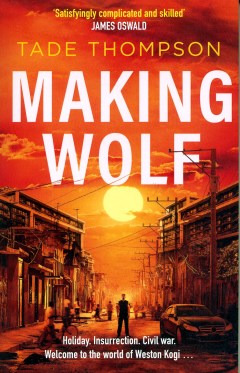
Weston Kogi is a security guard in a London supermarket, and the most excitement in his life is when he has to chase shop-lifters across the car park. When he hears that the woman who brought him up, his Auntie Blossom, has died at her home – the city of Ede in the West African republic of Alcacia – he decides to attend the funeral. You will look in vain for Alcacia on a map, but Tade Thomson describes it thus:

“He brought out a map of Alcacia. It was shaped like a sperm whale on the West African map, tiny, squeezed between Nigeria and Cameroon, the mouth of the whale drinking from the Atlantic.”

MW2017At his aunt’s funeral he meets Churchill “Church” Okuta. Church is a nightmare from Kogi’s schooldays, and the meanest person he has ever met. When asked what he does in London, Kogi, on impulse says that he is a homicide detective. Bad move. Church orchestrates the drugging and abduction of Kogi, and when he wakes up he finds that he is in the camp of the Liberation Front of Alcacia, one of two warring rebel groups trying to overthrow the government. Their leader, Enoch ‘Papa’ Olubusi has been assassinated, and the LFA, in the mistaken belief that Kogi is a crack British detective, want him to prove that the killing was the work of their bitter rivals – the People’s Christian Army.
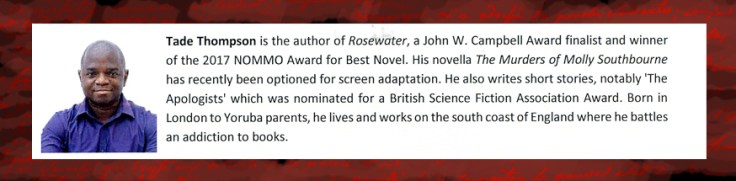
Sucked into a deadly game of recriminations, treachery and mind-numbing brutality, Weston Kogi soon finds himself unsure of who are the good guys and who are the villains. You might think, at first sight, that the People’s Christian Army and the Liberation Front of Alcacia are comedy turns, like the rival factions in Monty Python’s The Life of Brian, but as you turn the pages of Making Wolf, you will encounter graphic and disturbing descriptions of violence in a dystopian Africa where fair is foul and foul is fair. Even everyday domestic scenes have a touch of the nightmare about them:

“Dogs howled at the full moon, took a break, and then howled some more. People came out on raffia mats, deckchairs and carved stools. Children ran around the central wood-fed fire, squealing their delight and roasting wild mushrooms on dirty sticks. Wasps, sand flies, stick insects, confused termites and other arthropods flew into the flames for one shining moment before dying.”

Amid the corruption, cheap death and commonplace brutality, Tade Thompson has a keen eye for the absurd. Kogi and Church pay a visit to a Fagin-like character who is the lord of all the many beggars in Ede.

“The King of Boys wore a crown to receive us. The crown was jewelled with marbles – children’s marbles. It was a band of tin, beaten together from old Burma-Shave containers. His head was completely bald, shining from within the rim of his crown. He had a back tailcoat on and he looked like an impoverished Fred Astaire.”

As he lifts layer after layer of lies and deception, Kogi decides to visit the widow of the assassinated politician, and she invites him to an evening at the theatre. Diane Olubusi has dressed to kill:

“She wore a low-cut white dress, designed in such a way to give the impression of a woman wrapped in a bolt of silk which was about to slip off. She smelled like a botanical garden with all the flowers in full bloom.”

Weston Kogi discovers that Alcacia is awash with money. Hundreds of thousands of dollars – in suitcases, money belts, plastic bags – are traded back and forth between  sinister men in dark suits and their military friends in combat fatigues. All this while little people grind out their miserable lives in squalor and hardship. There is grim comedy, astonishing violence and a certain brutal poetry in Making Wolf. It is a book that will certainly shock you, but make no mistake, Tade Thompson is a writer to be reckoned with.

Making Wolf was first published in 2015, but is being reissued by Constable, and will be available from 7th May.

MW footer

Blog at WordPress.com.

Up ↑