Search

fullybooked2017

Tag

murder

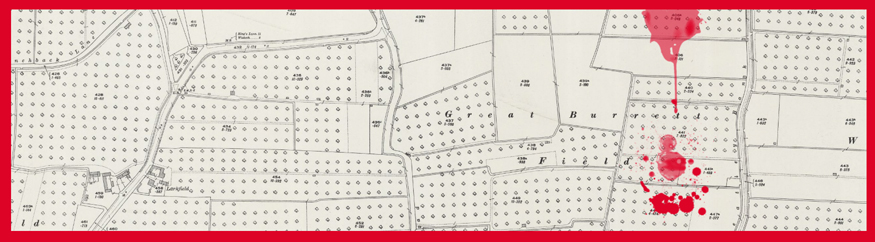
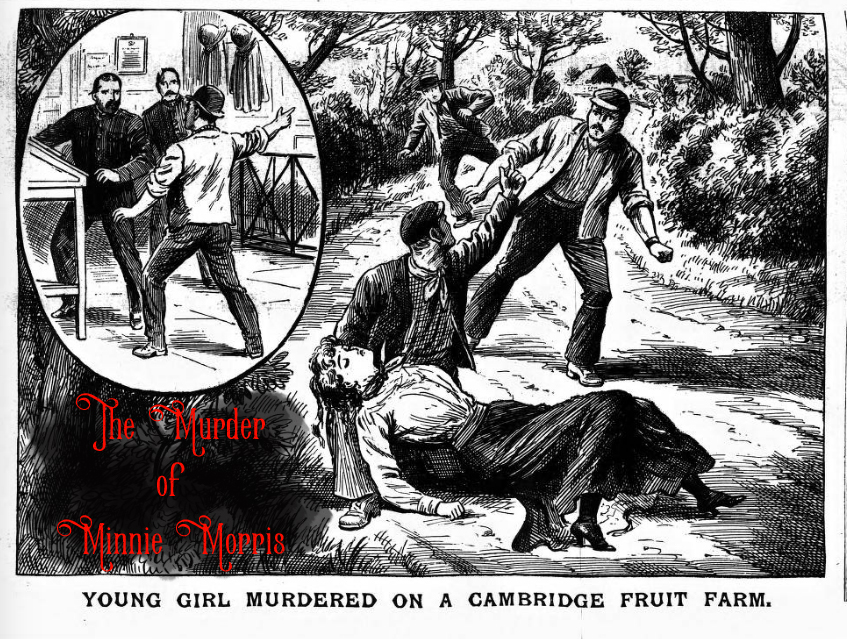
THE MURDER OF MINNIE MORRIS . . . The Walsoken Outrage (Part three)

Header

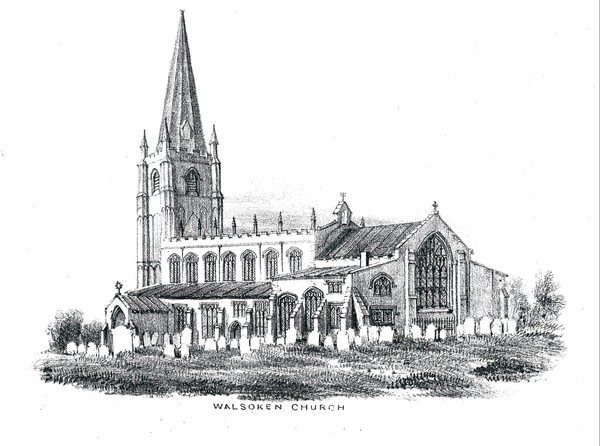
THE MORTAL REMAINS OF MINNIE MORRIS were laid to rest in Walsoken Cemetery on the afternoon of Friday 19th July 1912. The newspapers reported:

The officiating clergyman was the Rev. G. A. A. Finch, of Loughborough, who is in charge of the parish whilst the Rector (the Rev. J. Young) is on his holidays. The first part of the service was conducted in the church. The funeral was largely attended, it being estimated that there were quite 300 fruit pickers -from all parts of the district present.

The scene was a very impressive one, for many of the pickers, who are generally so light-hearted, were greatly touched by the solemn ceremony, and numerous were those who were moved to tears as the coffin was lowered into the grave. The chief mourner was the mother of the girl and for her much sympathy had been shown in the parish, a collection on her behalf amounting to £1. The girl’s sweetheart, a London bricklayer, came down to see her body, but was unable to wait for the funeral. There were nearly a dozen floral tributes, one from the mother, and the others, from pickers. Most of the wreaths were made by a Mrs. Love, wife of the copperman at Mr. J. S. Batterham’s farm, where the girl had been working.

On the spot where the body of Morris was found, a cross has been cut in the turf and flowers have been laid on the cross. On Sunday hundred, of people visited Burrett Road to see the spot. The charge of murdering Morris which has been preferred against Robert Galloway. – of No. I Angola Mews, Babington-road, North Kensington, to be investigated at a special sitting of the Marshland Magistrates at Wisbech today (Friday).
walsoken-ch-old

Headline2The inquest on the body of Morris was conducted at the Bell Inn, Old Walsoken, on Wednesday 24th July. Presiding was  the District Coroner (Mr. R. A. Wilkins). Supt. Powles represented the police. The morning was to be dramatic. The victim’s mother. Mrs. Springfield, was the first witness to be recalled, and when she entered the room she looked at Galloway, gasped for breath, and then crying said between her sobs:
“That is the villain.” Stating that her husband was outside ill. she signed the deposition. As she was rising from her seat she said:
“My sister said she would look after her; What this man wanted to kill my daughter for. I don’t know. She never did anyone any harm. He got into the company of the girl, and I quite understand he got jealous. Oh God love her.”
The Coroner: “Do not get excited.”
Mrs. Springfield: “It is cruel. Look at the man. (Then to Galloway): Look at me – look at her mother. (Lifting her hands as a warder stood in front of her, and between her and Galloway): I would if I dare. You scamp, you dirty dog, you villain.”

The witness, who was crying as she was speaking, then left the room. It transpired that the man who cut the cross on the spot where the body was found, and filled the cross with flowers, was James Long, an employee of Mr. Blunt. The Coroner said it was a very nice idea. and quite refreshing after the brutal things they had been listening to.

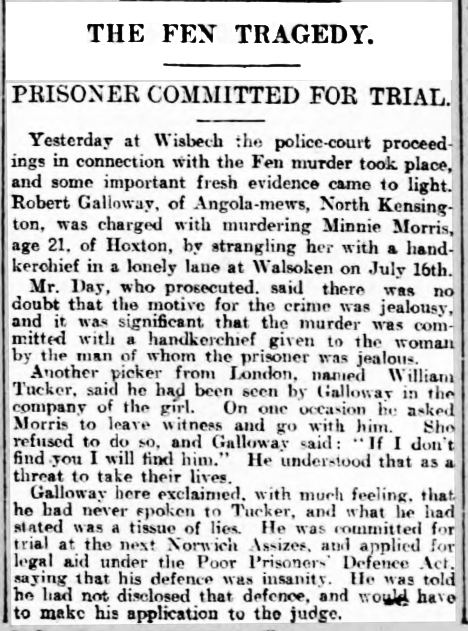
The grim wheels of the legal process ground ever onwards. The next stage in the process was the police court in Wisbech on 1st August. The findings were never in doubt, but Galloway’s behaviour remained bizarre. He had now decided to opt for an insanity plea.
Police Court
Mr Justice DarlingGalloway remained under lock and key for the next three months, but in October he had to face the finality of justice. At the Norwich Assizes in October his belated attempt to plead insanity cut no ice with either the jury or Mr Justice Darling (right). He was sentenced to death and on the morning of Tuesday 5th November he had no option but to keep his appointment with Thomas Pierrepoint and his assistant George Brown. Newspaper reports said:

“He walked firmly to the scaffold, and death was instantaneous.”

Prior to 1887, Norwich prison – and its gallows had been within the walls of the castle, but Galloway’s last days would have been spent in the institution on Knox Road, and his remains presumably lie therein.

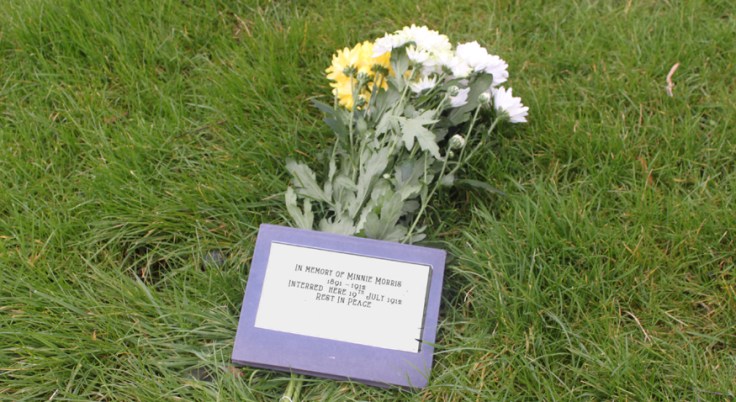
Minnie Morris’s body lies in a quiet corner of Walsoken cemetery, forgotten, unmarked and unvisited. Her family were poor, and unable to afford a headstone. Thanks to the efficiency of the District Council we know her last resting place, and I was able to put some flowers on the spot. If you click on the media player at the bottom of this feature, you will hear a lovely old hymn, written by Ira D. Sankey, which reminds us of our mortality.

Grave

Plaque

I KNOW WHAT I SAW . . . Between the covers

ikwis021

Imagine having a perfect memory. Being able to replay words, sounds, situations – from years ago. It’s all there, in your head, ready to be recalled. Great for exams when you were younger, but what about when something unpleasant happened to you, and it won’t ever go away? Nicola Walker has Hyperthymesia. She has been the subject of scientific studies and examinations, but her condition is what it is. Now, it’s 2020 and, at the age of 51, she has a humdrum job in London’s British Library. Sher marriage ended half a lifetime ago, and now she lives from day to day with only her cat for company. Until she receives an alarming telephone call.

The call is from a Metropolitan Police detective. Her former husband, Declan, has been arrested on suspicion of murdering his father, years earlier. And his only witness? Nicola and her perfect memory.

We are basically in two time zones. The present day, 2020, and a summer Sunday in June 1985, which is Arty Robbins’s 50th birthday. The event is being celebrated at a pub called The Mary Shelley, and the landlord is Arty’s father, Vincent. Nicola, aged 16, and Declan Robbins, aged 18, son of Arty, are ‘an item’. A list of the other characters is not something I normally compile, but it might be useful in this case.

Craig Walker, Nicola’s father
Susan Walker, Nicola’s mother
Dave Crane, friend of the Walkers. He married Susan after Craig’s death from cancer.
Kat Clarke, Nicola’s contemporary, and best friend. Her father Daniel, Arty Robbins’s brother, walked out on them years earlier.
Chloe Clarke, Kat’s mother
Gary Barclay, Kat’s boyfriend. They later marry.
Anne Robbins, wife of Arty, mother of Declan

ikwis022Arthur Robbins is a pillar of the community. Successful estate agent, all-round diamond geezer and school governor. But then, he just disappears. He was last seen in the small hours on the night of his birthday party. Lost for 35 years – until his remains turn up in the foundations of a building being demolished to make way for a new development.

We have, in one sense, a traditional whodunnit, but it is unconventional insofar as  the usual police work, while still taking place, is secondary to the agonising replays going on inside Nicky’s head. What did she see? Who did she see? Where were they? How do these memories stack up against the ticking clock on that warm summer night 35 years ago? Has she mis-remembered? What if she is shutting out some memories in order to protect someone she loves? There’s no shortage of suspects, as the real Arty Robbins is far from the jovial character he pretends to be.

The killer of Arty Robbins is eventually unmasked, and SK Sharp leads us down many a blind alley as the narrative unfolds, and Nicola finally completes the jigsaw of her memories. It’s clever stuff, and gripping – I read it in two enjoyable sessions – but for me, the strength of the novel is the relationship between Declan and Nicola, both then and now. I don’t remember a more sensitive and perceptive account of teenagers falling in love with each other, but the most moving and effective counterpoint to this is how it all plays out, decades later, with so much water under the bridge, so much hurt, so many mistakes and so much misunderstanding.

This is a fine novel, a thriller, yes, but full of compassion and telling insights into what people do to each other, and how secrets corrode trust. I Know What I Saw was first published in October 2020 by Cornerstone Digital. This paperback edition is from Arrow, and is out now.

SK Sharp (aka Stephen Deas) is on Twitter

Screen Shot 2021-01-29 at 19.12.18

THE MURDER OF MINNIE MORRIS . . . The Walsoken Outrage (Part two)

HeaderTHE STORY SO FAR . . .  July 1912. Wisbech, Cambridgeshire.Two Londoners in their 20s – Minnie Morris and Robert Galloway – have come to the Fenland town for the fruit-picking season, and are working for a local farmer. J.S. Batterham. They are in a relationship, of sorts, because Minnie is very attractive and enjoys male company. Sadly, Robert Galloway is prone to jealousy, and every word Minnie exchanges with other young men is a dagger in his heart.

On 16th July both had been drinking. Licensing restrictions were only to be introduced a few years later, as part of the effort to boost munitions production in WW1, and both The Black Bear and The Bell Inn in Walsoken were “open all hours”.

The pair went for a walk after a lengthy session in the pub. They followed Lynn Road. and then turned right into Burrett Road. At some point, Galloway’s jealousy and – perhaps – Minnie’s indifference triggered a violent response. Galloway throttled Minnie, using a handkerchief she had been given by another admirer to make a fatal tourniquet around Minnie’s neck. It seems that Galloway then headed back to seek solace in alcohol.

Witness reports in subsequent court hearings tell their own tale:

Bertie Ash, labourer, Walsoken, said that on Tuesday afternoon, 16th July, he was cycling along Burrett Road,. towards the Black Bear, and his attention was attracted by a woman lying flat on her back on the grass with a man kneeling over her. They were on the left-hand side of the road. He did not know what the man was doing. The man’s left hand appeared to be on the woman’s mouth or breast, and a cap was over the woman’s face. He did not stop, but proceeded to Mr. J. S. Batterham’s farm, where he stayed 10 minutes.

He returned the same way on his bicycle and that the woman was lying in the the same position, but the man had gone. She was not moving, and was alone. He did not stop. He thought they were a young couple courting, and that the woman was asleep. When he first passed the couple they did not appear to be struggling at all.

William Frusher, labourer, Old Walsoken, said that on Tuesday, 16th July, he was walking along Burrett Road in the direction of his home, which was away from the Black Bear. It was 5.10 p.m., and he saw woman lying on the left-hand side of the road. She was on her back, and was not moving. He stood for a moment and looked at the woman. He could not see her face as a man’s cap was over it. He felt her hands, and they were cold. He removed the cap and saw there was a lot of brown froth around her mouth. She was not breathing. He did not move the body, and left it just as it was.

He went away and returned with a sack to cover the woman. That was about ten minutes after he first saw her. He returned with a man named Lankfer and remained by the body until the police arrived. He did not notice a letter until P.C. Taylor came. It was in the waistband of her skirt. The woman’s head was bare and her hair was light coloured.

Galloway was either drunk or obsessed. Having walked into Wisbech he spoke to the first policeman he found:

PC. Jacobs, of Wisbech, said that at 6.45p.m. on Tuesday, 16th July, he was on duty on Wisbech Market Place, and the prisoner came up to him and said: “Have you heard of a murder on the Lynn road, Walsoken? I have strangled a woman. I thought you were looking for me. 1 am ready to suffer for what I have done.”

Galloway was arrested and secured in police cells, and at no time did he deny what he had done. In fact, Police Sergeant Arthur Webb, of Walsoken, stated that when he received the prisoner into custody, Galloway said: “Is she dead? I hope so. You can take that down.”

IN PART THREE

A Burial
A Trial
An execution

THE MURDER OF MINNIE MORRIS . . . The Walsoken Outrage (Part one)

HeaderThese days when Fenland fruit needs picking, the hands that do the work will belong to people who come from places like Vilnius. Klaipeda, Varna, Daugavpils, or Bucharest. Back in the day, however,the pickers came from less exotic places like Hackney, Hoxton or Haringey, and the temporary migration of Londoners to the Wisbech area was an established part of the early summer season. In the autumn, the same people – predominantly women and children, might head south to the hop fields of Kent, but in the July of 1912 the Londoners were here in Fenland.

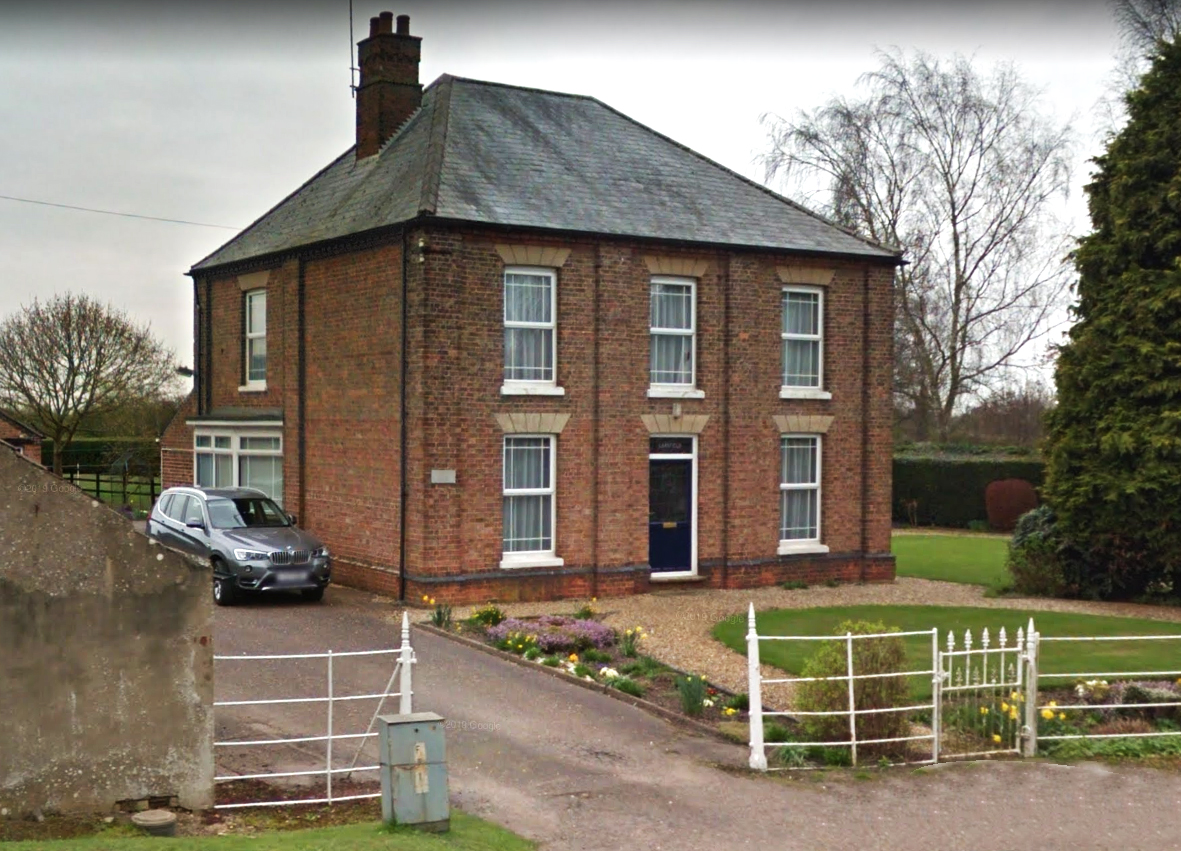
One of the farms in the area which welcomed the London visitors was that of John Stanton Batterham, of Larkfield, Lynn Road, Walsoken. His house still stands:

Larkfield

He was to play no direct part in the tragedy that unfolded on the afternoon of 16th July, 1912, but some of the people who worked for him – and two in particular – were key players.

Minnie Morris has been hard to trace using public records. Her mother, Minnie Gertrude Morris had married (a re-marriage) John M Stringfield in the autumn of 1911, but the 1901 census has her living with a Henry Morris (who was almost twice her age) in Grays Inn Buildings, Roseberry Avenue, Holborn. Also listed is a daughter, also called Minnie, born in Hoxton in 1891.

Screen Shot 2021-01-25 at 21.38.11

Minnie junior is hard to locate in 1911, but on the other side of town, in North Kensington, a young man named Robert Galloway was living with his large family in Angola Mews:

Galloway census

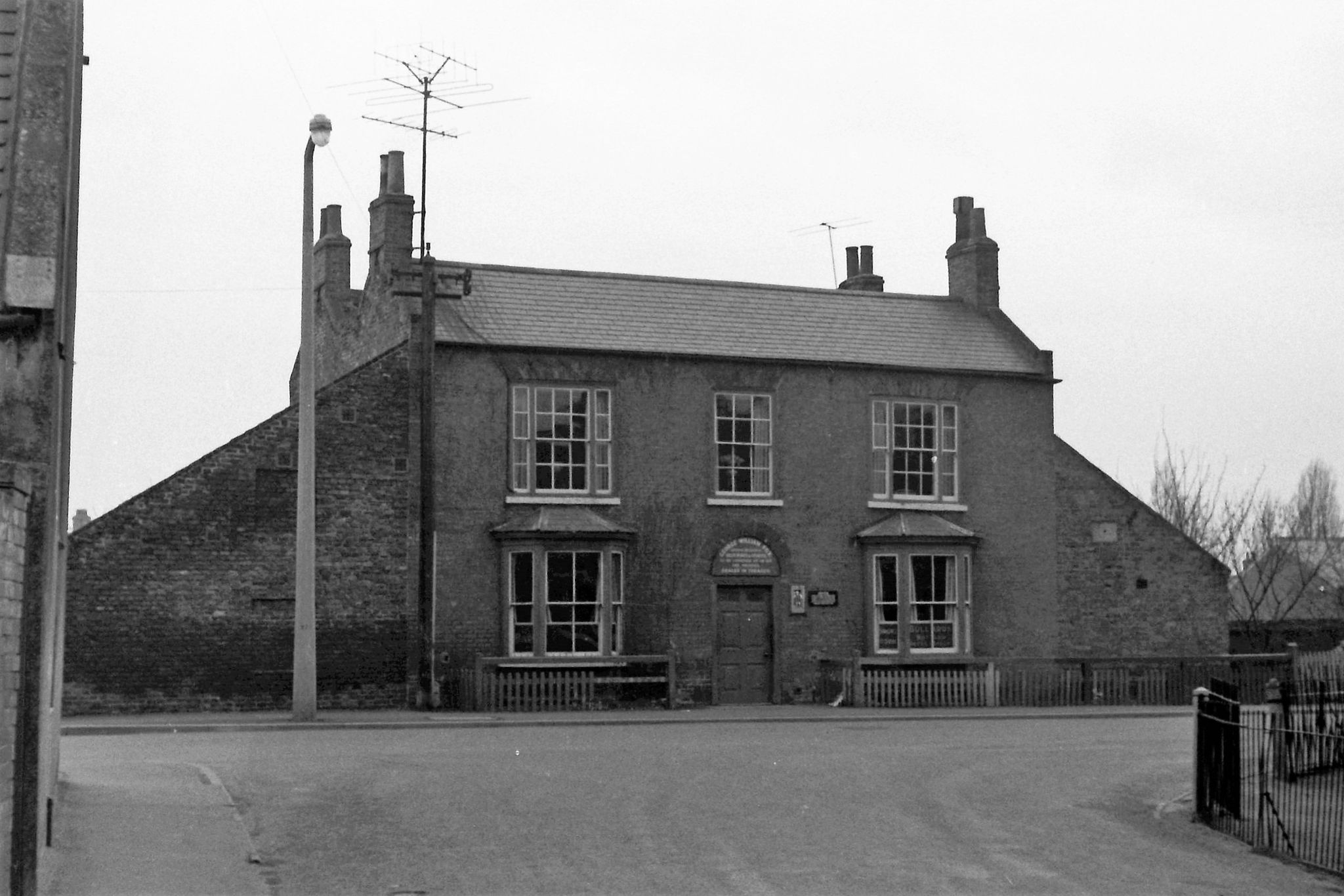
To call Robert and Minnie “star-crossed lovers” is probably pushing the Shakespeare analogy a step too far, but their paths crossed in the summer of 1912. Both turned up, from different parts of the country, to pick fruit for Mr Batterham. It seems that the hours were flexible, and there was money to be handed over the bar in The Black Bear, and the Bell Inn. The Black Bear still thrives, despite the curse of lock-down, but the Bell Inn is long gone. (below)

Old Bell

William Tucker, labourer, Old Walsoken, said he came from London in May last for fruit-picking. He knew Minnie Morris for a few months, and he met her in London. He saw her in the Bell Inn Walsoken, in June. He used to meet her about four times a week and was fond of her. He used to give her grub and spend evenings with her.”

Galloway was described as a seaman in contemporary reports, but there is no evidence to support this. Perhaps the term suggested something exotic and dangerous, and journalists at the time would be as aware of ‘clickbait’ as we are today, even though they might have used a different term. He was clearly violently jealous, and anyone paying court to Minnie Morris was regarded as a mortal enemy.

On 11th July there was a clashing of heads in the Black Bear inn.

Galloway saw William Tucker and Minnie Morris drinking together in the Black Bear inn. Galloway said: “Minnie. I want to speak to you.
She replied: “I’m all right where I am.”
Tucker and Minnie Morris then went out of the inn and stood talking. Galloway said the girl:

“If I don’t find you I’ll find him”, meaning William Tucker.

Over a century later, it is hard to come to any other conclusion other than that Robert Galloway was obsessed with Minnie Morris, and his feelings were that if he couldn’t have her, then no-one could.

IN PART TWO

A fateful stroll
A case for the police


CROW COURT . . . Between the covers

CC FOOTER

We begin in the peaceful Dorset town of Wimborne in the spring of 1840. Just a few months earlier, in the Chapel Royal of St. James’s Palace, London, Queen Victoria had marred Prince Albert of Saxe-Coburg. Louisa Chilcott and Samuel Portman are also due to be married, in the equally beautiful Wimborne Minster, but the joy of their day is short-lived.

CC cover015Just days earlier, Samuel had approached his best man, Charles Ellis, with a request for help. Louisa’s young cousin, Henry Cuff, is a member of the Minster choir, but it has been reported that he is desperately unhappy, is absenting himself from school, and refusing to sing in the choir. So how can Charles help? His half brother, Matthew Ellis is the Choirmaster. Could Charles please intercede, and try to find out what is the matter with young Henry?

Charles agrees, but with a heavy heart. He and his half brother are barely on speaking terms. Charles is gentle, urbane and conciliatory, while Matthew – a brute of a man – is bad tempered, censorious, and has an evil reputation. Charles speaks to Matthew, but gets nowhere. A visit to Henry Cuff and his parents is equally fruitless. The boy is clearly terrified, and Mr and Mrs Cuff are unhelpful.

Louisa and Samuel’s wedding goes off as planned, but Henry Cuff – who was due to sing a solo – is nowhere to be found. As the happy couple are basking in the love of well-wishers after the ceremony, a townsman interrupts the festivities with the terrible news that Henry Cuff’s body has been found in the river.

Resentment and anger at Matthew Ellis begins to seethe in the town. Things worsen when it becomes clear that Ellis has not only been cruel and bad-tempered with his boys, but has been abusing them in the vilest manner imaginable. When a  group of men decide to take things into their own hands, and Ellis disappears, the consequences are far reaching.

CC header014

The structure of this fascinating novel is worth examining. It is, in effect, fourteen short stories, cleverly written so that they stand alone – indeed, three of the episodes have been published separately – but are linked to a central event, in this case the disappearance of Matthew Ellis. I am struggling for a suitable metaphor; ripples in water spreading out from a central disturbance, maybe? The trouble with that one is that literal ripples weaken the further they spread, and in this case, with the time span being twenty years or more, the ‘ripples’ don’t weaken – they become stronger and more deadly.

I suspect that the author knows and loves his Thomas Hardy. There are tragic outcomes for many of the characters in this novel, not because they are bad people (the only malignant person is Matthew Ellis) but because they have made errors of judgment, or pursued a wrong option. The words that are singing in my ears come from the last page of Tess of the d’Urbervilles:

“Justice” was done, and the President of the Immortals (in Aeschylean phrase) had ended his sport with Tess.”

This book operates on so many levels. At its simplest it is a murder mystery, a whodunnit, almost, (and yes, we do learn the identity of the killer in the final pages) but it is also brilliant history reflecting, as it does, on the hardships inflicted on the rural poor by increased mechanisation. I won’t call it a comedy of manners, because there is very little to laugh about, but we are treated to intriguing glimpses of social conventions and the sensitive hierarchies of the mid nineteenth century. Finally, the book is shot through with beautifully imagined descriptions of the Dorset countryside across the seasons. Crow Court is Andy Charman’s first full length novel. It is published by Unbound, a crowdfunding publisher, and is available here.

CC explanation

SUFFER THE LITTLE CHILDREN . . . A Warwickshire murder (part three)

Header

THE STORY SO FAR … Fanny Dodd and Joseph Hewitt, two “star-crossed lovers” if ever there were, had a brief relationship in the summer of 1886. The result? A baby girl named Daisy Hewitt Dodd. In April 1887, the body of a baby is found beside a stream. Arrests are made.

MachinThen, as now, criminal cases are first presented at Magistrates’ Courts. On Wednesday 11th May 1887, Charlotte Dodd and her daughter Fanny  appeared at Kenilworth Magistrates’ Court, charged with the wilful murder of Daisy Hewitt Dodd.  The presiding magistrate was Colonel John Machen (left), a distinguished local figure and a surgeon by profession.. His military rank was an honorary one, awarded for his prominent role in raising the 10th (Leamington) Warwickshire Rifle Corps in 1860, becoming its first Captain.

The hearing was a brief one because, for some reason, the court demanded a formal identification of the victim. Consequently, the court was adjourned and a submission sent to The Home Office requesting that the recently interred body of baby Dodd be exhumed. The request was granted, and the poor child had one last, pointless indignity inflicted on her. The next day, the coffin was brought from the ground and opened in the presence of PC Standley and the church sexton. The newspaper report makes for grim reading:

Exhumation

On 18th May, the adjourned hearing reopened, and a bizarre tale unfolded. On the morning of 26th April, Charlotte and Fanny Dodd, carrying baby Daisy, had set out from their Moreton Morrell home to walk to Warwick. They were accompanied for part of the way by an elderly neighbour, a Mrs Wincote. She was told that Fanny was taking the baby to Stoneleigh, where it would be looked after by its paternal grandmother, Mrs Hewitt. The party arrived in Warwick and went to sit in The Castle Arms, where they ate bread and cheese, and drank beer. Not long after they arrived, Fanny Dodds left with the baby, presumably heading for Stoneleigh, some five miles away.

The landlady of The Castle Arms, Elizabeth Hannah Butler, testified that Fanny Dodds returned later on that afternoon, holding a bundle of baby clothes, stating that the grandmother didn’t need them, as she had plenty of her own.

Justice_Wills_Vanity_Fair_25_June_1896The magistrates’ hearing, despite its length, was a formality. Colonel Machen decided that there was a case to answer, and the cavalcade moved on – to the Warwick Assizes to be held at the beginning of August. The presiding judge was Sir Alfred Wills, (right) a Birmingham man whose career defining moment was yet to come,as he would be the judge in the third trial of Oscar Wilde and when the writer was found guilty of gross indecency, Wills sentenced him to two years hard labour.

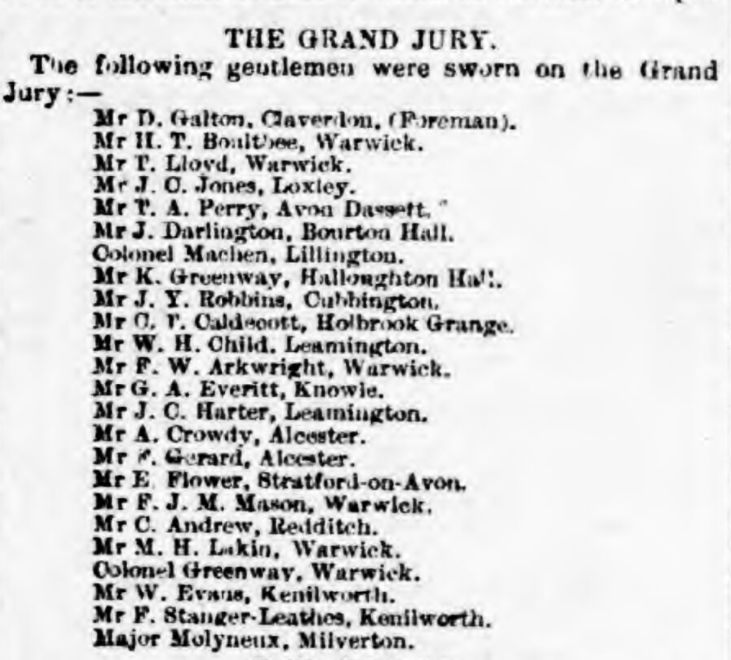
As was customary in those days, the names of the jurors were published in the press, and it is worth noting that among their number was Colonel Machen, who had been the magistrate when Charlotte and Fanny were first brought to court. The press report began in this fashion:
Prisoners pleaded not guilty. Mr Soden with Mr Keep conducted the prosecution, and the prisoners were defended by Mr Hugo Young, with whom was Mr Cartland. The Court was crowded and much interest was excited by the case. The younger prisoner, whose appearance is somewhat prepossessing, apparently felt her position keenly. Mr Soden, for the Crown, having given an outline the facts of the case, adduced the following evidence :”

Jury
The evidence was provided by the old lady who had walked into Warwick with Charlotte and Fanny on that fateful morning, the landlady of The Castle Arms, Joseph Hewitt and his father and, of course the police. The principle argument by the defence counsel was that Fanny, pausing at Wootton Court Bridge, had accidentally killed the baby by dropping it and had then panicked. Mr Young stated:

If that occurred  – and he submitted it was a most probable inference – it was only natural that the girl, with no one to advise her what do, should take means to hide the body, in order that she should not be charged with having intentionally killed the child. In the fear which was then upon her, it was a likely thing that she would take off its clothes so as not to leave any traces of identity. If it was her intention to have killed the child, he submitted that it would be improbable that she would go to Warwick, where she would be seen by many people, or that she would go far in the direction of Stoneleigh.

It was far more probable that she would have disposed of the body in another direction, without running the great risk of going to Warwick. After the occurrence he had described, the girl, upon getting home, told her mother all the had happened, and it was quite natural that the mother, in her endeavour to shield her daughter, would support her story.”

Another bizarre possibility was raised, and it was that Daisy had been killed in Moreton Morrell, and then carried into Warwick and on towards Leek Wootton. This was inferred from the fact that neither the old lady who accompanied them nor the pub landlady never once heard the baby cry or witnessed it being fed. The judge, in a lengthy summing up hinted that there was no evidence that Charlotte Dodd had done anything except cover up for Fanny which, as a mother, would be perfectly understandable. The Leamington Spa Courier reported the dramatic conclusion to the trial:

“The jury then retired their room, and were absent about half an hour. Upon their return into Court, and in answer to the usual question put the Clerk of Arraigns, the foreman said they found the younger prisoner, Fanny Goldby guilty, but strongly recommended her to mercy. They found the elder prisoner Dodd not guilty. The prisoner Goldby then stood with the assistance of the gaolers, and the Clerk of Arraigns (Mr Coleridge), who exhibited much emotion, put the formal question as whether she had anything to say as to why she should not die, according law.

The prisoner upon hearing this screamed in the most agonizing manner, and threw herself upon the floor the dock. She was held upon her feet by the gaolers and surgeon (Dr. Browne), and the Judge, having assumed the black cap, said: “Fanny Goldby, you have been found guilty of the crime of wilful murder. The jury recommended you to the mercy of the Crown, and that recommendation shall be conveyed to the Secretary of State, but I am bound say there is little except your youth to justify that recommendation, for it was a cruel murder of an unoffending child. There is but one sentence for this crime, and it is that you taken hence to the place from whence you came, and thence to the place of execution, and there hanged by the neck till you are dead and your body buried within the precincts of the gaol. May the Lord have mercy your soul.” The prisoner uttered several loud screams during the sentence, and was removed from the dock in a fainting condition.”

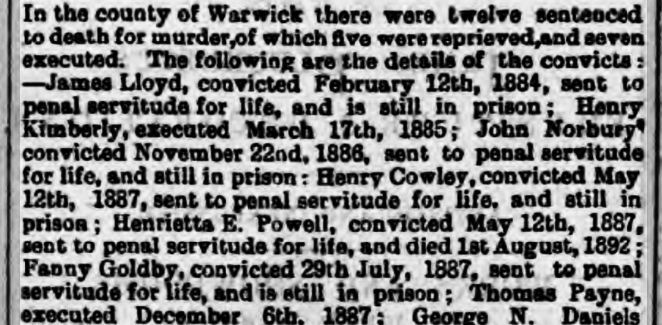
An application for clemency was sent to the Home Secretary, Henry Matthews, and Fanny was spared the death sentence, but was sentenced to penal servitude for life.

AFTERMATH

The sorry affair raises several questions that remain unanswered. Firstly, why was Fanny calling herself Goldby? She may have assumed the name when she fled to Birmingham, but one would have thought that the authorities would have insisted she revert to her maiden name during the legal process. Secondly, if Daisy was killed intentionally, what was Fanny’s motive? She had every reason to believe that Joseph Hewitt would continue his support for his daughter, and up until the fateful day there was every sign that the baby was loved and looked after – Fanny had even taken Daisy to the vaccination clinic. Thirdly, where did the baby die? It seems improbable that the two women would have carried a corpse all the way to Warwick and beyond, but for a normal baby to be silent for the duration of the six mile walk, and then still show no signs of life while the women had lunch in the pub is, at the very least, strange.

As to what became of the people in this story, we know that in 1891, Fanny was in the female prison at Knaphill near Woking, After that, apart from one mention, she goes off the radar. The Dodd family were still in Moreton Morrell

Prison

in 1901, but not in 1911. In 1901, the Hewitts still kept the shop in Stoneleigh, but Joseph had left home, destination unknown.

Courier

18932

18931

SUFFER THE LITTLE CHILDREN . . . A Warwickshire murder (part two)

Header

THE STORY SO FAR . . . It is the spring of 1887, a young woman from the Warwickshire village of Moreton Morrell, Fanny Dodd, has given birth to a baby girl. The child, registered as Daisy Hewitt Dodd is, in the parlance of the day, illegitimate. The father, Joseph Hewitt, a baker from Stoneleigh has accepted that the child is his, and has sent money by post to Fanny to help with the child’s upkeep.

On the morning of 26th April a man named Thomas Hoare, of Chesham Place, Leamington Spa was on the road between Warwick and the village of Leek Wootton. He was described in the press as a hawker – someone who sells items from place to place. By the very nature of the job, the goods have to be carried, and Hoare paused to rest, perching on the parapet of a little bridge, under which ran a small stream. He often used the spot to rest his legs on his journey from Warwick to Kenilworth, but out of the corner of his eye he noticed something unusual. Lying at the edge of the stream was what appeared to be a small bundle. When he took a closer look, Hoare was shaken to the core when he realised that it was the body of a baby.

Hoare alerted two other men who were on the road, and they went to find a policeman. First on the scene was a PC Fletcher, and he later stated that the dead infant wore only a nappy and a little shirt and, incongruously, was wrapped in brown paper. Two days later a Kenilworth surgeon, Mr Clarke conducted a post mortem examination. An inquest was held the next day at The Anchor inn in Leek Wootton. He found:

“…the child to be about five or six weeks old. It was not a particularly small one. He examined the body externally, and found that the child had thick dark hair. was well nourished. Upon feeling over the head, he discovered the symptoms of a fracture of the skull, and there was discolouration around the right eye, and opaqueness of the pupil. The discolouration was something like a bruise. There was no evidence to show that the child had been drowned. He took off the skull, and found extraverted blood. The fracture was about four inches in length and two in breadth. It involved two bones – the parietal and temple bones, and extended from the right eye. He removed the bones at the seat of the fracture, and found effusion of blood on the brain.

The fracture was sufficient to cause death. He was of opinion the fracture was caused during life, because there was the effusion of blood. At that time he formed an opinion that the child had been dead only a few hours, as it presented such very fresh appearance. It was quite possible for child to been there four or five days during that cold weather without decomposing. Judging by the appearance of the child, and the cold weather, he was now of opinion that it might have been dead four or five days.”

Anchor

The child – its short life ended – was  buried in the churchyard at Kenilworth, but for the police this was just the beginning. There was only one clue as to the possible identity of the child. On the brown paper were written the words “Dodd, passenger to Milverton Station”. Contemporary archives shed little light on the police investigation, or how they made the connection to the Dodd family in Moreton Morrell, but we know that on 5th May Sergeant Alcott and PC Standley visited the cottage. They found Charlotte Dodd, aged 47, and asked her if she had a daughter with a baby. Mrs Dodd answered in the affirmative, but said that her daughter had moved away, taking the child with her.Mrs Dodd was arrested and taken into custody.

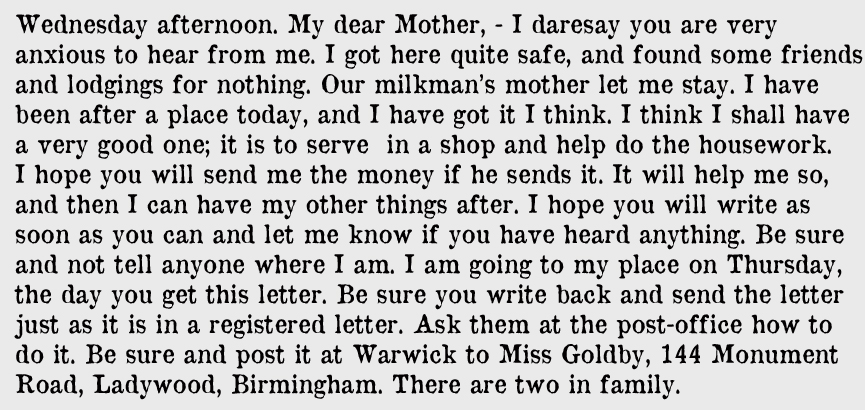
The police searched the cottage and found brown paper identical to that which had been used as a makeshift shroud for the dead baby. Crucially, they also found a letter, which the newspapers later printed:

Letter2

Sergeant Alcott In company with Detective Baker, went to 144, Monument Road. Birmingham, and found Fanny Dodd, now calling herself Goldby. They went outside together, and Alcott asked her if her name was Fanny Goldby, and if she had been living at Moreton Morrell, and she replied
“Yes.”
He also asked her she if had had a child about six weeks ago and she replied,
“About two months ago, sir.”
He asked her where the child was, and she replied,
“Morton Morrell.”
He then told her he should charge her with the murder of the child on or about the 20th April, and she made no reply. He then took her into custody, and brought her Kenilworth. After the remand at Milverton, he took the prisoner her to Warwick Gaol in a cab. She said,
“How long have I got to stay here, sir?”
Alcott told her that she would stay in gaol until the magistrates’ hearing the coming Wednesday. She then said,
“Do you think they will hang me? “
He replied,
“I can’t say.” 

IN PART THREE

An exhumation
The law takes its course
Unanswered questions

SUFFER THE LITTLE CHILDREN . . . A Warwickshire murder (part one)

Header

In 1870-72, John Marius Wilson’s Imperial Gazetteer of England and Wales described the Warwickshire village of Moreton Morrell like this:

Screen Shot 2021-01-19 at 18.43.38

The 1881 census records that living in a cottage on Morrell Farm in the village were the Dodd family.

Census

Just six years later, Charlotte Dodd and her daughter Fanny were to be the central figures in a murder case which shocked the country. Fanny Dodd was evidently something of a beauty. In the court case which decided her fate she was described thus:

“The younger prisoner, whose appearance is somewhat prepossessing….”

By 1886, Fanny had taken a very common career route for young women from poor backgrounds – she went into service. Wealthy families had servants, and the Trueloves of Stoneleigh – a village between Leamington and Coventry – were no exception, and Fanny was their domestic servant. Stoneleigh is the site of a Cistercian abbey, but it suffered the fate of so many similar institutions at the hands of Henry VIII. The Leigh family had acquired the site in 1558, and in the eighteenth century, a grand house was built on the site, and Benjamin Truelove was a tenant farmer of the current Lord Leigh.

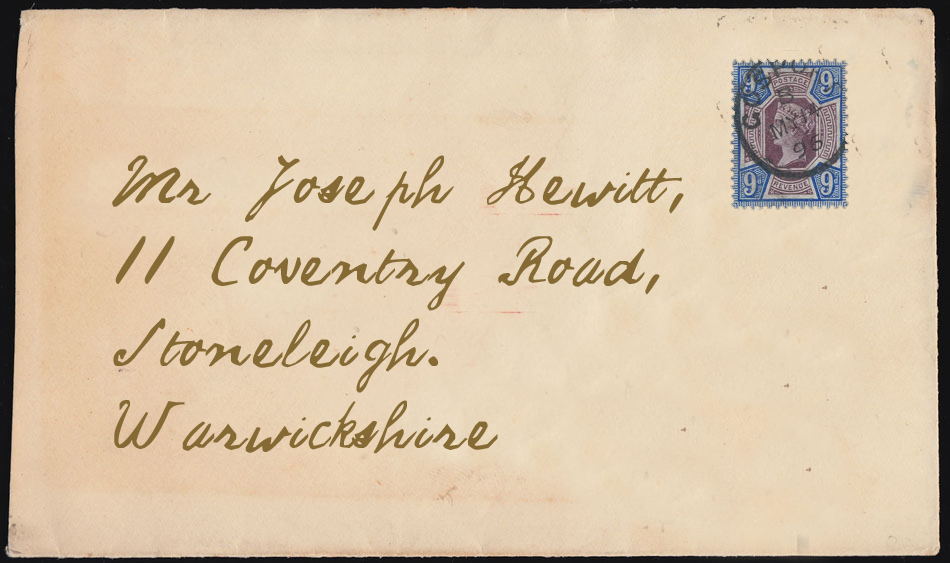
Stoneleigh had a Co-operative Stores, and it was managed by William Hewitt. His son, Joseph, had learned the bakers’ art, and had a comfortable life in the family home. At some point in 1886 the 18 year-old lad had come into contact with Fanny Dodd, a couple of years older than he, and something of a beauty. Evidence given at Fanny’s trial suggests that on Whit Sunday  – 13th June – the pair had gone for a walk together, and somewhere near Pipe’s Mill – a water mill on the River Sowe – one thing had let to another, and the couple had, well, coupled (please feel free to substitute your favourite euphemism).

Getting pregnant was certainly not in the job description of domestic servants in Victorian times, so at some point later in 1886 Fanny returned to Morton Morrell. On 8th March, 1887, Fanny gave birth to a healthy girl. The child was duly registered, and her name was Daisy Hewitt Dodd.

At this point there was no evidence to show that Fanny Dodd had any feelings other than love for her daughter. Indeed, records showed that she had taken Daisy to nearby Wellesbourne to be vaccinated – probably against snallpox.

On 15th March, Fanny sent a letter to the young man she believed to be the father of her child.

Morton Morrell, 15th March.

Dear Joe
l dare say you will surprised hear that I was confined last Tuesday—a little girl. Of course it has come from last Whitsunday, when of course you know what took place by Pipe’s Mill. It comes exactly from that time. At least I know it belongs you, because there has not been any transaction between me and any man since I went with you then. Dear Joe, I hope you will come to some arrangement. Once, when you asked me, I said not, but I did not know for certain then, but I knew before I left Trueloves for I had gone half my time nearly when I left her. I hope you will either have me or come to some pairing arrangement without going to any further trouble. I ought to have written to you before now, but I kept it from everyone, not even my mother knew I was in the family way until the child was born on Tuesday. I am very weak and can scarcely scribble this letter. I ought to have written to you before. I very sorry it ever occurred. I think the child will own you anywhere. It is a strong healthy looking baby, and likely to live. I think have told you all at present. Believe me, yours sincerely Lizzie, or, as they call me, Miss Dodd.

letter

Joseph Hewitt was evidently not prepared to settle down to married life. A couple of days later, he replied. The substance of what he wrote was never recorded, but one can guess what he wrote, judging by Fanny’s reply:

Mr J. Hewitt – I am writing to thank you for the money that you sent me, which I received quite safe last Tuesday morning, but I was quite surprised at the abusing letter you sent me: and as to saying the child belongs to Charley, that quite untrue, for I am quite sure it belongs to you, and if you do not continue to pay the money I shall swear it on you, because I have things against you to show plain proof. You know you bought me gin and came to meet me with it, but I didn’t take it. and then you sent me that 10s. That has done it at once if I was to swear you. I shall be sure to get pay, for Lord Leigh only asks the girl a few questions and if I tell him you cannot get over it, and it will be nothing but the truth. The time will tell anyone; it comes from Whit-Sunday, at least. I never had any dealings with anybody else, and if old Joe says he can prove it, I should like him to do so. And as for my carrying on here with chaps, I have only spoken to one since I left Stoneleigh. I can get that proved by the people at Moreton Morrell, and can get it proved that those people that told you are very great liars. If they were to look at home and themselves, they have no room to talk about me, and as for you calling me a prostitute, I think you had better mind, or I shall come over and see you and some one else too. I shall expect to hear from you again on the eighth of next month, or I shall swear it was you. The child belongs to you. I should never have said it was yours if you did not get me into trouble, and now you must help me to get out it. People were great liars to say we knocked French’s wheat down, and if we had, the child did not come from that, but we did not. F. Dodd.

Several truths emerge from this exchange. Firstly, Fanny and Joe had enjoyed a brief but tumultuous sexual relationship. Secondly, Fanny had what we might call something of a reputation – she was clearly a very attractive and passionate young woman. Thirdly, Joe Hewitt had been swept off his feet but, while being prepared to send money for the upkeep of his daughter, saw no future in a long term relationship with Fanny Dodd.

IN PART TWO

A gruesome discovery…
A brown paper clue
A trip to Birmingham


THE ART OF DYING … Between the covers

TAOD header

Ambrose Parry is a pseudonym for a collaboration between Chris Brookmyre and Marisa Haetzman (pictured below). They  live in Glasgow,  slightly less genteel – at least in popular image – than Edinburgh, where this novel is set. It novel weaves together two stories, both of which have have factual origins. One strand deals with an horrific serial killer and her victims, while the other story is seen through the eyes of a young doctor in the middle years of the 19th century. The novel is a follow-up to the 2018 publication, The Way of All Flesh.

71tHql951uL._SX800_

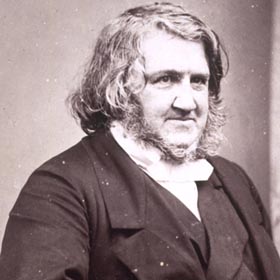
SimpsonThis is not a book for those squeamish about medical details – especially those common in the 19th century. There are tumours, painful deaths both lingering and sudden, surgical procedures that involve much guesswork and hopeful blundering about the human body – externally and internally. If you are still with me, then the story is this. It is 1849, and we first meet young Dr Will Raven when he is involved in a street brawl in Berlin, where he has been studying. He survives the encounter, and returns to Edinburgh, where he is reunited with his former mentor, Dr James Simpson. Simpson – a real-life character, pictured –  is highly regarded, but also the object of much jealousy from less gifted physicians, and is facing charges of malpractice brought about by his envious peers.

Raven had hoped to find an earlier object of his affections – a young woman called Sarah, who also worked with Dr Simpson – available for further dalliance, but in the interim, she has married another doctor, Archie Fisher. He is terminally ill, and as both Will and Sarah are aware of this, the sad fact adds a certain piquancy to the relationship.

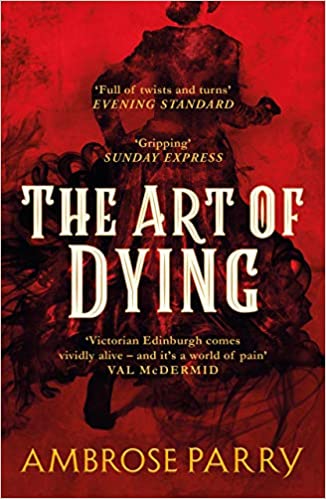
TAOD cover2Away from the relative gentility of the Simpson household, we have a young woman who moves in very different circles. She has suffered a brutal and traumatic childhood. This has either directed her on a devilish pathway, or kindles a spark which was already there but, either way, she has become a murderer. The writers employ an obvious – but effective – counterpoint here, in that Sarah Fisher desires to become a doctor, while Mary Dempster seeks to hone her skills as a killer. Contemporary society believes that a woman cannot possibly be a success in either occupation.

It takes a while for Will and Sarah to come round to thinking the unthinkable – that Mary Dempster is a clever and a successful killer. Because we, as readers, have had the advantage of reading first-person-viewpoint chapters, we know that she is a devious and malevolent individual. Yes, she has had a terrible upbringing, involving degradation and abuse, but not all orphans who suffered at the hands of Victorian institutions turned out to be serial killers.

As I said earlier, if you are the kind or reader who would shudder at the thought of reading a cut-by-cut account of an early surgical attempt to save a woman from an ectopic pregnancy, then this may not be the book for you. Bolder souls will enjoy a gripping and twisty murder mystery shot through plenty of gore and passion. The Art of Dying came out in hardback in August 2019. This paperback edition is published by Black Thorn and is out now.

Blog at WordPress.com.

Up ↑