
Search

fullybooked2017

Tag

Jonathan Kellerman

THE LOST COAST … Between the covers

lost coast SPINE073 copy

Sometimes, how co-writing works seems fairly obvious. Ambrose Parry is the husband and wife writing team of Chris Brookmyre and Dr Marisa Haetzman. Their books are set in early 19th century Edinburgh, and centre on a physician called Will Raven. I imagine Chris provides the crime fiction experience – plotting, dialogue and such, while Marisa provided the (sometimes gory) medical details. Much as I admire James Patterson for his early books (and his amazing work for charity) I imagine that these days, when you see a novel by JAMES PATTERSON (large print) WITH (slightly smaller print) RANDOM NAME, all he is doing is replicating the painting school in Renaissance Europe, where a painting might be identified today as “school of” Raphael, or Leonardo, but was actually produced by apprentices working to a set formula. Incidentally, I am told that there is a “school of” Damien Hurst, which involves budding young artists sitting in a studio making objects in the stylle of ‘the master’. I am a huge fan of Jonathan Kellerman’s Alex Delaware books, and if his son has some input with this, the latest book in the Clay Edison series, then fair play, as long as it is readable – and it certainly is.

Clay Edison is a former San Francisco coroner, and I reviewed previous books in the series, Lost Souls and The Burning (click the links to go the reviews). Now, Edison has given up working for the state, and is registered as a private investigator. This case starts when an old friend is unexpectedly named as executor in a deceased relative’s will. He asks Edison for help, because he has discovered that the old lady had been paying monthly amounts for years into what seems to have been a mortgage on a property in a remote coastal settlement called Swann’s Flat.

Initially doing much of the work online, Edison suspects that a massive scam has been set up. Yes, Swann’s Flat exists, but the houses and building plots are nothing like those shown in the glossy brochures which have sucked in many gullible people. The business structure is a complex web of false corporations hiding behind other companies that exist in name only.

Edison makes the long drive to see for himself. The place is wild, remote, and the last few miles into the settlement are a terrifying drive along a steep trail that rises and the plummets between vertiginous cliffs and gullies. When he finally makes it into the tiny town, he finds one or two larger houses behind forbidding security arrangements, but most of all he sees ‘streets’ that have name posts, but no houses, no utilities and a general sense of being abandon. There is, however, a hotel, where he checks in under an assumed name. Later, after meeting Beau Bergstrom and his father Emil, who seem to be the town bigshots, he convinces them that he is looking to buy a building plot.

By now, the writers have introduced what seems to be a separate plot involving a missing college-age boy called Nicholas Moore, whose poster was pinned up, with several others, outside a grocery store in the next town along. Edison is intrigued by this, and when he leaves Swann’s Flat, telling the Bergstroms that he is going to sort out all the arrangements for the land purchase they think he is going to make, he returns to The Bay Area, and makes contact with the boy’s mother,Tara. She is single, neurotic, and initially doesn’t trust Edison. She tells him she no money to pay for another investigation, but gives him the name of the last person she hired, a woman called Regina Klein.

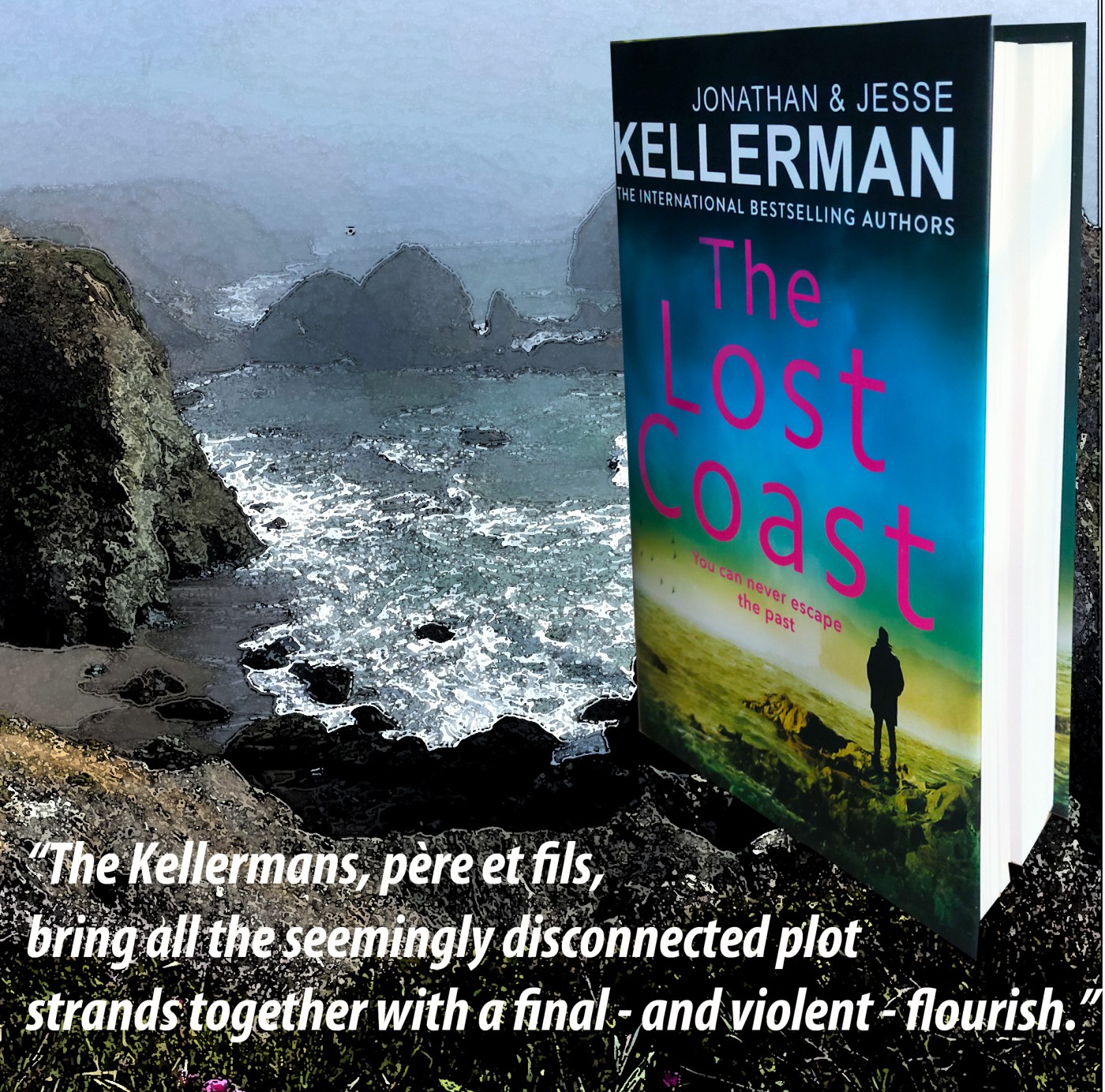
There is yet another strand to the plot, and this involves an avant-garde novelist called Octavio Prado, with whom Nicholas had become obsessed. Prado, too, has disappeared, leaving only the one widely acclaimed published work, and another which was so over-the-top that his agent failed to find a publisher. It remains, in original handwritten form, and this becomes key to what is going on. The case has thrown up many seemingly unconnected questions, but Edison believes that the answers to them all lie in Swann’s Flat. He persuades Regina Klein to join him and, posing as man and wife they return. The Kellermans, père et fils, bring all the seemingly disconnected plot strands together with a final – and violent – flourish. This entertaining thriller is published by Century and is available now.

Screen Shot 2024-08-20 at 18.07.11

THE GHOST ORCHID . . . Between the covers

TGO spine018 copy

I suppose in the kingdom of detective partnerships, Holmes and Watson will never be dethroned, and quite rightly, too. I would however nominate (alongside Rizzoli and Isles, Morse and Lewis, Bryant and May, Wolfe and Goodwin) Alex Delaware and Milo Sturgis. Jonathan Kellerman’s duo of a child psychologist and LA homicide cop have for me, in dozens of novels, never failed to deliver. Yes, there’s a formula at work here, but that’s what makes all these partnerships work. Sturgis is abrasive, socially insecure and, because of his homosexuality, fighting an endless battle against his censorious LAPD colleagues, but he is a brilliant investigator: add into the mix Delaware’s social awareness, acutely attuned antennae for  people telling lies, and you have a winning mix.

A glamorous woman and a younger man are found shot dead at a Bel Air property. Her expensive jewellery has not been taken, and it looks like a professional job. Sturgis asks Delaware to take a look at the crime scene*.

*For new readers who wonder why Delaware is brought into the case, it’s simple. It’s the way the books work. Sturgis is something of a maverick, loose-cannon, lone-wolf – choose your own metaphor- and as long as he does the business, his colleagues leave him alone, so he always welcomes the extra pair of eyes and psychological insight that Delaware brings. In case you were wondering, Delaware earns a good living as a court-acknowledged expert in legal cases involving children so, thankfully for fans like me, he can afford the time to help Sturgis.

It transpires the dead woman is Meagin March, whose husband Doug is a real estate billionaire, and the corpse alongside hers belonged to, as they say, her toy-boy. Not short of a cent or three himself, Giovanni Aggiunta is the errant younger scion of a top draw Italian shoe making firm. He receives a generous allowance to amuse himself while his older brother and other family continue creating wealth with their exclusive designer footwear.  is not all she seems to have been, however, and it turns out that in a previous life she was a Vegas glamour escort. Yes, she finally snared Mr Right – and a life of luxury – but Delaware and Sturgis can find no-one who has a bad word to say about the murdered lovers, but become convinced that the woman was the intended target, and that her Italian lover was, sadly, collateral damage.

Doug March is a thoroughly unpleasant fellow. He was away on a business trip at the time, so it wasn’t his finger on the trigger of the .38 revolver, but could he have been so angry at Meagin that he hired a contract killer? Delaware is convinced that there is a message waiting to be discovered in one of the rooms of the March’s mansion. Meagin was an amateur artist and the room was her studio. All but one of her paintings are unremarkable ‘chocolate box’ scenes, but the exception seems to be a particularly severe abstract. Eventually, Delaware’s live-in romantic interest, Robin, identifies as a painting of a strange and rare flower, known as a ghost orchid*.

*Dendrophylax lindenii, the ghost orchid (a common name also used for Epipogium aphyllum) is a rare perennial epiphyte from the orchid family. It is native to Florida, the Bahamas, and Cuba. Other common names include palm polly and white frog orchid.

Robin provides more insight by suggesting that Delaware and Sturgis take a look at the unusual spelling of the dead woman’s name. I won’t say any more, but it’s not too hard an anagram to solve. These fresh clues result into a deep dive into ‘Meagin’s’ childhood which reveals horrors hitherto unsuspected. Delaware and Sturgis finally get their killer, but not quite in the way they were expecting. This is another classy and absorbing tale from the casebook of one of modern crime fiction’s most endearing partnerships. It is published by Century/Penguin Random House and will be out on 15th February.

UNNATURAL HISTORY . . . Between the covers

UH spine

Guilty pleasures? At my time of life, there should be no guilt involved. I have no intention of troubling the funeral director just yet, but I am nearly six years over my biblically allotted span and I will take every opportunity to enjoy my reading on my terms, and I do love a good series. Yes, I know the analogies – comfortable slippers, well-worn cardigan and all the rest. But why not? When time is not on one’s side, what is the point of enduring the pain of breaking in new shoes? Other metaphors are available, but here are a few of my favourite series by authors who are still with us.

Series

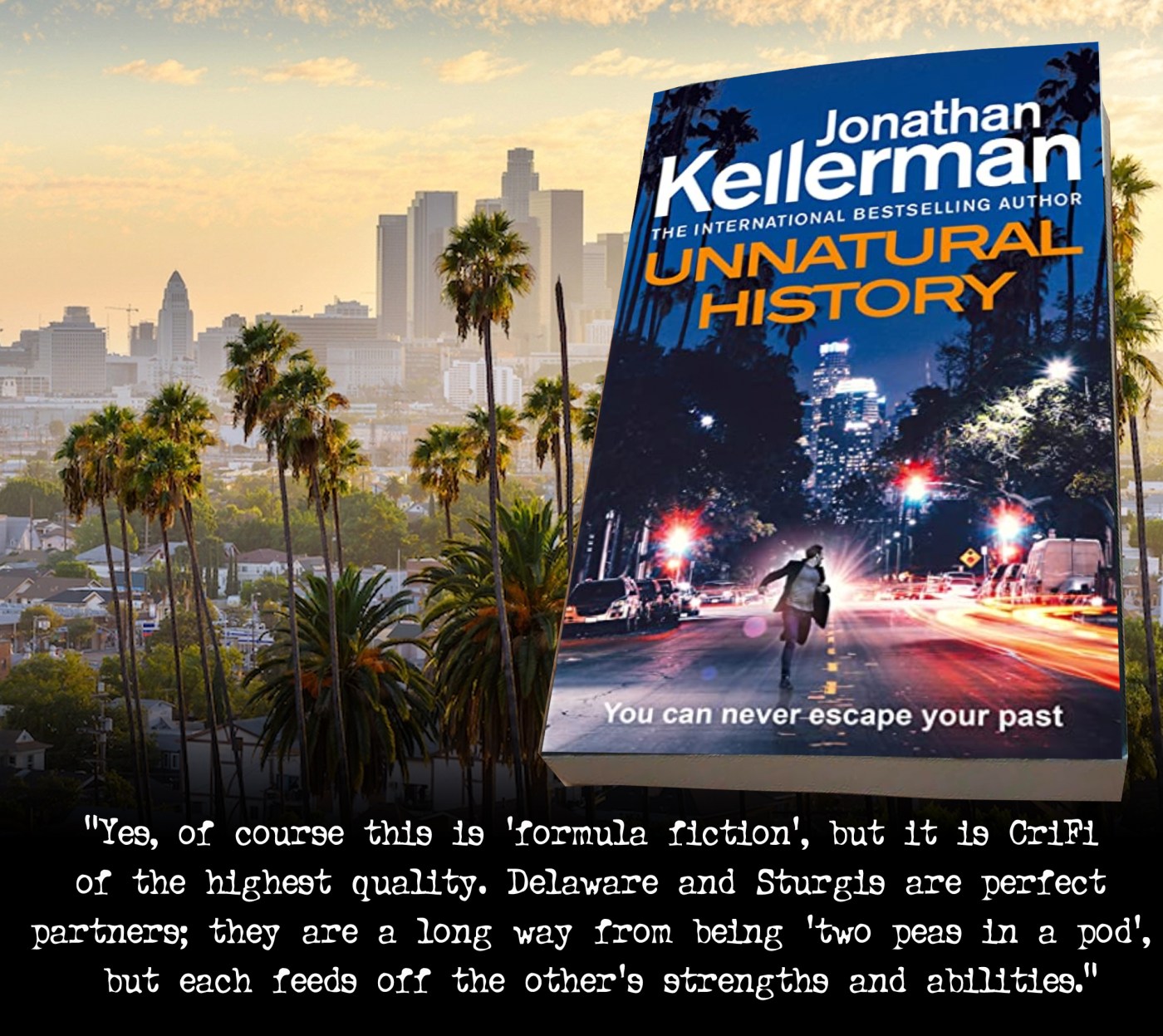
With that heartfelt (not) apology out of the way, here’s my take on the latest Alex Delaware novel from Jonathan Kellerman, Unnatural History. Quick bio. of Dr Alex Delaware (who first appeared in 1985, so he is one of those characters for whom time stands still). He is a Los Angeles forensic psychologist, his live-in girlfriend is a builder/restorer of high end guitars and stringed instruments, and he is involved in crime due to his friendship with Detective Milo Sturgis who is gay, very smart, and a man who, if eating were an Olympic event, would be a multiple gold medal winner.

Adonis ‘Donny’ Klement, an artist who specialises in photography, has been found shot dead in his converted warehouse studio. Three bullets to the chest, bang, bang bang – a concise equilateral triangle. Donny is a member of a very unusual family. His father Viktor is an elusive and secretive billionaire businessman, so careful to escape publicity that not a single photograph of him exists. He has a strange habit. He marries, fathers a child, and then moves on. Donny was the latest progeny, but he had several half-siblings.

By all accounts, Donny was gentle, talented, but rather naive. His most recent project was called The Wishers. He recruited several homeless down-and-outs, dressed them in exotic and fantastical costumes,and photographed them. They were well paid, but was one of them deranged enough to come back and murder the man who, if only for a brief hour, had enabled them to act out their fantasies?

Delaware and Sturgis are convinced that the murder of Klement is connected with the street people he brought into his studio, and when one of them – a deaf mute woman called Jangles – is found strangled, it begins to look as if they are right. Or are they? There is an elegant and clever plot twist which confirms that they were, but not quite in the way they were expecting.

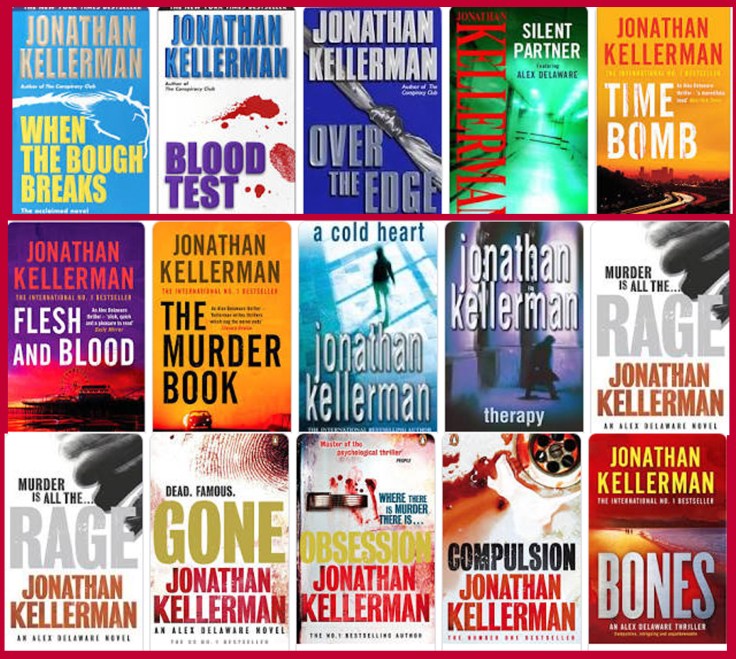
As well as Kellerman’s taut dialogue and plotting, we should not forget that he is up there with the best writers (including his contemporary Michael Connolly and the Master himself, Raymond Chandler) in bringing to life the dramatic contrasts of the LA landscape, with its beaches, grim neon strip-malls, spectacular hills and – more recently – the horrific shanty cities full of homeless down-and-outs. Yes, of course this is ‘formula fiction’, but it is also CriFi of the highest quality. Delaware and Sturgis are perfect partners; they are a long way from being ‘two peas in a pod’, but each feeds off the other’s strengths and abilities. Unnatural History is a riveting read, and will be available from Century/Penguin Random House from 16th February. Click the image below to read more reviews of books by Jonathan Kellerman.

JK footer

THE POSTMAN DELIVERS . . . Barton, Gough, Kellerman & Leavers

Header

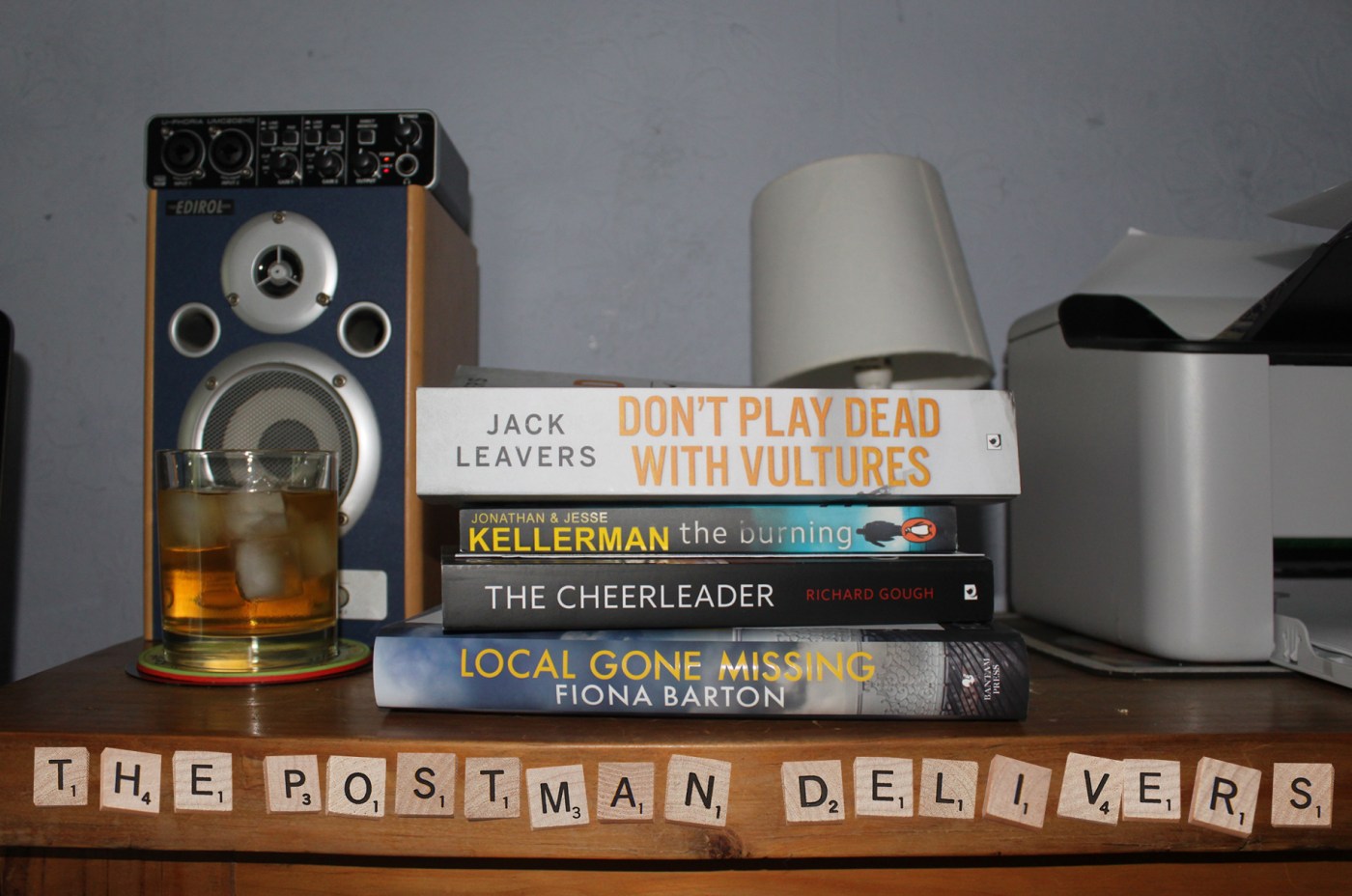
LOCAL GONE MISSING by Fiona Barton

Detective Elise King moves to the apparently placid seaside town of Ebbing after illness threatens her career. What should be a period of rest and recuperation turns distinctly nasty when tension between locals and  rich weekender visitors bubbles over into violence. When two teenagers end up in hospital and a local man vanishes without trace, Elise searches for answers from the community, but all lips are sealed. This will be out on 9th June from Bantam Press. Back in 2019 I read and reviewed Fiona Barton’s The Suspect, and you can see what I thought by clicking this link.

THE CHEERLEADER by Richard Gough

The Cheerleader is a psychopathic serial killer who is terrorising London. On the trail is maverick Detective Chief Inspector Rachel Cortes who, with a reputation for arrogance and a very individual approach to policing, has to try to get inside the mind of a mentally disturbed person who – just like her –  makes their own rules. The Cheerleader is available now, and is published by The Book Guild.

THE BURNING by Jonathan  and Jesse Kellerman

The latest case for Deputy Coroner Clay Edison involves the mystery of a millionaire found dead in his luxury hilltop home. The matter becomes personal when, at the crime scene, evidence is found that links to Ckay’s own brother Luke, recently released from prison. This came out in hardback last year, and you can read my review here. This paperback edition will be out on 12th May and is published by Penguin.

DON’T PLAY DEAD WITH VULTURES by Jack Leavers

Author Jack Leavers is a former Royal Marine with over thirty-years’ experience spread across the military, private security, corporate investigations, maritime counter-piracy, and risk management. This fast paced novel reflects his own experiences, and features mercenary John Pierce as he battles greed, intrigue, a ferocious climate and international gangsters in the inhospitable jungle of what used to be known as French West Africa. Don’t Play Dead With Vultures is published by The Book Guild and is available now.

CITY OF THE DEAD . . . Between the covers

cotd012 copy

This is another case for psychologist  Professor Alex Delware and his buddy, LAPD cop Lieutenant Milo Sturgis. As ever, the book is brimming with all the joys of Californication – fake lifestyle gurus, washed-up former pop stars, bent lawyers, damaged families and dead bodies – always plenty of dead bodies. The first of these is of a young man, stark naked, who – in an apparent psychotic episode – runs out from a house in a smart district in the LA suburbs, at 4.00am – and straight into the side of a moving truck. Instant fatality.

cotd013When the cops investigate the house from which the young man ran, they find the second corpse of the morning, with her throat slit. She is – or rather was – Cordi Gannet. She made a decent living producing lifestyle videos for YouTube, full of cod psychology and trite advice about life improvement strategies. Her psychology degree was apparently bought mail-order from an on-line university, and when Alex Delaware gets to the scene with Milo, he remembers that he was once involved in a child custody case where Cordi Gannet was introduced as an expert witness – with disastrous consequences.

They soon find that Cordi Gannet’s family background was suitably California Chaotic – no known father, a mother who scraped by waiting tables until she got lucky and married an affluent surgeon. As for the young man, after much tail-chasing they learn that he was a harmless and affable young hairdresser who had something of a ‘gay-crush’ on Ms Gannet with all her pan flutes and whale songs, but had no obvious enemies.

The investigation meanders, slows – and then grinds to a halt. Delaware and Sturgis are sidetracked by another murder – the killing of a violent testosterone-fueled bodybuilder whose onetime business partner was a former adversary of Delaware’s in the family courts. This one they manage to crack, but it is not until Delaware goes back to the day job and begins consultation sessions with another pair of warring parents – one of whom was a  near neighbour of Cordi Gannet, that the breakthrough comes.

Screen Shot 2022-01-19 at 19.13.17Watching the Delaware-Sturgis partnership work on a case is fascinating. Yes, by my reckoning this is the 37th in the series. No, that’s not a typo. Thirty seven since their debut in When The Bough Breaks (1985). 1985. Blimey. Amongst other ground-breaking events in that year, I read that Playboy stopped stapling its centrefolds, the first episode of Eastenders was broadcast, and Freddie Mercury stole the show at Live Aid. But I digress.
There are no surprises in City of The Dead, at least in terms of the personal dynamics between the investigators. Delaware is super-cool, Sturgis has zero dress sense and is inveterate fridge raider, and the pair never really get ‘down and dirty’ with the criminals they hunt. In spite of the familiar formula, this is still a cracking read and cleverly plotted, with Kellerman (right)  setting several snares for the unwary reader. City of The Dead is published by Century, and will be available from 17th February.

THE BURNING . . . Between the covers

Burning027 copy

The Kellerman family – Jonathan, Faye and now Jesse – seem to be able to turn out highly readable thrillers at the flick of a switch. My personal favourites are the Alex Delaware novels, but this is the second Clay Edison book I’ve read, and it’s excellent. The Burning is billed as 4 of 4, so the series will come nowhere near the astonishing 36 books books of the Delaware series (with the 37th due next year) You can read my review of the 36th, Serpentine, by clicking the link. My review of the third Clay Edison book, Lost Souls is here.

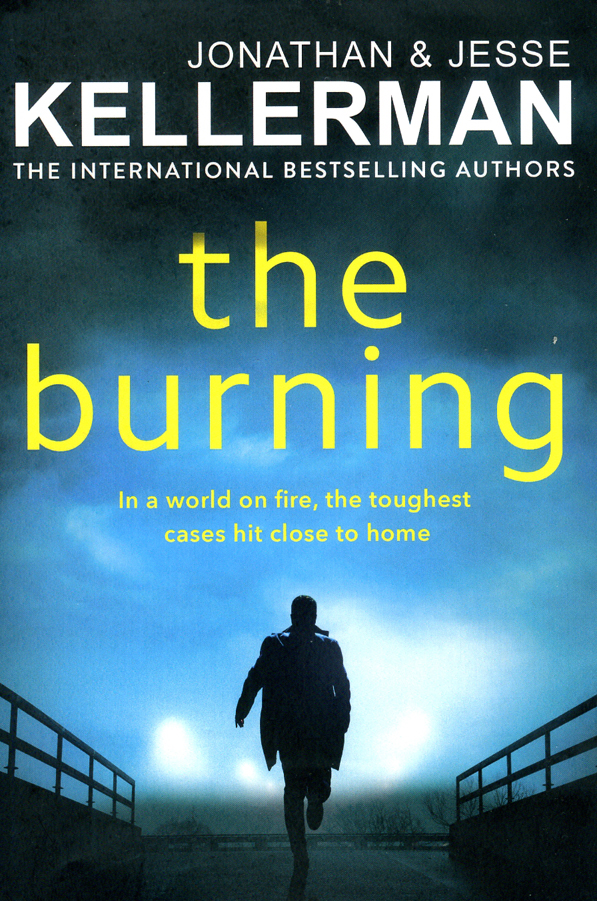
Burning028But back to Clay Edison. He is a Deputy US Coroner in Berkeley, California, and The Burning begins, quite topically, with a destructive bush fire that has knocked out power supplies for everyone except those with their own generators. When Edison and his partner are summoned to retrieve a corpse from a mansion up in the hills, they find that Rory Vandervelde – a multi millionaire – has died from gunshot wounds. He was an avid collector. Rare baseball and basketball memorabilia, Swiss watches, antique knives – you name it, and Vandervelde had bought it. It is when Edison is inspecting the dead man’s astonishing collection of classic cars, stored in a huge garage, that he discovers something that sends a shiver down his spine, and not in a pleasant way.

“I’d missed the Camaro on my way in. So much to gawk at. Eyes not yet adjusted. I saw it now. It was, to be specific, a 1969 SS/Z28. V8 engine, concealed headlights, black racing stripes, custom leather upholstery.

A hell of a car. One that I recognised specifically. I had seen it before. Not once, but many times.

It was my brother’s.”

Edison muses that there has to be an innocent explanation why his brother’s prize possession – a car he had restored from near junk – is in the murdered man’s garage. He surely wouldn’t have sold it to him? Luke Edison is a reformed addict who has done jail time for killing two women in a drug fuelled car theft, but he has rebuilt not only the car, but his life. Simple solution – call Luke on his cell phone. No answer. Repeated calls just go to voice mail. Clay Edison has the black feeling that something is very, very wrong, but in an instinct for family protection, he tries to prevent any of his law enforcement colleagues from identifying the vehicle’s owner and linking him with the murder.

No-one – Luke’s neurotic hippy partner, his parents, his boss at a marijuana-based therapy start-up – has seen or heard of Luke for several days. Working off the record, explaining to no-one what he is doing, and sensing that his brother is a victim rather than a perpetrator, Clay Edison finally discovers that his brother is being used as bait by some seriously evil characters who – as payback for deaths in their family for which they hold him, Clay, responsible – are prepared to stop at nothing to exact their revenge.

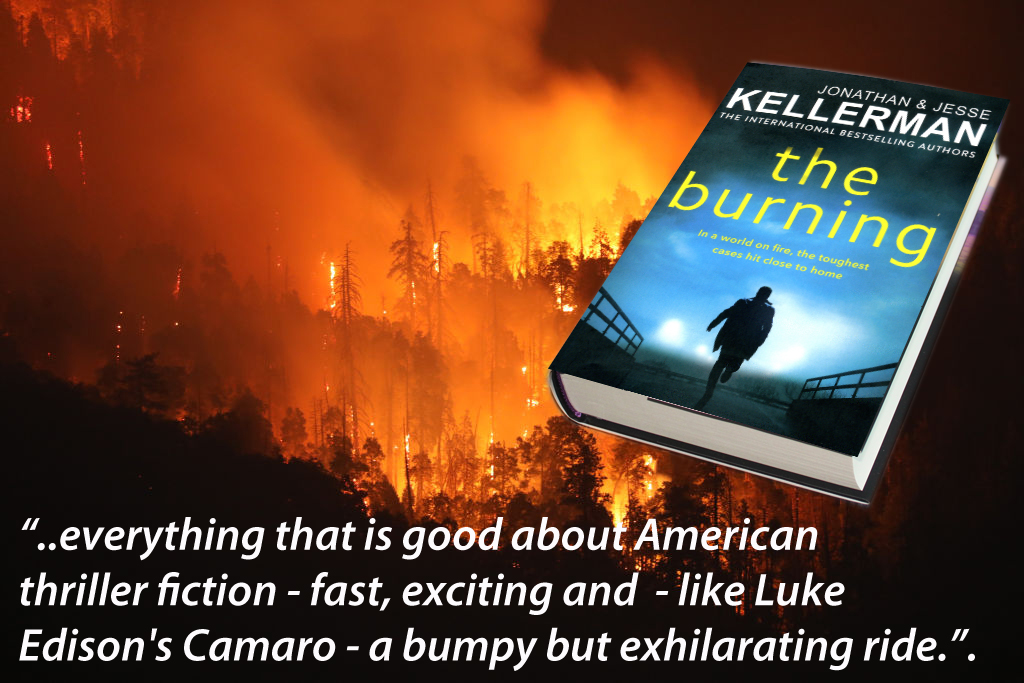
I finished this book during a return train journey and a quick hour before bedtime. It is ridiculously readable. Yes, it’s slick, unmistakably American, and probably formulaic but, as the late, great British film reviewer Barry Norman used to say, “And why not?” Just shy of 300 pages, it is everything that is good about American thriller fiction – fast, exciting and  – like Luke Edison’s Camaro – a bumpy but exhilarating ride. I have no idea who wrote what in the Jonathan and Jesse Kellerman partnership, but who cares? Published by Century, The Burning is out on 21st September in Kindle and hardback, and will be available next year in paperback.

Camaro

THE MUSEUM OF DESIRE . . . Between the covers

MOD coverThe strange-looking empty mansion in the dry hills above Los Angeles is rented out as a venue for everything from cancer charity fundraisers to wild parties. As the much put-upon guy from the agency wearily pushes his cart of cleaning materials up the hill, he is expecting the usual joyless cocktail of spilled food, used needles and condoms. What he actually finds causes him to part company with his breakfast burrito.

In a stretch limo parked in front of the house, he finds four people, each very, very dead, and with the floor of the car swimming in blood. Cue another case for LAPD Detective Milo Sturgis and psychologist Dr Alex Delaware. Veterans of the long-running series (this is book number 35 since When The Bough Breaks in 1985) will know the basic set-up. Delaware’s day job is in child psychology, while Sturgis is, in now particular order, gay, unkempt, a brilliant cop and eternally hungry.

The four corpses in the limo seem to have nothing at all in common aprt from being dead; a thirty-something professional bachelor with an insatiable – but perfectly legal – love life, and elderly chauffeur, a gentle and harmless man with mental problems who lives in sheltered accommodation, and a rather unprepossessing middle-aged woman who, it transpires, had drink and drug issues, and lived mostly on the streets. To add to the mystery, the forensic team analyses the blood on the floor of the car – and it is canine.

Delaware and Sturgis are convinced that the killings took place elsewhere, and the interior of the limo was an elaborate stage set. But who is the director of this hellish drama, what is the message of the play, and who was the intended audience?

jonathan-kellermanBit by bit, one slender thread at a time, the tangle of the mystery is unpicked. As per usual Kellerman (right) gives us a spectacularly complex solution to the quadruple murder. It’s almost as if we are passengers on a train journey, and some of the sights that flash by the window before we reach our destination include erotic Renaissance paintings, a chillingly damaged autistic teenager and a brief glimpse of Herman Göring’s fabled collection of looted art.

There will be, no doubt, some people who will look down their noses at this book – and others like it – while dismissing it as formulaic. Of course it is written on a certain template, but that’s what makes it readable. That’s why readers turn, again and again, to books that are part of long running series. We don’t want John Rebus to start behaving like Jack Reacher, any more than we will be happy for Carol Jordan to turn into Jane Marple. The Museum of Desire is slickly written, for sure, but I think a better word is ‘polished’. Both the dialogue and interaction between Delaware and Sturgis crackle with their usual intensity, and we are not short-changed in any respect in terms of plot twists and deeply unpleasant villains.

The Museum of Desire is published by Century/Arrow/Cornerstone Digital, came out in hardback  and Kindle earlier this year, but this paperback edition will be available from 12th November.

LOST SOULS . . . Between the covers

header

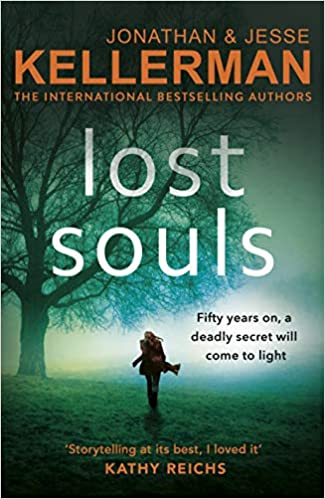
51K-Sy2OGJL._SX323_BO1,204,203,200_Lost Souls is something of an oddity, and no mistake. There’s nothing at all wrong with the novel itself apart from something of an identity crisis. Search for it on Amazon UK, and up it comes, but the page URL contains the title Half Moon Bay. Search for Half Moon Bay and up comes the same novel, but with a different cover. It looks as though Half Moon Bay is the Penguin Random House American title, while on this side of the Atlantic Century are going with Lost Souls.

Deputy US Coroner Clay Edison first appeared in Crime Scene (2017). That was followed by A Measure of Darkness in 2018, and now Edison returns but this time with baby Charlotte to look after when his wife is out on shift in her hospital. The Edisons live in that eternal bastion of West Coast sensibilities, Berkeley, and it is in the infamous People’s Park that the case begins.

LS illustration

Clay Edison is called to the park, scene of decades of hippy protest. Two bodies have been found during building excavation. The first is neither human nor animal. It is a stuffed blue teddy bear, missing an eye. The second is the skeleton of a baby, and the glare of the pathologist’s strip lights reveal that it was once a little boy. Edison is drawn into an investigation to see if the teddy bear and the boy are connected, and this means he has to visit a truly terrifying settlement of biker red-necks:

“I bounced along the tracks, wheels spitting gravel. Slowly the smudge began to resolve like a body surfacing in swamp water. Structures, then vehicles, then living things: gaunt dogs and children chasing one another, their roles as hunter or prey in constant flux. Bare feet raised a dusty haze. ….. Amid a weedy patch a woman slouched in a lawn chair. Pustulant acne ravaged her face; she could have been eighteen or forty. A slack-limbed toddler slept on her chest.”

51wZ1Fd-WIL._SX327_BO1,204,203,200_As Edison tries to link the skeleton of the baby with the abandoned cuddly toy, he accepts an ‘off-the-books’ job. A wealthy businessman, Peter Franchette, asks him to try to find the truth about his missing sister. Possibly abducted, perhaps murdered, she has disappeared into a complexity of disfunctional family events – deaths, walkouts, divorces, remarriages and rejections.

The Kellermans clearly have an ambivalent view of Berkeley. A place perhaps, where a seventy-something former revolutionary might wake up and imagine, for a fleeting moment, before old age and reality kick in, that it is 1966, and everything is still possible. The reality is more sobering, however:

” … and the countless others, men and women alike, who’d found their way to the Pacific, only to find that it was not the golden bath they’d expected but a terrifying force of nature, immense and violent and indifferent.”

I’ll be blunt and say that I have never understood the concept of writing partnerships in fiction. Over many years I enjoyed Jonathan Kellerman’s Alex Delaware books. They are slick and formulaic, but never less than gripping, and it is obvious that Kellerman is a gifted writer. Why he should want to want to pair up with someone else – even if it is his son – is for him to know and me to be left wondering. Lost Souls reads as if it has been written by one person, so I suppose that is all that matters.

Lost Souls is cleverly written and has a plot which is, like Chandler’s immortal The Big Sleep, deeply complex. Rather like the anecdote which has Chandler being asked who killed the chauffeur, and him replying that he wasn’t sure, I couldn’t put my hand on my heart and say that Edison finds Peter Franchette’s missing sister. I think he does, but you must judge for yourselves.

Lost Souls and/or Half Moon Bay are out now, and available here.

Blog at WordPress.com.

Up ↑