Search

fullybooked2017

Tag

Historical Crime Fiction

THE DOOM LIST . . . Between the covers

hollywood2-1280x600

I loved The Long Silence (click to read more) by Irish writer Gerard O’Donovan, and now his LA private detective Tom Collins returns, for another scandal-filled affair among the great and not-so-good in 1920s Hollywood. The Doom List refers to the campaign by the garrulous and ambitious Republican politician who set out to ‘clean up’ what he saw as the Sodom and Gomorrah of Tinsel Town. He is best remembered for the 1930 Motion Picture Production Code, informally referred to as the Hays Code, which spelled out a set of industry moral guidelines for the self-censorship of content in Hollywood cinema.

TDL coverFormer city cop Collins has earned a reputation among movie producers and stars as a man who gets things done, but in a discreet way, and here he becomes involved in getting to the bottom of a nasty blackmail case involving one of Hollywood’s rising stars. José Ramón Gil Samaniego is a young man who was to become better know as Ramon Novarro, star of many hit movies, and an heir to the throne of screen heart-throb vacated by Rudolf Valentino after his untimely death. O’Donovan peoples his story with actual real life characters as far as possible, and it is a winning formula. Samaniego is in trouble because there are intimate photographs of him taken a notorious club for homosexuals. Both he and his studio bosses are desperate that these photos and the negatives are found and destroyed.

There is another case occupying Tom’s mind and time. An old buddy from his police days, Thad Sullivan is in big trouble. Already feeling the heat from his senior officers because he refuses to look the other way when they accept backhanders and pervert the course of justice, he now faces another challenge, Some boys exploring a canyon in the Hollywood hills have discovered the corpse of a man, dried out by the fierce heat and unrecognisable. In his pocket, however, is a piece of paper with Thad’s name and police number. Can Tom save his friend’s career?

This is a thoroughly entertaining and intriguing glimpse into the murky world of the early Hollywood stars away from the popping of camera flash bulbs and hyped newspaper articles. Tom Collins is an old fashioned hero – incorruptible and determined. The Doom List is published by Severn House, and is out now. For more information about the author, you can visit his website by clicking the image below.

GTwitpic_400x400

 I had great fun looking up all the real life characters in this novel. Some of them are pictured below. First row, left to right: Roscoe Arbuckle, hugely popular comedian, ruined by a sex scandal. Charles H Crawford, LA mayor and organised crime boss. Douglas Fairbanks, star of many hit movies. Will H Hays, politician and ‘moral guardian’ of the silver screen.
Second row, left to right: Rex Ingram, Irish-born director, writer and actor. Kent Kane Parrot, corrupt lawyer and LA ‘fixer’. Barbara la Marr, dubbed as “The Girl Who Is Too Beautiful”. Joe Martin, an orangutan who featured in several movies.
Third row, left to right: Ramon Novarro, screen heart-throb. Alice Terry, American actress and director. Adolph Zukor, producer and one of the founders of Paramount Pictures.

mugshots

THE THREE LOCKS . . . Between the covers

TTL006In a sappingly hot Indian Summer in central London, Dr John Watson is sent – by a relative he hardly remembers – a mysterious tin box which has no key, and no apparent means by which it can be opened. Watson and his companion Sherlock Holmes have become temporarily estranged, not because of any particular antipathy, but more because the investigations which have brought them so memorably together have dwindled to a big fat zero.

TTL007But then, in the space of a few hours, Watson shows his mysterious box to his house-mate, and the door of 221B Baker Street opens to admit two very different visitors. One is a young Roman Catholic novice priest from Cambridge who is worried about the disappearance of a young woman he has an interest in, and the second is a voluptuous conjuror’s assistant with a very intriguing tale to tell. The conjuror’s assistant, Madam Ilaria Borelli is married to one stage magician, Dario ‘The Great’ Borelli, but is the former lover of his bitter rival, Santo Colangelo. Are the two showmen trying to kill each other for the love of Ilaria? Have they doctored each other’s stage apparatus to bring about disastrous conclusions to their separate performances?

As for the missing young woman, Odile ‘Dilly’ Wyndham, she is only ‘missing’ because she has a pied-à-terre, unknown to her parents, where she can flirt with her admirers to her heart’s content, and it transpires that the thoughts of the young priest-in-waiting are not wholly as pure as the waft of incense. Was he responsible for the doll found on Jesus Lock footbridge, dressed to look like Dilly, but with its arm wrenched off?

TTL009

As an aside, this tale has Holmes and Watson as younger men, perhaps in their thirties. MacBird includes all the standard tropes – Watson’s bemused geniality and stiff upper lip, Holmes’s mood swings and reliance on cocaine when life becomes too dull, and even the stern but maternal presence of Mrs Hudson.

Much of the action takes place in Cambridge, and it is there that the murder which occupies much of the book is committed. MacBird does a fine job of keeping the two strands of the plot – the warring conjurors, and the love life of Dilly Wyndham – running together side-by-side, and she shows us some magic of her own by bringing them together by the end . Watson’s mysterious box? It does get opened eventually, and what it reveals is rather moving. Fans of the great detective will not be disappointed by The Three Locks – it has enough twists and surprises to satisfy even the sternest Holmesian.

TTL009
Is ‘pastiche’ the right word for this book? Maybe ‘re-imagining’, or ‘tribute’ might be kinder. Whichever word we use, the central problem facing modern writers of Sherlock Holmes stories is that of length. Even the four full length canonical novels – A Study In Scarlet, The Sign of The Four, The Hound of the Baskervilles and The Valley of Fear – are very short compared to modern books. The bulk of the Holmes canon are the short stories, which spark and fizz brilliantly for a few thousand words, and then are gone. Yes, short story writing is an art in itself (which very few have mastered) but maintaining pace and narrative drive for four hundred or more pages is a different challenge.  A writer of a Holmes and Watson homage has to spin out every gesture, comment and impression which, in the originals, crackle and then are gone in a moment. I haven’t read the previous three MacBird Holmes novels, but The Three Locks works as well as most other novels in the genre, and certainly better than some. It is published by Collins Crime Club and is out on 1st April. If you click on the image below, it will take you to Bonnie MacBird’s website, and a very entertaining set of annotations linked to the novel.

TTL008

LAST NOCTURNE . . . Between the covers

LN HEADER


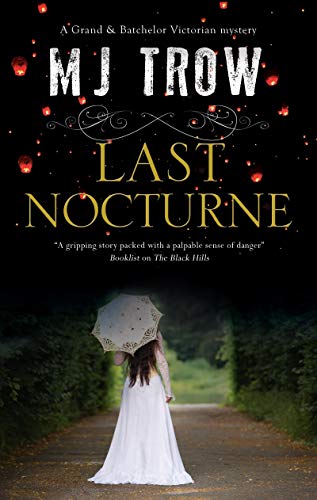
I am a huge fan of MJ Trow’s books. We have some things in common. I don’t share his gifts as a writer but we did go to the same school and we both had long careers as teachers. We certainly share the same acerbic views of the bean counters and politically correct apologists who run schools these days. If you want first hand knowledge of these miserable characters, then read any of Trow’s wonderful Peter ‘Mad’ Maxwell series. They are great entertainment – very, very funny, but with a serious side, too.

Like his creator, Peter Maxwell has left the chalk face and retired to his Isle of Wight home, but Trow’s brilliance as a historian still shines in the Grand and Batchelor series, of which Last Nocturne is the seventh. Reviews of some of its predecessors are here, and the new book has the usual dazzling mix of real-life characters – try Oscar Wilde, GF Watts, John Ruskin and James McNeill Whistler for starters –  knockabout humour and murder most foul.

41xgC83kdoLGrand & Batchelor are private investigators based in 1870s London and – much to the relief of James Batchelor, who is a terrible traveller – Last Nocturne has its feet securely on home soil. Grand is from a wealthy New England family, and fought bravely for the Union in The War Between The States, while Batchelor is a journalist by trade. Murder – what else? – is the name of the game in this book, and the victims are, you might say ‘on the game’. Cremorne Gardens were popular pleasure gardens beside the River Thames in Chelsea, but after dark, the ‘pleasure’ sought by its denizens was not of the innocent kind. ‘Ladies of the Night’ are being murdered – poisoned with arsenic – but the killer doesn’t interfere with them, as the saying goes, but instead leaves books by their dead bodies.

As the two investigators become involved in the police hunt for the bookish poisoner, they are still doing the day job which, in this case, is being employed by Grand’s fellow countryman Mr Whistler – he of the painting of his mum – to dig out any dirt they can find on art critic John Ruskin who, ‘as any fule no’ (to quote Nigel Molesworth) wrote, of one of Whistler’s paintings, “never expected to hear a coxcomb ask two hundred guineas for flinging a pot of paint in the public’s face”


SCROLL
Trow has great fun
with John Ruskin’s back story, particularly his disastrous marriage to Euphemia ‘Effie’ Gray , and the disastrous first night of their honeymoon when he was so traumatised by her luxuriant pubic hair that he was unable to continue with his marital duties. The Pre-Raphaelite painter John Millais clearly had no such qualms, as he married Effie in 1855, and they produced eight children.

The search for the killer, however, continues, but G & B, along with the police, remain mystified. They even resort to a seance involving the well-known society medium, Miss Florence Cook, whose reputation has gone before her:

“The murmurs from the guests were mixed, but Florence was used to that. Speaking for herself, she couldn’t really see why people were always so surprised when she was from time to time exposed as a fraud. What did they expect? That the dead would turn up on cue to talk to people about the other side? Why would Uncle Norman come back to a seedy scullery in Acton to tell his niece that it was all very l, he was at peace, and he’d been talking to Beethoven only the other day, who told him to tell little Bessie to carry on with her piano lessons?”

SCROLL
Eventually G & B solve the mystery, but rather more by accident than design and the book comes to a dramatic and entertaining conclusion. Last Nocturne is published by Severn House, and is available in hardback and as a Kindle.

MURDER AT THE RITZ . . . Between the covers

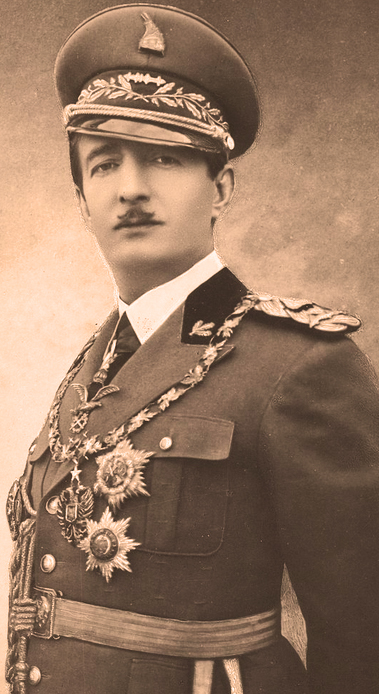
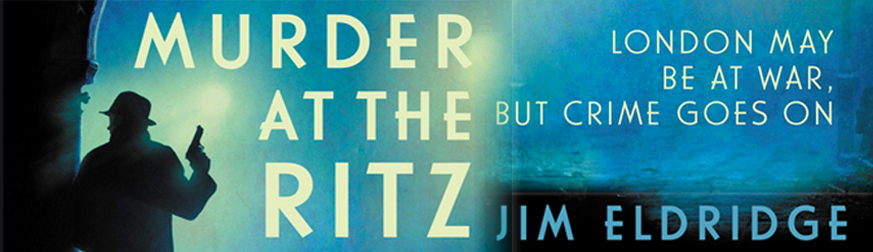
MATR headerZogAny novel which features – in no particular order – Commander Ian Fleming, King Zog of Albania, a dodgy lawyer called Pentangle Underhill, and a Detective Chief Inspector named The Hon. Edgar Walter Septimus Saxe-Coburg promises to be a great deal of fun, and Murder At The Ritz by Jim Eldridge didn’t disappoint. It is set in London in August 1940, and Ahmet Muhtar Zogolli, better known as King Zog of Albania (left) has been smuggled out of his homeland after its invasion by Mussolini’s Italy, and he has now taken over the entire third floor of London’s Ritz Hotel, complete with various retainers and bodyguards – as well as a tidy sum in gold bullion.

Anyone who has studied the history of Albania will know that it has always been a chaotic place. In the 1920s, while working at the League of Nations, the famous sportsman CB Fry was reputedly offered the throne. For a rather more serious memoir of Albania during WW2, Eight Hours From England (click for the review) by Anthony Quayle is well worth a read, and we all know – thanks to the Taken franchise, starring Liam Neeson, that Albania’s chief export to the rest of the world is organised crome, drug-running, money laundering and people trafficking.

Screen Shot 2021-02-25 at 19.08.38Back to the story, and when a corpse is discovered in one of the King’s suites, Coburg is called in to investigate. The attempt to relieve the Albanian monarch of his treasure sparks off a turf war between two London gangs who, rather like the Krays and the Richardsons in the 1960s, occupy territories ‘norf’ and ‘sarf’ of the river. After several more dead bodies and an entertaining sub-plot featuring Coburg’s romance with Rosa Weeks, a beautiful and talented young singer, there is a dramatic finale involving a shoot-out near the Russian Embassy. This is a highly enjoyable book that occupies the same territory as John Lawton’s Fred Troy novels (click to read more). It is nowhere near as dark and dystopian as those books, but Murder At The Ritz is none the worse for that.

Since 2016 Jim Eldridge has concentrated on writing historical crime fiction for adults. Previously he worked as a scriptwriter and wrote books for children and young adults. As a scriptwriter he had over 250 TV and 250 radio scripts broadcast in the UK and internationally. In 2019 I read, enjoyed and reviewed an earlier book by this writer, and if you click on the title – Murder At The British Museum – you can see what I thought. Murder At The Ritz is published by Allison & Busby and is out now.

CROW COURT . . . Between the covers

CC FOOTER

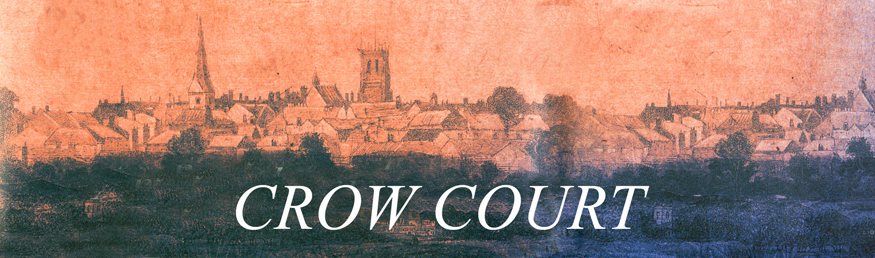
We begin in the peaceful Dorset town of Wimborne in the spring of 1840. Just a few months earlier, in the Chapel Royal of St. James’s Palace, London, Queen Victoria had marred Prince Albert of Saxe-Coburg. Louisa Chilcott and Samuel Portman are also due to be married, in the equally beautiful Wimborne Minster, but the joy of their day is short-lived.

CC cover015Just days earlier, Samuel had approached his best man, Charles Ellis, with a request for help. Louisa’s young cousin, Henry Cuff, is a member of the Minster choir, but it has been reported that he is desperately unhappy, is absenting himself from school, and refusing to sing in the choir. So how can Charles help? His half brother, Matthew Ellis is the Choirmaster. Could Charles please intercede, and try to find out what is the matter with young Henry?

Charles agrees, but with a heavy heart. He and his half brother are barely on speaking terms. Charles is gentle, urbane and conciliatory, while Matthew – a brute of a man – is bad tempered, censorious, and has an evil reputation. Charles speaks to Matthew, but gets nowhere. A visit to Henry Cuff and his parents is equally fruitless. The boy is clearly terrified, and Mr and Mrs Cuff are unhelpful.

Louisa and Samuel’s wedding goes off as planned, but Henry Cuff – who was due to sing a solo – is nowhere to be found. As the happy couple are basking in the love of well-wishers after the ceremony, a townsman interrupts the festivities with the terrible news that Henry Cuff’s body has been found in the river.

Resentment and anger at Matthew Ellis begins to seethe in the town. Things worsen when it becomes clear that Ellis has not only been cruel and bad-tempered with his boys, but has been abusing them in the vilest manner imaginable. When a  group of men decide to take things into their own hands, and Ellis disappears, the consequences are far reaching.

CC header014

The structure of this fascinating novel is worth examining. It is, in effect, fourteen short stories, cleverly written so that they stand alone – indeed, three of the episodes have been published separately – but are linked to a central event, in this case the disappearance of Matthew Ellis. I am struggling for a suitable metaphor; ripples in water spreading out from a central disturbance, maybe? The trouble with that one is that literal ripples weaken the further they spread, and in this case, with the time span being twenty years or more, the ‘ripples’ don’t weaken – they become stronger and more deadly.

I suspect that the author knows and loves his Thomas Hardy. There are tragic outcomes for many of the characters in this novel, not because they are bad people (the only malignant person is Matthew Ellis) but because they have made errors of judgment, or pursued a wrong option. The words that are singing in my ears come from the last page of Tess of the d’Urbervilles:

“Justice” was done, and the President of the Immortals (in Aeschylean phrase) had ended his sport with Tess.”

This book operates on so many levels. At its simplest it is a murder mystery, a whodunnit, almost, (and yes, we do learn the identity of the killer in the final pages) but it is also brilliant history reflecting, as it does, on the hardships inflicted on the rural poor by increased mechanisation. I won’t call it a comedy of manners, because there is very little to laugh about, but we are treated to intriguing glimpses of social conventions and the sensitive hierarchies of the mid nineteenth century. Finally, the book is shot through with beautifully imagined descriptions of the Dorset countryside across the seasons. Crow Court is Andy Charman’s first full length novel. It is published by Unbound, a crowdfunding publisher, and is available here.

CC explanation

NO GOOD DEED . . . Between the covers

ngd header009

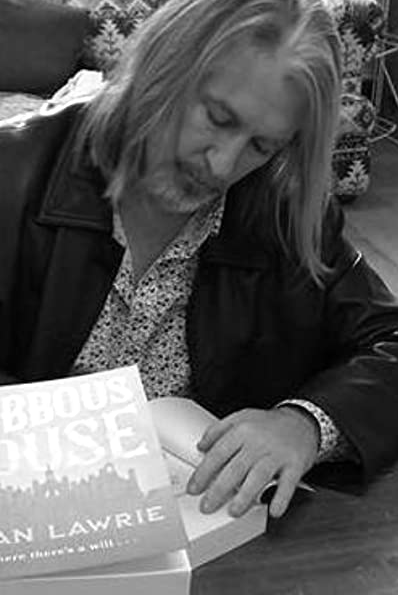
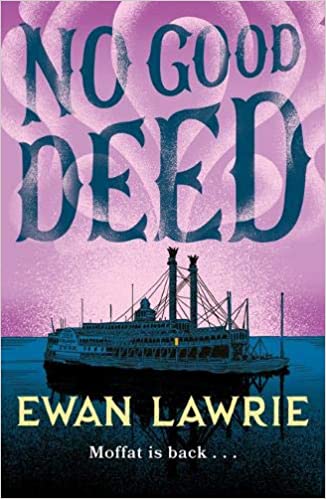
Screen Shot 2021-01-13 at 19.14.13First, a word about the author, Ewan Lawrie (left). He comes to the book world by a rather different route than many of his fellow writers. There cannot be many authors who served for nigh on a quarter of a century in the armed forces – in this case, the RAF – and then turned to writing. His first novel, Gibbous House, (2017) introduced us to a gentleman called Alasdair Moffat, who rejoices in the appellation Moffat the Magniloquent. In that novel he was a prosperous and successful criminal in Victorian London, but now, a decade later, he  – having fallen on hard times – has relocated to America, along with countless other folk of the “huddled masses”, the “wretched refuse” and the “tempest-tossed”. Unlike them, however, he is not seeking the “lamp beside the golden door”, but a rather better place in which to exercise his criminal talents.

It is 1861, and America is on the verge of the disastrous conflict which will shape the nation’s future for decades to come. Moffat has fetched up in St Louis, pretty much stony broke. With an unerring talent for sniffing out trouble, he murders a man named Anson Northrup, assumes his identity and, in order to pay off a brothel bill he cannot afford, accepts the task of delivering a mysterious package further down the Mississippi River. He boards the steam-driven riverboat The Grand Turk. The package he is carrying contains operational details of what was known as The Underground Railroad – a network of secret routes and safe houses established in America used by slaves to escape into freedom. Moffat, of course, being British, takes the metaphor literally, and it is some time before he realises that he is not carrying a conventional railway timetable, and that the late Anson Northrup is a key figure in a plot to steal silver bullion from the Mint in New Orleans – the major city in the state of Louisiana, which had just seceded from the United States.

NGD1In his guise as Northrup (although not everyone is fooled) Moffat meets several larger-than-life and almost grotesque fictional characters, and lurches from one crisis to the next, but one of the most spectacular parts of the novel is when he meets Marie Laveau, a real life New Orleans character renowned for her mystical qualities, as well as her expertise in the black arts of voodoo.

Lawrie is an entertaining writer who has clearly done his historical homework, but also adds a heady combination of whimsy, smart jokes and improbable situations to make for an entertaining read. The rather old fashioned literary term picaresque came into my mind as I was reading this, but I needed to check what it meant. The ever-present Google says that it is:

“relating to an episodic style of fiction dealing with the adventures of a rough and dishonest but appealing hero.”

I think that pretty much sums up No Good Deed. The novel succeeds not through the particular integrity of the plot, but more through the relentlessly entertaining episodes, and the grim allure of Moffat himself. There is more than a touch of George MacDonald Fraser and his likeable coward Harry Flashman about this book, and I can thoroughly recommend it to anyone who enjoyed that series of novels. No Good Deed is published by Unbound Digital, and is out now.

THE ART OF DYING … Between the covers

TAOD header

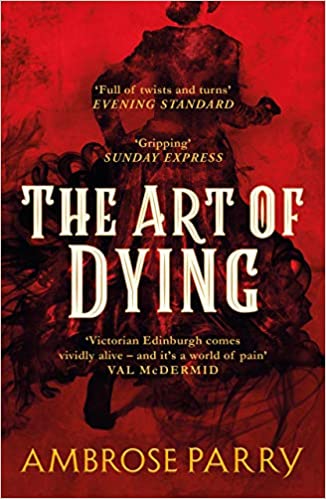
Ambrose Parry is a pseudonym for a collaboration between Chris Brookmyre and Marisa Haetzman (pictured below). They  live in Glasgow,  slightly less genteel – at least in popular image – than Edinburgh, where this novel is set. It novel weaves together two stories, both of which have have factual origins. One strand deals with an horrific serial killer and her victims, while the other story is seen through the eyes of a young doctor in the middle years of the 19th century. The novel is a follow-up to the 2018 publication, The Way of All Flesh.

71tHql951uL._SX800_

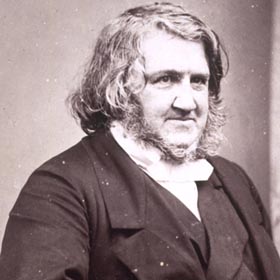
SimpsonThis is not a book for those squeamish about medical details – especially those common in the 19th century. There are tumours, painful deaths both lingering and sudden, surgical procedures that involve much guesswork and hopeful blundering about the human body – externally and internally. If you are still with me, then the story is this. It is 1849, and we first meet young Dr Will Raven when he is involved in a street brawl in Berlin, where he has been studying. He survives the encounter, and returns to Edinburgh, where he is reunited with his former mentor, Dr James Simpson. Simpson – a real-life character, pictured –  is highly regarded, but also the object of much jealousy from less gifted physicians, and is facing charges of malpractice brought about by his envious peers.

Raven had hoped to find an earlier object of his affections – a young woman called Sarah, who also worked with Dr Simpson – available for further dalliance, but in the interim, she has married another doctor, Archie Fisher. He is terminally ill, and as both Will and Sarah are aware of this, the sad fact adds a certain piquancy to the relationship.

TAOD cover2Away from the relative gentility of the Simpson household, we have a young woman who moves in very different circles. She has suffered a brutal and traumatic childhood. This has either directed her on a devilish pathway, or kindles a spark which was already there but, either way, she has become a murderer. The writers employ an obvious – but effective – counterpoint here, in that Sarah Fisher desires to become a doctor, while Mary Dempster seeks to hone her skills as a killer. Contemporary society believes that a woman cannot possibly be a success in either occupation.

It takes a while for Will and Sarah to come round to thinking the unthinkable – that Mary Dempster is a clever and a successful killer. Because we, as readers, have had the advantage of reading first-person-viewpoint chapters, we know that she is a devious and malevolent individual. Yes, she has had a terrible upbringing, involving degradation and abuse, but not all orphans who suffered at the hands of Victorian institutions turned out to be serial killers.

As I said earlier, if you are the kind or reader who would shudder at the thought of reading a cut-by-cut account of an early surgical attempt to save a woman from an ectopic pregnancy, then this may not be the book for you. Bolder souls will enjoy a gripping and twisty murder mystery shot through plenty of gore and passion. The Art of Dying came out in hardback in August 2019. This paperback edition is published by Black Thorn and is out now.

TO THE DARK . . . Between the covers

TTD header

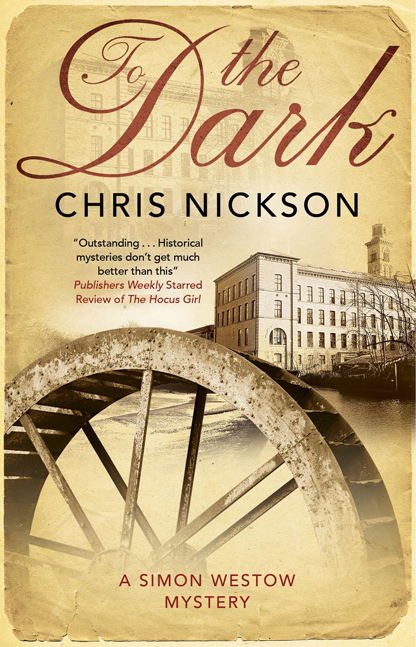
Screen Shot 2021-01-03 at 21.02.58I am delighted to say that my first review for 2021 is a new book by the reliably excellent story-teller, Chris Nickson. For those new to his books, he is a widely travelled former music journalist, who has rubbed shoulders with some of the big names in rock, but now pursues a rather more sedentary lifestyle in the Yorkshire city of Leeds. When he is not tending his treasured allotment, he writes historical novels, based around crime-solvers across the  centuries, most of them based in Leeds.

You can click the link to check out his late 19th century novels featuring the Leeds copper Tom Harper, but his latest book takes us back a little further, to Georgian times. Leeds is undergoing a violent transformation from being a bustling, but still largely bucolic centre of the wool trade, to a smoky, clattering child of the Industrial Revolution.

There are fortunes to be made in Leeds, but crime is still crime, and Simon Westow is known as a thief-taker. Remember, this is before the emergence of a regular police force, and what law there is is enforced by (usually incompetent) town constables, and men like Westow who will recover stolen property – for a fee.

the-darkWestow is a man who has survived a brutal upbringing as an institutionalised orphan, and there is not a Leeds back alley, courtyard or row of shoddily-built cottages that he doesn’t know. He doesn’t work alone. He has an unusual ally. We know her only as Jane. Like Westow, this young woman has survived an abusive childhood, but unlike Westow – who isn’t afraid to use his fists, but is largely peaceable – Jane is a killer. She carries a razor sharp knife, and uses it completely without conscience if she is threatened by men who remind her of the degradation she suffered when younger.

When a petty criminal is found dead in a drift of frozen snow, Westow frets that he will be linked with the murder as, only a week or so earlier, he had completed a lucrative assignment that involved returning to their owner stolen goods that had come into the hands of the dead man. Instead of being harassed by the lazy and vindictive town constable, Westow is asked to try to solve the crime. It seems that two aristocratic officers from the town’s cavalry barracks might be involved with the killing, and this sets Westow a formidable challenge, as the soldiers are very much a law unto themselves. Meanwhile a notebook has been found which is connected to one of murdered criminal’s associates, but it reveals little, as it is mostly in code. Someone cracks the cipher for Westow, but he is little the wiser, especially when the text contains the enigmatic phrase ‘To The Dark.’

Douville-Hours

The discovery of a stolen handwritten Book of Hours, potentially worth thousands of gold sovereigns, further complicates the issue for Westow, and when the seemingly invincible Jane suffers a crippling injury, his eyes and ears on the Leeds streets are severely diminished. Still, the significance of ‘To The Dark’ escapes him, and when his life and those of his wife and children are threatened he is forced to face the fact that this seemingly intractable mystery may be beyond his powers to solve.

As ever with Chris Nickson’s novels we smell the streets and ginnels of Leeds and breathe in its heady mixture of soot, sweat and violence. In one ear is the deafening and relentless collision of iron and steel in the factories, but in the other is the still, small voice of the countryside, just a short walk from the bustle of the town. Nickson is a saner version of The Ancient Mariner. He has a tale to tell, and he will not let go of your sleeve until it is told. To The Dark is published by Severn House and is out now.

RIVER OF SINS . . . Between the covers

River Header

A little while ago I reviewed a novel set in Worcestershire – it was the beginning of WW2, and it centred on the fictional village of Ambridge and, of course, featured The Archers. History of a very different kind now. River of Sins is the seventh in a series of historical mysteries written by Sarah Hawkswood set in and around the city of Worcester in the 12th century.

Filler 1
I am new to the series but I enjoyed the fact that we have that most dependable of crime fiction tropes – a pair of investigators. There is a slight variation a theme in this case, as they are aided by an intrepid young apprentice. The dynamic between the three works well. Hugh Bradecote is the Under Sheriff, and is of noble birth with a degree of hauteur, while Sergeant Catchpoll is Worcester through-and-through, rough and ready, but very street-wise. Walkelin – the apprentice – is something of a ‘gofer’, but is bright, perceptive, and not afraid to speak his mind.

Filler 2

The novel begins with a woman being brutally done to death on a small island in the River Severn on the northern outskirts of Worcester. We learn that the woman and her killer are acquainted, but just how, and what the significance is, only unfolds with the investigation.

The dead woman is Ricolde, known throughout the city as The Whore of Worcester. She was widely despised by the gentlewomen of the city, while being used by their husbands, but as Bradecote and Catchpoll discover, there was another dimension to Ricolde. Educated, and perfectly content to talk the night through with men who demanded nothing other than her company, she also gave money to the church to be used to ameliorate the misery of other women of the street who were less resilient than she.

The investigators struggle to find a motive for the murder. Moral disapproval doesn’t usually lead to someone being dismembered with a woodsman’s axe, but does the clue to Ricolde’s death lie deep in her past, and has it to do with the horrific scars on the soles of her feet, inflicted decades earlier?

Sarah Hawkswood’s Worcester is a place we can see, hear, feel, breathe – and smell – as the mystery unfolds. What is the River of the title? It is the River Severn, broad and deep, a source of fresh food, a vital artery of transport at a time when roads were just beaten dirt, but also a means of escape and concealment. With only the most rudimentary forensic skills available, Bradecote and Catchpoll must rely on the most basic and time-honoured methods of detection, means, motive and opportunity. This is an excellent detective story which also gives us an intriguing glimpse into a long-lost world.

River of Sins is published by Allison & Busby and will be out in paperback and as a Kindle on 19th November.

Hawkswood books

Blog at WordPress.com.

Up ↑