
Search

fullybooked2017

Tag

Historical Crime Fiction

BRASS LIVES . . . Between the covers

Brass Lives header

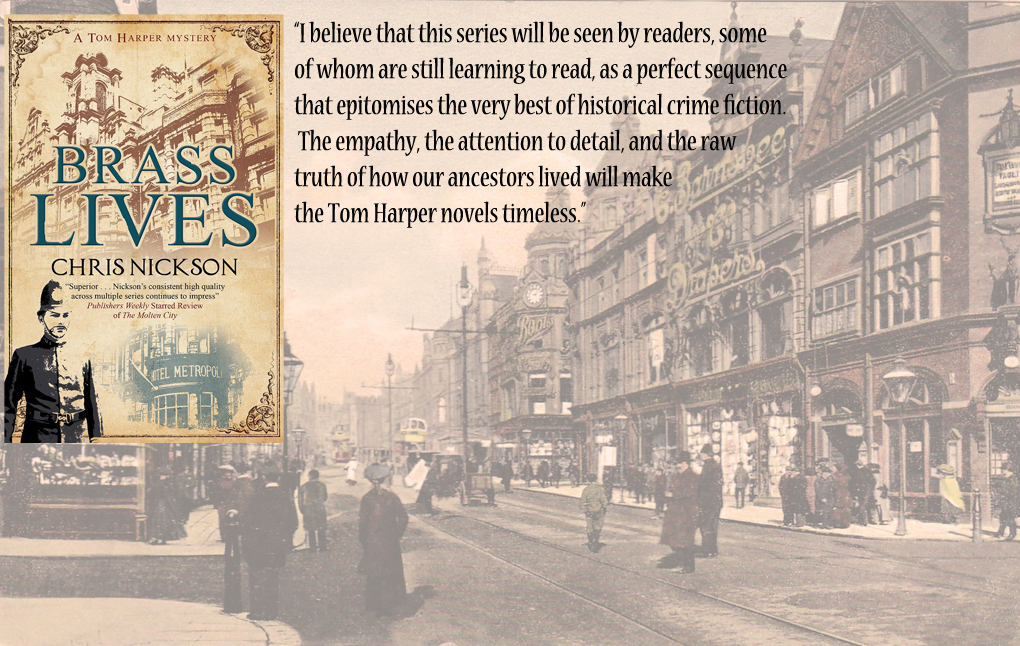
The prolific and ever-reliable Yorkshire author Chris Nickson has been writing his Tom Harper series since 2014 when he introduced the Leeds copper in Gods of Gold. Since then he has stuck to the  theme of metal in the book titles, and now we have Brass Lives. Harper is now Deputy Chief Constable of the city where we first met him as a young detective in the 1890s.

As is customary, the action doesn’t stray much beyond the city and its surrounding (and rapidly diminishing) countryside, but a slightly exotic element is introduced by way of two American gangsters. One, Davey Mullen, was born in Leeds, but emigrated across the Atlantic, where he has found infamy and wealth as a New York gangster. He has returned to his home town to visit his father. Louis Herman Fess, on the other hand has no interest in Leeds other than the fact that it is the current whereabouts of Mullen. Fess is a member of the delightfully named Hudson Dusters gang. They shot rival hoodlum Mullen eleven times, but he survived, and it seems as if Fess has come to West Yorkshire to resolve unfinished business. When Fess is found shot dead, Mullen is the obvious suspect, but try as they may, Harper and his team can find no evidence to link Mullen to the killing.

BrassPolitics are never far away in Chris NIckson novels, and in this case it is the enthusiasm of his delightful wife, Annabelle, for the Suffragist cause that takes centre stage. Note the word ‘Suffragist’ rather than ‘Suffragette’, a term we are more familiar with. The Suffragists were the earliest group to seek emancipation and electoral parity, and they believed in the power of persuasion, debate and education, rather than the direct action for which the Suffragettes were later known. Annabelle has always been careful not to embarrass her husband by falling foul of the law, but she plans to march alongside other campaigners in a march which is shortly due to enter Leeds. (See footnote * for more details) Annabelle’s plans are, however, thwarted at the last moment by a cruel  twist of fate.

There is more murder and mayhem on the streets of Leeds and Tom Harper finds himself battling to solve perhaps the most complex case of his career, made all the more intractable because he faces a personal challenge more daunting than any he has ever faced in his professional life. Guns have played little part in Harper’s police career thus far, but the theft of four Webley revolvers – plus ammunition – from Harewood Barracks, and the subsequent purchase of the guns by members of the Leeds underworld, adds a new and dangerous dimension to the case.

Nickson’s love for his city – with all its many blemishes – is often voiced in the thoughts of Tom Harper. Here, he declines the use of his chauffeur driven car and opts for Shanks’s Pony:

“A good walk to Sheepscar. A chance to idle along, to see things up close rather than hidden away in a motor car where he passed so quickly. All the smells and sounds that made up Leeds. Kosher food cooking in the Leylands, sauerkraut and chicken and the constant hum of sewing machines in the sweatshops. The malt from Brunswick brewery. The hot stink of iron rising from the foundries and the sewage stink of chemical works and tanneries up Meanwood Road. Little of it was lovely. But all of it was his. It was home.”

Harper, rather like WS Gilbert’s Ko-Ko, has a little list. It contains all the victims – and possible perpetrators – of the spate of crimes connected to Davey Mullen. One by one, through a mixture of persistence, skill and good luck, he manages to put a line through most of them by the closing chapters of Brass Lives. The book ends, however, on a sombre note, rather like a funeral bell tolling: it warns of a future that will have devastating consequences not only for Tom Harper, his family and his colleagues, but for millions of people right across Europe.

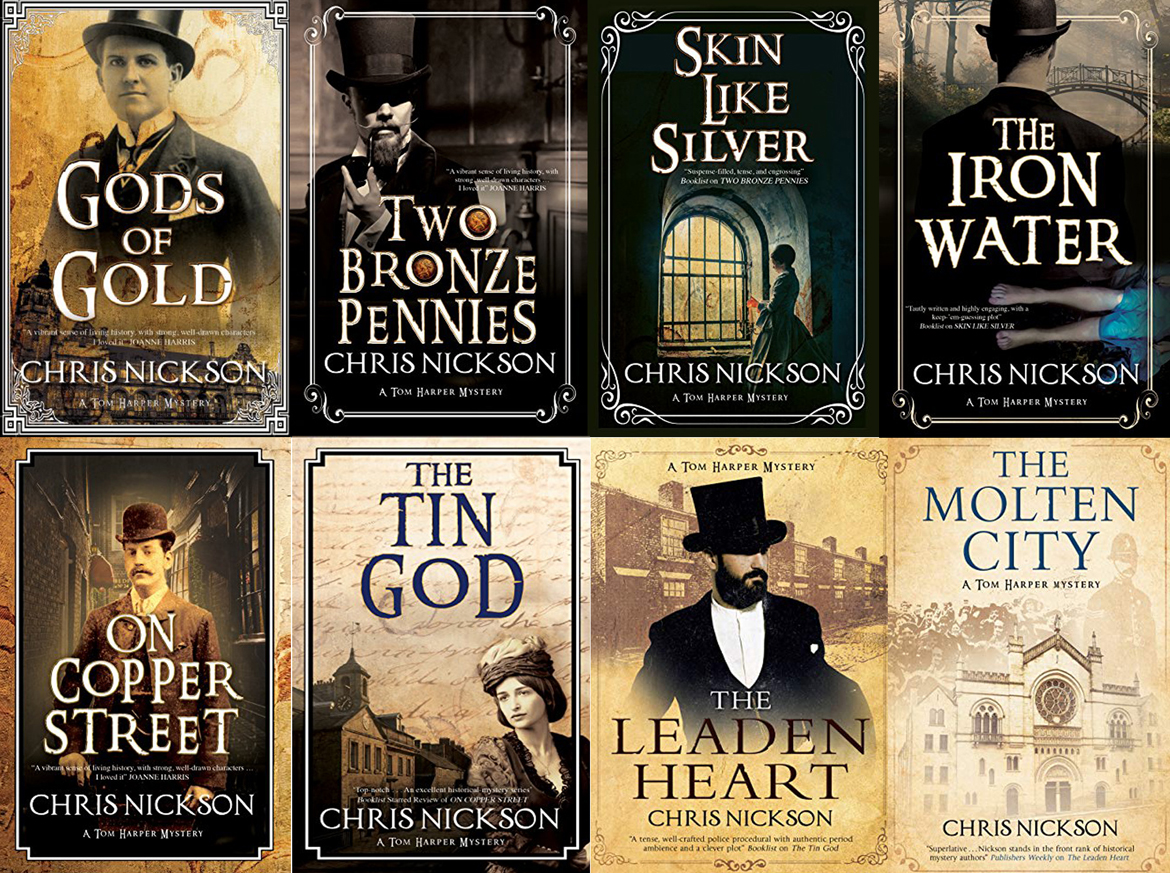
I believe that this series will be seen by readers, some of whom are still learning to read, as a perfect sequence that epitomises the very best of historical crime fiction. The empathy, the attention to detail, and the raw truth of how our ancestors lived will make the Tom Harper novels timeless. Brass Lives is published by Severn House in hardback, and is available now. It will be out as a Kindle in August. For reviews of other novels in this excellent series, click on the graphic below.
Harper

*The Great Pilgrimage of 1913 was a march in Britain by suffragists campaigning non-violently for women’s suffrage, organised by the National Union of Women’s Suffrage Societies (NUWSS). Women marched to London from all around England and Wales and 50,000 attended a rally in Hyde Park.
MURDER AT MADAME TUSSAUDS . . . Between the covers

Murder header

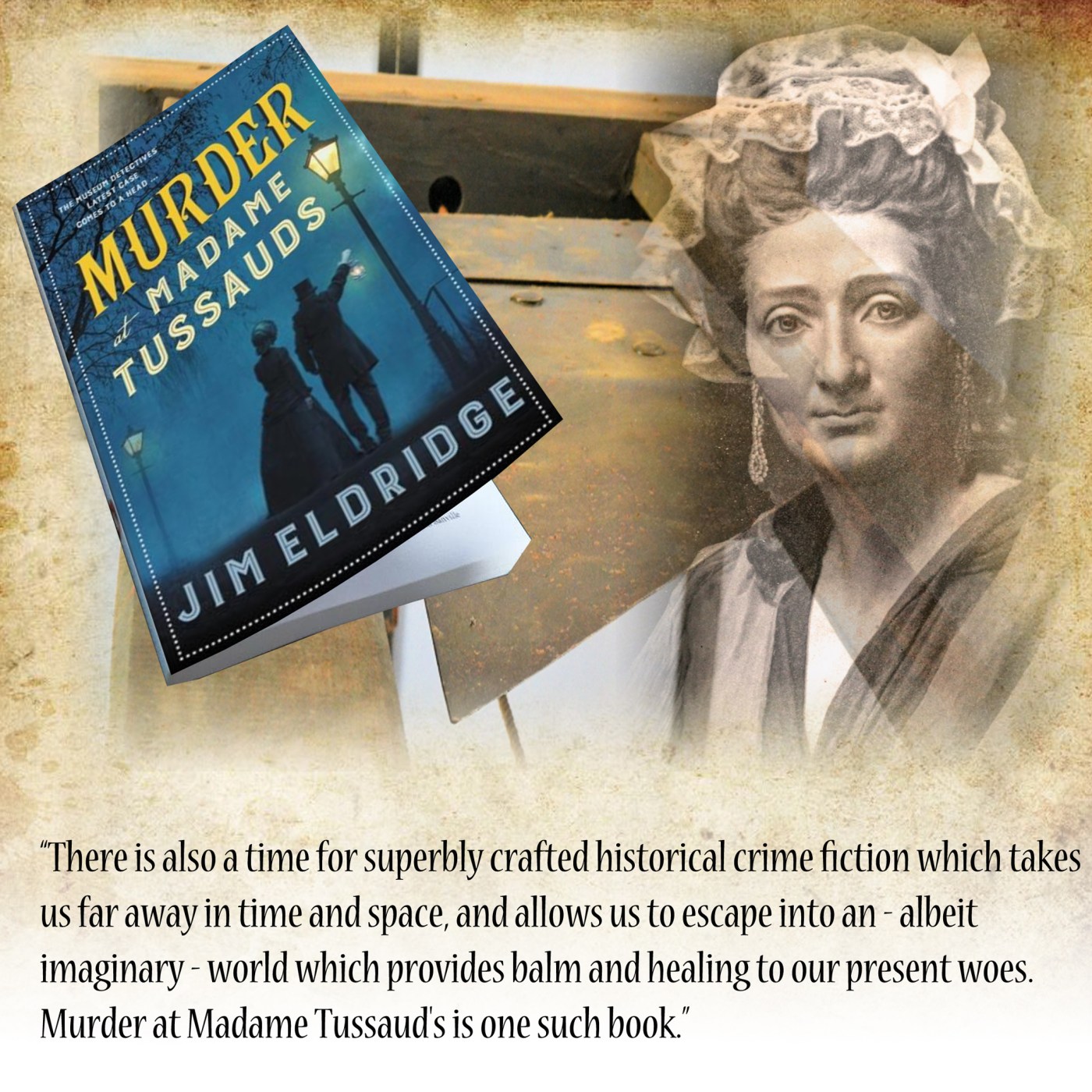
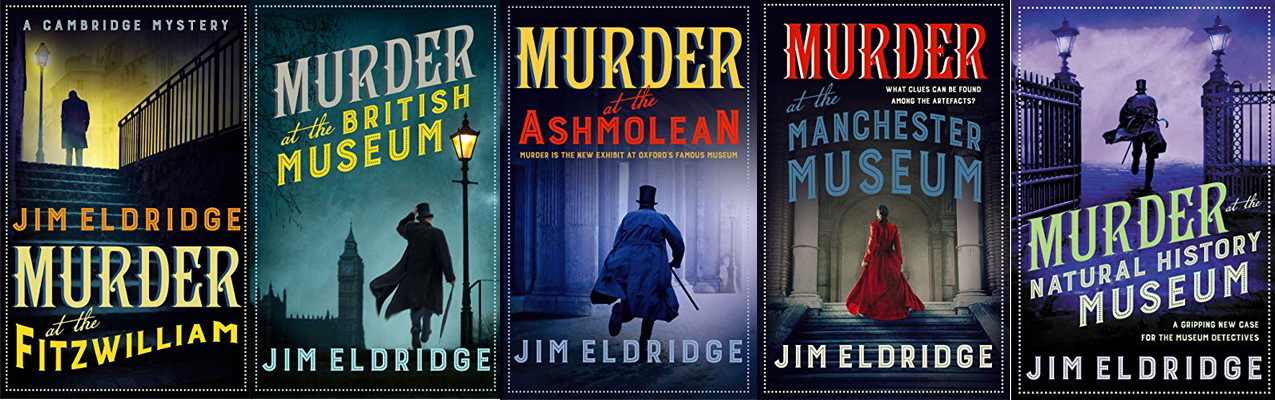
This is the sixth book in the delightful series from Jim Eldridge set in the last years of Queen Victoria’s reign, and featuring a private investigator partnership between Daniel Wilson and Abigail Fenton. The pair are so mismatched that they make a delightful fit, if that makes any sense. Former policeman Daniel is short, stocky and of solid working class London stock, while Abigail is of more ‘noble birth’,  tall, elegant, and an expert in archaeology, particularly that of the classical world. As you can see from the banner above, they have worked their way around the major museums of England, but now they are called to a slightly less academic venue – Madame Tussaud’s waxworks on Baker Street.

One of the night watchmen is found decapitated, his body (and head) posed next to the instrument of death that caused Anna Maria “Marie” Tussaud née Grosholtz to fear for her own life during the French Revolution – the guillotine. Wilson and Fenton immediately smell a rather large and malodorous rodent. The dead man – Eric Dudgeon – and his fellow watchman, Walter Bagshot, were lifelong friends, and former army colleagues. Now Dudgeon is dead and Bagshot is missing. Even stranger is the fact that some months earlier the previous watchmen, Donald Bruin and Steven Patterson, both left at the same time and, within days, Dudgeon and Bagshot arrived at the exhibition asking if there were any vacancies for security staff.

BigWigs

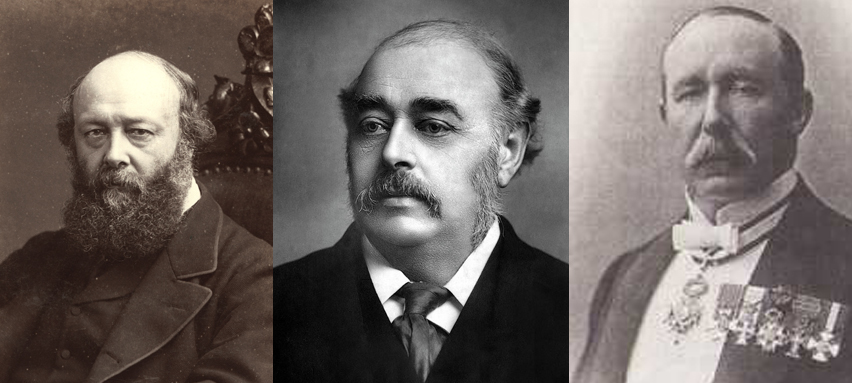
Meanwhile, Eldridge has introduced some real life characters (pictured above) – Prime Minister the Marquess of Salisbury, Sir Matthew White Ridley the Home Secretary, and William Melville head of the Special Branch. The men are concerned about a series of successful bank robberies, each of which has been carried out by the robbers tunneling into the bank vault from the cellar of an adjoining building. The sums taken have been eye-wateringly huge – so much so that the government is concerned about a run on the banks. Dedicated Sherlockians, when hearing about the robbers’ method, will raise an eyebrow and say, “A-hah – The Red Headed League!*

The murder plot becomes more twisted, when a young man, working on the basis that if he can scare his girlfriend she will succumb to his advances, hides with her in a Tussaud’s broom cupboard at closing time, and then sneaks out into The Chamber of Horrors. What they find is a genuine horror rather than a wax version, and all thoughts of dalliance go out of the window. Abigail, meanwhile, is courted (in a gentlemanly way) by none other than Arthur Conan Doyle, who wants her to lead an expedition to excavate an obscure group pf pyramids in Egypt. Both she and Daniel have their lives threatened, however; Abigail by an obsessed young woman who lusts after Daniel, and Daniel himself by a powerful and seemingly untouchable crime boss, Gerald Carr. But is Carr the real spider at the centre of this web, or is it someone much more closely connected to high society?

Screen Shot 2021-06-20 at 19.30.31This shouldn’t be dismissed as ‘comfort reading’. Yes, we know what we are going to get – the atmospheric late Victorian setting, the warm human chemistry between Daniel and Abigail, the absence of moral ambiguity and the certainty that good will prevail. Any genuine reader of fiction – and in particular, crime fiction – will know that, rather in the manner of Ecclesiastes chapter III , there is a time for everything; there is a time for the dark despair of Derek Raymond, there is a time for the intense psychological dramas of Lisa Jewell, and a time for workaday police procedurals by writers like Peter James and Mark Billingham. There is also a time for superbly crafted historical crime fiction which takes us far away in time and space, and allows us to escape into an – albeit imaginary – world which provides balm and healing to our present woes. Murder at Madame Tussaud’s is one such book. It is published by Allison & Busby and is available now.

*The Red-Headed League” is a short story by Sir Arthur Conan Doyle in which Sherlock Holmes takes the case of a businessman who feels that he’s been duped. A small business owner named Wilson tells Holmes how a man named Spaulding convinced him to take a job with The Red-Headed League. The League pays Wilson to copy out the Encyclopedia Britannica in longhand. Wilson does this for seven weeks, until the League is disbanded. Holmes realizes that Spaulding just wanted Wilson out of the shop so that he could dig a tunnel into the nearby bank.

SILESIAN STATION . . Between the covers

spines028

Followers of this website will, hopefully, have read my 1st May review of David Downing’s Wedding Station (click link to visit). It is actually the seventh book in the series, but is a prequel, being set in 1933. I was so impressed by it that I have raided my piggy bank and bought several others. This review, then, is of a book I have bought for pleasure, rather than a freebie from a publisher. Silesian Station was first published in 2008, and is the second in the series. The central character is John Russell, an Anglo-American political journalist. He married (but later divorced) a German woman, and as their son Paul is a German citizen, Russell is allowed to make his home in Berlin. We are in the late summer of 1939. Six years into the Thousand Year Reich. Six months since Hitler invaded Czechoslovakia. Just days away, maybe, from an invasion of Poland?

spines029Russell is a survivor, a man who can usually talk his way out of trouble. Multilingual, and with that all-important American passport, he keeps a wary eye on the features he wires back to his newspaper in the states, but has – more or less – managed to stay out of trouble with the various arms of the Nazi state  – principally the Gestapo, the SS and their nasty little brother the Sicherheitsdienst. Russell fought in the British Army in The Great War, but in its wake became a committed Communist. Although he has now ‘left the faith’ he still maintains discreet contacts with the remaining ‘comrades’ in Berlin. With that in mind, it is unsurprising, perhaps, that he has been manoeuvred into the sticky position where both the German and Russian intelligence services believe that he is working uniquely for them, and he is being used to pass on false information from one to the other.


It’s probably not a bad idea at this stage to do a brief political and strategic summary of how the land lay in the late summer of 1939. Germany and the Soviet Union were – in theory – the best of friends, but divided both geographically and in terms of future intent by Poland. Hitler still smarted from the loss of previously German territory after the Treaty of Versailles, while both he and Stalin had eyes on encroachment, to the east in Hitler’s case and to the west for Stalin. Hitler knows that Britain and France are treaty-bound to protect Poland, but is more worried about the reaction from the Kremlin should he try to retake the former German lands of Prussia.

Back to the more human and personal elements of Silesia Station. Russell has agreed to do a favour for his brother-in-law, and investigate the disappearance of a  Jewish girl, Miriam Rosenfeld, who has been sent by her parents – who own a small farm near Breslau (modern day Wrocław) to live with her uncle in Berlin, for the chillingly ironic reason that the family are among the few Jews left in the area, and they feel threatened. Russell – aided by his film star girlfriend Effie Koenen – start their search, but Miriam seems to have vanished into thin air. Effie is integral to the story. Very beautiful, and a fine actress, it doesn’t hurt that Hitler’s minister for propaganda, Joseph Goebbels, is an avid film buff, and has rubbed shoulders with Effie at premieres of her films, and is apparently a great admirer.

Months later, of course, all these ambiguities were wiped out by the fury of war, but John Russell has one other contradiction to deal with. Another acquaintance, Sarah Grostein is ‘walking out’ with a prominent SS officer who is – clearly – unaware that she is Jewish. When their relationship goes disastrously wrong, Russell feels obliged to pick up the pieces.

Aside from the human dramas, Downing describes with great clarity the fateful days before the Soviets and the Nazis – via the short-lived Molotov-Ribbentrop Pact – agreed to allow each other to live and let live, and how that fateful decision gave Hitler the green light to invade Poland, thus triggering six years of death, terror and mayhem.

Is Miriam Rosenfeld found? Where did she go? Can John Russell and Effie Koenen keep one step ahead of both the SS and the NKVD? Well, the fact that they appear in later books will answer the last question, at least, but you will have a few hours of tense reading a classic piece of historical fiction while you find out how. Silesian Station is published by Old Street Publishing Ltd and is available now.
 

WEDDING STATION . . . Between the covers

ws header018

Coming late to a well-established series can pose problems for a reviewer but, happily, this book is a prequel to the six published previously. The series is known as the Station Series, written by David Downing, and featuring the investigative crime reporter John Russell. The titles all take their names from railway stations around Berlin. They are Zoo Station (2007), Silesian Station (2008), Stettin Station (2009), Potsdam Station (2010), Lehrter Station (2012), and Masaryk Station (2013).

Fans of the books will have to excuse me while I paint a quick background picture. It is early 1933, and Hitler has been Chancellor for just a few weeks. We begin just hours after the Reichstag fire, and the SA – Sturmabteilung – are going about their grisly business with renewed vigour. Russell is English, a veteran of WW1 – and a former communist – but due to his marriage (now failed) to a German woman, he can happily say, “Ich bin ein Berliner.

WS coverWhile reporting on the death and mutilation of a young rent boy, Russell is asked by a friend to take on another case, this time on behalf of a senior army officer whose daughter is missing. It is a delicate business, because there is a strong suspicion that Lili Zollitsch has run off with a boyfriend who is an active member of the Kommunistische Partei Deutschlands.

Russell seems to collect mysterious deaths and disappearances like some men collect stamps. Hard on the heels of the Colonel’s missing daughter, he hears that a prominent genealogist has been killed in what seems to be a case of hit-and-run. One of Herr Mommsen’s most popular services had been producing evidence of racial purity – as in no trace of Jewish blood – for his clients. Had he made a rather unfortunate discovery and signed his own death warrant? If this weren’t enough, a well-known astrologer has gone missing – believed permanently – and when Russell investigates via one of Harri Haum’s customers he is astonished when she tells him that in a crystal ball-reading session a few days before the event, the seer had predicting the burning of the Reichstag.

But there is yet more for Russell to deal with. One of the friends of the murdered rent boy contacts the journalist and hands him the dead lad’s diary, in which he has faithfully recorded the names of his clients, as well as intimate physical descriptions. As Russell turns the pages, he finds the names of prominent members of the SA. Now while homosexuality is – along with communism, and being Jewish – a big no-no in the eyes of the Schutzstaffel (SS) it is a different matter in the rival organisation, the SA. The SA’s head, Ernst Röhm along with a good number fellow brownshirts are, as coy newspaper obituaries used to say, “confirmed bachelors.”

The final straw for Russelland one that very nearly breaks the back of the proverbial desert beast of burden – is when a knock on the door of his apartment reveals a young woman called Evchen who, years earlier, was a communist comrade. Not only is she still a party member, she has just shot dead one SA trooper and seriously injured another. And now she seeks shelter. How Russell gets himself out of these various pickles is gripping stuff. Some of the tension is obviously diminished by the fact that we know that the journalist survives to feature in six further books, but it is still a very good read.

We are clearly in Bernie Gunther territory here, and comparisons are inevitable, but in no way negative. This is a compelling read and a chill reminder – if any were necessary – of the gathering storm facing Germany and the wider world in the 1930s. Wedding Station is published by Old Street Publishing. The hardback is available now, and the paperback version will be out on 4th May.

SUMMON UP THE BLOOD . . . Between the covers


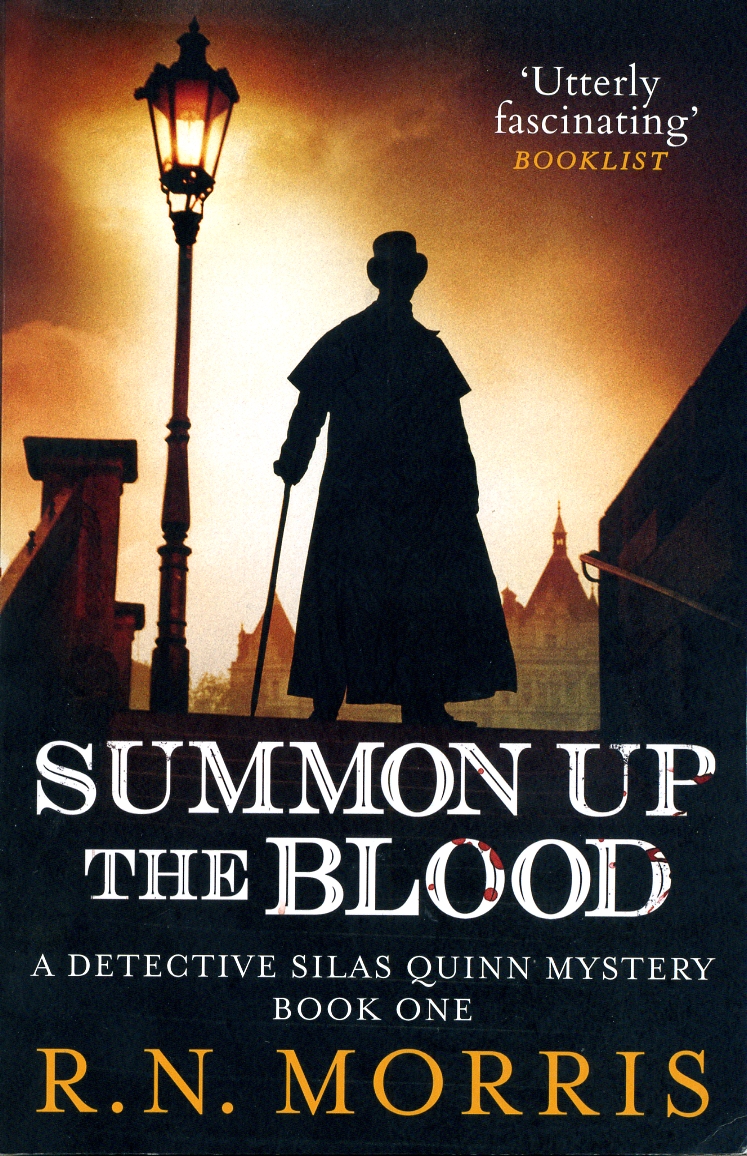
This is a recent edition of a book that was first published by Severn House in 2012, and was the first in a continuing series featuring an unusual Metropolitan Police detective, Inspector Silas Quinn. We are in 1914, a few months before the outbreak of The Great War. I have reviewed two others in the series, and the links are below.

The White Feather Killer (2019
The Music Box Enigma (2020)

Is Summon Up The Blood any good, even if it is a reissue? An absolute and unequivocal “Yes!” from me. Quinn is an intriguing fellow. never at ease socially, particularly with women. He seems driven by his own demons – if demons they are – as he seeks to investigate the crimes that other men on the payroll of The Metropolitan Police can’t fathom (or perhaps can’t be bothered with) His  superior officers realise that Quinn has a certain talent, but one that does not fit well into the the day-to-day operations of the force. So, he has been shunted off into a siding where he can pursue his own lines of investigation, but not make himself an irritant to the establishment. Quinn is The Special Crimes Department of Scotland Yard and with the assistance of his sergeants Inchcape and Macadam he ploughs his own furrow.

When a rent boy is found dead, his throat cut from ear to ear, there is initially little interest by the police, as the lad is just assumed to have paid the price for being in a risky line of business, but when the post mortem reveals that he has had every drop of blood drained from his body, Quinn is summoned and told to investigate. After a droll episode where Quinn decides to pose as a man smitten by “the love that dare not speak its name”, and blunders around in a dodgy bookshop, but he does find out that the dead youngster was called Jimmy, and had links to a ‘gentleman’s club’ where he would find men appreciative of his talents.
After the episode in the bookshop, Quinn decides to take things one step further and, armed with a distinctive brand of cigarettes favoured by the homosexual demi-monde, he sets out to impersonate a potential customer of Jimmy and his friends. Let’s just say that this does not go well, but he manages to emulate the News of The World reporters of later decades, who used to pass themselves off as punters in brothels, strip clubs, drug dens and the rest, and would then close the resultant exposé with the words, “I made an excuse and left.

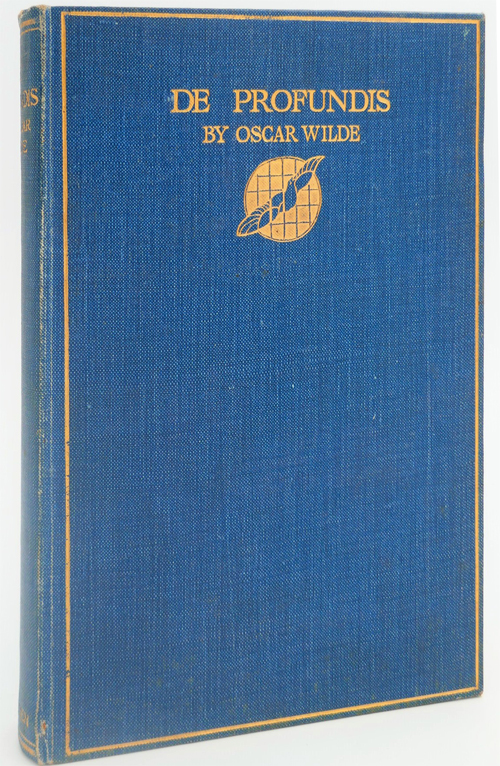
There are more deaths among what were known as renters, and Quinn’s frustration mounts. One of the enigmas is that the victims each possessed a silver cigarette case, inscribed with what appear to be literary quotes: it is not until Quinn learns that they all come from De Profundis, Oscar Wilde’s letter, written in Reading Gaol, to his lover Bosie, and subsequently published, that pieces of the proverbial jigsaw start to fit together.


Thankfully
, Morris makes no attempt to get in the politics of homosexuality and the law: his characters simply inhabit the world in which he puts them, and their thoughts, words and deeds resonate authentically. In 1914, remember, the trial of Oscar Wilde and the Cleveland Street Scandal were still part of folk memory. It’s an astonishing thought that had Morris been writing about similar murders, fifty years later in 1964, virtually nothing would have changed – think of the scandals involving such ‘big names’ as Tom Driberg, Robert Boothby and Ronnie Kray, and how their lives have been written up by such novelists as Jake Arnott, John Lawton and James Barlow.

As ever, Shakespeare said it first, but RN Morris has written a chilling and convincing murder mystery with an impeccably researched historical background. The book is an intriguing – and sometimes unnerving – mixture of grim violence, gallows humour, literary research, sexual degradation – and old fashioned detective work. Silas Quinn’s London of Spring 1914, blithely ignorant of the horrors that were to begin later in the year, is hypnotic and addictive. Summon Up The Blood is published by Canelo, and is out now.

THE HERETIC’S MARK . . . Between the covers

THM header006
SW Perry’s Elizabethan medical man Nicholas Shelby
returns in the latest of the ‘Mark’ series. We’ve had The Angel’s, The Serpent’s and The Saracen’s, (click to read reviews) and now we have another journey through the complex religious politics of the 16th century with The Heretic’s Mark. Nicholas has married his fiery Anglo-Italian lady Bianca née Merton. Her London South-Bank pub – The Magpie – has been destroyed by fire, but is being rebuilt. The newly-weds have a pressing problem, however. An innocent Jewish doctor has been executed for trying to poison the Queen, and Sir Fulke Vaesy, an embittered rival of Nicholas, has attempted to link him to the conspiracy. Fortunately, Nicholas has the ear of the Queen’s spymaster Robert Cecil, but he is advised to make himself scarce while the furore dies down.

Nicholas and Bianca decide to undertake a journey, posing as Catholic pilgrims, along the the Francigena, a route from France into Italy, its path worn by the feet of the devout. Along the way they are accompanied by a strange young woman – Hella – who they met in the Low Countries. She is a member of the Beguines – nothing to do with the dance, but a lay order, similar to Nuns. Hella is both disturbed and disturbing, as well as being sexually attractive. While Nicholas and Bianca are foot-slogging across the alps, back in London all is far from well. Rosa Monkton –  Bianca’s maid – and her husband Ned have been given oversight of the reconstruction of The Magpie, but Ned has become obsessed with trying to find out who has put Nicholas in harm’s way.

Nicholas and Bianca have arrived in the city of Padua, along with the enigmatic Hella. Padua is Bianca’s former home, and they become involved with a scheme – spearheaded by Bianca’s cousin Bruno and his friend Galileo (yes, the very same) – to build a huge and complex system of globes, rings and cogs which will predict the movements of the planets. Bianca has become (as they used to say) “with child”, but has been told by Hella – much given to doom-laden prophecies – that the child will be stillborn and, thereafter, Bianca will be unable to bear children.

Much of the action of this book takes place in Padua, but occasionally darts back to London to report on the travails of Ned and Rose Monkton. As Bruno and his acquaintances work feverishly at their great *armillary sphere, Nicholas becomes uncomfortable aware that Hella is determined to prise him away from Bianca, and her motives, as well as the obvious sexual one, are deeply sinister. No-one realises just how sinister, however, until a mysterious man in grey – who has been dogging Nicholas and Bianca’s footsteps on their journey across Europe – is unmasked.

This is seriously good historical crime fiction. SW Perry has done – as ever – an impressive piece of history homework, but that doesn’t matter, because great narrative drive, believable characters and an almost tangible sense of time and place make this a compelling read. The Heretic’s Mark is published by Corvus and is out now.

*An armillary sphere (variations are known as spherical astrolabe, armilla, or armil) is a model of objects in the sky (on the celestial sphere), consisting of a spherical framework of rings, centred on Earth or the Sun, that represent lines of celestial longitude and latitude and other astronomically important features, such as the ecliptic. As such, it differs from a celestial globe, which is a smooth sphere whose principal purpose is to map the constellations. It was invented separately in ancient Greece and ancient China, with later use in the Islamic world and Medieval Europe.

SECRET MISCHIEF . . . Between the covers

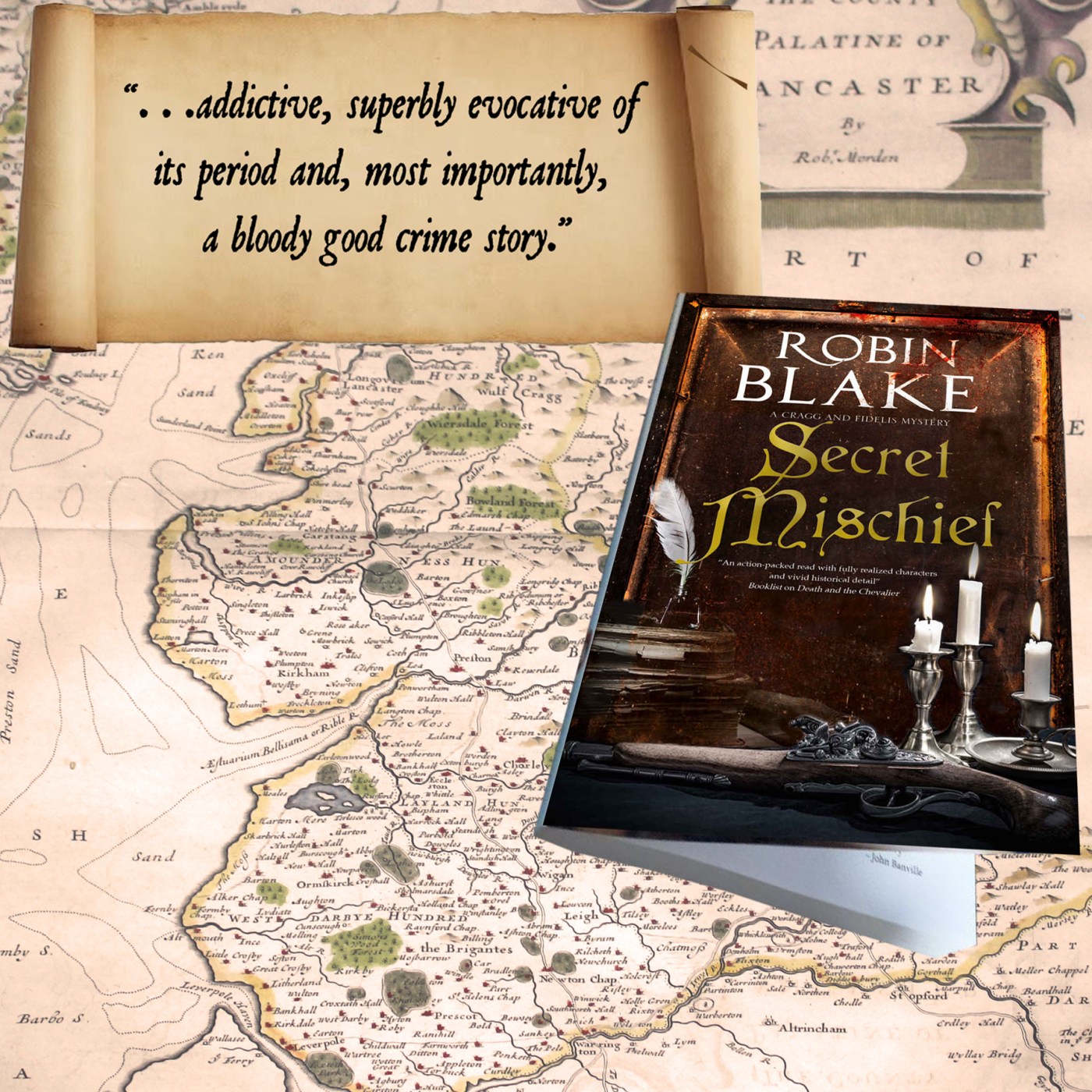
A new Cragg and Fidelis mystery from Robin Blake is always an event, so thank you, Severn House, for the review copy. For those  who have yet to meet this pair of 18th century investigators, here’s a quick heads-up. We are in the mid 1700s, in Lancashire, and King George II has not long since led his army in the field to defeat the dastardly French at The Battle of Dettingen. Titus Cragg is the County Coronor, and lives with his wife and son in Preston. His friend Luke Fidelis is a local doctor who is much admired by his patients, but viewed as highly suspect by some of the older medical fraternity in the area. This is the seventh in the series, and you can read my reviews of of a couple of the earlier novels here.

As ever, murder is the word, and a series of deaths in and around the town of Omskirk are linked to an archaic form of business plan for raising money, known as a Tontine. The investment plan was named after Neapolitan banker Lorenzo de Tonti and, to put it simply, was a pot of money where a number of people contributed an equal sum. The money would either be invested, with interest paid to the members, or used to fund capital projects. As time went on, and investors died, the fund became the property of the remaining members, until the last man (or woman) standing hit the jackpot.

Sounds like a good excuse to bump off a few people? Doesn’t it just! The first victim is, comically enough, a prize porker called Geoffrey. When Cragg is called to examine the corpse he thinks his time is being wasted, but when the late pig’s owner – one of the Tontine members – is shot dead a few days later, Cragg realises that the pig took a bullet aimed at his owner, and the shooter came back to finish the job.

One by one the Tontine signatories come to sticky ends: one is, apparently, hit by the sail of a windmill; another is found dead on Crosby beach, apparently drowned, but Luke Fidelis conducts a post mortem and finds that the dead man’s body has been dumped on the seashore. Things become even more complex when a reformed ‘lady of the night’, now a maid, is accused of pushing the poor woman into the path of the windmill sail. Cragg is convinced she is innocent, but faces an uphill struggle against a corrupt judge.
Not the least of the charms of these books is the description of Luke Fidelis as a medical man who questions existing – and faulty – medical procedures. There is a melancholy moment when he examines the young daughter of one of Cragg’s relatives, and finds that she is suffering from Consumption and is terminally ill. ‘Consumption’ is, obviously, archaic, but so descriptive of a disease that did, until relatively recent times, almost literally consume its victims.

Titus Cragg gets to the bottom of the mystery eventually, of course, even the investigation has his ship sailing dangerously close to members of his own extended family. Off at a slight tangent, I do love books with a map as part of the frontispiece. What was good enough for the Macmillan editions of Thomas Hardy’s novels is plenty good enough for Robin Blake, too. Another left-field thought: the Cragg and Fidelis tales occupy the same geography as the excellent Henry Christie novels by Nick Oldham (click to read reviews) – just a few centuries earlier.

Secret Mischief is addictive, superbly evocative of its period and, most importantly, a bloody good crime story. Also – and I can’t remember a novel doing so in a long time – it features a cricket match as part of the plot! It is published by Severn House and is available now.


THE CUSTARD CORPSES . . . Between the covers

TCC header
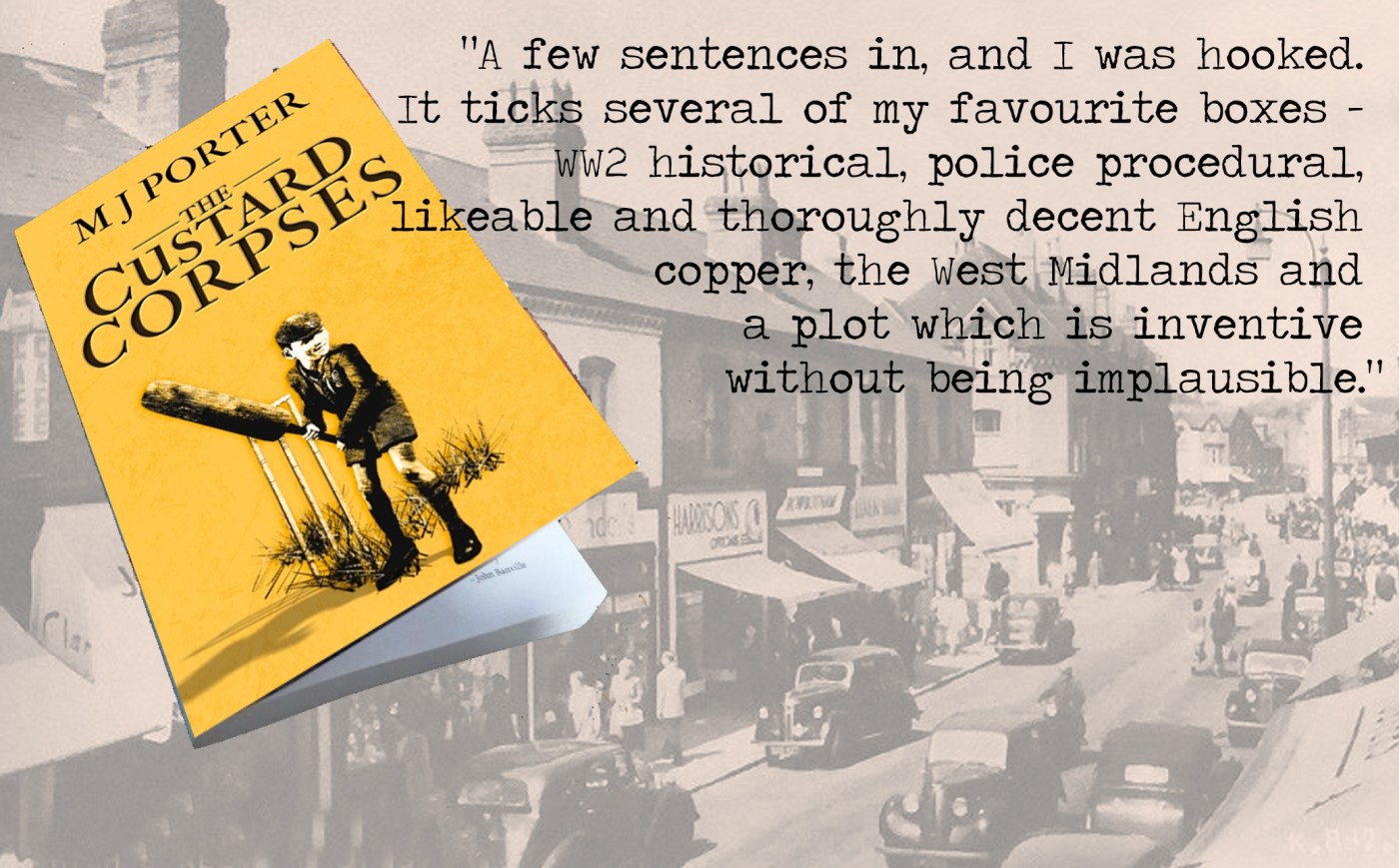
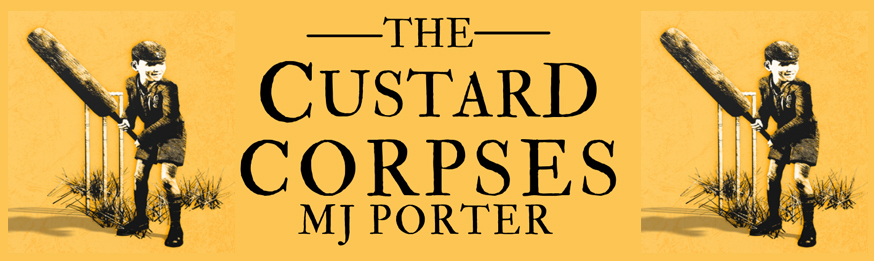
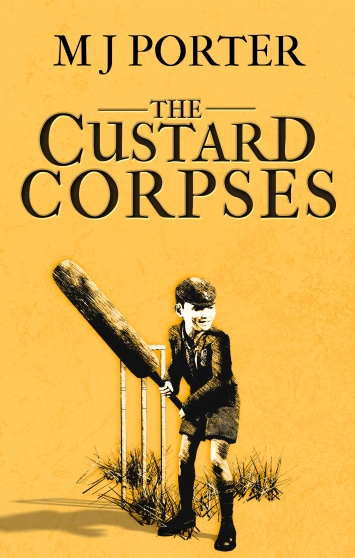
Sometimes a book comes along with very little by way of advanced publicity or hype, and it hits the sweet spot right away. One such is The Custard Corpses by MJ Porter. Strangely-named it might be but the reason for the title becomes more obvious - and appropriate - the more one reads. A few sentences in, and I was hooked. It ticks several of my favourite boxes - WW2 historical, police procedural, likeable and thoroughly decent English copper, the West Midlands and a plot which is inventive without being implausible.

We are in the Birmingham district of Erdington. It is 1943 and Great War veteran Sam Mason is a uniformed Chief Inspector at the local nick. He is not yet on the downward slope heading for retirement, but he is like Tennyson's Ulysses:

“Tho’ much is taken, much abides; and tho’
We are not now that strength which in old days
Moved earth and heaven, that which we are, we are;
One equal temper of heroic hearts,
Made weak by time and fate, but strong in will
To strive, to seek, to find, and not to yield.”

Screen Shot 2021-04-05 at 19.39.14Mason is a man given to reflection, and a case from his early career still troubles him. On 30th September 1923, a boy’s body was found near the local church hall. Robert McFarlane had been missing for three days, his widowed mother frantic with anxiety. Mason remembers the corpse vividly. It was almost as if the lad was just sleeping. The cause of death? Totally improbably the boy drowned. But where? And why was his body so artfully posed, waiting to be found?

Mason and his then boss, Chief Inspector Fullerton, had never solved the crime, and Mrs McFarlane died without knowing the whys and wherefores of her son’s death. When  Mason learns that there had been a similar case, a couple of years later, he is close to despair that it hadn’t come to light earlier. He realises that the fault was theirs. They hadn’t circulated the strange details of Robert’s death as widely as they should.

Attempting to make amends, albeit two decades too late, he has a circular drawn up, and sent to the police forces across England, Scotland and Wales. To his dismay, a succession of unsolved killings come to light; the dead youngsters are of different ages, but there is one bizarre common factor – the bodies have been posed as if in some kind of sporting action. Mason is given permission to devote his energies to this macabre series of killings, and with the resourceful Constable O’Rourke, he sets up an incident room, and begins to receive case notes and crime scene photographs from places as far apart as Inverness, Weston, Conway and Berwick.

Picture_Post_21-Sep-40One evening, after he has taken images and documents home with him, his wife Annie makes a startling discovery. Like nearly two million other readers across the country, she is a great fan of the magazine Picture Post, and while thumbing through a recent copy she notices that the sporting youngster drawn in an advertisement for a well-known brand of custard is posed in a way that has a chilling resemblance to the way one of the victims that Sam is investigating.

At this point, the investigation sprouts wings and takes flight and, in a journey that takes them across England, Mason and O’Rourke eventually uncover a tale of horror and obsession that chills their blood. MJ Porter has written a  series of historical and fantasy novels, mostly set in what we call The Dark Ages – Vikings, Goths and those sorts of chaps. That doesn’t tend to be ‘my thing’ but, my goodness, Porter is a good writer. The Custard Corpses goes straight onto my early shortlist for Book of The Year, and I do hope that he can tear himself away from his tales of ravens, rape, swords and general pillage to bring us another novel featuring Sam Mason. The Custard Corpses is out now.

Blood Runs Thicker . . . Between the covers

BRT HEADERThis is the eighth book in a very popular series set in 12th century Worcestershire. I am a latecomer to the party, but I thoroughly enjoyed the previous book River of Sins, and you can read my review by clicking this link. Now, Under-Sheriff Hugh Bradecote and his grizzled ally Serjeant Catchpoll – along with apprentice lad Walkelin – investigate the murder of an irascible and little-loved nobleman, Osbern de Lench.

The late man had a habit of sitting on his horse atop a small hill near his house and gazing at his land. It was said that doing so calmed him down when he was in one of his more wrathful moods. On the fateful day the horse comes back alone and a search party finds de Lench stabbed to death. His family was certainly not a happy one. Baldwin, his son by his first wife (who died in a mysterious riding accident) has the same choleric temper as his father. There is a second son – the result of de Lench marrying again, but Hamo is very different from his half brother. He is studious and solitary and probably has what we now call Asperger’s Syndrome.

BRT DIVIDER

Incidentally, there are three real-life villages near Worcester which rejoice under the names Church Lench, Ab Lench and Rous Lench, but I believe Osbern de Lench exists only in Sarah Hawkwood’s vivid and blessed imagination. Back to the novel, and Bradecote & Catchpoll learn that de Lench had ‘history’ with other local landowners, but was this enough to link any of them to his death? And was Fulk, the family Steward providing home comforts to Lady de Lench, a woman not unused to being roughly dealt with by her husband? The seemingly pointless murder of Mother Winflaed, a harmless woman who ministers to the villagers with her herbal knowledge – and also delivers its babies – only adds to the confusion.

The ingredients that make up the chemistry between the three investigators is cleverly worked. Young Walkelin is callow, but clever and inquisitive, while Catchpoll’s world-wearness is an excellent counter balance to Bradecote’s more lofty idealism.

By no means is this a preachy or political novel, but Sarah Hawkswood has some pertinent points to make – via Hugh Bradecote – about the treatment and role of women, and the very real perils of childbirth. As a man of advanced years I can find much to moan about in current society, but modern obstetrics (at least in the western world) is something for which we should all be eternally grateful.

I am very much an amateur book reviewer, and there are probably hundreds of us who love to read, and are grateful for publishers and publicists who trust us to deal fairly with the books they send us. One of the downsides is that there is always a To Be Read pile, with deadlines to meet, and little chance to sit back and read purely for pleasure. I am determined, however, to find time to catch up with the previous books in this series. If they are all as good as this one, then my time will not be wasted

 This novel is thoroughly immersive and the blend of classic whodunnit, gritty historical detail and the sense of a glorious landscape now all but vanished is utterly beguiling. Blood Runs Thicker is published by Allison & Busby, and is available now.

Blog at WordPress.com.

Up ↑