

In all my 76 years, I have never visited Brighton. Nothing personal, but I have never had a reason to go there. As a locus for crime novels it is certainly up there with its not-so-near northern neighbour, London. It probably all started with the evil doings of Charles ‘Pinky’ Hale in Graham Greene’s classic 1938 novel. In more recent times Peter James, with his Roy Grace series, has dispelled any notion that the resort is a happy and cheerful place of innocent fun, handkerchief hats, deck chairs and donkey rides. In a totally different vein, the Colin Crampton novels written by another Peter – this time Bartram – have hinted at a less malevolent Brighton in the 1960s.
Graham Bartlett’s Brighton is simply foul. Drug addicts from all over the country huddle in their rancid blankets in shop doorways. In summer, the warm breezes from the south still entice Londoners to take the trains from Victoria, and the shingle beaches still remain attractive. Walk just a hundred yards or so from the promenade, however, and you come face to face with the unique dangers generated by shattered human lives colliding with the vicious criminals who provide the drugs on which their victims have become reliant.
When Ged, a Liverpudlian undercover cop briefed to penetrate the Brighton drug scene announces that, after this current job, he is looking forward to a spell of paternity leave to welcome his firstborn, it is an obvious ‘tell’. You don’t need to have a PhD in contemporary crime fiction to know that this means he is not long for this world. He gets on the wrong side of Sir Ben Parsons, a Brighton legend, and a man who has worked his way from the metaphorical barrow boy to be CEO of an international pharmaceutical giant. Parsons’ latest money spinner is Synthopate, a drug that replicates the peaceful oblivion of heroin, but has no need of drug cartels, murderous enforcers, and street trash addicts.
Chief Superintendent Jo Howe has a dog in this fight. Her sister Caroline is not long dead, a victim of her opiate addiction. She is spearheading an initiative to get as many addicts as possible off the street , cleaned up, and into rehab. It is working well, but it is the last thing that Parsons wants, as it will hit the sales of Synthopate. Parsons has powerful friends everywhere – in politics, business, the media – and even the police. Together with Brighton crime boss Tony Evans, he starts to target the police officers themselves, and their families. All of a sudden, officers are calling in sick, becoming unavailable for court cases and showing a marked reluctance to volunteer for extra duties. Howe is furious but then it hits her world, too. Her journalist husband Darren is arrested by the Metropolitan Police for alleged corruption, and he looks to be facing serious jail time.
Things get even worse. Service companies employed by Sussex police – court staff, mortuaries, vehicle maintenance – all suddenly become unavailable – and there is a killer blow. Jo Howe’s two young sons go into convulsions after eating their school packed lunches and are on life support. There is a trope which suggests that there is no more dangerous being in creation than a mother when she realises her children’s lives are threatened. So it is here. Jo Howe becomes a blistering force of nature, and in a literally explosive finale she saves her sons, her own career – and ends the malevolent reign of Ben Parsons and Tony Evans.
One of the trademarks of the great film director Roger Corman (and he is still with us, aged 97) was to end his Hammer films with a fire – mansion, castle, cottage, it didn’t matter. Graham Bartlett makes a nod in his direction at the end of this book. Good prevails in the end, but the author paints a picture of a police force and justice system that is just a few malign keystrokes away from dystopia – and we should all be very worried. City On Fire is published by Allison & Busby and is available now.

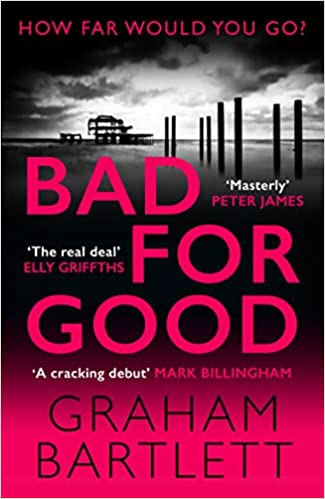 The plot hinges around a series of dire events in the life of Jo Howe’s boss, Detective Chief Superintendent Phil Cooke. Already trying to keep his mind on the job while his wife is dying of cancer, fate deals him another cruel blow when his son Harry, a promising professional footballer, is murdered, seemingly a casualty in a drug turf war. He steps down, but then comes into contact with a shadowy group of apparent vigilantes, who tell him that Harry was not the clean-cut sporting hero portrayed in the local media – he was heavily into performance enhancing drugs. The vigilantes – whose business plan is to provide a highly illegal alternative police force, where customers pay for the quick results that the Sussex Constabulary seem unable to provide – blackmail Phil into standing in the election of Police and Crime Commissioner. He is forced to agree, and is elected.
 Graham Bartlett (right) was a police officer for thirty years and mainly policed the city of Brighton and Hove, rising to become a Chief Superintendent and its police commander, so it is no accident that this is a grimly authentic police procedural. It is also very topical as, away from the violence and entertaining mayhem, it focuses on the seemingly insoluble problem of the divide between the public’s expectations of policing, and what the force is actually able – or willing – to deliver. Bartlett doesn’t over-politicise his story but, reading between the lines – and I may be mistaken – I suspect he may feel that, with ever more limited resources, the police should not be so keen to divert valuable time and resources away from their core job of catching criminals. My view. and it may not be his, is that effusive virtue signaling by police forces in support of this or that social justice trend does them – nor most of us – no favours at all.


 fullybooked2017