

SPRING IN THE EAST OF ENGLAND has been played rather a nasty trick by the weather Gods. February fooled us with its sunshine, gentle breezes and benign temperatures. March is taking its revenge. Blossom, daffodils and narcissi are nodding gamely but only just about holding their own in the teeth of savage winds. Still, indoors is relatively calm, and with a stack of excellent new books to ponder, I think I will make it through to May. Our four authors are all on Twitter, so just click on the little birdy to see what they are all up to.
THE CONFESSIONS OF FRANNIE LANGTON by Sara Collins

 This sounds as if it could be one of those bawdy recollections of a Victorian courtesan which passed for erotic literature in pre – 50 Shades days. It is, I am glad to say, nothing of the kind. It is, instead, a literary whodunnit set in early 19th century England. Then, as now, the media love an exotic criminal, no matter what crimes they may have committed. The chattering classes in the London of 1826 are, in turn, horrified and luridly curious about the defendant in a murder trial. The accused is a young woman, brought up on a slave plantation in her native Jamaica, and now she stands in the dock of the Old Bailey, charged with the murder of her employers, Mr and Mrs Benham. The indictment is sensational:
“FRANCES LANGTON, also known as Dusky Fran or Ebony Fran, is indicted for the wilful murder of GEORGE BENHAM and MARGUERITE BENHAM in that she on the 27th day of January in the year of Our Lord 1826 did feloniously and with malice aforethought assault GEORGE BENHAM and MARGUERITE BENHAM, subjects of our lord the King, in tat she did strike and stab them until they were dead, both about the upper and middle chest, their bodies having been discovered by EUSTACIA LINUX, housekeeper of Montfort Street, London.”
Frannie Langton tells her story courtesy of Sara Collins who, after a successful career as a lawyer, took a Masters degree in creative writing at Cambridge. This, her debut novel, is published by Viking/Penguin and will be available on 4th April.
THE LONELY HOUR by Christopher Fowler
 I have never written anything more eye-catching or erudite than these book reviews, so I don’t really know what real authors use (apart from sales figures) as ‘performance indicators’ for success. I use the speech marks to show that I would never normally use such examples of Management Speak, so it’s irony, OK? I imagine, though, that when you have created a central character, or in this case a duo, that is is so recognisable that it gets a bigger font than both the book title and the author’s name on the dust jacket, then maybe you have made it. Christopher Fowler’s ageless pair of investigators are, in the nicest possible way, an in-joke before the first page is turned. Fowler is second to none in his ability to use obscure British brand names as he puns and funs his way through what are the most irresistibly English novels of our time, and his two constabulary codgers are, for younger readers, named after a brand of British matches which were first sold in the mid nineteenth century. Their latest adventure begins, as ever, in London, with a mysterious death which may be connected to black magic. The book blurb promises “murder, arson, kidnap, blackmail ….. and bats.” Expect brilliant use of language, an eccentric and bewildering plot with a breathtaking resolution – and many a good joke. The Lonely Hour is out on 21st March and is published by Doubleday. The more perceptive among you might infer that I am a fan of Christopher Fowler. To find out more about his books, click on the gentleman’s image below, and all will be revealed.

BONES OF THE EARTH by Eliot Pattison
Eliot Pattison is an American writer who has written a superb series of novels, of which this the tenth, featuring a Chinese detective, Inspector Shan Tao Yun, who has upset the Communist regime by his honesty and single minded integrity. Managing to escape a state firing squad he has, instead, been exiled to the wilds of Tibet where, or so his masters believe, he can do no harm. The Inspector is forced to witness the execution of a Tibetan for corruption, but he can’t shake the suspicion that he has instead witnessed a murder arranged by conspiring officials. As ever, Shan chooses the hard road, and his investigations bring him into contact with the vengeful father of a murdered American archaeologist who is determined to find justice for his dead son. Shan becomes slap dab in the middle of a deathly struggle between the mystical world of Tibetan gods and the implacable bureacrats back in Beijing. Bones Of The Earth is out on 26th March, and is published by Minotaur Books. I’ve reviewed and recommended earlier novels by Eliot Pattison, so click the image below to find out more.

NO ONE HOME by Tim Weaver
It seems like only the other day that Tim Weaver introduced us to his investigator David Raker, yet No One Home is the tenth novel in the series. Raker has, you might say, a niche talent. He finds missing people. People in whom the police have lost interest, with just their distraught wife, husband, son or daughter left to care. Raker pursues his missing folk to some of the most far-flung parts of the world, but here, the mystery begins close to home. In a baffling disappearance to rival the unsolved mystery of the Marie Celeste, Raker isn’t just chasing one elusive subject – he’s after an entire community. The nine members of a tiny hamlet sit down to eat, drink and have fun on All Hallows Eve. When the grey dawn comes, they are gone. Every single one of them. Is Raker about to unravel a breathtaking conspiracy, or will he just have to settle for corpses? You will have to be patient to read how David Raker tackles this latest challenge, as Michael Joseph will be publishing the book on 16th May. Meanwhile click on the picture below to find out a little more about how Mr R operates.




 If a more extraordinary duo of fictional detectives exists than Christopher Fowler’s Bryant & May, then I have yet to discover them. The peculiar pair return in Hall of Mirrors for their fifteenth outing, and this time not only are they far from their beloved London, but we see a pair of much younger coppers on their beat in the 1960s. Fowler’s take on the period is typified by each of the fifty chapters of the novel bearing the title of a classic pop hit. We are also reminded of the strange fashions of the day.


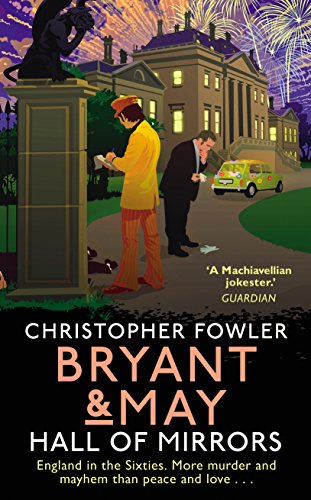 The dust jackets of the Bryant & May novels are a work of art in themselves, but between the covers is where the true genius lies. Arthur Bryant and John May are detectives working for the Peculiar Crimes Unit, an imaginary department of London’s Metropolitan Police. Their adventures take them mostly to curious and forgotten corners of London where the past is just below the modern surface. Fowler has many talents as a writer, not least of which is his comedic talent. He is a direct descendant of English humourists such as George and Weedon Grossmith and HV Morton, and the jokes come thick and fast amid the serious business of solving murders or strange crimes.

 The Urban Dictionary tells me that a “keeper” is
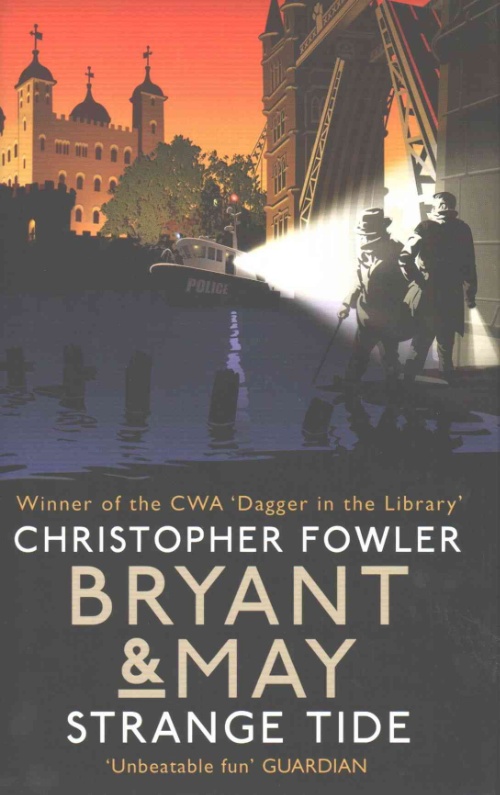
 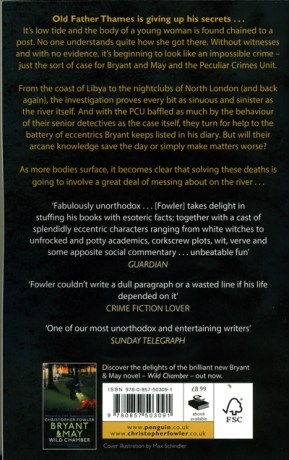 STRANGE TIDE is set, as you may expect, in London, but it’s a London few of us will ever see. It’s a world of forgotten alleyways, strange histories, abandoned amusement arcades, inexplicable legends and murder – always murder. Strange Tide was my book of the year for 2016, and you can read my review of it by following

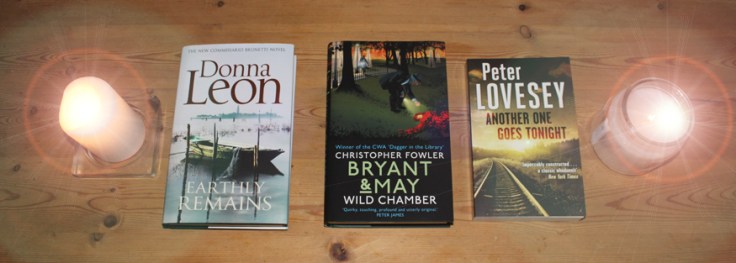
 To London, and most elderly pair of investigators currently still working. Existing fans of Arthur Bryant and John May have come to expect quirky humour, clever wordplay, an unrivaled knowledge of the topography and history of London, and a Betjeman-esque poetry of description which sometimes appears humdrum, but is often very profound. Christopher Fowler loves jokes that involve popular culture and brand names, and readers of a certain age will know that even the naming of the two elderly investigators is a little gem of a joke. The cobwebby pair work for the Peculiar Crimes Unit, an esoteric (and purely fictional) branch of the Metropolitan Police. They are constantly under threat of being pensioned off, but their investigations always take them to mysterious parts of London (usually entirely factual). Arthur Bryant – as usual – baffles and exasperates his colleagues, but in this tale his arcane knowledge of London helps the Unit solve the open air version of The Locked Room Mystery. The title? This is from Fowler’s erudite and entertaining website.
 This week’s award for the most menacing title must go to Peter Lovesey (right) and his Somerset and Avon copper, Peter Diamond. More used to solving high profile murder cases, Diamond is not best pleased when he is called in to investigate an apparent motoring accident. Tragically, a police vehicle, speeding late at night to a possible crime scene, spins off the road, killing one of the officers. Hours later, Diamond discovers that the officer is not the only victim. On an adjacent embankment, undiscovered by the emergency teams, is the rider of a motorised trike. The man is close to death, but Diamond administers CPR successfully enough for the victim to be taken to hospital, where he remains in a critical condition. Diamond, however, is not able to sit back and bask in the warm knowledge that he has carried out a valuable public service. His bosses are desperate that the whole RTA is not blamed on the police force, but what causes Diamond the most anxiety is the emerging likelihood that the man whose life he saved is almost certainly a serial killer.

 But all is not well. Arthur Bryant is physically sound enough, but his encyclopaedic mind is starting to betray him. He is suffering episodes of serious dislocation. He causes havoc in what he thinks is an academic library when he’s actually in the soft furnishings department of British Home Stores. While soaking up the ambiance of a Thames-side crime scene, all he can sense are the sights, sounds and smells of the early 20th century docks. John May and the more sprightly members of the PCU have to keep Arthur virtually under lock and key, for his own protection.


 fullybooked2017