
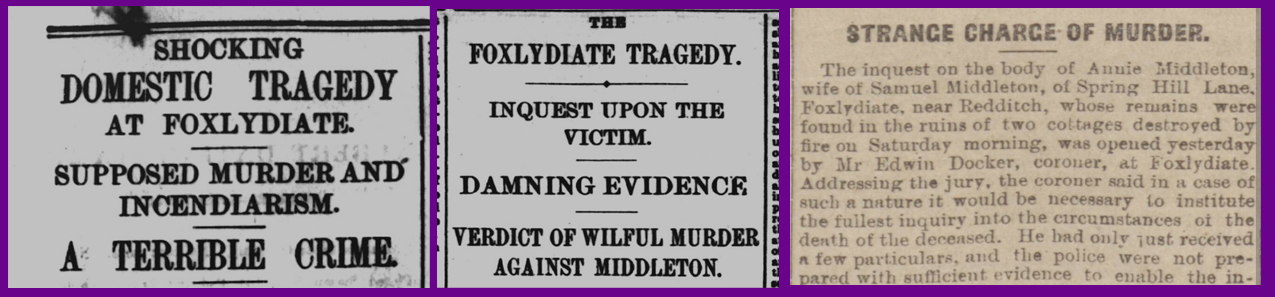
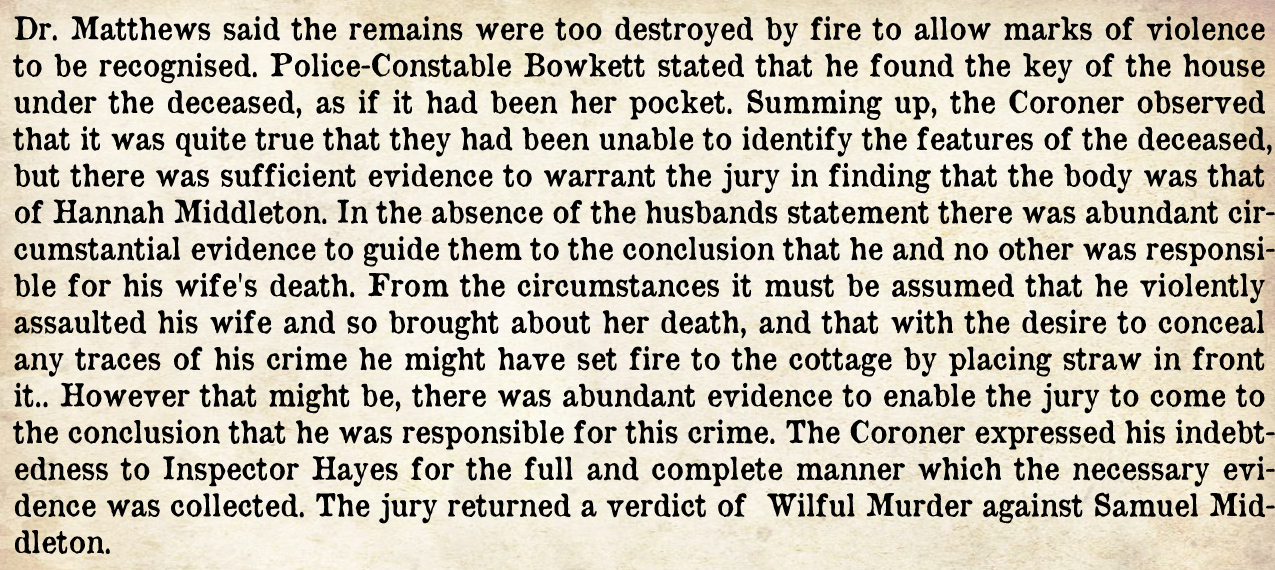
 SO FAR: On the evening of 10th/11th May 1902, Foxlydiate couple Samuel and Hannah Middleton had been having a protracted and violent argument. At 3.30 am the alarm was given that their cottage was on fire. When the police were eventually able to enter what was left of the cottage there was little left of Hannah Middleton (left, in a newspaper likeness) but a charred corpse. Samuel Middleton was arrested on suspicion of murdering his wife. The coroner’s inquest heard that one of the technical problems was that Hannah Middleton’s body had been so destroyed by the fire that a proper examination was impossible.
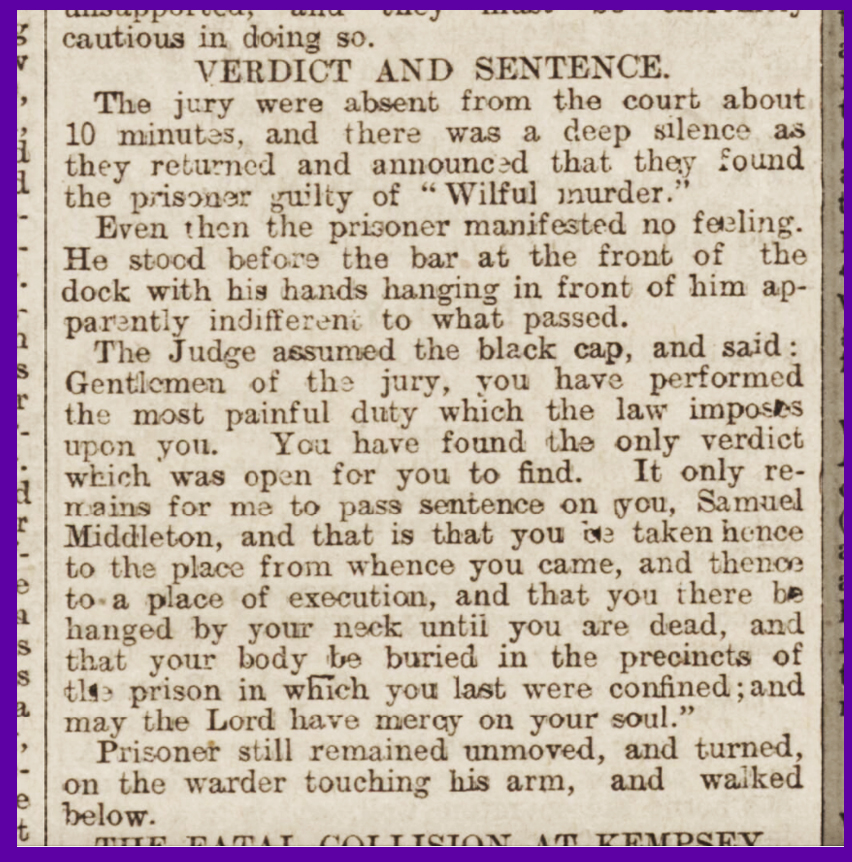
 Samuel Middleton was sent for trial at the summer assizes in Worcester. Assize courts were normally held three or four times a year in the county towns around the country, and were presided over by a senior judge. These courts were were for the more serious crimes which could not be dealt with my local magistrate courts. At the end of June, Samuel Middleton stood before Mr Justice Wright (left) and the proceedings were relatively short. The only fragile straw Middleton’s defence barristers could cling to was the lesser charge of manslaughter. Middleton had repeatedly said, in various versions, that his wife had clung to him with the intention of doing him harm – “She would have bit me to pieces, so I had to finish her.” It was clear to both judge and jury, however, that Middleton had battered his wife over the head with a poker, and then set fire to the cottage in an attempt to hide the evidence. Mr Justice Wright delivered the inevitable verdict with due solemnity.
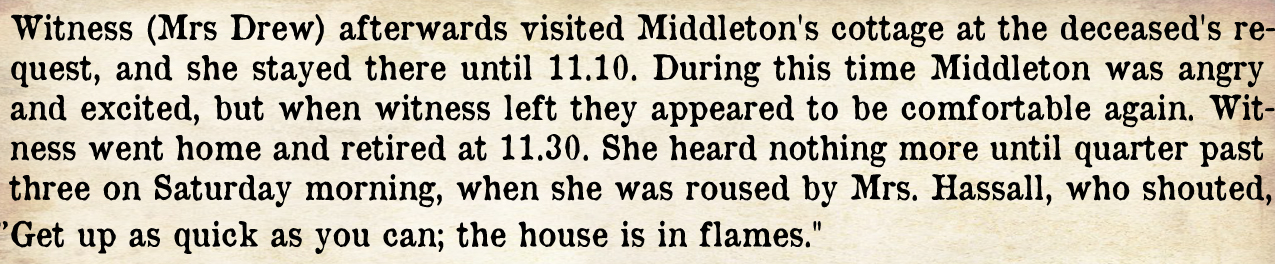
On the morning of Tuesday 15th July 1902, within the walls of Worcester gaol, the wheels of British justice, with the assistance of executioner John Billington, made their final turn in the case of Samuel Middleton. Public executions ended in 1867, but newspaper reporters were granted certain levels of access, and what they couldn’t actually see, they made sure their readers had full access to their imaginative skills.
“The Press representatives had full leisure to observe all these details while they were waiting for the arrival of tbe procession. The time went slowly for the waiters, but too fast, alas, for the wretched criminal awaiting his doom in the condemned cell. The minutes went by, till at length the warder flung open the huge gates, which extend the whole length of the wall, and let in a flood of summer sunshine. The sad procession made its appearance by a door on the opposite side of the yard, descended the few steps, and slowly crossed to the place of execution. The Chaplain, the Rev. R. R. Needham, headed the cortege, and was closely followed by the condemned man, his arms pinioned behind him, and supported by a warder on either side. His face was deathly pale, and his eyes had a terrified expression, but otherwise he appeared quite calm. Others in the procession were the Governor of the Prison (Mr. H. B. Lethbridge), tbe Under-Sheriff of the County (Mr. W. P. Hughes), the surgeon (Mr. L. J. Wilding), Ald. J. Millington (one of the Visiting Justices), Chief Warder Gibson, and other warders, and the Sheriff’s officer.”
“Arriving at the death-chamber, Middleton was assisted on to the trap doors, and in a moment Billington and his assistants, two young, active men, had the noose affixed and the strap securely bound round the man’s legs. All this while Middleton made no sound or sign. The white cap was pulled down over his head, Billington sprang to the lever, gave a sharp pull, the doors flew open, and the miserable man’s body plunged down into the pit. There was a jerk, the rope vibrated for a few seconds, and then all was still. Middleton had paid the penalty of his crime.”
“As soon as the body disappeared, the Rev. R. R. Needham read a few sentences from the Burial Service, while the prison bell tolled, conveying to the waiting throng outside an intimation that the last act in the tragedy had been accomplished. The Chaplain’s voice sounded unsteady as he read the words of awful import, but he proceeded to the end. Then slowly the spectators filed out, giving one glance down the pit as they passed at the motionless, white-capped figure, the rope taut round the neck, and the head bent on to the shoulder a a horrible angle.”
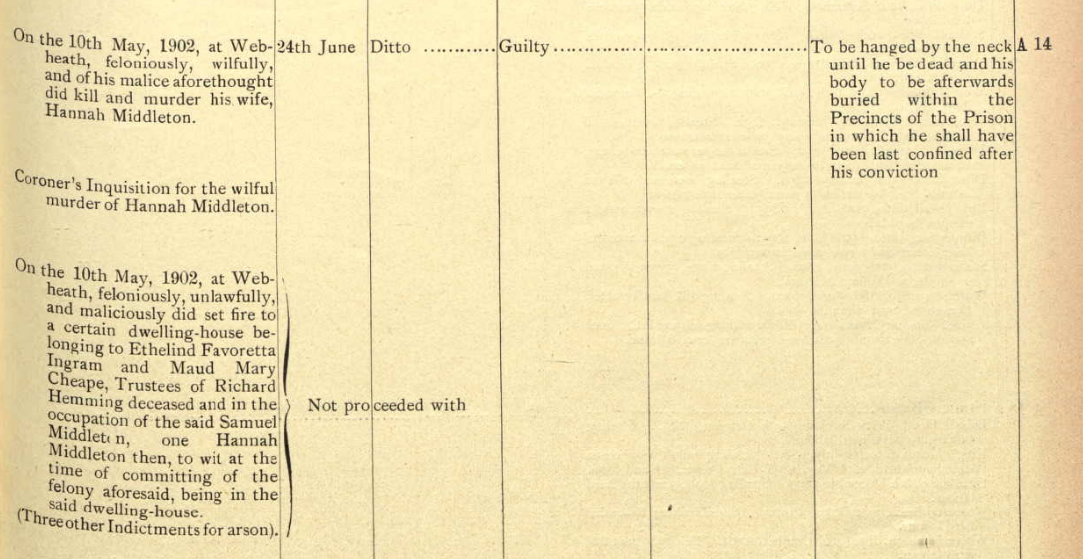
In a bizarre postscript, Middleton’s official criminal record includes the charge of destroying the cottage in which he lived, and the one occupied by Mrs Hassall.
FOR MORE HISTORICAL MURDER CASES, CLICK HERE


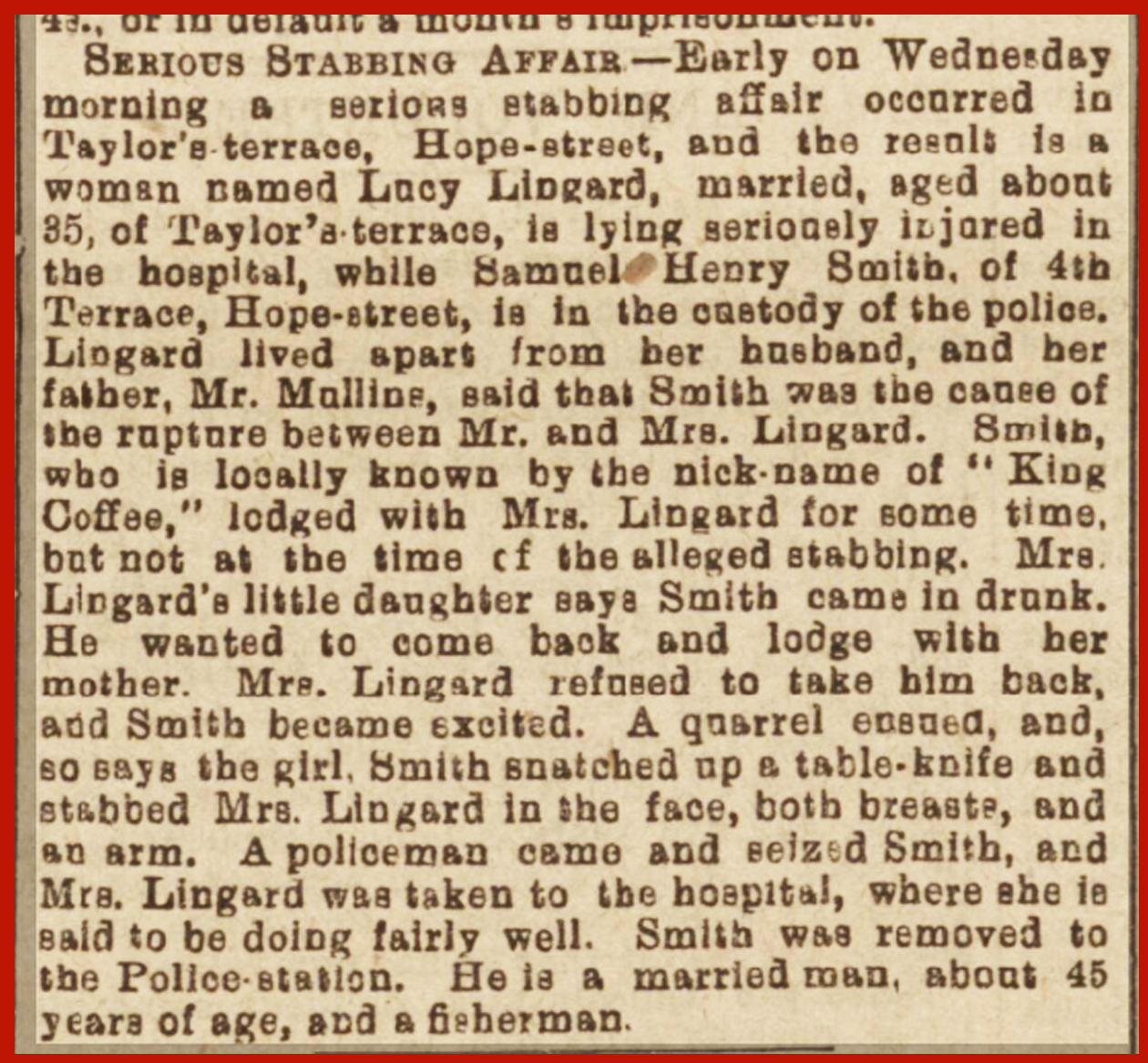
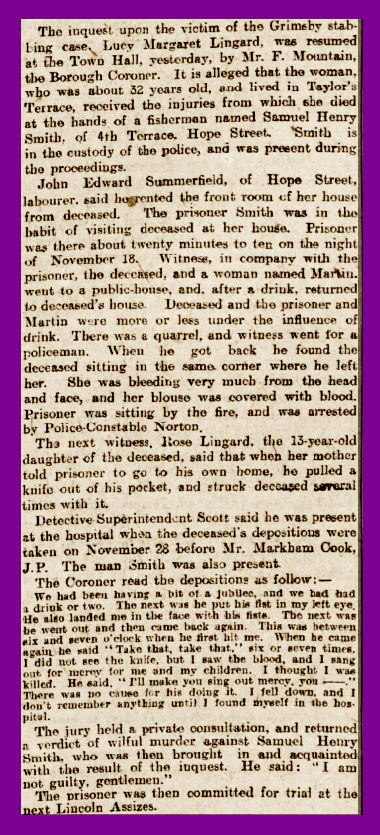 The report was overly optimistic. Lucy Lingard hovered between life and death for a while, but on the Sunday, four days after the attack, she died of her injuries, described below at the subsequent inquest.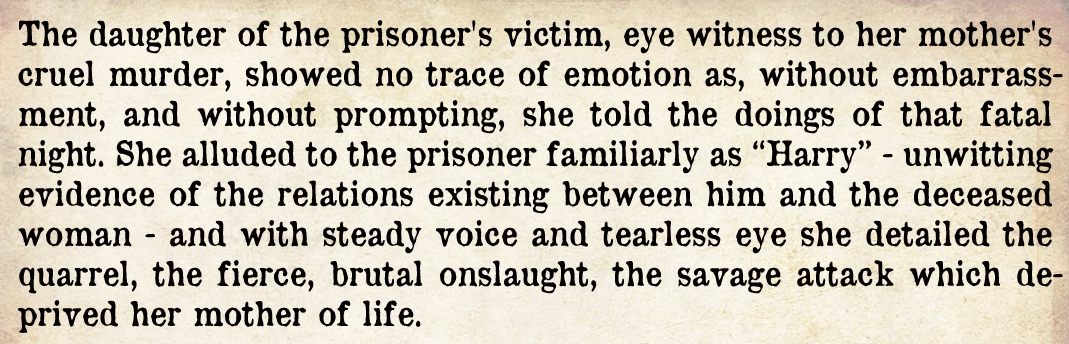
 Inevitably, the Coroner’s court, convened at the beginning of December, declared Smith to be guilty of murder, and now it would be up to the Lincoln Assizes court, Judge and Jury, to determine his fate. Smith spent the rest of December – including Christmas – and the greater part of February in Lincoln gaol. On Wednesday 25th February 1903, before Mr Justice Kennedy (right), Samuel Henry Smith ‘had his hour in court’. Despite the suggestion to the jury that the charge should be reduced to one of manslaughter, it all went badly for Smith.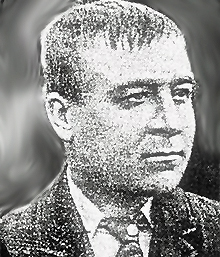


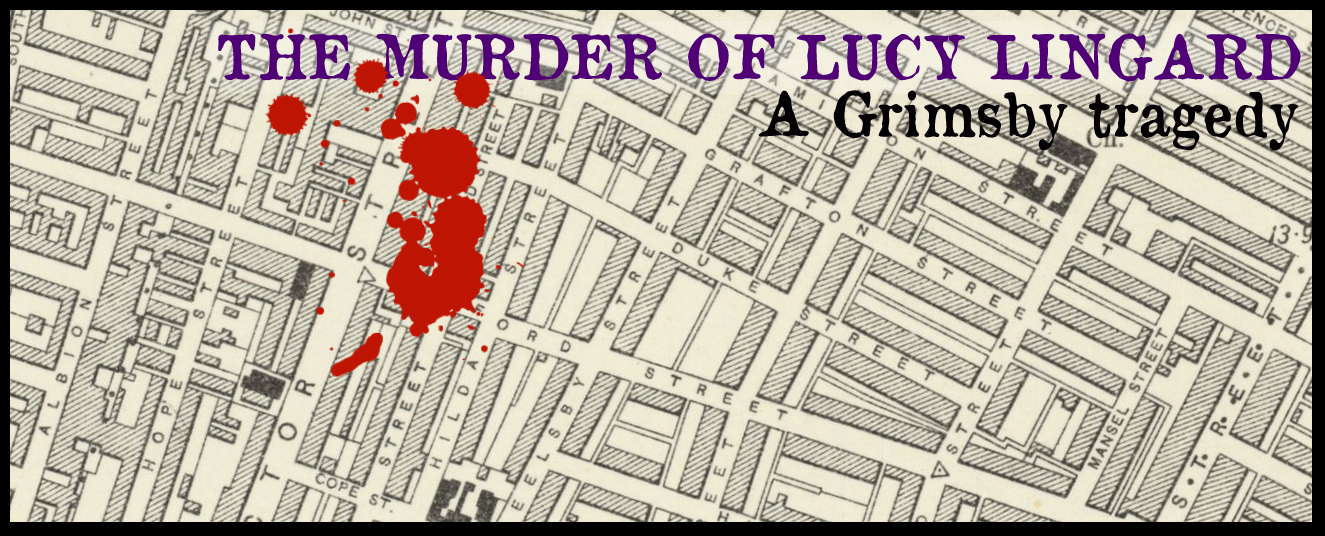
 Hope Street in Grimsby was cleared of its terraces in the late 1960s (pictured above, thanks to Hope Street History), but a late 19th century map shows back-to-back houses opening directly onto the street, and every so often there would courtyards, each open area being surrounded on three sides by further dwellings. For those interested in the history of Hope Street, there is a Facebook page that gives access to an excellent pdf document describing the history of the street. That link is

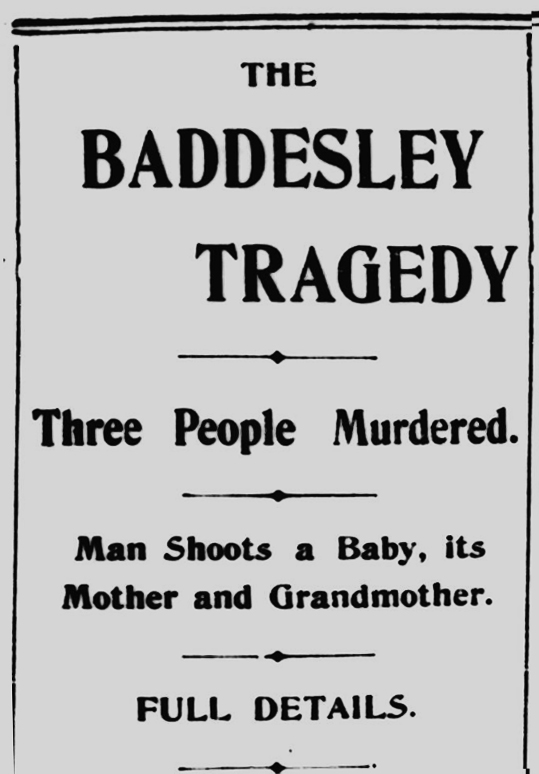
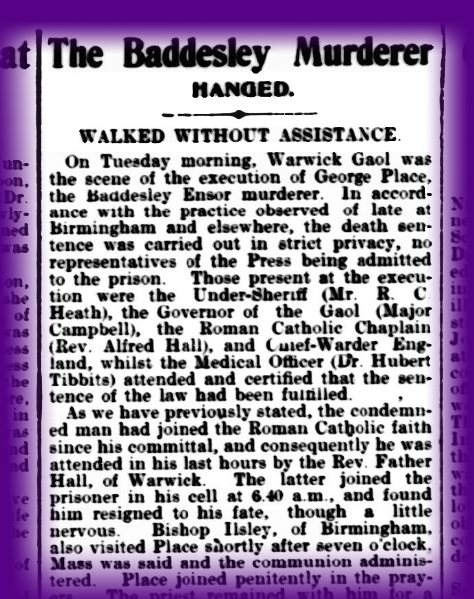 The rest of this grim tale almost tells itself. George Place, apparently unrepentant throughout, was taken through the usual procedure of Coroner’s inquest, Magistrates’ court, and then sent to the Autumn Assizes at Warwick in December. Presiding over the court was Richard Webster, 1st Viscount Alverstone, and the trial was brief. Despite the obligatory plea from Place’s defence team that he was insane when he pulled the trigger three times in that Baddesely Ensor cottage, the jury were having none of it, and the judge donned the black cap, sentencing George Place to death by hanging. The trial was at the beginning of December, the date fixed for the execution was fixed for 13th December, but George Place did not meet his maker until 30th December. It is idle to speculate about quite what kind of Christmas Place spent in his condemned cell, but for some reason, during his incarceration, he had converted to Roman Catholicism. It seems he left this world with more dignity than he had allowed his three victims. The executioner was Henry Pierrepoint.


 fullybooked2017