


MR BULMER’S GOLDEN CARP by John Bingham (1971)
 Mr Bulmer is a uniquely repulsive little man who manages a dry cleaning shop in Mayfair, and uses the opportunity of searching through the jackets and trouser pockets of wealthy individuals to service his own very profitable blackmail industry. His malignant little sideline has provided him with a regular income – and driven at least one of his victims to suicide. When he seizes upon what he sees as the opportunity of a lifetime, he is unaware that is about to be snared by his own hook. John Bingham, in addition to being a writer of distinction, was also a highly placed official in British Intelligence operations.
WE KNOW YOU’RE BUSY WRITING… by Edmund Crispin (1969)
 Crispin, aka Robert Bruce Montgomery, is best known for his Gervase Fen novels but here he spins a delightfully black tale of a struggling writer whose hospitality is impinged upon by a pair of runaways, both seeking a new life away from their spouses. Crispin intersperses the narrative with vivid accounts of a writer desperately searching for the words which will bring his latest novel to life. Sadly for the would-be lovers, their fate is to be organic fertiliser for Mr Bradley’s vegetable plot.
INDIAN ROPE TRICK by Lionel Davidson (1981)
 Davidson’s internationally themed thrillers were his bread and butter, but we must not forget that he was a writer of immense sensitivity with a wide range of influences. His own upbringing as a child of a hard-scrabble Polish-Jewish family might have made it unlikely that he would compose a chilling tale of murder on the banks of s Scottish river frequented only by rich Englishmen with the money to buy the rights to snare incoming salmon. A man whose sexual abilities have been devastated by a potentially fatal illness plans revenge on a friend whose libido remains undiminished. The denouement takes place on the banks of Scotland’s sacred salmon river – the Spey.
AT THE LULU-BAR MOTEL by Colin Dexter (1981)
 Colin Dexter? Cue Oxford, an irascible senior policeman, pints of English beer and crossword puzzles? Think on. When this story was published, Dexter was already four books into his Inspector Morse series, but the TV adaptations were still six years away. In this tale, Dexter takes us to, of all places, rural America, where a coach load of middle-aged and elderly tourists take a rest stop at the eponymous wayside hotel. The action is centred around a game of vingt-et-un, designed to empty the wallets of the gullible travellers. Dexter describes a scam-within-a -scam -but saves until the last few paragraphs a chilling finale in which the scammer becomes the scammed.
DEATH OF AN OLD DOG by Antonia Fraser (1978)
 People might forget that Antonia Fraser, as well as being the daughter of Lord Longford the widow of Harold Pinter and a superb historical biographer, is no slouch when it comes to crime fiction. Here, she taps into that strange love affair that English people have with their dogs. Richard Gavin is a successful barrister (is there ever another sort?) who has kept his upper lip stiff and tremble-free during the death of his first wife, and remarried. The new lady of the Gavin household is Paulina – young. bright and adorable. Her judgment, however is brought into question, when her decision to put an aged, smelly and incontinent spaniel out of its misery coincides with Richard opening an ominous letter from his London doctor.
THOSE AWFUL DAWNS by Patricia Highsmith (1977)
 This is the most shocking and slap-in-the-face story in the collection. I would go as far as to suggest that it would not have been written – let alone published – today, with our heightened awareness of child abuse and domestic violence. As an account of casual violence, domestic cruelty, alcohol abuse – and the pervasive power of the Roman Catholic church – it makes for uncomfortable reading. Highsmith’s misanthropy can never have been more glaringly or honestly displayed. her publisher wrote:
“She was a mean, cruel, hard, unlovable, unloving human being…I could never penetrate how any human being could be that relentlessly ugly…. But her books? Brilliant.”
Otto Penzler was right, and his verdict resonates in every single sentence of this account of the misfortunes of Eddie, Laura – and their children.
MARY by PM Hubbard (1971)
 Like Hubbard’s longer works, which are examined in this feature, a dream-like quality pervades this story, but the dreams are not necessarily pleasant ones. The first words are:
“The nastiest house I have ever been in was the Margesons’ house at Marlowe.”
Bill, the narrator is referring to the style and decor, rather than anything more sinister, but the darkness is about to descend. The lawn stretches down to the river and one day when Bill is sitting outside with Gerald and Janet Margeson, a waif-like teenage girl dressed only in a swimming costume walks up the path from the river. The girl, Mary, has thus invited herself into the otherwise humdrum world of the Margesons, and so begins a subtly erotic tale of obsession, betrayal and, ultimately, murder.
THE GIRL WHO LOVED GRAVEYARDS by PD James (1983)
 This exquisite masterpiece tells of a nameless girl, an orphan, who is brought up in a loveless terraced house in east London, the home of her Uncle Victor and Aunt Gladys. Her only joy is the adjacent cemetery which becomes a place of mystical and endless attraction:
“Even the seasons of the year she experienced in and through the cemetery. The gold and purple spears of the first crocuses thrusting through the hard earth. April with its tossing daffodils. The whole graveyard en fête in yellow and white as mourners dressed the graves for Easter. The smell of mown grass and the earthy tang of high summer as if the dead were breathing the flower-scented air and exuding their own mysterious miasma. Seeing the cemetery transformed by the first snows of winter, the marble angels grotesque in their high bonnets of glistening snow.”
Amid the poetry, however, James does not lose sight of the fact that we readers are in search of shocks and sensation. When the girl becomes a young woman, and is determined to find the grave of her dead father, we sense that her quest will end in tears. And so, in a drab suburb of Nottingham, so it does – but not quite in the manner which we have been led to expect
The Best Of Winter’s Crimes 1 has long been out of print, but as it was meant for mass circulation there are plenty of second-hand copies available from dealers such as Abe Books for less than the price of a pint.


 The ‘Bow’ in the title is not some fabric adornment, but the working class district in East London. If you were born within earshot of its church bells, then you were said to be a true Cockney. It’s December, and the nineteenth century is on its last legs. A dense morning fog, aided and abetted by the smoke of a million coal fires, swirls around the mean streets.
 The formidable lady has overslept, but after lighting the downstairs fire, she remembers to wake one of the lodgers. Arthur Constant is an idealist, and a campaigner for workers’ rights. She bangs on his bedroom door, then makes the day’s first pot of tea. Taking a tray upstairs, she calls again. Still no response. She peeps through the keyhole, but the key is firmly in place. As she pounds on the door once again, she has a premonition that something is very, very wrong. So she summons her neighbour, the redoubtable retired detective Mr George Grodman. He batters down the door, which was locked and bolted from the inside, and is forced to cover Mrs Drabdump’s eyes from the horrors within…
 Some contemporary critics were puzzled and irritated by Zangwill’s satirical style. They felt that there was no place for comedy in the tale of a young man, dead in his bed, his throat cut from ear to ear. The exchanges in the court scenes between pompous officials and outspoken ‘low life’ types on the jury are delightfully reminiscent of similar encounters between Mr Pooter and disrespectful tradesmen in that classic of English humour, The Diary of A Nobody.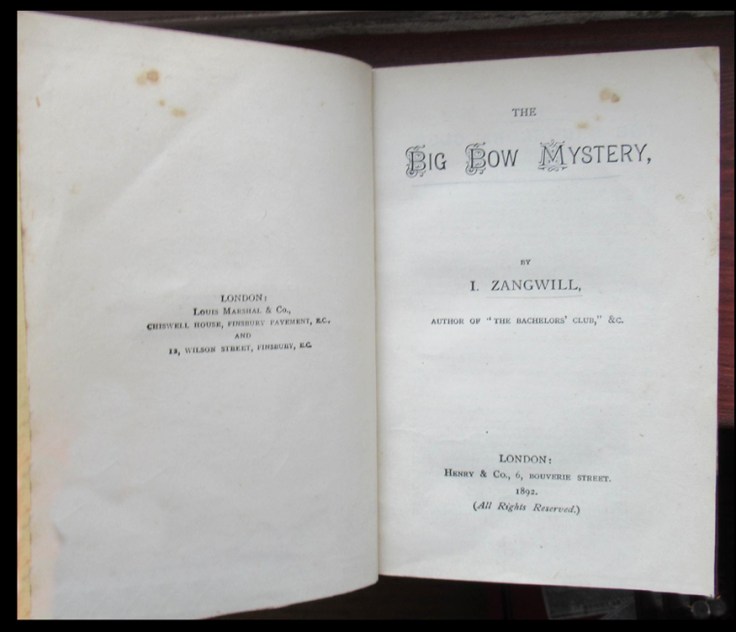





 Side by side with a pharmaceutically-addicted genius called Dante Torre she attempts to solve a grotesque mass murder. The express train from Milan to Rome arrives safely. Safe, that is, except for the passengers in the first class compartments who have all died in grotesque agony. Their bodies are discovered by an officer of the Railway Police and when he alerts his superiors,“la merda colpisce il ventilatore..” as they might (but probably don’t) say in Rome. Ironically, it is the fan from the air conditioning unit which has spread the deadly gas.
 Kill The Angel, translated from the Italian by Antony Shugaar (right), is ridiculously entertaining. The narrative constantly breaks the speed limit, and Colomba Caselli and Dante Torre are wonderfully imagined character. We can boo and hiss as Colomba is screwed – in all senses of the word – by sinister global forces, but she is a truly modern kick-arse (‘ass’ for US readers) heroine and she scorches her way across the pages of this gripping novel.
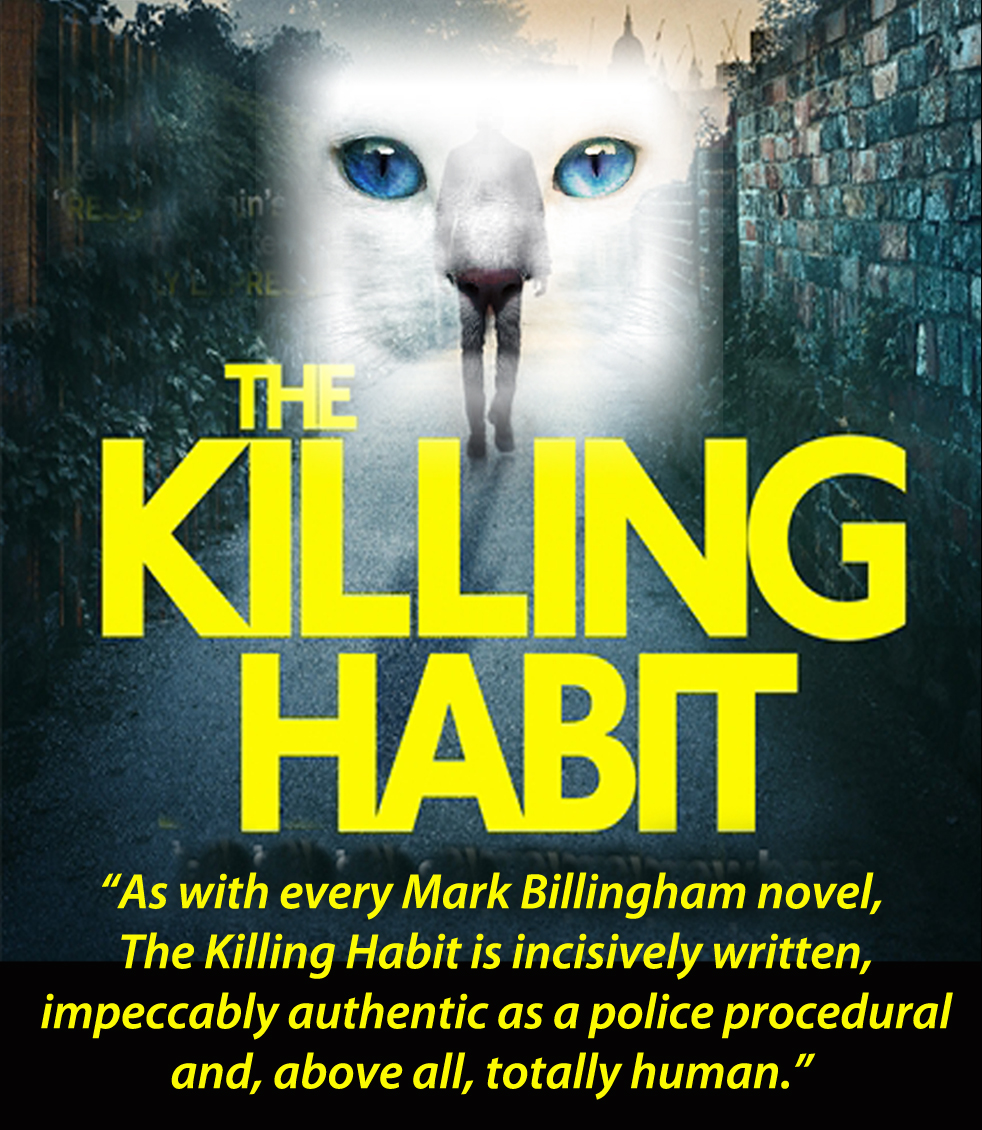

 The Thorne novels have a recurring cast list. As Salvatore Albert Lombino, aka Ed McBain said, quoting a 1917 popular song, “Hail, Hail, The Gang’s All Here!” Indeed they are. Its members include Helen, Tom Thorne’s long suffering partner plus little boy Alfie, and the bizarrely tattooed and pierced Mancunian pathologist Phil Hendricks. We have Nicola Tanner the police officer scarred by the murder of her alcoholic partner, Susan, and the perpetually cautious DCI Russell Brigstocke. Between them, they pursue two killers; one who murders losers-in-the-Game-of-Life on the periphery of a drugs gang, and another who seems to be targeting lonely women via a match-making service.
 Just when you think that he has provided all the answers to the complex plot, and the characters are, to quote the only bit of Milton I can remember from ‘A’ Level, “calm of mind and all passion spent,” Billingham (right) provides a breathtaking epilogue which, in addition to turning my preconception on its head, (feel free to add your own metaphor) bites you on the bum, punches you in the gut, hits you over the head with a piece of four by two, takes the wind out of your sails and grabs you by the short-and-curlies. Hopefully recovering from this multiple assault, you will be hard pushed to disagree with me that this is a brilliant crime thriller written by a master storyteller at the very top of his game.


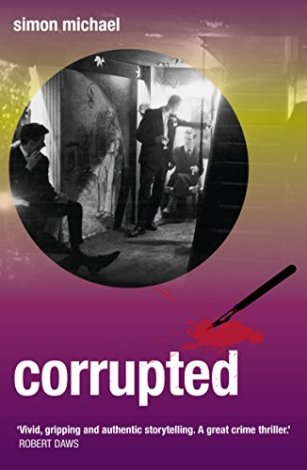 It is 1964, and Alec Douglas-Home’s Conservative government is on its last legs. The sex scandals which brought down his predecessor Harold Macmillan may have faded, but another one threatens to be just as explosive. Holborne is persuaded to defend a teenage boy accused of murdering one of the Krays’ stooges, but the fact that the youngster is what we would now call a rent boy sees Holborne accused of bringing his chambers into disrepute.
 Charles Holborne is a powerful and attractive central figure, but he is far from perfect. His chaotic private life reveals both passion and weakness. His judgement of human character also leaves something to be desired, as Simon Michael (right) shows, with a delicious and unexpected plot twist in the final pages of the novel. Corrupted is published by Urbane Publications


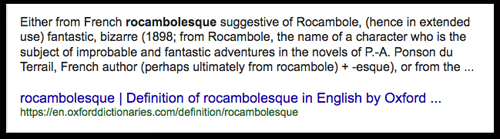 THEY SAY THAT YOU’RE NEVER TOO OLD TO LEARN – and reading the Amazon description of Dazieri’s novels I came across the amazing word Rocambolesque. As ever, Google had an answer of sorts, and I am now waiting for the opportunity to drop the word into casual conversation with my friends and family. That aside, Dazieri returns with another case for detectives Torre and Caselli. An express train from Milan arrives in Rome, but several of its passengers and train crew won’t be disembarking, at least without the help of medical teams, stretchers and body bags. This is Italian Noir at its finest, and not for the faint of heart. Published by Simon & Schuster, Kill The Angel is translated by Anthony Shugaar, and is out now.

 If you said either “Dracula” or “Vampire”, I win. But maybe you’ve been reading the novel by Irish-Hungarian actress and poet, Vivienne Vermes? If so, you’ll know that her novel The Barefoot Road definitely doesn’t involve teeth, cloaks, garlic or unconventional blood transfusions. It dos however, involve blood which is shed by violence. A young woman is found near a Romanian village. She is unconscious, half -starved, and barely alive. She is from an ethnic group which were brutally expelled by the ancestors of the present villagers. Humanity temporarily triumphs over tribal bigotry and she is nursed back to health, but when she begins a relationship with one of the villagers, and a child disappears, the embers of old hatreds burst into flames. The Barefoot Road is published by Matador, and is available as a Kindle or a paperback.


 But he has, as far as is possible, moved on. He has an unexpected family in the form of a daughter from an early relationship, and he keeps his chin up and his eyes bright. Because to do otherwise would mean self destruction, and he owes the physically absent but ever-present spirit of Derryn that much. His world, however, and such stability as he has been able to build into it, is rocked on its axis when a woman turns up at a West End police station claiming to be his wife. Derryn. Dead and buried these nine years. Her fragile remains consigned to the earth. He sees the woman through a viewing screen at the police station and he is astonished. In front of him sits his late wife, the love of his life, and the woman for whom he has shed nine years of tears.
 So many questions. The answers do come, and the whole journey is great fun – but occasionally nerve racking and full of tension. Tim Weaver (right) has crafted yet another brilliant piece of entertainment, and placed a further brick in the wall built for people who know that there is nothing more riveting, nothing more calculated to shut out the real world and nothing more breathtaking than a good book.


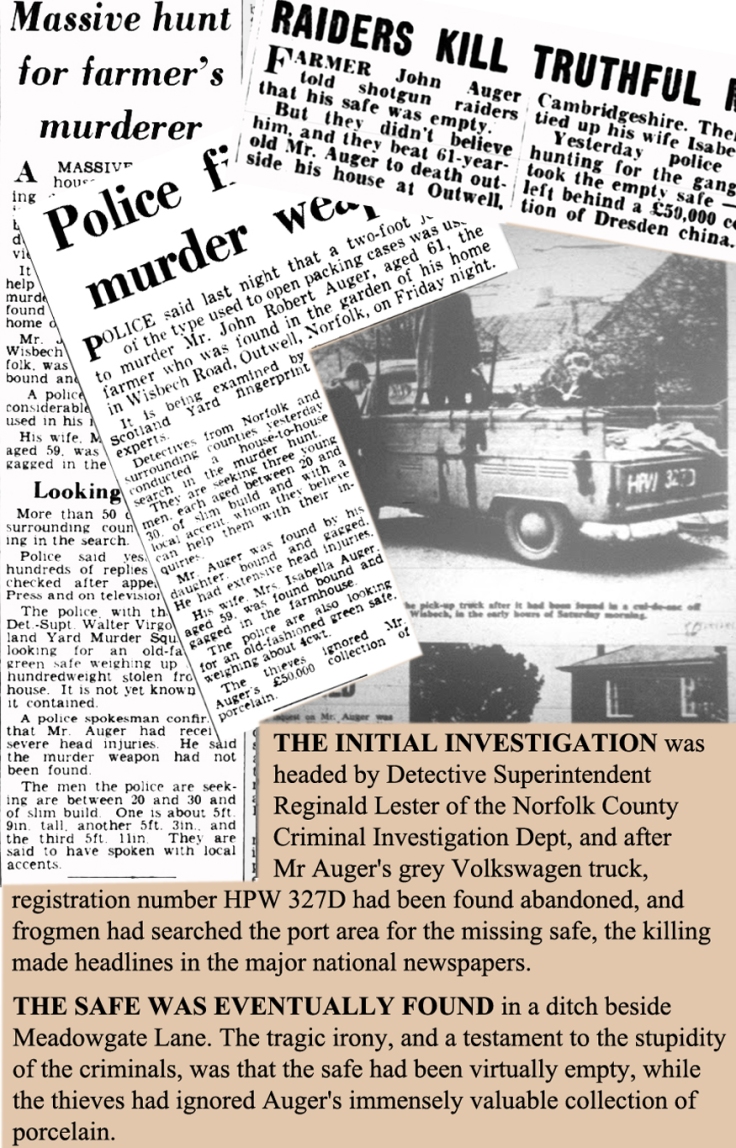


 And yet, and yet. In 1977, Commander Wallace Virgo (left) head of the Serious Crime Squad, was convicted of corruption, and sent to jail . As the ensuing corruption investigations widened, the obscene publications squad was replaced in its entirety with a new group of officers drawn from the uniformed branch, and in all over twenty detectives were dismissed or required to resign. When the cases ultimately came to trial in 1977 the presiding judge Mr Justice Mars-Jones summarised those involved as having engaged in “corruption on a scale which beggars description” Ten years earlier, had the case-hardened and confident London detectives arrived in the relative backwater of the Fens and ‘done a job’ on some local men who were certainly career petty criminals, but not very bright?


