Search

fullybooked2017

THE STRANGE DEATH OF CATHERINE GEAR . . . A Lincolnshire murder (2)

Duddles header

SO FAR: On the afternoon of October 8th 1907, a strange weekday drinks party had been held in a tied cottage belonging to Guy’s Head Farm near Sutton Bridge. Some of the drinkers went home for tea, the tenant of the cottage, William Gear, departed in fetch more beer, leaving his wife, Kate, alone in the house with their lodger, William Duddles. When her returned, he found that his neighbours had found Mrs Gear lying on the floor of the cottage, mortally wounded, a bloodstained hammer by her side. Of Duddles, there was no sign.

The police went in search of Duddles, and he was soon found. A newspaper reported:

“Sergeant Taylor, of Long Sutton, went in search of him. and he was discovered in the Marsh, near to the sea bank. He was then charged with attempted murder, the deceased at that time not being dead. His hands and clothing bore marks of blood, and in answer to the charge he said, “A still tongue makes a wise head,” and made no definite statement.”

The same newspaper went on to say:

“At Long Sutton, on Wednesday, William Duddles, aged forty-seven, was charged with the wilful murder of Catherine Gear, aged thirty-six, at Lutton Marsh, on October 8th. Supt. Osborn, of Spalding, gave evidence similar what is stated above. Sergt. Taylor, stationed Long Sutton, said he charged the prisoner with the attempted murder of Mrs. Gear, in Lutton Marsh, that afternoon. Prisoner replied : ” I have never done anything wrong before ; I am a bad ‘un, I know. I have been put on.” A short time afterwards he said: “A still tongue makes a wise head ; I shan’t say nowt.”

“That morning, from further information, and after cautioning him again, witness charged him with the wilful murder of Catherine Gear, and he made no reply. The prisoner was remanded until Wednesday, the l6th. He appeared in court with a black eye and cuts on the left temple and over the left eye, which, it was suggested, indicated that the woman had tried to defend herself. The inquest was held on Wednesday evening, before Dr. Barritt the Spalding District Coroner, at Lutton Marsh. William Gear, the husband, said that he and his wife got on very well together. A lodger named Duddles had been with them about two years, he occasionally had some words with them when was in drink, and sometimes made imputations against deceased.”

“They had some words recently. Duddles called his wife some some abusive names, and witness, taking her part, struck him. On Tuesday, witness went out at four o’clock to fetch some beer, and upon returning found his wife lying on the floor with her head in a pool of blood, a coal hammer lying few yards away. She was not dead, but was unconscious. Evidence was also given by Edwin Hocking, living next door, and a neighbour named Towson. The inquiry was adjourned until Monday next, and a post-mortem examination was ordered. The hammer, with which the tragedy alleged was alleged to have been enacted was produced in Court; it is an engineer’s hammer, fifteen inches long, with a heavy head of iron.”

Church

The funeral of Kate Gear was a lonely and bleak affair:

Funeral

Justice moved swiftly in the case of William Duddles. He was swiftly indicted for murder, and sent for trial at the November Assizes in Lincoln. This was not before the national press had a few things to say about him.

Demon

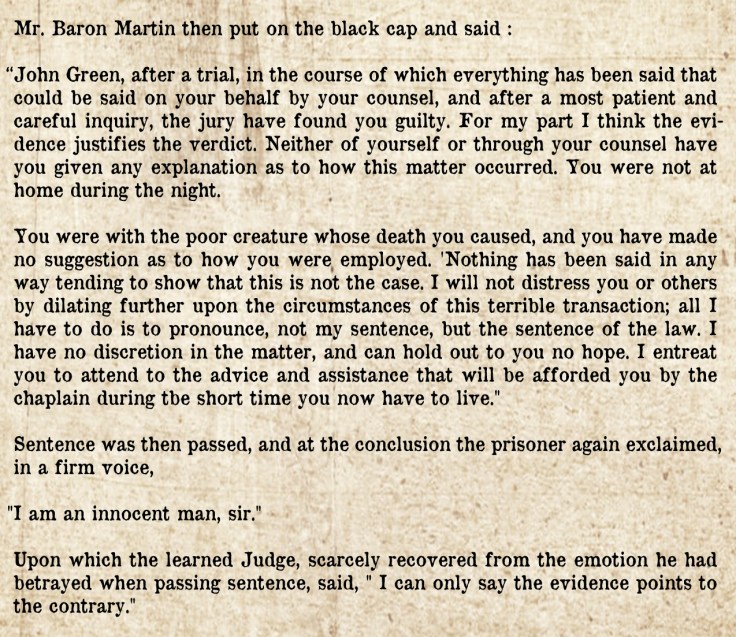
IPNThe “diminutive man of repulsive appearance” was found guilty of murder, and sentenced to death by the judge, despite the jury recommending mercy due to the prisoner’s mental state. One of the strange things about this case is that newspapers at the time normally reported verbatim anything said in court, either by the accused or his legal representatives. In this case, I have been able to find absolutely nothing. Defence barristers are known to this day for concocted elaborate excuses when pleading clemency for their clients, but here they either had nothing to say, or it was never reported. The obligatory plea for mercy was sent to the Home Secretary, Herbert Gladstone (son of the great former Prime Minister) but it fell on deaf ears, and William Duddles was executed on 20th November in Lincoln Prison. In charge of proceedings were the Pierrepoint brothers, Henry and Tom – father and uncle to the more celebrated Albert.


The classic mantra of solving murders – both real and fictional –  is ‘Means, Motive and Opportunity’. In the case of William Duddles, the means and opportunity are obvious, but the big question remains “why”? From the limited evidence that remains available through old newspapers, it is hard not to conclude that there was a sexual element in this murder. Out of consideration for the dead woman and her family, the newspapers would have remained silent, but it seems to me that Kate Gear was, in some way, tormenting Duddles over a period of time, perhaps promising much but delivering little, and the teasing became too much for a man of limited intelligence made dangerous by drink.


Does this excuse what he did? Never in a million years. He battered a woman to death and, depending on your views on capital punishment, was punished accordingly. There is a strange undercurrent to this case – the mid-week drinking binge being the strangest – that will remain a mystery. Kate Gear lies in the peaceful churchyard of St Nicholas, Lutton, while her killer is buried in the poignant little plot reserved for hanged men within the grounds of Lincoln Castle.

THE STRANGE DEATH OF CATHERINE GEAR . . . A Lincolnshire murder (1)

Duddles header

On a bright summer day, the table-flat marshland between Long Sutton and The Wash is beautiful. Endless blue skies, waving fields of wheat and skylarks singing overhead. On a grey autumn afternoon, however, the countryside takes on a much more menacing aspect. It was on such an afternoon in October 1907 that a brutal murder took place near Guy’s Head Farm. Two people are central to the drama, a 36 year-old farm labourer’s wife named Catherine Gear, and a 47 year-old man called William Duddles.

William Duddles was born in 1860 in High Toynton, just on the edge of the Lincolnshire Wolds. In the 1891 census he is living with his mother and sister in Boston. Somehow he doesn’t appear in the 1901 census, but we know that in 1907 he was working on Guys Head Farm, on the left bank of Tycho Wing’s Channel, the arrow straight cut that takes the River Nene into The Wash. He was lodging with another farm worker in their tied cottage. William Gear and his wife Catherine, always known as Kate. They had married in 1898, and she was from the Bontoft family, born in Wrangle, between Boston and Skegness.

On the afternoon of Tuesday 8th October 1907, some employees of Guy’s Head Farm were, for whatever reason, not engaged in honest toil. In the Gear’s cottage Kate, William, Duddles and two other workers, James Towson and Edwin Hocking, were having a party which certainly involved drinking beer, if nothing more sinister. At some point, the beer ran out, and William Gear volunteered to walk the mile or so to Gedney Drove End and fetch more beer from one of its three pubs. By the time he returned, Towson and Hocking had, as they used to say, ”made an excuse and left”, leaving Kate Gear and William Duddles in the cottage on their own.

What William Gear found in his cottage when he returned with fresh supplies was not a convivial booze-up, but a dying woman – his wife. She had been battered about the head with something heavy and deadly. She lay on the floor, her life oozing away inexorably from a terrible head wound. Gear’s return to the cottage had coincided with neighbours hearing some kind of disturbance and going to the cottage to investigate. Their evidence was later reported in the newspaper:

“Whilst witness (Mrs Jane Hocking) was getting her tea a friend who was with her remarked, ” I think I can hear a scream,” and upon going into Gear’s house they found the woman in a dying condition. Robert Stebbings, labourer, of Lutton Marsh, said about the time of the tragedy he noticed William Duddles coming from the direction of Gear’s cottage, and at the same time Mr Gear was going an opposite direction, Duddles turned off to avoid him. When Duddles passed witness he noticed that he was in excited and frightened state, and witnessed confessed to being alarmed at his appearance. He stated that a fortnight previously he had heard Duddles say, ” I will be the death of the **** if I swing for it.”

The sensationalist newspaper, The Ilustrated Police News, were quick to have one of their house artists draw a dramatic reconstruction of the discovery of Kate Gear’s body.

IPN2

The police and medical help were summoned, but Kate Gear was beyond help, and she died later that evening without ever recovering consciousness. A heavy coal hammer, its head bearing the marks of blood, bone, hair and skin tissue had been discarded next to the woman’s body, and was obviously te murder weapon, but where was William Duddles, the obvious culprit? The Boston Guardian reported on Duddle’s movements – and the amount he had drunk:

After the murder

IN PART TWO:

An arrest, a funeral, an execution – and a mystery

MURDER MOST VILE . . . Between the covers

MMV header

Having not come across author Eric Brown before, I did a quick search, and Wiki told me that he was a prolific science fiction writer, and I immediately thought I must have got the wrong chap, but he is one and the same. His versatility in writing Golden Age-ish mysteries set in the 1950s as well as futuristic fantasies is to be commended, but after all, he was born and raised in Haworth which, if you are looking for literary connections, is as good a place as any, and better than most.

MMV coverWhat is happening then, in Murder Most Vile? All too often these days, I am a late arrival at the ball and this is the ninth in a series centred on a pair of investigators in 1950s England. Donald Langham is a London novelist, who runs an investigation agency with business partner Ralph Ryland. Langham’s wife, Maria Dupré,  is a literary agent. Here, Langham is engaged by a rather unpleasant and misanthropic – but very rich – old man named Vernon Lombard. Lombard has a daughter and two sons, and the favourite one of the two boys, a feckless artist called Christopher, is missing.

Old Lombard has history, and not a particularly salubrious one in terms of British politics in the 1930s. He was a fervent supporter of Oswald Mosley and his fascists, and while this years ago, it is to rake up uncomfortable memories for  Ralph Ryland when it emerges that the boss of a London brewery is also a pervert, a gangster – and, like Vernon Lombard – someone who longs for the glory days of the British Union of Fascists.

Langham and Ryland are an interesting team, with Langham the more urbane and middle class of the two, while Ryland’s father was a London docker who was on what we now consider to be the wrong side of things during the infamous Battle of Cable Street in 1936, when Mosley’s fascists went head to head with an opposing force of trade unionists, Jewish groups and communists, with the police trying to keep the sides apart. Out of loyalty to and, perhaps, fear of his father, Ryland was there that day, and what he saw – and did – has continued to haunt him, especially since he was among the Allied troops who liberated Belsen in April 1945 – a month that has special significance for some of the characters in this novel.

Screen Shot 2022-03-02 at 19.24.36

What the pair uncover is that most poisonous of situations – bitter family jealousy. It transpires that Christopher Lombard’s apparent success as an artist is due to his father buying up most of his canvases, and the other two siblings are not happy. There are abductions, murders and mysteries – and Eric Brown provides a clever plot twist which I never saw coming.

It’s not always helpful to shepherd crime novels into genres, but I know that many readers are not comfortably retired like me, and the time they have for settling down with a good book is limited, and that is why they sometimes welcome a ‘heads-up’ as to what kind of book to pick up next. I would say that Murder Most Vile is cosy crime, but with a hard edge. It is also, I suppose, historical crime fiction, because, for some, 1957 is as far away as 1757 in terms of social attitudes and the trappings of technology. It might also be doffing its trilby to the world of bygone investigators – Paul Temple, certainly, with maybe just a hint of Bulldog Drummond. We have dead bodies, escapes from dungeons, powerful embittered and influential old men and  – essential to all private investigators – friends in the police force. The bottom line, however, is that this is cleverly written by Eric Brown, and is well worth a few hours of anyone’s time. Murder Most Vile is published by Severn House and is out now.

ERIC BROWN’S WEBSITE IS HERE

THE KING STREET SHOOTING . . . A Leamington murder in 1921 (2)

KSS header

SO FAR: It is late afternoon on Thursday 19th March, 1921. Motor mechanic Frederick Pugh (47) has spent most of the day drinking in various Leamington pubs, and he has returned to the house he shares with his wife, Constance Ethel Pugh, at 50 King Street. Rows between the two are frequent and always noisy. The next door neighbour has come to remonstrate with Pugh, who is now outside the house. Pugh complains that his wife is always nagging him and goes back indoors.

The neighbour, Thomas Mills, returns to his own house, but then hears two loud bangs. He goes to look through the window of number 50, and seeing Mrs Pugh lying on the floor, runs into the town until he finds a policeman, Police Sergeant Pearson, who was on duty where Regent Street crosses The Parade.

Pearson was later to give this evidence:

“I was on duty on the Parade at the Regent Street crossing when Mills called me. Upon arriving at 50, King Street, I knocked at the back door, but received no reply. Looking through the kitchen window I saw a revolver lying in front the fire. I knocked again, but there was still response, so I decided to break in. Upon  opening the door, Pugh put his face round the door and looked at me. His face was badly injured and covered with blood, and he was staggering about. I took hold of him and said ” What’s the matter? “

I assisted the man to the kitchen and laid him on the floor, having first taken charge of the revolver. Two chambers had been fired, and one had missed fire. One of the spent cartridges had been struck twice. When I loosened Pugh’s collar, the man said ” Let me get up,’’

After calling a doctor, I examined the house. The woman was lying on her back with her head under the sink, and she was quite dead, with blood-marks on the right side of the face. The appearances were that the shots had been fired at close range. The condition of the room did not suggest a struggle. The woman had been washing, and the utensils were in their correct position. By this time Pugh had become unconscious and upon following up my examination I found bloodmarks on the stairs and on the pillow on the bed.”

Constance Pugh was beyond mortal help, and her body was removed to the mortuary, but Frederick Pugh was rushed to the Warneford Hospital.

On the following Tuesday the inquest into Constance Pugh’s death was opened, and the sad state of the Pughs’ marriage was laid bare. This report is from The Leamington Courier:

“The first witness called was Mrs. J. H. Cooke, sister of Mrs. Pugh, who said that deceased was Pugh’s second wife. Pugh served during the war.
The Coroner: ‘Did you know the conditions under which they lived?’
Witness: ‘They were’nt very happy’
‘Did your sister’s husband ill-treat her and keep the children short of food?’
‘Yes, he had an abnormal temper.’
Witness proceeded to say that one day last week she had a conversation with her sister relative to Pugh and deceased then said that her husband had threatened to “do her and the children in.”
He had said this many times that they did not take him seriously.
The Coroner: ‘On this particular occasion had he used the expression because she had asked for food for the house?
‘Yes.’
Mrs. Cooke said that one of the sons lived at Luton, Pugh’s native town, and a daughter was in a home in London.
Foreman (Mr. R. E. Moore); ‘Was Pugh usually sober when he made these threats?’
Witness: ‘I was not there whenhe  used them, but my sister said he had taken to drink again.’
‘You didn’t know much about the man himself?’ asked the Coroner.
“I simply hated him!” exclaimed the witness in reply.
The Foreman : Did you know that Pugh kept firearms in the house?
‘No, I shouldn’t have gone there had I known that he did.’
Mrs. Ada Key, another witness, living at 19 Plymouth Place, said the deceased had often complained of her husband’s treatment of her. and alleged that he kept the children short of food. He had a very bad temper. ‘My sister to come down to my house to get something to eat,’ continued the witness, ‘for she couldn’t get enough for the children at home.”
The Coroner: ‘You knew by her actions that she was not being supported properly at home?’
Witness: ‘Yes.’
‘Did she ever complain her husband drinking?’ asked the Coroner.
At this point the witness broke down, and the Coroner did not press his questions. “

Screen Shot 2022-02-27 at 18.31.05

Mr. E. F. Hadow (Coroner for Mid-Warwickshire) did eventually reconvene the inquest, but his optimism that Frederick Pugh would be able to attend to account for his crime was unfounded. Pugh eventually died, still in hospital, on Friday 2oth May. There only remained the technicality of deciding if Pugh was in his right mind when he shot his wife and then turned the gun on himself.

Last word

Warneford_Hospital,_Leamington_Spa

PughAs with many of these stories, there are always the children who become victims of adult misdeeds. The Pughs had two children. In the census which was held in the summer of 1921, an Arthur Frederick Pugh, born in 1920 and listed as grandson, was living in Leamington in a house, the head of which was Edith Jones, born in Bishops Itchington, and almost certainly Constance Pugh’s mother. Sadly, the next time we hear of Arthur Frederick Pugh it is as a casualty in WWII. His body lies in Madras War Cemetery. Arthur was a cook in the Army Catering Corps. He was working at a military hospital in Burma. While walking around the hospital grounds he was shot by a sniper in a tree and killed on 28th April 1945 just two weeks before the end of the war in Europe. Peter Colledge reminded me that the war in the Far East was to continue until August, days after the second atomic bomb was dropped on Nagasaki. Thanks to Julie Pollard (a relative) for this information.

Screen Shot 2022-02-27 at 19.43.02

The older child, Tessa Vernie Yvonne Pugh (thanks again to Julie Pollard) was born in 1913. She was brought up by Constance’s brother Leonard. Records show that she married a man called Felix Jackson at Stratford in 1939. The 1939 register shows them living at 128 Tavern Lane Stratford.  She died in 1973, her husband having passed away two years earlier.

Was Frederick Pugh driven to commit murder by some awful residual damage he had incurred during the Great War? One newspaper report suggests that he had come home “with a piece of bullet lodged in his head.” He would not have been the only man damaged by the horrors of 1914 – 18, but we shall never know. The only certainty is that a fatal combination of anger and drink – and possibly war trauma – cost two people their lives on that March afternoon.

THE KING STREET SHOOTING . . . A Leamington murder in 1921 (1)

KSS header

Thursday 19th March 1921. Leamington Spa. On this chilly spring day, those who read the newspapers could follow the ongoing unrest in Ireland while, even further away, the conflict between the ‘Red’ and ‘White’ armies in Russia was generating even more bloodshed. Much closer to home, in King Street, neighbours of Mr and Mrs Pugh at No. 50, were to have their own share of gunfire and bloodshed.

Constance Pugh (née Jones, a woman from Bishops Itchington) had married Frederick Pugh in 1910. The 1911 census has them living in Moss Street, a little cul-de-sac off Althorpe Sreet. There is little there today that they would have known except the railway arches on its south side. According to newspaper reports that Pugh (who in the 1911 census had given his age as 31. and his place of birth as Cardiff) had ‘done his bit’ in The Great War, serving as a sergeant with the Leicestershire Regiment, but had been invalided out with injuries caused by a a gas attack. In 1921, they were living in King Street, at No. 50. They had two young children, and Pugh had recently started a car mechanics business.

The Beds & Herts Tuesday Telegraph of 15th March 1921 tells us that Frederick Pugh was the son of Mr and Mrs William Pugh of Luton. They had a large family scattered across the Luton area, but Frederick had left “about fifteen years ago.” He had left his first wife “who was a Perry” and two children and moved to Leamington, but volunteered for the army in 1914. His first wife died in Bute Hospital, Luton, below, of “a serious illness” in 1915. The Pughs had two children. In 1921 the boy was working at a cinema in Luton, while the girl was living with an aunt in London.

Bute_Hospital,_Luton

Back in Leamington, it is clear that Pugh’s marriage to Constance was in poor shape. They argued and fought so noisily that neighbours were often minded to intervene, if only to bring about a few moments of peace and quiet. King Street, back in the day was rather different from what it is today. Here is a ‘then and now’ video showing how it has changed. The ‘then’ image (courtesy of Our Warwickshire) comes from before The Great War but, apart from the clothes of the people in the picture, little would have changed by 1921.

Despite – or perhaps because of – having his own business to run, Frederick Pugh could go for a daytime drink whenever he felt like it. That Thursday he had been to The Warwick Arms in Regent Street before lunch, and then moved on to The Greyhound in Lansdowne Street. From there he went to the Ex-Servicemen’s Club in Beachamp Square, where he had another couple of pints. His final port of call was The Fox and Vivian, after which he walked the few hundred yards home to King Street. His two young children were apparently playing in the street outside the house. He arrived home just after 2.00pm. This evidence was later given by Mr Thomas, a provision dealer, who lived next to the Pughs at No. 52. The report is from the Leamington Courier.

Report1

 IN PART TWO:
A TERRIBLE DISCOVERY
& THE GRIM REAPER HAS THE LAST WORD

HUNGRY DEATH . . . Between the covers

HD header

I have become a huge fan of the Cragg and Fidelis books written by Preston-born Robin Blake. They are set in the 1740s in Lancashire, Titus Cragg is the county coroner, and his friend Luke Fidelis is an enterprising  and innovative young physician. Hungry Death is the eighth in this excellent series, and to read my reviews of three of the previous books Skin and Bone, Rough Music, and Secret Mischief, click the links.

HD coverCragg is instructed to ride out to a lonely moorland farmhouse, and what he finds surpasses any of the previous horrors his calling requires him to confront. He finds an entire family slaughtered, by whose hand he knows not, unless it was the husband of the house, himself hanging by a strap hooked over a beam. To add even more mystery to the grisly tableau, Cragg learns that the KIdd family were members of a bizarre dissenting cult which encourages its members into acts of brazen sexuality. Then, in a seemingly unconnected incident, the gardener at a nearby mansion, trying to improve the drainage under his hothouse, discovers another body. This corpse may have been in the ground for centuries, as it has been partly preserved by the peat in which it was buried. When Fidelis conducts an autopsy, however, he concludes that the body is that of a young woman, and was probably put in the ground within the last decade or so.

Bodies – dead ones – are central to Titus Cragg’s world. A coroner, then and now,  must try to be led, hand in hand, by the dead until the circumstances of their demise is revealed. Sometimes, through his investigations and observations, Cragg (helped by the medical eye of Fidelis) can make the dead talk, but the peat-blackened young woman seems to have little to say. Painstaking and shrewd deduction leads Cragg to believe that she was a servant girl once employed at one of the large households in the area. But who? The girls came and went, changed their names through marriage, and the passing years have cast a shroud of fog over the matter.

insert2

Regarding the slaughter at the farmhouse, Cragg discovers that the answer lies in the peculiar – and vengeful – nature of the Eatanswillian sect. I believe Robin Blake has used a little historical license here, as the only mention of the word  online  that I could find is that of the election in the fictional town of Eatanswill (described so satirically in The Pickwick Papers). The resolution of the case hinges on a note pinned to the door of the farmhouse, apparently written in some kind of code. Cragg hopes that  deciphering the code will lead him to the perpetrator of the slaughter.

All is resolved, of course, in the final pages, which are framed around the coroner’s inquest into both cases, and Robin Blake gives us a courtroom drama worthy of anything in the distinguished career of Perry Mason or, more recently Micky Haller. This is a cracking piece of historical crime fiction from the first word to the last, but I have to say the opening chapter was one of the most horrific passages I have read for a long time. Hungry Death is published by Severn House and is available now.

FOUR ENGLISH POETS . . . A personal choice (4)

poets header

If Betjeman was the poet of joyful nostalgia, Philip Larkin inhabited a much darker universe. He was born in Coventry in 1922, and after attending King Henry VIII school went on to Oxford to read English. There, he began to write poetry and became friends with KIngsley Amis who shared Larkin’s love of jazz, which he was to write about as jazz critic for The Daily Telegraph. He was an ardent traditionalist and loved Bessie Smith, Bix Beiderbeck and Louis Armstrong, but had little time for what he saw as the the more self-obsessed music of modern players like John Coltrane.

After graduating, Larkin became a librarian, first in Shropshire, then Leicester, Belfast and, finally at the University of Hull in 1955. He was to remain there for the rest of his life, and he took the job extremely seriously and was responsible for overseeing and encouraging the growth of the collection and buildings, and was regarded as an excellent administrator.

His first collection of poems was published in 1945 under the title The North Ship. The poem of the title is very different in tone and structure from more familiar works of later years.

TheNorthShip

Larkin takes the traditional Christmas carol and adds a more sombre note with the enigmatic fate of the third ship, “rigged for a long journey”. It was ten years before his second collection of poems, The Less Deceived was published. The twenty nine poems included Church Going, where he rubbed shoulders with John Betjeman, but in a darker and – perhaps – more disturbing – way.

Once I am sure there’s nothing going on
I step inside, letting the door thus shut.
Another church: matting, seats, and stone,
And little books; sprawlings of flowers, cut
For Sunday, brownish now; some brass
Up at the holy end; the small neat organ;
And a tense, musty, unignorable silence,
Brewed God knows how long.
Hatless, I take off My cycle clips in awkward reverence.

He wonders if the nondescript church is worth stopping for, but then reflects on what the building has meant to generations of people, and he wonders how long the place will remain central to the lives of people nearby, or if it has already outlived any use it may have had:

Yet stop I did: in fact I often do,
And always end much at a loss like this,
Wondering what to look for; wondering, too,
When churches will fall completely out of use
What we shall turn them into, if we shall keep
A few cathedrals chronically on show,
Their parchment, plate and pyx in locked cases,
And let the rest rent free to rain and sheep.
Shall we avoid them as unlucky places?

Here, he presages a sentiment expressed in one of his more celebrated later poems, Going, Going (1972)

For the first time I feel somehow
That it isn’t going to last,

That before I snuff it, the whole
Boiling will be bricked in
Except for the tourist parts –
First slum of Europe: a role
It won’t be hard to win,
With a cast of crooks and tarts.

And that will be England gone,
The shadows, the meadows, the lanes,
The guildhalls, the carved choirs.
There’ll be books; it will linger on
In galleries; but all that remains
For us will be concrete and tyres.

By this time Larkin had completely found his voice, and while his early work showed something of the lyrical intensity of Yeats, the gentle pessimism and sense of regret found in Thomas Hardy was embedded in everything he wrote. There are differences. Hardy’s novels look back to the rural communities he knew – or was told about –  in the 1850s, while his poems often reflect on his troubled relationship with his first wife, Emma Gifford. So what does Larkin regret? In what is one of his most celebrated poems, This Be The Verse, he seems to blame his parents, despite his early years being notable for the absence of obvious neglect or cruelty. The crucial four words are “they may not mean to”:

They fuck you up, your mum and dad.
They may not mean to, but they do.
They fill you with the faults they had
And add some extra, just for you.

But they were fucked up in their turn
By fools in old-style hats and coats,
Who half the time were soppy-stern
And half at one another’s throats.

Man hands on misery to man.
It deepens like a coastal shelf.
Get out as early as you can,
And don’t have any kids yourself.

Larkin’s poems, although often misanthropic, are not without humour. In Annus Mirabilis he pokes sly fun at the sexual revolution. He also echoes Betjeman’s love of what we might call product placement – the use of brand names to evoke a period atmosphere that would ring the bells of readers of a certain age:

Sexual intercourse Began
In nineteen sixty-three
(which was rather late for me)
Between the end of the “Chatterly” ban
And the Beatles’ first LP

Larkin’s genius and his sheer Englishness is nowhere better expressed than in MCMXIV which was published as part of his 1964 collection The Whitsun Weddings. Larkin grew up at a time when there were still tens of thousands of survivors from The Great War across the country and even by the 1960s they still marched on Armistice Sunday. He contrasts the bustling masculinity of sporting venues with the timeless nature of the ancient rural landscape, and makes the telling observation that the men in the “long uneven lines” staring out from old photographs were more than just from a bygone age – the “moustached archaic faces” might have been from another universe. His comment on the  bitter and catastrophic effects of the coming slaughter on families couldn’t be more eloquent – “The thousands of marriages Lasting a little while longer.” The shattering of the established social order and the death of the Edwardian dream remain a constant theme in Great War literature, but the last four words of this poem encapsulate it with such a depth of sadness.

MCMXIV

It has been asserted, in recent times, that Larkin was not the kindest of people, had a misogynistic streak in him, and was not destined to fit the stringent requirements imposed on us all by modern sensibilites about race and gender. It is not my place to apologise to people he may have treated badly, but I can only say that when creative people mine down into the complex geology of humanity, they rarely emerge with clean hands. For me, at any rate, his consummate poetry and what it tells us about the human condition completely diminishes any failings he may have had as a person.

DEAD END STREET . . . Between the covers

DES header

Screen Shot 2022-02-17 at 19.21.12Jimmy Mullen is a former Royal Navy man, but he has fallen on hard times. He served in The Falklands and has recurrent PTSD. He has served a  jail term for manslaughter after intervening to stop a girl being slapped around and, until recently, lived out on the streets of Newcastle, among the city’s many homeless. Now, for the first time in years, he has a job – working for a charity – and a proper roof over his head. Author Trevor Wood (left)  introduced us to Mullen in The Man On The Street (2019), and the follow-up novel One Way Street (2020) Thanks to his Navy training, Mullen has skills in investigation, and his closeness to the dark end of Newcastle street life has enabled him to put himself in places and among people where access is denied to conventional detectives.

Mullen frequents The Pit Stop, a refuge for the homeless and one of his closest mates is a man known as Gadge, who is cranky, abrasive, drinks for England, but highly intelligent. For the first time, we learn about Gadge’s back story. In the late 1980s, he was married, had a thriving tech start-up business – hence ‘Gadge’ for gadget – and had the world at his feet. His downfall makes for grim reading, but now he is in even more trouble. There has been an outbreak of assaults on homeless men, some receiving cruel beatings. Can these be linked to the campaign of a city pub owner, who is convinced that most of the homeless are working a clever scam, begging during the day, and then secretly returning to homes in the suburbs at night with a pockets full of untraceable cash?

DES coverGadge becomes the victim of one of these assaults, but when he is woken up from his drunken stupor by the police, he is covered in blood – most of it not his – and in an adjacent alley lies the corpse of man battered to death with something like a baseball bat. And what is Gadge clutching in his hands when the police shake him into consciousness? No prizes for working that one out!

Keith Kane aka Gadge is arrested on suspicion of murder. All the forensic evidence suggests he is the killer, and he basically has only one chance of redemption, and that is if Mullen can get to the bottom of a complex criminal conspiracy involving a bent taxi firm, a former drug dealer and pimp mysteriously knocked down and killed by a bus and  – just possibly – a family who may still be seeking revenge for a death, years ago, which brought about Gadge’s metamorphosis from wealthy tech wizard to alcoholic tramp.

As Mullen bobs and weaves between some of the nastier inhabitants of Newcastle’s gangland, the case becomes ever more complicated and, just as when a rock is turned over, all kinds of nasty things scuttle away from the unwelcome light. There are embittered folk determined to avenge family members, ghosts from the past, and increasing pressure on Mullen to make some pretty momentous moral choices.

Trevor Wood’s  novel – apparently the final one in this series – is compassionate and compelling but,  above all, a bloody good crime story. It is published by Quercus and is available in all formats now.

FOUR ENGLISH POETS . . . A personal choice (3)

poets header

SBBI have spent longer on the biographical details of John Betjeman because, in what was his longest and most profound poem, Summoned By Bells (1960), he writes his autobiography in blank verse. 

He was born in London in 1906, the only child of a prosperous middle class family. The family firm made what we might call ‘Knick-knacks’ from silver and fine woods, destined to grace houses that boasted parlour maids, cooks and nannies. The family were originally Dutch, but at prep school during The Great War John was bullied because the name had a Germanic ring to it. “Betjeman’s a German spy – shoot him down and let him die!” was the cruel chant.

His senior schooling was at Marlborough. He hated games and was too bookish for his more muscular Christian school chums, but managed to survive by being clever. He began to write poetry, obsessively, and it was here that he developed a lifelong passion for an England dotted with rarely-visited churches, cross-crossed with sleepy country railway lines, with dusty trunk roads punctuated by mock Tudor pubs serving the Bona Fide traveller.

By the time he went up to Oxford, tensions were already well developed at home. His father had begun to suspect that his son had no intention of succeeding him as head of the business, and he saw this as a betrayal not only of himself, but the dozens of craftsmen who relied on the firm for their livelihood. This bitter division was to haunt Betjeman in later life, but was inevitable. Throughout this his mother – a rather fragile hypochondriac – tried to act as conciliator, with little success.

Oxford

Oxford was a time of church-crawling, endless sherry lunches with fellow disciples of Maurice Bowra, but little academic success. After being sent down he briefly followed the time-honoured route of failed undergraduates and became a teacher at a prep school – in his case an obscure establishment called Heddon Court in East Barnet where, bizarrely, he was in charge of cricket. This was in 1929, but by 1933 the school folded and has long since been demolished. Gradually, he made his way in the literary world, while being paid as the assistant editor of The Architectural Review. His later career, when his poetry flourished, is well documented elsewhere. He was a natural for television and broadcasting, and became something of a national treasure. He died in Cornwall, at the age of 77, in May 1984.

John-Betjeman-225x300So what are we to make of Betjeman’s poetry today, the age of cancel culture, triggered university graduates, and the most virulent class war that I can remember in my seventy-odd years of being sentient? He has been described – by lesser writers –  as mediocre. His  prevailing themes included  the foibles and rituals of the English middle class, churches, railways, Victorian buildings and London. Hardly the stuff to bring him to the cutting edge of the literary razor in 2022, admittedly. But his detractors – or those who see him as an anachronistic bumbler, mugging it up for TV cameras and radio microphones – miss the point, big time. Time and space forced me to ignore the sheer joy found in his description of railway stations, gymkhanas, Edwardian suburbs and churches  and look at his compassion. In Sun and Fun, he begins by gently mocking the ‘morning after’ scene in a tawdry London nightclub where, in a corner, is an elderly socialite, lamenting the passing of youth and recalling her heady days as a debutante. But the mockery turns on its head in the last verse:

There was sun enough for lazing upon beaches,
There was fun enough for far into the night.
But I’m dying now and done for,
What on earth was all the fun for?
For I’m old and ill and terrified and tight.

That scared old woman confronting her mortality tugs at my heart every time I read those words. Another elderly lady, probably long widowed, perhaps sent to a nursing home by her family, features in Death In Leamington Spa. Verse one speaks for itself:

She died in the upstairs bedroom
By the light of the ev’ning star
That shone through the plate glass window
From over Leamington Spa

But then the nurse, oblivious, comes into the room:

And Nurse came in with the tea-things
Breast high ‘mid the stands and chairs-
But Nurse was alone with her own little soul,
And the things were alone with theirs.

Again, the final two verses need no commentary from me:

Nurse looked at the silent bedstead,
At the gray, decaying face,
As the calm of a Leamington ev’ning
Drifted into the place.

She moved the table of bottles
Away from the bed to the wall;
And tiptoeing gently over the stairs
Turned down the gas in the hall.

Betjeman was Poet Laureate from 1972 until his death, but this beautiful elegy on a national event was written long before those years. What never fails to amaze me is the sheer craftsmanship of the poem. He wrote his poems to be spoken out loud, and worked them over and over, and said them to himself endlessly until he was satisfied. King George V died at Sandringham on 20 January 1936. The ‘young man’ in the final line is, of course, the future Edward VIII.

Spirits of well-shot woodcock, partridge, snipe
Flutter and bear him up the Norfolk sky:
In that red house in a red mahogany book-case
The stamp collection waits with mounts long dry.

The big blue eyes are shut which saw wrong clothing
And favourite fields and coverts from a horse;
Old men in country houses hear clocks ticking
Over thick carpets with a deadened force;

Old men who never doubted, never cheated,
Communicated monthly, sit and stare
At the new suburb stretched beyond the run-way
Where a young man lands hatless from the air

Ladies and gentleman, I rest my case.

IN PART FOUR
THE UNIVERSITY LIBRARIAN WHO
CAPTURED HIS ENGLAND IN VERSE

Blog at WordPress.com.

Up ↑