Search

fullybooked2017

AUTHOR PROFILE – Kirk Alex

KA Header

HHH024The Tucumcari Press is based in Tucson, Arizona, and they have kindly sent me a couple of books by  Kirk Alex. So who is he? He can tell us:

“I was born in Sarajevo in 1951. My family moved to Brussels when he was eight. I loved Brussels and wanted to stay on. Had the French language down in no time and wished to remain in Europe, at the least. But no, my parents felt like moving again, and there we were, two years later, U.S.-bound. Chicago, to be exact.

After finishing out my two-year military bit returned to Chicago in pretty sorry shape, dealing with bad dreams and a general state of numbness; I was dead inside. Got myself a slave-wage job not far from the Loop, picked up a typewriter for thirty bucks (on layaway; they had layaway back then) and started writing short stories. Got nowhere. After six months of that, tossed what few possessions I had (some paperbacks and clothes) into the used convertible I owned at the time, and headed west. Thought that’s what I had to do, go along with the Pull of the Mythical West, to pursue a dream or two.

I was young and naive, didn’t realize I could just as easily have remained in the Windy City like the great Nelson Algren and written my ass off right there. Live and learn. Instead, ended up in a vicious pit called L.A. for too many years to count.

HNH025In L.A., unless you have the flashy car, luxury apartment, good paying job, you can forget about having a woman in your life to be with, any of that; so yeah, we hung in there alone. What doesn’t break you makes you stronger, so they say.

Was a furniture mover, delivered phone books door-to-door, drove a taxi, was a movie extra, did factory work, painted apartments, did TV repos even, sold rebuilt mattresses to Sunset Strip prostitutes and out-of-work Hollywood actor types. Kept writing and reading. Amassed my share of rejection slips.

Bottom line: My olivetti/LETTERA provided the only light at the end of the tunnel. Granted it may have been a weak light, still, it was the only lifeline available. Without books/writing, I might easily have ended up in a straightjacket in a rubber room somewhere, or dead.

Found myself in the jungles of ‘Nam at nineteen, ducking sniper fire and mortar shrapnel, when I wasn’t busy burning leeches off my testicles and side-stepping snakes and boobytraps.”

Kirk Alex’s novel Lustmord: Anatomy of a Serial Butcher was a finalist in the Kindle Book Review’s Best Book Awards of 2014. He is also the author of Zook, Fifty Shades of Tinsel, the story collection: Ziggy Popper at Large, and the Love, Lust & Murder series:

So what about the Edgar ‘Doc’ Holiday books? You might meed to be a fan of Westerns to get the nickname. The LA private eye’s near namesake (there’s an extra ‘L’) wasn’t a doctor at all, but an infamous gambler and gunfighter, who happened to be a dentist. He was a chum of Wyatt Earp, and took part in the legendary shoot-out at the OK Corral in Tombstone. One thing is for sure, the Edgar ‘Doc’ Holiday books are long – the two I have run to 573 and 631 pages respectively. Alex is also an admirer (as am I) of one of the all-time geniuses of crime fiction, and he includes a couple of quotes from the great man in the frontispiece to the books.

DRquote

To give you an idea of Alex’s prose style, there’s a vivid scene (probably not for pet lovers) in Hard Noir Holiday where the detective ends up at an Arizona dogfight as part of his investigation.

“The MC waved his arms and the killers were released. NightDemon’s lunge was so fierce and carried so much force that the black pit bull not only knocked the other down, but was already plowing his jaw back into the other’s snout. He was tearing away at the left side of Max Pain’s mouth. The tan pit bull attempted to pull away and only managed to lose a chunk of his snout in the process.”

With characters called Biffle, McCrud, Jack Spot and Ilsa Goth, there is no mistaking that we are deep in Noir territory, and this novel is clearly not for the faint of heart, or those who like their fictional crime committed in sleepy English villages. I intend to make a start on these books as soon as I can fit them in around blog tour commitments, but for now, they are available on Amazon.

MR BUNTING AT WAR . . . Between the covers

Bunting header

This is another in the superb series of republished novels set in the Second World War. As author Wiliiam Boyd remarked:

“If poetry was the supreme literary form of the First World War the, as if in riposte, in the Second World War, the English novel comes of age. This wonderful series is an exemplary reminder of that fact.”

Robert Greenwood introduced Mr Bunting to the world in the book of the same title, published in 1940. He is something of a ‘stuffed shirt’, but entirely without malice, and he lives with his family in Essex, but within commuting distance of his work at an ironmongers in London. This is set in 1941, with London under siege from the skies, but by the end of the book the strategically unimportant district where the Buntings live is feeling the full wrath of the Luftwaffe.

George Bunting and his wife Mary have three grown up children, Chris, Ernest and Julie. Chris is, it could be said, George’s favourite son. He is practical, endlessly optimistic and cheerful, while Ernest is more introspective – and a gifted pianist. Both young men are trying hard to make a go of their respective careers, while Julie is something of a dreamer, and looking for suitable work.

The day to day world that Robert Greenwood describes would have been completely familiar to thousands of readers in 1941. So many elements of life then, however, are almost unimaginable to us now: the sheer terror of being under regular attack from the skies, the dread of receiving a telegram from the armed forces, the privations and shortages of food and the heavy hand of a wartime government laid on every aspect of normal life.

I was initially tempted to compare Mr Bunting with another  gentleman from an earlier generation, Charles Pooter. Mr Pooter (the creation of George and Weedon Grossmith in Diary of A Nobody) lived closer to ‘town’,  in Holloway. His house was called The Laurels, while Mr Bunting lives at Laburnum Villa. While the Grossmiths wanted us to laugh at Mr Pooter, Robert Greenwood takes a very different approach. He invites us, perhaps, to smile and raise an eyebrow at Mr Bunting’s rigid view of the world and his own place in it, but he never mocks. Bunting is a man of simple pleasures:

“There was nothing Mr Bunting liked better than to escape from the war and listen to his wife and daughter-in-law discuss the technicality of ‘turning the heel’ or report on experiments with recipes recommended by the Ministry of Food. To sit placidly smoking and listening to these discussions was to realise one had a home and a wife who was a jewel. If there was anything better in life, Mr Bunting wanted to know what it was.”

Through Mr Bunting, as he travels into London each day on his morning train, we see the carnage being wrought on the city. As he walks from the station to Brockleys, things almost become too much for him:

“Through the devastation he walked, stepping over hoses, skirting the edge of craters, threading his way past grimed and bloodshot firemen, single-mindedly pursuing his own particular business. There were gruesome sights, too, sensed rather than seen, tarpaulins stretched over what he knew were human forms. Once, a lock of a girl’s hair fluttered brightly as the wind ruffled her crude shroud. He bit his lip, and looked away.”

In George Bunting, Robert Greenwood created a character who is ordinary in the extreme, socially gauche, but from a generation of people who simply ‘got on with things’ when the darker side of life – in this case, a world war – threatened to overwhelm them. When tragedy strikes the family, he is devastated, but breaking down is simply something that was ‘not on’ in those days. To the fraudulent modern day gurus of self-love and ’emotional intelligence’, George Bunting would seem like someone from another planet, but Greenwood gives him courage, dignity and – above all – common decency. Mr Bunting at War is an Imperial War Museum Classic, and will be out on 21st April.

Greenwood

For reviews of other IWM Classics, click the link below.

IMPERIAL WAR MUSEUM CLASSICS

THE POSTMAN DELIVERS . . . Fuller & Jacobsen

TPD header

TREVIGGEN by Edward John Fuller

You won’t need to be an expert in English place names to work out where this is set – and no, it’s not a grim piece of domestic Noir set in Stoke-on-Trent. As the name suggests, we are in the brooding and romantic country of Cornwall, where Emma Courteis just wants to live quietly with her daughter in Cornwall and paint. Of course, that’s not how things turn out, and we are promised revenge, and a tale that is brutal, romantic and sensual. It is available now, published by Matador and, just for a change, here’s a link to buy it from somewhere other than Amazon.

treviggen023

SHADOWS OF FURY by Keith Jacobsen

We remain in Cornwall, where a dying woman is suffocated in her hospital bed. Her last visitor, Madeleine Reed, is accused of the crime. There are no witnesses. Madeleine cannot recall committing the murder and has no motive. Claiming to be pursued by the Furies, punitive figures from Greek mythology, she is found guilty of manslaughter on grounds of diminished responsibility. After her release from a secure hospital she is drawn back to the Cornish coastal village where she lived before the murder and where her mother had died years before in mysterious circumstances.

Slowly, her memories begin to return. She knows that she must finally confront the hideous Furies who alone can bring the truth to light. But can she bear to uncover the horrific, distant memories she has repressed for so long? This is published by The Book Guild and is available now.

SOF022

A GEOGRAPHY OF HORROR . . . Between the covers

James header

Ghost_stories_of_an_antiquaryWho was the most celebrated writer of ghost stories? The genre doesn’t lend itself particularly well to longer book form, and even classics like Henry James’s The Turn of The Screw and Susan Hill’s The Woman In Black are relatively slim volumes. The master of the shorter version and, in my view, a man who unrivalled in the art of chilling the spine, was MR James. Montague Rhodes James was born in Kent in 1862, and in his main professional life he became a renowned scholar, medievalist and academic, serving as Provost of King’s College Cambridge, and Provost of Eton. His first collection of ghost stories, Ghost Stories of an Antiquary, was published in 1904 and has, as far as I am aware, never been out of print.

Screen Shot 2022-03-24 at 18.57.29

From the age of three, until he was in his forties, James’s  home was in Suffolk, and several of his most chilling tales were set in the county. Now, Simon Loxley, himself a Suffolk man who is a celebrated expert on typography, has written a book which examines James’s links with the county and the places which he is convinced that James had in his mind as the settings for such stories as Whistle and I’ll Come to You. Older readers of this review may remember a magnificent television adaptation of this story which was first shown in 1968, starring the great MIchael Hordern as the sceptical academic who, after rubbishing the very existence of a supernatural world, has a very nasty encounter with bed-sheets in his hotel room. A DVD is available (at a price), but as with so many other things, it’s on YouTube.

Simon Loxley’s book is, among other things, a superb piece of research. He has walked every inch of his territory, and has read every word that James wrote. He notes the distinctive Englishness of the characters and , in particular, their emotional restraint:

“They are people who would not normally foist their life story upon you at a moment’s notice. They have no-one close to confide in, so they carry the story with them, unspoken until, perhaps underv the encouragement of a social setting, they tell. That fits in with the perceived British national character of the period. The sanity and the solidarity of the characters is emphasised.”

Here, Loxley hits the button which reveals why the  MR James stories are so believable. The people who experience the unpleasant, dusty, scuttling – and long since dead – entities that still terrify us today, are not gullible fools, nor are they emotionally fragile. Instead they are solid, pragmatic ‘tweedy types’ who live their lives based on evidence and things empirical.

The book is lavishly illustrated with maps and photographs, and the author examines James as a man, as a writer, and also looks at his contemporaries, predecessors in the genre, and those he influenced. Loxley is also a perceptive critic and does not shy away from identifying the stories which he believes are weaker than James at his very best. Anyone who lives in Suffolk, or plans a visit. will find  particularly fascinating the  examination of the eight stories that are precisely linked with locations within the county.

Suffolk

The first of these, The Ash Tree, remains embedded in the darkest corner of my imagination, and has been there ever since I first read the story in my teens. I am an incurable arachnaphobe and, despite having lived for several years in Australia, where daily acquaintance with the eight-legged devils was commonplace, the very though of hand-sized versions of the worst thing that God ever created leaping onto your face as you lie asleep still makes me sweat with terror. MR James may not have shared my visceral fear of these creatures. but he certainly knew that his words would strike terror into the minds of people who see spiders as the ultimate evil.

A Geography of Horror is a mini-masterpiece, and an absolute ‘must’ for anyone who has read MR James, and, like the unfortunate Professor Parkins. still worries about the hunched and menacing shape of a dressing-gown carelessly hung on the inside of their bedroom door. To buy a copy, the best thing is to go to Simon Loxley’s website, or contact him on sloxley@btinternet.com.

ON MY SHELF . . . March 2022

OMS header2

TALL BONES by Anna Bailey

Tall BonesWhatever other qualities the book may have, the name of the town in which it is set gets first prize for the most sinister sounding location – Whistling Ridge. You just know that this is a town with dark secrets and simmering tensions that have festered for generations. Throw in a charismatic hellfire preacher who seems to have the town in his thrall, a girl who inexplicably disappeared into the woods, and a mysterious outsider who fascinates the young folk but arouses deep resentment in their parents – and you have a crackerjack thriller. Published by Doubleday, Tall Bones is out on 1st April.

WHAT HIS WIFE KNEW by Jo Jakeman

WHWKA husband disappears, leaving only a one word scribbled note that says “Sorry“. As the police assume Oscar has committed suicide and put the case at the back of the file drawer, wife Beth is determined to find out the truth and, to re-use an old metaphor, when people turn over stones, they shouldn’t be dismayed at what they see scurrying about underneath. Expect elements of deceit, revenge and betrayal – with many a plot twist.  This is a Vintage publication, and is available now in audiobook, Kindle and paperback.

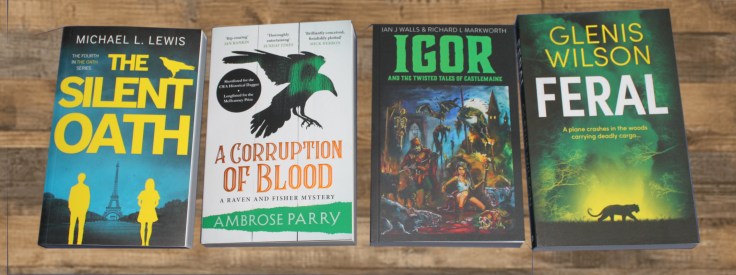
THE FATAL OATH by Michael L Lewis

TFOSchool stories, at least those written for younger readers, were once ‘a thing’ but something of a rarity these days. This book, the third in a series, is aimed at adult readers, and is set in 1957 within a boys’ boarding school in Yorkshire, and is centred on a Jewish teenager who is made to feel an outcast by senior boys who feel he is not “one of us“. His fate, and that of his friend, another ‘outsider’ is in the hands of a powerful clan of senior pupils who bully even the ineffectual school leadership team. The Fatal Oath will be available on 28th of March and is published by The Book Guild.

THE RETREAT by Sarah Pearse

RetreatSarah Pearse’s previous (and debut) novel The Sanatorium (click for review) was a huge commercial and critical success and now she returns with another psychological thriller based on the same theme – that of isolation, secrets, and mysterious death. There’s more than a touch of one of Agatha Christie’s most famous novels (choose the title you prefer!) here, as a group of people are stranded on an island retreat as a destructive storm prevents anyone leaving or arriving. It’s a case of “as soon as the weather clears..” but much can (and does) happen in the meantime! Published by Bantam Press, this will be available in July.

THE PEOPLE OPPOSITE by Georges Simenon

PeoplePenguin are publishing new translations of Simenon’s  stories. I’ve reviewed The Little Man From Archangel and Death Threats & Other Stories. This is another non-Maigret story, set in pre-war Russia, and tells the tale of Adil Bey, a lonely Turkish diplomat sent as consul to a dilapidated port on the Black Sea. He is viewed with suspicion by the locals, and when he develops a relationship with his Russian secretary, he soon learns that living in Stalin’s Russia as an outsider has many pitfalls. Translated by Sian Reynolds, this is a Penguin Classic, and is available now.

BLIND JUSTICE . . . Between the covers

BJ header

In the thirteenth episode of what is a genuinely impressive series, David Mark’s Hull copper Aector McAvoy returns, along with the established cast – his wife Roisin and their two children, and his boss, Detective Superintendent Trish Pharoah. McAvoy is, as the name suggests, a Scottish exile, and he is built like the proverbial brick you-know-what. Despite his forbidding appearance, McAvoy is a peaceable and studious man, shy with other people, but perceptive and with an attention to detail that matches his formidable appearance.

Screen Shot 2022-03-15 at 19.07.34The book begins with a flashback to an attempt by young men to carry out what seems to be a robbery in an isolated rural property. It ends in horrific violence, matched only by the destructive storm that rages over the heads of the ill-advised and ill-prepared group. Cut to the present day, and another storm has lashed Humberside, bringing down power lines, flooding homes, and uprooting trees. One such tree, an ancient ash, reveals something truly awful – a human body, mostly decayed, entwined within its roots in a macabre embrace.

McAvoy is called to the scene, and it doesn’t take too much evidence – in this case a pair of fashionable trainers – for McAvoy to deduce that this body has been put into the ground in living memory. What is astonishing, however, is that two Roman coins have been nailed into the victim’s eyes. The gentle policeman can only hope and pray that this act was not done while the victim was still alive. To make matters more disturbing, the fragile bones of two babies are also found.

The body is soon identified as that of a university student who went missing in the 1990s, but what on earth was he doing in this remote spot, and who had cause to kill and maim him in such a fashion? The owners of the adjacent property are interviewed, but add nothing to the investigation. Pharoah and McAvoy discover that the case may be linked to the trade in ancient artifacts discovered by illegal metal detectorists – nighthawks – and there is disturbing evidence that a notorious Manchester gangster – convicted of horrific torture just a few years earlier – may be involved on the fringes of the case.

Screen Shot 2022-03-20 at 19.29.57David Mark (right) writes with a sometimes frightening intensity as dark events swirl around Aector McAvoy. The big man, gentle and hesitant though he may seem, is, however, like a rock. He is one of the most original creations in a very crowded field of fictional British coppers, and his capacity to bear pain for others – particularly in this episode his son Fin and Trish Pharoah – is movingly described. Mark’s work may – at first glance – seem miles away from the Factory novels of that Noir genius Derek Raymond, but McAvoy shares the same compassion, the same sworn vow to find justice for the slain, and the same awareness of suffering shown by the nameless sergeant in masterpieces like I Was Dora Suarez.

The terrifying climax to Blind Justice is also straight out of the Derek Raymond playbook and is not for the squeamish, but vivid and visceral. Where David Mark does differ from his illustrious predecessor is that he allows McAvoy the redemption and respite denied to Raymond’s sergeant with his dead child and mad wife, and it comes in the shape of his intriguing part-gypsy wife and their children.

If I read a better book all year, be sure that I will let you know. Blind Justice is published by Severn House and will be out on 31st March.

THE POSTMAN DELIVERS . . . Darkin-Miller and MacBride

tpdheader

IT’S ALL ABOUT TEDDY by Lee Darkin-Miller

Screen Shot 2022-03-17 at 18.57.46

This is the debut novel from Lee Darkin-Miller (left),  an award-winning composer and multi-instrumentalist whose work has featured in film, TV and video games. From first impressions it seems to be a blend of fantasy, black humour and crime, and it tells the story of a man called TC, “a hapless middle-aged widower desperate to find his green-eyed angel. The blurb tells us we can expect violent death, a mysterious cult, and a new street drug called Fudge, which is deadly to those who misuse it. It’s All About Teddy is published by The Book Guild and will be available from 28th March

NO LESS THE DEVIL by Stuart MacBride

Screen Shot 2022-03-17 at 19.24.30It seems like an eternity since I read a Stuart MacBride (right) novel, and it was back in his Logan McRae days. The last of those was All That’s Dead (2019) but this might be the start of a new police procedural series featuring Detective Sergeant Lucy McVeigh. We are once more in Aberdeen, and a serial killer known as The Bloodsmith is doing his grisly business,  McVeigh’s police team, working under the name Operation Maypole, having failed to get close to the killer. To add to her problems, she has to deal with a young man who, at the age of eleven, inexplicably killed a homeless man. He served his time, and now is out and about again – and convinced that a mysterious ‘they’ are out to kill him. Does McVeigh ignore him and concentrate on finding The Bloodsmith, or could she have another potential maniac on her books? No Less The Devil will be published by Bantam Press on 28th April.

MURDER AT CLARIDGES . . . Between the covers

MAC header

Screen Shot 2022-03-14 at 19.49.22Jim Eldridge (left) and his aristocratic Detective Chief Inspector Edgar Saxe-Coburg are working their way around the best hotels in 1940s London, investigating murder We have had The Ritz  (click for my review), The Savoy, and now Claridges. Setting a murder against a grand backdrop is a simple but agreeable  formula which Eldridge has employed in his ‘museum series’, which are set in late Victorian England. The action takes place in October 1940, with Londoners under the hammer from Hitler’s bombers each and every night.

The concept which underpins the plot is similar to the one used in Murder at The Ritz. In the late 1930s, there were still countries in Europe ruled by what we might dismiss as ‘minor monarchies’. Albania, Yugoslavia and Romania all had ruling families, and some of them decamped to London, along with their coffers of gold. Also in London, which adds spice to the plot, were less fortunate people, some of them with a political agenda. One such, a Romanian kitchen hand at Claridges, is found garotted outside on the pavement. Saxe-Coburg’s boss calls hands him the murder investigation. The reason he wants Edgar on the case is touchingly naive. He thinks that when peace returns, and the ruling families of the Balkans resume their thrones, they will remember fondly the  discretion and tact used by an English detective. The garotter then finds another victim, but what possible connection does a young woman working for the Free French headquarters in London have the unfortunate Romanian?

murder-at-claridge-sLurking in the background of this tale is a man who is less than noble, but with more power than all the kings and queens sheltering in London’s best hotel suites. Henry ‘Hooky’ Morton is a London gangster who is building his empire on black market scams, the most profitable of which is his manipulation of the petrol market. We think of fuel supply – or lack of it – as a very modern problem, but in 1940, having fuel to put in your car was crucial to many organisations. Hooky Morton has a problem, though. Someone has infiltrated his gang, and is making him look stupid. Then, Hooky does something really, really stupid and, no nearer identifying the garotte killer or their motives, Saxe-Coburg becomes involved in investigating what is, for any copper, the worst crime of all.

Saxe-Coburg’s wife Rosa, a popular pianist and singer does her bit for morale in concert halls and hotels in the evening, but her day job is more exacting and brings her face to face with the havoc raining down on London from the sky – she drives an ambulance. Her assistant is killed when a bombed building collapses on him, and a little while later, when Rosa goes to visit his widow. she is horrified to find the woman dead on the kitchen floor, killed with the same method used to despatch the Romanian kitchen hand and the young Frenchwoman.

I suppose Murder at Claridges is, if genres mean anything, on the fringe of cosy crime, but is a genuine page-turner. Despite the grimly authentic background of London being battered by the Luftwaffe, it gives us larger-than-life characters and, of course, it allows us to peep into a world which only the truly rich inhabit. The suave Saxe-Coburg is a timely antidote to the damaged, troubled and – frankly – disturbing world of so many fictional Detective Inspectors who inhabit our contemporary world. Eldridge is a fine writer and never has escapism been so elegantly penned. This book is published by Allison & Busby, and will be out in Kindle and hardback on 21st April, with a paperback edition due in the autumn. To read my reviews of two of Jim Eldridge’s ‘museum series’, click the links below.

Murder at Madame Tussaud’s

Murder at the British Museum

SHAKING HANDS WITH THE DEVIL . . . Between the covers

shwtd header014

There is an interesting debate which raises its head periodically, and it involves the tricky subject of what can – or should not – become the subject of comedy. Jimmy Carr was in the news only the other day, because he made a joke about the deaths of Roma people in The Holocaust. There are numerous TV sitcoms from back in the day which are fondly remembered by us older folks, but would not survive the heightened sensibilities of modern publicists and producers. This preamble is by way of a warning that Bryan J Mason’s novel, Shaking Hands With The Devil, will not be for everyone. There are jokes and themes in here which, as they say, push boundaries, so if you are someone who takes offence at words on a page, then I think it’s probably ‘Goodnight Vienna‘. For those made of sterner stuff, here’s the story.

We are in late 1980s London – the autumnal years of Thatcher’s Britain – beset by strikes and endless assaults by the IRA. A predatory killer called Clifton Gentle – think Denis Nilsen – is enticing young homosexuals to come back to his home, where they have sex, but the post coital routine is that he kills them and chops them up into pieces. Sometimes the pieces stay in his flat, but when they become too noxious, he leaves them spread about the capital, in skips, under bushes or in Biffa bins.

SHWTD coverOn his trail is a grotesque cartoon of a copper – DCI Dave Hicks. He lives at home with his dear old mum, has a prodigious appetite for her home-cooked food, is something of a media whore (he does love his press conferences) and has a shaky grasp of English usage, mangling idioms  like a 1980s version of Mrs Malaprop.

The other gags come thick and fast. We have three new police cadets – Oldfield, Abberline and Slipper –  working on the case (Google if you’re not sure}, while the editor of The Herald Review (one of the newspapers covering the case) is a certain Mr Charles Manson.

Mason’s final audacious name-check is when he reveals that there is a second killer on the loose, a young man who has won all the glittering prizes, but has been diagnosed with terminal cancer. Peter Kurten is determined to make the most of his final six months by a bit of casual ‘triple D’ – Date, Death, Dismember. A confession. Suspecting that this was another joke, I Googled the name (so you don’t have to) and found that Peter Kurten a.k.a The Vampire of Düsseldorf was a notorious German serial killer who went to the guillotine on 2nd July 1931.

When he learns that he has a rival, Clifton Gentle is most aggrieved. That is not his only problem, however, because a young rent boy called Jimmy is Clifton’s only failure. Not only did Jimmy escape before fulfilling his date with the cleaver and hacksaw, he has now located his would-be assassin and is blackmailing him.

Hackney’s finest, Dave Hicks or, as he prefers to be known, ‘The Dick from The Sticks’ is also up against it. As clueless as ever, he unwisely announces in a news conference that he had set himself just fourteen days to bring the killer to justice. The days and hours tick by, without Hicks having any genuine leads. Then, on the eve of the expiry of his deadline, he decides to save his reputation. In a a bizarre attempt to blend in with the crowds in London’s gay clubs, Hicks sets out to attract the killer (he is unaware that there are two) and is dressed to kill, decked out in:

BJM“A fuchsia -pink shirt with outsize wing collar, over-tight lime green denim jeans, a brand new squeaky-clean leather jacket and, just for good measure, a black beret with white trim.”

The finale of Dave Hicks’s  quest to catch his man is set in an old fashioned Soho of seedy clubs, touts and pimps that would be unrecognisable to the trendsetters who frequent it today. Bryan Mason (right) has written a dystopian novel which is, in turn, ghastly, eyebrow-raising and hilarious, but is also a must for those who like their satire as black as night.

Shaking Hands With The Devil is published by Vanguard Press/Pegasus Publishing, and is available now.

Blog at WordPress.com.

Up ↑