
London. 1873. It would be another fourteen years before a gentleman calling himself a Consulting Detective would make his first appearance in Beeton’s Christmas Annual, but Matthew Grand and James Batchelor are just that – people consult them, and they try to detect things. That is pretty much where any resemblance to the residents of 221B Baker Street ends. Neither Grand nor Batchelor is nice but dim, nor is either given to bashing out a melancholy bit of Mendelssohn on a Stradivarius. Matthew Grand, though, has seen military service; rather than battling the followers of Sher Ali Khan in Afghanistan, he has had the chastening experience of fighting his fellow Americans during the War Between The States a decade earlier. While James Batchelor is an impecunious former member of The Fourth Estate, his colleague comes from wealthy New Hampshire stock.
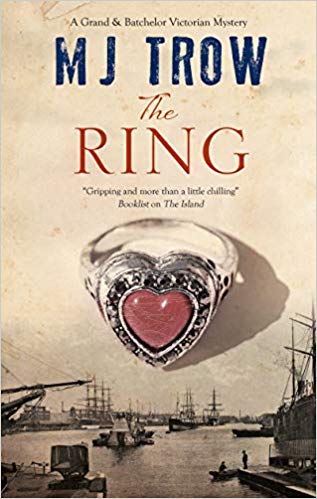 The River Thames plays a central part in The Ring. Although Joseph Bazalgette’s efforts to clean it up with his sewerage works were almost complete, the river was still a bubbling and noxious body of dirty brown effluent, not helped by the frequent appearance of human bodies bobbing along on its tides. In this case, however, we must say that the bodies come in instalments, as someone has been chopping them to bits. PC Crossland makes the first grisly discovery:
“… he knew exactly what the white thing was. It was the left side of what had once been a human being, sliced neatly at the hip and below the breast. There was no arm. No head. No legs.”
Trow gives us a Gilbertian cast of comedy coppers, in this case the River Police, led by the elephantine Inspector Bliss. While Bliss and his minions are trying to put together a case – and also the various limbs and organs of an unfortunate woman – Grand and Batchelor are visited by Selwyn Byng, an unseemly and ramshackle character, who believes his wife has been abducted, and has the ransom note to prove it. Byng may look cartoonish, and lack moral fibre; “Where’s your stiff upper lip?” “Underneath this loose flabby chin!” (quoted with due reverence to Tony Hancock and Kenneth Williams) but he has a bob or two, and so our detectives take on the search for the missing Emilia Byng.
It occurs to me that in dismissing any resemblance between H&W and G&B I am missing out one very important personage, and that is the housekeeper. The much revered Mrs Hudson is felt, rather than seen or heard, but Mrs Rackstraw is another matter entirely. The formidable woman dominates the apartment supposedly ruled over by the two young gentlemen:
“Mrs Rackstraw had been brought up in a God-fearing household and didn’t really hold with young gentlemen of their calibre not going to church. Had they been asked, both Grand and Batchelor would have preferred the constant nagging; her frozen silence and the way the boiled eggs bounced in their cups as she slammed them down on the table was infinitely worse.”
 MJ Trow (right) has been entertaining us for over thirty years with such series at the Inspector Lestrade novels and the adventures of the semi-autobiographical school master detective Peter Maxwell. Long-time readers will know that jokes are never far away, even when the pages are littered with sudden death, violence and a profusion of body parts. Grand and Batchelor eventually solve the mystery of what happened to Emilia Byng, both helped and hindered by the ponderous ‘Daddy’ Bliss and a random lunatic, recently escaped from Broadmoor. Trow writes with panache and a love of language equalled by few other British writers. His grasp of history is unrivalled, but he wears his learning lightly. The Ring is a bona fide crime mystery, but the gags are what lifts the narrative from the ordinary to the sublime:
“They adjusted their chairs and faced the wall. Mr and Mrs Gladstone stared back at them from their sepia photographs, jaws of granite and eyes of steel. Since he was the famous politician and she was merely loaded and fond of ice-cold baths, he sat in the chair and she stood at his shoulder, restraining him, if the rumours were true, from hurtling out of Number Ten in search of fallen women.”
The Fully Booked review of The Island, the previous Grand and Batchelor mystery, is here. The Ring is published by Severn House, and will be out on 28th September.








 Jack Reacher. Deadly. Calculating. Fearless. Invincible. Lee Child has probably created the nearest possible thing to James Bond, but has tailored his hero to a modern world and its expectations. Not for Jack Reacher is the lurid appeal of a Monaco casino, or the precision of a beautifully shaken (but not stirred) vodka Martini. Fast cars are not his thing, and his sexual needs seem, for the most part, to be sublimated beneath a rugged desire to mind his own business. As for tailored dinner jackets and Jermyn Street shirts, Jack normally replaces his wardrobe every hundred miles or so for a handful of dollars in a main street store. His only concession to style is a pair of beautifully made English leather brogues – which come in very handy when kicking the bejasus out of bad guys.
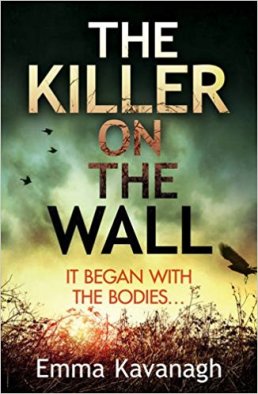 THIS IS A COMPETITION TO TEST SERIOUS CRI-FI BUFFS To win a copy of Emma Kavanagh’s brilliant new psychological thriller The Killer On The Wall you will need to exercise the grey matter. It may well be a distinct advantage if you are old enough to remember the 1960s! To be in the draw, you will need to identify the title of a 2009 novel which dramatised the Hammersmith Murders, and featured several real life personalities who feature in the montage below. We will post the prize worldwide, so followers in Europe, the Far east USA or Australasia are welcome to compete.

 Bernie Gunther fans will already be aware of the company he is forced to keep in the years before and during Hitler’s war. Previous books have found him working uneasily alongside such monsters as Joseph Goebbels, Heinrich Himmler and Gruppenführer Arthur Nebe, but it is his relationship with SS Obergruppenführer Reinhard Heydrich that Kerr (left) has explored in the greatest depth. Now, Heydrich, ever mindful of his place in Hitler’s hierarchy, sends Gunther to Hitler’s Bavarian retreat in Berchtesgaden, ostensibly to investigate the murder of a minor functionary, but hopeful that Gunther’s investigations will embarrass Martin Bormann, personal secretary to the Führer, and Heydrich’s political rival.
 The human link between these two episodes in Gunther’s life is a fellow policeman called Friedrich Korsch. In his former life, Korsch helped Gunther discover who actually put the bullet from a Mannlicher hunting rifle through the head of a corrupt bureaucrat called Karl Flex on that brisk April day seventeen years earlier. Korsch is nothing if not a survivor. Unlike Gunther, who is forced to sail the post-war seas like a latter day Flying Dutchman, Korsch has taken the King’s Shilling – or at least Erich Mielke’s Deutschmark – and is under strict orders to make sure his former boss gets to England to kill the fugitive Anne French.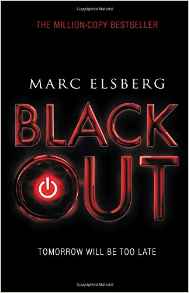
 This fiendish competition has been devised by American crime writer Mike Mayo. He says:

 THE PRIZE? A copy of Marc Elsberg’s new bestseller, Blackout. This has been around in one form or another since 2012, but since it is billed as “a 21st century high-concept disaster thriller”, it is probably safe to assume that the latest edition has been made future-proof. Elsberg (aka
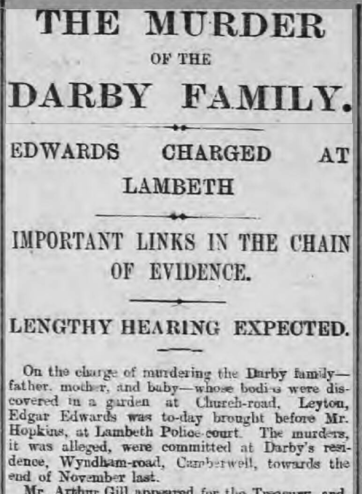 Having done the deed, Edwards concealed the bodies in a room above the shop, and installed his shop manager, a man named Goodwin. Goodwin and his wife ran the business for a few days, presumably oblivious of the dead bodies lying above the shop. In the meantime, Edwards had taken Darby’s gold watch and chain, and pawned it for cash. He had also rented a separate premises in the east London borough of Leyton, and on 10th December he explained to Goodwin that he was going to sell the Camberwell shop.
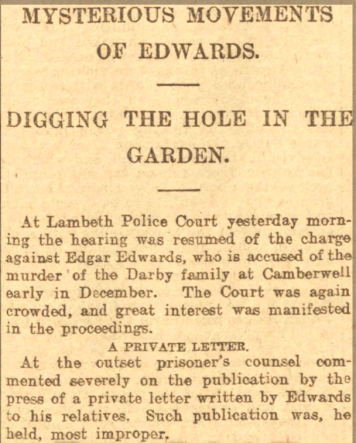 His trial at The Old Bailey was something of a foregone conclusion, brightened only by speculation as to whether Edwards would plead insanity. It was revealed that there was a strong streak of mental illness in his family. His mother and an aunt had died insane; one of his cousins was in an asylum and two others were what contemporary newspapers called “mental defectives”. Edwards was found guilty and apparently burst into manaical laughter when he was sentenced to death. As he stood on the scaffold on 3rd March 1903, it is alleged that he turned to the prison chaplain, giggled, and said, “I’ve been looking forward to this lot!”
 It seems from Sirens that you have a love-hate relationship with Manchester. Give us some idea of your impressions of the city. Was it a wrench to move to London, or a relief?
 Sirens is a great title. Are we talking blue flashing lights or voluptuous ladies luring sailors to their death?

 Miss Christie Regrets by Guy Fraser-Sampson
 presented. This is the debut novel from Joseph Knox (right) and by contrast with Miss Christie Regrets and its golden tinge, this is very much noir territory. The book opens in a bleak Manchester street and, as you might expect, it’s raining. DC Waits, a young Manchester detective is drawn into an investigation of the disappearance of Isabel Rossiter and he finds that her home life is complex. Meeting her rich and influential father, Waits has to mine down beneath the conventional surface of the Rossiter family until the truth begins to emerge – and it is far from pretty.


