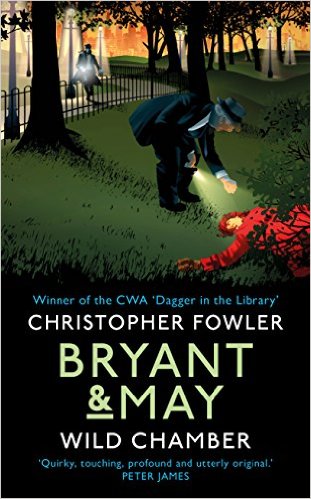

WILD CHAMBER by CHRISTOPHER FOWLER
When a woman is found strangled in one of those little gated parks within a square of houses, unique to London, the Metropolitan Police’s Peculiar Crimes Unit swings into action. Led – and sometimes misled – by its two extremely senior detectives, John Bryant and Arthur May, the other members of the PCU realise that they are faced with an outdoor version of the crime fiction staple – the locked room mystery.
 Other murders follow, and each has been committed in one of the parks and gardens – the Wild Chambers – which are scattered throughout central London. Are the gardens linked, like some erratically plotted ley line? Why are the murders connected to a tragic freak accident in a road tunnel near London Bridge? Why are the murder sites speckled with tiny balls of lead?
For Arthur Bryant – and his creator – London’s past is like a great sleeping creature buried beneath the layers of the city’s history. Sometimes it stirs in its slumber, and the vibrations are felt far above, by those who wish to feel. On other occasions, it sighs, and its breath stirs the leaves in the trees of memory, but only people like Bryant, for whom the present is just a footnote in the chapter of life, can hear the rustling.
Bryant’s unique relationship with London’s vibrant and violent past is described thus:
“London’s lost characters were to him close companions, from the bodysnatchers of Blenheim Street to the running footman of Mayfair and the rat man of Tottenham Court Road. He saw Queen Elizabeth I dancing alone on rainy days in Whitehall Palace
and female barbers shaving beards in Seven Dials, but he could barely recall his mother’s face.”
Fowler came up with the brainwave of having Bryant undertake a course of experimental chemical therapy to treat a life-threatening condition. He recovered, but the drugs have left him prone to out-of-body experiences. These – and here is The Fairy Feller’s masterstroke – allow him to have occasional meetings with pivotal figures from London’s past, such as Sir William Gilbert and Samuel Pepys. Such is the spell that Fowler casts, that these seem perfectly natural and without artifice.
Fowler is, among other things, a comic genius. He mines the rich and productive seam of peculiarly English comedy which gave us George and Weedon Grossmith,
J B ‘Beachcomber’ Morton, the sublime pretensions of Anthony Aloysius Hancock and the surreal world of Basil Fawlty. The book is full of great gags and very good one-liners, such as the world view of a British Library researcher who is consulted for his erudition:
“I expect my libraries and churches to be like my ex-wife:
unlovely, unforgiving, and underheated when you’re inside them.”
 Along the way, Fowler (right) has the eagle eye of John Betjeman in the way that he recognises the potency of ostensibly insignificant brand names and the way that they can instantly recreate a period of history, or a passing social mood. At one point, Bryant tries to pay for a round of drinks in a pub:
“Bryant emptied his coat pocket onto the bar counter and spread out seventeen and sixpence three farthings in pre 1973 money, two tram tickets and a Benwell’s Aerial Bombshell left over from a long-past Guy Fawkes night.”
Sometimes Fowler throws in a literary reference that is tailor made for the job. When John May exclaims:
“God, it’s as cold as Keats’s owl in here..”
… I had to reach for my Oxford Book of English Verse to confirm a vague schoolboy memory of Keats;
“St. Agnes’ Eve—Ah, bitter chill it was!
The owl, for all his feathers, was a-cold”
Fowler has his own view of the modern world, and he occasionally treats himself to the luxury of having a character give voice to it. One of Bryant’s eccentric acquaintances lets rip:
“I’m staying where no one who’s interested in singing competitions or baking shows will ever venture. I pray that when we find life on another planet it turns out to be a lot more fun than ours and that they have relaxed immigration laws. I really do prefer 1752. If we’d had the internet back then people would have spent their days looking at Rembrandt’s Storm on the Sea of Galilee, not shots of Justin Bieber’s dick.”
Such is the rich entertainment that Fowler serves up – bravura writing, poignancy, compassion, complex plotting, biting humour and a unique view of London’s landscape – that it doesn’t really matter who did what to whom, but he stays staunch and true to the crime fiction genre and gives us the answer to the intricate whoddunnit he has constructed. I have read all the previous Bryant and May novels, and this gem more than maintains the high standard Fowler has set for himself. If you love an intriguing murder plot, sparkling humour, wonderful scene-setting and brilliantly stylish writing, then get hold of a copy of this. You won’t be sorry. Wild Chamber is out now.


 As I got further into the book, I was beginning to wonder just what the point was of having Jem Flockhart cross-dressing, as it didn’t seem to have any real bearing on events. Just at the point when I was about to dismiss the idea as a conceit, Thomson delivered a beautifully written scene which made sense of Flockhart’s subterfuge, and added extra poignancy to the relationship between Jem and Will.


 As the pathologists – literally – piece together the evidence they conclude that the shattered remains in the tree is that all that is left of Bill Chalmers, a copper who was not so much bent as tangled and doubled up on himself. After surviving a jail sentence for his misdeeds, he used his connections and his wits to found a drug rehabilitation charity, which drew immense support from the community.
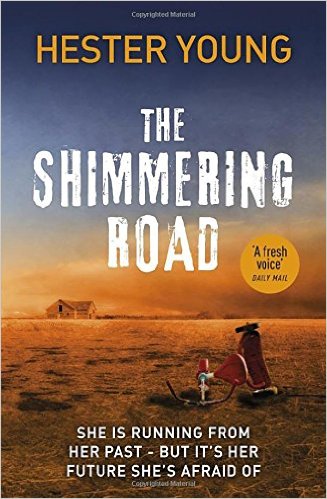
 Then, as Noah is trying to tempt Charlie into marrying him, and agree to their moving into a luxurious new home, comes the ‘phone call which triggers the enthralling next chapter in Charlie’s life. She takes a call from a distant aunt, and the news is that Charlie’s estranged mother Donna, and her half sister Jasmine, have been found shot dead in Jasmine’s Tucson apartment. There is another complication. Jasmine’s daughter Micky was also in the apartment but in another room. She is shaken, but very much alive, and has been taken into protective care.
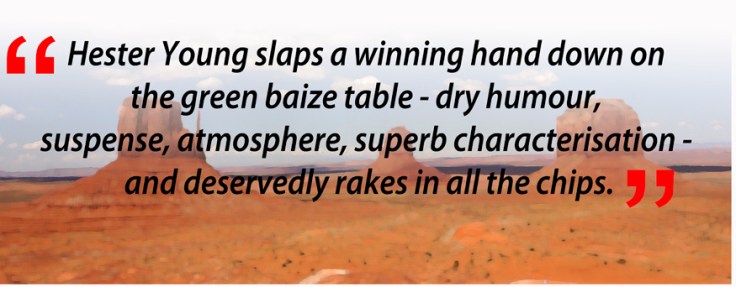
 The greatest strength of the book is the magical spell Hester Young (right) casts as she links the reader to Charlie Cates. As a cynical, autumnal English male, with a downbeat view of life and the tricks it can play, I am not the obvious candidate to be entranced by a slightly manic, conflicted and complex American female journalist, but by the time the novel reached its gripping conclusion in the Arizona desert, I was ready to crawl over broken glass to make sure that Charlie survived with body and soul intact. Hester Young slaps a winning hand down on the green baize table – dry humour, suspense, atmosphere, superb characterisation – and deservedly rakes in all the chips.


 The remains of Daniel Cardozo are hauled off to the city morgue to join those of several of his professional associates who have met a similar fate in recent months. Penley and his new partner Detective Paula Newberry know only that the killer is also a butcher, perhaps not by trade, but certainly by intent. They also become aware that the human remains are minus their soft tissue organs – hearts, livers, kidneys.
 The author (right) certainly knows his way around the American justice system, with his background in probation, parole, investigation and prison operation. An experienced Associate Warden, Chief of Institution Operations, Hostage Negotiator and Director of Parole, he has also done extensive homework on the medical background to the complex world of organ donation and transplants. The plot rattles along with scarcely a breath being drawn, and in Penley and Newberry, L’Etoile has created a partnership which is complex and attractive enough to feature in more adventures further down the line.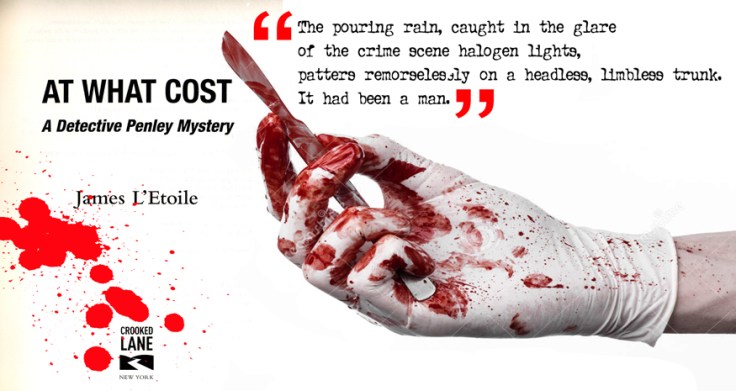


 Inspector Kosuke Iwata’s personal life is as scarred and trauma-ridden as the human tragedies he faces daily as a member of the Homicide division of the Tokyo Municipal Police Department. He was abandoned by his mother in a bus station when he was a child, but has become partly Americanised since she reappeared, now married to a prosperous US citizen, to reclaim him. In the intervening years, Iwata grew up in a Catholic orphanage, and his sleep is frequently disturbed by fretful dreams of those days, with the voices of both his disturbed best friend, as well as the abusive head of the institution, forever whispering in his ear.
 This a superb novel and goes way beyond the restraints and conventions of crime fiction. In his afterword, Obregón says of Iwata:


 Not the least of Eva Dolan’s achievements in this remarkable novel is to pinpoint with painful accuracy and honesty what happens to children and wives when a father – originally Colin Sawyer – decides to abandon the male role and become a woman. Even after the nightmare scene where Sawyer’s daughters come back to the house unexpectedly, and find their father en femme at the sink, doing the dishes, Jessica and Lily have come to think of their dad as ‘mum’. The pain that this must cause a biological mother in this situation can only be imagined, and it is interesting that Nina Sawyer is drawn as a fairly unpleasant piece of work.
 Aside from the nuanced description of gender politics and psychological challenges faced by the characters in this novel, we have to ask the burning question. Does Watch Her Disappear work as a crime story? My answer is a resounding and emphatc ‘Yes”. The whodunnit aspect of the story is teasingly effective, with Dolan (right) scattering little hints, false leads and blind alleys in her wake as she races along ahead of us. Crime fiction is full almost to the brim with Detective Inspectors and their trusty Sergeants, but Dolan breathes on those particular embers and makes them fire up afresh in the shape of Detective Inspector Dushan Zigic and Detective Sergeant Mel Ferreira of the Hate Crimes Unit. The neat twist is, of course, that both Zigic and Ferreira are themselves children of immigrants, and the chemistry between the two is potent and complex.

 Being as this book is, in one sense, a police procedural, an introduction to the investigating officers is essential. Detective Sergeant Karen Willis is an elegant and well educated woman, whose personal life is complex. She is courted by two suitors; the first, Dr Peter Collins, is a consultant psychologist who, although undeniably clever, may not be entirely of sound mind himself, as he is prone to nervous attacks. When with Karen, he also tends to drop into a Lord Peter Wimsey persona and, yes, he does insist on calling Karen “Harriet”. The other claimant to the hand of Willis is Detective Inspector Bob Metcalfe, a much more grounded fellow who certainly does not mimic characters from Golden Age fiction. In fact, he could be said to be very worthy, but rather dull. Overseeing the investigations is Detective Superintendent Simon Collison, an urbane and civilised man who is regarded with a certain suspicion by more belt-and-braces officers such as Chief Inspector Tom Allen. One stock police character who is very much noticeable by his absence is a badly dressed, misanthropic and foul mouthed Detective Inspector type, much loved of many crime authors. If any such person did operate out of Hampstead nick, he must long ago have been transferred elsewhere.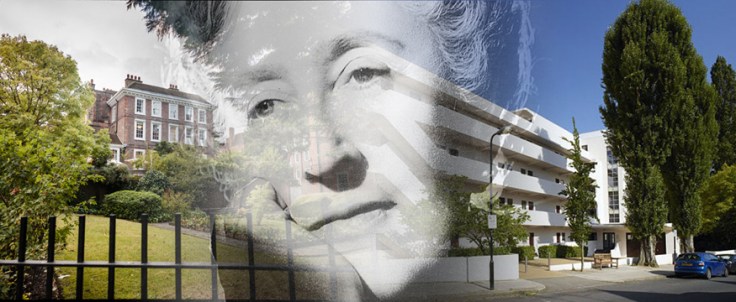

 The town of Kiewarra is a dusty five hour drive from Melbourne. Five hours. Six, maybe, if you weren’t that anxious to get there. Five hours, under the same relentless sun, but it might as well be fifty, for all the similarity there is. Melbourne, with its prosperity, its glass and steel central business district, its internationally renowned restaurants and its louche air as a cosmopolitan city. Kiewarra. A pub, a couple of bottle shops and a milk bar; a run-down school, starved of funds; a farming economy choked and parched by two years without rain; families turned bitter and taciturn by the shared misery of failed crops and burgeoning overdrafts. Author Jane Harper (left) takes us right into the deep dark blue centre of this community.
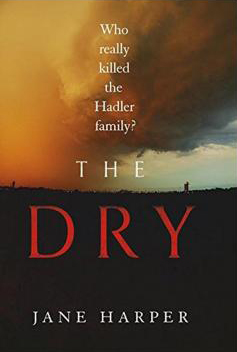 Seeing the coffin of a contemporary being carried through the church is bad enough for Falk, but when it is followed by two smaller ones, one being very much smaller, that is a different thing altogether. For the other two coffins are occupied by Hadler’s wife Karen, and his young son Billy. The story has played out across the mainstream media as a suicide-killing. Luke Hadler, driven mad by debt, failure, jealousy, despair – who knows? – has shot dead his wife and son, and then turned the gun on himself, albeit leaving his thirteen month old daughter Charlotte in her cot, screaming, terrified, but very much alive.


