Search

fullybooked2017

Category

REVIEWS

DEATH SHIP … Between the covers

Death Ship spread


In Jim Kelly’s novels, the past is like a sunken ship that has lain undisturbed on the sea bed for decades. Then, with a freak tide, or maybe some seismic shift, the ship’s blackened timbers surface once again, breaking through the surface of the present. In this, the latest case for Detective Inspector Peter Shaw and Sergeant George Valentine, the metaphor becomes literal. In the terrible storm of January 31st 1953, a tempest that battered the East Anglian coast and claimed over 300 lives, a dilapidated Dutch coaster, the Coralia, went down, taking its captain and crew with her.

Meanwhile, the unique seaside town of Hunstanton – unique in that it is an east coast resort which faces west – has been literally rocked by an explosion on its crowded beach. Something buried deep beneath the sand is triggered by some boys determined to dig a sink-hole sized pit before the tide sweeps in. There is a brief moment when something metallic and shiny appears in the wall of their excavation, but then hell is unleashed. Miraculously, no-one is seriously hurt, but the beach is closed to holidaymakers while forensic experts and a bomb disposal team from the army do their stuff.

Shaw is faced with several possibilities. Was the explosive device recently planted by extremists from the STP – Stop The Pier – movement, who are protesting against the construction of a huge new pier which will suck trade and footfall from existing businesses? Was the explosion a result – as a teenage boffin from King’s Lynn suggests – of the very late detonation of an unexploded bomb dropped in a Zeppelin raid way back in 1915?

Shaw’s case is complicated by the discovery of a dead diver, tethered to the underwater remains of Hunstanton’s Victorian Pier, destroyed by storms in 1978. Eventually, he learns that the murdered diver is the son of one of the crew members of the ill-fated Lagan, whose remains are rotting on the seabed a couple of miles distant from the pleasure beach. And what of the apparently guileless old lady who has been caught giving arsenic-laced sweets to people in a local ‘bus queue.

Detective partnerships have become one of the enduring clichés of crime fiction. Sometimes – but not always – the pairings work, and when they do, they are a very satisfying literary device. The trope usually requires the senior partner to be yin to the junior’s yang. In this case, Peter Shaw has the imagination. George Valentine the curmudgeonly common sense; Shaw is the live wire to Valentine’s earth. The telling difference between these two and other ‘odd couples’ is that Kelly explores the psychological make up of both men, and the glimpses into their personal lives are equally perceptive and revealing. Valentine is older than Shaw by many a mile; so much so, that Valentine actually served in the force alongside Shaw’s late father, a man still revered within the Constabulary. We also learn that were it not for a faux pas which almost ended his career, Valentine would now be Shaw’s senior officer.

New readers will be pleasantly surprised at how Kelly knits together the misdeeds of the past and the murderous intent of the present. Existing fans will simply smile, and say, “He’s done it again.” You will be pushed to find a novel which so successfully welds together the police procedural, the psychological thriller, the ‘whodunnit’, and the atmospheric novel of place. If you find one, please let me know. In the meantime, I will not be holding my breath – except in waiting for the next masterpiece from one of our finest writers. Death Ship is published by Severn House, and is available here. The official launch will be – very appropriately – at the RNLI Headquarters in Hunstanton on 3rd September. For tickets and enquiries ‘phone 07840 375 984

jim kelly Small_0

OUT OF BOUNDS … Between The Covers

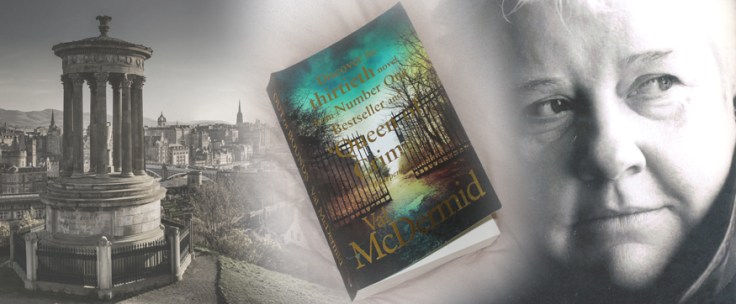
Val HeaderThere’s an old expression that describes someone as “having a way with words’. There can’t be any contemporary writer who has a better “way with words” than Val McDermid. There are no dramatic flourishes, no histrionics and no scatter-gun blasts of redundant adjectives. What we have is simplicity, purity, and a command of language that is almost minimalist. She describes DCI Karen Pirie, thus:

“…a wardrobe that always looked slightly rumpled;
a haircut that never quite delivered what it had promised in the salon.
Women never felt threatened by her,
and men treated her like a wee sister or a favourite auntie.”

 This is the fourth book featuring Karen Pirie, but newcomers learn just enough of Pirie’s backstory. Her lover, a fellow police officer has been killed. She is coping with her grief, but not easily. She tells civilians that she is attached to the Police Scotland Historic Cases Unit. The reality is that she – and her nice-but-dim assistant, DC Jason ‘The Mint’ Murray – are the PSHCU. An idiot boy and his mates steal a Land Rover, and decide to test it to destruction by driving over roundabouts. It works once, but the second time, the four-by-four flips, killing the hapless passengers and delivering driver Ross Garvie to the local hospital ICU. A routine DNA test links him to an unsolved rape and murder in Glasgow, years earlier. It clearly wasn’t him, but who was it?

 To add to Pirie’s complicated life, a mentally troubled man is found shot through the head beside Loch Leven. He was harmless, occasionally foolish and always garrulous, but why was he a threat? Did the fact that his mother had been killed in an assumed IRA assassination mark him out for this totally unwanted attention? The trail of Ross Garvie’s DNA leads Pirie through a minefield of botched investigations, incorrect assumptions and misdeeds sheltering behind fiercely protected rights to privacy.

 As you might expect, McDermid is completely at home in her geographical surroundings. We have the stark contrasts of the historic streets and alleyways of Edinburgh and the city’s brutal and depressing tower blocks clinging to its suburban coat tails. All too rarely, Karen Pirie gets to sit in her beautifully situated apartment, and we share her reverie as she looks out over the dark waters of the Firth of Forth, and across to the lights twinkling away on the Fife shore. The setting of the novel is cleverly done, but it is just one piece of the jigsaw – along with the fascinating details which make up the police procedural aspects of the story.

 McDermid puts most of the pieces in place for us, but leaves us plenty to do for ourselves, and the completed picture is one that shows jealousy, human frailty, the sheer darkness of some people’s lives – but also a glittering thread of compassion and redemption. If the novel inspires you to check up on Karen Pirie’s backstory, then you will find it in The Distant Echo (2003), A Darker Domain (2008), and The Skeleton Road (2014)

It is lazy of critics to talk about “Queens” of crime, but since the deaths of PD James and Ruth Rendell, there is only one heir to the throne. McDermid just gets better and better with every book. Some writers grab us by the throat and drag us through the narrative; there are others who take us by the hand and lead us; McDermid simply has to beckon – and we follow.

You can follow the link to see your buying choices for Out of Bounds

STOP PRESS MURDER …Between the covers

SPM GraphicSome historical crime fiction takes us back to times way, way before our own memories could have any validity. Then there are stories set in periods that many of us could reasonably have experienced at first hand. With the former, it is simply the author’s research versus the depth – or lack of – our own historical knowledge. The latter is a much more tricky enterprise, as someone who sets their book in the 1960s, for example, can be exposed to a more searching light – that of readers who actually lived through the years in question.
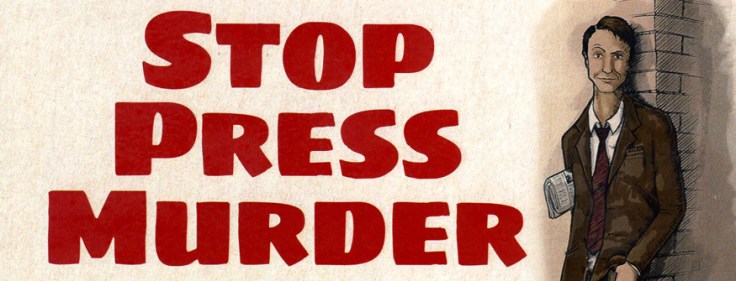

Peter Bartram’s mileu of choice is the early 1960s. We are in Brighton, the celebrated seaside town on England’s south coast. Its days of fame as the Gay capital of Western Europe, and infamy as the first large local authority to be mismanaged by the Green Party were yet to come, but the seeds of eccentricity have already been sown. Our guide through the Sussex town is Colin Crampton, the scoop-hungry reporter for The Evening Chronicle – a Brighton newspaper. He is a thoroughly engaging character with a quick wit, and it isn’t too fanciful to imagine that he might resemble the author in his younger days. If you read Bartram’s biography, you will be forgiven for thinking that if Crampton is not Bartram, then he is someone who the author knew very well in his early days as a journalist.

The basic plot is that we have a long-retired star of What The Butler Saw machines – Marie Richmond – who dies in a mysterious road accident. Then, a machine featuring her in her prime is broken into, and the revealing footage is stolen. The man who should have been guarding the pier is found bludgeoned to death – with a coconut. Crampton/Bartram introduces us to some memorable characters, including a camp, overdressed theatre critic and a toupéed old thespian, both of whom are crying out for the much-missed talents of John Inman and Charles Hawtry to bring them to life.

As Crampton attempts to unravel the mystery of why the ample charms of a silent movie star should have given someone cause for murder, there are some delightful period references and jokes which made me laugh out loud, although younger readers might not get the gags unless they are students of British popular culture in the second half of the 20th century.

There may well be readers who, by this point, have been receiving ‘cosy’ messages on their genre radar. All well and good, as there are elements of cosy crime here. We have an unambiguously likeable central character, a familiar and lovingly-painted background, and a cast which includes several amiably odd characters. We reviewers love our genres, and some readers may even share this obsession, so I’ll pop Stop Press Murder into the Cosy pigeonhole, with one or two caveats. Although the tone is generally as gentle and as light as a Brighton breeze, Bartram finds enough dark corners in the seaside town to keep the interest of those who like their crime fiction with a harder edge. The style of the book reminds me very much of the sharply humorous writing of Colin Watson and his Flaxborough novels, which also delight in the dafter aspects of English life, as well as boasting a collection of folk with similarly improbable surnames

Crampton is convinced that there is a link between the odd events on the pier, and discovers that Richmond – or to use her real name, Sybil Clackett – has a twin sister who is no lesser personage than the Dowager Marchioness of Piddinghoe. The local police and the Chronicle’s rival newspapers are seeing the case differently, however, and Mr Figgis, Crampton’s boss, is becoming increasingly twitchy as he fears for his sales figures.

Peter Bartram explores all possibilities inherent in the twin sisters storyline, and delivers an excellent novel, full of twists and turns, plenty of action scenes, crackling dialogue – and a great sense of fun. I’m looking forward to yet more encounters with the Evening Chronicle’s star turn. You can find a copy of Stop Press Murder by following the link.

SPM Graphic2

CHARCOAL JOE … Between The Covers

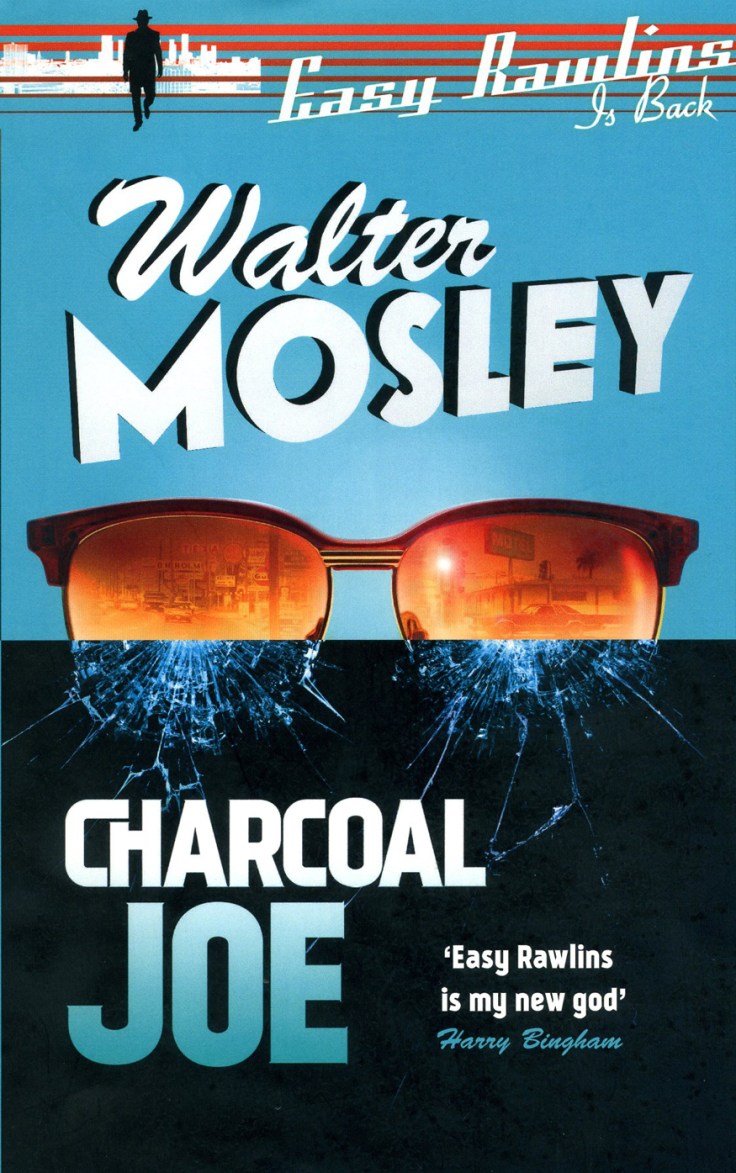
Mosley


“This money is from me, Easy. I’m the one hirin’ you”
“Cheddar or blue?” I asked, taking the cash.
“Say what?”
“I just wanna know what kind of cheese is in this trap.”

Thus Walter Mosley’s Los Angeles PI Ezekiel ‘Easy’ Rawlins takes a thick wad of cash from his long term buddy Raymond ‘Mouse’ Alexander, as a down payment on his latest case, to extricate 25 year-old Dr – of physics – Seymour Brathwaite from a murder rap. The fact that Easy, like a huge number of fellow Angelinos, could never say “no” to Mouse, is one thing; Mouse may well be the most dangerous man in the city, but the legendary Charcoal Joe is probably next in line. And it’s Joe who had called in a favour of Mouse.

Seymour Brathwaite has been found at a murder scene in Malibu beach with two corpses lying on the floor. When LAPD’s finest catch a black man at the scene of a shooting, that’s normally case closed, give or take a few minutes of paperwork, but this is different. Brathwaite has no connection with either the corpses or crime in general, and he seems to have a very powerful friend in underworld fixer, arranger of violent death and generally lethal string puller Rufus Tyler – better known as Charcoal Joe.

Joe is currently residing in one of LA’s more relaxed and well appointed correctional facilities, serving a short sentence for some minor infraction. Easy pays him a visit to learn more about why young Dr Brathwaite was in the wrong place at the wrong time, and finds Joe attended by his minders and gophers. He asks why Joe is so convinced of Seymour’ innocence.

“The young man is a doctor of science,” Rufus Tyler the prodigy intoned. “He’s teachin’ at UCLA right this semester while he finishes his postgraduate work. Now how’s a man like that gonna be some kinda niggah like the people you and me consort with?”
I could think of a dozen ways. The universities in the late sixties were hotbeds of bombers, Liberation bank robbers and stone-cold killers.

Despite his misgivings, Easy sets about his work. At this point, it may be the moment to bring people new to the series up to speed with the who, what and why of the world of Easy Rawlins. Our man fought for Uncle Sam in WW2, and returned to an America where the yoke of oppression may have been lifted in Western Europe, but not in hometown USA. Battling everyday racism, put-downs and casual affronts, he has survived death on several occasions by the thickness of a cigarette paper, managed to earn the grudging respect of certain members of the LAPD, and has raised a family – albeit an unconventional one. Conscious that his work is always attracting new readers Mosley – like the weaver of dreams he is – fills in the biography with the deftest of touches, as he goes along.

Inevitably, Easy is being lied to by pretty much everyone involved in the case of the naïve Dr Brathwaite. The body count is spectacular, and even as he mourns the loss of his best love, Easy manages to squeeze in a couple of ‘romantic encounters’. The euphemism is mine. One of Mosley’s skills is to dance his way deftly through the minefield that faces writers who tackle sex scenes. Where many tread too heavily and die, Mosley escapes unscathed.

Mosley009The plot, as they say, thickens – to the point where you may need to skip back a few pages just to be sure that you are certain who has done what to whom. To me, this is neither here nor there. Sometimes cliches are unavoidable because they tell a simple truth, and with any Easy Rawlins novel it is all about the journey rather than the destination. An Easy Rawlins tale is what you get when a poet writes crime fiction. If Raymond Chandler were a deity, then I would worship him, but I would be hard pressed to summarise the detailed plots of Philip Marlow’s cases. I could, however, rattle off a dozen one-liners and brilliant descriptions which have made Chandler immortal. So it is with Mosley.
Easy goes to an illegal club called The Black Door Bar, and is reunited with an old flame.

“Hey, Easy,” Louise Lash said.
She was maybe forty with a face that would be beautiful twenty years after her death. Her skin was black and flawless. Even when she wasn’t talking her mouth seemed to be saying something elusive.

Read this book, and cherish it. Mosley is not an old man by today’s standards, but there will come a time when there will be no more Easy Rawlins, and the world will be a poorer place for his passing.

Follow the link to get your copy of Charcoal Joe.

Mosley010.jpg


THE HISTORY OF BLOOD …Between The Covers

AHOBWith a worldwide wave of support, optimism and hopes for a bright future, the African National Congress swept to power in 1994, and post-apartheid South Africa was born, blinking in the light, but healthy and vigorous. Paul Mendelson’s gripping novel of crime and corruption shows that the rainbow dream has not yet turned into a fully grown nightmare, but it reveals a country where racial and social tensions are never far from the surface.

Mendelson introduced readers to Colonel Vaughn de Vries of The Special Crimes Unit in The First Rule Of Survival (2014) and now de Vries returns to investigate the grim world of the international drug trade. The novel is set mostly in Cape Town, where Mendelson lives for part of the year, and it begins with the sad discovery of the body of a young woman in a run-down hotel. Chantal Adam is the adopted daughter of Charles Adam, a rich and influential businessman, but her blood father was Willem Fourie Adam, Charles’s brother, who was assassinated in 1994, after the elections.

Chantal lived the dream as a successful model and advertising poster girl, but a move to America brought only grief, heartbreak, and a bitter separation from her adoptive family. Now she lies dead, wrists slashed with glass, in a shabby hotel room usually used for by-the-hour sexual sexual activities. She is haggard and emaciated, but her degradation is complete when the post mortem reveals that she has ingested a large number of condoms packed with heroin.

We follow de Vries as he picks up the trail from the wretched death of Chantal Adam, to a stable of girls used by ruthless men to ferry drugs to the Far East, and then on to a man whose organised crime CV includes running a game park offering forbidden targets to American trophy hunters, and being at the very centre of political and financial corruption in South Africa and neighbouring states. Reluctantly, de Vries enlists the help of John Marantz, a former British intelligence agent, whose life has been rendered meaningless by the abduction and murder of his wife and daughter.

Like all interesting fictional coppers, de Vries is conflicted. He suffers fools with a bad grace, if at all, and his contempt for incompetence in fellow police officers is entirely colour blind. There aren’t too many of his comrades-in-print who have happy and flourishing marriages, and he is not one of them, although his fierce love for his daughters remains undiminished. He is not a man to back away from a fight, either political or physical, but neither is he a stone cold killer, as a key incident in this book reveals. He is also human enough to make dumb personal decisions which threaten to derail his career.

There are two distinct backdrops to this excellent novel; the first shows a country where the natural landscape can be harsh or almost impossibly beautiful; the second is the socio-political climate, and here Mendelson shows compassion, subtlety, but – above all – honesty. This is not a hatchet job where the white minority watch with sneers on their faces as the country’s new rulers make mistake after mistake, but a thoughtful and perceptive account of the pitfalls and temptations facing those for whom high office is, in some cases, a genuine challenge.

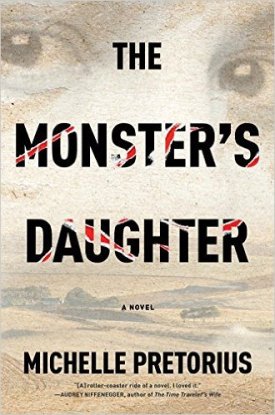
The complexities of the politics make for an intriguing read, but above all this a thoroughly good crime thriller, and I look forward to Vaughn de Vries returning for a new battle with the forces of evil. The History Of Blood is available online and if you want another fine novel set in contemporary South Africa, then try The Monster’s Daughter by Michelle Pretorius

WHEN THE MUSIC’S OVER – Between The Covers

BanksThe van skids to a halt on the lonely hill top lane. Occasional distant lights from isolated farms and cottages are all that pierce the darkness. The young men inside the van giggle as they open the rear doors and throw the girl from the dirty mattress on which she has been sprawled. She hits the roadside with a body-jarring crunch.

Thus begins the 23rd episode in the career of Yorkshire copper, Alan Banks, who we first met in 1987, when he had moved from London to the Yorkshire Dales to work in the market town of Eastvale. Banks is now Detective Superintendent, but what long-time readers of the series might call The Eastvale Repertory Company are pretty much all present and correct, in the shape of fellow cops Annie Cabbot, Winsome Jackson and Ken Blackstone. We even have a guest appearance from one of Banks’s less wholesome colleagues, Richard “Dirty Dick” Burgess, who is now working for the National Crime Agency, the closest thing to the FBI within the UK.

The unfortunate girl we meet in the first few pages does not take the stage again, unless we include her appearance on the mortuary slab. She has been found by a shocked cyclist, the morning after her ride in the van ended so abruptly. She is stark naked, and has died from a severe beating. Whatever took place on Bradham Lane is not the most pressing concern for Alan Banks, however. He is called to a high level conference and brought into what will become an investigation into the life and crimes of Danny Caxton, a much loved and respected entertainer and performer on stage and TV. Caxton, like his real life counterparts Savile and Harris, was ever-present in living rooms and lounges of ordinary people up and down the land, for decades. Now in his eighties, he has been accused of historic sex crimes.

While Banks must focus on the Caxton case, by his new seniority he must also oversee the investigation into the murder of the girl on Bradham Lane. Annie Cabbot is doing most of the legwork on this, and with the help of Detective Constable Geraldine Masterson, she discovers that the dead girl is Mimosa ‘Mimsy’ Moffat. Mimsy was 15, knocking-on 25, sexually attractive and experienced, and with a home life so bad that neither ‘home’ nor ‘life’ seem to be the right words. Cabbot and Masterson begin to explore the connection between Mimsy and the Pakistani Briton who runs a kebab shop on the edge of a nearby run-down estate.

By this time, we have met Danny Claxton in his Ponderosa-style home, and a thoroughly reptilian character he seems to be – a far cry from the smiling, handsome and genial TV presence of his younger days. Banks’s chief witness – and accuser – is Linda Palmer. She is now a widow in middle age, but has become a respected and well published poet. Her accusation about Caxton dates back to what should have been a happy family holiday in Blackpool in the 1960s.

As the two cases run their parallel courses, I found the investigation into Mimsy Moffat’s death the more compelling. Robinson takes an unflinching look at the issue of vulnerable white girls being groomed and abused by men of Pakistani origin. He exposes the extremes of views held by all those involved, from the men themselves, the girls and their relatives and – most tellingly – those in positions of power, such as the police and social workers. Banks himself, probably due to his management responsibilities, keeps his own anger in check, but Robinson allows Annie Cabbot to voice her violent disgust – a feeling which I infer is shared by the author.

The book is only a whodunnit for a short period of time, as there are enough clues for CriFi buffs to work out who murdered Mimsy. Robinson’s broader message seems to be a variant on Who Killed Cock Robin? For the fly, the fish, the beetle and the owl we could probably substitute:

‘”I,” said the policeman, “with my fear of being called racist.”‘
‘” I,” said the social worker, “with my political correctness.”‘
‘”I,” said the kebab shop owner, “with my attitude towards women.”‘
‘”I,” said the mother, “with my drug addiction and neglect.”‘

There is closure, of a kind, in both cases, but Robinson, in his epilogue, offers us nothing resembling a happy ending. This book is, at its core, a brilliant police procedural. Crime fiction fans are no strangers to the police interview room, but Robinson not only uses the staple ingredient very cleverly, he gives it a lick of fresh paint, a new carpet – and maybe even a nice vase of flowers on the table. My only irritation was – as always with Banks – that we learn far more than we ever need to know about his tastes in music, but an irritation is all it was, and it didn’t spoil my enjoyment of this excellent book.

When The Music’s Over is on Amazon, as well as in all decent book shops, and you can find out more about Alan Banks and his creator by visiting Peter Robinson’s website.

THE DEAD HOUSE – Between the covers

The Dead HouseNewly promoted Detective Sergeant Fiona Griffiths, of South Wales Police, might be said to have a disability. She suffers from…..no, wait, we mustn’t use the word ‘suffers’, in case of causing offence. ‘Has’, maybe? OK, DS Griffiths has Cotard’s Syndrome. This strange condition can manifest itself in many ways, the most extreme of which convinces the person concerned that they are actually dead. Less extreme symptoms include partial disconnection between brain and body, and some of the traits of Asperger’s Syndrome, such as an inability to read or understand social gestures or convention.

So Fiona has been employed as part of some diversity box-ticking exercise, yes? Nay, and thrice nay. After the horrors of her teenage years, when she was institutionalised and in a pharmaceutical haze, she went to university, excelled, and then joined the police. This might be considered an odd career choice, given that Fiona has an the kind of electric intelligence which might not sit well within staid police procedures, but even more strange because her father was – and let’s not mince words – a notorious Cardiff gangster. Father? Well, no. Another intriguing ambiguity is that Mr Griffiths and his homely wife are not Fiona’s blood parents. Fiona came into their lives when they emerged from a social function to find an infant girl sitting in their Jaguar coupe. No message. No name. No reason.

At this point, it is best to make clear that Fiona’s search for her real ancestry and her ambivalence about her adoptive dad’s occupation are a recurrent theme in the career of Fiona Griffiths. Author Harry Bingham introduced us to this remarkable young woman in Talking To The Dead (2013). This debut was followed by Love Story With Murders (2014), The Strange Death of Fiona Griffiths (2015) and This Thing Of Darkness (2016).

In this welcome return, Fiona is called to the strangest of crime scenes. Is it a crime scene? Maybe not. A young woman is found, very dead, but dressed in white linen, remarkably peaceful, surrounded by votive lights, and lying on a table in a Dead House – an ancient form of mortuary chapel attached to a medieval church. An autopsy concludes that she died, basically, from heart disease, as young as she was. While the local police are intent on wrapping the case up as unexplained, Fiona is struck by two irreconcilable facts. Why would a woman who has had, according to the autopsy, subtle – and expensive – cosmetic surgery, have stubbly unshaven legs?

The ensuing investigation romps along at great pace, as Fiona – teamed with a grumpy, phlegmatic Camarthen Detective Inspector – uncovers a terrifying conspiracy involving, among other things, Ukranian oligarchs, wild Welshmen who eat badgers, a secret tunnel under a Brecon hillside – and a community of distinctly unsaintly monks.

Just as in This Thing Of Darkness there was a terrifying passage where Fiona was hanging on for dear life to the a boat thrashing about in a storm, there is a section here which will be very hard going for anyone who suffers from claustrophobia. Fiona and her temporary boss struggle through a tunnel system under a Welsh hillside, and I felt every second of it – the constriction, the inability to move more than a few inches, and the sheer terror of being in a virtual rock coffin.

Aside of creating a unique central character, Bingham writes like an angel. His descriptions of the Welsh countryside put you right there in the muddy field, with the smell of sheep, and the distant haze of smoke from a hard-scrabble hill farm chimney. Fans of Fiona Griffiths will know that she courts danger, gets herself into the most terrible scrapes, but will come out fighting like a five-foot-nothing whirling Dervish. Her boss says:

And well done, I suppose. I can’t think of any other officer of mine who’d have got themselves into that situation. But I can’t think of anyone who’d have got out of it either.”

I wrote, when reviewing an earlier Fiona Griffiths novel for another book site:

“In a lifetime of reading crime fiction I have never come across anyone quite like Fiona Griffiths …. Read this book. Enjoy every syllable.”

The publishers have used that quote on my edition of The Dead House, and I stand by every word. You won’t read a better book all year.

You can buy The Dead House from Harry Bingham’s Amazon page and check up on the previous adventures of Fiona Griffiths. Harry’s website is here.

THE MONSTER’S DAUGHTER – Between the covers

MP

MICHELLE PRETORIUS (above) is a South African writer who was born in Bloemfontein. She currently lives and works in Ohio. The Monster’s Daughter is her first novel.

Alet Berg has an uphill struggle to establish her credibility as a constable in the South African Police Service. Firstly, she is a woman, and the attitude of Alet’s male colleagues is no better than that of a dozen other police forces across the world. Secondly, she is smart and well educated, but has done herself few favours at the start of her career, and has been sent to the small town of Unie to redeem herself. Thirdly, and most troubling, she is the daughter of Adriaan Berg, a legendary strong man in the force from back in the days of apartheid and the struggle between the ANC and the white government.

Alet is called to a suspicious death out on the hill-top farm of a man called Terblanche. The corpse has been burned beyond recognition, and it is not clear if it is that of a man or a woman. Her partner is the inscrutable and rather prim Sergeant Mathebe, but neither of them can make – literally – head nor tail of the body, and it is removed to the morgue to await an autopsy.

Subsequently, Alet becomes involved in another sinister incident. While driving home one night, she pulls over to find a woman, near death, in a roadside pull-off. While tending to the woman, Alet is disturbed by a man who then attempts steals her car, but his escape is halted by Alet drawing her weapon and shooting at the car. The man, a petty criminal, is duly arrested, but there is no evidence to connect him to the injured woman, and Alet is suspended from duty pending further investigations.

The Monster's DaughterBy this time in the novel, you will have had one or two diversions from the more-or-less present day (2010). The Boer War and its aftermath clearly play an important part in the narrative, and we look on queasily as a number of teenagers from the Afrikaans population are taken from their families and used in some kind of genetic experiments by an English doctor. As the century grows older two children, Tessa and Ben, who are the results of these experiments, strike up a relationship, but they then go their different ways.

To say any more about how these apparently disparate story strands merge together would be irresponsible, both to the author and to you, the reader. Suffice to say that Michelle Pretorius takes a breathtaking risk in her plot. As experienced readers, both you and I will have read novels where such risks are taken but backfire spectacularly. This time, however, as Alet closes in on the truth about the lonely death on Terblanche’s hill farm, you will only be a couple of steps ahead of her, and her growing incredulity and ultimate acceptance of an astonishing truth is superbly described.

The tensions and contradictions of Modern South Africa are described in an unflinching fashion, but without preaching or moralising. The account of the country’s troubled past is secure and convincing. It is barely credible that this is a debut novel. The writing is spectacularly good; compassionate, evocative of time and place and, above all, totally credible. It is this which makes the author’s gamble pay off – in brilliant fashion. You may also realise, by the last page, that there is a telling ambiguity in the book’s title. If it is intentional, it is very, very clever. If it is mere chance, then it still works beautifully.

You can buy the book by following the link to Amazon, and learn more about the author from her webpage.

Go to the index of fullybooked to find more reviews, news and features.

WW2 HISTORICAL CRIME FICTION (2) A Coin For The Hangman

A Coin For The HangmanA REAL LIFE SUSSEX BOOK DEALER called Ralph Spurrier has written a book. It starts in the present day, with a Sussex book dealer, name of – you guessed it – Ralph Spurrier, and Mr S has bought a job lot of books and bits. Their erstwhile owner is dead, and his bungalow and its contents are being sold at auction. The fictional Mr S – and probably his real-life doppelganger – make their livings by buying van-loads of books in the hope that somewhere in the pile of book club reprints and assorted dross there will be a first edition, something autographed, or another rarity which can be sold on to pay the bills.

The wheat amongst the chaff in this case is the autobiography of Britain’s most celebrated hangman, Albert Pierrepoint who hanged, among many others, Gordon Cummins and Ruth Ellis. The book is inscribed to Reginald Manley who, fictionally, was to become a hangman himself. Manley’s effects include a diary written by one of his judicial victims, a young man called Henry Eastman.

Executioner-Pierrepoint

The diary tells how Eastman was convicted of murder. His victim? A man called George Tanner. At this point, the law of coincidences takes over, because Tanner and Manley were in the advanced patrol of Allied troops who forced their way into the nightmare landscape of the Belsen concentration camp. The things they saw – the smells and the sensations – would stay with them for ever. But all wars end, and George Tanner, after demob, ends up in a small English town. He strikes up a friendship with a war widow, Mavis Eastman, proprietor of a small sweetshop in the town, struggling with post-war economic privations, helped only by her son Henry.

Henry Eastman watches impotently as his close relationship with his mother dilutes with every day that Mavis becomes closer to George. Mavis, however, does not lack for admirers, but when George is found dead, Henry Eastman becomes the prime suspect. He is unworldly, far from stupid, but naïve. He is tried, found guilty, and sentenced to be hanged. Now the executioner, Manley botches the job, but eventually Henry Eastman is laid in the ground, but far from ‘at rest’. Eastman’s copious diary is kept by Reginald Manley and, as a reader, you are left to speculate whether or not it is a reliable narrative, or the ramblings of a delusional young man.

Ralph Spurrier (the real one) has written a compelling novel which weaves together the threads of a possible miscarriage of justice, the grinding pressures of post-war austerity and a hint of the timeless damage caused by an Oedipus Complex. Best of all, for me, is his beautiful recreation of an England which I remember, but will never come again. The sights, the sounds, the noisy shuffle of steam trains in country stations, all are recreated with a telling authenticity.

This book ticks all the boxes that, for me, make for a good novel. The characterisation and plot are both well out of the ordinary and the sense of time and place reveals just what a fine writer Spurrier is. It is not a book that could ever have a sequel, or become part of a series but it is, nonetheless, a superb read.

A Coin For The Hangman is available on Amazon, where you can also read more about the author (below)
Ralph Spurrier

Blog at WordPress.com.

Up ↑