Search

fullybooked2017

Category

REVIEWS

WHAT ALICE KNEW … Between the covers

WAK header

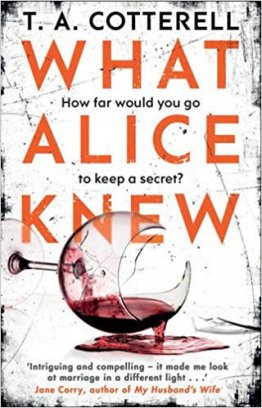
WAKBack in late 2016, I had the pleasure of listening to T A Cotterell read an extract from his debut novel, What Alice Knew. He made it clear that this was a book about secrets, and about that strange beast, family life. Family life. The words are anodyne, mild and reassuring, but we all know that many families are not what they seem to be to an outsider. Cotterell’s question, though, is simply this: “How well do members of a family know each other?”

This particular family is as close to the notion of perfection as can be. Husband Ed Sheahan is a senior obstrician at a Bristol hospital while Alice Sheahan, née Tenterden, is a successful and highly regarded portrait painter. They have two adorable children and a beautiful house in a sought-after Bristol district – one of those places which delights in calling itself a village, complete with ‘proper’ shops which strive to be terribly artisan and traditional.

As Alice is driving home from painting a commission in Suffolk, she takes a ‘phone call from daughter Nell. The first five words send a stab of anxiety through her. “Mummy – Daddy hasn’t come home.” Ed Sheahan simply isn’t the kind of father to leave his children alone in the house at night. He is not answering his mobile, he is not at the hospital, his suitcase, hold-all and travel bag are still in their cupboard. Eventually Alice discovers that Ed was last seen at a party with some younger colleagues.

Much to Alice’s relief, the absent Ed finally breaks surface and reveals, much to his embarrassment, that he had drunk well rather than wisely and had passed out in an expensive apartment belonging to a mature art student called Araminta Lyall. The apartment is in the district of Stokes Croft, which Cotterell describes as:

“..home to artists’ studios and vegan cafés, squatter collectives that sprout in disused buildings, all-night clubs, wraith-like dealers, protest groups.”

Ed Sheahan makes his way home very much with his tail between his legs. Alice is actually rather amused, because he is no sort of a party animal and much less a drinker. She is just happy that the temporary scare and anxiety have passed with no real harm being done to the family. But – and of course there is always a ‘but’ in domestic noir thrillers – her contentment is short lived when she reads the newspaper headline SOCIETY GIRL DIES, and when she reads to story, one name leaps out at her. Araminta Lyall.

T-A-CotterellFrom this point on, the dreamy soft-focus life of the Sheahan family descends into a nightmare reality, all jagged edges and harshly grating contrasts. The visual metaphor is actually totally appropriate, as one of the great strengths of the novel is how Alice sees much of life through her painterly eyes. Rose madder, cadmium yellow, viridian, alizarin crimson and flake white. Alice’s world is the world of the quaintly named oil paints on her palette. It came as no surprise to me to learn that Cotterell (right) studied History of Art at Cambridge.

One of the most gripping chapters in the book is the description of Alice being commissioned to paint a mystery sitter, who turns out to be a woman who was her best friend at school, but from whom she parted under traumatic circumstances. The woman has become dazzlingly rich through business, and has changed her name. In an atmosphere that could be sliced with a razor, the two eventually come face to face. Even if you read another two hundred books this year you will not experience a more tense and excoriating account of the power of memory, guilt and bitterness.

The tale is told from first to last by Alice herself. This poses interesting possibilities for the reader, particularly in the light of the shocks contained in the final few pages of the novel. Is Alice a reliable narrator? Does her ruthless honesty as a portraitist extend to what she is telling us – and herself? Cotterell certainly takes a huge gamble and puts our credulity on the table as stakes. I think it works, thus seating him up there on the High Table where the more established purveyors of domestic noir sup and dine. As ever, you must judge for yourselves. What Alice Knew is published by Transworld/ Black Swan/Penguin Random House and is available here.


WAK header

BRIGHT SHINY THINGS … Between the covers

BST HEADER

barbara-nadel-c-teri-varholBarbara Nadel (left) has created one of the more adventurous pairings in recent private eye fiction. The pair return for another episode set in the modern East End of London. Lee Arnold is a former soldier and policeman but now he is the proprietor of an investigation agency, partnered by a young Anglo Bengali widow, Mumtaz Hakim. Abbas al’Barri was an interpreter back in the first Gulf War, where he became close friends with Arnold. He escaped from Iraq with his family, and settled in London, but now he has a huge problem for which he requires the services of Arnold and Hakim. Fayyad – Abbas’s son – has become radicalised and gone to wage jihad in Syria. After receiving a mysterious package containing a significant religious artifact, Abbas and his wife are convinced that it represents a cry for help from Fayyad who, they believe, is desperate to return home.

Like all his fellow crusaders for The Caliphate, Fayyad has cast off his familial name and now has an identity more fitting, in his eyes, for someone wielding the sword of Islamic justice against the kaffir. Abu Imad also knows his way about the internet and he has established a very distinctive social media profile. On the basis of this, Arnold and Hakim hatch a scheme to lure the young jihadi to Amsterdam where they can discover if his parents’ belief in his change of heart is justified, or simply wishful thinking.

BSTTheir plan, it must be said, is fraught with danger and is almost bound to go pear-shaped, but within the confines of crime fiction thrillers, makes for a nail-biting narrative. What could possibly go wrong with Hakim befriending Abu Imad on Facebook and pretending to be a starstruck Muslim lass called Mishal who would like nothing better than to travel out to Syria to be at her hero’s side? Facebook leads to Skype, and with the help of make-up and a head covering, ‘Mishal’ arranges to travel to Amsterdam, complete with Abu Imad’s shopping list from Harrods. As you might expect, everything then goes wrong, in bloody and spectacular fashion.
Nadel, cleverly, has two plotlines operating in tandem, quite different but subtly linked. We have a standard police procedural centred on the murder of a flamboyant Hindu shopkeeper, Rajiv Banergee, who has been openly gay for a long time. This exposes the flaws and fault lines within Islamic society in regard to its attitude towards homosexuality but also keeps us grounded on familiar territory, fiction-wise. The second plot, of course, is the attempt to ‘rescue’ Fayyad al’Barri. This narrative is laden with tension. We soon realise that Arnold and Hakim are in way over their heads, and we can only hope that the pair escape with their lives from a maelstrom of terrorism, counter terrorism and industrial-strength deception

Nadel gives us an unflinching portrait of the social stresses and strains of the Bengali community in and around its Brick Lane heartland. She pulls no punches when describing how the position and treatment of women by many Bengali men is so often at odds with what could be called modern British and, indeed, Western European values.

The novel never becomes mere polemic, but Nadel does address one of the apparent conundrums of Islam, and that is how a so called religion of peace can allow the atrocities carried out by ISIS and other jihadis. Her answer is not the complete solution, but she neatly points out that most of the carnage is carried out by relatively young people, much to the shock and shame of their parents and, in turn, she poses the question, “Since when, in any society, have young people ever listened to their elders?”

Mumtaz Hakim has a considerable back-story which will be familiar to those who have read previous books in the series. For newcomers, the grim events are described with a deft touch which tells the reader everything they need to know, while enabling that part of the plot to simmer away nicely in the background. This is a gripping read which will entertain and cause nails to bitten to the quick. It also raises some significant questions about British society. Bright Shiny Things is available now in all formats.


SKELETON GOD … Between the covers

Skeleton God Header

It is hard to believe that in the not-so-distant past western crime authors were prone to portraying Chinese detectives as little more than grotesques, acting out every preconception of what such a person must look and sound like, and how they should behave. The excellent Robert van Gulik, with his Judge Dee novels (1950 – 1968), was one of the earliest writers to move crime fiction set in China out of the Fu Manchu mode, and into a more credible world. Eliot Pattison introduced us to his modern day Chinese policeman, Shan Tao Yun, in Mandarin Gate (2012).

Shan is a former Beijing Police Inspector who has managed the not-so-difficult task of upsetting the monolithic party machine which controls The Motherland. After exile to the Chinese equivalent of the gulags, he has been paroled to an isolated town in Tibet, where he is officially The Constable. His main tasks seem to be rescuing yaks stranded in the winter mud or chasing goats away from municipal buildings. Above all, he must and uphold the law in a community largely stripped of its traditional identity by decades of Chinese Imperialism.

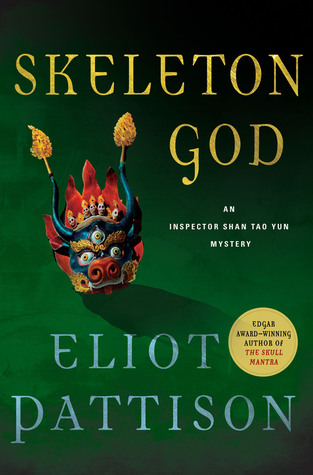
Skeleton GodThe book actually begins with Shan rescuing one of the aforementioned yaks, but events take a more sinister turn. An ancient grave is uncovered, but the inhabitants are unlikely bedfellows. The original occupant is a long dead priest, mummified and gilded. But his companions are the remains of a Chinese soldier, and the very recent corpse of an American visitor. There is cultural confusion when a mobile ‘phone, presumably not the property of either the priest of the soldier, chimes out Handel’s Hallelujah Chorus across the chill mountain air and into the ears of alarmed Yangkar locals.

Shan discovers that the American is an ex-US Navy rating called Jake Bartram. Unlikely though it may seem, Bartram’s mother is Tibetan, and came from Yangkar itself, before marrying an American citizen and settling in Pennsylvania. Rather like the relationship between Philip Kerr’s Bernie Gunther and his Nazi bosses, Shan is regarded with a mixture of caution and tolerance by those who sit in power within the Communist Party of China and, ipso facto by every single one of its eighty million members.

Shan walks a never-ending tight-rope. If he falls to one side he risks the wrath of The Party, and he is ever aware of their power. Should he fall to the other side, he knows that he will betray the Tibetan people with whom he lives. A young Chinese Public Security officer who is, effectively, moonlighting, alerts Shan to the misdeeds of a prominent retired military hero, General Lau, and the resultant investigation taxes to the limit both Shan’s integrity and his instinctive desire to keep his head in physiological contact with the rest of his body.

Pattison’s evocation of the fragile remnants of Tibetan culture is masterly. The rich and mystical Buddhist past is now little more than the rags on a scarecrow, buffeted and shredded by the savage winds of conformity which have howled from the east since the 1950s. The monasteries have gone, and their timbers and stone recycled to build barns. Gone, too, are the monks, but the ancient Tibetan ghosts remain, at least in the minds and imaginations of those who still scratch out a living in the valleys and high passes.

Readers are left in little doubt as to where Pattison’s sympathies lie, between the hard put-upon Tibetans and their Chinese masters. The sheer enormity of the chain of command between Sinophile officials in the windswept uplands of Tibet and their Pattison-2masters far away to the east is described with wit and a certain degree of compassion. I am never completely convinced by the regular use of italicised foreign language nouns in novels, particularly when the original words would have used an entirely different alphabet, but this is a tiny complaint dwarfed by what is a brilliant and evocative police procedural, albeit one set in a world as far away from our European certainties as it is possible to recreate. Pattison (right) has written a novel which  reminds us that China’s eminence as a world power has not been achieved painlessly.
Skeleton God is published by Minotaur Books and is out now.

THE KILLER ON THE WALL … Between the covers

DescriptionVB21980382

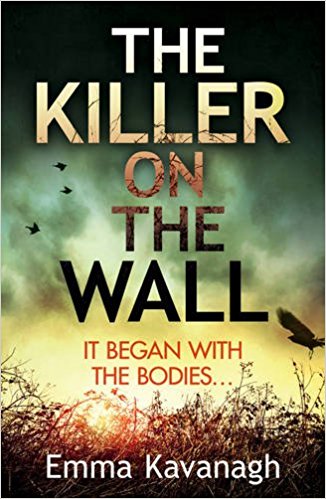
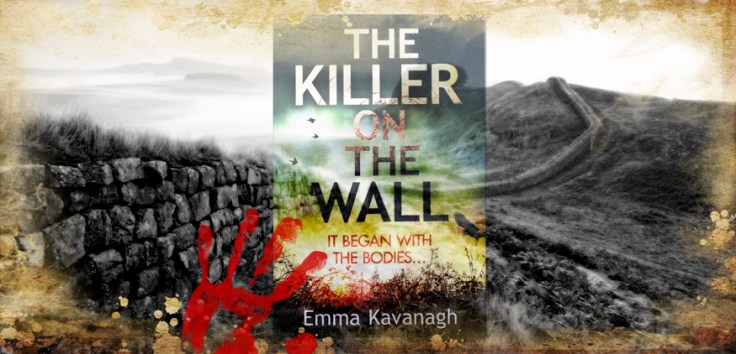
There are towns and villages the world over which in themselves are insignificant in the greater scheme of things, but whose names are indelibly imprinted on the public consciousness for the evil deeds committed there. My Lai, Sandy Hook, Columbine, Dunblane, Hungerford: the names resonate, and cause us to shudder. In the latest novel from Emma Kavanagh, Briganton is such a place. It is a village otherwise little worthy of note, with nothing to detain either the traveller or the tourist save, perhaps, for its proximity to the remains of the winding wall built to protect the northern limits of Roman Britain from so-called Celtic barbarians.

TKOTWThe name Briganton, to most British people, conjures up a series of murders, where the victims were dragged up the steep hillside and posed, in death, gazing with sightless eyes out over the windswept moorland. But all that was long ago. The killer, Heath McGowan, was brought to justice by the determination of Eric Bell, a local policeman who has since been promoted and has achieved national celebrity due to his solving the case. His triumph had added poignancy because it was his teenage daughter, Isla, who discovered the first bodies while out for an early morning run.
Twenty years have past, and now Isla Bell is Professor of Criminal Psychology at the University of Northumberland. Her husband, Ramsey Aiken was one of the original victims of The Killer On The Wall, but he survived his injuries, and is now a freelance journalist, while her father, Superintendent Eric Bell has become something of a police legend.

Isla is working on a project to identify physical differences between the brains of serial killers and normal people, and her work takes her to the prison where Heath McGowan is serving several life sentences for his murderous activities in and around Briganton. As she persuades him to undergo an MRI scan, she tries to persuade him to talk about the killings, but he treats it as a game, and refuses to divulge any useful information.

Then, the unthinkable – even the impossible – happens. In quick succession, two more local women are murdered and take the places of the long-dead bodies propped up against the limestone blocks of Hadrian’s Wall. Clearly, McGowan is not the killer, but does he have an imitator? An accomplice, maybe, who was never caught decades earlier? A young Detective Constable, Mina Arian, has made her home in Briganton and she becomes obsessed with finding – or disproving – links between the original killings and the new murders.

Emma Kavanagh has a doctorate in psychology, and her understanding both of what we know – and what we don’t know – about the workings of the human mind give this novel a very distinct and disturbing potency. Her academic credentials aside, she is a very gifted writer. As far as the plot is concerned she gives us a trawl net full of red herrings to sift through, and her vivid characterisations, particularly of Mina Arian, Eric Bell and Isla Aiken, give the narrative an electric charge.

This is a guided missile of a book: it explodes into life, and then keeps burning, inexorably homing in on a target which you will only foresee by cheating and flipping through to the last few pages. When it comes, the detonation is as devastating as it is unforeseen. Only the very best writers have the daring and dexterity to deliver such a plot twist and make it as credible as it is shocking, and Emma Kavanagh must be a founder member of that exclusive club.

You can read our review of The Missing Hours, an earlier novel by Emma Kavanagh, and she also wrote a very perceptive feature on Trauma. The Killer On The Wall is out now.

Killer footer


DIE LAST … Between the covers …

Die Last Header

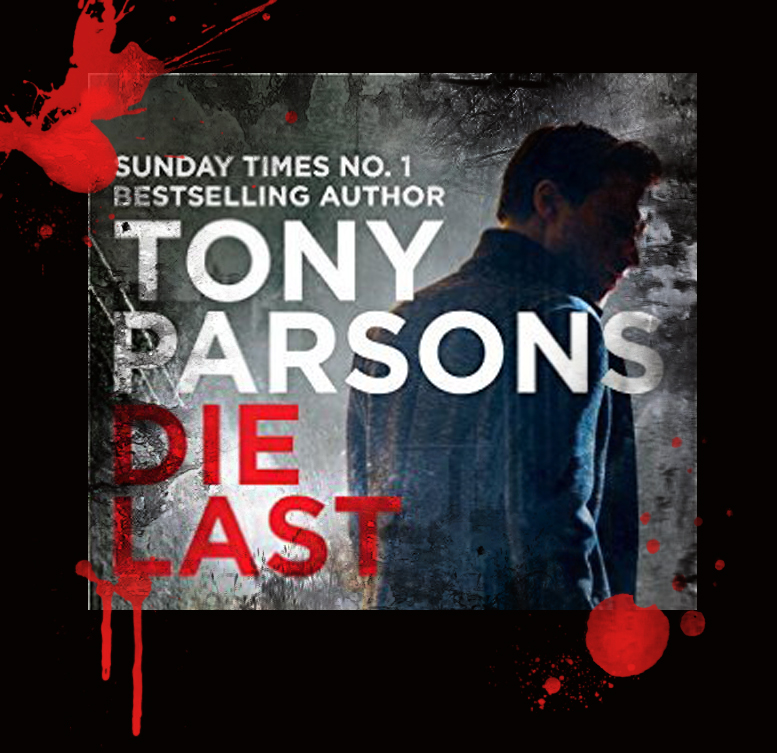
Tony Parsons has passionately held political views, and he takes no prisoners in this searing account of how human life has become a mere commodity in the biggest criminal racket ever to infect British society. Worse than drugs, more damaging than financial fraud and with a casualty list that makes the Kray twins and the Richardson brothers look like philanthropists, the trafficking of people into Britain is a growth industry which attracts the investment of evil men and women, and pays guaranteed dividends – in blood money.

DLHis London copper, DC Max Wolfe, becomes involved when a refrigerated lorry is abandoned on a street in London’s Chinatown. The emergency services breathe a huge sigh of relief when they discover that the truck is not carrying a bomb, but their relaxed mood is short-lived when they break open the doors to discover that the vehicle contains the frozen bodies of twelve young women. The bundle of passports – mostly fake – found in the lorry’s cab poses an instant conundrum. There are thirteen passports, but only twelve girls. Who – and where – is the missing person?

One of the young women shows a flicker of life, and she is rushed off to hospital, but hypothermia has shut down her vital organs beyond resuscitation, and she dies with Max Wolfe at her bedside. He discovers her true identity and vows to bring to justice the people responsible for her death, the people who brought her from poverty in Serbia, the people who promised her that she would find work as a nurse.

The search for the slavers – and the missing girl – takes Wolfe and his colleague Edie Wren to the hell on earth that is the makeshift migrant camp near Dunkerque. They discover a brutal racket run by a group of anarchists posing as voluntary workers, but police attempts to infiltrate the network – whimsically called Imagine – end in tragedy.

Wolfe feels that he has blood on his hands, but this makes him all the more determined, and the deeper he digs, the more convinced he is that someone more powerful and with a much bigger bank balance than the hippies of Imagine is at the heart of the operation. From the mud, despair and violent opportunism of the Dunkerque camp Wolfe follows the trail to millionaire properties in central London and the influential men and women whose lifestyles reek of privilege and wealth.

tony_400x400Max Wolfe certainly gets around for a humble Detective Constable, but he is an engaging character and his home background of the Smithfield flat, young daughter, motherly Irish childminder and adorable pooch make a welcome change from the usual domestic arrangements of fictional London coppers with their neglected wives, alcohol dependency and general misanthropy. Parsons (right)  is clearly angry about many aspects of modern life in Britain, but he is too good to allow his writing to descend into mere polemic. Instead, he uses his passion to drive the narrative and lend credibility to the way his characters behave.

The plot twists cleverly this way and that, and Parsons lays one or two false trails to entice the reader, but in the end, a kind of justice is done. This is compelling stuff from one of our best crime writers, and his anger at the utter disgrace of modern slavery drives the narrative forward. Die Last is a novel that will hook you in and keep you turning the pages right to the end. Your natural disappointment at finishing a terrific book will be tempered by the excellent news that Max Wolfe returns in 2018 with Tell Him He’s Dead. You can grab a copy of Die Last from all good booksellers, or by following this Amazon link.

DL footer

THE REDEMPTION OF CHARM … Between the covers

Westworth header

This is the final part of Frank Westworth’s startling Killing Sisters trilogy, in which JJ Stoner – a black ops ex-SAS type – pits his wits against the physical wiles and mental agility of three violent sisters, known as Charm, Chastity and Charity. Readers new to the series are warned not to expect a hero they are likely to fall in love with any time soon. Stoner lives – unencumbered by the burden of empathy – in an existentialist world of which he is the deep dark blue centre.

“He simply appeared to lack both curiosity – which was famously fatal to felines – and appeared also to be wondrously capable of detaching himself from everything unimportant to him.”

charm frontHe has killed at the bidding of his masters, who are shadowy government types, but now things have changed. Stoner has been stitched up, people close to him have been badly hurt, and he has retreated from the his former world. He is shattered, mentally and physically.

Exactly what is Stoner’s world? In physical terms, it consists of a love for Harley Davidson motorcycles, a serious coffee addiction, and a passion for blues guitar. He still owns the Blue Cube, a jazz and blues nightspot, keeps many of the tools of his trade in a former workshop tucked away in an anonymous industrial estate, and has among his acquaintances many strange and shadowy people, including the enigmatic pair Menace and Mallis, who orchestrate violence in the smoky limbo which exists between the authorities and others who seek only subversion. Then, of course, we have the sisters.

Charity has died. She was not killed in the line of dubious professional duty, but from a particularly virulent cancer, although her actual death was at the hands of her sister, by way of a mercy killing. The two remaining sisters are polar opposites in looks and demeanour. Chastity is a blonde hardbody with a ripped physique and a penchant for violent – and sometimes bloody – sex. Charm, while equally amoral, sexually voracious and manipulative as her surviving sister, has the outward appearance and manner of an attractive middle class suburban housewife.

The plot is jarringly simple. It is a variation on the trope whereby a retired special operative comes back from his rural retreat to do one final job. This is by no means a criticism because the book is a long highway of intense dialogue and character, with rest areas offering wild violence and inventive eroticism. The final job in this case is the hunting down of an almost mythical Irish killer called Blesses, who served her apprenticeship in The Troubles.

“She has a way with her eyes – I can’t tell you how it works – because I don’t understand it – but it was brilliant as a way of getting information from reluctant Provos. She didn’t need to screw them, thus revealing to us how crap was the UK’s honey-trap technique, but somehow made them want to talk to her about … well … everything. I mean that. Everything. Anything.”

We learn that it is her manipulation of people’s minds and bodies which has led to Stoner’s retirement, before which he was forced to watch a video showing his girlfriend being first raped and then – literally – gutted.

 I have to declare an interest here. In terms of motorcycles, I never advanced beyond an inoffensive Honda back in the 1970s, but I do love JJ Stoner’s passion for guitars, and his creator’s lovely name-dropping of snatches of 1960s pop lyrics. There’s even a series of chapter headings all taken from one of the great songs – She’s Not There. You aren’t that old? That’s no crime, but take a listen, while you ignore the awful miming. Click on the image to watch the video.

Zombies

The novel is both stylish and stylised. The dialogue is mannered and full of whip smart responses and put-downs. Despite the immediate plot being simple, the backstory has more than just a drizzling of Twin Peaks about it. If we think we know what is going on, then we probably don’t, but we come to expect appearances by random enigmatic characters who must be significant, but we are never quite sure why.

Westworth realLike its two predecessors, The Redemption of Charm is immensely entertaining and another bravura performance from Frank Westworth (right), who shares his creation’s love of Harleys and fine guitars. We are led to believe that a love of killing and a knowledge of inventive ways to use an SAS dagger are skills that, to date, divide the two men.
Frank Westworth wrote an entertaining piece for Fully Booked, in which he outlined his favourite – theoretical – ways of killing people.  Follow the link to read Killing Me Softly.

A Last Act of Charity was published in September 2014, details here.

The Corruption of Chastity was published in September 2015, details here.

The Redemption of Charm is out now, details here.

All three books are published by Book Guild Publishing.

charm-footer


WILD CHAMBER … Between the covers

Wild Chamber 1

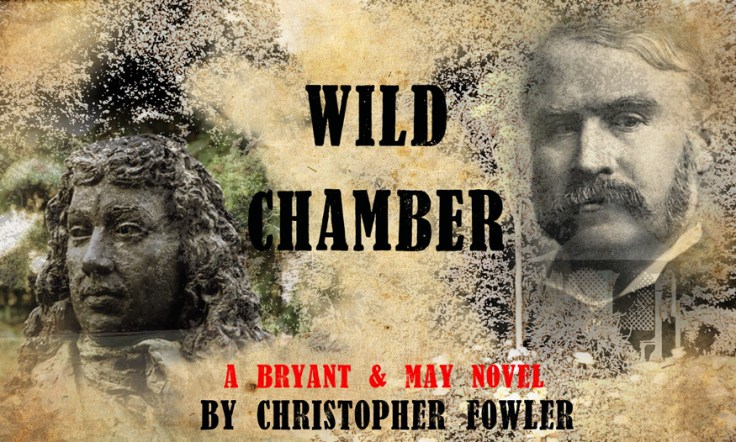
WILD CHAMBER by CHRISTOPHER FOWLER

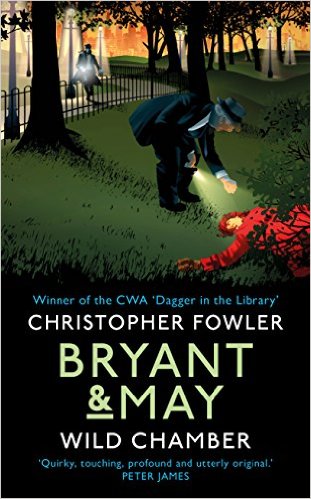
When a woman is found strangled in one of those little gated parks within a square of houses, unique to London, the Metropolitan Police’s Peculiar Crimes Unit swings into action. Led – and sometimes misled – by its two extremely senior detectives, John Bryant and Arthur May, the other members of the PCU realise that they are faced with an outdoor version of the crime fiction staple – the locked room mystery.

51o95c8FyjL._SX309_BO1,204,203,200_Other murders follow, and each has been committed in one of the parks and gardens – the Wild Chambers – which are scattered throughout central London. Are the gardens linked, like some erratically plotted ley line? Why are the murders connected to a tragic freak accident in a road tunnel near London Bridge? Why are the murder sites speckled with tiny balls of lead?

For Arthur Bryant – and his creator – London’s past is like a great sleeping creature buried beneath the layers of the city’s history. Sometimes it stirs in its slumber, and the vibrations are felt far above, by those who wish to feel. On other occasions, it sighs, and its breath stirs the leaves in the trees of memory, but only people like Bryant, for whom the present is just a footnote in the chapter of life, can hear the rustling.

Bryant’s unique relationship with London’s vibrant and violent past is described thus:

“London’s lost characters were to him close companions, from the bodysnatchers of Blenheim Street to the running footman of Mayfair and the rat man of Tottenham Court Road. He saw Queen Elizabeth I dancing alone on rainy days in Whitehall Palace
and female barbers shaving beards in Seven Dials, but he could barely recall his mother’s face.”

Fowler came up with the brainwave of having Bryant undertake a course of experimental chemical therapy to treat a life-threatening condition. He recovered, but the drugs have left him prone to out-of-body experiences. These – and here is The Fairy Feller’s masterstroke – allow him to have occasional meetings with pivotal figures from London’s past, such as Sir William Gilbert and Samuel Pepys. Such is the spell that Fowler casts, that these seem perfectly natural and without artifice.

Fowler is, among other things, a comic genius. He mines the rich and productive seam of peculiarly English comedy which gave us George and Weedon Grossmith,
J B ‘Beachcomber’ Morton, the sublime pretensions of Anthony Aloysius Hancock and the surreal world of Basil Fawlty. The book is full of great gags and very good one-liners, such as the world view of a British Library researcher who is consulted for his erudition:

“I expect my libraries and churches to be like my ex-wife:
unlovely, unforgiving, and underheated when you’re inside them.”

Chris-FowlerAlong the way, Fowler (right) has the eagle eye of John Betjeman in the way that he recognises the potency of ostensibly insignificant brand names and the way that they can instantly recreate a period of history, or a passing social mood. At one point, Bryant tries to pay for a round of drinks in a pub:

“Bryant emptied his coat pocket onto the bar counter and spread out seventeen and sixpence three farthings in pre 1973 money, two tram tickets and a Benwell’s Aerial Bombshell left over from a long-past Guy Fawkes night.”

Sometimes Fowler throws in a literary reference that is tailor made for the job. When John May exclaims:

“God, it’s as cold as Keats’s owl in here..”

… I had to reach for my Oxford Book of English Verse to confirm a vague schoolboy memory of Keats;

“St. Agnes’ Eve—Ah, bitter chill it was!
The owl, for all his feathers, was a-cold”

Fowler has his own view of the modern world, and he occasionally treats himself to the luxury of having a character give voice to it. One of Bryant’s eccentric acquaintances lets rip:

“I’m staying where no one who’s interested in singing competitions or baking shows will ever venture. I pray that when we find life on another planet it turns out to be a lot more fun than ours and that they have relaxed immigration laws. I really do prefer 1752. If we’d had the internet back then people would have spent their days looking at Rembrandt’s Storm on the Sea of Galilee, not shots of Justin Bieber’s dick.”

Such is the rich entertainment that Fowler serves up – bravura writing, poignancy, compassion, complex plotting, biting humour and a unique view of London’s landscape – that it doesn’t really matter who did what to whom, but he stays staunch and true to the crime fiction genre and gives us the answer to the intricate whoddunnit he has constructed. I have read all the previous Bryant and May novels, and this gem more than maintains the high standard Fowler has set for himself. If you love an intriguing murder plot, sparkling humour, wonderful scene-setting and brilliantly stylish writing, then get hold of a copy of this. You won’t be sorry. Wild Chamber is out now.

Wild Chamber 2

DARK ASYLUM … Between the covers

DABANNER 1

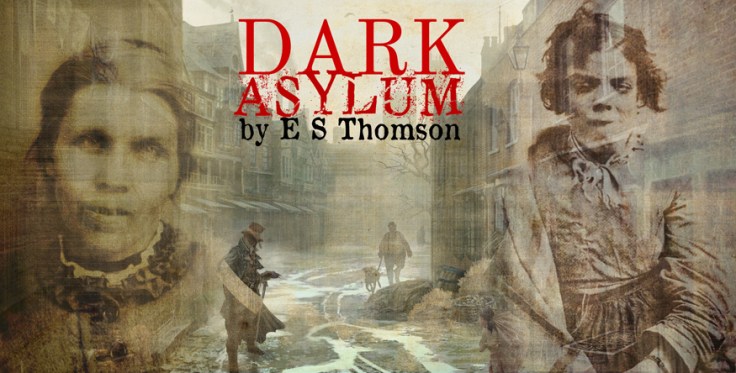
E S Thomson delivers a tale of Gothick horror, which features a young medical apothecary trying to find who killed the senior physician at a gloomy and grotesque hospital for the mentally ill in Victorian London. Jem Flockhart is not what he seems, however. Mr Flockhart is actually a Miss, as he was born female, a surviving twin. For reasons that are not immediately clear, her father switched her with the stillborn brother at birth – a birth which was so traumatic that it killed the mother. Now an adult, helped by her lack of obvious feminine sexual characteristics, she has carved out for herself a persona as a respected medical gentleman and herbalist, a position which, given the prevailing nineteenth century attitude towards women in the medical profession, would have otherwise been unattainable.

Jem, and her companion Will Quartermain – who is unequivocally male – are summoned to view the body of Doctor Rutherford who is found with his ears cut off and stuffed in his mouth, a surgical implement jammed fatally into his brain, and his lips and eyes sewn shut with crudely executed surgical stitches. Amid the carnage, there is no shortage of suspects. The other doctors attached to the asylum are jealous of Rutherford’s eminence, but scathing about his obsession that phrenology – the study of the contours of the skull – is the only true means of understanding mental illness.

DAAs I got further into the book, I was beginning to wonder just what the point was of having Jem Flockhart cross-dressing, as it didn’t seem to have any real bearing on events. Just at the point when I was about to dismiss the idea as a conceit, Thomson delivered a beautifully written scene which made sense of Flockhart’s subterfuge, and added extra poignancy to the relationship between Jem and Will.
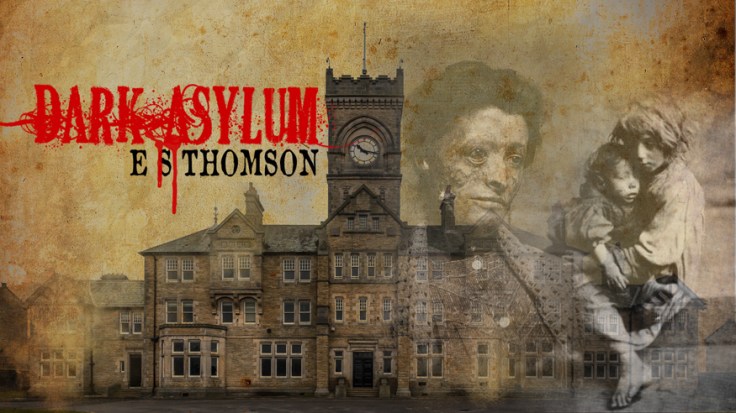
We learn that Jem has a disfiguring strawberry birthmark on her face, and Thomson writes with conviction on this issue, as her postscript to the story tells of how she suffered a temporary disfigurement herself, and how she came to be acutely aware of how people looked at her. I can say that this was a gripping read which drew me in to the extent that I finished the book in just a few sessions. The smells, sensations, sounds and social sensitivities of 1850s London are dramatically recreated, and provide much of the novel’s punch. Thomson has an eye for visceral horror and disease that David Cronenberg would approve of, and every time Jem Flockhart takes us into the room of one of the poorer denizens of London, we are inclined to hold our noses and be very careful where we put our feet.

Subtle, the book is not, but it is a dazzling, whirling, swirling riotous melodrama, which leaves little to the imagination. We have, in no particular order, people buried alive, heads being boiled in cauldrons, the shrieking, gibbering and cackling of the insane, a lunatic who keeps cockroaches as pets, the stench and degradation of prison transport ships, club-footed mad-women and the ghastly nineteenth century version of Britain’s Got Talent – the public execution.

Thomson also brings us some larger-than-life characters, none larger than the monstrous Dr Mothersole:

“His face was as smooth as a pebble, his mouth a crimson rosebud between porcelain cheeks. His head had not a single hair upon it and his lashes and brows were entirely absent, giving him a curious appearance, doll-like, and yet half complete….”

Also, very much to her credit, Thomson occasionally has her tongue firmly in her cheek. Why else would the dreadful and bestial Bedlam where most of the action takes place be called Angel Meadow, and what better name for a brothel keeper than Mrs Roseplucker? And what else are we to make of two of the charities patronised by Dr Mothersole, The Truss Society for the Relief of the Ruptured Poor, and The Limbless Costermongers Benevolent Fund ? I loved every page of this book. It is hugely entertaining and, unless something extraordinary happens, will be in the running for one of my books of the year. It is out now, and published by Constable.

DABANNER 2

WRITTEN IN BONES … Between the covers

WIB header

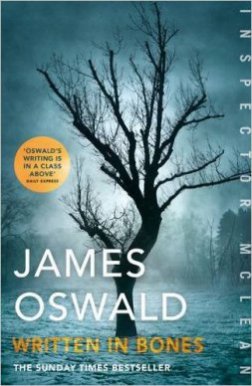
“Falling, yes I am falling, and she keeps calling me back again.” So went the lyrics of one of my favourite Beatles songs, but the unfortunate victim who features in the opening pages of this excellent police procedural from James Oswald has little to sing about. He plummets through the chill air of an Edinburgh winter early dawn. His descent is broken violently and catastrophically by the unyielding branches of a tree. Had the ten year-old boy out walking under the tree with his dog been an expert on Shakespeare’s Roman plays, he might have said, “Oh, what a fall was there, my countrymen!” Instead, he is interviewed as the only witness to one of the more bizarre crimes ever investigated by Detective Inspector Tony McLean.

bonesAs the pathologists – literally – piece together the evidence they conclude that the shattered remains in the tree is that all that is left of Bill Chalmers, a copper who was not so much bent as tangled and doubled up on himself. After surviving a jail sentence for his misdeeds, he used his connections and his wits to found a drug rehabilitation charity, which drew immense support from the community.
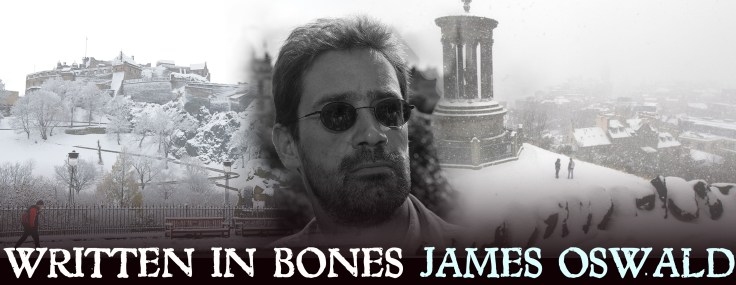
Now, his good deeds are over. His remains are laid out on a mortuary table. The lad who witnessed Chalmers’ final fall from grace is, himself, remotely connected to Edinburgh gangland gentry. His late father was Tommy Johnston, a club owner and provider of female flesh to the gentry. Johnston was shot dead years earlier, but although there was no shortage of potential suspects, his killer has remained unidentified and at large.

There are so many Detective Inspectors walking the corridors of British crime fiction that to succeed, each must have something different, something which will grab the readers’ attention. McLean is, thanks to a serendipitous bequest from a distant relative, materially far better off than his constabulary colleagues. Despite his ability to buy the flashiest of upmarket motors, he insists on driving an aged Alfa Romeo. He lives in a large house, alone except for his neighbour’s cat, and his on-off girlfriend, Emma. He is not in the first flush of youth, certainly, but he has few vices outside of a perfectly natural love of the warmth and texture of obscure single malt whiskies.

McLean’s quest for answers to explain the dramatic death of Chalmers is hampered by his ever increasing suspicion that if he were to find the truth, it would implicate several serving members of Police Scotland, and these would be men way, way above his own pay grade. As the worst snow for a decade brings chaos to the streets of Scotland’s capital, McLean finds himself the target of not only the weather, but powerful members of an international crime syndicate.

If there is a tiny weakness of the novel, it is its reliance on the backstory, as McLean eventually homes in on the culprits. We are made aware of the resourcefulness and malevolence of the person behind the mayhem – the enigmatic Mrs Saifre. The problem is that there are broad hints of how McLean has suffered at her hands in previous episodes, but we are left having to take this on trust.

This reservation aside, I can recommend Written In Bones to anyone who likes an intense police procedural, with just a dash of the supernatural, lavish helpings of atmosphere, evocative landscape descriptions and beautifully drawn characters. A few words about the author. James Oswald has a day job. That job is probably the most demanding of any occupations, as James is farmer in Fife, where he looks after pedigree Highland cattle and New Zealand Romney Sheep. Written In Bones is published by Michael Joseph and is out now.

WIB FOOTER

Blog at WordPress.com.

Up ↑