

 immy Mullen has been round the block. In the Falklands War his ship takes a direct hit from an Argentine fighter bomber and he watches his mates consumed by the ensuing fireball. Back home recuperating, with a pittance of a pension, he stacks supermarket shelves, battles with his nightmares and presides over the slow erosion of his marriage as drink becomes his only solace. Walking home one night from the boozer, he intervenes to prevent a girl being slapped around by her boyfriend. All very gallant, but the result is the boyfriend (an off-duty copper) lying insensible on the pavement in an expanding pool of blood.
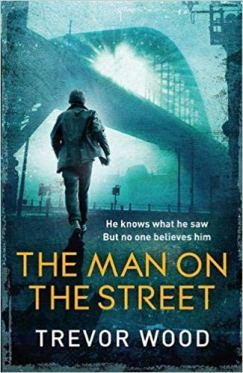 After the inevitable prison sentence Jimmy is now out on early release, but homeless, his ex-wife now remarried, and his daughter a complete stranger to him. Home is anywhere he can kip out of the rain. His social circle? A few fellow vagrants, raddled by drink, mental instability, drugs – or a toxic combination of all three. Their home-from-home is a charity called The Pit Stop where volunteers provide, food, showers and clothing.
One night as Jimmy lies under the stars on the banks of Newcastle’s River Tyne, voices intrude on his uneasy dreams. These are not the screaming ghosts of his former shipmates, but real human voices, here and now. And they are arguing. Two men, becoming increasingly agitated. Jimmy rolls over in his sleeping bag and takes a look. One man, tall, bulky, looks a bit like a bricklayer. The other fellow, slightly built, long hair, carrying a man-bag, looks a bit like a social worker. “Not my fight” thinks Jimmy. He learned that lesson years ago on his fatal walk home from the pub. As he drifts back into fitful sleep, he hears what he thinks is a splash, but the cocoon of his sleeping bag enfolds him. The words “not my fight” murmur in his ear.
 ome time later Jimmy sees a newspaper article featuring a young woman appealing for news about her missing father. The picture she is holding is of a man Jimmy thinks he recognises. It is the smaller man from the argumentative pair who disturbed his sleep a few weeks since. Or is it? With the help of a couple of his more social-media-savvy pals from The Pit Stop, Jimmy contacts the woman – Carrie Carpenter – and they are drawn into a mystery involving police (both complacent and corrupt), environmental activists, crooked businessmen and – as we learn near the end of the book – grim sexual deviancy.
This is a well written and convincing thriller with sensitive eyes and ears for the plight of ex-servicemen who, like Rudyard Kipling’s Tommy are only accepted by society when there is rough work to be done.

 uthor Trevor Wood (right) has lived in Newcastle for 25 years and considers himself an adopted Geordie, though he says that he still can’t speak the language. Despite this, his phonetic version of the unique Geordie accent is good. Normally, I shy away from books where writers try too hard to convey accents in dialogue, but I think Trevor Wood does rather well here. Perhaps this is a result of my addiction to my box set of When The Boat Comes In.
The Man on the Street, Trevor’s debut novel, will be published by Quercus as a Kindle on 31st October, and as a hardback in Spring 2020.



 nora Andresson is a distinguished English actress. Perhaps slightly past her youthful allure, she remains a beauty who can pick and choose her projects, and her films are highly thought of. She has three problems clouding her horizon. The first is, as they say, a bastard. She has a brain tumour. It has been treated but she is only too aware that she may have won a battle, but not the war. Problems two and three are related – literally. She is separated from her Swedish husband, but they have a son – a young man called Malo – who is something of a wrong ‘un. The third problem relates to the words “they have a son”. Fact is, she does – her husband doesn’t. Malo’s father is actually a millionaire businessman named Hayden Prentice, and Malo was conceived during a drunken one-nighter just before Enora’s wedding. So why is Harold a problem? Although he is now an honest man, with legitimate investments and business interests, he made his initial fortune as a drug baron.
 he main plot of Sight Unseen hinges around the kidnapping of Malo’s Colombian girlfriend Clemmie. When a ransom demand of a million dollars is received her father, who, like many rich men from that benighted republic, has kidnap insurance, simply hands the case over to the experts. H, however, has other ideas, and decides to do things his way.
 Hayden Prentice is a brilliant creation and is, in many ways, at the centre of the book, as he was when we first met Enora in

 t was not until the middle of the nineteenth century that Britain had anything like an organised police force. The Hocus Girl is set well before that time, and even a developing community like Leeds relied largely on local Constables and The Watch – both institutions being badly paid, unsupported and mostly staffed by elderly individuals who would dodder a mile to avoid any form of trouble or confrontation. There were, however, men known as Thieftakers. The title is self-explanatory. They were men who knew how to handle themselves. They were employed privately, and were outside of the rudimentary criminal justice system.
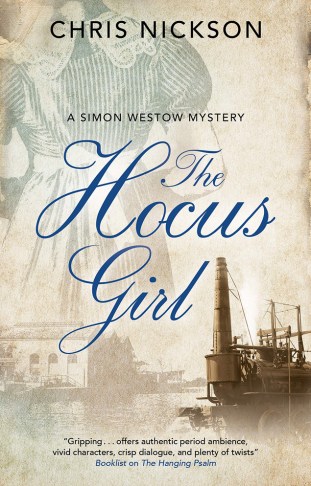 Such a man is Simon Westow. He is paid, cash in hand, to recover stolen goods, by whatever means necessary. His home town of Leeds is changing at an alarming rate as mechanised cloth mills replace the cottage weavers, and send smoke belching into the sky and chemicals into the rivers. We first met Westow in The Hanging Psalm, and there we were also introduced to young woman called Jane. She is a reject, a loner, and she is also prone to what we now call self-harm. She is a girl of the streets, but not in a sexual way; she knows every nook, cranny, and ginnel of the city; as she shrugs herself into her shawl, she can become invisible and anonymous. Her sixth sense for recognising danger and her capacity for violence – usually via a wickedly honed knife – makes her an invaluable ally to Westow. I have spent many enjoyable hours reading the author’s books, and it is my view that Jane is the darkest and most complex character he has created. In many ways The Hocus Girl is all about her.
 he 1820s were a time of great domestic upheaval in Britain. The industrial revolution was in its infancy but was already turning society on its head. The establishment was wary of challenge, and when Davey Ashton, a Leeds man with revolutionary ideas is arrested, Simon Westow – a long time friend – comes to his aid. As Ashton languishes in the filthy cell beneath Leeds Moot Hall, Westow discovers that he is treading new ground – political conspiracy and the work of an agent provocateur.


 very so often a book comes along that is so beautifully written and so haunting that a reviewer has to dig deep to even begin to do it justice. Shamus Dust by Janet Roger is one such. The author seems, as they say, to have come from nowhere. No previous books. No hobnobbing on social media. So who is Janet Roger? On her website she says:
 o, what exactly is Shamus Dust? Tribute? Homage? Pastiche? ‘Nod in the direction of..’? ‘Strongly influenced by ..’? Pick your own description, but I know that if I were listening to this as an audio book, narrated in a smoky, world-weary American accent, I could be listening to the master himself. The phrase ‘Often imitated, never bettered’ is an advertising cliché and, of course, Janet Roger doesn’t better Chandler, but she runs him pretty damn close with a taut and poetic style that never fails to shimmer on the page.
 ig mistake. Councillor Drake underestimates Newman’s intelligence and natural scepticism. Our man uncovers a homosexual vice ring, a cabal of opportunists who stand to make millions by rebuilding a shattered city, and an archaeological discovery which could halt their reconstruction bonanza.

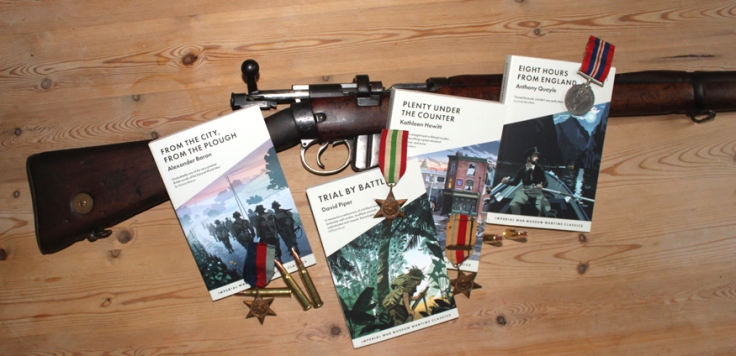
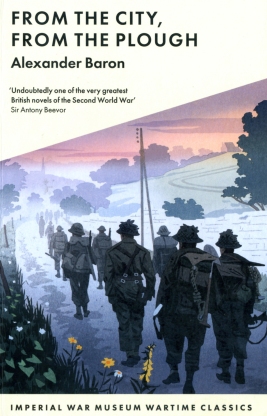
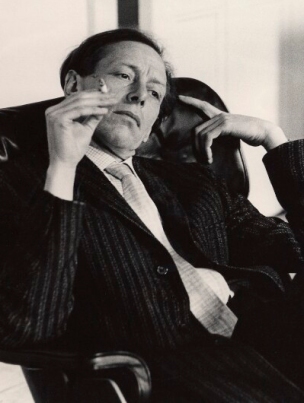
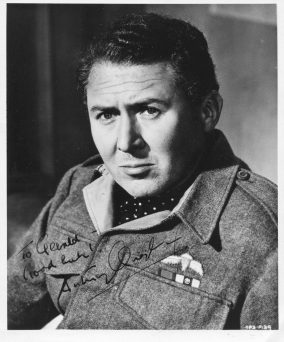 To many of us who grew up in the 1950s Anthony Quayle was to become one of a celebrated group of theatrical knights, along with Olivier, Gielgud, Richardson and Redgrave. Until recently I had no idea that he was also wrote two novels based on his experiences in WW2. The first of these, Eight Hours From England was first published in 1945 and is the fourth and final reprint in the impressive series from the Imperial War Museum.
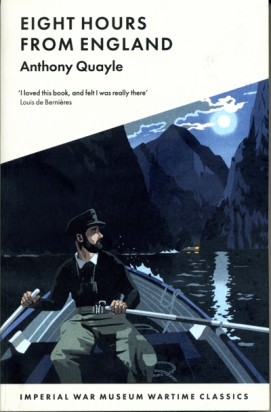 Of the three classic reprints which feature overseas action Eight Hours From England is the bleakest by far. The books by Alexander Baron and David Piper bear solemn witness to the deaths of brave men, sometimes heroic but often simply tragic: the irony is that Overton and his men do not, as far as I can recall, actually fire a shot in anger. No Germans are killed as a result of their efforts; the Allied cause is not advanced by the tiniest fraction; their heartbreaking struggle is not against the swastika and all it stands for, but against a brutally inhospitable terrain, bitter weather and, above all, the distrust, treachery and embedded criminality of many of the Albanians they encounter.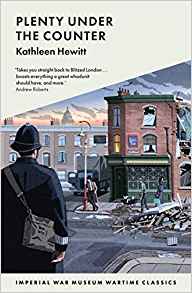
 A jolly murder? Well, of course. Fictional murders can be range from brutal to comic depending on the genre, and although the corpse found in the back garden of Mrs Meake’s lodging house – 15 Terrapin Road – is just as dead as any described by Val McDermid or Michael Connelly, the mood is set by the chief amateur investigator, a breezy and frightfully English RAF pilot called David Heron on recuperation leave from his squadron, and his elegantly witty lady friend Tess. He is from solid county stock:
 eaders will not need a degree in 20th century social history to recognise that the book’s title refers to the methods used by shopkeepers to circumvent the official rationing of food and fancy goods. More sinister is the presence – both in real life and in the book – of criminals who exploit the shortages to make serious money playing the black market and for whom deadly violence is just a way of life.
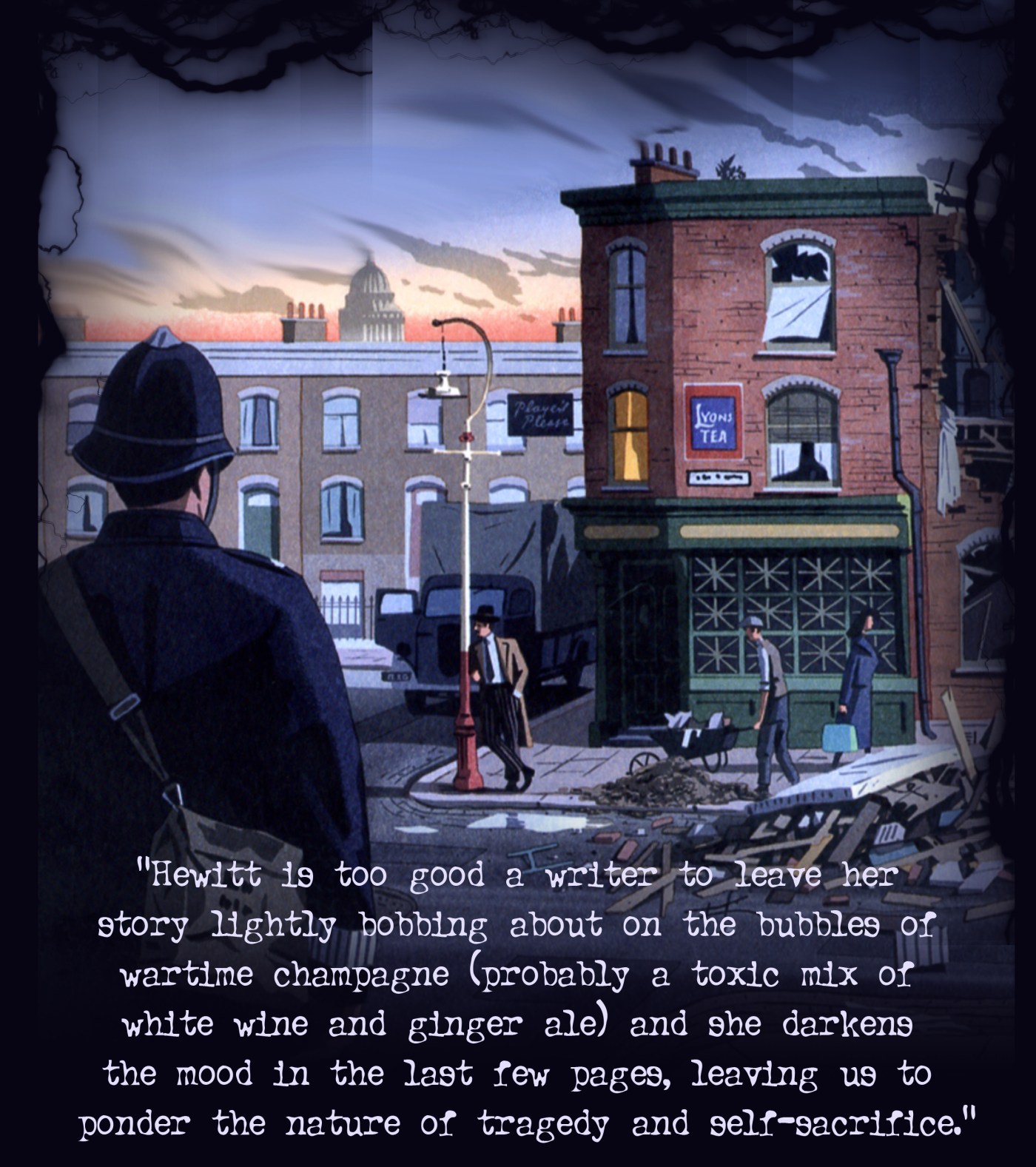
 The story rattles along in fine style as the hours tick by before David has to return to the war. He has two pressing needs. One is to buy the special licence which will enable him to marry Tess, and the other is to find the Terrapin Road murderer. Hewitt (right) is too good a writer to leave her story lightly bobbing about on the bubbles of wartime champagne (probably a toxic mix of white wine and ginger ale) and she darkens the mood in the last few pages, leaving us to ponder the nature of tragedy and self-sacrifice.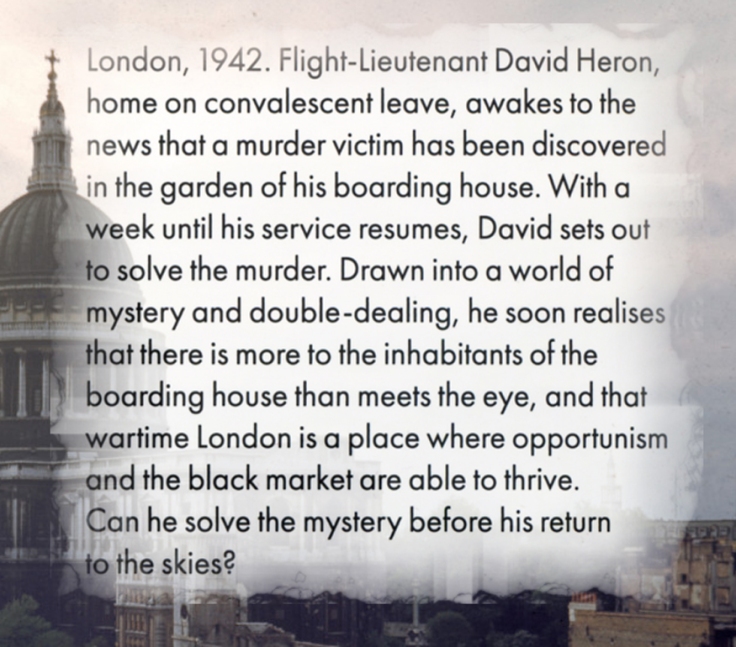
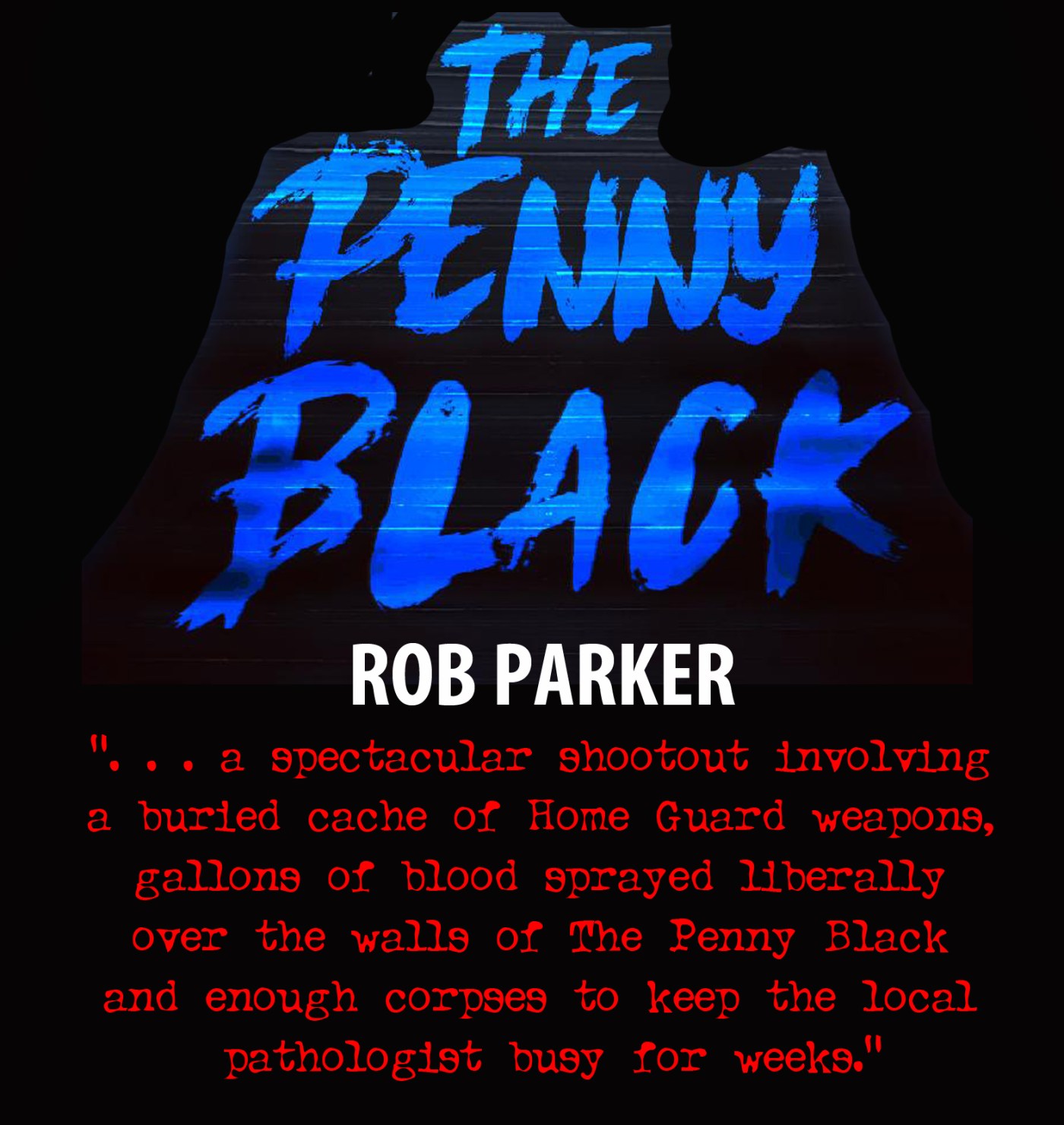

 o, this is not a novel about stamp collecting, and it would be a skillful writer who could turn the rather dry pursuit of philately into a thriller. The Penny Black is a pub – one of three – in the apparently languid and peaceful Norfolk riverside village of Horning. On the river pleasure boats glide, coots skate and squabble while, beneath the ripples, Esox Lucius bides his time, ready to snap up an unwary Roach or two, or perhaps a duckling who has strayed too far from its siblings.
 This riparian idyll is about to suffer a tsunami of turbulence however, partly due to one of its temporary residents. To call Ben Bracken, the creation of author Rob Parker (left), a Wild Card is something of an understatement. In A Wanted Man and Morte Point (
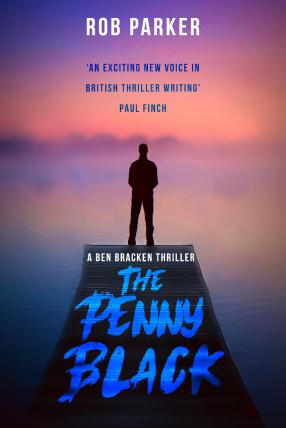 With the cash needed to pay for a fake passport and drivers’ licence Bracken prepares to bid farewell to Horning, a brutal murder and an encounter with a new enemy puts him – literally – on his back, recuperating in a lonely farmhouse. We learn that Norfolk’s would-be Medellin Cartel are actually dancing to the tune played by a London mobster called Terry “Turn-up” Masters, with whom Bracken has serious history. When Masters and his thugs turn up in Horning at the same time as a government Black Ops unit determined to eliminate Bracken, the scene is set for a spectacular shootout involving a buried cache of Home Guard weapons, gallons of blood sprayed liberally over the walls of The Penny Black and enough corpses to keep the local pathologist busy for weeks.
 ob Parker writes in a full-on style which frequently exceeds the speed limit and sometimes skates dangerously on the thin ice of probability, but he is never less than entertaining. Amid the mayhem, there are some sharp social observations:


 We first met London’s Detective Inspector Jake Porter and Sergeant Nick Styles in Robert Scragg’s debut novel What Falls Between The Cracks (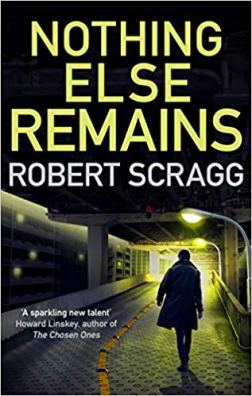
 orter is still haunted by the death of his wife in a hit-and-run accident and, like all good fictional DIs, he is viewed by his bosses – in particular the officious desk jockey Milburn – as mentally suspect. He is forced to go for a series of counselling sessions with the force’s tame psychologist, but after one hurried and fruitless encounter, he becomes totally immersed in a puzzling case which involves an old friend of his, Max Brennan. Brennan has arranged to meet his long-estranged father for the first time, but the older man fails to make the rendezvous. When Brennan’s girlfriend is abducted, he turns to Porter for help.
 eanwhile, Styles has a secret. His wife is expecting their first child and she has grave misgivings about her husband continuing as Porter’s partner, as their business puts them all too often – and quite literally – in the line of fire. Understandably, she recoils at the possibility of raising the child alone with the painful duty, at some point, of explaining to the toddler about the father they never knew. Styles has accepted her demand to transfer to something less dangerous, but as the Brennan Affair ratchets up in intensity, he just can’t seem to find the right moment to break the news to his boss.
 his is a well written and entertaining police procedural with all the necessary tropes of the genre – maverick cop, desk-bound boss, chaotic personal lives, grimy city background and labyrinthine plot. Naturally, Porter finally gets to the bottom of the mystery of the missing businessmen, but this point was reached with a fair few pages left to go, so clearly something else is about to happen. Sure enough, it does, and it is clever plot twist which I certainly didn’t see coming. Robert Scragg may be a relative novice in the crime fiction stakes but, to mangle a metaphor, he casts his red herrings with the ease and accuracy of an expert.

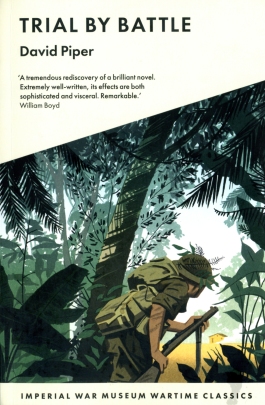
 lan Mart is a bookish, completely unmiitary young man who, fresh from Cadet College, is posted as a Second Lieutenant to an Indian Army Battalion in the autumn of 1941. The Japanese army is on the move, but are still believed to be just swarms of little yellow men who will melt away when faced with troops led by decent British officers. Mart is taken under the wing of Acting Captain Sam Holl:
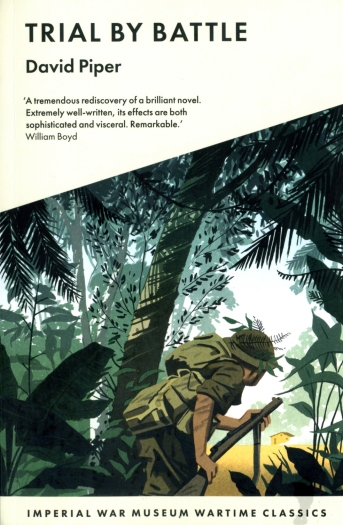 The figure of Sam Holl struck an immediate chord with me, and I wondered momentarily where I had met him before. He is a more warlike version of Guy Crouchback’s brother in arms, Apthorpe. In Men At Arms (1951) and Officers And Gentlemen (1955) Evelyn Waugh gives us a pompous and priggish chap with completely bogus military and social airs and graces. He invites us to scorn Apthorpe and his pretensions while slyly revealing the pathos of Apthorpe’s real identity; probably an orphan, brought up by an elderly aunt; sent to a very minor public school, and packed of, virtually penniless, to serve in some down at heel colonial service. When Apthorpe dies in hospital as a result of Crouchback having smuggled him a bottle of whisky, the comedy turns to tragedy, and our mockery turns to shame-faced guilt.
 espite Alan Mart being our eyes and ears as the real war gets nearer and nearer to the battalion, Holl is, literally and metaphorically, a towering figure. He has the worst aspects of the blinkered British imperialist, but he displays immense physical courage. His bluster, near alcoholism and debased view of native women contrast poignantly with moments of extreme social vulnerability:
 hen Mart and Holl reach Malaya they learn many things, few if any of them to their advantage. The sparkling new radio sets abjectly refuse to work over any distance further than the line of sight and, more disturbing still, the despised little yellow men are resolutely disinclined to scatter at the bark of a British military command. Quite the reverse; they are numerous, well trained, superbly equipped, utterly remorseless and, seemingly, irresistible.
 David Piper’s biography is covered comprehensively in the publicity for this series, so suffice it to say he writes of what he knows. I am reminded of the lines from the old hymn;


