

This fictionalised biography of the life of JD Salinger certainly begins with a name-dropping bang. Within the first twenty pages, we are in Manhattan’s legendary Stork Club, and we are rubbing shoulders with – alongside the young writer himself – Ernest Hemingway, Walter Winchell, Merle Oberon, Peter Lorre, and the bewitchingly erotic daughter of playwright Eugene O’Neill, Oona, who would later – much to Salinger’s chagrin – marry Charlie Chaplin.
 This prelude takes place in 1942, but two years later Salinger is in literally much deeper and more dangerous waters. He is a sergeant in the American army’s Counter Intelligence Corps (CIC) and has been posted to Tiverton in Devon, where the 4th Infantry Division is preparing for the D-Day landings. Salinger has to count the corpses as the US Army desperately tries to cover up two separate disasters which result in the deaths of over nine hundred American servicemen. The Slapton Sands fiasco (Operation Tiger) is described here.
The novel follows Salinger’s progress as he survives D-Day and the push through Normandy. He finds himself busy in French villages where former Nazi collaborators are trying to reinvent themselves as patriots, and he witnesses the scenes in Paris where the population takes revenge on men and women who co-operated with the German administration.
By far the toughest part of Salinger’s war, in terms of physical danger, is what he calls ‘The Green Hell.‘ The American forces were held up in the autumn and early winter of 1944 as the retreating German army took up positions in the Hürtgen Forest – over 50 square miles of dense and mountainous woodland on the Belgian German border. With splinters from shell-shattered trees causing as many casualties as bullets, the Americans suffered huge losses and only took the area when the German Army was eventually defeated at what has become known as The Battle of The Bulge.
Worse awaits Salinger, however. Not in terms of his own physical safety, but through a dreadful discovery which was to scar the minds of many of those who were present. As the Americans advance into Bavaria, they come across Kaufering Lager IV – part of the Dachau concentration camp complex. All but a handful of camp guards and administrators have fled, leaving behind them a scene from hell.
“Sonny climbed down from the jeep. He saw several axes near the siding, axes covered in blood. The guards must have been in a great hurry. They’d slaughtered prisoners of the camp even while they were herding them into the cars. Sonny found several bodies without head, hands or feet. He could follow the path of their butchery, footprints etched in blood.”
He discovers that the stationmaster of the railway siding is still hiding in his house. He gives Sonny (Salinger) a kind of perverse and depraved guided tour.
“The stationmaster led Sonny to three barracks that were partly underground, like wooden bunkers, but these bunkers had been nailed shut and set on fire while still packed with ‘citizens’ of Kaufering, the camp’s slave labourers. Sonny had to wear a handkerchief over his mouth and nose, otherwise he would have fainted right in the Lager. He couldn’t understand how the stationmaster had survived the stench, the crippling acid of rotten flesh.
‘Open the barracks,’ Sonny said, ‘Every one.’
‘But that is impossible,’ the stationmaster said, ‘It is not my job. I am responsible for the trains.’
‘Open’, Sonny said, handing him a bloody axe, ‘Or I’ll execute you on the spot.’
The stationmaster saluted Sonny with a sudden respect. ‘Yes, Herr Unteroffizier.’
He chopped away at the wood, pried out the nails, and opened the barracks, one by one. Some of the charred bodies were still smouldering. They were packed so tight, skull to skull, covered in shreds of their own burnt hair, that they had a perverse, horrifying beauty, as if they’d been sculpted out of fire.”

This horrific experience, on top of so many other traumas, tips Salinger into a kind of temporary insanity, and he checks himself into a German psychiatric clinic, where he meets a young German doctor, Sylvia Welter. They have a strange, but doomed attraction to each other and, when, war ends, they marry. Eventually the couple return to New York but, as they set up a kind of home with Salinger’s Jewish parents, it is clear that the marriage is dead, and Sylvia returns to Germany.
Sergeant Salinger is both dazzling and disturbing, and Jerome Charyn has written a brilliant account of Salinger the soldier, Salinger the writer and – above all – Salinger the troubled but deeply compassionate man. It is published by No Exit Press and is available now.



 I don’t review too many non-crime novels on here, but this one really appealed to me. It begins in the 1970s in an unnamed English town. Tim and Abi are teenage twins and, like many such siblings, have an almost preternatural bond that often transcends the spoken word and visual communication. They also have what might be called an unhealthy fascination with ghosts and the paranormal. One of Tim’s hobbies is painting pictures of bygone execution methods, and their favourite book is a well worn copy of The End of Borley Rectory (1946) by
 On a blank wall

 The team investigating the murder is led by Detective Inspector Isabel Blood, her Sergeant and a brace of DCs. They soon learn that the dead man is Kevin Spriggs, a middle-aged car mechanic, with a failed marriage behind him, an estranged son – and an argumentative temperament often fueled by drink. The murder raises many questions for Blood and her people. How did Spriggs and the person who killed him gain access to a locked house? Who hated Spriggs – admittedly not one of life’s natural charmers – enough to kill him? After all, he was something of a nobody, tolerated rather than loved by most people who knew him, but why this brutal – and mysterious – death?

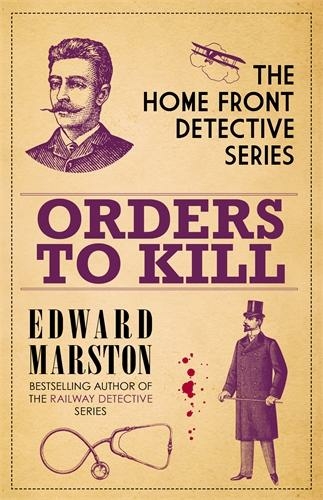 Investigating duos are always a reliable way to spin a police novel, and in this case we have Inspector Harvey Marmion and Sergeant Joe Keedy of the Metropolitan Police. Marmion is married to Ellen, with a son and daughter. Son Paul has been mentally damaged by his time on the Western Front, and has now disappeared leaving no clue as to his whereabouts, while daughter Alice – also a service police officer – is engaged to Keedy.
 Edward Marston

 The story begins with a murder, graphically described and, at this point in the review, it is probably pertinent to warn squeamish readers to return to the world of painless and tidy murders in Cotswold manor houses and drawing rooms, because death in this book is ugly, ragged, slow and visceral. The victim is a middle-aged woman who makes a living out of reading Tarot cards, tea leaves, crystal balls and other trinkets of the clairvoyance trade. She lives in an isolated cottage on the bleak shore of the Humber and, one evening, with a cold wind scouring in off the river, she tells one fortune too many.
 “She has found herself some mornings with little horseshoe grooves dug into the soft flesh of her palms. Sometimes her wrists and elbows ache until lunchtime. She sleeps like a toppled pugilist: a Pompeian tragedy. She sees such terrible things in the few snatched moments of unconsciousness.”








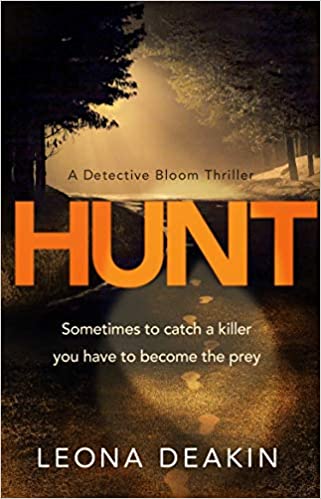 The answer to that conundrum forms the central premise of the book. Porter’s niece Scarlett has been drawn into the orbit of a feminist organisation called Artemis led by a charismatic woman called Paula Kunis. Porter will only answer police questions about his activities if Bloom undertakes to track down Scarlett and extract her from the clutches of Artemis. Bloom is smart enough to realise that Porter is up to something, but cannot work out why he is so worried about his niece, when every other aspect of his behaviour suggests that he is a cold and devious man, with psychopathological elements to his character.
 century Professor Moriarty, who has crossed swords with Bloom and Jameson before. Thirdly, Gerald Porter has inexplicably disappeared from police custody and, almost immediately, a huge social media campaign vilifying Paula Kunis and Artemis has been launched, with the result that scores of husbands and fathers of women “poached” by Artemis have headed to the Scottish retreat and are angrily congregating at its gates.


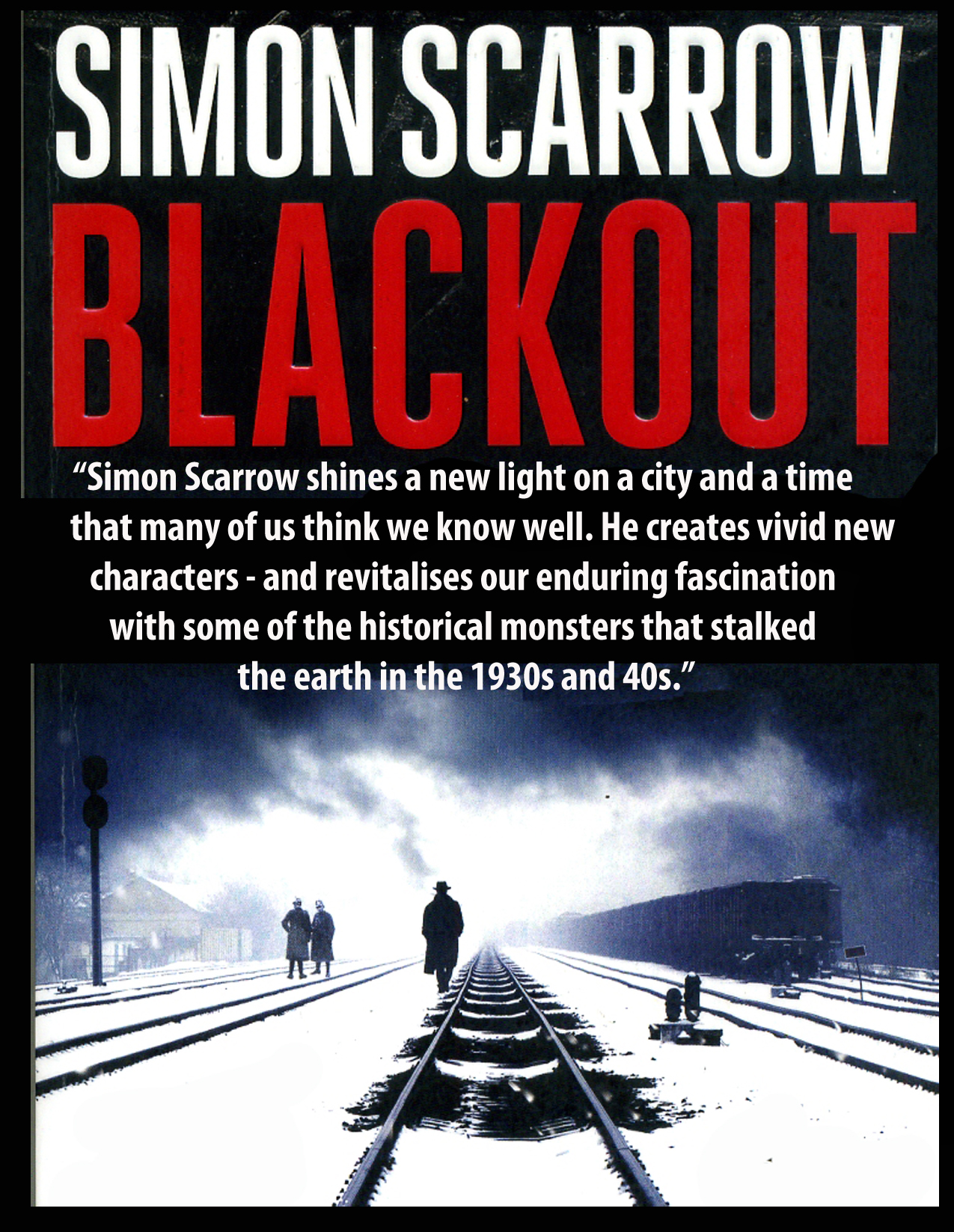

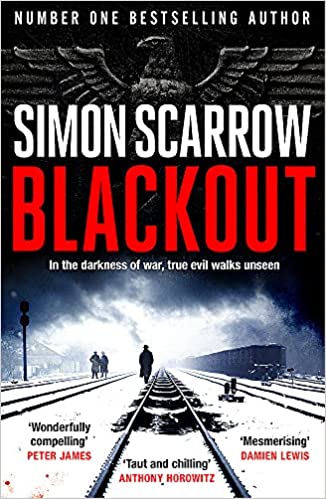 December 1939. Berlin. The snow lies deep and crisp and even, and Kriminalpolizei Inspector Horst Shenke is summoned to the Reich Security Main Office to meet Oberführer Heinrich Müller, a protege of Reinhardt Heydrich and recently appointed head of the Gestapo. Müller has a tricky problem in the shape of a former film star, Gerda Korzeny. Her husband is a lawyer and Nazi Party member who specialises in redrafting potentially awkward pieces of existing legislation in favour of the Party. And now Gerda is dead. Found by a railway track with awful head wounds. She had also been brutally raped. But what does this have to do with Heinrich Müller? His problem is that Gerda Korzeny was known to be having an affair with Oberst Karl Dorner, an officer in the Abwehr, Germany’s military intelligence organisation, and the Gestapo man wants the matter dealt with quickly and discreetly.
 Oberführer Müller, (right) in an attempt to keep tracks on what Schenke is doing, sends a young Gestapo officer called Liebvitz to shadow the Kripo officer, and that allows us to meet a rather unusual fellow. These days, we would probably say he has Asperger’s Syndrome, as he takes everything literally, has no sense of humour and a formidable eye for detail. He is also a crack shot, and this skill serves both Schenke and the department well by the end of the book.


TO ALL THE LIVING . . . Between the covers
This is the latest in the series of excellent reprints from the Imperial War Museum. They have ‘rediscovered’ novels written about WW2, mostly by people who experienced the conflict either home or away. Previous books can be referenced by clicking this link.
We are, then, immediately into the dangerous territory of judging creative artists because of their politics, which never ends well, whether it involves the Nazis ‘cancelling’ Mahler because he was Jewish or more recent critics shying away from Wagner because he was anti-semitic and, allegedly, admired by senior figures in the Third Reich. The longer debate is for another time and another place, but it is an inescapable fact that many great creative people, if not downright bastards, were deeply unpleasant and misguided. To name but a few, I don’t think I would have wanted to list Caravaggio, Paul Gauguin, Evelyn Waugh, Eric Gill or Patricia Highsmith among my best friends, but I would be mortified not to be able to experience the art they made.

So, could Monica Felton write a good story, away from hymning the praises of KIm Il Sung and his murderous regime? To All The Living (1945) is a lengthy account of life in a British munitions factory during WW2, and is principally centred around Griselda Green, a well educated young woman who has decided to do her bit for the country. To quickly answer my own question, the answer is a simple, “Yes, she could.”
Another question could be, “Does she preach?“ That, to my mind, is the unforgivable sin of any novelist with strong political convictions. Writers such as Dickens and Hardy had an agenda, certainly, but they subtly inserted this between the lines of great story-telling. Felton is no Dickens or Hardy, but she casts a wry glance at the preposterous bureaucracy that ran through the British war effort like the veins in blue cheese. She highlights the endless paperwork, the countless minions who supervised the completion of the bumf, and the men and women – usually elevated from being section heads in the equivalent of a provincial department store – who ruled over the whole thing in a ruthlessly delineated hierarchy.
Amid the satire and exaggerated portraits of provincial ‘jobsworths’ there are darker moments, such as the descriptions of rampant misogyny, genuine poverty among the working classes, and the very real chance that the women who filled shells and crafted munitions – day in, day out – were in danger of being poisoned by the substances they handled. The determination of the factory managers to keep these problems hidden is chillingly described. These were rotten times for many people in Britain, but if Monica Felton believed that things were being done differently in North Korea or the USSR, then I am afraid she was sadly deluded.
The social observation and political polemic is shot through with several touches or romance, some tragedy, and the mystery of who Griselda Green really is. What is a poised, educated and well-spoken young woman doing among the down-to-earth working class girls filling shells and priming fuzes?
My only major criticism of this book is that it’s perhaps 100 pages too long. The many acerbic, perceptive and quotable passages – mostly Felton’s views on the more nonsensical aspects of British society – tend to fizz around like shooting stars in an otherwise dull grey sky.
Is it worth reading? Yes, of course, but you must be prepared for many pages of Ms Felton being on communist party message interspersed with passages of genuinely fine writing. To All The Living is published by the Imperial War Museum, and is out now.