Search

fullybooked2017

Author

fullybooked2017

A retired Assistant Head Teacher, mad keen on guitars. Four grown-up sons, two delightful grandchildren. Enjoys shooting at targets, not living things. Determined not to go gently into that good night.

MIND OF A KILLER . . . Between the covers

image

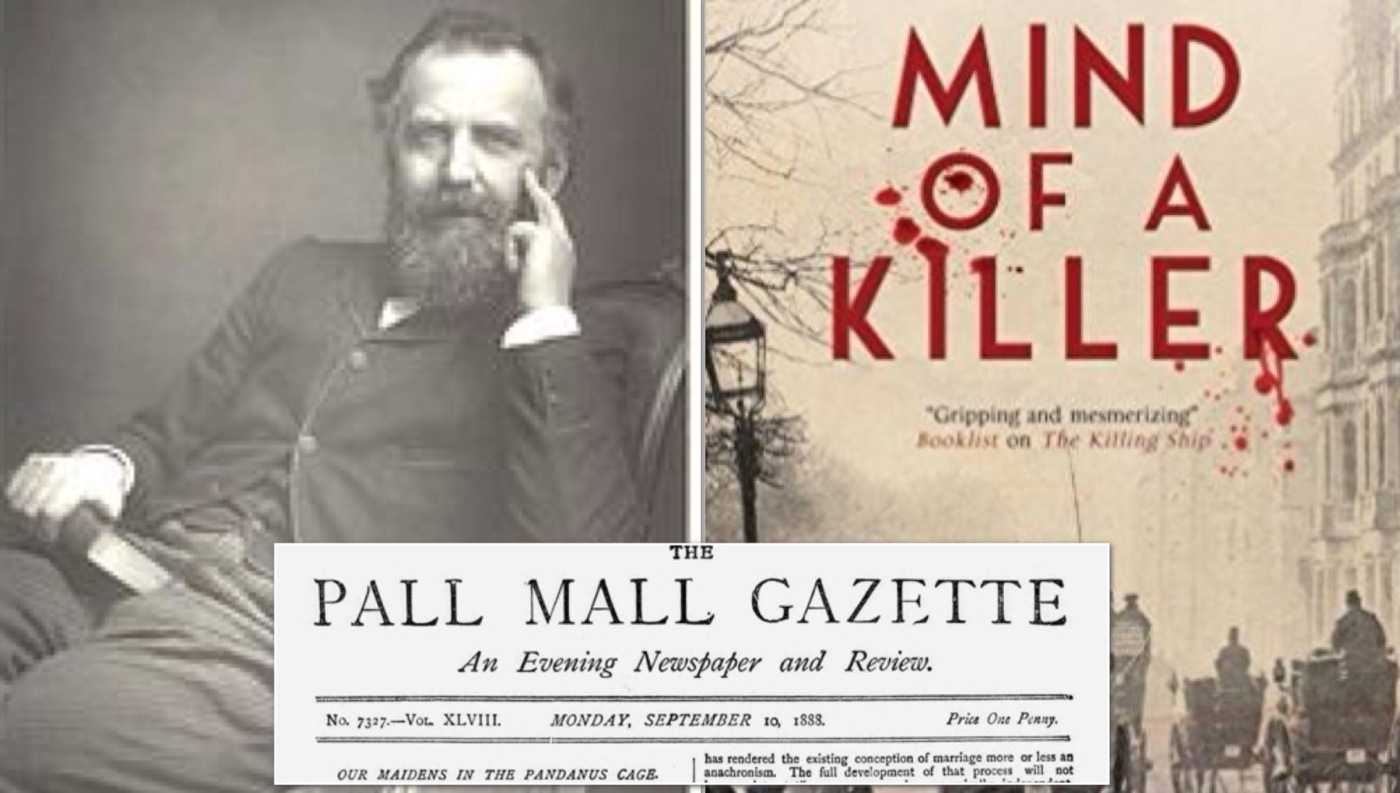
We are in London and it is the Spring of 1862. William Ewart Gladstone is two years into his second spell as British Prime Minister, The Irish Question dominates domestic politics and the campaigning journalist WT Stead is deputy editor of the evening newspaper The Pall Mall Gazette. Among his journalists is Alec Lonsdale, younger son of the Vicar of Raunds and brother of the prominent barrister, James Lonsdale.

Alec, on his way home from an unsuccessful attempt to interview the director of the Zoological Gardens, chances upon a very public emergency. A terraced house is ablaze, and its occupant – a Mr Donovan – has perished in the fire. When his body is hauled from the wreckage his head has been destroyed, but further examination reveals the astonishing fact that part of his brain – the cerebrum – has been surgically removed.
imageSimon Beaufort provides an exhilarating and madcap journey through the contrasting mileus of Victorian London. We experience gentlemen’s clubs with their subtle ambience of brandy and fine cigars, the visceral stench of low-life pubs and doss houses and the clatter of the hot lead printing presses of a vibrant daily newspaper. Lonsdale – with the assistance of Hulda Friedrichs, a fiercely independent early feminist journalist – painstakingly uncovers a nightmarish plot hatched by scientists who are obsessed with eugenics, and believe that the future of the human race depends on selective breeding and the suppression of ‘the undeserving poor’.

Alec Lonsdale is a thoroughly admirable hero who is as handy with his fists as he is with his pen. Most of the staff at the Pall Mall Gazette are actual historical figures, beautifully researched and described. We have gore, mortuary scenes, fights a-plenty, scrupulous period detail and also a sly sense of fun as we observe the elaborate formal minuet of courtship, particularly between Alec and his future sister-in-law Anne. Eventually the conspiracy is exposed by Alec and Hulda, but not before we have an exuberant reprise of the ‘mad scientist’ trope.

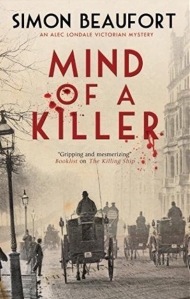
Simon Beaufort? Simon is a ‘they’ rather than a ‘he’. Beau Riffenburgh is a Californian born and bred, an expert in polar exploration, and an American Football coach. His wife – and writing partner – is none other than Liz Cruwys, better known as Susanna Gregory, best-selling author of many historical novels featuring medieval investigator Matthew Bartholemew. Mind Of A Killer is published by Severn House, came out in hardback just before Christmas 2017, and is now available in Kindle.

image


THE TIN GOD . . . Between the covers

TTGheader

“And the guardians and their ladies,
Although the wind is east,
Have come in their furs and wrappers,
To watch their charges feast;
To smile and be condescending,
Put pudding on pauper plates.
To be hosts at the workhouse banquet
They’ve paid for — with the rates.”

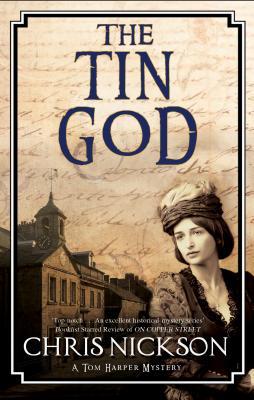
Verse two of the celebrated – and often parodied – ballad poem by the Victorian campaigning journalist George R Sims, In The Workhouse, Christmas Day. Most of us older folk know the poem and its melancholy message. An old man is sitting down to his Christmas dinner in the workhouse, but one memory is too much for him, and he angrily relates the tale of his late wife, who was forced to die of hunger on the streets because of the harshness of the workhouse regulations. The relevance of this to Chris Nickson’s The Tin God lies in the first line of the verse above, because the heroine of the story is the wife of Leeds copper Tom Harper, and she is standing for election to the workhouse Board of Guardians.

So? This Leeds in October 1897, and women simply did not stand for office of any kind, and when Annabelle Harper, along with several colleagues from the fledgling Suffrage movement decide to enter the election, it is a controversial decision, because the concept of women migrating from their proper places, be they the bedroom, the withdrawing room or the kitchen, is anathema to most of the ‘gentlemen’ in Leeds society.

TTG coverOutraged leading articles appear in local newspapers, but someone believes that the sword – or something equally violent – is mightier than the pen, and a homemade bomb destroys a church hall just before Annabelle Harper is due to speak to her supporters. The caretaker is tragically killed by the explosion, and matters go from bad to worse when more bombs are found, and several of the women candidates are threatened.

Superintendent Tom Harper is already involved in investigating the criminal aspects of the case, but when the husband of one of the women is murdered while sitting at his own kitchen table, the affair becomes a hunt for a murderer. The killer leaves a few tantalising clues, and Harper becomes conflicted between devoting every hour that God sends to tracking down the killer – and keeping his wife from becoming the next victim.

Nickson drops us straight onto the streets of his beloved Leeds. We smell the stench of the factories, hear the clatter of iron-shod hooves on the cobbles, curse when the soot from the chimneys blackens the garments on our washing lines and – most tellingly – we feel the pangs of hunger gnawing at the bellies of the impoverished. We have an intriguing sub-plot involving a smuggling gang importing illegal spirits into Leeds, authentic dialogue, matchless historical background and, best of all, a few hours under the spell of one of the best story tellers in modern fiction.

Kidson

You want more? Well, it’s there. Nickson is a fine musician and a distinguished music journalist, and he cunningly works into the plot one of the more notable musical names associated with Leeds and West Yorkshire, the folksong collector Frank Kidson (above). The killer shares Kidson’s passion for the old songs – if not his humanity and feelings for his fellow human beings – and he leaves handwritten fragments of English songs at the scenes of his attacks.

annabellebig

The Tin God is published by Severn House and is available now. It will be obvious that I am a great admirer of Chris Nickson’s writing, and if you click the images below, you can read the reviews for some of his other excellent novels.

TYOTG

CS

TIW


FFAD

GREEKS BEARING GIFTS . . . Between the covers

GBG compo header

philip-kerr“One of the greatest anti-heroes ever written,” says Lee Child of Bernie Gunther, the world weary, wise-cracking former German cop, and sometime acquaintance of such diverse historical characters as Reinhard Heydrich, Joseph Goebbels, Eva Peron and William Somerset Maugham. I was several chapters into this, the latest episode in Gunther’s career, when I heard the dreadful news of the death of his creator, Philip Kerr (left) at the age of 62. “No age at all,” as the saying goes.

We rejoin our man in 1957, where he is eking out a living in the economic miracle that is Konrad Adenauer’s West Germany. The prosperity and new international respectability created in a country that just ten years earlier lay devastated by war, has largely passed Gunther by. Under an assumed name, he is working as a mortuary attendant in a Munich hospital. It is not his ideal job, but as he says:

“So, until I could find myself something better, I was stuck with it and my customers were stuck with me. I certainly didn’t hear any of them complaining about my bedside manner.”

GBG
After being blackmailed into taking part in a financial scam involving local politicians, Gunther manges to come out of the affair smelling, if not of roses, like something fairly neutral, like amaryllis. He is rewarded with a new job – that of an insurance adjuster, investigating fraudulent claims and saving his employers precious deutschmarks. Gunther reflects, with typical hard nosed perception, about the state of modern West Germany, with the Third Reich having done one of the most spectacular disappearing acts in history.

” Germany would try its best to be nice to everyone and, in the interests of making money, everyone else would try their best to forget what Germany had done during the war. Bureaucracy and trade were to be my country’s new method of conquering Europe, and lawyers and civil servants were to be its foot soldiers.

adenauerHitler could certainly have taken a lesson from the Old Man (Adenauer, left) It was not the men with guns who were going to rule the world but businessmen …. with their slide rules and actuarial tables, and thick books of obscure new laws in three different languages.”


Gunther is sent to Greece to investigate the sinking of boat used by a German maker of underwater films, but soon he finds the owner shot dead through both eyes, and a trail of deception and murder that links the sunken boat to the shameful treatment of Thessaloniki’s thousands of Jews during the war. They were deceived, robbed, brutalised – and finally shipped off to the death camps – by men who seem to be still alive and well in Athens.

As Isaac Watts wrote so memorably, “Time, like an ever rolling stream, bears all its sons away..” and Gunther, while not dead yet, is not the man he was. He suffers a minor heart attack while chasing one of his suspects, but his remedy is not one that would appeal to modern cardiologists.

“But straightway I knew what needed to be done: I lurched into the café, ordered a large brandy, and lit a cigarette but not before snapping the filter off the filter to smoke it plain and get my breath. The old remedies are usually best. Throughout both wars it was a strong cigarette and a tot of something warm that kept the nerves in check, especially when the shells were falling around you like rocks at Muslim stoning. Once the nerves were sorted, the bullets wouldn’t touch you; and if they did, you hardly cared.”

Part of the delightfully complex plot involves the intervention of the Israeli secret service, the fearsome Mossad. The woman who is heading up their Athens operation is witheringly sarcastic when Gunther claims that, albeit under trying circumstances, he had kept a relatively clean conscience during the 1930s and 1940s.

” I’ve heard of the unicorn, the griffin, the great auk, the tart with a heart, and little green men from outer space. I’ve even heard of the good German, but I never thought to see one myself. You never voted for the Nazis, and you never liked Hitler. I suppose there was even a Jew you helped to survive the war. You hid him in your lavatory for a couple of days. And of course some of your best friends were Jews. It amazes me how many of us died.”

This is a magnificent book. Gunther’s cynicism, his basic decency, and his ability to keep the candle flame of his conscience flickering in the dark while still keeping his head attached to his body, are described by an author at the very peak of his powers. Philip Kerr may have passed from the sight of men, but Bernie Gunther is immortal.

GBG compo footer

PHILIP KERR . . . 1956 – 2018

philip-kerrDUE TO THE AWFUL NEWS that Philip Kerr has died, the current prize draw for a copy of Greeks Bearing Gifts will be suspended for the time being. I will be writing a tribute to Philip, one of our finest writers, in due course. The competition will be re-run later in the year. People who have already entered will have their names carried forward.

HALL OF MIRRORS . . . Between the covers

Collage

HOMIf a more extraordinary duo of fictional detectives exists than Christopher Fowler’s Bryant & May, then I have yet to discover them. The peculiar pair return in Hall of Mirrors for their fifteenth outing, and this time not only are they far from their beloved London, but we see a pair of much younger coppers on their beat in the 1960s. Fowler’s take on the period is typified by each of the fifty chapters of the novel bearing the title of a classic pop hit. We are also reminded of the strange fashions of the day.

“Two young men in Second World War army uniforms painted with ‘Ban The Bomb’ slogans were arguing with a pair of Chelsea Pensioners who clearly didn’t take kindly to military outfits being worn by trendy pacifists. They were briefly joined by a girl wearing a British sailor’s uniform with a giant iridescent fish on her head.”

Christopher-Fowler

In attempt to keep them out of trouble, our heroes are given the task of being minders to an important witness in a fraud trial, but Monty Hatton-Jones is due at a country weekend party deep in rural Kent, and so John and Arthur must accompany him to Tavistock Hall. What follows is a delicious take on the Golden Age country house mystery, with improbable murders, secret passages, an escaped homicidal maniac and suspects galore. Things are complicated by nearby military manoeuvres involving the British army and their French counterparts. Fowler (above) reprises the great gag from Dr Strangelove – “Gentlemen – you can’t fight in here. This is the War Room!” Captain Debney, the British Commanding Officer is having a bad day.

“The menu for tonight’s hands Across The Water dinner has already gone up the Swanee. We had terrible trouble getting hold of courgettes, and now I hear there’s no custard available. I don’t want anything else going wrong. These are international war games. We can’t afford to have anyone hurt.”

The urbane John May is quite at home in the faded grandeur of Tavistock Hall, but Arthur is like a fish out of water. He also has an aversion to the countryside.

“It appeared to be the perfect Kentish evening, pink with mist and fresh with the scent of the wet grass. Bryant looked at it with a jaundiced eye. There was mud everywhere, the cows stank, and were all those trees really necessary? As a child he had been terrified of the bare, sickly elm in his street with a branch that scarped at his bedroom window like a witch’s hand and sent him under the blankets.”

 As usual with the B & M books, the jokes come thick and fast, but we are reminded that Fowler is a perceptive and eloquent commentator on the human condition. Arthur investigates the local parish church as its rector, Revd Trevor Patethric is a house guest – and suspect.

“Bryant pushed open the church door and entered. He had never felt comfortable in the houses of God, associating them with gruelling rites of childhood: saying farewell to dead grandfathers, and the observance of distant, obscure ceremonies involving hushed prayers, peculiarly phrased bible passages, muffled tears and shamed repentance.”

HOM FOOTER

 Eventually, of course, the pair – mostly through Arthur’s twisted thought processes – solve the crimes. Prior to revealing his theories on the murder to the assembled guests, however, Bryant has a slight misfortune with a missing painting hidden in a very unswept chimney. Covered in soot, he somehow lacks the gravitas of a Poirot or a Marple.

“Bryant had made a desultory attempt to wipe his face, but the result was more monstrous than before. He rose before them now, a lunatic lecturer in the physics of murder.”

Reading a crime novel shouldn’t be about being educated, but Hall of Mirrors teaches us many things. Those who didn’t already know will learn that Christopher Fowler is a brilliant writer. He is, in my view, out on his own in the way he weaves a magic carpet from a dazzling array of different threads: there is uniquely English humour, the sheer joy of the eccentricities of our language and landscape, labyrinthine plotting, and an array of arcane cultural references which will surely have Betjeman beaming down from heaven. Those of us who, smugly perhaps, consider ourselves as old Bryant & May hands will also now know the origins of Arthur’s malodorous scarf and also his cranky, clanky Mini.

Amidst the gags, the fizzing dialogue and the audacious plot twists Fowler waves his magic wand, and with the lightest of light touches dusts a page near the very end with poignancy and great compassion. Look out for the section that ends:

“Bryant looked in his mirror to try and catch another glimpse of them, but they had disappeared, ghosts of a London yet to come.”

 And do you want to know the best five words of the entire book? I’ll tell you:

Bryant and May Will Return

Hall of Mirrors is published by Quercus, and is available from 22nd March.

HOM banner

ON MY SHELF . . . James, Turner & Pattison

OMS MARCH HEADER

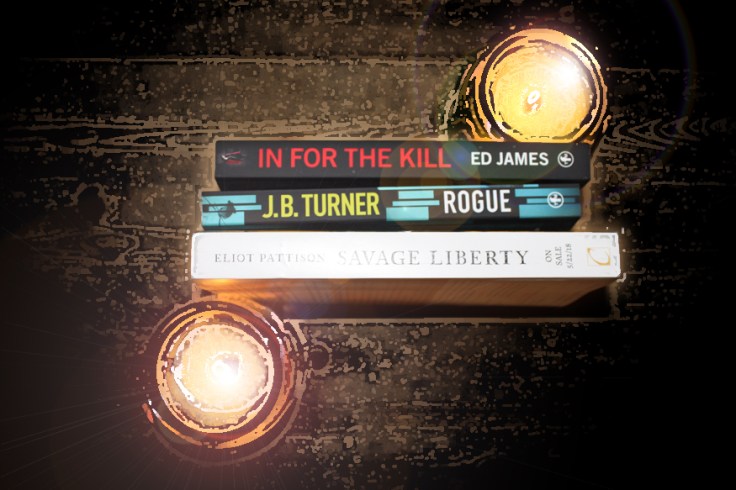
IN FOR THE KILL by ED James

ed-jamesEast London cop DI Steve Fenchurch makes a welcome return for the fourth book in this popular series by Ed James (left). It is part of urban folklore that attractive female students are sometimes tempted to use their charms to attract Sugar Daddies who will help with their fees and living costs. When one such young woman is found strangled in her bedroom, Fenchurch soon discovers that she was in the pay of a notorious city gangster. With his superiors poised to pounce on him at the first sign of a professional mistake, and his family in mortal danger, Fenchurch is faced with a no-win dilemma. If he persists in finding out who killed the young woman, he will attract incoming fire from very powerful people. If he just keeps his head down and allows the investigation to drift into the ‘unsolved’ file, his bosses will have him clearing his desk and locker before he can utter the word ‘sacked’. In For The Kill is published by Thomas & Mercer and will be available from 19 April in Kindle, paperback and MP3 CD.

ROGUE by JB Turner

TurnerThis is first in what promises to be a popular series with readers who love their novels spiced with the double-dealing and other shenanigans which are part and parcel of the work of American intelligence organisations.  Nathan Stone is a former CIA covert operative who has been critically wounded, and thought to be dead. But behind closed doors, he has been rehabilitated by a highly secretive government organization known as the Commission, given a new identity and appearance, and remoulded into a lethal assassin. His brief: to execute kill orders drawn up by the Commission, all in the name of national security. Turner (right) provides enough thrills to keep even the most jaded reader on their toes. Rogue is published by  Thomas & Mercer, and will be available in June.

SAVAGE LIBERTY by Eliot Pattison

Pattison-2I first came across Pattison (left) and his Revolutionary Wars hero Duncan McCallum when I was writing for Crime Fiction Lover. I reviewed Blood Of The Oak in March 2016, and you can read the piece by following the blue link. More recently, wearing my Fully Booked hat, I enjoyed Pattison’s Skeleton God, set in Tibet, light years away both in time and context from eighteenth century America. Savage Liberty brings us a further chapter in the eventful life of Duncan McCallum. The action begins in 1768. We are in Boston, where a ship from London has exploded, leaving the body parts of its crew and passengers scattered like flotsam in the cold waters. McCallum is a trained physician and his analytical mind soon detects the work of French secret agents. His investigations bring him onto extreme peril, however, and he finds himself in a jail cell accused of treason, with the hangman’s rope just days away. McCallum realises that his only hope is to escape and bring the true villains to justice. Savage Liberty is published by Counterpoint, and will be available in June
OMS MARCH FOOTER

WELCOME TO CAMP NIGHTINGALE . . . but the birds aren’t singing

CAMP HEADER

SUMMER CAMP – that particularly American institution which, for those of us in our dotage, evokes memories of Allan Sherman’s letter home from Camp Granada.


Camp Nightingale017RILEY SAGER (aka Todd Ritter) however takes a darker view. When Emma goes to Camp Nightingale, it is her first summer away from home. She learns how to play games, but she also learns a more sinister skill – how to lie. That golden summer dream becomes a twisted and feverish nightmare when three of Emma’s new-found friends set off to explore the woods, but are never seen again. It is inevitable that he subsequent furore spells the end for Camp Nightingale as a safe holiday destination for teenage girls. But times change. memories fade. Years after the terrible events of that summer, Emma is asked to return to the newly reopened camp. Will her return lay old ghosts to rest, or wake the spirits of the dead and rip away the veil of innocence to reveal a much darker truth?

LAST TIME I LIED  is published by Ebury Press/Penguin Random House, and will be available later this year. To find out more about Riley Sager, you can follow these links.

https://www.rileysagerbooks.com/

@riley_sager

CAMP2

CAMP FOOTER


PETER TEMPLE (1946 – 2018) . . . A tribute

TEMPLE HEADER

The distinguished Australian crime writer Peter Temple has died of cancer at the age of 71 at his home in the Victorian city of Ballarat. When some modern writers might have their output weighed rather than critically assessed, Temple wrote just nine novels and devoted much of his career to journalism – at which he excelled – and teaching others how to write. Nine novels only, but each is a gem – polished, hard, multi-faceted and brilliant. If he is known at all among casual readers of crime fiction in Britain, it may be for his four novels featuring the gritty private investigator, Jack Irish.

Irish, a former lawyer, inhabits an Australia which might surprise those who have never lived and worked in Melbourne. November through to March in the Victorian capital is pretty much the stereotype beloved of those who caricature Aussie life. It gets bloody hot, you don’t leave home without fly repellant and, across at the MCG, cricket fans, with the obligatory Eskies full of beer, are baying at the opposition players. But visit Melbourne between April and October, and you see a different city. The winter rain is usually an incessant but penetrative drizzle rather than a downpour and the wise supporter wraps up well to go and support his ‘footie’ team on a Saturday afternoon. The world of football – that strange hybrid we know as Aussie Rules – is one of the two contrapuntal themes in the Jack Irish novels, the other being the big business of horse racing. Whereas Jack Irish comes no closer to football than gloomy suburban pubs where old men rage against the dying of the light – and the current losing streak of their local team – his horse racing connections are far more potent. He has an uneasy relationship with a millionaire former jockey and the ruthless minder who looks after him, and his loyalty to the pair is sometimes repaid in cash but, on other occasions, with supportive but devastating violence.

The four Jack Irish novels are all in print, as follows:

Bad Debts (1996)
Black Tide (1999)
Dead Point (2000)
White Dog (2003)

Irish

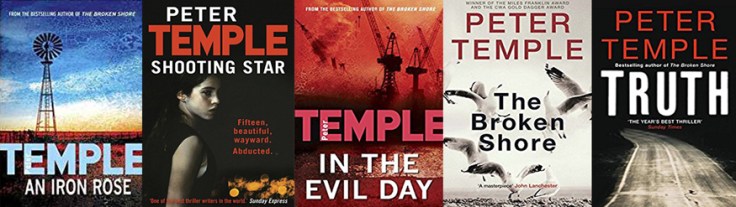
Never content to rest comfortably in the arms of a literary formula, Temple also wrote five other novels, each with a different protagonist, as follows:

An Iron Rose – featuring Mac Faraday (1998)
Shooting Star – featuring Frank Calder (1999)
In The Evil Day – featuring John Anselm (2002)
The Broken Shore – featuring Joe Cashin (2005)
Truth – featuring Steven Villani (2009)

Standalones

In The Evil Day is the only one of Temple’s works that has an international flavour. John Anselm is an ex-Beirut hostage who is eking out an existence working in surveillance in Hamburg, but becomes involved with a beautiful investigative journalist in London and an unscrupulous  mercenary. Messrs Faraday, Calder and Cashin, on the other hand,  ply their trade in deeply conservative country towns a couple of hours up the highway from the bright lights of Melbourne. Steven Villani, however, is back in Melbourne (which may seem more English than England, with its daily evensong at St Paul’s Cathedral, and its exclusive gentleman’s clubs) but there is nothing cosy or quaint about the corruption and venality that the hard-bitten police officer must confront.

Peter Temple was a fine journalist. Part of his training would have involved being cudgeled by hard-nosed editors into saying as much as possible in the fewest words. In his novels he added the imagination of a poet and the compassionate humility of a medieval saint. We have lost a writer who employed a style that was so terse and direct that it gave him the space and time for moments of such grace and perception that they take the breath away.

peter_temple


THE POSTMAN DELIVERS . . . FUDGEGATE!

FUDGEGATE HEADER

FUDGE TEXT

The Death of Mrs Westaway will be published in hardback and Kindle by Harvill Secker/Vintage Digital in June 2018.

Blog at WordPress.com.

Up ↑