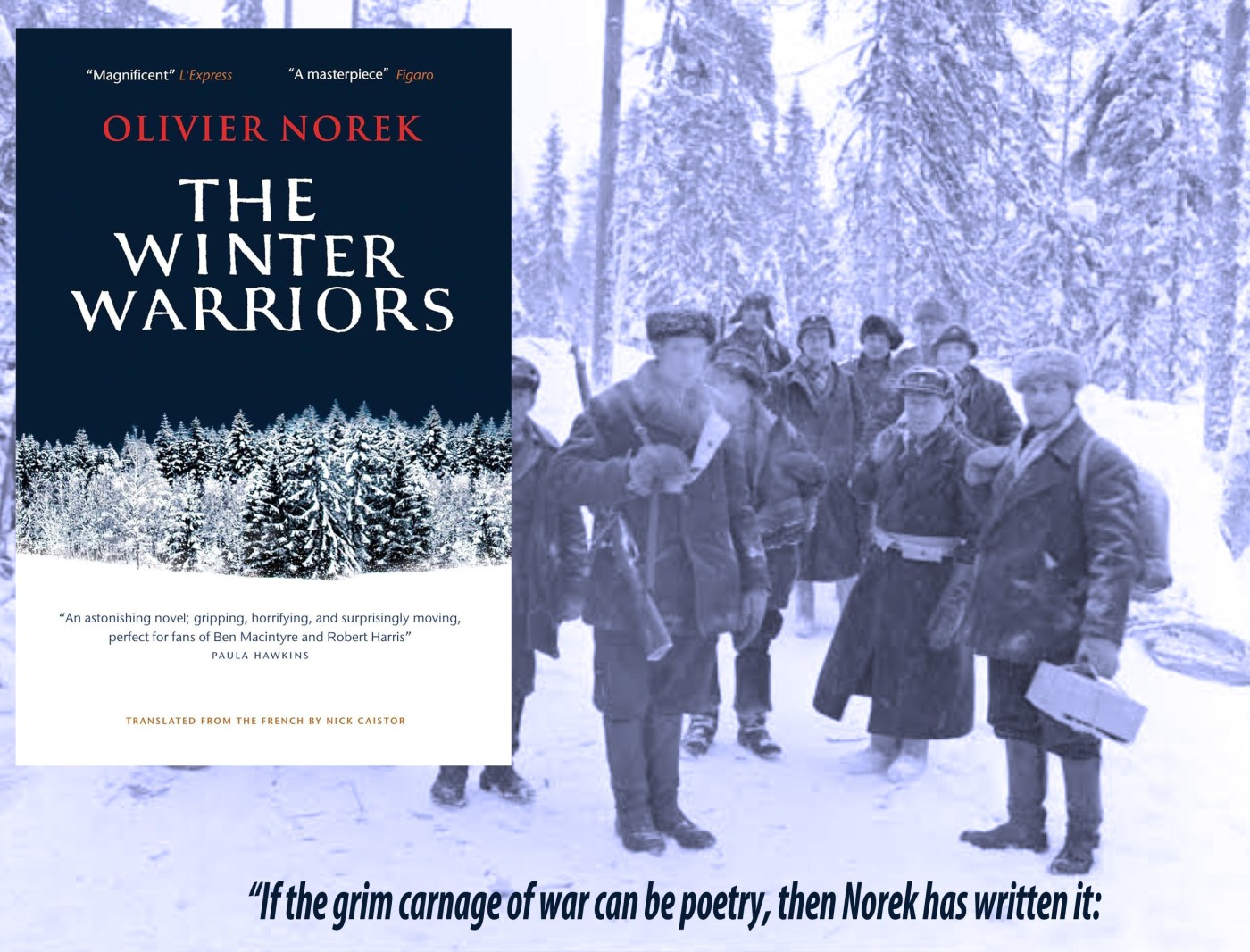

If the short but bloody war between Finland and Russia which took place in the winter of 1939/40 is largely forgotten today, it is simply because of the enormity of events which followed it. This is the story of that war, and of one man in particular – Simo Häyhä, who came to be known by the Russians as the White Death. A farmer and forester by trade, he was already renowned as a gifted marksman when the Russian invasion began, and was a reservist member of the Finnish Civic Guard. The narrative follows Simo and a small group of his childhood friends from the beginning of the war to Simo’s near-fatal wounding, just seven days before the end of hostilities on 13th March 1940.
This is, ostensibly, a novel, but the events depicted are as close to the facts as anything found in a dry history. Author Olivier Norek is a successful crime writer, but here, his descriptions of battle are as real and uncomfortably vivid as anything I have ever read. Most of the characters are from real life, and they include Russian foreign minister Vyacheslav Molotov and Finnish Commander in Chief Carl Gustav Mannerheim. One individual who stands out is Arne Juutilainen, one of the Finnish combat commanders. Known to his men as ‘The Terror’, he was a seldom-sober veteran of the French Foreign Legion, suicidally courageous with an almost insane lust for killing.
With skill and compassion, Norek describes Simo’s descent into a kind of moral numbness that enables him to do his job:
“For Simo, the first kill of the day was always painful. The second anaesthetised whatever feelings f pity he still had, and by the third he he was nothing more than a machine, mechanically adjusting each movement to increase his speed and precision. So as not to go mad, he forget they were men, forgot how many fathers and brothers he was sending six feet under the snow, even if they were Russian invaders.”
We are reminded of the paucity of Finnish resources: the uniforms of the dead, provided they are not too badly damaged, are laundered, patched and sent to clothe new recruits; lines of solemn faced women, many of them already widows, queue to hand in their gold wedding rings to be sold for currency on the international market.
While the book centres on the bravery and almost supernatural skills of Simo Hayha, one other character looms over the narrative like a spectre. In my opinion, Joseph Vissarionovich Dzhugashvili – Stalin – was unequalled in the twentieth century for his grotesque cruelty, inhuman lack of compassion, overwhelming ambition and demonic ability to embrace evil. His paranoia in the 1930s had led to thousands of senior military commanders to be shot, thus leaving the Russian army bereft of experienced generals, with those that survived policed at every turn by political commissars who reported back to Stalin only what they thought he wanted to hear. Thus the Russian tactics for most of the war were chaotic and myopic, and it was only better organisation and more intelligent – if brutal – use of firepower in the closing weeks of the war that forced the Finns to surrender.
If the grim carnage of war can be poetry, then Norek has written it:
“The dead from previous weeks were half-hidden in the earth. Only vestiges remained: their still visible helmets, occasionally part of their backs. Their arms were like aerial roots, as if growing out of the ground itself, ready to rise, get to their feet and haunt all those who had decided on this war, entirely forgotten by the world almost a century later.
Their blood would saturate the ground, their flesh would nourish the trees, mingle with the sap. They would be in every new leaf, every new bud.
There were more than a million of them, and when, tomorrow and beyond tomorrow, the wind blew through the forests of Finland, it would also carry their voices.”
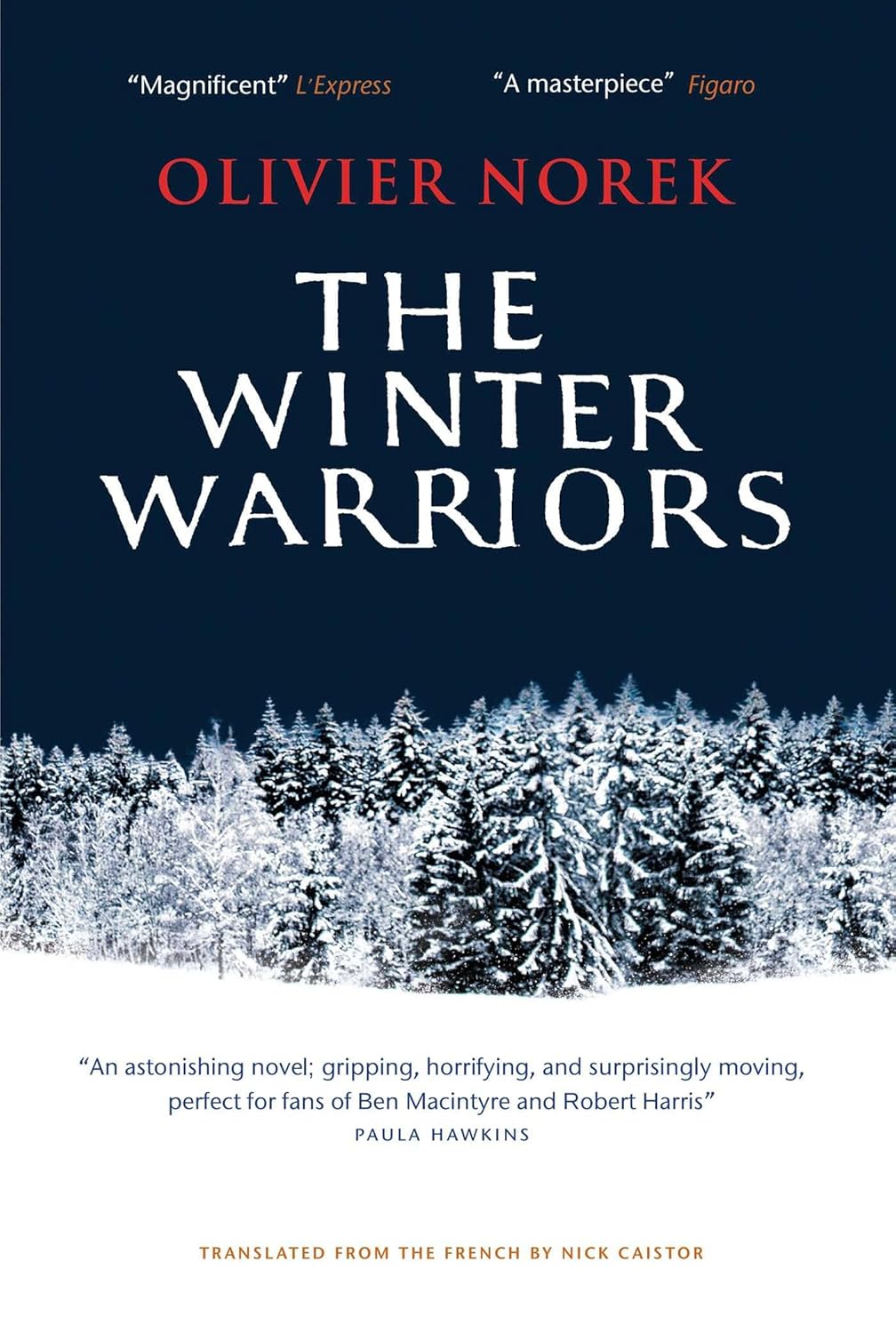
A cover blurb for this book says, simply, “a masterpiece”. For once, this is not hyperbole. The book takes its place in the pantheon of novels of war, alongside such as Alexander Baron’s From the City, From the Plough, John Harris’s Covenant With Death, Erich Maria Remarque’s All Quiet on the Western Front and Norman Mailer’s The Naked and The Dead. Translated from the French by Nick Caistor, it is published by Open Borders Press and is available now.


 fullybooked2017
September 11, 2025 at 4:33 pm
Thanks for the blog tour support x
LikeLike