Search

fullybooked2017

Month

July 2024

COGNIZANCE … Between the covers

cognizance SPINE069 copy

Guy Portman created a brilliantly psychotic serial killer called Dyson Devereux, and over the three books in the series, Necropolis, Sepultura and Golgotha, Portman took aim at every sacred cow in modern British society. Nothing – and no-one – escaped unscathed, from lavishly tasteless funerals, ‘woke’ human resources officials, earnest (and useless) social workers, gender-identity professionals right through to so-called ‘community leaders’. Devereux was killed off in Golgotha, but in Sepultura we learned that Mr D had fathered a son, Horatio, the mother being a borderline hapless Antiguan lady called Rakesha. In Emergence, we discovered that the teenage Horatio is a case of ‘like father, like son’, as he murders his mum’s boyfriend Brendan, a man he calls Fool’s Gold. The murder was cleverly disguised to make it seem that the unfortunate chap died as a result of a sexual experiment gone wrong.

In Arcadia, Horatio enjoys a brief (but violent) sojourn in Antigua, but Cognizance sees him back in London, and attending a particularly awful high school. Horatio is about to upset some of his classmates in his gang-infested school, but he has a much older enemy, the man he nicknames ‘Rat’. ‘Rat’, properly known as Roland Barstow was best mates with the late Brendan, and is convinced (rightly) that Horatio killed him. ‘Rat’ seems to be around every corner, and waiting at every bus stop, but Horatio manages – for a while –  to keep him at arms length.

In school, Horatio makes a serious error when he mocks a very large – and very stupid – fellow pupil. Unfortunately for our hero, this lad is gang-connected, and they take their revenge on Horatio in a rather smelly fashion in the boys’ toilets. Horatio vows revenge, and achieves this after a fashion when two rival gangs have a set-to in a particularly loathsome tower block of flats. Our hero has other worries, though, when he is attacked with a hammer, and left in a life – threatening condition.

Horatio’s sense of humour is suitably disturbed – and disturbing. While at his aunt’s funeral he remembers the fun he had when his mum’s boyfriend was laid to rest:
When the casket was carried in at the start of Fools Gold’s funeral, the music was supposed to be Never Say Goodbye by Bon Jovi. However, I sneaked into the room where the music system was and changed it. Because everyone thought he had died from auto erotic asphyxiation gone wrong, I chose the theme tune for Top Gun. Take My Breath Away. Fools Gold’s father went beserk, as did Rat. It was hilarious.”

The running joke in the series is that literally no-one (with the exception of Rat) sees Horatio for what he is. He fools everyone else, including his mother, his delightful girlfriend Serena, and his teachers. What to make of a teenage killer, obsessed with algebra and trigonometry, a boy whose favourite book is Bleak House, and someone who, as his aunt lies dying of cancer, imagines her in hell, perishing in the flames, suffering the torments of Tantalus as a family size bag of Maltesers is dangled just in front of her, but forever out of reach?

What Guy Portman does is to merge merge domestic disaster with caustic comedy, and he turns our normal, family-orientated sense of decency on its head, and has us cheering for the devious Horatio. The more malign his misdeeds, the more we laugh. Of course, this book will not appeal to everyone, but for those of us with a dark sense of humour it is pure gold. Lovers of dystopian comedy, this is for you – I dare you not to laugh. Cognizance is published by Pugnacious Publishing and is available now.

Screen Shot 2024-07-21 at 19.43.52

BEYOND CLOSED DOORS . . . Between the covers

BCD SPINE065 copy

This enjoyable police procedural novel is the sixth in the series (to read reviews of the previous two, click this link) following the career of Norfolk copper Detective Chief Inspector Greg Geldard, his girlfriend Detective Sergeant Chris Mathews, and the rest of their team. These novels pretty much follow on from each other, and in the previous book Geldard battled a violent Lithuanian gangster called Constantin Gabrys. Now, it’s March 2020, Gabrys is serving a long prison sentence and his psychotic son is dead. However, all is not well, because a key figure in the case, now under witness protection has been attacked. He survived, but a police officer has been seriously injured, and it is obvious that the leak of information can only have come from within the police forced itself.

Despite the Gabrys empire having been apparently dismantled, their poisonous legacy hangs over Norfolk like a miasma. Norfolk, I hear you ask? Surely not that wonderful holiday destination with its abundant wildlife, historic homes and beautiful coastline? While the entire county might not be a wretched hive of scum and villainy, there are places – like Yarmouth and Gorleston – which suffer deep deprivation, and are consequently ripe feeding grounds for organised criminals, whether imported from Eastern Europe or of the home-grown variety.

Geldard traces the leak to a civilian police secretarial worker, but is dismayed to learn that part of the conspiracy involves Helen Gabrys, a member of the family he thought to have been as innocent of wrong doing as she was disgusted at her father’s career.

You will notice in the first paragraph that the story is set in March 2020. Remember that? As the country begins to shut down against the ravages of Covid, life just gets more difficult for Geldard and his team. Right across the criminal justice system things are starting to unravel. Court backlogs become years rather than months, prisons are struggling with absent staff, and the police themselves have to try to hold important conversations yards apart from each other. As the cover blurb suggests, however, the streets may be nearly empty, but evil is just as happy within four walls as out in public places.

There is a parallel thread in the story, which I found unsettling and hard to read. In Yarmouth live the Mirren family. Children Karen and Jake don’t have the happiest lives. Their mum is well-meaning, but weak, and browbeaten by her brutish husband. Karen has a place where she feels valued, can be herself and feel comfortable with trusted adults. It is her primary school, and when it shuts, forcing all the children to stay at home, it is a life sentence for the little girl. The reason this part of the novel affected me is that I taught in Norfolk for over thirty years, and for the latter part of that I led Safeguarding, and the scenes that Heather Peck describes were uncomfortably familiar.

When tragedy strikes in the Mirren house, the subsequent events become very much the concern of Greg Geldard, and he has to add a significant missing persons search to his mounting caseload. In the best traditions of great Victorian writers like Dickens and Hardy, who serialised their novels in popular magazines prior to publishing them in their entirety, Heather Peck leaves us on a knife edge, eagerly awaiting the next novel in this impressive series. Beyond Closed Doors was published by Ormesby Publishing on 22nd June.

Screen Shot 2024-07-08 at 19.11.05

IMPOSTER SYNDROME . . . Between the covers

imposter spine064 copy

Joseph Knox made his name with a deadly dark trilogy of police procedural novels featuring Manchester copper Aidan Waits (click to read the reviews) and followed these with the standalone True Crime Story. His latest novel takes a leaf out of the book of Josephine Tey, whose novel  Brat Farrar (1949) many consider to be her finest work. That novel was inspired by a real case, known as The Tichborne Claimant, where a New South Wales butcher claimed that he was Roger Tichborne, heir to a huge fortune, but who  was supposed to have perished in a shipwreck. The butcher, Arthur Orton, was eventually found guilty of fraud in 1874 and given a long jail sentence.

Here, we meet Lynch, a young English conman. He flies out of Paris, with only the cheap suit he is standing up in, with no money, no prospects and only the bitter memory of his latest failed venture on his mind. En route, he meets a milfy heiress called Bobbie Pierce who mistakes him for her long lost brother, Heydon. Lynch immediately corrects her mistake, but is intrigued. Heydon is assumed to be dead. No trace of him has been found since his abandoned car was found on a Thames bridge five years earlier. Bobbie is something a ship foundering on storm tossed rocks, as she is on her way to yet another expensive bout of rehab in the States. She sends him a text message which contains the key codes to her parents’ house, and suggests that, as he is broke and pretty much down and out, he might find plenty of valuable items in the house to relieve his immediate Micawberish state.

Lynch, as much out of curiosity as anything else, goes to the house but, once inside, he is detained by security men. He then meets Miranda Pierce, the family matriarch and former film star, and Bobbie’s sister Reagan. Lynch makes no claim to be the missing Heydon, but Miranda has a use for him. Just before he disappeared, Heydon Lynch borrowed money from a loan shark called Bagwan, and left a case containing family items as security. Badwan has contacted the family, calling in the loan – now greatly inflated. Miranda and Reagan want Lynch, posing as  Heydon, to meet Badwan, pay him off, and recover the  case.

The case is recovered, and one of the things it contains is Heydon’s phone. Through what it contains, Lynch learns two things: one, Heydon Pierce was convinced he was being targeted by some shadowy organisation; two, he had become involved with a man calling himself Vincent Control, basically a conman trying to lure gullible people into a crypto currency scam. Lynch confronts Control and learns that there was, indeed, some dark security agency involved, but their conversation is interrupted by a masked gunman. Control is shot dead, but Lynch escapes.

At this point, half way through the book, I did ask myself why Lynch didn’t just disappear. He now has plenty of money, having being richly rewarded by Miranda Pierce, so why not simply get away, maybe fly back to Paris on his forged passport, and use his new-found wealth to fund another project designed to separate fools from their money? He then sets out his reasons. He has discovered that he is dealing with some very powerful and resourceful people who, he figures, will be able to find him and settle scores wherever he goes, and however long it takes.

The plot is of Chandleresque complexity, as Lynch ducks and dives  between various encounters which prove fatal for some of the characters. He suspects first one person, and then another, as he tries to find exactly why he was hired in the first place, and what actually happened to Haydon Pierce. The truth is only revealed to him (and us) in the final pages of the book.

This is a clever, tense and nervy thriller, which dwells on betrayal and the pernicious effect that the misuse of digital communications and media can have on human lives. Lynch is a long way from being an admirable character, but his street-smarts and survivalist instincts are straight out of the How To Be A Conman instruction manual.. Imposter Syndrome was published by Doubleday on 11th July.

CALICO . . . Between the covers

calico spine063 copy

Lee Goldberg baits the hook irresistibly within the first few pages of this novel. Disgraced former LAPD cop Beth McDade has been exiled to the desert wastes of Barstow, on edge of the Mojave Desert. She attends what seems to be a routine road death- pedestrian collides with motor home, only one winner – but the autopsy on the victim is astonishing. He was wearing jeans that hadn’t been made that way since the 1880s. What remains of his dental fillings reveal an amalgam not used in decades. His tobacco tin isn’t just repro. It is original, and contains tobacco not produced commercially since the end of the nineteenth century.

Things become even more baffling when a construction company doing groundwork for a new development unearth an old coffin containing equally old bones. Beth finds her ultra rational mindset severely challenged when the bones are dated to the early 20th century, but contain titanium implants only available to surgeons in more recent times. She then receives a visit from a former LA colleague (and lover) who is  on a missing persons case. He is looking for Owen Slader, a very 21st century social media personality and chef,who was last seen filling up his car with gas on the way to visit his daughter.

There are two parallel narratives, one being that of present day Beth McDade, and the other being the views and experiences of Owen Slader. On that February night he was engulfed by what appears to be a lightning storm and, when he recovers his senses, the freeway no longer exists, and he is stranded near the primitive and rumbustious silver mining settlement of Calico. And it is 1882. Slader hides his hired Mercedes in a cave, rigs up a solar battery charger to power his iPhone and, using his 21st century culinary skills, caries out a profitable life for himself cooking up delicacies for the hungry miners of Calico. He meets – and marries another refugee from another time, a woman called Wendy, but she was ‘taken’ by the Time Gods a couple of decades earlier than Slader. This is when the complexities and total unknowables of the time travel concept begin to cause brain hurt, and the obvious questions like the one below, can never be answered:
“If stamps on the titanium implants found in the bones within the ancient coffin identify the recipient as Owen Slader who, identifying as Ben Cartwright (1960s TV Western reference!), died in the early 1900s, how did he then father a daughter in the early decades of the 21st century?”

The author certainly has fun with some of the more bizarre aspects of being a time traveller. He has Ben Cartwright buying copies of new novels by writers like Mark Twain and Robert Louis Stevenson knowing that (as first editions) they will become immensely valuable decades ahead. When a cholera epidemic hits Calico, Cartwright, nursing the town judge in what seems to be his final fevered moments, takes out his iPhone and plays the dying man some music. Problem is, the judge doesn’t die, and when he recovers he goes around loudly humming ‘Somewhere Over The Rainbow.’

Meanwhile, Beth McDade struggles to reconcile facts that are, at the same time, impossible but also incontrovertible. She even finds, boarded up in a cave, the 2019 rental that Owen Slader was driving when he disappeared. It is, needless to say, improbably decayed and weathered given that it can only have been there a matter of months. Eventually, our heroine tackles – and bests –  the FBI and the implacable American military machine.

Lee Goldberg’s audacious plot and premise will not be for everyone, particularly those who think that Hamlet’s famous remark to Horatio was just the rambling of a confused and conflicted young man. Of course, time travel novels are nothing new, and Goldberg does nod in homage to the grand-daddy of the genre, Herbert George Wells, but also develops the ‘stepping on a butterfly’ trope that began with Ray Bradbury’s 1952 short story ‘A Sound of Thunder’. Key question, though. Does Lee Goldberg’s book work? Of course it does. The writer is also an experienced screenwriter, producer and TV executive, far too well versed in his trade to stretch  the credulity of his readers and viewers to beyond breaking point. Calico is immensely entertaining, with a runaway-train narrative drive. Published by Severn House, it came out in hardback and Kindlle in November 2023 and this paperback edition was published on 4th July.

Screen Shot 2024-06-28 at 21.01.23

INTO THE FLAMES . . . Between the covers

itf spine061 copy

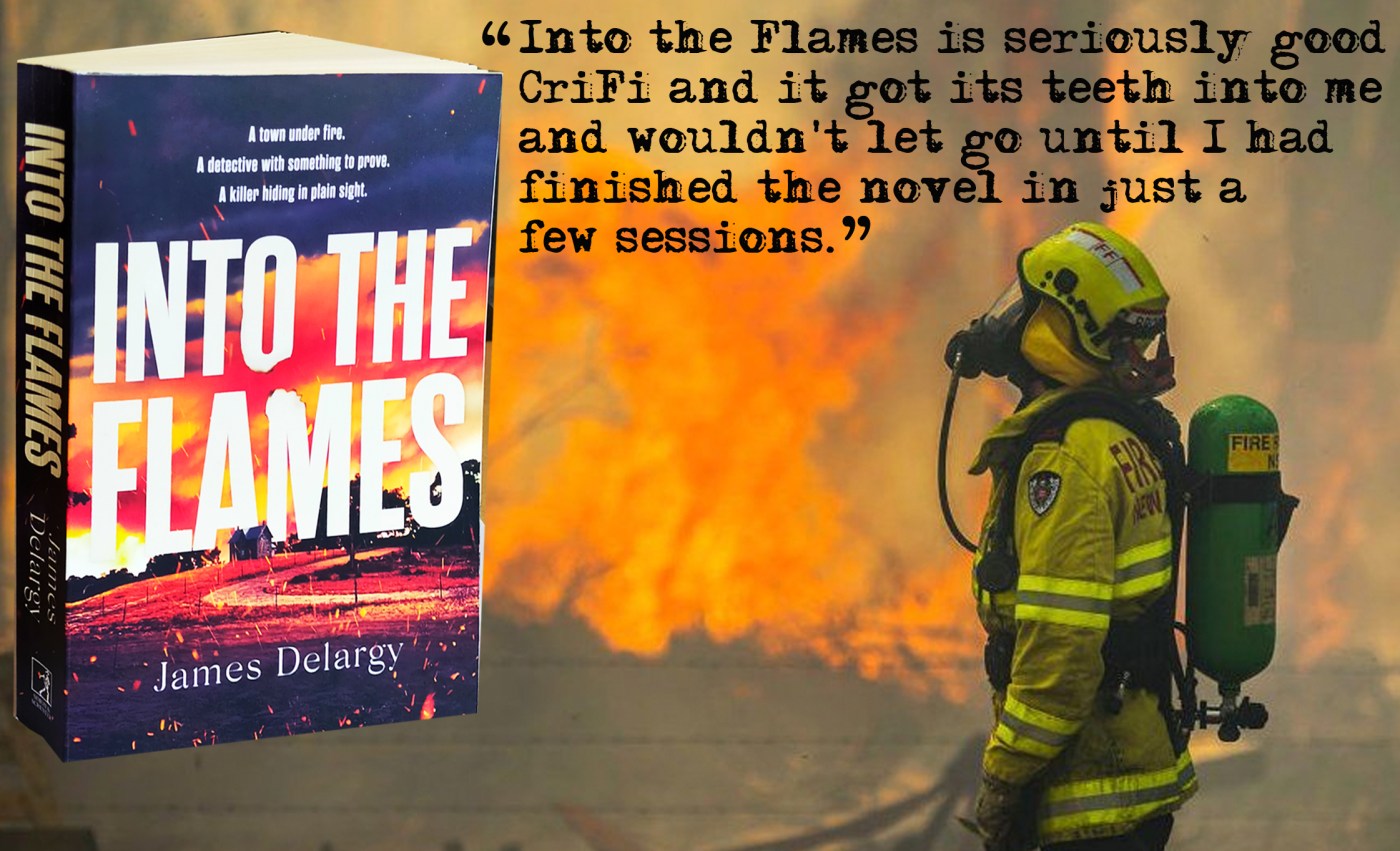
I lived and worked in Australia for a while, but being a city lad, I never came close to a bush fire. From speaking to people who had, and reading about them, they seem to be the very worst kind of natural disaster. Perhaps it is invidious to compare tornadoes, tsunamis, landslips and volcanlc eruptions, but bush fires seem to have an almost animal intensity. They devour people, buildings and forests like some kind of raging beast. Here, Aussie cop Alex Kennard has been bounced out of his job in a Sydney suburb for, as his bosses saw it, making the wrong call when he was forced to deal with a hostage situation. He is now more or less twiddling his thumbs dealing with drunks, petty thieving and the odd traffic incident in the town of Katoomba, in the heart of The Blue Mountains.

The little nearby town of Rislake is threatened by a serious bush fire, and Kennard drives across to help with crowd management in the event of a major evacuation. The local cops and fire service are basically taking a roll call, and it is soon apparent that one woman is missing. Tracey Hilmeyer is the wife of one of the firefighters and, against orders, Kennard and the woman’s husband, Russell, head out to the Hilmeyer property which is in danger of being engulfed. They find Tracey, but she is dead at the foot of the stairs, battered with a heavy implement. Russell Hilmeyer is distraught and wants to move the body of his wife, but Kennard insists that she stay in place and he attempts to preserve and record the crime scene as best he can.

Russell Hilmeyer is a local lad who didn’t quite make the big time on the football field, due to a career-ending injury. It has no bearing on the plot, but I am pretty sure Hilmeyer played Aussie Rules rather than what Americans call Soccer, or the major Sydney code of Rugby League. His wife Tracey was a glamorous prom-queen type in her teens, and had ambitions to be an artist. The gallery she ran in town has had to close, and she had become depressed, and only got through her days and nights with the help of prescription items like co-codomol. She had an abrasive relationship with her sister Karen who, with her husband, runs the farm that used to belong to their late parents. It is hard scrabble land, and they barely make ends meet. Did Karen and her Pacific Islander husband Alvin hate Tracey enough to kill her? The post mortem reveals that Tracey Hilmeyer was pregnant. Given that the couple had been trying for years to have children, does this add yet another dimension to the search for the killer and their possible motive?

The author has great fun making Kennard and his temporary partner DS Layton jump to one false assumption after another, while the fire grows steadily worse, a little like Satan as described in the office of Compline:

“Be sober, be vigilant, because your adversary the devil, as a roaring lion, walketh about, seeking whom he may devour:”

The conclusion comes with Layton temporarily out of action due to the fire having triggered her asthma, and we have Kennard, almost immobilised by the weight of his protective clothing, pursuing the killer in a Dante’s Inferno of blazing eucalyptus trees and showering sparks. Only one small problem. The person he is following isn’t the killer of Tracey Hilmayer. To say any more would clearly spoil your fun, but this is as exciting an end to a crime novel as I have read in many moons.

We lost the two modern giants of Australian crime fiction, the two Peters – Corris and Temple – within six months of each other in 2018 but, along with Jane Harper, James Delargy – although he now lives in England – taps into to the great tradition established by those writers. Into the Flames is seriously good CriFi and it got its teeth into me and wouldn’t let go until I had finished the novel in just a few sessions. Published by Simon and Schuster, it is available now.

RESOLUTION . . . Between the covers

iresolution spine062 copy

Edinburgh copper Ray Lennox last appeared a couple of years ago in The Long Knives. Now, he has quit the  force and, given his predilections, is in a strange place on what might be thought foreign soil – England’s south coast, a partner in a security firm based in Horsham, with his customer base ranging from the gay green madness of Brighton, to the villas of Eastbourne, where the silence is only punctuated by the quiet hum of wheelchair tyres and the creak of zimmer frames.

His business partner is  George Marsden, in some ways the antithesis of Lennox, in that he is English public school, suave, urbane, and speaks the esoteric language of the English middle classes. He is no man’s dupe, however, as we are given hints that he once served with the Special Boat Service.

Lennox is deeply in lust with a local chemistry lecturer, Carmel Devereux, some years his junior, and it is at a meet and greet party with potential wealthy sponsors of her research, that he is staggered to see the face of Mathew Cardingworth, a character from wounding nightmares. In an Edinburgh underpass, all those years ago, Cardingworth was one of a gang that captured Lennox and his teenage mate Les Brodie, and subjected them to grim sexual and physical abuse.

Fantasising about getting even with Cardingworth, Lennox actually meets him socially and then makes the error of accepting Cardingworth’s offer of a couple of tickets for the executive box at Brighton’s next Premiership home game against Liverpool. An even worse mistake is inviting Les Brodie down from Scotland, standing him the air fare as a treat. Whereas Lennox’s vengeance against his abuser have stayed firmly inside his head, Les Brodie is more volatile. He catches sight of Cardingworth as they drink their pints and graze at the buffet; it only takes seconds for Brodie to recognise his abuser, and he is just as quick to smash his glass on the bar counter and thrust it into Cardingworth’a face.

As his obsession with Cardingworth deepens, Lennox discovers that there is a tenuous – but intriguing link between the businessman and several youngsters who disappeared from the ‘care’ of Sussex Children’s Services. The fact that all local and national newspaper references to those years – print, microfiche and digital – have all disappeared. In another puzzle, at least for the reader, one of the non-Brighton, non-now narratives in the book is in the voice of an Englishman, perhaps a merchant seaman, who has killed a man in a Shanghai bar fight and been incarcerated sine die in a vile Chinese prison. He is clearly a deeply damaged and dangerous man, and he appears to be directing his story at Lennox, but who is he?

Lennox, as he peels back the layers of the recent past, all too late realises he is in way over his head, but with almost suicidal and terrier-like tenacity, he presses on regardless, perhaps echoing the thoughts of his famous fictional countryman, who mused:

I am in blood
Stepped in so far, that, should I wade no more,
Returning were as tedious as go o’er”

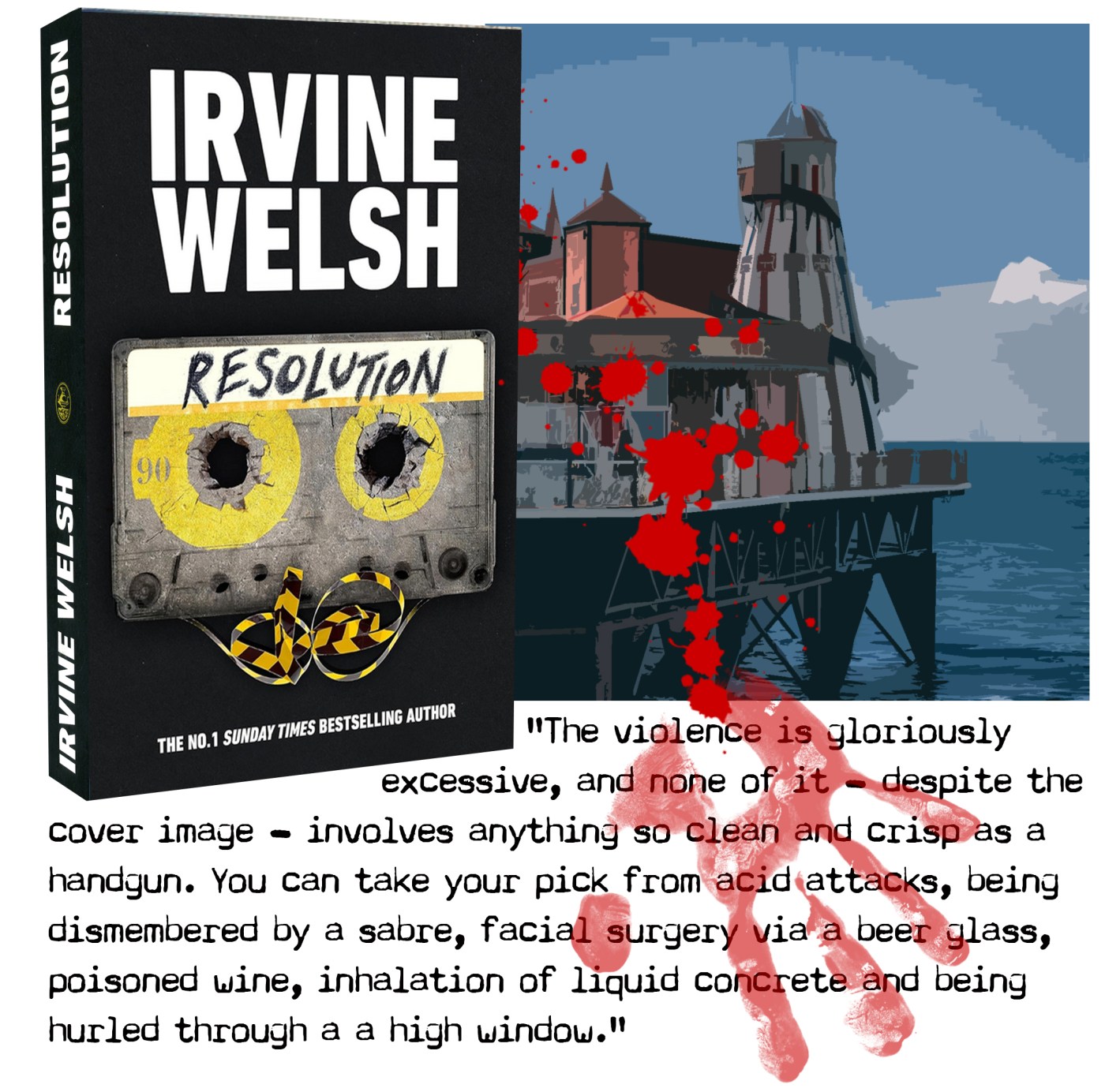
Fans of Welsh will love this, and feel at home with how the story darts back and forth between various characters, the Scottish conversational vernacular, the violence, the sex – and the grim humour. There is one wonderful example of the latter when contractors installing a new security system in a retirement home fall foul of a particularly demented resident, and all hell breaks loose. The titular resolution does not happen until the final pages of the book and it occurs, ironically, in the same care home where the contractors came so comically to grief. The violence is gloriously excessive, and none of it – despite the cover image – involves anything so clean and crisp as a handgun. You can take your pick from acid attacks, being dismembered by a sabre, facial surgery via a beer glass, poisoned wine, inhalation of liquid concrete and being hurled through a a high window. Resolution is published by Jonathan Cape and will be out on 11th July.

Screen Shot 2024-06-25 at 19.13.06

ONE FALSE STEP . . . Between the covers

OFS SPINE060 copy

We haven’t had a resounding cad in popular fiction since George MacDonald Fraser took Harry Flashman, a relatively minor character in a little-read Victorian school novel, and had him bestride the 19th century like a colossus, meeting (and cheating) pretty much everyone from Abraham Lincoln to Otto von Bismarck. Now, Clive Woolliscroft introduces Lieutenant William Dunbar, an impoverished younger son of a Scottish nobleman – and utter bounder*.

* Bounder (noun, archaic): a man who behaves badly or in a way that is not moral, especially in his relationships with women.

Unlike Flashman, Dunbar doesn’t lack physical courage, and he fights with his regiment against Bonnie Prince Charlie’s highlanders at Culloden, so this places the events of the novel somewhere in the years after 1746. Dunbar, however, has neither the skills nor the family fortune to lead the rich man’s life he so desperately craves, and so he is on the look-out for wealth  by marriage. Can he find a suitable young woman, with a sizeable *tocher and generous annual allowance from her wealthy parents?

* Tocher (Scots, archaic): A dowry: a marriage settlement given to the groom by the bride or her family.

For the first 120 pages or so, we view events through the eyes of William Dunbar. Thereafter, the narrative switches between that of Mercy Grundy and Dunbar. Quite early in the book, Dunbar had secretly married a Scottish heiress, Ann Macclesfield, (for her money of course) and she had borne him a daughter. The financial part of his plan had collapsed, due to religious complications after the battle of Culloden, but Anne now refuses to dissolve the marriage, thus putting a major impediment in the way of Dunbar’s plans to marry Mercy, and get his hands on her family’s wealth.

Dunbar leaves the army, and begins to make something of a living in the world of finance, managing to build up cash reserves, thus lessening the necessity of marriage. He then sees a chance to become very rich indeed by buying a share in a ship engaged in what was known, euphemistically, as the African Trade. This worked in a brutally simple fashion. The ship leaves Britain loaded with manufactured goods which could range from bolts of cloth to firearms and anything in between. These were then bartered for human cargo – slaves – on the coast of West Africa, which were then taken and sold in the slave markets of the Americas. In theory, the ship would then return to Britain, laden with cash.

Unfortunately for him, Dunbar’s ship, The Archer, is destroyed by fire after a mutiny of the slaves and he is, once again, left with nothing. He decides to try his luck once more with Mercy Grundy, but finding her father totally in opposition to his plans, he dupes Mercy into a course of action which will end disastrously for her. This mirrors the real life tragedy the book is based on – the case of Mary Blandy who, in 1752, was put on trial for poisoning her father.

The author served as an Army Officer in Germany, worked as an international money market trader in London, was a Management Consultant in Prague and Riga and practised as a solicitor in London, Hertfordshire, and Staffordshire. This is his second novel. ‘Less Dreadful With Every Step’ was published in May 2023.

Clive Woolliscroft’s attention to period detail is immaculate, and the mid-eighteenth century England of the wealthy middle class is beautifully recreated. William Dunbar is an out and out villain, with none of the dubious charm possessed by Harry Flashman.  The book’s title is extremely apposite for poor Mercy Grundy. One False Step is published by The Book Guild, and is available now.

THE LOST VICTIM . . . Between the covers

TLV header

The search for the killer of a child long dead is a recurring trope in crime fiction, and it carries with it all manner of similar plot strands. There will be dusty police files, parents – probably elderly by now – and still clinging to the faint hope that there might be answers; almost certainly we will meet police officers who made mistakes, made the wrong call, or took crucial short-cuts; there will be intriguing glimpses into what life was like twenty, thirty years earlier, and a sense of the truth being buried under too many lies, too many errors, too little police time, and – perhaps – a victim who was not attractive enough to the media.

We get all this – and more – from Robert Bryndza’s The Lost Victim. Three decades earlier, before King’s Cross in London was a dazzling hub of boutique restaurants, state-of-the-art apartments and conference venues, a teenage girl named Janey Macklin was sent by her mum to buy a packet of fags from a newsagent’s shop, which sat among the grim streets, derelict warehouses, dark railway arches, smoke-filled pubs and knocking shops that made up London N1C 4AX in 1988. Janey never returned to the pub with her mum’s cigarettes. Her body was never found, despite traces of her blood being recorded in and around the places where she was last seen.

On the balance of probability, Robert Driscoll was convicted of her murder, but after a decade in jail, his case was reviewed and with a much smarter barrister than he was given at his first trial, Driscoll was released. Contemporary with Janey’s disappearance, a series of girls were being abducted and savaged by a man the press dubbed ‘ The Nine Elms Cannibal’. This time , there was no miscarriage of justice, and Peter Conway was caught, tried and convicted. He was a police officer, and married to Kate Marshall. Kate, also a copper, survived a bout of alcoholism brought about by the trauma, left the force, but has now reinvented herself as a private investigator, partnered by Tristan Harper, and based in Devon.

When she is contacted by a media agency who say they are preparing a True Crime series based on Janet’s disappearance, and need her to provide material, she reluctantly agrees. Since the case overlaps the story of her murderous husband, she senses that she might be about to be exploited, but it is the middle of winter, and her case load is not so heavy that she can afford to refuse.It does not take long for Kate Marshall to realise that she is being played by these media spivs. Not only that, a man in a relationship with one the agency’s employees was, almost certainly, a person of interest in the original investigation into Janey Macklin’s disappearance.

With awful scenes from her own past flitting in and out of her mind, Kate digs deeper and deeper into what happened on that chilly December evening, all those years ago. She is working for nothing, and running on fumes. Robert Bryndza doesn’t spare us from the numbing sense of loss felt by the people who knew and loved Janey, and when her remains are eventually found, we are left with an almost tangible sense of loss. We know her as a person; the girl who liked a bag of chips on a Friday night; the girl who went to ballet classes, perhaps dreaming of a future that could never have been realised.

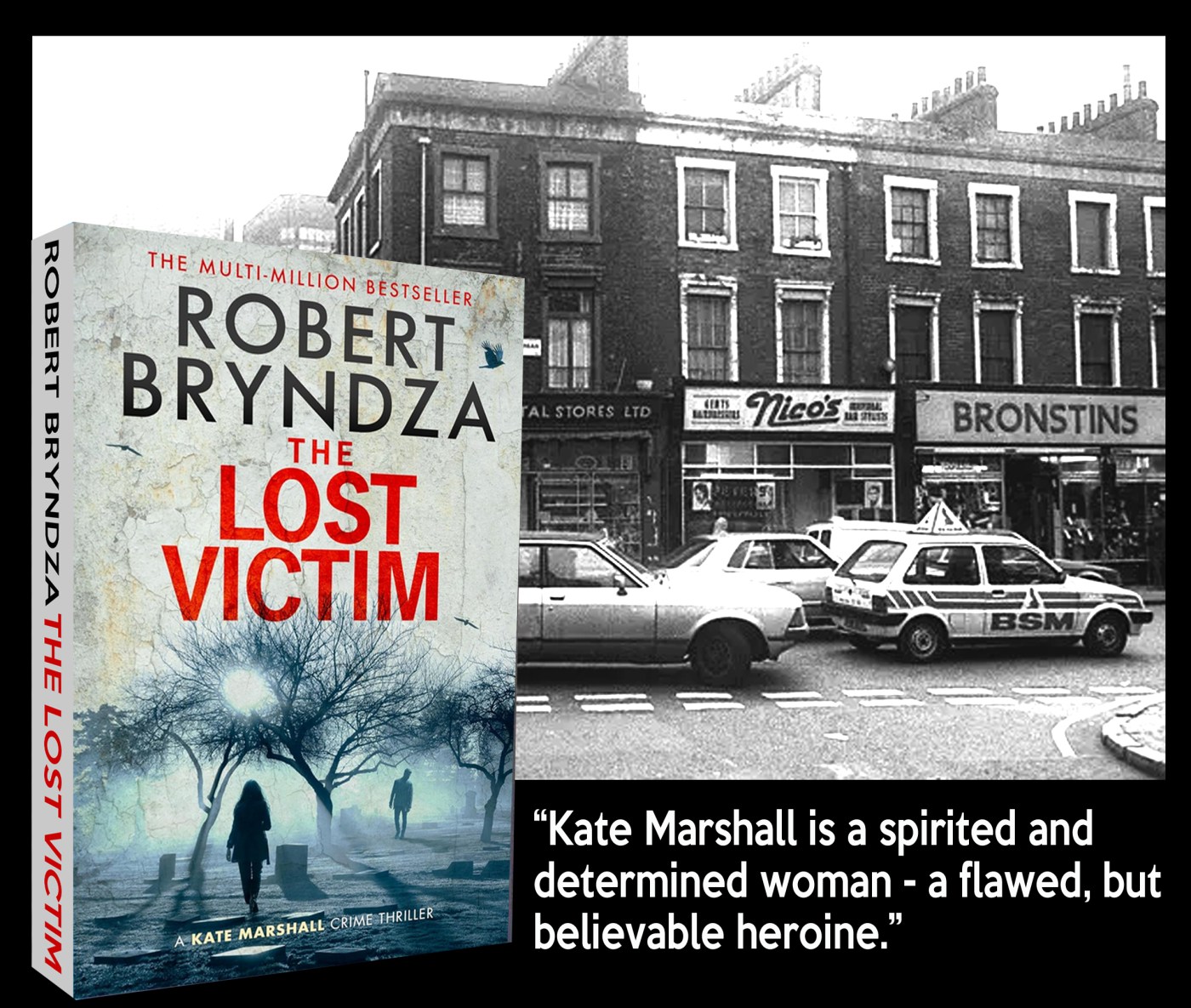
I first encountered Kate Marshall in Nine Elms, which goes some way to putting her life into perspective. Click this link to read my review of that novel. In The Lost Victim we come face to face with truly vile human beings, thankfully behind bars for desecrating the lives of young people. Kate Marshall is a spirited and determined woman – a flawed, but believable heroine. The Lost Victim is published by Raven Street Publishing, and will be available on 11th July.

Blog at WordPress.com.

Up ↑