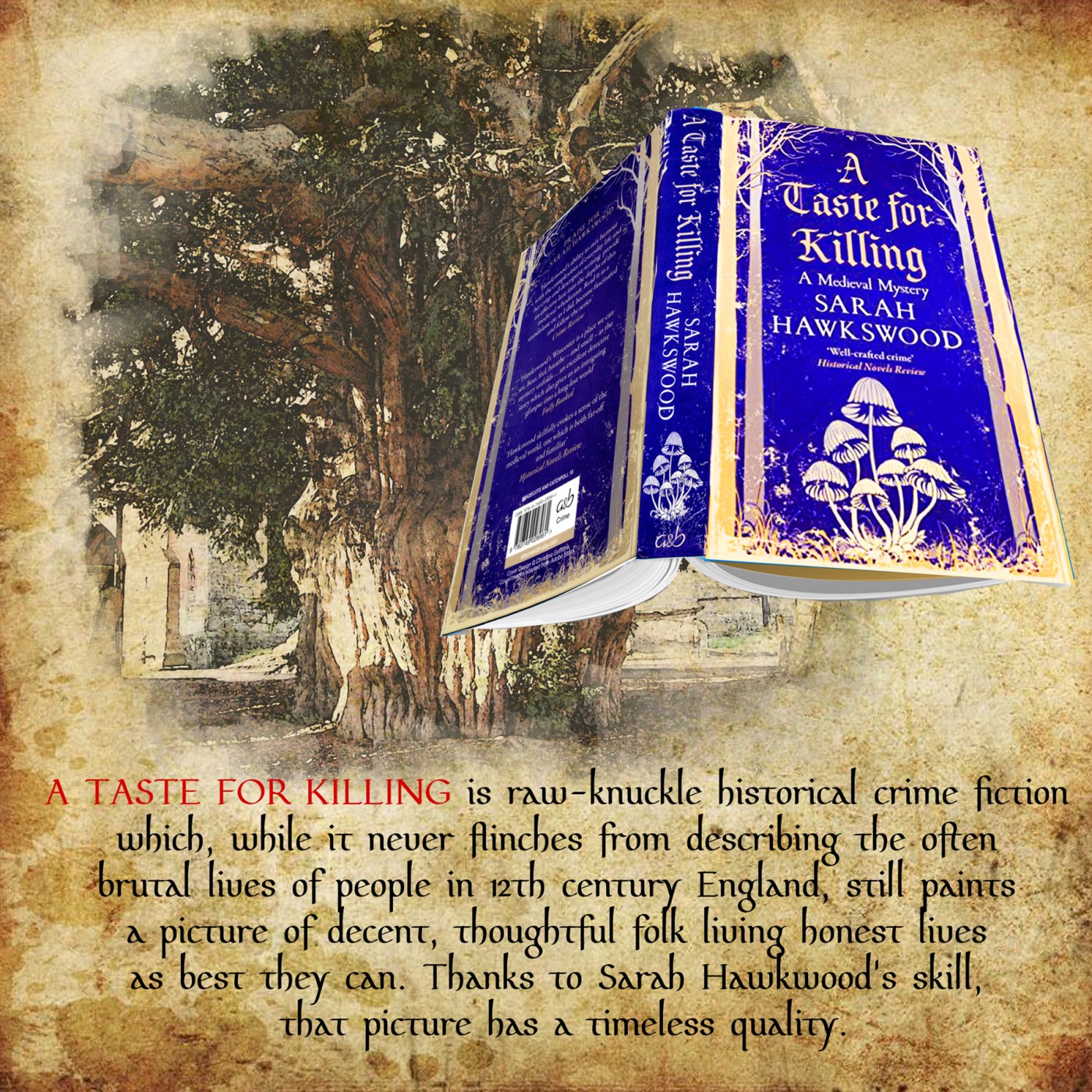
 Those of us who are lucky enough to be sent printed copies of novels for review almost certainly have “keepers” – books which don’t go off to friends, free libraries or charity shops once they are read. Looking across at my shelves, I see books by Jim Kelly, Christopher Fowler, Philip Kerr, John Connolly, Phil Rickman, James Oswald, Peter Bartram – and Sarah Hawkswood (left). I was a late arrival at the ‘Bradecote Ball’, but these superb stories of medieval Worcester have joined my list of favourite books which I will not be parted from. A Taste For Killing is the tenth in this splendid series featuring the 12th century Worcester trio of Hugh Bradecote, Serjeant Catchpoll and Underserjeant Walkelin.
It is a bitter January afternoon in Worcester, 1145. The wells have frozen, the streets are empty, and decent folk are huddled around their fires. In the house of Godfrey Bowyer – remember the origin of many surnames – a skilled, but widely disliked maker of longbows, it is supper time. As Godfrey sups his pottage with his wife Blanche, the servants cower in another room, listening to the customary arguments and smashing of crockery. Godfey and Banche (his second wife) frequently disagree, but they are as one when it comes to the adage about it being better to let it all out than to keep it in. Tonight’s row takes an unexpected – and fatal – turn, as both Godfrey and Blanche collapse with the symptoms of poisoning. Blanche recovers quickly enough, but it is to be Godfrey’s last night on earth.
Catchpoll and Walkelin are summoned and are joined – reluctantly – by Bradecote, who was anxiously at the side of his heavily pregnant wife. She has miscarried before, and he is reluctant to leave her, but suspected murder is what it is, and he joins his two colleagues. The row between Godfrey and Blanche which culminated in a dish of pottage (a soup thickened with grain, containing vegetables and – when available – meat) being thrown at the wall raises the crucial question – the contents of whose bowl redecorated the wall of the house? Was it Blanche’s, and did Godfrey then sup from the bowl intended for his wife? What was the poison, and who put it in the pottage?
It transpires that the Bowyer ménage is far from simple. Runild the servant girl is pregnant, but by whom? Alwin, Bowyer’s apprentice is out of the frame as he is too shy to even look at a girl, let alone do anything more physical, but there is another suspect. The late Godfrey’s hands often followed not far behind his roving eye, as more than one Worcester woman can testify. Furthermore, what was Blanche’s relationship with the Steward of Worcester Castle, Simon Furneaux, a pompous individual who has a hate-hate relationship with Hugh Bradecote? There was little love lost between Godfrey Bowyer and his younger brother Herluin the Stringere, also a maker of bows, and a man who has his eyes on his late brother’s business. There is even a rumour that they do not share the same father.

One of the many captivating qualities of this book is the reminder of the potent symbolism of the Yew tree in human history. The traditional home of the Yew tree in England is the village churchyard, and there is a deep irony that its wood was used to produce the fine – and lethal – bows that were to dominate medieval warfare. The Yew is also a more direct cause of death, however, as its wood contains toxins that bow makers had to wash from their hands before eating, and the seeds in the delightful red berries contain a deadly alkaloid.
When there is yet another death in the Bowyer household, a local herbalist and bone-setter called Roger the Healer, who has thus far been on the fringe of events, takes centre stage. He suspects that Yew killed Godfrey Bowyer, but a glance at the cover of the novel will give readers a clue as to what caused the second tragedy.
The chemistry between Bradecote, Catchpoll and Walkelin is a work of alchemy in itself. Bradecote is, I suppose, minor nobility, quick-witted and well educated, while Catchpoll is grizzled, rough round the edges, but wily. Walkelin, in the earlier books, was simply a clever but callow lad. Now, however, he uses his apparent naivety and lack of guile to extract information from people who would otherwise be too deferential to Bradecote, or too fearful of Catchpoll’s reputation as a street fighter.
A Taste For Killing is raw-knuckle historical crime fiction which, while it never flinches from describing the often brutal lives of people in 12th century England, still paints a picture of decent, thoughtful folk living honest lives as best they can. Thanks to Sarah Hawkwood’s skill, that picture has a timeless quality. The book is published by Allison & Busby and is out today, 12th May. Click on the images below for my reviews of earlier books in the series.



 fullybooked2017